Volume 63, 2019, Pages 140–149
Proceedings of 32nd International Conference on Computer Applications in Industry and Engineering
An algorithmic approach for finding minimum spanning
tree in a intuitionistic fuzzy graph
Kartick Mohanta
1∗, Arindam Dey
2†, Narayan C. Debnath
3‡, and Anita Pal
1∗§1 Department of Mathematics, National Institute of Technology, Durgapur, India. [email protected]
2 Department of Computer Science and Engineering,
Saroj Mohan Institute of Technology, Hooghly, India.
School of Computing and Information Technology, Eastern International University, Vietnam.
Department of Mathematics, National Institute of Technology, Durgapur, India.
Abstract
The minimum spanning tree (MST) problem is a well known optimization problem in graph theory that has been used to model many real life problems, e.g., telecommuni-cations,transportation network, routing and water supply network. The MST problems with deterministic edge costs have been worked intensively and the MST of a connected weighted graph can be determined using many efficient algorithms introduced by outstand-ing scientists. However, in real life scenarios, several types of uncertainties are generally encountered, because of insufficient information, imperfect information, failure or other reasons. In this paper, we concentrate on a MST problem of a undirected connected fuzzy graph in which a intuitionistic fuzzy numbers, instead of a crisp (real) number, is used to each edge as edge weight. We define this problem as intuitionistic minimum spanning tree (IMST) problem. We introduce an algorithmic approach for designing the IMST of a fuzzy. The Bor˚uvka’s algorithm is a popular greedy algorithm for designing a MST in a graph. Here, we have modified the classical Bor˚uvka’s algorithm to generate the IMST of fuzzy graph. The water distribution system is the lifeline of any city. We also describe the utility of IMST in a water distribution network. A numerical example is worked out to illustrate our proposed algorithm.
1
Introduction
LetG= (V, E) be a a weighted undirected graph. A tree is a connected circuit less graph. A spanning tree is a subgraph ofGthat is a treeT = (V, E0) withE0 ⊆E. A minimum spanning
∗Designed and implemented the manuscript
tree is a spanning tree that has the lowest possible weight. The MST is a spanning tree T
of graph Gwhich has the minimum cost among all the spanning tree of graph G. The MST problem is a fundamental and well known combinatorial optimization problem in the area of graph theory. It is widely applied in various fields of science and engineering, e.g., road network application, transportation, routing in communication channels and scheduling problems. In real life problems, edge costs are used to represent the parameter costs, capacities, demands, time, etc. Although in classical graph theory, real numbers are used in a MST problem to express the arc lengths of a connected weighted graph. We generally consider the classical MST problem as network optimization problem. In the classical MST problem, we assume the arc lengths (time, cost, distance, nature of connectivity between nodes, etc.) is certain. However, in real world problems, the information about any MST problems are generally not exact or precise due to several reasons such as incomplete data or insufficient data, less evidence, imperfect statistical. For e.g., in a weighted connected graph, the arc length may describe the traversing time between two nodes. This traveling time depends on traffic jam, accident, weather etc., each of the criteria differ from day to day. Therefore, it becomes difficult for the DM to estimate exactly the edge cost.
Several papers have been done on the Fuzzy MST [2], [3], [13], [15], [23], [24], [33], [34]. The work by Itoh and Ishii [23] is first work on this fuzzy domain and worked a MST problem with fuzzy costs as a chance constrained programming based on the necessity measure. Following that, some methods based on the ranking index for arc weights of FMST were proposed by Chang and Lee [15]. Almeidaet al. [13] described the fuzzy MST problem with fuzzy costs and introduced an algorithmic method to solve this FMST. They introduced a genetic algorithm founded on fuzzy logic and probability theory to compute the FMST with fuzzy weights. In [24], they described possibility theory to describe the minimum of edge of the fuzzy graph and to find a spanning tree where the fuzzy arc weights are in fuzzy intervals. Liu [27], [28] introduced the credibility theory including pessimistic value, credibility measure and expected value as fuzzy ranking methods. Based on the credibility theory, Gao and Lu [18] studied the fuzzy quadratic minimum spanning tree problem and formulated it as expected value model, chance-constrained programming and dependent-chance programming according to different decision criteria.
In this study, we introduce an algorithmic approach for the IMST problem in intuitionistic graphs with intuitionistic fuzzy numbers, i.e., for the IMST problem. The algorithmic method is based on intuitionistic fuzzy version of the classical Bor˚uvka’s algorithm. The Score and accuracy function of TIFN is used in the proposed algorithm for comparison between TIFN. First, we have established a water supply network using graph theory. The idea of fuzzy graph theory is used to solve this problem. We have used idea of IMST to find lowest in the case of pipeline connectivity.
Our proposed algorithmic approach has many significant advantages : (1) Compared with FMST algorithmic approach, the introduced algorithm for IMST problem is more efficient for handing the uncertainty. The ranking and the addition operation of IFN can be done easily and straight manner using mean on IFN. (2) In our IMST problem, the IMST and the cost are the most significant information for the us to use the IMST to formulate the real life scenarios. Existing approach for IMST problem can compute only the IMST of a graph. It is the main reason of this study to modify the algorithm that can determine IMST and the cost.
2
Preliminaries
A={< TA(ξ), FA(ξ)>
ξ : 0≤TA(ξ) +FA(ξ)≤1, ∀ξ∈X}.
HereTA:X →[0,1]is called membership funtion andFA:X→[0,1]is called non-membership
function.
Definition 2.2. (Intuitionistic Fuzzy set (IFS)) Let X be an universal set. An IFS A is represented as
A={< TA(ξ), FA(ξ)>
ξ : 0≤TA(ξ) +FA(ξ)≤1, ∀ξ∈X}.
HereTA:X →[0,1]is called membership funtion andFA:X→[0,1]is called non-membership
function.
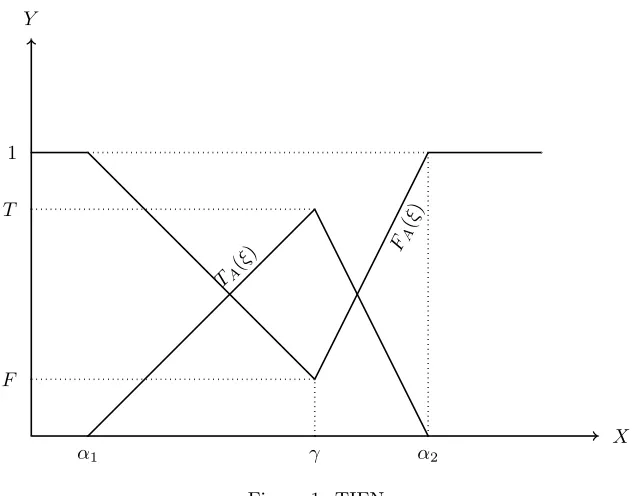
Definition 2.3. (Triangular Intuitionistic Fuzzy Numbers (TIFN)) IfAebe TIFN, its membershipship is defined as:
1. T
e
A(ξ) =
(ξ−α1
γ−α1)T, if α1≤ξ≤γ (α2−ξ
α2−γ)T, if γ≤ξ≤α2 0, otherwise;
and its non-membership function is defined as:
2. F
e
A(ξ) =
γ−ξ+F(ξ−β1)
γ−β1 , if β1≤ξ≤γ
ξ−γ+F(β2−ξ)
β2−γ , if γ≤ξ≤β2 1, otherwise;
where 0 ≤ T ≤ 1, 0 ≤ F ≤ 1, and T +F ≤ 1, α1, α2, β1, β2, γ ∈ IR. Then Ae =<
([α1, γ, α2], T),([β1, γ, β2], F)> is called an intuitionistic triangular fuzzy number ITFN. For
convenience ITFNAeis written as Ae= ([α1, γ, α2];T, F)and show in figure1.
Definition 2.4. (Arithmetic operation between TIFN’s)Let Ae= ([αA1e, γAe, αA2e];TAe, FAe) andBe= ([αB1e, γBe, α2Be];TBe, FBe)be two TIFN’s and λ≥0, then
1. addition of AeandBe is represented by Ae⊕Be and defined as: e
A⊕Be= ([αA1e+α1Be, γAe+γBe, αA2e+α2Be];TAe+TBe−TAeTBe, FAeFBe); 2. product of AeandBe is represented byAe·Be and defined as:
e
A·Be= ([αA1e·αB1e, γAe·γBe, αA2e·α2Be];TAe·TBe, FAe+FBe−FAe·FBe); 3. multiplication by a scalar λwith the TIFNAeis defined as follows:
λAe= ([λαA1e, λγAe, λαA2e]; 1−(1−TAe)λ,(FAe)λ);
α1 γ α2
Y
1
X T
F
TA(
ξ) F
A(
ξ)
Figure 1: TIFN
Definition 2.5. (Score and accuracy function of TIFN) If Ae= ([αA1e, γAe, αA2e];TAe, FAe) then score functionS(Ae)and accuracy function H(Ae)forAeis defined as:
S(Ae) =I(Ae)×(TAe−FAe) andH(Ae) =I(Ae)×(TAe+FAe)
, whereI(Ae) =
1 6 ×(α
e
A
1 +γAe+αA2e)×(1 +TAe−FAe)Let AeandBe be two TIFN’s, then
1. AeBe ifS(Ae)S(Be); 2. Ae≺Be ifS(Ae)≺S(Be); 3. if S(Ae) =S(Be), then
(a) AeBe ifH(Ae)H(Be); (b) Ae≺Be ifH(Ae)≺H(Be); (c) Ae=Be ifH(Ae) =H(Be).
3
Modified Boruvka’s Algorithm for IMST
of this graph. The following variables are used in proposed algorithm.
1. A undirected triangular intuitionistic fuzzy weighted connected graph (UITFWCG)Ge=
(V
e
G, EGe), where VGeis the set of the vertices andEGeis the set of the edges; 2. A UITFWCGfG0= (V
e
G, EGf0, whereGf
0 ⊆
e
G; 3. ξi is thei−th vertex of the vertex setVGe; 4. eij is the edge connecting the verticesvi andvj;
5. Mfis the A triangular intuitionistic fuzzy minimum spanning tree tree of Ge;
6. Wf(eij) is a discrete ITF weight associated with the edgeeij ofGe;
7. Wf(Mf) is the ITFW ofMf Proposed Bor˚uvka’s Algorithm:
Input: A graphGe= (V
e
G, EGe)
Output: The resultant MSTMfand fW(Mf)
Step 1: InitializeMfas empty graph. SetGf0=Ge
Step 2: foreachvi∈VGf0 do
Step 3: The score and accuracy function of TIFN is used for finding the sorting the edges of the graph. Based on the value of score of TIFN, we minimum arc of the graph.
Step 4: Mf←Mf∪ {eij}
Step 5: end for
Step 6: Gf0←Ge with all adges inMfcontracted
Step 7: Recursively compute the Mf till the size of Mf is |V
e
G| −1 and |VGe| = 1 after edge contractions
Step 8: Calculate fW(Mf) and defuzzify its value.
4
An application IMST in Water Supply Network
and develop production and construction. Urban water supply pipe network system can be regarded as an important lifeline of urban engineering. The traditional view is that the water supply network’s mission is to provide sufficient amount of water, the residents have enough water to use. However, with the continuous development of social economy, people put forward higher requirements for the safety, reliability and economy of the water supply. Specifically, in the process of water supply, the quality of supplied water is healthy or not, such as water pipe corrosion or other factors lead to water quality problems; after an earthquake or major disaster, the water supply network is reliable or not, urban water supply network can be normal without the occurrence of secondary disasters; pipe network not only to have above two characteristics, economic issues is the focus. In the case of the entire water supply network connectivity, we must to ensure the lowest costs that aim to produce hedge-fund-like returns at lower cost. So in recent years, research on the economic aspect of water supply network is increasingly attracted people’s attention. Water supply system is an important infrastructure of the city, and it also is an important part of urban lifeline project, which plays an irreplaceable role in protecting economic development, ensuring social production and meeting human life. In laying city network, the street interchanges must be considered because the pipelines must along the street to lay. In case of that water supply network can connect all users to make it with the lowest costs. To achieve this goal, you must consider how to select and handle these interchanges.
4.1
Graphical Model for Water Supply Network
In laying city nework, the street interchanges must be considered because the pipelines must along the street to lay. In case of that water supply network can connect all users to make it with the lowest costs. To achieve this goal, you must consider how to select and handle these interchanges. This problem is a serious problem. The solution of this problem can provide a standard for the laying of water supply network to ensure best desing effect. According to graph theory, the water supply network can be viewed as a graph. So the contents of the water supply network need to be translated into the language of graph theory to help solve the problem of water supply network costs. The language from pipelines to graph is described as follows :
1. The water supply center and users in the planning area are referred to as nodes, the intersection of the street known as the intersections. The nodes and intersections are regarded as the vertices of graph. So the issue can be converted to the shortest path between each vertex, and each vertex must be connected indirectly or not indirectly.
2. The routes that may be laying between nodes and intersections can be considered as edges of the graph.
3. The sum of construction costs and operating costs of each line is regarded as the weights of edges. The sum of weights is the minimum that is the lowest costs, that is the purpose of the design you want to achieve.
Through the above three steps, the water supply network can form a graph, this graph includes the vertices, edges and weights. UsingG= (VG, EG, WG) to represent, VG represents
the set of vertices in the graph; EG represents the set of edges in the graph; WG represents
the set of weights of each edge in the graph. SettingTGis a spanning tree of diagram ofG, then:
W(T) =X
eαβ
Among them,W(TG) is the sum of weights in the tree ofTG; euv is the any edge in the tree
ofTG; Wuv is the weights of euv. The purpose of design is to require the minimum values of
W(TG). Only this way can ensure the lowest costs of laying pipelines. In summary, the problem
of the minimum costs of the water supply network may be as a problem of seeking minimum spanning tree in the graph. The minimum spanning tree must exist. According to the actual situation, each node will certainly connected when laying water supply network, so there will be a minimum spanning tree certainly. There are a variety of algorithms to generate minimum spanning tree, such as Prim algorithm, Kruskal algorithm and simple algorithm and so on.
4.2
Numerical example
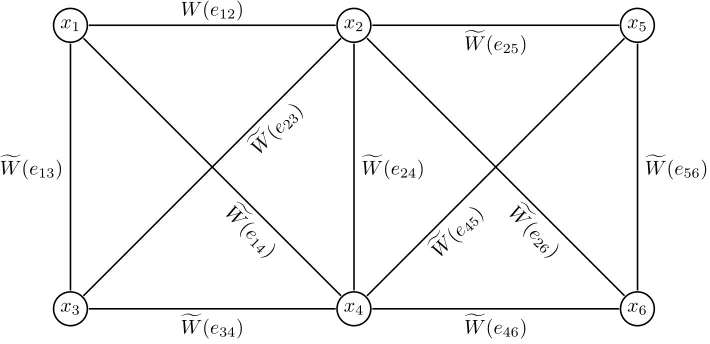
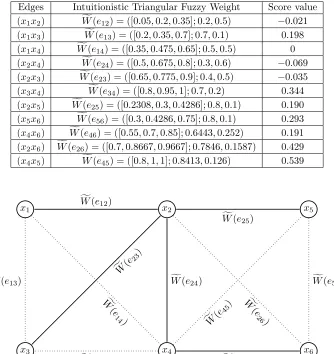
A city wants to lay the pipelines of water supply network, the lines show in2. Here we consider the edge weight of the graph as TIFN’s. In figure2 x6 is the source of water supply. We find
the MST of the graph by using Bor˚uvka’s algorithm [6]. The edges depicted as ‘black’ lines in Fig. 3determine the edges of the spanning tree.
x1 x2
x4
x3
x5
x6
f
W(e12)
f
W(e24)
f
W(e34)
f
W(e13)
f
W
(e
14
)
fW
(e23 )
f
W(e25)
f
W
(e
26
)
fW
(e45 )
f
W(e46)
f
W(e56)
Figure 2: An UITFCGGe whose edge weights are TIFN’s
5
Conclusion
Table 1: Edge Weights and score value of the Graph
Edges Intuitionistic Triangular Fuzzy Weight Score value (x1x2) Wf(e12) = ([0.05,0.2,0.35]; 0.2,0.5) −0.021
(x1x3) Wf(e13) = ([0.2,0.35,0.7]; 0.7,0.1) 0.198
(x1x4) fW(e14) = ([0.35,0.475,0.65]; 0.5,0.5) 0
(x2x4) Wf(e24) = ([0.5,0.675,0.8]; 0.3,0.6) −0.069
(x2x3) Wf(e23) = ([0.65,0.775,0.9]; 0.4,0.5) −0.035
(x3x4) fW(e34) = ([0.8,0.95,1]; 0.7,0.2) 0.344
(x2x5) Wf(e25) = ([0.2308,0.3,0.4286]; 0.8,0.1) 0.190
(x5x6) fW(e56) = ([0.3,0.4286,0.75]; 0.8,0.1) 0.293
(x4x6) Wf(e46) = ([0.55,0.7,0.85]; 0.6443,0.252) 0.191
(x2x6) fW(e26) = ([0.7,0.8667,0.9667]; 0.7846,0.1587) 0.429
(x4x5) fW(e45) = ([0.8,1,1]; 0.8413,0.126) 0.539
x1 x2
x4
x3
x5
x6
f
W(e12)
f
W(e24)
f
W(e34)
f
W(e13)
f
W
(e
14
)
fW
(e23 )
f
W(e25)
f
W
(e
26
)
fW
(e45 )
f
W(e46)
f
W(e56)
Figure 3: MST ofGe
References
[1] H. Mao, L. W. Xie, Z. X. Zhang, Applying Pruning-based Minimum Spanning Tree Algorithm Water Supply Networks,Computer Applications and Software,28, (2011), 109-110.
[2] A. Dey, A. Pal, Prim’s algorithm for solving minimum spanning tree problem in fuzzy environment, Annals of Fuzzy Mathematics and Informatics,12(3), (2016), 409-430.
[3] A. Dey, S. Broumi, L. H. Son, A. Bakali, M. Talea, F. Smarandache, A new algorithm for finding minimum spanning trees with undirected neutrosophic graphs,Granular Computing (Springer),
4(1), (2019), 63-69.
[4] A. Dey, R. Pradhan, A. Pal, T. Pal, A Genetic Algorithm For Solving Fuzzy Shortest Path Problems With Interval Type-2 Fuzzy Arc Lengths, Malaysian Journal of Computer Science,
[5] A. Dey, L. Son, A. Pal, Fuzzy Minimum Spanning Tree with Interval Type 2 Fuzzy Arc Length: Formulation and A New Genetic Algorithm,Soft computing, (2019), 1-12.
[6] J. Neˇsetˇril, E. Milkov´s, H. Neˇsetˇrilov´aand O. Bor˚uvka Otakar Bor˚uvka on minimum spanning tree problem Translation of both the 1926 papers, comments, history,Discrete Mathematics,,233, (2001), 3-36.
[7] K. Atanassov, Intuitionistic fuzzy sets,Fuzzy sets and system,20, (1986), 87-96.
[8] S. Das, S. Kar, T. Pal, Robust decision making using intuitionistic fuzzy numbers,Journal of New Theory,2(1), (2017), 41-54.
[9] L.A. Zadeh, Fuzzy sets,Information and Control,8, (1965), 338-353.
[10] M. G. Karunambigai, O. Kalaivani, Intuitionistic fuzzy graph, World Applied Science Journal,
14(12),(2011), 1928-1936.
[11] B. Asady and A. Zendehnam, Ranking fuzzy numbers by distance minimization, Applied Mathe-matical Modelling 31(11) (2007) 2589–2598. 176 (16) (2006) 2405–2416.
[12] S. Abbasbandy and T. Hajjari, A new approach for ranking of trapezoidal fuzzy num-bers,Computers & Mathematics with Applications 57(3) (2009) 413–419.
[13] T. A. De Almeida, A. Yamakami, and M. T. Takahashi, An evolutionary approach to solve mini-mum spanning tree problem with fuzzy parameters, in null. IEEE, (2005) 203–208.
[14] C. C. Chou, The canonical representation of multiplication operation on triangular fuzzy numbers, Computers & Mathematics with Applications 45(10)(2003) 1601–1610.
[15] P. T. Chang and E. Lee, Fuzzy decision networks and deconvolution, Computers & Mathematics with Applications, 37(11) (1999) 53–63.
[16] D. Dubois and H. Prade, Operations on fuzzy numbers, International Journal of systems science, 9(6) (1978) 613–626.
[17] J. C. Gower and G. Ross, Minimum spanning trees and single linkage cluster analysis, Applied statistics, (1969) 54–64.
[18] J. Gao and M. Lu, Fuzzy quadratic minimum spanning tree problem, Applied Mathematics and Computation, 164(3) (2005) 773–788.
[19] R. L. Graham and P. Hell, On the history of the minimum spanning tree problem, Annals of the History of Computing, 7 (1) (1985) 43–57.
[20] H. Ishii and T. Nishida, Stochastic bottleneck spanning tree problem, Networks, 13(3) (1983) 443–449.
[21] H. Ishii and T. Matsutomi, Confidence regional method of stochastic spanning tree problem, Mathematical and computer modelling, 22(10) (1995) 77–82.
[22] H. Ishii, S. Shiode, T. Nishida, and Y. Namasuya, Stochastic spanning tree problem, Discrete Applied Mathematics, 3(4) (1981) 1400–1412.
[23] T. Itoh and H. Ishii, An approach based on necessity measure to the fuzzy spanning tree problems, Journal of the Operations Research Society of Japan, 39(2) (1996) 247–257.
[24] A. Janiak and A. Kasperski, The minimum spanning tree problem with fuzzy costs, Fuzzy Opti-mization and Decision Making, 7(2) (2008) 105–118.
[25] J. B. Kruskal, On the shortest spanning subtree of a graph and the traveling salesman problem, Proceedings of the American Mathematical society 7(1) (1956) 48–50.
[26] A. N. C. Kang, R. C. Lee, C. L. Chang, and S. K. Chang, Storage reduction through minimal spanning trees and spanning forests,
[27] B. Liu and B. Liu, Theory and practice of uncertain programming, Springer, 2002. [28] B. Liu, Uncertainty theory: An introduction to its axiomatic foundations, 2004.
trees, SIAM Journal on Computing, 3(1) (1974) 23–40.
[31] G. Rodolakis, A. Laouiti, P. Jacquet, and A. M. Naimi, Multicast overlay spanning trees in ad hoc networks: Capacity bounds, protocol design and performance evaluation, Computer Commu-nications 31(7) (2008) 1400–1412.
[32] Salim Rezvani, Ranking method of trapezoidal intuitionistic fuzzy numbers, Annals of Fuzzy Mathematics and Informatics 5(3) (2013) 515–523.
[33] J. Zhou, L. Chen and K. Wang, Path optimality conditions for minimum spanning tree problem with uncertain edge weights, International Journal of Uncertainty, Fuzziness and Knowledge-Based Systems, 23(01) (2015) 49–71.