STORAGE AMONGST CONSULTANT FIRMS
IN MALAYSIAN CONSTRUCTION INDUSTRY
Azlan Othman1, Syuhaida Ismail2, Khairulzan Yahya1
1Faculty of Civil Engineering, Universiti Teknologi Malaysia, Johor Bahru, Malaysia 2UTM Razak School of Engineering and Advanced Technology,
Universiti Teknologi Malaysia, Kuala Lumpur, Malaysia
http://doi.org/10.31039/jomeino.2018.2.1.5
Abstract
In recent years, a major challenge in the field of knowledge management (KM) has been the way in which KM is implemented. Individuals and organisations are starting to understand and appreciate knowledge as the key element in the emerging competitive environment. As a preparation for the competitive industrial nation, KM is an important countenance that should be the point of convergence for the industry players. This paper wishes to draw the attention on the important of KM storing practice by focusing on consultant firms in construction industry in Malaysia. Questionnaires were distributed to about 200 respondents working in the industry, with the aim of investigating the KM storage implementation in the Malaysian consultant firms. In this paper, the data is analysed using Statistical Package of Social Sciences (SPSS) version 23.0. The analysed results from questionnaire survey and focus group showed that consultant firm in construction industries were involved in implementing KM storing in their organisation. This paper is beneficial in order to improve the KM storing practice in the organisation.
Keywords: Knowledge management (KM); consultant firm; civil engineering; Malaysian construction industry; KM Storing; KM implementation
INTRODUCTION
Knowledge is recognised as a source of competitive advantage in a dynamic and changing business environment today (Burton, 1999). Individual and organisational knowledge is important for
Received 16 October 2017 Revised 07 November 2017 Accepted 01 January 2018
Corresponding author:
61 business entrepreneurship and for managing change (Nonaka and Takeuchi, 1995). Knowledge management (KM) is very important in the construction industry in order to satisfy the requirements of quality, cost and time. Basically, KM is defined as a process that focuses on knowledge-related activities to facilitate knowledge creation, capture, transformation and use, with the ultimate aim of leveraging organisations’ intellectual capital to achieve organisational objectives (Cavaleri 2004).
There are different types of consulting firms serving different sectors. This paper mainly focuses on construction industry, which falls under civil engineering fields. A successful construction can only be achieved with good civil engineering design and consultations, which require decent engineering knowledge and experience. KM in construction projects is a challenging task due to several factors. The construction project consists of numerous people from different companies with different professional backgrounds, such as clients, architects, project managers, designers, site managers, and workers. Furthermore, most project-related problems, solutions and experiences are usually not documented or stored in a system database and the process of capturing and storing them in usable forms is not easy (Eardley, 2001). Therefore, there is a need of continuous efforts to improve the use of KM storage in construction industry.
KM systems and related initiatives have become a popular focus in many firms, yet many knowledge management systems initiatives fail to achieve their goals. Therefore, this paper focuses on investigating the implementation of KM storing in order to improve the performance of KM and make sure the implementation succeed.
1. KNOWLEDGE STORAGE
This section gives an overview of the key concepts of organisational storage. It is essentially important to deepen the understanding of knowledge storage through explaining organisational memory. Based on literature, El Sawy et al. (1986) define memory as “a hidden repository of details of past decisions and their perceived results, past surprises and the organisation’s responses, rules of thumb and other unwritten decisions that regulate current decisions and actions”. Reflecting this view, Probst et al. (2000) describe memory as “a system of knowledge
and skills that preserves and stores perceptions and experiences beyond the moment when they occur, so that they can be retrieved at a later time.” Olivera (2000) contends that an organisation’s ability to preserve knowledge has important consequences for its performance. In this regard, Argote et al. (1990) state that stored knowledge can effectively safeguard the organisation from the distracting effects of turnover. Furthermore, it can also assist in framing and solving problems Stein (1995). Viewing knowledge as a crucial resource, organisations recognise the value of knowledge storage for present and future use.
62 each day, which is 20% of their work time, employees get 50% to 75% of their relevant information directly from other people. Furthermore, more than 80% of enterprise’s digitised information resides in individual hard drives and personal files (Information Worker Productivity Council Research, 2004 and Gartner Research, 2002). This is the reason of why the storage of knowledge should be handled wisely.
Thus, managing knowledge storage in organisation has several options, which are by file system storage (local, network directories and folders), databases, e-mail and websites (intranet and external). Basically, knowledge can be categorised as in Figure 1. Approach on knowledge storage is categorised as structured and unstructured. Structured storage is divided into storage-wise (easy to locate) and document-storage-wise (easy to understand). Meanwhile, unstructured usually in the form of storage wise, where it is more on flexibility on storing new type of knowledge.
Figure-1: Knowledge Categorisation
There are two-step processes of organising knowledge. Firstly, the information should be divided into manageable units. Secondly, each unit should be categorised. Before the information is divided into smaller units, there is need to determine the size, or granularity, of each meaningful unit. The finer the subdivision or granularity of each unit the more tedious and time consuming the cataloging effort will be. After the information is divided into smaller units, the units must then be categorised by content type. In order to do this, it is necessary to create a list of all the content types for the organisation. This list may include classifications, such as proposals, invoices, white papers, and correspondence.
Knowledge that is transferred among the organisational members is more useful than it remains in a human brain. Moreover, such transferred knowledge needs to be stored and retained in a repository so that other members of the organisation could retrieve it for future use without an interaction with the person who possesses such knowledge in the first place. One point got to be taken into account is the fact that all knowledge of the organisation should not be preserved
Knowledge
Information
Data
Structured, Non Fact
Structured, Fact
63 and retained in a knowledge repository. It is because if irrelevant part of knowledge is stored then knowledge storage will be filled up with garbage. Thus, knowledge, which is perceived current, relevant and correct, should be stored into and should also be retrievable from the storage bins and consequently the storage of such knowledge could yield more benefit to the organisation. The fact is that knowledge in organisations resides in multiple repositories or retention bins (Walsh and Ungson, 1991; Levitt and March,1988; and Starbuck, 1992). Individuals, in the process of doing their work, generate knowledge that largely remains in their heads. Although no one particular member of an organisation is likely to be the sole repository of an organisation’s memory, networks of individuals can be a powerful medium of storage and retrieval of the organisation’s explicit knowledge (Olivera, 2000).
2. METHODOLOGY
This paper is materialised by performing a pilot study on 20 respondents, which is 10 percent from actual sample, in checking the feasibility of the actual questionnaire before being distributed to the intended sample. The primary data collection for this study is by the means of questionnaire survey. This is parallel with the claim made by McQueen and Knussen (2002) and Andi and Minato (2003), who mentioned that to achieve good result from large number of respondents, the used of questionnaire survey is one of the most economical methods. In order to help the respondents in understanding the questions and improving comprehension, a definition of knowledge management (KM) is provided in the questionnaire following the suggestion by Dillman (1999). As Cronbach’s alpha of an acceptable range is obtained via the analysis of this pilot survey, which demonstrates the content reliability of the questionnaire, actual questionnaire survey of about 200 respondents from the consultant firms in the northern region of Malaysia, including Perlis, Kedah, Pulau Pinang and Perak, is performed. These respondents are selected from the probability simple random sampling. The variables from the questionnaire survey are taken from the comprehensive literature review carried out by researchers. Data is analysed via Statistical Package of Social Sciences (SPSS) version 23.
3. RESULT AND DISCUSSION
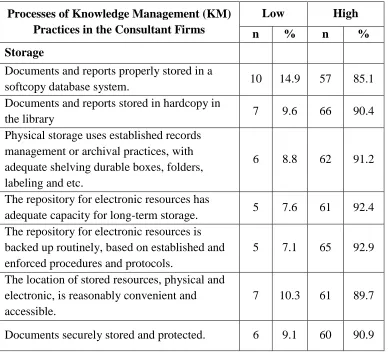
64 Table-1: Processes of Knowledge Management (KM) Practices in the Consultant Firms
Processes of Knowledge Management (KM) Practices in the Consultant Firms
Low High
n % n %
Storage
Documents and reports properly stored in a
softcopy database system. 10 14.9 57 85.1
Documents and reports stored in hardcopy in
the library 7 9.6 66 90.4
Physical storage uses established records management or archival practices, with adequate shelving durable boxes, folders, labeling and etc.
6 8.8 62 91.2
The repository for electronic resources has
adequate capacity for long-term storage. 5 7.6 61 92.4
The repository for electronic resources is backed up routinely, based on established and enforced procedures and protocols.
5 7.1 65 92.9
The location of stored resources, physical and electronic, is reasonably convenient and accessible.
7 10.3 61 89.7
Documents securely stored and protected. 6 9.1 60 90.9
65 Table-2: Compared mean based on storage
No Storage Mean SD
B22
The repository for electronic resources is backed up routinely, based on established and enforced procedures and protocols.
3.84 0.79
B19 Documents and reports stored in hardcopy in the
library. 3.79 0.79
B20
Physical storage uses established records
management or archival practices, with adequate shelving durable boxes, folders, labeling and etc.
3.73 0.8
B21 The repository for electronic resources has
adequate capacity for long-term storage. 3.72 0.77
B23
The location of stored resources, physical and electronic, is reasonably convenient and accessible.
3.72 0.79
B24 Documents securely stored and protected. 3.71 0.76
B18 Documents and reports properly stored in a
softcopy database system. 3.64 0.85
Total Mean 3.73 0.76
66 CONCLUSION
This paper has successfully achieved its objective to identify the knowledge management (KM) process specifically on KM storage for KM implementation in the Malaysian consultant firm working in construction industry in Malaysia. It is hoped that the discussion on KM storage implementation would lead to the successful implementation of KM practice amongst consultant firms in the Malaysian construction industry. It is expected that this paper will bring forward the ideas of eventually developing a better knowledge storage practice, faster accessibility and higher availability of the information, and easier to operate and maintain knowledge storage practice in organisation.
ACKNOWLEDGEMENT
The authors would like to express their since gratitude to the Ministry of Education, Universiti Teknologi Malaysia (UTM) and the Research Management Centre (RMC) of UTM for providing the financial support for this paper to be published. This paper is financed by UTM Grant for Research University (GUP) Tier 1 for research funding under Cost Centre No. Q.K130000.2540.11409.
REFERENCES
Andi and Minato, T. (2003). “Representing causal mechanism of defective designs: a system approach considering human errors”, Construction Management and Economics, 21(3), pp.297-305.
Argote L., Beckman S. L., and Epple D. (1990). “The persistence and transfer of learning in industrial settings”, Management Science, 36, pp.140-54.
Burton Jones, A. (1999). Knowledge Capitalism. Oxford: Oxford University Press.
Cavaleri Steven A., (2004) “Leveraging organizational learning for knowledge and
performance”, The Learning Organization, 11(2), pp.159-176, https://doi.org/10.1108/09696470410521619
Dillman, D. A., Redline, C. D., & Carley-Baxter, L. R. (1999, August). Influence of type of question on skip pattern compliance in self-administered questionnaires. In Joint Statistical Meetings of the American Statistical Association, Indianapolis.
Eardley, Alan, & Uden, Lorna. (2001). Innovation knowledge management: Concepts for organizational Creativity and Collaborative design. Staffordshire University, UK.
67 Casonato, R., & Harris, K. (2002). The Knowledge Worker Investment Paradox. Gartner
Research.
Levitt B., and March J. C. (1988). “Organizational Learning”, Annual Review of Sociology, 14, pp.319-340.
McQueen, R. A., & Knussen, C. (2002). Research methods for social science: A practical introduction. Pearson Education.
Nonaka, I. , and Takeuchi, H. (1995). The Knowledge Creating Company. New York: Oxford University Press.
Olivera F. (2000). “Memory systems in organizations: an empirical investigation of
mechanisms for knowledge collection, storage and access”, Journal of Management Studies, 37(6), pp.811-32.
Probst G., Raub S., and Romhardt K. (2000). Managing Knowledge- Building Blocks for Success, John Wiley & Sons Ltd.. Chichester.
Starbuck W. R. (1992). “Learning by knowledge intensive firms”, Journal of Management Studies, 29(6), pp.713-40.
Stein E. W. (1995). “Organizational Memory: Review of Concepts and recommendations for Management”, International Journal of Information Management, 15(2), pp.17-32.