ACTIVITY AND INDUSTRYBASED LEARNING APPROACH AS A SUSTAINABLE BASIS FOR ENHANCED ACADEMIC DEVELOPMENT
Amelia S. Serdena, Ma.Ed and Benedict DC. David, KCR, Ph.D, DHC, D.Hum
University of Santo Tomas and Universidad de Manila
IJMSSSR 2020 VOLUME 2
ISSUE 1 JANUARY – FEBRUARY ISSN: 2582-0265 Abstract: One of the progressions of the 21st educational systems is the Activity-Based Learning Approach in teaching. The idea of collaborative and cooperative learning is the foundation of this approach. For Gamit, Antolin and Gabriel (2017) cooperative learning is defined and conceptualized by many related literature as a teaching method where students support each other by working in a team. Each student contributes his own effort to uplift the group performance. Learners elaborate concepts that promote deep understanding while teachers act as facilitators by providing instructional materials.
The main purpose of this study was to examine the relationship of the activity-based learning approach in teaching science with the achievement performance of students, as basis for the enhancement of the curriculum guide. The target participants were the sixty (60) Grade 8 students randomly selected through random sampling which is used basically for the quasi-experimental method.
Significant results, in general, presented the fact that truly, the experiences of the teachers as industry practitioners prior to their pure academic professions do play a part towards the holistic learning of the students. This is attributed to the fact that the experiences that the teachers can share will be the one that the students will remember, not the theories.
Keywords: Activity-based learning, Academic Development, Competency Introduction
PROBLEM RATIONALE
It is no wonder that the quest on improving the education system has gone through ups and downs, even drastic changes, over centuries up to now. Roochnik (2016) paraphrases Aristotle from Politics (Book VIII, Chapter 2) that the philosopher and his contemporaries themselves found it difficult to agree on a fitting sort of education for the young because of certain social changes.
Around the globe, societies have undergone hastening speed of change in economy and technology since the mid-20th century. The effects of these struggles have marked significantly on workplaces, and eventually on the educational system that prepares students for the workforce. Beginning in the 1980s, government, educators, and major employers issued a series of reports identifying key skills and implementation strategies to steer students and workers towards meeting the demands of the changing and increasingly digital workplace and society. Twenty-first century skills are a series of higher order skills, abilities, and learning dispositions that have been identified as being required for success in 21st century society and workplaces by educators, business leaders, academics and governmental agencies (Graham, 2015). Many of these skills are also associated with deeper learning, including analytic reasoning, complex problem solving, and teamwork, compared to traditional knowledge-based academic skills (Cuban, 2015).
a collaborative environment. To assure proper utilization of the curriculum design, public school teachers had to undergo rigid trainings and seminars.
Ergo, given such thrust to improve the educational system, this research validated the following inquiries:
1. How would the prior industry experience of the teachers reflect and translate on their teaching methods?
2. How significant is the relevance of the teachers’ performance and experiencetowards the holistic learning of the students?
3. What are the experiences of the experimental group participants in the Activity based Learning Approach?
4. What enhanced curriculum guide can be proposed based on the findings of the study?
RESEARCH METHODOLOGY AND PARADIGM
According to Steeve Wheeler (2016), the objects that surround students such as white board, furniture, technology, and even the shape, size and configuration of the room, as well as the lighting and noise levels, greatly influence the learners’ ability to interact with others. He also points out that learning occurs usually through specific activities.
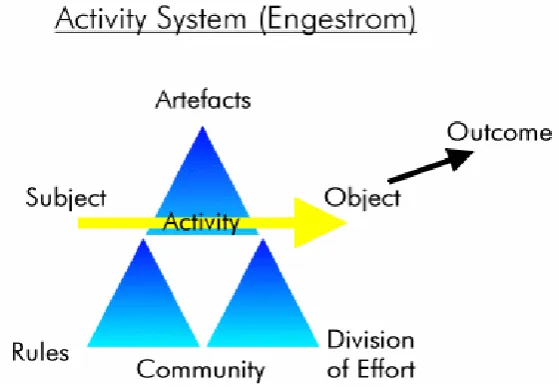
Fig. 1: Activity Theory
Figure 1 exhibits the paradigm of how broad-range factors aggregate together to result an activity. Lee, et.al (2015) shares the sequence in order to reach an outcome.
Based on the sequence, first, it is necessary to produce certain objects like experience, knowledge and physical products. Second, tools or documents which are called artifacts mediate human activity. Third, teachers and learners, termed here as a community, mediate activity. The community may impose rules that affect activity. Fourth, sequence states that the subject works as part of the community. In education, subjects pertain to academic subjects. Lastly, an activity normally features division of labor.
Dr. Joey Lee (2015) also cites four principles of the Activity Theory that are associated with various aspects of the whole activity. The first principle is known as the object orientedness or the views of a person based on his experience. The second is the internalization and externalization principle. The mental simulation and imagination fall under the internalization, while the performance of the internal activity is under the externalization. The third is called the principle of mediation. Here, the tool used may influence the nature of the external behavior and the functioning of individuals. And last, the principle which states that an active participation with monitoring of developmental changes can secure a better outcome.
The birth of Sapang Palay National High School was created by the virtue of Republic Act 5222 sponsored by Hon. Rogaciano M. Mercado, an eight hectares of undulating land in Area E were turn over by the Philippine Housing and Home site Corporation to the Department of Education for the school.
The participants of this study were the Grade 8-Strawberry and 8-Durian students of SapangPalay National High School since it was not possible to have the total Grade 8 population to be the participants in the study
Table 1:
Distribution of Participants
Group Male Female Total
Control 15 15 30
Experimental 15 15 30
Total 30 30 60
The researcher developed a table of specification based on the guide provide by the Department of Education that was suitably used in this study. It reflects the Learning Competencies that were least mastered based on the Science 8 First Quarter 2016 Pretest Results of SapangPalay National High School.
As necessary, the types of items in the TOS are classified according to the DepEd order number 8 series of 2015. These types of items are remembering, understanding, applying, analyzing, evaluating and creating, all adapted by DepEd from the cognitive process dimensions of Anderson and Krathwohl (2001).
With regard to the specified allotment of days per learning competency in the TOS, the researcher consulted the Science K to 12 Curriculum Guide 2016.
Following the “Elicit, Engage, Explore, Explain, Elaborate, Evaluate and Extend (7’Es)” format and pattern, the researcher developed seven lesson plans used for the control group. The learning competencies, budget of days, objectives and evaluation that make up these plans are as suggested in DepEd order number 8 series of 2015, DepEd learning Module and Science K to 12 Curriculum Guide of 2016.
Firstly, the “Elicit and Engage” part of each traditional lesson plans aims to pique the students’ interest and get them personally involved while pre-assessing prior understanding through introduction, orientation and clarification.
Next is the “Explore” part of the lesson which provides the learners a chance of building their own understanding through collaboration.
Then, the “Explain” part lets the student to communicate what they have learned through presentation while the “Elaborate” part lets the learners use their knowledge and continue to explore through specification or hitting the main objectives of the lesson, whereas supplementation is given whenever targets are not hit as expected.
Lastly, to determine how much learning has taken place, the collaborative part of the lesson, that is “Evaluate and Extend”, is executed.
For the seven activity based learning lesson plans that were used on the experimental group, the researcher opted to follow Col Muhammad Khan’s (2014) “Presentation, Practice and Production (3 P’s)” format in Activity Based Learning lesson planning.
Similar with the development of the non-activity based lesson plans, this activity based learning lesson plans cover learning competencies, budget of days, objectives and evaluation as suggested in DepEd order number 8 series of 2015, DepEd learning Module and Science K to 12 Curriculum Guide of 2016.
The last stage of these lesson plans is “production” (free), where real communication takes place based on the students’ natural expressions and learned functions. Students’ verbal or written responses are elicited in this stage.
SIGNIFICANT RESULTS
The following are the significant results of this research:
Performance of the Control and Experimental Groups
The topics discussed by the test subjects were not disclosed in order to protect their privacy and academic freedom. However, when they shared their experience and matched with the theories that they teach, the students were able to learn, as what is stared by the table below.
This could be gleaned that learning can be acquired through conventional approach as long as the teacher made use of different strategies and resource material needed to enhance learning and performance. From this data it could be affirmed that among the three topics experimental group achieved the performance needed to enhance the curriculum guide.
Significant Difference of Pretest and Posttest of the Control and Experimental Group
The table below showed that the P - value was less than 0 .0001. This meant that the level of significant which was 0.05 so the hypothesis was rejected.
Group Pretest Posttest
Mean 9.11 16.37
SD 3.64 4.23
N 30 30
Two tailed P value Less than 0.001
Hence, there was a significant difference between the blend of experience vis-à-vis the non-usage of such. This truly means that the students will utterly learn if they are being taught by both the books and the actual experience of the teacher.
INTERVENTIONS AND RECOMMENDATIONS
It was very evident that the utilization of experience and activity based learning approach was highly effective. This result showed that students get interested in lessons that are innovated encrypted with various fun activities that hooked their interest to learn more.
Topics Control Group Experimental Group
Mean
Score SD Interpretation Verbal Mean Score SD Interpretation Verbal
Random
Topic 1 17.33 4.58 Average 28.13 4.21 Excellent
Random
Topic 2 16.91 3.59 Average 27.09 2.77 Excellent
Genetics
(Mendelian) 14.11 3.92 Average 29.00 3.20 Excellent
In the light of the findings of this research, the following recommendations were hereby presented:
1. It is recommended that teachers should innovate and apply the technology more often in lessons to address the learner’s need and interest. Furthermore, various activity-based learning approach can be used to enhance the skills of the students’ like; critical thinking skills, and additional interactive simulation can be utilized to achieve high performance of students.
2. It can be suggested that teachers should embark researches on Enhancing Curriculum Guide. Teachers in the today’s world should be open – minded in adapting such changes for the improvement of the students.
3. The teachers should be engaged in implementing activity based learning approach research for the betterment and welfare of the students.
4. For future researchers, conduct this study to larger samples to confirm or negate results, as well as to further strengthen the acceptability of the study by utilizing the Activity- Based Learning approach in all subject areas of the curriculum.
REFERENCES
1. Alovera, Rissa N. (2016). ICT blended enrichment material in teaching grade 10 science: An assessment. Master Thesis. The National Teachers College,Quiapo, Manila City.
2. Bada, Steve Olusegun (2015). Constructivism learning theory: A paradigm for teaching and learning. IOSR Journal of Research &Method in Education (IOSR-JRME) e- ISSN: 2320–7388,p-ISSN: 2320–737X Volume 5, Issue 6 Ver. I
3. Baldesco,Brenda F. (2015). Achieving learning gains in science through reciprocal teaching. Master Thesis. The National Teachers College, Quiapo, Manila City.
4. Chickening&Gamsom (20017). Assessing the reliability of merging Chickening and Gamson’s seven
principles for good practice with Merrill’s different level of instructional strategy.
5. Cid, Antonio D. (2013). The pupil empowerment driven learning among the grade 6 pupils of Bangkal Elementary School I. Master Thesis. The National Teachers College, Quiapo, Manila City.
6. Cimer, Ailla (2012). What makes biology learning difficult and effective: Students’ Views.Vol. 7 (3), Issue 1190-3839, pp.61-71
7. Cloete, Elsabea. 2015. "Electronic Education System Model." Department of Computer Science and Information Systems in South Africa,
8. Cobacha, Maria Rosario D. (2014). Towards the development of an intervention program for Grade 8 dyscalculic students in Gen. Ricardo G. Papa Sr. Memorial High School. Master Thesis. The National Teachers College, Quiapo, Manila.
9. Cuban, Larry (2015), Content vs. Skills in high schools - 21st Century ArgumentsEcho 19thCentury Conflicts, Retrieved 2016-03-12
10. Dundar, et.al (2014). Which elementary school subjects are the most likeable, most important, and the easiest? Why?: A study of Science and Technology, Mathematics, Social Studies, and Turkish. Vol. 9 (13), pp. 417-428.
11. Dy and Gabuyo (2013). Assessment of learning II (Textbook and Reviewer. Rex Book Store, Inc., Philippines.
12. Fraenkel et al (2016). How to design and evaluate research in education. Mc Graw Hill, New York, 13. Lee, Joey J. (2015). Activity Theory. Available internet: http://www.learning-theories.com/activity-
theory.html
14. Pashler, Harold; McDonald, Mark; Rohrer, Doug; Bjork, Robert (2009). "Learning Styles: Concepts and Evidence"(PDF). Psychological Science in the Public Interest. 9 (3): 105–19.
15. Rubin, J. (1989). How learner strategies can inform language teaching in Proceedings of LULTAC. Institute of Language in Education, Hong Kong.
16. Shabiralyani, et.al. (2015). Impact of visual aids in enhancing the learning process case research: District Dera Ghazi Khan.Vol. 6, No. 19, pp.226- 234.
18. Ullah, Sha; Bodrogi, Andrew; Cristea, Octav; Johnson, Marjorie; McAlister, Vivian C. (2012)."Learning surgically oriented anatomy in a student-run extracurricular club: an education through recreation initiative". Anat Sci Educ. 5 (3)
19. van Aalderen-Smeets, S. I., Walma van der Molen, J. H., van Hest, E. G., &Poortman, C. (2017). Primary teachers conducting inquiry projects: Effects on attitudes towards teaching science and conducting inquiry. International Journal of Science Education, 39(2). 238-256. https://doi.org/10.1080/09500693.2016.1277280.
20. Wheeler, Steeve (2016). How activity learning theory works. Available interest site: