206
Available online at www.ijiere.comInternational Journal of Innovative and Emerging
Research in Engineering
e-ISSN: 2394 - 3343 p-ISSN: 2394 - 5494
Performance Evaluation of Internal Combustion Engine With
Hydrogen addition in Fuel
S. S. Kale
a,
Dr. B. K. Sonage
b, A. P. Bhalerao
caAsst. Prof. Mechanical Dept. N. K.
Orchid
college of Engg. & Tech., Solapur, Maharashtra, India. b2Professor Mechanical Dept. N. K. Orchid college of Engg. & Tech., Solapur, Maharashtra, India. c3PG Student,Mechanical Dept. N. K. Orchid college of Engg. & Tech., Solapur, Maharashtra, India.ABSTRACT-
We know that, now a days there is large scarcity of traditional fuels like diesel, petrol etc. A lot of effort is applied to find alternatives for this. Hydrogen is one of the good alternative fuel which can be used on the engine without modification of the engine. Major drawback of hydrogen fuel is storage problem. As hydrogen is highly flammable it cannot be stored safely. In our project we have avoided storage of hydrogen, we used electrolysis process for production of the hydrogen and it is used immediately on the engine without storage. We have added the Hydrogen as 0 lpm(liter per minuite), 0.5 lpm and 1 lpm in the suction air. We observed that addition of hydrogen gas in diesel engine increases brake thermal efficiency by 5.22%. By the use of hydrogen the fuel utility is reduced from 10% to 15%. It improves the life span of engine by decreasing carbon deposition in cylinder.
Keywords: - Hydrogen gas, C.I engine, Performance Parameters, Emissions, Engine life.
I. INTRODUCTION
The source of diesel, petrol, LPG is limited and availability is decreasing day by day in bulk and production rate of fuel will decrease in future and environmental pollution will increase by emission from engine exhaust gases. Therefore, there is strong motivation in looking for alternative fuel for different application. The history of alternative transportation fuels such as methanol, compressed natural gas and ethanol, biodiesel has not been very successful. Lack of any private benefits, need of major infrastructural changes for their mass acceptance has contributed to this failure. However, depending on the fuel supply and storage infrastructure and the application in present day vehicles, natural gas and bio-fuels are seen to be the short-term option for meeting the above mentioned goals, whereas hydrogen and the fuel cell technology are expected to contribute in the long run. Hydrogen is a colorless, odorless, nontoxic flammable gas, with less local pollutant effects. It can be used as a transport fuel, in internal combustion engine (ICE). It contains more energy per unit mass than other fuel. The future prospects of renewable hydrogen that is hydrogen produced from renewable sources, its availability, its penetration and acceptance in the future transport sector.
II. LITERATURE SURVEY
C. W. leung et al. [11]: An experimental investigation was conducted on the combustion, performance, regulated and unregulated emissions of a diesel engine with naturally aspirated hydrogen at the engine speed of 1800 rev min-1 under five engine loads. Hydrogen was added to provide 10%, 20%, 30% and 40% of the total fuel energy. Improvement of engine performance can be achieved at medium to high loads. At 90% load, abnormal combustion occurs with more than 30% hydrogen addition as indicated by the drastic increase of peak heat release rate, shortened ignition delay and combustion duration. CO/CO2 and seven kinds of unregulated emissions can be efficiently reduced.
207
measured under various engine loads and 0%-40% EGR ratios adjusting the hydrogen-energy-share ratio at 0%-20%, meaning that the energy of hydrogen replaced 0%-20% that of diesel fuel. The combustion characteristics such as cyclic variations, heat release rate, brake thermal efficiency, and specific fuel consumption (SFC) were determined. The results show that the variation coefficient values of indicated mean effective pressure (IMEP) are from 0.9% to 2.8%. The rate of decrease in the smoke emission is 37.6%, and that in the NOX emission is 59.5% for a 60% load, 40% EGR ratio, and 20% added hydrogen The efficiency is close at the same load with/without hydrogen for the same EGR ratio.A. Rashad [13]: - Evaluating the performance enhancement of a diesel engine through the addition of Oxy-hydrogen (HHO) gas generated through water electrolysis has been investigated by several researchers. The outcomes were claimed to be very promising. It is thought however that the results need more investigation. This study is carried out to evaluate the influence of adding HHO gas into the inlet air on the performance of a direct injection diesel engine. The experimental work is carried out under constant speed with varying load and amount of introduced HHO generated through water electrolysis. In this work the results contrary to many publications showed that, the thermal efficiency increases only at low loads and the brake specific fuel consumption consequently decreases at low loads too (up to 23% of maximum load). Using oxyhydrogen; the maximum engine power decreases with increasing electrolyte concentration. The maximum reduction in maximum power was (3.8 % to 7.6). An explanation for the results was attempted. The maximum power of the engine decreased with using HHO. This may be due to the lower amounts of excess air available in the cylinder, and the loss in volumetric efficiency due to the displacement of intake air by the large volume of oxyhydrogen in the intake mixture. The specific fuel consumption decreased at low load (up to 20%) but at higher loads the decrease in the specific fuel consumption was not noticed.
III. HYDROGEN AS ADD ITION AS FUEL
Hydrogen on burning produces only water. It is non-toxic, odorless and also results in complete combustion. Hydrogen is a long-term fuel and also it is a renewable and less polluting fuel. The hydrogen gas improves the quality of the fuel burn inside the engine cylinders, this can increase the engine power, reduces the unwanted exhaust emissions.
Some of the advantages of using hydrogen as fuel are readily available, no harmful emissions, environment friendly, renewable, and fuel efficient. When hydrogen is burned, the only emission it makes is water vapor, so a key advantage of hydrogen is that when burned, carbon dioxide (CO2) is not produced. Clearly, hydrogen is less of a pollutant in the air because it omits little tail pipe pollution. Hydrogen fuel has some of the disadvantages like highly flammable, storage difficulty etc.
IV. EXPERIMENTAL PROCEDURE
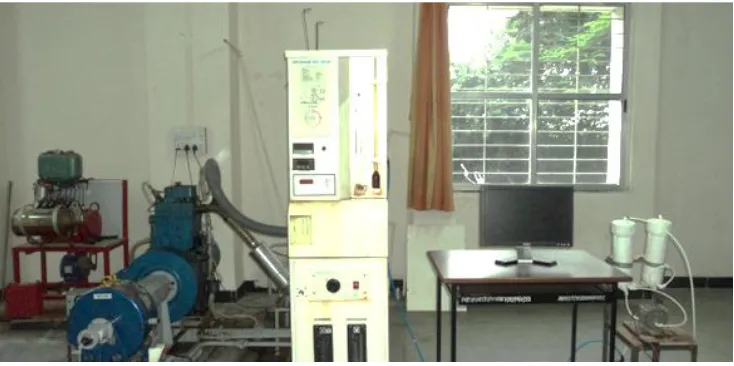
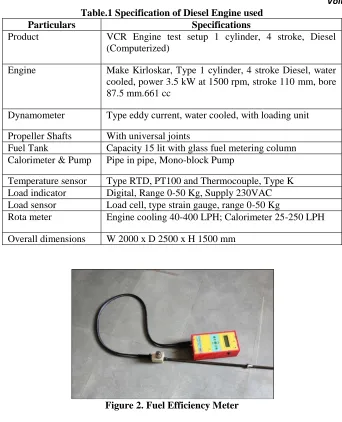
Figure 1 shows the experimental setup for the diesel engine supplemented with hydroxy gas through dry cell hydroxy (HHO) gas generator. The experimentation was carried on VCR diesel engine at 0lpm,0.5lpm,1lpmflow rate of hydroxy gas for compression ratio 17.5. The engine specifications are as shown in Table 1. The engine is coupled with eddy current dynamometer for loading and data is generated on computer. For emission measurement by using emission gas analyzer. First engine is set to compression ratio 17.5 and engine is started. The readings are taken for compression ratio 17.5 at 0lpm. The readings are taken for different load.
208
Table.1 Specification of Diesel Engine usedParticulars Specifications
Product VCR Engine test setup 1 cylinder, 4 stroke, Diesel (Computerized)
Engine Make Kirloskar, Type 1 cylinder, 4 stroke Diesel, water cooled, power 3.5 kW at 1500 rpm, stroke 110 mm, bore 87.5 mm.661 cc
Dynamometer Type eddy current, water cooled, with loading unit
Propeller Shafts With universal joints
Fuel Tank Capacity 15 lit with glass fuel metering column Calorimeter & Pump Pipe in pipe, Mono-block Pump
Temperature sensor Type RTD, PT100 and Thermocouple, Type K Load indicator Digital, Range 0-50 Kg, Supply 230VAC Load sensor Load cell, type strain gauge, range 0-50 Kg
Rota meter Engine cooling 40-400 LPH; Calorimeter 25-250 LPH
Overall dimensions W 2000 x D 2500 x H 1500 mm
Figure 2. Fuel Efficiency Meter
V. RESULTS AND DISCUSSION
We have analyzed various performance parameters of Diesel Engine like Brake power, Brake thermal efficiency, Mechanical efficiency, Indicated thermal efficiency. Also we have analyzed the exhaust emission as carbon monoxide, oxides of Nitrogen.
A. Break power
0 0.5 1 1.5 2 2.5 3 3.5 4
0 3 6 9 12
B
P
(k
w
)
Load (kg)
0 lpm 0.5 lpm 1lpm
209
Figure 3 shows the brake power for 0lpm, 0.5 lpm, 1lpm enrichment of hydroxy gas with different load. The brake power of diesel engine when enriched with hydroxy gas is higher than pure diesel i.e 0 lpm. It has observed that the nature of curve more or less remains same for all the Hydrogen mixture.B. Brake thermal efficiency
Figure 4. Variation of brake thermal efficiency with load
Figure 4 shows the brake thermal efficiency for 0lpm, 0.5lpm, 1lpm enrichment of hydrogen gas with different load. The thermal efficiency of diesel engine when enriched with hydrogen gas is higher pure diesel. Brake thermal efficiency is gradually increases with load. The brake thermal efficiency is maximum at compression ratio 17.5 at 12 load when enriched with hydrogen gas of 1 lpm. It has also observed that the brake thermal efficiency increases with hydrogen gas addition continuously.
C. Indicated thermal efficiency
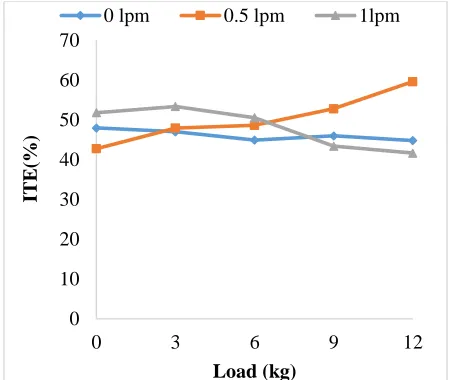
Figure 5 shows the Indicated thermal efficiency for 0lpm, 0.5lpm and 1lpm enrichment of hydrogen gas with different load. It has observed that the indicated thermal efficiency varies in the range of 40% to 60%. The Indicated efficiency of diesel engine when enriched with hydrogen gas is higher than pure Diesel. The Indicated thermal efficiency is maximum i. e. 60% at compression ratio 17.5 at 12 load when enriched with hydrogen gas.
Figure 5. Variation of Indicated thermal efficiency with load 0
5 10 15 20 25 30 35
0 3 6 9 12
B
T
H
(
%)
Load (kg)
0 lpm 0.5 lpm 1lpm
0 10 20 30 40 50 60 70
0 3 6 9 12
IT
E
(%)
Load (kg)
210
D. Mechanical efficiencyFigure 6 shows the Mechanical thermal efficiency for 0lpm, 0.5lpm ,1lpm enrichment of hydrogen gas with different load. It has observed that the Mechanical efficiency is gradually increasing with load. The Mechanical thermal efficiency is maximum at compression ratio 17.5 at 12 load when enriched without hydrogen gas.
Figure 6. Variation of Mechanical efficiency with load
EMISSION PARAMETERS-
In emission analysis we have analyzed Carbon Monoxide and Oxides of Nitrogen, We have used Fuel Efficiency Meter for exhaust gas measurement. Figure 2 shows Fuel Efficiency Meter.
A. Carbon Monoxide
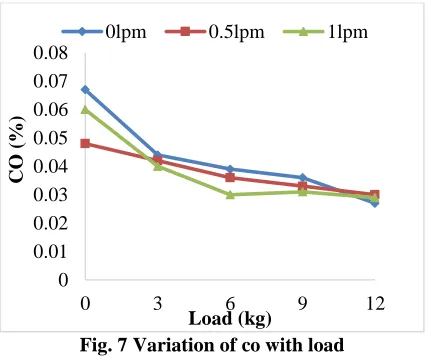
Figure 7 shows the CO for 0 lpm, 0.5lpm and 1lpm enrichment of hydrogen gas with different load. It has observed that the CO percentage reduces gradually with load. The CO of diesel engine when enriched with hydroxy gas is less than pure diesel. The CO is minimum at compression ratio 17.5 at 12 load when enriched with 1 lpm hydrogen gas. The carbon monoxide decreases with hydrogen gas addition.
Fig. 7 Variation of co with load
B. Oxides of Nitrogen
Figure 7 shows the NO for 0 lpm, 0.5 lpm and 1 lpm enrichment of hydrogen gas with different load. The exhaust gas NO of diesel engine observed to be increasing when enriched with hydrogen. The HHO calorific value is higher than the Diesel hence it increases average temperature of the engine and NO emission. The NO is maximum at compression ratio 17.5 at 12 load when enriched with 1 lpm hydrogen gas.
0 10 20 30 40 50 60 70 80
0 3 6 9 12
M
ec
ha
nica
l
ef
ficiency
(
%)
Load (kg)
0 lpm 0.5 lpm 1lpm
0 0.01 0.02 0.03 0.04 0.05 0.06 0.07 0.08
0 3 6 9 12
CO
(
%)
Load (kg)
211
Fig 8 Variation of NO with loadVI. CONCLUSIONS
By enriching the air with hydrogen gas we got satisfactory results. As compared to pure diesel, we found that, BP is increased up to 8.18%, BTE is increased by 5.22%, ITE is increased by 29.93%, and Mechanical efficiency is increased by 6.9%. Emission parameters like CO are reduced when diesel is used with hydrogen as additive whereas NO is increased. It has observed that HHO gas is one of the good alternatives for reducing use of diesel and reduces majority of pollution except NO pollution.
REFERENCES:
[1] J. H. Zhou, C. S. Cheung, C. W. Leung," Combustion performance, regulated &unregulated emission of a diesel engine with hydrogen addition", Applied Energy 126 (2014) 1–12.
[2] Sebastian Verhelst, Thomas Wallner, “Hydrogen-fueled internal combustion engines",Progress in Energy and Combustion Science 35 (2009) 490–527
[3] Eiji Tomita, Takashi Fujitani, Mithun Kanti Roy, “Hydrogen-fueled internal Combustion engines by Jet-guided Combustion characteristics and local fuel concentration measurements in a hydrogen direct injection spark- Ignition engine ", Proceedings of the Combustion
[4] Bo. Zhang, Shuoteng Wang, “Performance of a hybrid hydrogen gasoline engine under various operation conditions", Applied Energy 97 (2012) 584–589.
[5] K.M. Kalaiselvan, Saravanan, G. Nagarajan, C. Dhanasekaran,"An experimental investigation on hydrogen as a dual fuel for diesel engine system with exhaust gas recirculation technique", Renewable Energy 33 (2008) 422– 427.
[6] Suhail Dutta, Aritra Chatterjee, Bijan Kumar Mandal, "Combustion Performance and Emission Characteristics of Hydrogen as an Internal Combustion Engine Fuel", Aeronautical and Automotive Engineering (JAAE) Volume 1 (2014) 1-6.
[7] Joshua J Smith, Gerald Schneider, Dmitry Suslov, Michael Oschwald, Oskar Haidn," Steady state high pressure Lox/H2 rocket engine combustion", Aerospace Science and Technology 11 (2007) 39–47.
[8] Horng Wen Wu, Zhan-Yi Wu,"Investigation on combustion characteristics and emissions of diesel/hydrogenmixtures by using energy-share method in a diesel engine", Applied ThermalEngineering 42 (2012) 154-162.
[9] Joseph Burguburu, Gilles Cabot, Bruno Renou, Abdelkrim M. Boukhalfa, Michel Cazalens,"Effectsof Hydrogen Enrichment on flame stability and pollutant emissions for a kerosene/air swirled flame with an aeronautical fuel injector",Proceedings of the Combustion Institute 33(2011) 2927–2935.
[10] Midhat Talibi, Paul Hellier, Ramanarayanan Balachandran, Nicos Ladommatos,“Effect of hydrogen-diesel fuel co-combustion on exhaust emissions with verification using an in-cylinder gas sampling technique”, hydrogen energy 39 (2014) 15088-15102.
[11] J. H. Zhou, C. S. Cheung, C. W. leung," Combustion performance, regulated and unregulated Emission of a diesel engine with hydrogen addition", Applied Energy 126 (2014) 1–12.
[12] Horng Wen Wu, Zhan-Yi Wu,"Investigation on combustion characteristics and emissions of diesel/hydrogen mixtures by using energy-share method in a diesel engine", Applied Thermal Engineering 42 (2012) 154-162.
[13] Ahmed M. Rashad, “Investigating the Effect of Oxyhydrogen on the Performance of a Compression Ignition Engine”, International Journal of Energy Engineering 4 (2014)187-194
0 50 100 150 200 250 300
0 3 6 9 12
NO
(
pp
m
)
Loag(kg)