Original Article
Journal of Advances in Medical Education & Professionalism
Student’s perceptions of using scenario-based education to improve
civility: A mixed method study
ZAHRA ABEDINI1,2, PhD Candidate; SOROOR PARVIZY1*, PhD
1Department of Pediatric Nursing, School of Nursing and Midwifery, Nursing Care Research Center, Iran University of Medical Sciences,
Tehran, Iran ; 2Faculty of Nursing and Midwifery, Qom University of Medical Sciences, Qom, Iran
Introduction: Academic incivility is one of the major concerns among nursing student that disrupts the learning process and
influences the quality of nursing care. Investigating a useful strategy can be a crucial action in reducing the problem. The
purpose of this study was to evaluate the nursing student’s
perceptions of using scenario-based education to improve civility.
Methods: An explanatory mixed method approach was employed.
Nursing students who were studying in the second and third years
participated in research (N=81). Eight sessions were designed for
discussion regarding the scenarios that were directed by a faculty
leader. Changes in the students’ perception were evaluated four weeks after the sessions by a questionnaire. Data were analyzed using paired t-test and calculation of mean scores. Ten focus
groups were conducted and content analysis identifed two themes
and four subthemes. Both the qualitative and quantitative data were analysed separately and the findings were merged in the discussion.
Results: There was a significant difference between the student’s
perceptions for the perceived level and occurrence rate of incivility
before and after the intervention (P<0.05). The major themes
found included awareness of the importance of incivility and capability to change uncivil behavior. The results from the mixed
method study showed that the program increased awareness and
capability to change uncivil behaviors.
Conclusion: This research provided an extended understanding
of the outcomes of the scenario- based education on nursing student’s perceived behaviors and strengthened their beliefs and
capabilities about civil behaviors. It can be applied as an effective strategy to raise the perception of the program value and use.
*Corresponding author:
Soroor Parvizy, PhD; Department of Pediatric Nursing, School of Nursing and Midwifery, Nursing Care Research Center, Iran University of Medical Sciences, Tehran, Iran
Tel: +98-912-5805039
Email: s_parvizy@yahoo. com
Please cite this paper as: Abedini Z, Parvizy S. Student's perceptions of using
scenario-based education to improve civility: A mixed
method study. J Adv Med Educ Prof. 2019;7(4):165-174. DOI: 10.30476/
jamp.2019.74933.
Received: 28 December 2018
Accepted: 7 August 2019
Keywords: Incivility, Scenario, Problem based, Nursing student, Education
A
bs
tr
ac
t
Introduction
U
ncivil behavior has been defined asdisrespect, impolite, discourteous or rude behavior that may be intended to upset or harm
others. Drastic incivility has been described
as severe hostility, strife and violence towards
others (1). It has been referred to as threats, insults and abuse (2). Faculty members often
complain about the students arriving late, cheating, making indecent remarks toward others, holding inopportune or aberrant dialogues
and being uninterested in class (1). Other
disruptive behaviors are unrelated conversation, using the laptop and other devices during class, not preparing assignments, having distracting
Discourteous actions are on increase among students. Some studies have revealed that
uncivil behavior has had an ascending growth
in recent years (4). According to a study, more than 50% of the students and faculty members mentioned experiencing rude behavior (5).
Nearly all faculty nurses have encountered
student incivility while working (6).
Numerous elements like stress are
associated to disruptive behaviors. Clark (2011)
explained that stress, feeling of inferiority, unclear regulations, and lack of awareness
lead to incivility (7). Other effective factors
include different individual beliefs, diversity in values, ambiguous expectations, and lack of
integration (8). Dissatisfaction, unmet needs and
unsolved problems often result in misbehavior
by students (9). It is clear that nursing schools
are considerably at risk for this problem and
its negative outcomes. Most nursing students
and faculty members introduced incivility as a concern in academic and clinical settings because
of its threatening outcomes (10). Incivility
undermines the solidarity, mutual understanding and healthy relationship and leads to hatred,
hostility and disrespectful interaction. Disruptive
behavior negatively impacts self-esteem and
self-confidence (11). Therefore, rude behavior is known as a source of anxiety (7).
It is obvious that some annoying
communication such as asking unreasonable
questions, indecent speech and distracting dialogue may impede effective education. Students do not learn when they are apathetic or sleepy. These conditions can lead to wasting time and energy (12). Unfavorable meeting in the
educational environment disrupts teaching and
the learning process. Most academic members
have encountered the negative outcomes of
incivility (1). These circumstances discourage the academic community and lead to unfit conditions. Uncivil acts can endanger the tranquility and
welfare of the academic community on the college
campus (2). When uncivil actions remain ignored
or unsolved this situation may be associated
with critical and dangerous consequences (13). It seems that rude behavior in nurses begins in
schools and then is transferred to the workplace
(2). Incivility may be normalized secondary to
the known culture of the institute and change to
permanent habits and traditions. Some researchers
believed that misbehavior in formal settings may
be an acquired experience that is expressed in a susceptible environment (14). These situations may negatively affect the quality of nursing care and its outcomes.
Hence, it is required to manipulate academic
training to raise the quality of interactions. Teachers have a main role in developing moral virtues. They are responsible for establishing civility in academic settings. They must be
prepared to manage the academic environment to prevent further complications and uncompensated
effects. Many sources are focused on guiding
teachers to support and encourage students
(9). Ultimately, students need to recognize the
incivility and the way to deal with misbehavior in
an academic and clinical setting. However, some authors emphasized involving both students and educators in fostering the civility (15). It seems that civility is neglected in the academic course. In other words, faculty members do not pay attention to this important issue in the curriculum.
There is similar literature on the issue of
academic civility, but effective strategy to
promote civility remains unknown (16). Although
the incidence of incivility has been documented
in many studies, the influence of strategies on resolution of conflict and elimination of incivility has received poor attention. Clark reported that
problem-based learning scenarios were effective
in teaching civility. Students expressed their views on how to deal with scenarios; thus, they were
more prepared to perform the right behavior in the
nursing work environment. Results showed that
didactic presentation and interactive instruction
can lead to learning academic norms (17). Scenario is an effective learning tool for working with problems. Scenario-based discussion is a
valuable strategy for learners to think and work on realistic situations and try to explore the
solutions (18). Scenarios create opportunities for brainstorming and reflection (19). It is a method
which enables the learners to practice in a safe
condition (20). It is known as a useful tool to
improve judgment, communication, competence,
self-efficacy and suitable performance. Case-based learning helps the students to analyze the matters and seek proper answers (21). It helps
the students to gain a better understanding
about complex matters (15). Using a method that
includes real issues and challenging matters, a
useful solution can be found (9, 21).
In another research, educational intervention,
article presentation, and active discussion were employed to change uncivil behaviors in nursing
students. Their formal course was useful to raise civility (22). According to Clark, workshops
may provide a suitable situation for students and faculty members to state their ideas about uncivil
acts. The students’ perception and frequency
of incivility were reduced after the sessions
believed that a civility-based curriculum could help the faculty members to manage destructive
behaviors (24). It seems that there are a few
empirical researches with regard to promoting
civility. Review of articles showed that the effect
of teaching civility on the students’ behaviors
in Iran has not been addressed. Rad (2017)
conducted a grounded theory research to evaluate
the strategies for handling incivility. They found
that modifying the culture of the institute was
an effective approach to promoting civility. They suggested using democracy for academic management. Instructional strategies are usually applied in order to gain better outcomes. We used
an active training method of to educate nursing
students in a semi realistic environment. The
purpose of this article was to describe nursing student’s perceptions of using scenario-based
education to promote civility.
Methods
An explanatory mixed method approach using
a self-reported questionnaire and ten focus groups
was used to describe the students’ perceptions
regarding the efficacy of scenario-based learning. This design was chosen since t different methods
can give a comprehensive understanding of the
issue (25). A quantitative study was used to obtain
data on the preliminary perspective of the student’s
views then, a qualitative study was undertaken to
gain better insight into the program and in depth
perspective of students. A quasi-experimental
study with one group pretest-posttest design was
conducted at the nursing department of an Iranian university for a period of 4 months. Second and
third year nursing students participated in the
research. The inclusion criteria were: being a
full time nursing student who had studied at least two semesters and experienced uncivil
behaviors during a previous year. The final year
students were excluded because they were often working in a hospital and were not attending the
nursing school. They were not chosen because
numerous factors as environmental and staff members elements affected on their experiences
and views. The other exclusion criteria included
lack of willingness to participate and being a
guest student.
Data were collected using self-reported INE-R
survey that included demographic and uncivil
behavior items. This instrument was developed by Clark (2014) and its reliability was confirmed in several studies (26, 27). The 4-point
Likert-type scale was used to evaluate the students’
point of view. This questionnaire was reviewed by ten nursing faculty members. They confirmed the validity of the instrument. The mean content
validity index was computed 0.89. The questions were understandable and clear. A pilot study was
done on nursing students and the reliability of the
tool was determined with test-retest. Coefficients for the student incivility were 0.78 and 0.89
for the perceived level and occurrence rate,
respectively. Cronbach alpha coefficient ranged from 0.82 to 0.87 for the items. Results indicated the high consistency of the questionnaire with α=0.86 and intra-class correlation coefficient= 0.78. The students were asked to respond to the questionnaire based on their own perceptions.
Questions were about the students’ perception
and occurrence rate of uncivil behaviors. Eighty
one students were invited to participate in this
research during the second semester in March 2018. The intervention and data gathering took place over 14 weeks.
Pre-test evaluation was conducted to measure
the student responses as the baseline assessment. This phase included evaluating the frequency of occurrence and perceived level of incivility.
Ultimately, the subjects responded to the
questions in the post-intervention phase. They completed questionnaires without identifying the characteristics.
The program was designed to be implemented
in clinical course because the target content was
parallel to the course objectives. There were
appropriate conditions in the clinical course
such as sufficient time and appropriate place for sessions. Each group consisted of twenty students.
Scenarios were structured by the researcher and faculty members. The researcher was a doctoral
student without experience with participants
and declared no conflict of interest. Issues of the
scenarios focused on common uncivil actions that were experienced by students, for example being dishonest, unaccountable, irresponsible and disrespectful, and having indelicacy and
irregularity. The contents of the scenario were
designed to motivate and encourage the students
to brainstorm and think about the issues.
Each session lasted 90 minutes. The director
led the participants to discuss the issues for cognition and provoking incivility during the
session. All the students wanted to listen to
the preparatory scenarios and interpret their
opinions. They were allowed to think about the issues for 5 minutes. A problem was analyzed and described by the students. They suggested pathways to change the rude behaviors. The
faculty had noted comments on the board and
ultimately summarized the results.
Overall, the students participated in eight
formal program. The sessions were designed to
promote the knowledge of students about civil concepts such as responsibility, accountability, dignity, respect, commitment, privacy, and
sympathy. The researcher and leader did not have a role in teaching and giving a grade to students. The learners were informed that withdrawal from the study would not affect their evaluation.
Following the intervention, the post-test was
conducted to evaluate the changes of rate and
level of disruptive behaviors. Quantitative data were analyzed using SPSS version 18 . All effects were calculated at 0.05 level of significance.
Paired sample t-test was computed to compare the differences between pre-intervention and
post-intervention responses.
Qualitative data were obtained by eight focus
groups. The rationale for choosing focus groups
was to gain a better insight into the students’
views. It provides forums for the participants and researchers to develop insights and reflecting together (25, 28, 29). Focus group was used for
this study because it encourages the students to interact actively with classmates by exchanging
ideas, asking questions and commenting on viewpoints. Groups with a diversity of students
in age, gender, marital status, academic year
and residential status participated. Students
participated in interviews which lasted for
60-80 minutes. All focus groups were conducted by the researcher in a calm classroom. Interviews were continued until data saturation. Two more
sessions were carried out, but no new code was
extracted. Research questions included: How did the intervention affect you? Could you describe your experiences regarding benefits of
intervention? How did the intervention result in changes to the student’s uncivil behaviors?
Interviews were audiotaped and transcribed verbatim immediately. Coding was conducted by the authors and another experienced researcher. Content analysis was conducted as introduced by Wildemuth (28) including 1) transcription of data and assigning numbers to students, 2) identifying meaning units, 3) coding the data, 4) matching the codes with the data, 5) assessing
the codes and combining them, 6) classifying
similar codes, 7) assessing the categories, and 8) assigning the themes (24). Coding and analysis were done several times. The repeated coding
and credibility approach were used to increase
the rigor and trustworthiness. Other strategies
included presenting the themes to the students, having long term relationship with the students, exact recording of the process, and presenting
the quotes. The codes were reviewed and compared with previous data. Furthermore,
the themes, codes, categories and parts of texts
were confirmed by two nursing faculty members familiar with qualitative studies. Two selective
scenarios were explained as follows:
One of the students arrives late in class and
plays with his personal phone, so that he does
not pay attention to the professor’s comments. Suddenly, his phone rings and he leaves without permission. The student goes back to the class and interrupts the class. When asked to explain his behaviors, he said that traffic was heavy.
Teacher assigned a schoolwork to the tree students. Two students decided to go ahead
and complete the assignment without the third
member of the group. After the third member realizes the matter, he has an aggressive behavior toward his classmates and teacher. He leaves the professor’s office and slams the door.
Ethical Consideration
Institutional approval for this study was obtained from the ethical board of Iran University of Medical Sciences. Nursing
students completed the formal consent to enter
the study. Students who had been invited to the study became well-informed about the quality of the intervention. We randomly assigned numbers for the students. These numbers were recorded in a notebook. Students were informed that no one else was aware of these numbers. The principles of anonymity and confidentiality and
voluntary participation were considered in the
focus groups.
Results
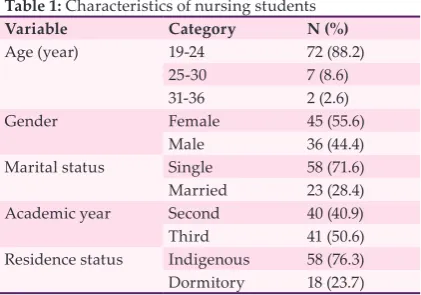
Eighty one nursing students participated in the present research. Their mean age was 22.11±3.58 years. Female subjects constituted 55.6% of the students. Most of the participants (71.6%) were unmarried. The majority of them (76.3%) were indigenous students. Table 1 displays the general characteristics of nursing students.
Student responses before the intervention
Table 1: Characteristics of nursing students
Variable Category N (%)
Age (year) 19-24 72 (88.2)
25-30 7 (8.6)
31-36 2 (2.6)
Gender Female 45 (55.6)
Male 36 (44.4)
revealed serious perceived level and rate of
incivility. Perceived level and occurrence mean scores were 74.81±11.55 and 45.93±13.31 respectively at baseline. After instruction, the
mean score of the perceived level of incivility was
68.87±13.31. There was a significant difference between the pre-test and post-test scores (P<0.05).
All of the item means decreased between pre- and post-intervention, but only six items
were statistically significant (P<0.05). These
behaviors included 1) using a computer, phone,
or other media device during the class, 2)
holding side conversations that distract others,
3) skipping class or other scheduled activities, 4) ignoring, failing to address, or encouraging disruptive behaviors, 5) making discriminating
comments toward others, and 6) leaving class
or other scheduled activities early. The mean
scores of post-test responses indicated that the
occurrence rate of incivility was 41.84±10.87. The
comparison of the mean scores before and after
the instruction revealed significant improvements in the occurrence rate of incivility (P<0.05).
Results are summarized in Table 2. According to INE-R scale, the findings showed that mean
scores of perceived level and rate of incivility
were on a moderate level. This intervention had a positive effect on incivility.
Qualitative Analysis
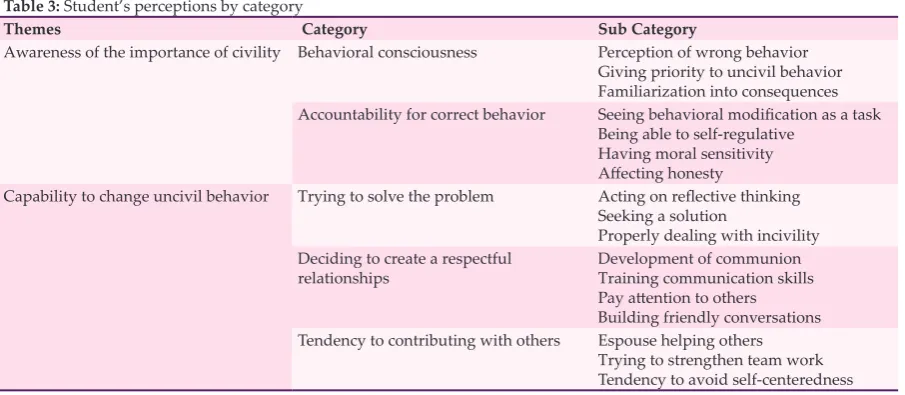
The analysis produced 184 codes which were reduced to 53. These data generated two themes and
four subthemes. Selected quotations are mentioned. The content analysis of data from the ten focus
groups indicated the following themes: “awareness of the importance of civility” and “capability to
change uncivil behavior” (Table 3). Selected quotations for the extracted themes are exhibited. Theme one: awareness of the importance of civility. The subthemes of this theme included
behavioral consciousness and accountability for
correct behavior.
Behavioral consciousness
Perception of wrong behavior
“When we talk about disrespectful works and classroom disturbance, we realize the effects of our behaviors. We had numerous mistakes; I felt
that the disrespect had a significant influence
on others, and we were accustomed to some behaviors”.
Giving priority to uncivil behavior
“I believe that incivility cannot be ignored. This is a serious matter in nursing schools; these activities would clarify the importance of rudeness and violence. Unfortunately, this problem is common”.
Familiarization into consequences
“We were able to share our previous experiences and think about the consequences of incivility”.
“I found that the rude actions have a
negative effect on others. It is difficult to study
in an aggressive environment; it disrupted the classroom”.
Table 2: Effect of scenario based education on perceive and occurrence rate of incivility among nursing students
Students incivility
(n=81) Pre-testMean±SD Post-testMean±SD ChangeMean±SD t-test P
Perceived level 74.81±11.55 68.87±13.31 5.93±16.50 3.22 0.01*
Occurrence rate 45.93±13.31 41.84±10.87 4.09±14.81 2.39 0.03*
M: Mean; SD: Standard deviation; *P<0.05
Table 3: Student’s perceptions by category
Themes Category Sub Category
Awareness of the importance of civility Behavioral consciousness Perception of wrong behavior
Giving priority to uncivil behavior
Familiarization into consequences
Accountability for correct behavior Seeing behavioral modification as a task
Being able to self-regulative Having moral sensitivity Affecting honesty
Capability to change uncivil behavior Trying to solve the problem Acting on reflective thinking
Seeking a solution
Properly dealing with incivility Deciding to create a respectful
relationships Development of communionTraining communication skills
Pay attention to others Building friendly conversations
Tendency to contributing with others Espouse helping others
Accountability for correct behavior
Seeing behavioral modification as a task “We became distressed by the discussion about ugly behaviors. I think that disruptive behaviors must be followed and all of the students and teachers should help to root out this problem”.
Being able to be self-regulative
“Talking about the positive behaviors caused the students to assess their own actions; then, they were able to stop negative acts.”
Having moral sensitivity
“By implementing this program, we became sensitive to harassment and violence, I don’t like to make trouble”.
Affecting honesty
“We were willing to participate in the dialogue; we were more likely to guide others. When I hear a gossip, I try not to support it; I try to minimize blame”.
“I feel that the course had a significant influence on students; the behavior of many
students has been changed. These classes
influenced how they deal with others”.
Theme two: capability to change uncivil
behavior
The subthemes of this theme included trying
to solve problem, deciding to create respectful relationship, and having the tendency to
contribute to others’ issues. Trying to Solve the Problem
Acting on reflective thinking
“We became aware of the other’s thoughts and views; it led us to ask questions. The faculty members asked the students to state how these behaviors affect the environment. It helped me to think more deeply”.
Seeking a solution
“There was an opportunity to identify how we were able to avoid irritations and troubles; we
attempted to find a way together”.
Properly dealing with incivility
“My poor experience can distract me from how to deal with impolite classmates. I learned how I should respond to certain behaviors”. Deciding to Create Respectful Relationship
Development of communion It helped me in my relationships.
“Fighting and harassment could harm our relationships. I think that kindness is one of the key factors for building a positive environment. We should respect each other. Such conversations facilitate this”.
“My opinion that the respectful relationships
are significant has become stronger”.
Training communication skills
“The most important benefit of participating
in sessions was working together; we learned to respect others, to listen and to be patient”.
“The best work in academia is dialogue; we should be prepared to build good relationships.”
Paying attention to others
“We learn to be sensitive versus each other and listening to other’s beliefs. I should notice other people’s needs”.
Building friendly conversations
“I stated my emotions in a comfortable atmosphere. I verbalized them without fear and without any problem”.
Tendency to Contribute to Others’ Issues Espouse helping others
“I judged students based on my view, but I am more likely to help others in different situations. Some students have problems and it is necessary to help them”.
Trying to strengthen team work
“I felt the sessions were like the council; relationships were supportive and friendly. We worked together and I found that tensions should be solved in relationship with students in a peaceful and calm environment”.
Tendency to avoid self-centeredness
“It is not easy to verbalize virtual issues. Each person wants to get what he needs”.
“Before I was thinking about myself, this caused me to neglect the other peoples’ needs”.
Discussion
The findings from both the quantitative and qualitative approaches showed that scenario
was perceived as a useful strategy to improve
civility. The analysis of data indicated that scenario-based training is a beneficial way for
promoting academic civility and handling the
rate of uncivil actions among nursing students. The decrease in some uncivil behaviors between pre- and post-tests was significant including:
using a computer, phone, or other media device during the class, holding side conversations that distract others, skipping class or other scheduled activities, ignoring, failing to address, or encouraging disruptive behaviors, making discriminating comments toward others, and
leaving class or other scheduled activities early. Researchers indicated that having no discipline,
were the most frequent uncivil behaviors (12, 30, 31), Ibrahim and Qalawa (2015) reported a high
level of irresponsible behaviors and a lower level
of aggressive behaviors; they suggested that there
was a need to train the students to behave in a
respectful and accountable manner. According to Clark (2013), scenarios can be used for promoting respectful relationships (15) and improving the
ability to build a regular learning environment
(20). It seems that aggressive behaviors were
not common and the related changes were not
significant. In this research, selected issues were
according to common uncivil actions that were
frequently reported in nursing literature. This
approach helped the students to understand
incivility and improve their performance.
As a result of the focus groups, many students stated that changing their behaviors affected
honesty. Therefore, they were able to apply learning experiences in the actual setting. Kerber (2012) also noted that problem-based discussion
improved the students’ awareness and their
tendency to be civil (1). These results were in
accordance with similar research in which active training raised awareness and led to reduction
in incivility (15). According to the students’
perceptions, awareness was the main core
category in this study. Some authors reported that
most students do not have enough information
about academic norms (3). Ability to educate and
raise consciousness is necessary to foster civility
(9). Consciousness was also one of the subthemes
in similar studies, orientation of students by educators has been proposed to exemplify and
distribute desirable behavior (17). These qualities
include moral values and acceptable acts such as truth telling, honesty, positive communication,
and social support (16). These results were in accordance with the quantitative findings.
Giving priority to behavior was another subtheme. According to Clark et al. (2014),
students who participated in the program became
informed of the significance of civility. They
believe that learning of norms and moral virtues is an imperative priority and students must be informed about how to modify their ideas and
emotions.
Our intervention helped the students to realize
their mistakes and develop their sensitivity to
moral issues. Shanta and Eliason (2014) pointed
out that expectations and rules should be clearly
explained. Of course, some students had different perspectives regarding cheating (32, 33). They
believed that cheating is a friendly behavior which is performed for helping a classmate
to pass a course (1). Students usually want to succeed in any way. In this situation, civility and
moral values may be ignored (3). However, they
are expected to behave in an honest way even
in unpleasant situations. According to Russell (2014), the scenarios that demonstrated real
relationships between students and educators were useful starting points to promote moral
sensitivity (16).
The current study showed that critical
conversations could help the students to
understand defects and improve self-regulation. This reality has been confirmed by other authors (20). We arranged sessions as a means to promote
social interaction, and creating respectful relationships was cited by the participants as
an important issue. In a similar study, during
the sessions, the students were asked to learn and speak about career and its social matters because the nursing profession is progressing
consistently (3). It is clear that the college campus,
as a social environment, exposes the learners to
varied situations such as tasks and roles (16). Promoting socialization towards disseminating
culture of civility is an important priority in
nursing education (18). Proper interaction generates social behaviors (34). Students ought
to experience interpersonal communication and evaluate their own abilities and faults to extend
the social relationship.
Building friendly conversation was extracted as a significant topic. Students can learn from peers via social interactions. In the study of Jenkin’, students mentioned that they required
discussion with peers to improve the academic
relationship (2). Kerber also showed that students
discussed with peers to be aware of other opposite
and similar attitudes (1). Peer group is a substantial
factor in consciousness and preparation for the
new social situation. The main matter in this
condition is the poor knowledge about the norms and safe behavior, especially when entering the
academic environment. Students who participated in our study were young. The majority of them belonged to the 19-27 year old age group and were unmarried. They had different cultures and values. Therefore, a proper strategy can promote civility through social approaches (2). Empathetic
perception and active listening can result in safe
relationship (33, 35).
This research emphasized the active participation of students during discussions. Their
chairs were arranged in a semi-circle position
for use in class (2). Clark also stated that students’
chairs should be arranged face-to-face or in a semi-circle manner that allows mutual interaction,
so that the participants can see each other (5). In
a similar study, the students were placed in a half-circle manner in the sessions. According to their findings, the friendly interaction helped them to express ethical information (36).
Reflection was a key element in learning civility. We used a strategy which combined questioning and ethical dialogue to raise the students’ knowledge and change behavior. Students stated the scenario-based discussion was a useful tool for reflective thinking. The facilitator
primarily asked the students to explain opinions
regarding a specific matter. Self-reflection, as
an educational major skill, was recommended
to teach civility (37). In the current study, the
students listened to a scenario and participated
in an analyzing debate. Scenario prompted them
to think about incivility and its impacts on the
academic community.
Participants also believed that seeking a solution and properly dealing with incivility
were valuable outcomes of the intervention. In
the present study, the students were allowed
to criticize and conclude the dialogues. It was beneficial for preparing them for a positive performance in real life situation. Learning
through a case includes useful skills such as critical thinking, communication, and problem
solving. This intervention was conducted to
teach the students about how they think and
make decisions on specific situations. They answered the questions. Problem solving and
critical thinking enhance the students’ ability to eliminate errors and increase knowledge regarding their own behaviors and highlight the
importance of a respectful relationship (1).
Additionally, this program helped the students
to recognize the outcomes of their own behaviors. During the sessions, the students pointed to the outcomes and negative effects of incivility. They stimulated the dialogue by reflective questions. The authors showed that a similar instructional
intervention developed the abilities such as critical appraisal, responsibility, accountability, commitment to rules and regulations, social support and offence avoidance (1), the use of respectful speech and friendly language, accountability and responsibility, professional action and ethical values are examples of behaviors that should be demonstrated by the
faculty members (14). Individual accountability is required to make effective decisions (7). Students
should be responsible for respecting academic
rules and regulations (6).
In the current study, the leader of the sessions was a professor at the Center of Research Ethics and member of the Ethics Department at the University. Students were familiar with him as an ethics-centered teacher.Faculty members can
help to promote the moral development using
reflective thinking, case presentation, and role modeling.
Ultimately, in our study eight training sessions
were implemented.A similar study showed that positive outcomes were achieved by six to eight
weekly sessions (20). Another author reported
that six biweekly sessions were associated with
significant changes (1). Torabizadeh et al. (2018)
showed that six educational sessions had positive
effects. In their study, each meeting lasted 45 minutes (36). Using six to eight sessions to reduce
perceived level and rate of incivility has been
suggested. On the basis of findings, a minimum one hour discussion can be useful.
Limitation
The results of this research may be applicable in other nursing schools, but generalization should be done doubtfully. Firstly, it was implemented among nursing students at a single school. It is
suggested that more evaluations should be done
and compared in several colleges. Secondly, this intervention did not have a control group. It is
recommended that the future researches should
include a control group without the training. Thirdly, findings were collected by self-reported questionnaire. Therefore, responses may be biased by students. Additionally, this study was
conducted on the second and third year students
and more studies are required to be performed on different academic levels of students.
Conclusion
Our mixed method approach provided convergent findings of the changes in the nursing
student’s perceptions regarding civility after the
intervention. It results in a better insight and
understanding of the outcomes of the
scenario-based education. This research indicated that
the program provided extended knowledge of students and strengthened their beliefs about civil
behaviors. Uncivil behavior reached a desirable level through educational intervention. On the basis of the findings, case-based learning as a cooperative and reflective method that includes a real issue can help the students to acquire useful resolutions for the challenging matters. Students
participated in sessions, disclosed their opinions
and shared information in a friendly manner.
effective roles on improving incivility.
Acknowledgement
The present paper was adopted from the PhD thesis of the first author. It has been approved by the board of ethics at Iran University of Medical Sciences, Tehran, Iran.The authors acknowledge
the nursing students and faculties who actively
cooperated in the current research.
Funding: The researchers supported by Iran
University of Medical Sciences for conducting the study.
Conflict of Interest: None declared.
References
1. Kerber C, Jenkins S, Woith W, Kim M. Journal clubs: a strategy to teach civility to nursing students. Journal of Nursing Education. 2012; 51(5): 277–82.
2. Jenkins SH, Woith WM, Stenger DA, Kerber CS. Using
an innovative journal club strategy to teach civility to
nursing students: Lessons learned. Journal of Nursing Education and Practice. 2013; 4(3): 161.
3. Woith WM, Jenkins SH, Kerber CH. The impact of a
journal club intervention on student perceptions and
behaviours regarding academic dishonesty. Journal of Nursing Education and Practice. 2012; 3(3): 27. 4. Gallo VJ. Incivility in nursing education: A review
of the literature. Teaching and learning in Nursing. 2012; 7(2): 62–6.
5. Clark CM. Faculty field guide for promoting student civility in the classroom. Nurse Educator. 2009; 34(5): 194–7.
6. Rad M, Ildarabadi EH, Moharreri F, Moonaghi HK. Causes of incivility in Iranian nursing students: A qualitative study. International journal of community based nursing and midwifery. 2016; 4(1): 47. 7. Clark CM, Olender L, Cardoni C, Kenski D. Fostering
civility in nursing education and practice: Nurse leader
perspectives. Journal of Nursing Administration. 2011; 41(7/8): 324–30.
8. Ibrahim SAEA, Qalawa SA. Factors affecting nursing
students’ incivility: As perceived by students and
faculty staff. Nurse education today. 2016; 36: 118–23. 9. Clark CM, Kenaley BLD. Faculty empowerment of
students to foster civility in nursing education: A
merging of two conceptual models. Nursing outlook. 2011; 59(3): 158–65.
10. Luparell S. Incivility in nursing: The connection between academia and clinical settings. Critical care nurse. 2011; 31(2): 92–5.
11. Natarajan J, Muliira JK, van der Colff J. Incidence and
perception of nursing students’ academic incivility in
Oman. BMC nursing. 2017; 16(1): 19.
12. Sun RCF, Shek DTL. Classroom misbehavior in the eyes of students: A qualitative study. The scientific world journal. 2012; 4: 8.
13. Rawlins L. Faculty and student incivility in
undergraduate nursing education: An integrative
review. Journal of Nursing Education. 2017; 56(12): 709–16.
14. Woodworth JA. Promotion of nursing student civility in nursing education: A concept analysis. Nurs Forum. 2016; 51(3):196-203.
15. Clark CM, Ahten SM, Macy R. Using problem-based
learning scenarios to prepare nursing students to
address incivility. Clinical Simulation in Nursing. 2013; 9(3): e75-e83.
16. Russell MJ. Teaching civility to undergraduate nursing students using a virtue ethics-based curriculum. Journal of Nursing Education. 2014;53(6):313-9. 17. Authement R. Can a comprehensive code of conduct
discourage incivility in nursing students? Nursing. 2016; 46(8): 14–9.
18. Milesky JL, Baptiste DL, Foronda C, Dupler AE, Belcher AE. Promoting a culture of civility in nursing education and practice. Journal of Nursing Education and Practice. 2015; 5(8): 90.
19. Clark CM. Pursuing a culture of civility: An intervention study in one program of nursing. Nurse Educator. 2011; 36(3): 98–102.
20. Kim JH, Hur MH, Kim HY. The efficacy of
simulation-based and peer-learning handover training for new
graduate nurses. Nurse education today. 2018; 69: 14–9. 21. Abou-Zaid CM. Action research for change:
Implementation of ‘case based learning’ to the undergraduate nursing students: A qualitative study. Journal of Nursing Education and Practice. 2014; 4(12): 105.
22. Jenkins SD, Kerber CS, Woith WM. An intervention to promote civility among nursing students. Nursing Education Perspectives. 2013; 34(2): 95–100. 23. Clark CM. Pursuing a culture of civility: An
intervention study in one program of nursing. Nurse Educator. 2011; 36(3): 98–102.
24. Clark CM. An evidence-based approach to integrate
civility, professionalism, and ethical practice into
nursing curricula. Nurse Educator. 2017; 42(3): 120–6. 25. Creswell JW. Research Design: Qualitative,
Quantitative, and Mixed Methods Approaches. London: SAGE Publications; 2014.
26. Clark CM, Barbosa-Leiker C, Gill LM, Nguyen D. Revision and psychometric testing of the incivility in nursing education (INE) survey: introducing the INE-R. Journal of Nursing Education. 2015; 54(6): 306–15.
27. Gagne JC de, Kang HS, Hyun MS. Psychometric properties of the Korean version of the incivility in nursing education-revised (INE-R) survey. Nursing & health sciences. 2016; 18(4): 425–34.
28. Yan Z, Wildemuth B. Unstructured interviews, Applications of social research methods to questions in information and Library Science [Internet]. Westport, CT [Cited 3 Jan 2010]; 2009. Available from: www. ils. unc. edu/-yanz/unstructuredintervuews, 2009. 29. Creswell JW. A Concise Introduction to Mixed
Methods Research. London: SAGE Publications; 2014. 30. Natarajan J, Muliira JK, van der Colff J. Incidence and
perception of nursing students’ academic incivility in
Oman. BMC nursing. 2017; 16(1): 19.
32. Clark CM, Ahten SM, Macy R. Nursing graduates’ ability to address incivility: Kirkpatrick’s level-3 evaluation. Clinical Simulation in Nursing. 2014; 10(8): 425–31.
33. Shanta LL, Eliason ARM. Application of an
empowerment model to improve civility in nursing
education. Nurse Education in Practice. 2014; 14(1): 82–6.
34. Masoumpoor A, Borhani F, Abbaszadeh A, Rassouli M. Nursing instructors’ perception of students’ uncivil behaviors: A qualitative study. Nursing ethics. 2017; 24(4): 483–92.
35. Gholamzadeh S, Khastavaneh M, Khademian Z, Ghadakpour S. The effects of empathy skills training
on nursing students’ empathy and attitudes toward
elderly people. BMC Medical Education. 2018; 198: 18. 36. Torabizadeh C, Homayuni L, Moattari M. Impacts of
Socratic questioning on moral reasoning of nursing students. Nursing ethics. 2018; 25(2): 174–85. 37. Rad M, Moonaghi HK. Strategies for managing
nursing students’ incivility as experienced by nursing