PowerPoint Lectures
Chapter 11
11.1 Proteins interacting with DNA turn
prokaryotic genes on or off in response to
environmental changes
• Gene regulation is the turning on and off of genes.
• Gene expression is the overall process of information flow from genes to proteins.
• The control of gene expression allows cells to
11.1 Proteins interacting with DNA turn
prokaryotic genes on or off in response to
environmental changes
• Gene Expression must be controlled for cellular
differentiation
• In a typical human cell only 3-5% of genes are
expressed at a time
• Most commonly regulated at the transcription level
• Our earliest understanding of gene control came
11.1 Proteins interacting with DNA turn
prokaryotic genes on or off in response to
environmental changes
• An operon is a cluster of genes with related functions, along with the control sequences.
• With rare exceptions, operons only exist in
11.1 Proteins interacting with DNA turn
prokaryotic genes on or off in response to
environmental changes
• When an E. coli encounters lactose, all the
enzymes needed for its metabolism are made at once using the lactose operon.
• The lactose (lac) operon includes
1. three adjacent lactose-utilization genes, 2. a promoter sequence, a site where RNA
polymerase binds and initiates transcription of all three lactose genes, and
11.1 Proteins interacting with DNA turn
prokaryotic genes on or off in response to
environmental changes
• E. coli uses three enzymes to take up and start metabolizing lactose only when lactose is present.
• The genes coding for these three enzymes are
11.1 Proteins interacting with DNA turn
prokaryotic genes on or off in response to
environmental changes
• Regulation of the lac operon
• A regulatory gene, located outside the operon, continually codes for a repressor protein.
• In the absence of lactose, the repressor binds to the operator and prevents RNA polymerase action. • Lactose inactivates the repressor, so
• the operator is unblocked,
• RNA polymerase can bind to the promoter, and
Figure 11.1b-0
Operon turned off (lactose is absent):
Operon turned on (lactose inactivates the repressor): Regulatory
gene
OPERON
Promoter Operator Lactose-utilization genes
DNA
mRNA
Protein Active
repressor
RNA polymerase cannot attach to the promoter
DNA
mRNA
Protein
RNA polymerase is bound to the promoter
11.1 Proteins interacting with DNA turn
prokaryotic genes on or off in response to
environmental changes
• There are two types of repressor-controlled
operons.
• The lac operon is an example of an inducible operon that is usually turned off but can be
stimulated (induced) by a molecule—in this case, by lactose.
Figure 11.1c
Lactose
lac operon (inducible) trp operon (repressible) Promoter Operator Gene
DNA
Active repressor
Active repressor
Inactive repressor
Inactive repressor
11.1 Proteins interacting with DNA turn
prokaryotic genes on or off in response to
environmental changes
• Another type of operon control involves activators,
proteins that turn operons on by
• binding to DNA and
• stimulating gene transcription.
11.2 Chromosome structure and chemical
modifications can affect gene expression
• Differentiation
• involves cell specialization in structure and function and
• is controlled by turning specific sets of genes on or off.
• Almost all of the cells in an organism contain an
identical genome.
• The differences between cell types are
11.2 Chromosome structure and chemical
modifications can affect gene expression
• Eukaryotic chromosomes undergo multiple levels
of folding and coiling, called DNA packing.
• Nucleosomes are formed when DNA is wrapped around histone proteins.
• This packaging gives a “beads on a string” appearance.
• Each nucleosome bead includes DNA plus eight histones.
11.2 Chromosome structure and chemical
modifications can affect gene expression
• Eukaryotic chromosomes undergo multiple levels
of folding and coiling, called DNA packing.
• At the next level of packing, the beaded string is wrapped into a tight helical fiber.
• This fiber coils further into a thick supercoil.
Figure 11.2a-0
Linker DNA double helix
(2-nm diameter)
“Beads on a string”
11.2 Chromosome structure and chemical
modifications can affect gene expression
• DNA packing tends to prevent gene expression by
preventing RNA polymerase and other
transcription proteins from contacting the DNA.
• Higher levels of packing can therefore inactivate
genes for the long term.
• Highly compacted chromatin, found in varying
11.2 Chromosome structure and chemical
modifications can affect gene expression
• Chemical modification of DNA bases or histone
proteins can result in epigenetic inheritance.
• Certain enzymes can add a methyl group to DNA bases, without changing the sequence of the
bases.
11.2 Chromosome structure and chemical
modifications can affect gene expression
• Removal of the extra methyl groups can turn on some of these genes.
• Inheritance of traits transmitted by mechanisms not directly involving the nucleotide sequence is called
11.2 Chromosome structure and chemical
modifications can affect gene expression
• X chromosome inactivation
• In female mammals, one of the two X chromosomes is chemically modified and highly compacted.
• Either the maternal or paternal chromosome is randomly inactivated.
• Inactivation occurs early in embryonic development, and all cellular descendants have the same
inactivated chromosome.
• An inactivated X chromosome is called a Barr body. • Tortoiseshell fur coloration is due to inactivation of X
Figure 11.2b-0
Early Embryo Adult
X chromosomes Cell division and random X chromosome inactivation Active X Inactive X
Two cell populations
Orange fur
Inactive X
Active X Black fur Allele for
orange fur
11.3 Complex assemblies of proteins control
eukaryotic transcription
• Prokaryotes and eukaryotes employ regulatory
proteins (activators and repressors) that
• bind to specific segments of DNA and
• either promote or block the binding of RNA
11.3 Complex assemblies of proteins control
eukaryotic transcription
• In eukaryotes, activator proteins seem to be more
important than repressors. Thus, in multicellular eukaryotes, the default state for most genes
seems to be off.
• A typical plant or animal cell needs to turn on and
11.3 Complex assemblies of proteins control
eukaryotic transcription
• Eukaryotic RNA polymerase requires the
assistance of proteins called transcription factors.
• Transcription factors include
• activator proteins, which bind to DNA sequences
called enhancers and initiate gene transcription, and • other transcription factor proteins that interact with
the bound activators, which then collectively bind as a complex at the gene’s promoter.
• RNA polymerase then attaches to the promoter,
11.3 Complex assemblies of proteins control
eukaryotic transcription
• Coordinated gene expression in eukaryotes often
depends on the association of a specific
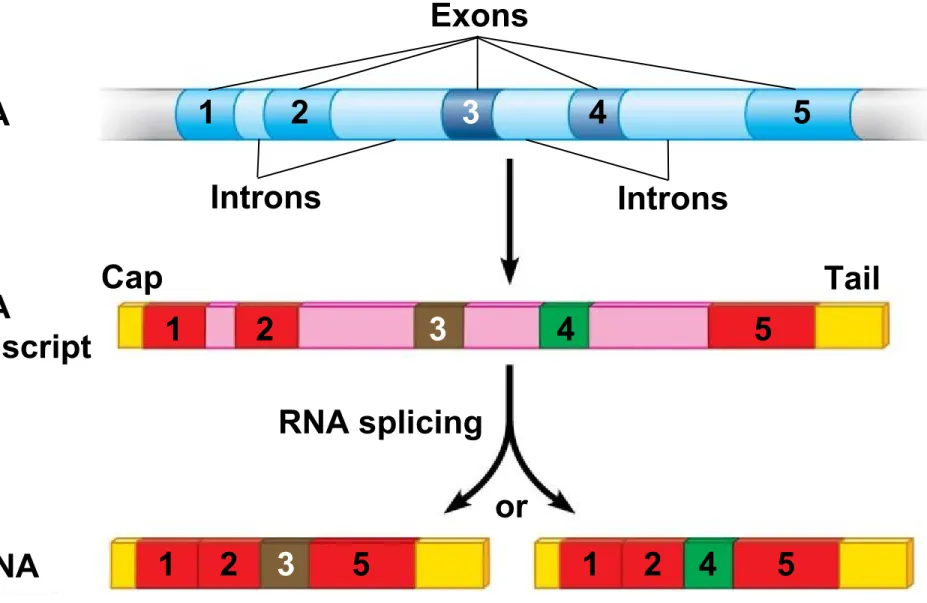
11.4 Eukaryotic RNA may be spliced in more
than one way
• Alternative RNA splicing
• produces different mRNAs from the same transcript and
• results in the production of more than one polypeptide from the same gene.
• In humans, more than 90% of protein-coding
Figure 11.4-3
Exons
DNA
Introns Introns
RNA
transcript
Cap Tail
RNA splicing
or mRNA
1 2 3 4 5
1 2 3 4 5
11.5 Small RNAs play multiple roles in
controlling gene expression
• Only about 1.5% of the human genome codes for
proteins. (This is also true of many other multicellular eukaryotes.)
• Another small fraction of DNA consists of genes for
ribosomal RNA and transfer RNA.
• A flood of recent data suggests that a significant
11.5 Small RNAs play multiple roles in
controlling gene expression
• microRNAs (miRNAs) can bind to complementary
sequences on mRNA molecules either
• degrading the target mRNA or • blocking its translation.
• RNA interference (RNAi) is the use of miRNA to artificially control gene expression by injecting
1
Figure 11.5-3
Protein miRNA
Target mRNA
miRNA-protein complex
or 2
11.6 Later stages of gene expression are also
subject to regulation
• After a eukaryotic mRNA is fully processed and
transported to the cytoplasm, gene expression can still be regulated by
Figure 11.6-3
Cleavage Folding of the
polypeptide
and the formation of S — S linkages
Initial polypeptide (inactive)
Folded polypeptide (inactive)
11.7 VISUALIZING THE CONCEPT: Multiple
mechanisms regulate gene expression in
eukaryotes
• Multiple control points exist where gene expression
in eukaryotes can be
• turned on or off, • speeded up, or • slowed down.
• Although many control points are shown, only a
Figure 11.7-8
Chromosome
DNA unpacking Gene
DNA
Exon
NUCLEUS
Splicing Intron Addition of a
cap and tail
RNA transcript mRNA in
nucleus Tail Flow through
nuclear envelopeCap
mRNA in cytoplasm Breakdown of mRNA Cleavage, modification, activation Broken-down mRNA Polypeptide Active protein CYTOPLASM
The flow of genetic information from a chromosome to a protein is controlled at several points, just as the flow of water through pipes is controlled by valves.
Transcription
11.8 Cell signaling and waves of gene
expression direct animal development
• Early research on gene expression and embryonic
development came from studies of a fruit fly.
• Research on fruit flies and other developmental
11.8 Cell signaling and waves of gene
expression direct animal development
• Homeotic genes are master control genes that
• regulate the “batteries” of other genes that
determine the anatomy of parts of the body and • determine which body parts will develop where in
Figure 11.8a-0
Eye
Antenna
Figure 11.8b-0
Egg cell within ovarian follicle
Follicle cells
Egg cell
Egg cell and follicle cells signaling
each other Gene expression Growth of egg cell
Localization of “head” mRNA Egg cell
“Head” mRNA
Cascades of gene expression
Fertilization and mitosis Embryo
Body segments
Expression of homeotic genes and cascades of gene expression Adult fly
1
2
3
11.10 Signal transduction pathways convert
messages received at the cell surface to
responses within the cell
• A signal transduction pathway is a series of
molecular changes that convert a signal on the target cell’s surface to a specific response within the cell.
• Signal transduction pathways are crucial to many
Figure 11.10-0 Signaling cell 1 2 3 4 5 Signaling molecule Receptor protein Plasma membrane Target cell Relay