6.1 Photosynthesis and cellular respiration
provide energy for life
•
Life requires energy.
•
In almost all ecosystems, energy ultimately comes
from the sun.
•
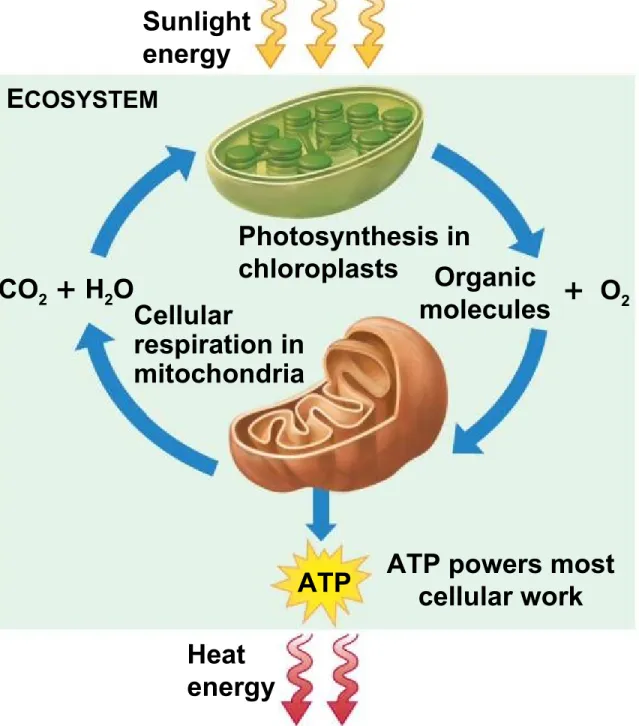
In photosynthesis,
• some of the energy in sunlight is captured by chloroplasts,
• atoms of carbon dioxide and water are rearranged,
and
6.1 Photosynthesis and cellular respiration
provide energy for life
•
In
cellular
respiration
,
• sugar is broken down to carbon dioxide and water
and
• the cell captures some of the released energy to make ATP.
•
Cellular respiration takes place in the mitochondria
of eukaryotic cells.
Figure 6.1
Sunlight energy
ECOSYSTEM
Photosynthesis in
chloroplasts Organic molecules Cellular
respiration in mitochondria
ATP powers most cellular work
CO2 + H2O + O2
6.2 Breathing supplies O
2for use in cellular
respiration and removes CO
2•
Respiration, as it relates to breathing, and cellular
respiration are not the same.
• Respiration, in the breathing sense, refers to an exchange of gases. Usually an organism brings in oxygen from the environment and releases waste CO2.
Figure 6.2-0
Lungs
Transported in bloodstream
Muscle cells carrying out Breathing
Cellular Respiration O2
O2
CO2
6.3 Cellular respiration banks energy in ATP
molecules
•
Cellular respiration is an exergonic (energy-
Figure 6.3
Glucose Oxygen Carbon
dioxide
Water
Heat ATP
H2O 6
CO2 6
6.5 Cells capture energy from electrons
“falling” from organic fuels to oxygen
•
How do your cells extract energy from glucose?
•
The answer involves the transfer of electrons
6.5 Cells capture energy from electrons
“falling” from organic fuels to oxygen
•
During cellular respiration,
• electrons are transferred from glucose to oxygen
and
• energy is released.
•
Oxygen attracts electrons very strongly.
6.5 Cells capture energy from electrons
“falling” from organic fuels to oxygen
•
Energy can be released from glucose by simply
burning it.
•
This electron “fall” happens very rapidly.
6.5 Cells capture energy from electrons
“falling” from organic fuels to oxygen
•
Cellular respiration is a more controlled descent of
electrons and like rolling down an energy hill.
6.5 Cells capture energy from electrons
“falling” from organic fuels to oxygen
•
The movement of electrons from one molecule to
another is an oxidation-reduction reaction, or
redox
reaction
. In a redox reaction,
• the loss of electrons from one substance is called
oxidation,
• the addition of electrons to another substance is called reduction,
• a molecule is oxidized when it loses one or more
6.5 Cells capture energy from electrons
“falling” from organic fuels to oxygen
•
A cellular respiration equation is helpful to show
the changes in hydrogen atom distribution.
• Glucose loses its hydrogen atoms and becomes
oxidized to CO2.
• Oxygen gains hydrogen atoms and becomes
Figure 6.5a
Loss of hydrogen atoms (becomes oxidized)
Gain of hydrogen atoms (becomes reduced) (Glucose)
6.5 Cells capture energy from electrons
“falling” from organic fuels to oxygen
•
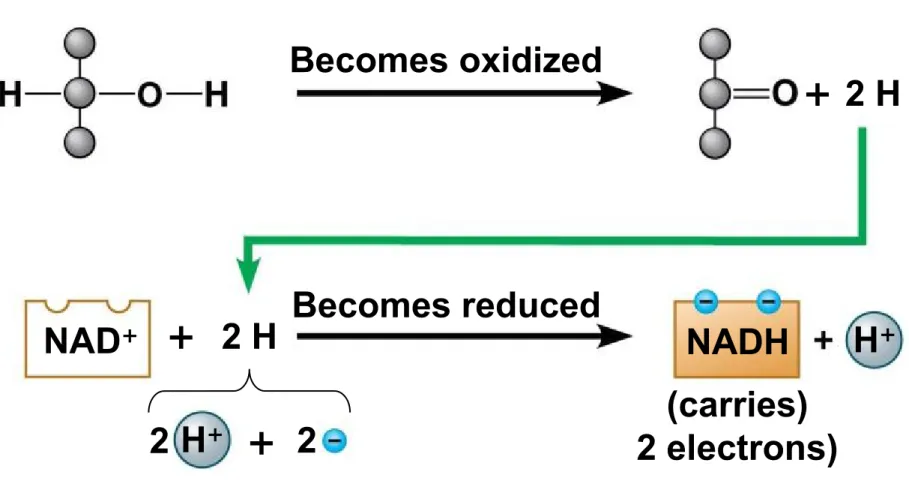
An important player in the process of oxidizing
glucose is a coenzyme called
NAD
+, which
• accepts electrons and
Figure 6.5b
Becomes oxidized
+ 2 H
+ 2 H Becomes reduced
NAD+ NADH H+
(carries) 2 electrons)
+
6.5 Cells capture energy from electrons
“falling” from organic fuels to oxygen
•
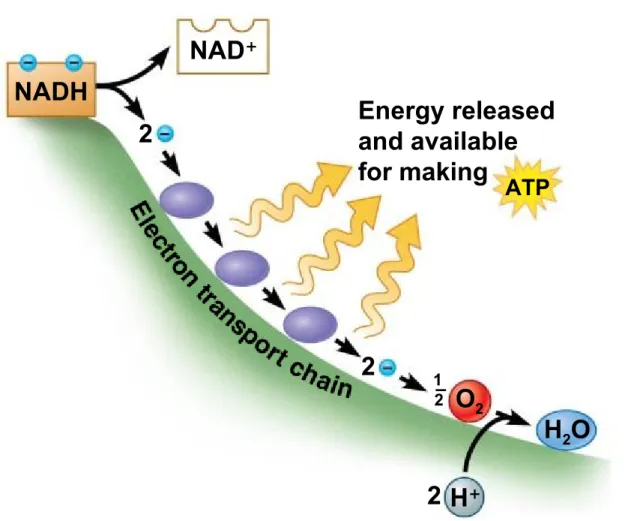
NADH delivers electrons to a string of electron
carrier molecules, which moves electrons down a
hill.
•
These carrier molecules constitute an
electron
transport
chain
.
•
At the bottom of the hill is oxygen (1/2 O
2), which
• accepts two electrons,
• picks up two H+, and
Figure 6.5c
NAD+
H+
NADH
Energy released and available for making 2
2
O2
2
H2O −
2 1
6.6 Overview: Cellular respiration occurs in
three main stages
•
Cellular respiration consists of a sequence of steps
that can be divided into three stages.
• Stage 1: Glycolysis
• Stage 2: Pyruvate oxidation and the citric acid cycle
6.6 Overview: Cellular respiration occurs in
three main stages
•
Stage 1:
Glycolysis
• occurs in the cytosol,
• begins cellular respiration, and
• breaks down glucose into two molecules of a
6.6 Overview: Cellular respiration occurs in
three main stages
•
Stage 2: Pyruvate oxidation and the
citric
acid
cycle
• take place in mitochondria,
• oxidize pyruvate to a two-carbon compound, and
• supply the third stage with electrons.
6.6 Overview: Cellular respiration occurs in
three main stages
•
Stage 3:
Oxidative
phosphorylation
• NADH and a related electron carrier, FADH2, shuttle electrons to an electron transport chain embedded in the inner mitochondrial membrane.
• Most ATP produced by cellular respiration is
generated by oxidative phosphorylation, which uses the energy released by the downhill fall of electrons
from NADH and FADH2 to oxygen to phosphorylate
6.6 Overview: Cellular respiration occurs in
three main stages
•
Stage 3:
Oxidative
phosphorylation
• As the electron transport chain passes electrons down the energy hill, it also pumps hydrogen ions (H+) across the inner mitochondrial membrane, into the narrow intermembrane space, and produces a concentration gradient of H+ across the membrane.
Figure 6.6-0
Electrons carried by NADH FADH2
Glycolysis
Glucose Pyruvate OxidationPyruvate Citric Acid Cycle
Oxidative Phosphorylation (Electron transport and chemiosmosis)
Figure 6.6-1
Electrons carried by NADH FADH2
ATP
ATP
ATP
Glycolysis
Glucose Pyruvate OxidationPyruvate Citric Acid Cycle Substrate-level phosphorylation Substrate-level phosphorylation Oxidative phosphorylation Oxidative Phosphorylation (Electron transport and chemiosmosis)
6.7 Glycolysis harvests chemical energy by
oxidizing glucose to pyruvate
•
In
glycolysis
,
• a single molecule of glucose is enzymatically cut in half through a series of steps,
• two molecules of pyruvate are produced,
• two molecules of NAD+ are reduced to two molecules of NADH, and
Figure 6.7a
Glucose
2 ADP
ATP 2
NADH NAD+
+2 H+
+2
6.7 Glycolysis harvests chemical energy by
oxidizing glucose to pyruvate
•
ATP is formed in glycolysis by
substrate-level
phosphorylation
during which
• an enzyme transfers a phosphate group from a
substrate molecule to ADP and
• ATP is formed.
•
The compounds that form between the initial
Figure 6.7b
Enzyme Enzyme
ADP
Substrate Product
P
P P
6.7 Glycolysis harvests chemical energy by
oxidizing glucose to pyruvate
•
The steps of glycolysis have two main phases.
• In steps 1–4, the energy investment phase, energy
is consumed as two ATP molecules are used to
energize a glucose molecule, which is then split into two small sugars.
• In steps 5–9, the energy payoff phase, two NADH
molecules are produced for each initial glucose molecule and four ATP molecules are generated.
Figure 6.7c-1-2 Glucose 1 3 1 2 3 4 4 Glucose 6-phosphate Fructose 6-phosphate Fructose 1,6-bisphosphate ENERGY INVESTMENT PHASE Step P ATP ADP
Step A six-carbon
intermediate splits into two three-carbon intermediates. ATP ADP P P P
Steps – Glucose
Figure 6.7c-2-2 5 5 5 6 9 7 8 8 7 6 6 Glyceraldehyde 3-phosphate (G3P) ATP ADP P ATP ADP ADP ADP
H2O H2O
NAD+ NAD+
NADH NADH
+ H+ + H+
P
P P
P P P P
P P P P P P ENERGY PAYOFF PHASE 1,3-Bisphosphoglycerate 3-Phosphoglycerate 2-Phosphoglycerate Phosphoenolpyruvate (PEP)
Step A redox reaction generates NADH.
Steps – ATP
6.8 Pyruvate is oxidized in preparation for the
citric acid cycle
•
The pyruvate formed in glycolysis is transported
from the cytosol into a mitochondrion where the
citric acid cycle and oxidative phosphorylation will
occur.
6.8 Pyruvate is oxidized in preparation for the
citric acid cycle
•
Pyruvate does not enter the citric acid cycle but
undergoes some chemical grooming in which
• a carboxyl group is removed and given off as CO2,
• the two-carbon compound remaining is oxidized
while a molecule of NAD+ is reduced to NADH, and
• coenzyme A joins with the two-carbon group to
form acetyl coenzyme A, abbreviated as acetyl
CoA.
Figure 6.8
Pyruvate
NAD+ NADH + H+
1
2
3
Coenzyme A CO2
CoA
6.9 The citric acid cycle completes the
oxidation of organic molecules, generating
many NADH and FADH
2molecules
•
The citric acid cycle
• is also called the Krebs cycle (after the
German-British researcher Hans Krebs, who worked out much of this pathway in the 1930s),
• completes the oxidation of organic molecules, and
Figure 6.9a
Citric Acid Cycle
NAD+
NADH
+ 3 H+
CO2 CoA
CoA Acetyl CoA
2
3 3 FADH2
6.9 The citric acid cycle completes the
oxidation of organic molecules, generating
many NADH and FADH
2molecules
•
During the citric acid cycle
• the two-carbon group of acetyl CoA is joined to a
four-carbon compound, forming citrate,
• citrate is degraded back to the four-carbon compound,
• two CO2 are released, and
• one ATP, three NADH, and one FADH2 are
6.9 The citric acid cycle completes the
oxidation of organic molecules, generating
many NADH and FADH
2molecules
•
Remember that the citric acid cycle processes two
molecules of acetyl CoA for each initial glucose.
•
Thus, after two turns of the citric acid cycle, the
overall yield per glucose molecule is
• 2 ATP,
• 6 NADH, and
6.9 The citric acid cycle completes the
oxidation of organic molecules, generating
many NADH and FADH
2molecules
•
Thus, after glycolysis and the citric acid cycle, the
cell has gained
• 4 ATP,
• 10 NADH, and
• 2 FADH2.
•
To harvest the energy banked in NADH and
Figure 6.9b-3
Citric Acid Cycle
NAD+
NADH
+ H+
CO2 CoA CoA Acetyl CoA FADH2 FAD P ADP +
CO2
+ H+
+ H+
NAD+
NADH
H2O
2 carbons enter cycle
6.10 Most ATP production occurs by
oxidative phosphorylation
•
The final stage of cellular respiration is oxidative
phosphorylation, which
• involves electron transport and chemiosmosis and
• requires an adequate supply of oxygen.
•
The arrangement of electron carriers built into a
membrane makes it possible to
• create an H+ concentration gradient across the membrane and then
6.10 Most ATP production occurs by
oxidative phosphorylation
•
Electrons from NADH and FADH
2travel down the
electron transport chain to O
2, the final electron
acceptor.
• Oxygen picks up H+, which forms water.
• Energy released by these redox reactions is used
6.10 Most ATP production occurs by
oxidative phosphorylation
•
In chemiosmosis, the H
+diffuses back across the
inner membrane, through
ATP
synthase
Figure 6.10a
OUTER MITOCHONDRIAL MEMBRANE
Q
FADH2 FAD
ATP P
ADP + H+
NAD+
NADH
H2O O2 H+ H+ H+ H+ H+ H+ H+ H+ H+ H+ H+
Cyt c
−12 + 2
II III I ATP synthase Protein complex of electron carriers Mobile electron carriers Intermem-brane space Inner mito-chondrial membrane Mito-chondrial matrix Electron flow
Electron Transport Chain Chemiosmosis
Figure 6.10b
INTERMEMBRANE SPACE
Rotor
Internal rod
Catalytic knob
ADP
H+
6.12 Review: Each molecule of glucose yields
many molecules of ATP
•
Recall that the energy payoff of cellular respiration
involves
1. glycolysis,
2. alteration of pyruvate,
3. the citric acid cycle, and
6.12 Review: Each molecule of glucose yields
many molecules of ATP
• The total yield is about 36 ATP molecules per glucose
molecule.
• The number of ATP molecules cannot be stated exactly for
several reasons.
• The NADH produced in glycolysis passes its electrons across the mitochondrial membrane to either NAD+ or FAD. Because
FADH2 adds its electrons farther along the electron transport chain, it contributes less to the H+ gradient and thus
generates less ATP.
• Some of the energy of the H+ gradient may be used for work
Figure 6.12
NADH FADH2
CO2
Maximum per glucose:
+ 2
ATP
Glycolysis
Glucose Pyruvate2
Pyruvate Oxidation 2 Acetyl CoA Citric Acid Cycle
by substrate-level by substrate-level by oxidative
Oxidative Phosphorylation (electron transport and chemiosmosis) CYTOSOL MITOCHONDRION 2 NADH
2 6 NADH + 2
+ 2
ATP +32 aboutATP About
36 ATP O2
FERMENTATION:
6.13 Fermentation enables cells to produce
ATP without oxygen
•
Fermentation is a way of harvesting chemical
energy that does not require oxygen. Fermentation
• uses glycolysis,
• produces two ATP molecules per glucose, and
• reduces NAD+ to NADH.
6.13 Fermentation enables cells to produce
ATP without oxygen
•
Your muscle cells and certain bacteria can
regenerate NAD
+through
lactic
acid
fermentation
, in which
• NADH is oxidized back to NAD+ and
Figure 6.13a
Glucose
2 ADP
2 NADH
2 NAD+
2 ATP 2 NADH
2 NAD+
+ 2 P
G
ly
co
ly
si
s
6.13 Fermentation enables cells to produce
ATP without oxygen
•
Lactate is carried by the blood to the liver, where it
is converted back to pyruvate and oxidized in the
mitochondria of liver cells.
•
The dairy industry uses lactic acid fermentation by
bacteria to make cheese and yogurt.
6.13 Fermentation enables cells to produce
ATP without oxygen
•
The baking and winemaking industries have used
alcohol
fermentation
for thousands of years.
•
In this process, yeast (single-celled fungi)
• oxidize NADH back to NAD+ and
Figure 6.13b
Glucose
2 ADP
2 NADH
2 NAD+
2 ATP 2 NADH
2 NAD+
+ 2 P
G
ly
c
o
ly
si
s
2 Pyruvate
6.13 Fermentation enables cells to produce
ATP without oxygen
•
Obligate anaerobes
• require anaerobic conditions,
• are poisoned by oxygen, and
• live in stagnant ponds and deep soils.
•
Facultative anaerobes
• can make ATP by fermentation or oxidative
phosphorylation and
Figure 6.15-1
Food
Carbohydrates Fats Proteins
Oxidative Phosphorylation
Sugars Glycerol Fatty acids Amino acids
Amino groups
Glucose G3P Pyruvate Glycolysis
Acetyl CoA
Figure 6.UN02
Electrons carried by NADH FADH2
ATP ATP ATP
Glycolysis
Glucose Pyruvate OxidationPyruvate Citric Acid Cycle
Substrate-level phosphorylation
Substrate-level phosphorylation
Oxidative
phosphorylation
Oxidative Phosphorylation (Electron transport and chemiosmosis)
Figure 6.UN03 Cellular respiration glucose and organic fuels cellular work chemiosmosis ATP (a) (b) (c) (d) (e) (f) (g)
generates has three stages oxidizes
produce some
produces many energy for
by a process called
uses
H+ diffuse
through ATP synthase
uses
to pull
electrons down to