https://doi.org/10.5194/gmd-11-4021-2018 © Author(s) 2018. This work is distributed under the Creative Commons Attribution 4.0 License.
Implementation of a comprehensive ice crystal formation
parameterization for cirrus and mixed-phase clouds in
the EMAC model (based on MESSy 2.53)
Sara Bacer1, Sylvia C. Sullivan2, Vlassis A. Karydis1,a, Donifan Barahona3, Martina Krämer4, Athanasios Nenes2,5,6,7,8, Holger Tost9, Alexandra P. Tsimpidi1, Jos Lelieveld1,10, and Andrea Pozzer1
1Atmospheric Chemistry Department, Max Planck Institute for Chemistry, Mainz, Germany 2School of Chemical and Biomolecular Engineering, Georgia Institute of Technology, Atlanta, USA 3NASA Goddard Space Flight Center, Greenbelt, Maryland, USA
4Institute for Energy and Climate Research – 7, Forschungszentrum Jülich, Jülich, Germany 5School of Earth and Atmospheric Sciences, Georgia Institute of Technology, Atlanta, USA 6ICE-HT, Foundation for Research and Technology, Hellas, Greece
7IERSD, National Observatory of Athens, Athens, Greece
8Laboratory of Atmospheric Processes and Their Impacts, École Polytechnique Fédérale de Lausanne, Lausanne, Switzerland 9Institute for Atmospheric Physics, Johannes Gutenberg University Mainz, Mainz, Germany
10Energy, Environment and Water Research Center, The Cyprus Institute, Nicosia, Cyprus
anow at: Institute for Energy and Climate Research – 8, Forschungszentrum Jülich, Jülich, Germany
Correspondence:Sara Bacer ([email protected])
Received: 1 March 2018 – Discussion started: 13 March 2018
Revised: 6 September 2018 – Accepted: 12 September 2018 – Published: 5 October 2018
Abstract.A comprehensive ice nucleation parameterization has been implemented in the global chemistry-climate model EMAC to improve the representation of ice crystal number concentrations (ICNCs). The parameterization of Barahona and Nenes (2009, hereafter BN09) allows for the treatment of ice nucleation taking into account the competition for wa-ter vapour between homogeneous and hewa-terogeneous nucle-ation in cirrus clouds. Furthermore, the influence of chemi-cally heterogeneous, polydisperse aerosols is considered by applying one of the multiple ice nucleating particle parame-terizations which are included in BN09 to compute the het-erogeneously formed ice crystals. BN09 has been modified in order to consider the pre-existing ice crystal effect and implemented to operate both in the cirrus and in the mixed-phase regimes. Compared to the standard EMAC parameter-izations, BN09 produces fewer ice crystals in the upper tro-posphere but higher ICNCs in the middle trotro-posphere, es-pecially in the Northern Hemisphere where ice nucleating mineral dust particles are relatively abundant. Overall, IC-NCs agree well with the observations, especially in cold cir-rus clouds (at temperatures below 205 K), although they are
underestimated between 200 and 220 K. As BN09 takes into account processes which were previously neglected by the standard version of the model, it is recommended for future EMAC simulations.
1 Introduction
of the chemical and physical principles underlying ice nu-cleation, and the complexity of ice nucleation mechanisms and aerosol–ice interactions (Cantrell and Heymsfield, 2005; Gultepe and Heymsfield, 2016; Heymsfield et al., 2017; Ko-rolev et al., 2017).
Cirrus clouds form at high altitudes and very low tem-peratures (below 238 K), and consist purely of ice crystals. They strongly impact the transport of water vapour enter-ing the stratosphere (Jensen et al., 2013) and play an im-portant role as modulator of radiation fluxes in the global radiative budget: they scatter solar radiation back into space (albedo effect) and absorb and re-emit longwave terrestrial radiation (greenhouse effect). Differing from other types of clouds, cirrus clouds produce a net warming at the top of the atmosphere (TOA; e.g. Chen et al., 2000; Hong et al., 2016; Matus and L’Ecuyer, 2017). In addition, mixed-phase clouds consist of both supercooled liquid cloud droplets and ice crystals, and appear at subfreezing temperatures above 238 K. Mixed-phase clouds generate a net cooling at the TOA, although the estimates of their radiative effects are complicated by the coexistence of both ice and liquid cloud phases (Matus and L’Ecuyer, 2017). Due to the difference between vapour pressure over water and over ice, ice crystals grow at the expense of water droplets (Wegener–Bergeron– Findeisen process); thus, mixed-phase clouds are thermo-dynamically unstable and can convert into ice-only clouds (e.g. Korolev, 2007; Korolev et al., 2017). As ice crystals can grow quickly to precipitation-sized particles, precipita-tion is mainly formed in mixed-phase clouds, while precipi-tation from cirrus clouds does not usually reach the surface (Lohmann, 2017). The mixed phase is also important for cloud electrification and intracloud lightning, which occur through the in-cloud charge separation via a transition from supercooled raindrops to graupel over the mixed-phase tem-perature range (Korolev et al., 2017). The fraction of cloud ice has a profound impact on the cloud forcing in global cli-mate models, one of the reasons why cloud radiative forcing is so diverse and uncertain (McCoy et al., 2016; Tan et al., 2016; Vergara-Temprado et al., 2018).
Ice crystal formation takes place via homogeneous and heterogeneous nucleation, depending on environmental con-ditions (e.g. temperature, supersaturation, vertical velocity) and aerosol populations (i.e. aerosol number concentrations and physicochemical characteristics) (Pruppacher and Klett, 1997; Kanji et al., 2017; Heymsfield et al., 2017; Korolev et al., 2017). Homogeneous nucleation occurs through the freezing of supercooled liquid droplets at low tempera-tures (T <238 K) and high supersaturation over ice (140 %– 160 %) (Koop et al., 2000). Heterogeneous nucleation refers to the formation of ice on an aerosol surface, which reduces the energy barrier for ice nucleation and lets ice crystals form at lower supersaturations and/or at higher (subfreezing) tem-peratures than homogeneous nucleation. The aerosols that lead to the generation of ice crystals are called ice nucle-ating particles (INPs) and are mostly insoluble, like mineral
dust, soot, organics, and biological particles (Pruppacher and Klett, 1997). Heterogeneous nucleation occurs via different mechanisms called “nucleation modes” (deposition, conden-sation, immersion, and contact nucleation). In several mod-elling studies, homogeneous nucleation has been considered the dominant process for cirrus formation (e.g. Haag et al., 2003; Hendricks et al., 2011; Gettelman et al., 2012; Bara-hona et al., 2014) because the concentration of liquid droplets is higher than that of INPs in the upper troposphere. How-ever, some field measurements found a predominance of het-erogeneous nucleation and lower ice crystal number concen-trations (ICNCs) than produced by homogeneous nucleation (e.g. Cziczo et al., 2013; Jensen et al., 2013). What process is dominant is still under debate, although recent studies sug-gested the overestimation of the vertical velocity as a possi-ble cause of the discrepancy between modelled results and observations (e.g. Barahona and Nenes, 2011; Zhou et al., 2016; Barahona et al., 2017).
Overall, two different regimes for ice crystal formation are distinguished: the cirrus regime at low temperatures (T <238 K), where ice crystals originate via heterogeneous and homogeneous nucleation to form cirrus clouds and the
mixed-phase regime at subfreezing temperatures between 238 and 273 K, where ice crystals exclusively form via het-erogeneous nucleation and alter the phase composition of the mixed-phase clouds. In the latter regime, besides primary nu-cleation, another mechanism which controls ICNCs is the secondary ice production, i.e. the production of new ice crys-tals via the multiplication of pre-existing ice particles without the action of INPs.
Cloud schemes in atmospheric and climate models have evolved from using only macrophysical properties, like cloud cover, to representing the microphysics explicitly, e.g. forma-tion, evoluforma-tion, and removal of cloud droplets and ice crys-tals (Kärcher et al., 2006; Lohmann et al., 2008; Gettelman et al., 2010; Barahona et al., 2014). Including sophisticated schemes in general circulation models (GCMs) allows for a more realistic description of the variability in cloud proper-ties and cloud radiative effects, improving the model climate predictions (Lohmann and Feichter, 2005; Barahona et al., 2014). Recently, sophisticated parameterizations have been developed, taking into account the aerosol influence on ice formation and different modes of heterogeneous nucleation. Liu and Penner (2005) presented an ice nucleation scheme based on numerical parcel model simulations which con-siders the competition between homogeneous and hetero-geneous nucleation following the classical nucleation the-ory (CNT). Kärcher et al. (2006) developed a physically based parameterization scheme of ice initiation and ice crys-tal initial growth in cirrus clouds, considering the PREICE effect and allowing for competition between heterogeneous and homogeneous nucleation. Barahona and Nenes (2009) introduced an ice cloud formation parameterization, based on the analytical solution of the cloud parcel model equa-tions, which calculates the competition for water vapour be-tween homogeneous and heterogeneous nucleation and takes into account the variability (in size and chemical composi-tion) of different aerosol species through a variety of INP parameterizations. Since then, these parameterizations have been included in GCMs in order to better predict cloud phase partitioning. Hendricks et al. (2011) and Kuebbeler et al. (2014) have implemented the parameterization of Kärcher et al. (2006) into the ECHAM4 and ECHAM5-HAM mod-els, respectively. Liu et al. (2007) and Liu et al. (2012) have implemented the parameterization of Liu and Penner (2005) into the CAM3 and CAM5 models, respectively. Also, Liu et al. (2012) and Barahona et al. (2014) have implemented the scheme of Barahona and Nenes (2009) in CAM5 and GEOS-5, respectively.
In this study the parameterization of Barahona and Nenes (2009, hereafter BN09) has been implemented into the ECHAM/MESSy Atmospheric Chemistry (EMAC) global model to improve the representation of ice nucleation. The BN09 algorithm has been modified in order to include the PREICE effect and has been used to compute the new ice crystals formed both in the cirrus regime and/or in the mixed-phase regime. Its performance has been compared with the results generated via the standard model configuration, and the model evaluation has been carried out paying particu-lar attention to the ice-related results. The paper is orga-nized as follows: the description of the operational model and the BN09 scheme are in Sect. 2, as well as the information about the implementation work and the simulations run for this study, Sect. 3 describes the modelled ice-related
prod-ucts, Sect. 4 contains the evaluation of the model, and Sect. 5 presents our conclusions.
2 Model description and set-up of simulations 2.1 EMAC model
The EMAC model is a numerical chemistry-climate model which describes tropospheric and middle-atmosphere pro-cesses and their interactions with ocean, land, and human in-fluences. Such interactions are simulated via dedicated sub-models in the MESSy framework (Modular Earth Submodel System; Jöckel et al., 2010), while the 5th generation Eu-ropean Centre Hamburg GCM (ECHAM5; Roeckner et al., 2006) is used as core of the atmospheric dynamics. For the present study we have used ECHAM5 version 5.3.02 and MESSy version 2.53.
temperature and updraught strength. Detrainment from con-vection is treated by taking updraught (and downdraught) concentrations of water vapour and cloud condensate and the corresponding mass flux detrainment rates into account. These are merged including turbulent detrainment (i.e. ex-change of mass through the cloud edges) and organized de-trainment (i.e. organized outflow at cloud top). The detrained water vapour is added to the large-scale water vapour field, while the detrained cloud condensate is directly used as a source term for cloud condensate by the large-scale cloud scheme (i.e. the CLOUD submodel), which considers the de-trained condensate as either liquid or ice depending on the temperature (ifT <238 K the phase is ice) and the updraught velocity. The number of detrained ice crystals is estimated from the ice condensate detrained from convection by as-suming an only temperature dependent radius. The CLOUD submodel uses a double-moment stratiform cloud micro-physics scheme for cloud droplets and ice crystals (Lohmann et al., 1999, 2007; Lohmann and Kärcher, 2002), which de-fines prognostic equations for specific humidity, liquid cloud mixing ratio, ice cloud mixing ratio, cloud droplet number concentration (CDNC), and ICNC. The advantage of us-ing a two-moment scheme is that it allows aerosol–cloud interactions, improving calculations of cloud microphysical processes and radiative transfer. In the CLOUD submodel, ice crystals form via homogeneous nucleation in the cirrus regime, and via immersion and contact freezing in the mixed-phase regime (more details about ice nucleation are given in the next subsection). Cloud droplet formation is param-eterized by the “unified activation framework” (UAF; Ku-mar et al., 2011; Karydis et al., 2011). It is an advanced physically based parameterization which merges two theo-ries:κ-Köhler theory (KT; Petters and Kreidenweis, 2007), which governs the activation of soluble aerosols, and the Frenkel–Halsey–Hill adsorption activation theory (FHH-AT; Kumar et al., 2009), which describes the droplet activation due to water adsorption onto insoluble aerosols (e.g. min-eral dust). Aerosol modes that consist of only soluble mate-rial follow the KT, and the required effective hygroscopic-ity (κ) is calculated based on the chemical composition of the mode as described by the ISORROPIA thermodynamic equilibrium model (Fountoukis and Nenes, 2007). Aerosol modes that consist of an insoluble core with soluble coat-ing follow the UAF scheme, which takes into account the effects of adsorption and absorption on the cloud condensa-tion nuclei (CCN) activity of the mixed aerosol. More details about the UAF scheme and its implementation in the EMAC model can be found in Karydis et al. (2017). The diagnostic cloud cover scheme of Sundqvist et al. (1989) based on the grid mean relative humidity is used; it assumes that a grid box is partly covered by clouds when the relative humidity exceeds a threshold and is totally covered when saturation is reached. Other microphysical processes, like phase tran-sitions, autoconversion, aggregation, accretion, evaporation of rain, melting of snow, and sedimentation of cloud ice, are
also taken into account by the CLOUD submodel. An evalua-tion of the double-moment cloud microphysics scheme used by ECHAM5 was presented in Lohmann et al. (2007, 2008) and Lohmann and Hoose (2009), applying the two-moment aerosol microphysics scheme HAM (Stier et al., 2005). Lauer et al. (2007) and Righi et al. (2013, 2015, 2016) showed an evaluation of the CLOUD submodel in conjunction with the aerosol microphysics submodel MADE (Ackermann et al., 1998), while Tost (2017) evaluated the CLOUD submodel in combination with the GMXe submodel. In Sect. 4 we will extend the comparison with various observations. Finally, physical loss processes, like dry deposition, wet deposition, and sedimentation of aerosol, are explicitly considered by the submodels DRYDEP, SEDI, and SCAV (Kerkweg et al., 2006; Tost et al., 2006a).
2.2 Default ice nucleation in EMAC
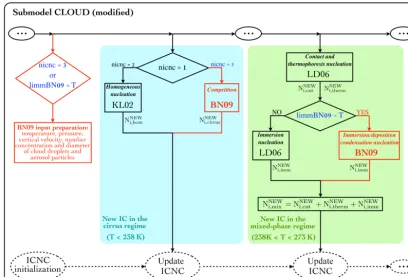
The CLOUD submodel describes the evolution of the prognostic variables which undergo all cloud microphysi-cal processes (e.g. precipitation, deposition, and evapora-tion/sublimation). As far as the formation of new ice crystals is concerned, they are computed via two independent param-eterizations, as shown in black in Fig. 1.
In the cirrus regime (T ≤238.15 K) it is assumed that cir-rus clouds exclusively form homogeneously using the param-eterization of Kärcher and Lohmann (2002, hereafter referred to as KL02). Such parameterization computes the newly formed ice crystals via homogeneous nucleation (Ni,homNEW) of supercooled solution droplets and allows supersaturation with respect to ice. Alternatively, it is possible to use the pa-rameterization of Kärcher and Lohmann (2003) to simulate cirrus formation via pure heterogeneous freezing; however, by default the model operates with KL02, under the assump-tion that the dominant freezing mechanism for cirrus clouds is homogeneous nucleation.
In the mixed-phase regime (238.15 K < T ≤273.15 K) heterogeneous nucleation occurs via immersion (Ni,immNEW) and contact (Ni,cntNEW) freezing as described in Lohmann and Diehl (2006, hereafter referred to as LD06). Insoluble dust can ini-tiate contact nucleation in the presence of supercooled wa-ter droplets following the paramewa-terization of Levkov et al. (1992). Soluble dust and black carbon can act as immer-sion nuclei, according to the stochastic freezing hypothe-sis described in Diehl and Wurzler (2004). Possibly, con-tact freezing via thermophoresis can be included (Ni,thermNEW ), but it is usually not considered (i.e.Ni,thermNEW =0) since its contribution is negligible (Lohmann and Hoose, 2009). The Wegener–Bergeron–Findeisen (WBF) process at subfreezing temperatures is parameterized, so liquid water is forced to evaporate from cloud droplets and deposit onto existing ice crystals.
Figure 1.Scheme of the new ice crystal formation in the CLOUD submodel: different ice nucleation schemes can be used in the cirrus and in the mixed-phase regimes.nicncandlimm_BN09are variables defined in the namelist file “cloud.nml”; red parts are new; three dots indicate other processes coded in the CLOUD submodel.
(e.g. Guo et al., 2008). This is a simplification which is com-monly used by GCMs; nevertheless, important progress has been recently achieved on this front to describe the subgrid-scale variability in updraught velocity using high-resolution simulations (Barahona et al., 2017). In EMAC, the subgrid-scale variability in vertical velocity is introduced by a turbu-lent component (wsub), which depends on the subgrid-scale
turbulent kinetic energy (TKE) described by Brinkop and Roeckner (1995), such that wsub=0.7
√
TKE. The vertical velocity is given by the sum of the grid mean vertical veloc-ity (w) and the turbulent contribution:w=w+0.7
√
TKE (Kärcher and Lohmann, 2002). Zhou et al. (2016) analysed the effect of different updraught velocity representations on ice number concentrations and showed that usingwsub
over-estimates the ICNCs at temperatures below 205 K, but agrees better with the observations at higher temperatures. Other studies, e.g. Kärcher and Ström (2003) and Joos et al. (2008), showed thatwis in good agreement with vertical velocity ob-servations. Given the importance of updraught velocities for ice formation (Donner et al., 2016; Sullivan et al., 2016), fu-ture studies could implement a complete probability distribu-tion of updraughts. Finally, the influence of the pre-existing ice particles is not taken into account. The CLOUD submodel simply reduces the number of aerosol particles available for
ice nucleation by the existing ice particle number in the cirrus regime.
2.3 Ice nucleation parameterization BN09 2.3.1 Scheme characteristics
The BN09 parameterization is computationally efficient and suitable for large-scale atmospheric models. It explicitly con-siders the competition for water vapour between homoge-neous and heterogehomoge-neous nucleation in the cirrus regime, the influence of chemically heterogeneous, polydisperse aerosols acting as INPs, and allows us to use different het-erogeneous nucleation parameterizations.
The BN09 algorithm can be divided into three subsequent parts. First, the limiting number of INPs (Nlim) needed to
in-hibit homogeneous nucleation is computed if temperatures are below 238 K. Indeed, at such low temperatures homo-geneous and heterohomo-geneous nucleation compete for water vapour decreasing ice supersaturation. When INPs exceed Nlimand the maximum supersaturation (smax) is less than the
threshold for homogeneous nucleation (shom), homogeneous
nucleation is suppressed and ice crystals are formed only het-erogeneously.Nlimis determined by computing the number
In the second step, ice crystals nucleated heterogeneously
(Ni,het) are computed via the selected INP
parameteriza-tion at shom, then two cases can follow. If the condition
Ni,het(shom)≥Nlim is satisfied, ice crystals are formed only
heterogeneously atsmax(i.e.Ni,het(smax)), as homogeneous
nucleation is suppressed. Here, the smax is determined
us-ing a bisection method to balance the supersaturation within the air parcel. If Ni,het(shom) < Nlim, the competition
be-tween homogeneous and heterogeneous nucleation is sim-ulated. The ice crystals nucleated homogeneously (Ni,hom)
are determined via the homogeneous nucleation parameteri-zation of Barahona and Nenes (2008, 2009) (hereafter BN-hom):
fc=fc,hom[1−(
Ni,het(shom)
Nlim
)3/2]3/2, (1)
Ni,hom=Nce−fc(1−e−fc), (2)
where Nc is the number concentration of supercooled
liq-uid cloud droplets and fc is the fraction of freezing
solu-ble aerosol. The first factor of fc(i.e. fc,hom) is defined by
Barahona and Nenes (2008), while the second factor is the correction introduced by Barahona and Nenes (2009) to take into account the reduction of the probability of homogeneous nucleation due to the change in the droplet size distribution during crystal formation.
Third, the total concentration of new ice crystals formed in the cirrus regime (Ni,cirrusNEW ) is determined by the contribu-tion of both heterogeneous and homogeneous nucleacontribu-tion, i.e.
Ni,cirrusNEW =Ni,het+Ni,hom (see Fig. 1). On the other hand, if
the temperature is higher than 238K, the algorithm uses the INP parameterization to computeNi,het(smax).
It is important to stress that the BN09 code actually in-cludes five INP parameterizations to deal with heterogeneous nucleation (as mentioned before) and these are described by (i) Meyers et al. (1992), (ii) Phillips et al. (2007), (iii) Phillips et al. (2008), (iv) Phillips et al. (2013), and (v) Barahona and Nenes (2009). They are all empirically based except the lat-ter, which is derived from the CNT. Sensitivity studies have shown that global means of ICNC vary by up to a factor of 20 according to the INP parameterization used (when the competition between homogeneous and heterogeneous nu-cleation is taken into account) and empirical-based parame-terizations better agree with observations, while CNT over-estimates the number of ice crystals (Barahona et al., 2010; Sullivan et al., 2016). Therefore, the simulations described in Sect. 2.4 use the parameterization of Phillips et al. (2013, hereafter referred to as P13) to simulate heterogeneous nu-cleation, since it better agrees with observations (Sullivan et al., 2016). P13 is the improved version of Phillips et al. (2008), a comprehensive empirical formulation which takes into account the surface area contribution of different insol-uble aerosols (with diameters larger than 0.1 µm) to deposi-tion and immersion/condensadeposi-tion nucleadeposi-tion modes, besides the temperature and the supersaturation with respect to ice.
The aerosol particles responsible for ice nucleation are di-vided into four groups: mineral dust (DU), inorganic black carbon (BC), biological aerosols (BIO), and soluble organ-ics (OCsol). Dust and soot, the aerosol species considered in this work for the reasons explained in Sect. 2.4, contribute to determineNi,hetin the following way:
nINP,X=
∞ Z
log(0.1 µm)
[1−e−µX(DX,Si,T )] dnX
d logDX
d logDX;
X=DU, BC; T <273.15 K; (3)
Ni,het(smax)=
NX X
X=1
nINP,X, (4)
wherenINP,X is the number concentration of INPs activated
at a saturation ratio with respect to iceSi and temperature
T for the aerosol speciesX,µXrepresents the mean
num-ber of activated ice embryos per insoluble aerosol particle of speciesXwith diameterDX>0.1 µm,nX is the number
concentration of aerosol particles (interstitial and INP im-mersed in cloud droplets) of speciesX, andNXis the number
of different aerosol species. Equation (3) can be further ex-tended for biological aerosols and soluble organics, as shown in Phillips et al. (2013), andNi,hetdenotes the new ice
crys-tals formed via deposition and immersion/condensation nu-cleation modes.
To summarize (see Fig. 1), according to BN09 the new ice crystals formed in the cirrus regime are
Ni,cirrusNEW = (5)
(
Ni,hom+Ni,het(shom), Ni,het(shom) < Nlim, smax=shom,
Ni,het(smax), Ni,het(shom)≥Nlim, smax< shom,
while in the mixed-phase regime they are computed as
Ni,immNEW=Ni,het(smax). (6)
In order to account for subgrid variabilities, the output variables of BN09, which depend on the vertical velocity (f (w)), are weighted over a Gaussian updraught velocity distribution by numerically calculating the integral (Morales and Nenes, 2010; Sullivan et al., 2016):
f (w)= R∞
0 f (w
0)P (w0)dw0 R∞
0 P (w0)dw0
, (7)
where P (w0) is the Gaussian probability density function of subgrid vertical velocities (w0) with mean 0.1 cm s−1and standard deviation equal towsub.
2.3.2 Implementation
The input variables of BN09 are the following: temperature (T, K); pressure (P, Pa); width of the vertical velocity distri-bution (wsub, m s−1) with upper limit 3 m s−1and lower limit
0.01 m s−1; number concentration of activated cloud droplets (Nc, m−3), dry diameter of Aitken soluble mode (Dc, m; see
Appendix A); standard deviation of the Aitken soluble mode (σc); number concentrations (NX, m−3), geometric mean dry
diameters (DM, m), and lognormal standard deviations (σM)
of interstitial aerosol of species X (which can be DU, BC, OCsol, and BIO, depending on the choice of the INP pa-rameterization). Given the internally mixed representation of aerosols in EMAC, the diametersDM are not distinguished
among aerosol species but only among the modes (Aitken (K), accumulation (A), coarse (C); i.e.M=K, A, C) which the species belong to. Similarly, the standard deviationsσM
are constant depending only on the mode (in EMACσK=
σA=1.59 andσC=2.0).
A schematic overview of how BN09 has been imple-mented in EMAC through the CLOUD submodel is shown in Fig. 1. Moreover, the PREICE effect has been included in the BN09 code. This effect is parameterized by reducing the vertical velocity for ice nucleation (wsub) by a factor
de-pending on the pre-existing ice crystal number concentration and size, limiting the expansion cooling. Such a “corrected” vertical velocity (wsub,pre) has been computed as defined in
Eq. (24) by Barahona et al. (2014). Further information about the implementation is given in Appendix A.
2.4 Set-up of simulations
In this study EMAC simulations have been carried out with the T42L31ECMWF resolution, which corresponds to a spherical truncation of T42 (i.e. quadratic Gaussian grid of approx. 2.8◦×2.8◦in latitude and longitude) and 31 verti-cal hybrid pressure levels up to 10 hPa (approx. 25 km) at the lower stratosphere. All simulations have been run for 6 years (1 year as spin-up time plus 5 years for the analy-sis) using emissions starting from the year 2000 (GFEDv3.1 from van der Werf et al., 2010, for biomass burning and CMIP5-RCP4.5 from Clarke et al., 2007, for anthropogenic emissions). As in Pozzer et al. (2012), dust is off-line pre-scribed using monthly emission files based on the AERO-COM dataset (Dentener et al., 2006). Also, volcanic and sec-ondary organic aerosol emissions are based on AEROCOM, while GFEDv3.1 and CMIP5-RCP4.5 have been used to sim-ulate emissions of black carbon and organic aerosols, respec-tively. Finally, aerosol climatologies have been used for the interactions with radiation (Tanre et al., 1984) and heteroge-neous chemistry (Aquila et al., 2011). Prescribed climatolo-gies of sea surface temperatures (SST) and sea-ice concen-trations (SIC) from AMIP (30 years: 1980–2009) have been used as boundary conditions. Daily means have been saved as output, and monthly means have been used for the analysis in Sects. 3 and 4.1.
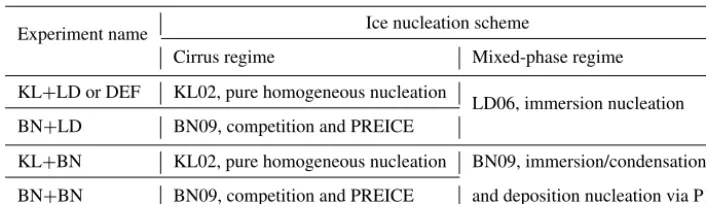
Table 1 lists all simulations of this study and summarizes their main characteristics. The default experiment (DEF or KL+LD) is performed with the standard configuration of the EMAC model, i.e. using the parameterization of Kärcher and Lohmann (2002) for cirrus clouds and the parameteri-zation of Lohmann and Diehl (2006) for immersion nucle-ation in the mixed-phase regime. The UAF scheme is used as cloud droplet formation parameterization, like in Karydis et al. (2017). In order to investigate the model performace using the BN09 scheme, we carried out three other experi-ments where BN09 operates in the two cloud regimes in dif-ferent combinations: BN09 computing the new ice crystals in the cirrus regime (BN+LD), in the mixed-phase regime (KL+BN), and in both regimes (BN+BN).
In all experiments, contact nucleation is computed accord-ing to LD06, while thermophoresis contact nucleation is not considered since its contribution is negligible (as remarked in Sect. 2.2). The P13 parameterization is used to simulate de-position and immersion/condensation nucleation whenever BN09 is called (for the reasons explained in Sect. 2.3). Since LD06 takes into account only dust and soot for immersion nucleation, we set the same aerosol species as contributions for P13 and turned off the biological and organic contribu-tions.
3 Model results
BN09 improves the ice nucleation representation in EMAC by taking into account processes (e.g. water vapour com-petition, influence of polydisperse aerosols, PREICE effect) which were previously neglected by KL02 and LD06. In this section we investigate the changes and the effects obtained by using BN09 in the different regimes.
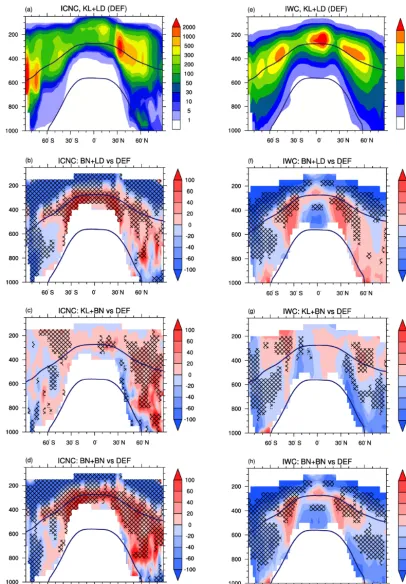
3.1 Annual zonal means
Table 1.All experiments carried out in this study.
Experiment name Ice nucleation scheme
Cirrus regime Mixed-phase regime
KL+LD or DEF KL02, pure homogeneous nucleation
LD06, immersion nucleation BN+LD BN09, competition and PREICE
KL+BN KL02, pure homogeneous nucleation BN09, immersion/condensation
BN+BN BN09, competition and PREICE and deposition nucleation via P13
a function of latitude and temperature (Fig. S1 in the Supple-ment) show that ICNCs in BN+KL are lower than the default case by 300 L−1at temperatures below 220 K. As ice
crys-tals are formed almost exclusively via homogeneous nucle-ation here (not shown) and BNhom and KL02 produce the same order of magnitude of ICNCs (Barahona and Nenes, 2008), the negative bias is likely due to the PREICE effect predicted by BN09. Indeed, it has been demonstrated that homogeneous nucleation dominates in the upper troposphere in the tropics and in the SH (Haag et al., 2003; Liu et al., 2012; Barahona et al., 2017), while heterogeneous nucleation is important in the NH (Li et al., 2012; Kuebbeler et al., 2014; Storelvmo and Herger, 2014; Shi et al., 2015; Gas-parini and Lohmann, 2016; Barahona et al., 2017) where cir-rus clouds are formed from a combination of homogeneous and heterogeneous processes. Interestingly, ICNCs at lower altitudes are also influenced by the ice nucleation parameter-ization used in the cirrus regime. In fact, there is an increase in ICNCs in the mixed-phase regime probably due to a faster sedimentation of the larger ice crystals produced by BN09 in cirrus clouds, especially in the NH where there are larger sources of efficient ice-nucleating mineral dust. Overall, as remarked later in Sect. 4.1, the total ICNC in BN+LD glob-ally decreases. The changes produced by applying BN09 in the mixed-phase regime (Fig. 2c) result from the different heterogeneous ice nucleation parameterizations used to sim-ulate immersion nucleation, P13 vs. LD06. The changes are especially evident in the NH (more than 40 %), where min-eral dust is more abundant than in the SH. As P13 produces fewer new ice crystals than LD06 (not shown), the positive biases in the mixed-phase regime are possibly due to influ-ences from the cirrus regime (e.g. ice crystal sedimentation) and convective detrainment. Overall, the ICNC deviations in the mixed-phase regime obtained using the two different pa-rameterizations are smaller (mostly within ±20 %) than in the cirrus regime. This is also evident from Fig. S1 in the Supplement (last row), where the absolute changes are, on average, between 200 and−200 L−1when BN09 is used in the cirrus regime and between 50 and −50 L−1when com-paring KL+BN with KL+LD. Possibly, the rate associated with heterogeneous nucleation in the mixed-phase regime is masked by other processes, like sedimentation and
aggrega-tion, which also contribute to ICNC in this regime. Finally, the simulation using BN09 in both regimes combines the ef-fects described so far (Fig. 2d). Since cirrus clouds do not occur throughout the whole year, we present in the Supple-ment (Fig. S2) the ICNC seasonal means for summer (June– July–August, JJA) and winter (December–January–February, DJF). The seasonal analysis helps to understand why there is cirrus occurrence at temperatures higher than 238 K, showing that the ICNC growth in the mixed-phase region predicted by BN+LD is actually very small, as expected given that the ice scheme used in the mixed-phase regime is the same as the default simulation.
The IWC pattern (Fig. 2e) qualitatively follows the ICNC distribution. It is quite symmetrical between the two hemi-spheres except at high latitudes in the NH, where IWC is slightly higher because of the higher values of ICNC. Partic-ularly, IWC exhibits three local maxima: two over the mid-latitudes in both hemispheres and one in the tropics, asso-ciated with storm tracks and deep convections, respectively (Li et al., 2012), in agreement with satellite observations, e.g. Waliser et al. (2009), Li et al. (2012). The relative changes in Fig. 2f show a pattern very similar to Fig. 2b; therefore, IWC decreases where ICNC reduces (and vice versa) when BN09 is used in the cirrus regime. On the other hand, IWC in KL+BN slightly reduces (up to 20 %) in the mixed-phase regime in areas where ICNC increases, especially in the NH at high latitudes (Fig. 2g). This could be due to the different sizes of ice crystals; however, the areas with significance are rather small. Finally, BN+BN in Fig. 2h simulates an overall reduction of IWC except in the three areas with higher values of IWC described in Fig. 2e.
3.2 Global distributions
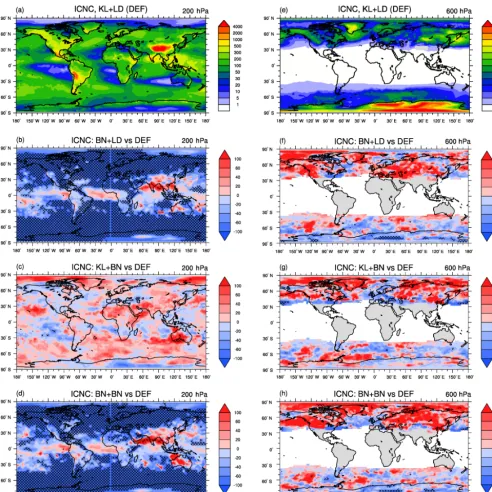
related to the turbulent contribution of the vertical veloc-ity wsub and in agreement with Gryspeerdt et al. (2018a),
who detected mostly orographic cirrus clouds in these ar-eas. Figure 3a also shows higher ICNCs around the edge of the Antarctic ice sheet and over those regions which experi-ence a strong convective activity, i.e. the Intertropical Con-vergence Zone (ITCZ) and the Tropical Warm Pool (TWP), as observed in Sourdeval et al. (2018). The annual global mean of ICNC at 200 hPa is about 200 L−1(∼390 L−1over land and∼124 L−1over ocean). The relative changes clearly show that BN09 used in the cirrus regime (Fig. 3b, d) re-duces ICNC (up to 60 %) worldwide with respect to the de-fault experiment, and the ICNC annual global mean drops to 137 L−1 (i.e. more than 30 %). As the ice crystals are mainly of homogeneous origin at this altitude, such a re-duction is probably due to the PREICE effect. However, there are positive biases along the ITCZ and over the TWP area. As the concentrations of new ice crystals produced by BN09 are not particularly remarkable in these regions (not shown), convective detrainment is likely to play a role. In-deed, there is a certain response of the convective activity to the choice of the ice nucleation scheme used in the cir-rus regime. On the contrary, KL+BN is characterized by a general increase in ICNC (Fig. 3c). However, most of the areas with strong positive changes (larger than 60 %) cor-respond to regions characterized by low ICNC (<30 L−1), thus the global annual mean increases just up to 218 L−1(i.e.
+9 %). At 600 hPa, ICNCs increase towards high latitudes, in particular over Greenland (up to 2000 L−1) and Antarctica (mostly>2000 L−1) (Fig. 3e). It must be said that, due to the very low temperatures in the latter region, even at 600 hPa the conditions are typical of the cirrus regime, and the high IC-NCs can be related to the high values of bothwsub and ice
supersaturation. Gryspeerdt et al. (2018a) found that cirrus clouds over Antarctica have primarily synoptic origin. How-ever, differently from Fig. 3e, observations do not present such a high peak of ICNC over Antarctica (Gryspeerdt et al., 2018b; Sourdeval et al., 2018). The annual global mean is about 53 L−1, which means about one-quarter with respect to the ICNC global mean at 200 hPa. Figure 3f confirms what was already noticed in Figure 2b, which is that the ice nu-cleation scheme used in the cirrus regime affects the ICNC at the mixed-phase regime altitudes predicting higher ICNCs especially in the NH. However, the largest differences occur in areas where ICNCs are very low and slightly affect the absolute ICNC values. As a result, the annual global mean actually decreases to 47 L−1because of the negative
contri-bution in the SH. Figure 3g also shows strong positive biases, but ICNCs do not change globally (52 L−1). Thus, we can re-iterate that the ICNC in the mixed-phase regime is less sen-sitive to the ice nucleation scheme changes than the ICNC in the cirrus regime. Vertically integrated ice crystal num-ber concentrations (ICNCburden, Fig. S3 in the Supplement)
clearly show that concentrations are higher over continents (∼48×108m−2), where vertical updraughts are stronger
and aerosol concentrations more abundant, than over oceans (∼11×108m−2).
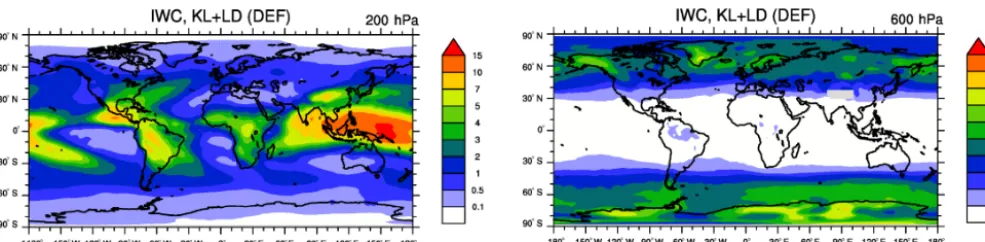
IWC at 200 and 600 hPa (Fig. 4) presents a pattern qual-itatively similar to the ICNCs at the corresponding heights. Nevertheless, two interesting features appear. First, there are high IWC values (>10 mg kg−1) over the TWP at 200 hPa, where ICNCs are not particularly high. This is probably caused by the larger radius of ice crystals simulated in this area. Second, IWC at 600 hPa is rather low over Antarc-tica (likely because of the low water vapour concentration), which is instead one of the regions with the highest ICNC. The relative changes in IWC with respect to the default sim-ulation (Fig. S4 in the Supplement) approximately follow the changes obtained for ICNC, i.e. IWC reduces where ICNC decreases and vice versa.
4 Model comparisons and observations 4.1 Annual global means
Table 2 shows an overview of the global annual means of cloud microphysical variables and radiative fluxes computed for different observations and for all experiments, and the percentage changes with respect to the default simulation. The global vertically integrated ice crystal number concen-tration changes considerably depending on the ice scheme used in the cirrus regime and in the mixed-phase regime. When BN09 operates in the cirrus regime, ICNCburden
de-creases by 10 % due to the competition between homoge-neous and heterogehomoge-neous nucleation and the PREICE ef-fect (a similar result has been also found by Liu et al., 2012; Kuebbeler et al., 2014; and Shi et al., 2015). On the other hand, ICNCburdenincreases by almost 7 % when BN09
is used in the mixed-phase regime, i.e. when P13 simu-lates heterogeneous nucleation. On a large scale, these ef-fects offset each other in BN+BN, where the global an-nual mean is basically unchanged with respect to the de-fault simulation. Overall, the ICNCburden values are very
close to the global annual means found by Lohmann et al. (2008) and Kuebbeler et al. (2014), while they are 1 or-der of magnitude higher compared to the results of Wang and Penner (2010) and Shi et al. (2015). ICNCburden,cirriand
ICNCburden,mixed are vertically integrated ICNCs in the
cir-rus regime and in the mixed-phase regime, respectively. It is interesting to quantitatively see the different contributions to the total ICNC: ICNCsburden,cirriare about 6 times larger than
the ICNCsburden,mixedwhen KL02 is used and about 5 times
when BN09 is applied in the cirrus regime. In general, we observe that the variability in ICNC increases when BN09 is used. Vertically integrated cloud droplet number concentra-tion (CDNCburden) is basically not influenced by the choice
Figure 3.Annual means of (grid-averaged) ice crystal number concentration (ICNC, L−1) at 200 hPa (cirrus regime) and 600 hPa (mixed-phase regime) for the default simulation KL+LD and the relative percentage changes in BN+LD, KL+BN, and BN+BN with respect to it (i.e.(experiment-DEF)/|DEF| ·100). The crossed pattern indicates areas with a significance level of 95 %.
Kuebbeler et al., 2014; Shi et al., 2015) and observations, although satellite observations are still affected by strong un-certainties (Bennartz and Rausch, 2017).
The ice water path (IWP) decreases by almost 7 % when BN09 is used in the cirrus regime, similarly to what has been found in Kuebbeler et al. (2014), who compared simulations assuming pure homogeneous nucleation against simulations including water vapour competition. Overall, the model
Figure 4.Annual means of (grid-averaged) ice water content (IWC, mg kg−1) at 200 hPa (cirrus regime) and 600 hPa (mixed-phase regime) for the default simulation KL+LD.
1994). The modelled results fall within this range and the one indicated as acceptable in Mauritsen et al. (2012), which is 50–80 g m−2. The LWP variations among the experiments are much smaller than the IWP variations.
The absolute values of the shortwave cloud radiative ef-fect (SCRE) and longwave cloud radiative efef-fect (LCRE) are higher than those derived from satellite data, especially when KL02 is employed in the cirrus regime. However, when the net cloud radiative effect (NCRE) is computed, the same sim-ulations with KL02 in the cirrus regime are closer to the ob-servations. Looking at the absolute changes and the global distributions in the Supplement (Fig. S5) it is evident that the cloud radiative effects are sensitive to the ice nucleation scheme used for cirrus clouds. Indeed, SCRE with BN09 becomes weaker (more than 5 %) because of the less effi-cient scattering of shortwave radiation by fewer and larger crystals. More importantly, LCRE decreases up to 15 % in BN+LD because cirrus clouds, at the same, can trap less longwave radiation in the Earth–atmosphere system. As a re-sult, NCRE becomes more negative, with statistical signifi-cance over some areas in the tropics and high latitudes, and the cooling effect is enhanced.
The total cloud cover (TCC) is slightly overestimated by the model (likely explaining why the cloud radiative forc-ing is high despite IWP beforc-ing half of the observed values). However, Mauritsen et al. (2012) assert that a global model is acceptable if TCC is higher than 60 %. The changes with respect to the default simulation are very low (below 2 %), and the biggest change is in BN+LD where TCC reduces by 1.39 %, since lower ICNCs lead to higher sedimentation rates. Finally, the model tends to overestimate the total pre-cipitation (Ptot), i.e. the sum of large scale and convective
precipitations, but this has also been found with other global models (e.g. Barahona et al., 2014, with GEOS-5; Shi et al., 2015, with CAM5; and Lohmann et al., 2008, and Kuebbeler et al., 2014 with ECHAM-HAM). When BN09 is used in the cirrus regime, Ptot grows by 4 % especially because of
the increase in the convective precipitation contribution, due to some feedbacks on the convective activity generated by
the different ice nucleation schemes used, as mentioned in Sect. 3.2.
The annual zonal means of vertically integrated number concentration of ice crystals and cloud droplets, ice water path, liquid water path, shortwave and longwave cloud ra-diative effects, and total cloud cover are shown in Fig. S6 (in the Supplement) and are comparable with the literature cited before. The annual zonal mean profiles clearly show that the simulations using the same ice nucleation scheme in the cirrus regime are very close to each other, i.e. KL+LD and KL+BN, and BN+LD and BN+BN (as already visible in Table 2).
Overall, the model performs well with respect to observa-tions and the literature. Mostly, the experiments do not yield evident differences among each other at the global scale, as regional variations may cancel out; however, there are clear effects on SCRE and LCRE from changing the cirrus ice nu-cleation scheme. As there is not a clear indication which sim-ulation performs better, in the next subsection we extend our analysis including a statistical comparison with aircraft mea-surements.
4.2 Comparison with aircraft measurements
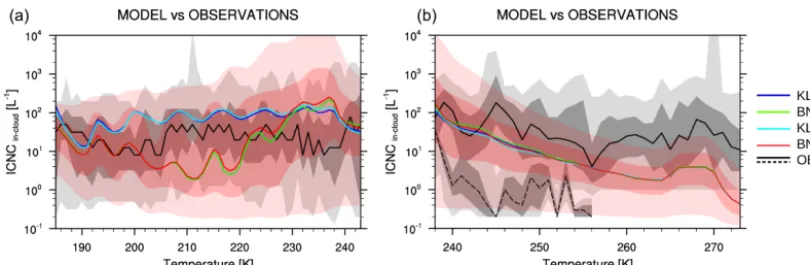
Figure 5.In-cloud ice crystal number concentrations (ICNCin−cloud, L−1) versus temperature for modelled results and flight measurements.
Medians are computed for modelled results (using daily means between 25◦S and 75◦N, masking ICNCin-cloud<0.1 L−1, i.e. the minimum
observed value) and observations, for each 1 K temperature bin. They are shown with coloured lines: KL+LD (blue), BN+LD (green), KL+BN (light blue), BN+BN (red), and observations (black). Darker gray/red colours indicate the observations/BN+BN between the 25th and 75th percentiles, while lighter gray/red colours indicate the observations/BN+BN between the 5th and 95th percentiles.(a)Cirrus regime: the modelled medians are computed approximately in the range of 4–20 km height, the observations come from Martina Krämer (personal communication, not yet published, 2017).(b) Mixed-phase regime: the modelled medians are computed approximately in the range of 0–20 km height, the observations belong to the projects WISP-94 (solid line) and ICE-L (dashed line) and concern INP concentrations.
Again, the simulations can be grouped into two sets ac-cording to the ice nucleation scheme used in the cirrus regime, i.e. KL+LD/KL+BN and BN+LD/BN+BN, be-cause of their similarities. For most of the temperature range, the simulations which use KL02 in the cirrus regime over-estimate the observed ICNCs (although they mostly remain below the 75th percentile). The overestimation of ICNCs is common to other modelling studies (e.g. Wang and Penner, 2010; Liu et al., 2012; Shi et al., 2015) and especially in cold cirrus clouds (forT <205 K). On the other hand, the simu-lations which use BN09 in the cirrus regime are very close to the observations at temperatures below 200 K and between 220 and 230 K, while they underestimate ICNCs between 200 and 220 K. In this temperature range the simulations can exceed the observed 25th percentile (although remain-ing within the 5th percentile). In comparison with the other two simulations, BN+LD and BN+BN always predict lower ICNCs at temperatures below 230 K, as expected because of the competition and PREICE effects. Finally, all four simu-lations overestimate ICNCs by 1 order of magnitude in the temperature range 230–240 K.
Overall, the simulations BN+LD and BN+BN agree par-ticularly well with the measurements at temperatures lower than 200 K but underestimate the ICNCs within the interval 200–220 K, due to an overestimation of the competitive nu-cleation and PREICE effects. Barahona et al. (2010) showed that the competitive nucleation effect is small using P13. Also, Liu et al. (2012) found that BN09 (using the param-eterization of Phillips et al., 2008, for heterogeneous nucle-ation) and BNhom produced very similar results in the cir-rus regime, suggesting that the competitive nucleation ef-fect was small because of the low ICNCs formed hetero-geneously. Thus, we can deduce that the PREICE effect is
the one which is likely overestimated in our simulations. Interestingly, modelled ICNCs do not show any particular trend, as with Kuebbeler et al. (2014) who used ECHAM-HAM. Disagreeing, other studies found that ICNCs are in-versely proportional with temperature, e.g. Liu et al. (2012) and Shi et al. (2015) with CAM5 (using both the ice nucle-ation scheme of Liu and Penner (2005) and BN09) and Bara-hona et al. (2010) with GEOS-5 and BN09. Such distinct be-haviours are likely derived from the wide model variabilities in reproducing subgrid-scale processes, like vertical velocity, which play a role in ice nucleation. We reiterate that ICNC is highly dependent on the vertical velocity which is usually poorly represented in terms of spatial and temporal variabil-ity (Barahona et al., 2017).
how-ever, it is well known that the two concentrations show dis-crepancies with increasing temperature because of the sec-ondary ice formation (Kanji et al., 2017). Finally, ICNCs in Fig. 5b are in good agreement with the results of Heymsfield et al. (2013), also based on flight campaigns. They found that ICNCs decrease as temperature increases and are within the range 5–50 L−1in the mixed-phase regime.
Besides the flight measurements, the recent ICNC esti-mates from lidar–radar satellite retrievals must be mentioned, e.g. Sourdeval et al. (2018) and Gryspeerdt et al. (2018b). In particular, Gryspeerdt et al. (2018b) analysed the behaviour of ICNCs within clouds as a function of temperature. Con-trary to Fig. 5a, they showed that there is a weak temperature dependence of ICNC, which increases with decreasing tem-perature. On the other hand, similarly to Fig. 5, they found a small increase in ICNC around 265–270 K, and, interest-ingly, a small peak at about 233 K due to orographic and frontal regimes, which could explain our higher modelled IC-NCs between 230 and 240 K.
5 Conclusions
In this study we have implemented the ice nucleation scheme of Barahona and Nenes (2009) into the global chemistry-climate model EMAC. The parameterization takes into ac-count the water vapour competition between homogeneous and heterogeneous nucleation and has been modified to also consider the depositional growth of pre-existing ice crystals. Heterogeneous nucleation can be computed through differ-ent INP parameterizations, and we have chosen the empirical INP parameterization of Phillips et al. (2013) for our experi-ments. We have tested the BN09 scheme operating in the cir-rus and/or in the mixed-phase regimes and compared the re-sults with the standard configuration of the model, which as-sumes that cirrus clouds form via pure homogeneous nucle-ation (Kärcher and Lohmann, 2002) and uses the immersion nucleation parameterization of Lohmann and Diehl (2006) for mixed-phase clouds.
Focusing on the ice-related results, e.g. ICNC and IWC, we found that using BN09 in the cirrus regime strongly re-duces the total ICNC worldwide because of the competition and PREICE effects, but increases ICNC along the tropics. In contrast, BN09 in the mixed-phase regime produces slightly higher ICNCs, especially in the NH where mineral dust par-ticles are more abundant. We found that changing the ice nucleation scheme in the cirrus regime generates larger dif-ferences in ICNC and IWC than changing parameterization in the mixed-phase regime, that is the simulations using the same parameterization in the cirrus regime (e.g. BN+LD and BN+BN) are easily discernible from the others (LD+KL and LD+BN). Interestingly, we observed a certain dependence of ICNC and IWC in the mixed-phase regime on the parame-terization used for cirrus clouds, likely due to a faster
sedi-mentation of larger ice crystals produced by BN09 in cirrus clouds at higher altitudes.
Overall, all modelled results agree well with global obser-vations and the literature data. The comparison made with flight measurements has pointed out that ICNCs are overesti-mated by KL02 in the cirrus regime. BN09 agrees well with the observations in cold cirrus clouds, but the PREICE ef-fect is likely overestimated causing the underestimation of ICNCs between 200 and 220 K.
As BN09 takes into account additional processes which were previously neglected by the standard version of the model, without consuming extra computational resources, we recommend to apply this ice nucleation scheme in future EMAC simulations. We also suggest to select P13 among the INP parameterizations available in BN09, since it incorpo-rates the ice-nucleating ability of different aerosol species (dust, soot, bioaerosols, and soluble organics) and simulates both deposition and immersion/condensation nucleation. By using the configuration BN+BN, the EMAC model becomes one of the few GCMs which take into account, in a detailed manner, the complexity of ice nucleation. Finally, this work offers further material for future GCM comparisons with a focus on ICNC estimates and for future modelling evalua-tions against flight measurements and lidar–radar satellite re-trievals.
Appendix A
In this appendix we provide some additional technical infor-mation about the implementation of BN09 into the EMAC model. The BN09 parameterization has been added as a Fortran95 module in the submodel core layer (SMCL) of MESSy (named as messy_cloud_ice_BN09.f90). BN09 operates in the cirrus regime and/or in the mixed-phase regime according to the calls made in the CLOUD submodel (messy_cloud_lohmann10.f90). As shown in Fig. 1, BN09 computes the newly formed ice crystals in the cirrus regime when nicnc=3 and in the mixed-phase regime when limm_BN09=.TRUE., where nicnc
andlimm_BN09 are variables defined in the namelist file
cloud.nml(the set-up ofcloud.nmlfor the simulation
BN+BN is shown in Table S1 as an example).
Other changes made during the implementation are the fol-lowing.
– Temperature threshold.The original BN09 assumes the value 235 K as a temperature threshold between the two regimes, while the CLOUD submodel uses the value 238.15 K. For consistency, we used the second thresh-old as a limit condition to call BN09, and we changed the original threshold of BN09 to the value 238.15 K in-side the BN09 code.
– Number concentration and diameter of cloud droplets.
Supplement. The supplement related to this article is available online at: https://doi.org/10.5194/gmd-11-4021-2018-supplement.
Author contributions. SB wrote the paper with contributions from all coauthors. VAK, APT, and JL proposed the development of the CLOUD submodel. AN and DB provided the ice nucleation param-eterization. SB – together with SCS, AP, and HT – performed the implementation in EMAC. MK provided the flight measurements. All authors were involved in discussions during the analyses.
Competing interests. The authors declare that they have no conflict of interest.
Acknowledgements. We would like to thank Mattia Righi from the German Aerospace Center (DLR) for the discussion on the modelled results. We acknowledge the usage of the Max Planck Computing and Data Facility (MPCDF) for the simulations performed in this work. Sylvia C. Sullivan and Athanasios Nenes acknowledge funding from a NASA Earth and Space Science Fel-lowship (NNX13AN74H), a NASA MAP grant (NNX13AP63G), and a DOE EaSM grant (SC0007145). Moreover, Athanasios Nenes acknowledges funding by the European Research Council Consolidator Grant 726165 (PyroTRACH), Vlassis A. Karydis acknowledges support from an FP7 Marie Curie Career Integration Grant (project reference 618349), Holger Tost acknowledges fund-ing from the Carl-Zeiss Foundation, and Alexandra P. Tsimpidi acknowledges support from a DFG individual grand programme (project reference TS 335/2-1). Finally, we acknowledge the use of the programmes Ferret (product of the NOAA’s Pacific Marine Environmental Laboratory, http://ferret.pmel.noaa.gov/Ferret/, last access: 3 September 2018) and NCL (product of the Com-putational and Information Systems Laboratory at the NCAR, https://www.ncl.ucar.edu/, last access: 3 September 2018) for the analyses and graphics in this paper.
The article processing charges for this open-access publication were covered by the Max Planck Society.
Edited by: Simon Unterstrasser Reviewed by: two anonymous referees
References
Abdul-Razzak, H. and Ghan, S. J.: A parameterization of aerosol activation: 2. Multiple aerosol types, J. Geophys. Res.-Atmos., 105, 6837–6844, https://doi.org/10.1029/1999JD901161, 2000. Ackermann, I. J., Hass, H., Memmesheimer, M., Ebel, A.,
Binkowski, F. S., and Shankar, U.: Modal aerosol dynam-ics model for Europe: development and first applications, At-mos. Environ., 32, 2981–2999, https://doi.org/10.1016/S1352-2310(98)00006-5, 1998.
Aquila, V., Hendricks, J., Lauer, A., Riemer, N., Vogel, H., Baum-gardner, D., Minikin, A., Petzold, A., Schwarz, J. P., Spackman, J. R., Weinzierl, B., Righi, M., and Dall’Amico, M.: MADE-in: a new aerosol microphysics submodel for global simulation of
insoluble particles and their mixing state, Geosci. Model Dev., 4, 325–355, https://doi.org/10.5194/gmd-4-325-2011, 2011. Barahona, D. and Nenes, A.: Parameterization of
cir-rus cloud formation in large-scale models: Homoge-neous nucleation, J. Geophys. Res.-Atmos., 113, d11211, https://doi.org/10.1029/2007JD009355, 2008.
Barahona, D. and Nenes, A.: Parameterizing the competition be-tween homogeneous and heterogeneous freezing in ice cloud for-mation – polydisperse ice nuclei, Atmos. Chem. Phys., 9, 5933– 5948, https://doi.org/10.5194/acp-9-5933-2009, 2009.
Barahona, D. and Nenes, A.: Dynamical states of low tem-perature cirrus, Atmos. Chem. Phys., 11, 3757–3771, https://doi.org/10.5194/acp-11-3757-2011, 2011.
Barahona, D., Rodriguez, J., and Nenes, A.: Sensitivity of the global distribution of cirrus ice crystal concentration to het-erogeneous freezing, J. Geophys. Res.-Atmos., 115, d23213, https://doi.org/10.1029/2010JD014273, 2010.
Barahona, D., Molod, A., Bacmeister, J., Nenes, A., Gettelman, A., Morrison, H., Phillips, V., and Eichmann, A.: Development of two-moment cloud microphysics for liquid and ice within the NASA Goddard Earth Observing System Model (GEOS-5), Geosci. Model Dev., 7, 1733–1766, https://doi.org/10.5194/gmd-7-1733-2014, 2014.
Barahona, D., Molod, A., and Kalesse, H.: Direct estimation of the global distribution of vertical velocity within cirrus clouds, Sci. Rep.-UK, 7, 1–11, https://doi.org/10.1038/s41598-017-07038-6, 2017.
Bennartz, R. and Rausch, J.: Global and regional estimates of warm cloud droplet number concentration based on 13 years of AQUA-MODIS observations, Atmos. Chem. Phys., 17, 9815– 9836, https://doi.org/10.5194/acp-17-9815-2017, 2017. Brinkop, S. and Roeckner, E.: Sensitivity of a general
circula-tion model to parameterizacircula-tions of cloud–turbulence interac-tions in the atmospheric boundary layer, Tellus A, 47, 197–220, https://doi.org/10.1034/j.1600-0870.1995.t01-1-00004.x, 1995. Cantrell, W. and Heymsfield, A.: Production of Ice in
Tropo-spheric Clouds: A Review, B. Am. Meteorol. Soc., 86, 795–807, https://doi.org/10.1175/BAMS-86-6-795, 2005.
Chen, T., Rossow, W. B., and Zhang, Y.: Radia-tive Effects of Cloud-Type Variations, J. Cli-mate, 13, 264–286, https://doi.org/10.1175/1520-0442(2000)013<0264:REOCTV>2.0.CO;2, 2000.
Clarke, L., Edmonds, J., Jacoby, H., Pitcher, H., Reilly, J., and Richels, R.: Scenarios of Greenhouse Gas Emissions and Atmo-spheric Concentrations, Sub-report 2.1A of Synthesis and As-sessment Product 2.1 by the US Climate Change Science Pro-gram and the Subcommittee on Global Change Research, De-partment of Energy, Office of Biological & Environmental Re-search, Washington, DC, USA, 260 pp., 2007.
Cziczo, D. J., Froyd, K. D., Hoose, C., Jensen, E. J., Diao, M., Zondlo, M. A., Smith, J. B., Twohy, C. H., and Mur-phy, D. M.: Clarifying the Dominant Sources and Mecha-nisms of Cirrus Cloud Formation, Science, 340, 1320–1324, https://doi.org/10.1126/science.1234145, 2013.
pre-scribed data-sets for AeroCom, Atmos. Chem. Phys., 6, 4321– 4344, https://doi.org/10.5194/acp-6-4321-2006, 2006.
Diehl, K. and Wurzler, S.: Heterogeneous Drop Freezing in the Immersion Mode: Model Calculations Consider-ing Soluble and Insoluble Particles in the Drops, J. At-mos. Sci., 61, 2063–2072, https://doi.org/10.1175/1520-0469(2004)061<2063:HDFITI>2.0.CO;2, 2004.
Dietmüller, S., Jöckel, P., Tost, H., Kunze, M., Gellhorn, C., Brinkop, S., Frömming, C., Ponater, M., Steil, B., Lauer, A., and Hendricks, J.: A new radiation infrastructure for the Mod-ular Earth Submodel System (MESSy, based on version 2.51), Geosci. Model Dev., 9, 2209–2222, https://doi.org/10.5194/gmd-9-2209-2016, 2016.
Donner, L. J., O’Brien, T. A., Rieger, D., Vogel, B., and Cooke, W. F.: Are atmospheric updrafts a key to unlocking climate forc-ing and sensitivity?, Atmos. Chem. Phys., 16, 12983–12992, https://doi.org/10.5194/acp-16-12983-2016, 2016.
Duncan, D. I. and Eriksson, P.: An update on global atmospheric ice estimates from satellite observations and reanalyses, Atmos. Chem. Phys., 18, 11205–11219, https://doi.org/10.5194/acp-18-11205-2018, 2018.
Fountoukis, C. and Nenes, A.: ISORROPIA II: a computation-ally efficient thermodynamic equilibrium model for K+–Ca2+– Mg2+–NH+4–Na+–SO42−–NO−3–Cl−–H2O aerosols, Atmos.
Chem. Phys., 7, 4639–4659, https://doi.org/10.5194/acp-7-4639-2007, 2007.
Gasparini, B. and Lohmann, U.: Why cirrus cloud seeding can-not substantially cool the planet, J. Geophys. Res.-Atmos., 121, 4877–4893, https://doi.org/10.1002/2015JD024666, 2016. Gasparini, B., Meyer, A., Neubauer, D., Münch, S., and Lohmann,
U.: Cirrus Cloud Properties as Seen by the CALIPSO Satel-lite and ECHAM-HAM Global Climate Model, J. Climate, 31, 1983–2003, https://doi.org/10.1175/JCLI-D-16-0608.1, 2018. Gettelman, A., Liu, X., Ghan, S. J., Morrison, H., Park, S.,
Con-ley, A. J., Klein, S. A., Boyle, J., Mitchell, D. L., and Li, J.-L. F.: Global simulations of ice nucleation and ice super-saturation with an improved cloud scheme in the Community Atmosphere Model, J. Geophys. Res.-Atmos., 115, d18216, https://doi.org/10.1029/2009JD013797, 2010.
Gettelman, A., Liu, X., Barahona, D., Lohmann, U., and Chen, C.: Climate impacts of ice nucleation, J. Geophys. Res.-Atmos., 117, d20201, https://doi.org/10.1029/2012JD017950, 2012.
Gryspeerdt, E., Quaas, J., Goren, T., Klocke, D., and Brueck, M.: An automated cirrus classification, Atmos. Chem. Phys., 18, 6157–6169, https://doi.org/10.5194/acp-18-6157-2018, 2018a. Gryspeerdt, E., Sourdeval, O., Quaas, J., Delanoë, J., and
Kühne, P.: Ice crystal number concentration estimates from lidar-radar satellite retrievals. Part 2: Controls on the ice crystal number concentration, Atmos. Chem. Phys. Discuss., https://doi.org/10.5194/acp-2018-21, in review, 2018b.
Gultepe, I. and Heymsfield, A. J.: Introduction Ice Fog, Ice Clouds, and Remote Sensing, Pure Appl. Geophys., 173, 2977–2982, https://doi.org/10.1007/s00024-016-1380-2, 2016.
Guo, H., Liu, Y., Daum, P. H., Senum, G. I., and Tao, W.-K.: Charac-teristics of vertical velocity in marine stratocumulus: comparison of large eddy simulations with observations, Environ. Res. Lett., 3, 1–8, https://doi.org/10.1088/1748-9326/3/4/045020, 2008. Haag, W., Kärcher, B., Ström, J., Minikin, A., Lohmann, U.,
Ovarlez, J., and Stohl, A.: Freezing thresholds and cirrus
cloud formation mechanisms inferred from in situ measure-ments of relative humidity, Atmos. Chem. Phys., 3, 1791–1806, https://doi.org/10.5194/acp-3-1791-2003, 2003.
Han, Q., Rossow, W. B., and Lacis, A. A.: Near-Global Survey of Effective Droplet Radii in Liquid Water Clouds Using IS-CCP Data, J. Climate, 7, 465–497, https://doi.org/10.1175/1520-0442(1994)007<0465:NGSOED>2.0.CO;2, 1994.
Hendricks, J., Kärcher, B., and Lohmann, U.: Effects of ice nuclei on cirrus clouds in a global climate model, J. Geophys. Res.-Atmos., 116, d18206, https://doi.org/10.1029/2010JD015302, 2011.
Heymsfield, A. J., Schmitt, C., and Bansemer, A.: Ice Cloud Particle Size Distributions and Pressure-Dependent Terminal Velocities from In Situ Observations at Temperatures from 0◦to 86◦C, J. Atmos. Sci., 70, 4123–4154, https://doi.org/10.1175/JAS-D-12-0124.1, 2013.
Heymsfield, A. J., Krämer, M., Luebke, A., Brown, P., Cziczo, D. J., Franklin, C., Lawson, P., Lohmann, U., McFarquhar, G., Ulanowski, Z., and Van Tricht, K.: Cirrus Clouds, Meteor. Mon., 58, 2.1–2.26, https://doi.org/10.1175/AMSMONOGRAPHS-D-16-0010.1, 2017.
Hong, Y., Liu, G., and Li, J.-L. F.: Assessing the Radiative Effects of Global Ice Clouds Based on CloudSat and CALIPSO Measure-ments, J. Climate, 29, 7651–7674, https://doi.org/10.1175/JCLI-D-15-0799.1, 2016.
Hoose, C., Lohmann, U., Bennartz, R., Croft, B., and Lesins, G.: Global simulations of aerosol processing in clouds, Atmos. Chem. Phys., 8, 6939–6963, https://doi.org/10.5194/acp-8-6939-2008, 2008.
ICE-L: Continuous Flow Diffusion Chamber Ice Nuclei, Version 1.0, UCAR/NCAR – Earth Observing Laboratory, available at: https://doi.org/10.5065/D6GF0RTM (last access: 14 December 2017), 2011.
IPCC: Climate Change 2013: The Physical Science Basis, Cam-bridge University Press, 1535 pp., 2013.
Jensen, E. J., Diskin, G., Lawson, R. P., Lance, S., Bui, T. P., Hlavka, D., McGill, M., Pfister, L., Toon, O. B., and Gao, R.: Ice nucleation and dehydration in the Tropical Tropopause Layer, P. Natl. Acad. Sci. USA, 110, 2041–2046, https://doi.org/10.1073/pnas.1217104110, 2013.
Jöckel, P., Kerkweg, A., Pozzer, A., Sander, R., Tost, H., Riede, H., Baumgaertner, A., Gromov, S., and Kern, B.: Development cycle 2 of the Modular Earth Submodel System (MESSy2), Geosci. Model Dev., 3, 717–752, https://doi.org/10.5194/gmd-3-717-2010, 2010.
Joos, H., Spichtinger, P., Lohmann, U., Gayet, J.-F., and Minikin, A.: Orographic cirrus in the global climate model ECHAM5, J. Geophys. Res.-Atmos., 113, D18205, https://doi.org/10.1029/2007JD009605, 2008.
Kanji, Z. A., Ladino, L. A., Wex, H., Boose, Y., Burkert-Kohn, M., Cziczo, D. J., and Krämer, M.: Overview of Ice Nucleating Particles, Meteor. Mon., 58, 1.1–1.33, https://doi.org/10.1175/AMSMONOGRAPHS-D-16-0006.1, 2017.
Kärcher, B. and Lohmann, U.: A parameterization of cirrus cloud formation: Heterogeneous freezing, J. Geophys. Res.-Atmos., 108, 4402, https://doi.org/10.1029/2002JD003220, 2003. Kärcher, B. and Ström, J.: The roles of dynamical variability and
aerosols in cirrus cloud formation, Atmos. Chem. Phys., 3, 823– 838, https://doi.org/10.5194/acp-3-823-2003, 2003.
Kärcher, B., Hendricks, J., and Lohmann, U.: Physically based parameterization of cirrus cloud formation for use in global atmospheric models, J. Geophys. Res.-Atmos., 111, d01205, https://doi.org/10.1029/2005JD006219, 2006.
Karydis, V. A., Kumar, P., Barahona, D., Sokolik, I. N., and Nenes, A.: On the effect of dust particles on global cloud condensation nuclei and cloud droplet number, J. Geophys. Res.-Atmos., 116, D23204, https://doi.org/10.1029/2011JD016283, 2011. Karydis, V. A., Tsimpidi, A. P., Pozzer, A., Astitha, M., and
Lelieveld, J.: Effects of mineral dust on global atmospheric nitrate concentrations, Atmos. Chem. Phys., 16, 1491–1509, https://doi.org/10.5194/acp-16-1491-2016, 2016.
Karydis, V. A., Tsimpidi, A. P., Bacer, S., Pozzer, A., Nenes, A., and Lelieveld, J.: Global impact of mineral dust on cloud droplet number concentration, Atmos. Chem. Phys., 17, 5601–5621, https://doi.org/10.5194/acp-17-5601-2017, 2017.
Kerkweg, A., Buchholz, J., Ganzeveld, L., Pozzer, A., Tost, H., and Jöckel, P.: Technical Note: An implementation of the dry removal processes DRY DEPosition and SEDImentation in the Modu-lar Earth Submodel System (MESSy), Atmos. Chem. Phys., 6, 4617–4632, https://doi.org/10.5194/acp-6-4617-2006, 2006. Klingmüller, K., Metzger, S., Abdelkader, M., Karydis, V. A.,
Stenchikov, G. L., Pozzer, A., and Lelieveld, J.: Revised min-eral dust emissions in the atmospheric chemistry–climate model EMAC (MESSy 2.52 DU_Astitha1 KKDU2017 patch), Geosci. Model Dev., 11, 989–1008, https://doi.org/10.5194/gmd-11-989-2018, 2018.
Koop, T., Luo, B., Tsias, A., and Peter, T.: Water activity as the de-terminant for homogeneous ice nucleation in aqueous solutions, Nature, 406, 611–614, https://doi.org/10.1038/35020537, 2000. Korolev, A.: Limitations of the Wegener–Bergeron–Findeisen
Mechanism in the Evolution of Mixed-Phase Clouds, J. Atmos. Sci., 64, 3372–3375, https://doi.org/10.1175/JAS4035.1, 2007. Korolev, A., McFarquhar, G., Field, P. R., Franklin, C.,
Law-son, P., Wang, Z., Williams, E., Abel, S. J., Axisa, D., Bor-rmann, S., Crosier, J., Fugal, J., Krämer, M., Lohmann, U., Schlenczek, O., Schnaiter, M., and Wendisch, M.: Mixed-Phase Clouds: Progress and Challenges, Meteor. Mon., 58, 5.1–5.50, https://doi.org/10.1175/AMSMONOGRAPHS-D-17-0001.1, 2017.
Kuebbeler, M., Lohmann, U., Hendricks, J., and Kärcher, B.: Dust ice nuclei effects on cirrus clouds, Atmos. Chem. Phys., 14, 3027–3046, https://doi.org/10.5194/acp-14-3027-2014, 2014. Kumar, P., Sokolik, I. N., and Nenes, A.: Parameterization of cloud
droplet formation for global and regional models: including ad-sorption activation from insoluble CCN, Atmos. Chem. Phys., 9, 2517–2532, https://doi.org/10.5194/acp-9-2517-2009, 2009. Kumar, P., Sokolik, I. N., and Nenes, A.: Cloud condensation nuclei
activity and droplet activation kinetics of wet processed regional dust samples and minerals, Atmos. Chem. Phys., 11, 8661–8676, https://doi.org/10.5194/acp-11-8661-2011, 2011.
Lauer, A., Eyring, V., Hendricks, J., Jöckel, P., and Lohmann, U.: Global model simulations of the impact of ocean-going ships on
aerosols, clouds, and the radiation budget, Atmos. Chem. Phys., 7, 5061–5079, https://doi.org/10.5194/acp-7-5061-2007, 2007. Levkov, L., Rockel, B., Kapitza, H., and E., R.: 3D mesoscale
nu-merical studies of cirrus and stratus clouds by their time and space evolution, Beitr. Phys. Atmos., 65, 35–58, 1992.
Li, J.-L. F., Waliser, D. E., Chen, W.-T., Guan, B., Kubar, T., Stephens, G., Ma, H.-Y., Deng, M., Donner, L., Seman, C., and Horowitz, L.: An observationally based evaluation of cloud ice water in CMIP3 and CMIP5 GCMs and contemporary reanaly-ses using contemporary satellite data, J. Geophys. Res.-Atmos., 117, d16105, https://doi.org/10.1029/2012JD017640, 2012. Lin, H. and Leaitch, W. R.: Development of an in-cloud aerosol
ac-tivation parameterization for climate modelling, in: Proceedings of the WMO Workshop on measurement of Cloud Properties for Forecasts of Weather, Air Quality and Climate, World Meteoro-logical Organization, Geneva, 328–335, 1997.
Liu, X. and Penner, J. E.: Ice nucleation parameteriza-tion for global models, Meteorol. Mag., 14, 499–514, https://doi.org/10.1127/0941-2948/2005/0059, 2005.
Liu, X., Penner, J. E., Ghan, S. J., and Wang, M.: Inclu-sion of Ice Microphysics in the NCAR Community Atmo-spheric Model Version 3 (CAM3), J. Climate, 20, 4526–4547, https://doi.org/10.1175/JCLI4264.1, 2007.
Liu, X., Shi, X., Zhang, K., Jensen, E. J., Gettelman, A., Bara-hona, D., Nenes, A., and Lawson, P.: Sensitivity studies of dust ice nuclei effect on cirrus clouds with the Community Atmo-sphere Model CAM5, Atmos. Chem. Phys., 12, 12061–12079, https://doi.org/10.5194/acp-12-12061-2012, 2012.
Lohmann, U.: Anthropogenic Aerosol Influences on Mixed-Phase Clouds, Current Climate Change Reports, 3, 32–44, https://doi.org/10.1007/s40641-017-0059-9, 2017.
Lohmann, U. and Diehl, K.: Sensitivity Studies of the Impor-tance of Dust Ice Nuclei for the Indirect Aerosol Effect on Stratiform Mixed-Phase Clouds, J. Atmos. Sci., 63, 968–982, https://doi.org/10.1175/JAS3662.1, 2006.
Lohmann, U. and Feichter, J.: Global indirect aerosol ef-fects: a review, Atmos. Chem. Phys., 5, 715–737, https://doi.org/10.5194/acp-5-715-2005, 2005.
Lohmann, U. and Hoose, C.: Sensitivity studies of different aerosol indirect effects in mixed-phase clouds, Atmos. Chem. Phys., 9, 8917–8934, https://doi.org/10.5194/acp-9-8917-2009, 2009. Lohmann, U. and Kärcher, B.: First interactive simulations of cirrus
clouds formed by homogeneous freezing in the ECHAM gen-eral circulation model, J. Geophys. Res.-Atmos., 107, AAC 8– 1–AAC 8–13, https://doi.org/10.1029/2001JD000767, 2002. Lohmann, U., Feichter, J., Chuang, C. C., and Penner,
J. E.: Prediction of the number of cloud droplets in the ECHAM GCM, J. Geophys. Res.-Atmos., 104, 9169–9198, https://doi.org/10.1029/1999JD900046, 1999.
Lohmann, U., Stier, P., Hoose, C., Ferrachat, S., Kloster, S., Roeck-ner, E., and Zhang, J.: Cloud microphysics and aerosol indi-rect effects in the global climate model ECHAM5-HAM, Atmos. Chem. Phys., 7, 3425–3446, https://doi.org/10.5194/acp-7-3425-2007, 2007.