Improvement in Mechanical Properties of Titanium
De-formed by ECAE Process
J. Nemati
a, S. Sulaiman
b,∗, A. Khalkhali
c aMechanical Engineering Department, Faculty of Engineering, Bu-Ali Sina University, Hamadan, Iran.
bDepartment of Mechanical and Manufacturing Engineering, University Putra Malaysia, Malaysia. c
School of Mechanical Engineering, Islamic Azad University, Takestan Branch, Takestan, Iran.
Article info
Article history: Received 2016.06.05 Received in revised form 2016.08.05
Accepted 2016.08.17
Keywords: CP-Ti (Grade2) ECAE
Mechanical properties Bending fatigue Microhardness
Abstract
In this study, annealed CP-Ti (Grade 2) was processed by Equal Channel Angular Extrusion (ECAE) up to 2 passes at a temperature of 400◦C following route A with a constant ram speed of 30 mm/min through a die angle of 90◦ between the die channels. Mechanical properties of the extruded materials were obtained at different strain rates. The results indicated that the tensile yield stress and ultimate tensile strength of the extruded specimens increased significantly after 2 passes of ECAE process. The maximum increase for yield stress was around 90% which occurred at the pulling rate of 0.5 mm/min. The bending fatigue life of the extruded specimens improved significantly so that in low cycle fatigue regime a 700% increase in fatigue life was observed after two ECAE passes. The improvement was lower in high cycle fatigue regime. The microhardness measurement of the specimens indicated that the average microhardness of the samples increased about 140% after 2 passes. The fracture mechanism of the ECAE specimens was also studied by fractography of the fracture surface of specimens. Microstructure of the extruded specimens was also examined by optical microscopy.
1. Introduction
Titanium has excellent corrosion resistance and high strength-to-density ratio, thus the material and its al-loys such as CP-Ti Grade 2 are widely used in in-dustrial applications [1] chiefly in chemical, marine, aerospace and medical applications [2,3]. It is well-organized that grain refinement can improve the me-chanical behavior of materials without changing their chemical compositions [4,5]. Severe plastic deformation (SPD) techniques have been innovated over the past few decades for producing ultrafine-grained (UFG) ma-terials [5,6]. Equal channel angular extrusion (ECAE) is one of the SPD techniques which was developed in early 1990s by V.M. Segal in the Soviet Union [7]. In this technique, plastic deformation is caused by simple shear [7], near-nano to nanosized equiaxed grains are
generated while the dispersion of orientations at high strains remains unchanged [8, 9]. In this process, a bil-let is extruded through a die containing two channels with equal cross-section which interconnect at an angle
φand an angleψ which specifies the curvature of the outer point of intersection of the two channels [10,11]. Different modified ECAE techniques have been pro-posed to obtain improvement in homogeneity of strain in the specimens. Typical modification has been re-ported by Shaeri et al. [12]. Different equal channel angular pressing configurations have been investigated by Ebrahimi et al. [13] to obtain materials with the high effective strain level, more uniform strain distribu-tion and lower pressing force. The influence of ECAE process on mechanical behaviour and microstructural evolution of many metals has extensively been stud-ied over the past two decades. However, less attention
∗Corresponding author: S. Sulaiman (Professor) E-mail address: [email protected]
has been paid to titanium. Kang and Kim [14] studied the effect of T-type ECAP process on the mechanical and microstructural properties of commercially pure titanium; it was revealed that the yield and ultimate strength of CP-Ti were significantly improved and a remarkable refinement of the microstructure was ob-tained. There are reports implying that the ultimate tensile strength of CP-Ti (Grade 3) can reach to 1218 MPa after eight passes followed by cold rolling in liq-uid nitrogen [15]. Jiang et al. [16] investigated the commercial pure titanium subjected to four passes of ECAE process at a temperature of 400◦C using BC route and studied the evolution of effective strain up to four passes. In the other research [17] they used 3D FEM analysis to study the temperature rise and temperature distribution in the die and CP-Ti billet during the course of deformation in ECAE process. It was shown that the temperature rise in the die and the billet was very different in different locations. Vin-gradove et al. [18] studied the cyclic behavior of UFG titanium processed by ECAE technique and found a remarkable improvement in fatigue limit and fatigue life of the processed material. The experimental study of using was conducted by Nagasekhar et al. [19] who examined two different processing routes to study the effect of three-pass ECAE process on the mechanical properties of CP-Ti by experiment.
The results of different studies obtained from different researchers on the effects of ECAE on different materi-als such as, pure copper [20,21], Fe-Mn-Si-Cr-Ni shape memory alloy [22], Al 6082 alloy [23,8], polymer mate-rials [10], Mg-9Al-Zn alloy [11] and Al 6063 alloy [24, 25] shows that as a proposing technique, ECAE pro-cess can improve the mechanical properties of extruded materials, as well as their microstructures. All results reveal that the grains of processed materials are signif-icantly refined even after one pass of ECAE process. As discussed above, only several investigations have been conducted on the effect of ECAE on titanium. Moreover, a few of these investigations are purely nu-merical and the others are incomprehensive and have provided only a narrow information on various features of the effect of ECAE on titanium. In this study, the effect of the ECAE process on mechanical and fatigue behaviors of CP-Ti (Grade 2) was comprehensively in-vestigated. The mechanical properties of the extruded materials were obtained at different strain rates. Fa-tigue resistance of the ECAEed samples was also in-vestigated by bending fatigue test. The microstructure and grain refinement of the extruded billets was stud-ied by optical microscopy and the fracture mechanism of the samples was examined by fractography. Micro-hardness of the extruded materials was also measured.
2. Material, Specimens and Testing
De-vice
Commercially pure titanium (CP-Ti) Grade 2 was used in this work. The as-received samples were annealed at 673◦K for one hour and were cooled in the furnace at a cooling rate of 293◦K/hr. The chemical composition of the as-received material is given in Table 1.
Table 1
Chemical composition of CP-Ti (Wt %).
Al V Cr Cu Fe Mn
<0.01 <0.05 <0.02 <0.02 <0.03 <0.02 Mo Nb Sn Zr Si Ti
<0.03 <0.01 <0.05 <0.01 <0.01 Base
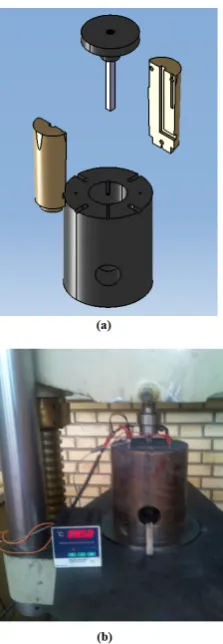
The specimens were fabricated from 12×12×110 mm billets and the ECAE tests were conducted for 1 and 2 passes using routeAatatemperature of 4000C±10◦C. The ECAE was carried out on a 60-ton Avery universal testing machine. The billets were extruded through a split die as shown in Fig. 1. The figure illustrates the schematic view of the ECAE die and the die assembly mounted on the Avery universal testing machine. As Fig. 1a suggests, the ECAE die consists of two chan-nels intersecting at an inner angle of 90◦ and an outer angle of 22◦. The die was equipped with the heating elements for hot extrusion.
Fig. 2. Fabrication of tensile test specimens from the extruded materials.
All ECAE process of the billets were accomplished at a constant ram speed of 30 mm/min. Before the extrusion, the billets and the die walls were lubricated with M oS2 mineral oil to diminish the friction. The billets were first manually embedded in the die chan-nel and were heated for 10 minutes to reach the tem-perature required for extrusion. The extruded billets were then used to prepare the specimens for mechani-cal characterization and micro-structural examination of the extruded material.
3. Mechanical Characterization Tests
3.1. Tensile Test
Tensile test specimens were prepared from the as-received and extruded billets in the flow direction of the extrusion process according to the ASTM E8 stan-dard as shown in Fig. 2. Tensile tests were conducted for the as-received and the extruded materials after the 1st and 2nd passes using a universal Instron test-ing machine.
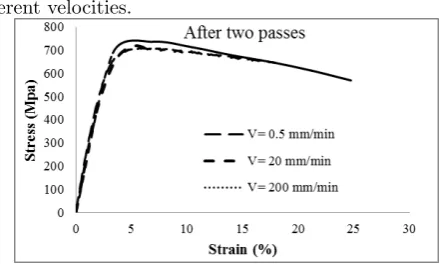
The stress-strain curves of the extruded specimens af-ter the first and the second passes were obtained at three pulling velocities of 0.5,20 and 200 mm/min which correspond tentatively to the strain rates of 2.5×10⁻³, 10−2and 10−1s−1. The strain rate was cal-culated roughly from ˙ϵ= V
H in whichV andH are the
pulling velocity and the gauge length of the specimens, respectively. The stress-strain curves of the as-received material at the foregoing three velocities are depicted in Fig. 3. The stress-strain curves after the first and second passes for the various velocities are illustrated in Figs. 4 and 5, respectively. The stress-strain curves for the as-received material and the extruded speci-mens for the velocities of 0.5,20 and 200mm/min are illustrated in Figs. 6-8, respectively.
Fig. 3. Stress-strain curves of the as-received material at three different velocities.
Fig. 4. Stress-strain curves after the first pass at dif-ferent velocities.
Fig. 6. Stress-strain curves of titanium for V = 0.5 mm/min after different passes.
Fig. 7. Stress-strain curves of titanium for V = 20 mm/min after different passes.
Fig. 8. Stress-strain curves of titanium forV = 200 mm/min after different passes.
The results shown in Fig. 6 suggest that the YS (yield stress) and UTS (ultimate tensile strength) in-creased from 264 to 514 MPa and 371 to 577 MPa respectively, after the 1st ECAE pass for the
veloc-ity of 0.5mm/min. The figure also indicates that the UTS increased from 371 MPa to 700 MPa after the 2nd
pass and for the velocity of 0.5mm/min. This shows an impressive increase of about 88% in UTS of ma-terial. The improvements for the other velocities are still significant. As Figs. 6 and 7 show, the increase of strength of extruded materials, due to the effect of strain rate, does not show a regular trend with the increase of strain rate so that it is negligible for the
velocity of 200 mm/sec as indicated in Figs. 6-8. A comparison between the Figs. 4-6 and the Figs. 7-9 reveals that the major cause of enhancement of the strength of the processed materials is due to the extru-sion rather than the strain rate.
Fig. 9. The increase in ultimate strength after two passes for three different velocities.
3.2. Fatigue Test
The processed billets were subjected to bending fatigue test. Dog bone type fatigue specimens were prepared from the processed billets after the 1st and the 2nd
passes. The bending fatigue tests were carried out un-der the stresses of 100, 110, 125, and 140 MPa on a Moore fatigue machine. Fatigue tests were also con-ducted on the as-received specimens. The S-N curves for different one and two passes are shown in Fig. 10. As the figure suggests, the fatigue life of the processed billets is significantly enhanced after the 1st and the
2nd passes. The fatigue failure life after one and two
dur-ing each cycle in benddur-ing fatigue test of a round bar, each point on the specimen surface experiences alter-nate tension and compression. The tension tends to open the crack and compression tends to close it. The alternate crack opening and closure retard the crack propagation and postpone the failure of the specimen. Evidently, the crack closure can be more effective for higher bending stresses. This may explain the cause of drastic improvement in fatigue life of low cycle fatigue tests.
Fig. 10. S-N curves for unprocessed and extruded specimens.
Fig. 11. The cycles to failure for different number of passes at different stresses.
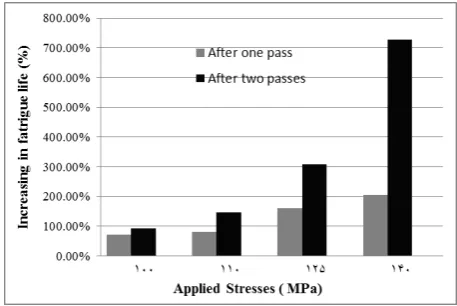
Fig. 12. The total increase in fatigue life for different applied stresses after one and two ECAE passes.
3.3. Hardness Measurement
Vickers micro hardness was measured according to the standard ASTM E-384 using a load of 500g for 30 sec-onds. The processed billets were cut from the middle of the extruded material along the direction of the ex-trusion process. Hardness was measured at thirty loca-tions arranged in three rows (top, middle and bottom). The motivation for selecting three rows was due to non-uniformity of deformation as the top and the rear sur-faces of the billets billets subjected to compression and tension during the ECAE process, respectively and the mid-surface experiences less deformation. Therefore, the mean of microhardness in each row (10 points) may provide a more realistic value for the hardness of the extruded specimens. The average Vickers Microhard-ness for different passes on the top, middle, and rear surfaces of the billets is illustrated in Fig. 13. As the figure suggests, the hardness of the top surface where the billet undergoes compression is slightly higher than that of the mid-surface. For the bottom surface, the situation is vice versa. The results indicated that the major improvement in the microhardness occurred af-ter the 1st pass. In the second pass, the microhardness
kept going high, but at a lower rate.
Fig. 13. The average Vickers Microhardness for dif-ferent passes on top, bottom and mid-surface of the billets.
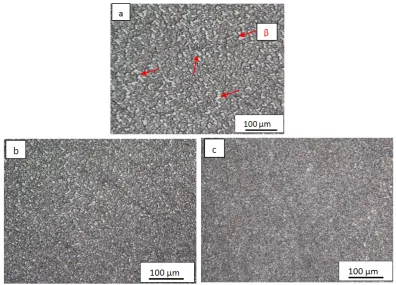
Fig. 15. Optical micrograph of CP-Ti (a) as-received, (b) after one pass and (c) after two passes.
The total improvement in the microhardness of the extruded specimens in the three rows after one and two ECAE passes is illustrated in Fig. 14. The figure indi-cates that a total of around 140% increase in hardness can be observed after 2 passes.
3.4. Metallography
Metallography of the as-received and the extruded bil-lets after the 1th and 2nd passes was performed by optical microscopy. Specimens were cut from the as-received and the extruded titanium material Ti-CP (Grade 2) and mounted in a Bakelite. The mounted samples were then mechanically polished. The polished samples were subsequently etched using a reagent that was a solution mixture of 5-ml of nitric acid (HNO3), 10 ml of hydrofluoric acid (HF) and 85 ml of water (H2O). The polished and the etched surfaces of the specimens of Ti-CP (Grade 2) were studied by optical microscopy. Typical micrographs of the samples are depicted in Fig. 15. The distribution of the alpha (α) and beta (β) phases and grains can be obviously seen in the Fig. 15a. The figure Fig. 15 reveals that the pri-mary (α) grains are intermingled with small pockets of theβ grains. The white spots indicateβ phase, which are distributed in the texture of α phase. The figure also indicates that the grain size remarkably decreased after two ECAE passes.
3.5. Fractography
The Fracture mechanism of all extruded specimens af-ter tensile and fatigue tests were studied on a JEOL scanning electron microscope (SEM). Therefore, the ef-fect of strain rate on fracture mechanism of extruded specimens was studied by fractography of the tensile tested specimens and the effect of cyclic loading on fracture mechanism was investigated by fractography of fatigue tested samples. The results are explained in the next two subsections.
3.5.1. Tensile Tested Specimens
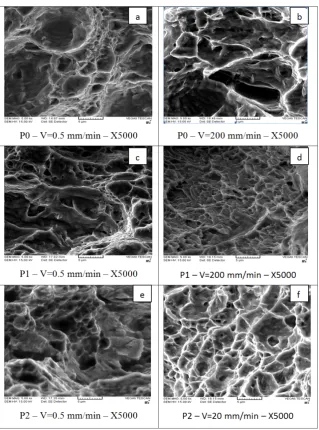
Fig. 16. SEM micrograph of extruded specimens after different ECAE passes for the velocities of 0.5 and 200 mm/min.
3.5.2. Fatigue Tested Specimens
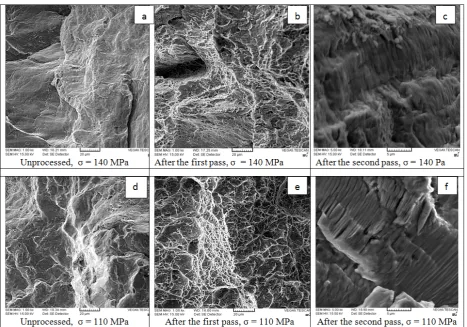
Fracture surfaces of the fatigue samples were exam-ined on a JEOL scanning electron microscope (SEM). Typical fractographs of the fatigue fracture surfaces of the CP-Ti (Grade 2), at different stress levels are illustrated in Fig. 17. Figs. 17b and 17e exhibit ar-eas of populated dimples along with voids of different shapes and sizes, representing that fracture mechanism is ductile. In Figs. 17a and 17d flat regions populated with randomly distributed fine microscopic cracks are observed. In these pictures, regions of stable crack growth containing pockets of shallow striations can be observed which sign of localized micro-plastic
Fig. 17. Micrographs of the fracture surfaces of unprocessed and extruded specimens after the first and the second passes at the stresses of 110 and 140 MPa.
4. Conclusions
The following conclusions can be derived in this study:
1. The yield stress and the ultimate strength of the extruded specimens significantly increased after two passes of the ECAE process. The average increase was found to be around 80%, regardless of the tension velocities. The major improvement was achieved after the first pass.
2. The effect of strain rate on the strength of ex-truded material did not show a regular trend.
3. The elongation and hence the ductility of the extruded specimens decreased by increasing the pass number.
4. For low stresses (or HCF regime), a total increase of approximately 100% in fatigue life of the ex-truded material was observed after two passes. This maximum increase was 700% and was ob-tained for the highest applied stress (or LCF regime).
5. The improvement in fatigue life after the 1stand
the 2ndpasses were more or less the same.
6. The microhardness of the work pieces increased significantly during the deformation. A total of around 140% increase in hardness was observed after 2 passes.
7. Optical microscopic examinations revealed that the grain size reduced significantly after two passes.
8. Micrographs of the fracture surfaces of the ten-sile tested samples showing the morphology and distribution of dimples and fine microscopic voids feature reminiscent of locally ductile failure mechanisms. The fracture surfaces also exhibited an irregular fracture surface related to the (hcp) phase.
References
[1] ASME I. Properties and Selection: Nonferrous Al-loys and Special-Purpose Materials, ASME Hand-book, 2 (1990) 592-593.
[2] R. Chaudhari, R. Bauri, Microstructure and Me-chanical Properties of Titanium Processed by Spark Plasma Sintering (SPS), Metallurgic Mi-crostructure anu. 3 (2014) 30-35.
[3] G. Purcek, O. Saray, O. Kul, I. Karaman, G.G. Yapici, M. Haouaoui, H.J. Maier, Mechanical and wear properties of ultrane-grained pure Ti pro-duced by multi-pass equal-channel angular extru-sion, Mater. Sci. Eng. A. 517 (2009) 97-104.
[4] V.P. Basavaraj, U. Chakkingal, T.S.P. Kumar, Study of channel, angle inuence on material ow and strain inhomogeneity in equal channel angu-lar pressing using 3D nite element simulation, J. Mater. Process. Tech. 209 (2009) 89-95.
[5] I. Kim, J. Kim, D.H. Shin, C.S. Lee, S.K. Hwang, Effects of equal channel angular pressing tempera-ture on deformation structempera-tures of pure Ti, Mater. Sci. Eng. 342 (2003) 302-310.
[6] Y.W. Tham, M.W. Fu, H.H. Hng, M.S. Yong, Lim KB, Study of deformation homogeneity in the multi-pass equal channel angular extrusion process, J. Mater. Process. Tech. 192 (2007) 121-127.
[7] V.M. Segal, Materials processing by simple shear. Mater. Sci. Eng. 197 (1995) 157-164.
[8] E. Cerri, P.P. De Marco, P. Leo, FEM and metal-lurgical analysis of modied 6082 aluminium alloys processed by multi pass ECAP: Inuence of material properties and different process settings on induced plastic strain, J. Mater. Process. Tech. 209 (2009) 1550-1564.
[9] R. Luri, C.J. Luis Prez, D. Salcedo, I. Puertas, J. Len, I. Prez, J.P. Fuertes, Evolution of damage in AA-5083 processed by equal channel angular extru-sion using different die geometries, Mater. Des. 211 (2011) 48-56.
[10] Q. Jianhui, M. Takuya, W. Xueli, K. Masayoshi, Plastic deformation mechanism of crystalline poly-mer materials in the equal channel angular extru-sion process, J. Mater. Process. Tech. 212 (2012) 1528-1536.
[11] J. Jiang, Y. Wang, Z. Du, J. Qu, Y. Sun, L. Shoujing, Enhancing room temperature mechanical properties of Mg-9Al-Zn alloy by multi-pass equal channel angular extrusion, J. Mater. Process. Tech. 210 (2010) 751-758.
[12] M.H. Shaeri, F. Djavanroodi, M. Sedighi, S. Ah-madi, M.T. Salehi, SH. Seyyedein, Effect of copper tube casing on strain distribution and mechanical properties of Al-7075 alloy processed by equal chan-nel angular pressing, J. Strain. Anal. Eng. Des. 48 (2013) 512-521.
[13] M. Ebrahimi, B. Rajabifar, F. Djavanroodi, New approaches to optimize strain behavior of Al6082 during equal channel angular pressing, J. Strain. Anal. Eng. Des. 48 (2013) 395-404.
[14] D.H. Kang, T.W. Kim, Mechanical behavior and microstructural evolution of commercially pure ti-tanium in enhanced multi-pass equal channel an-gular pressing and cold extrusion, Mater. Des. 31 (2010) S54-S60.
[15] F. Zhiguo, J. Hong, S. Xiaogang, S. Jie, Z. Xi-aoning, C. Xie, Microstructures and mechanical de-formation behaviors of ultrane-grained commercial pure (Grade 3) Ti processed by two-step severe plastic deformation, Mater. Sci. Eng. 527 (2009) 45-51.
[16] J. Hong, F. Zhiguo, C. Xie, 3D Finite element simulation of deformation behavior of CP-Ti and working load during multi-pass equal channel angu-lar extrusion, Mater. Sci. Eng. 485 (2008) 409-414.
[17] J. Hong, F. Zhiguo, C. Xie, Finite element analy-sis of temperature rise in CP-Ti during equal chan-nel angular extrusion, Mater. Sci. Eng. 513 (2009) 109-114.
[18] A.Yu. Vinogradov, V.V. Stolyarov, S. Hashimoto, R.Z. Valiev, Cyclic behavior of ultrane-grain ti-tanium produced by severe plastic deformation, Mater. Sci. Eng. 318 (2001) 163-173.
[19] A.V. Nagasekhar, U. Chakkingal, P. Venugopal, Candidature of equal channel angular pressing for processing of tubular commercial purity-titanium, J. Mater. Process. Tech. 173(1) (2006) 53-60.
[20] J. Nemati, G.H. Majzoobi, S. Sulaiman, B.T.H.T. Baharudin, M.A.A. Hanim, Finite element and metallurgical study of properties of deformed pure copper by ECAE at various strain rates, J. Mech. Eng. Sci. 228(9) (2014) 1461-1473.
[21] J. Nemati, G.H. Majzoobi, S. Sulaiman, B.T.H.T. Baharudin, M.A. Azmah Hanim, Improvements in the microstructure and fatigue behavior of pure copper using equal channel angular extrusion, Int. J. Miner. Metall. Mater. 21(6) (2014) 569-576.
[23] A.S.M. Agena, A study of ow characteristics of nanostructured Al-6082 alloy produced by ECAP under upsetting test, J. Mater. Process. Tech. 209 (2009) 856-863.
[24] J. Nemati, G.H. Majzoobi, S. Sulaiman, B.T.H.T. Baharudin, M.A. Azmah Hanim, Improvements in the microstructure and fatigue behavior of pure copper using equal channel angular extrusion, Int. J. Miner. Metall. Mater. 22(4) (2015) 395-404.