Http://www.ijetmr.com©International Journal of Engineering Technologies and Management Research [95]
QUANTIFICATION OF PLEURAL EFFUSION ON CT IMAGES BY
AUTOMATIC AND MANUAL SEGMENTATION
Murk Rehman *1, Dr. Pertab Rai 2*1, 2 Department of Biomedical Engineering, Mehran University of Engineering & technology
Jamshoro, Pakistan
Abstract:
The objective of this research is to make reliable estimation of pleural effusion volume in CT imaging using digital image processing algorithms. In order to make reliable estimation we need to do the manual and automatic segmentation of CT images and to perform the comparison of automatic and manual segmentation for the quantification of pleural effusion on CT images which provides help in the diagnosis of the pleural disease. Pleural effusion is the collection of excess fluid in the pleural cavity. Excessive amount of fluid can impair breathing by limiting the expansion of lungs. Heart failure, cancer, cirrhosis, pneumonia, tuberculosis and many other are the causes of pleural effusion. A number of noninvasive imaging techniques such as radiography, ultrasound and computed tomography (CT) can detect the pleural effusion. The problem faced is the quantification of pleural effusion volume for the purpose of diagnosis of the pleural disease. The objective of this research is to make reliable estimation of pleural effusion volume in CT imaging using digital image processing algorithm. In order to make reliable estimation we need to do the manual and automatic segmentation of CT images and to perform the comparison of automatic and manual segmentation for the quantification of pleural effusion on CT images which provides help in diagnosis of the pleural disease. The results obtained by both the aforementioned techniques indicate that the manual segmentation is better because automated technique has less number of pixels.
Keywords: Quantification; Pleural; Segmentation; Automatic.
Cite This Article: Murk Rehman, and Dr. Pertab Rai. (2019). “QUANTIFICATION OF PLEURAL EFFUSION ON CT IMAGES BY AUTOMATIC AND MANUAL SEGMENTATION.” International Journal of Engineering Technologies and Management Research, 6(5), 95-100. DOI: https://doi.org/10.29121/ijetmr.v6.i5.2019.375.
1. Introduction
Http://www.ijetmr.com©International Journal of Engineering Technologies and Management Research [96]
purposes because it produces cross-sectional images by using computer processing of particular areas from different angles of the body [5]. The problem faced is the quantification of pleural effusion volume for the purpose of diagnosis of the pleural disease. The research carried out in this thesis is based on the manual and automatic segmentation of pleural effusion on CT images and then performs the comparison by receiver operating characteristic curve (ROC). Mathew et al [8] proposed the simplest method for estimating the size of the pleural effusions on CT scans with the three point scale rule. The rule demonstrates the (small, medium and large) anterior posterior quartile and maximum anterior posterior quartile of the pleural effusions. There are several limitations first, the sample size was very small. Secondly, the pleural effusion cases were not taken randomly. Third, the separations for sizes were chosen as small, medium and large. Fourth, the patients of pleural effusions with bilateral side were included. Lastly, the measurements of CT scan were not confirmed with the basic radiographs grading systems. Yao et al [9] proposed computer aided automatic program designed for the estimation of the pleural effusions size. It is highly correlated with the radiologist grading. There are several limitations in the proposed program, the program is applied on 2D slice for segmentation, therefore the continuation of the pleural space between slices was difficult to maintain. Another limitation was the images used for the experiment were all having the drained plural fluid several months before, therefore the accuracy of the program did not verified. Jianhua Yao et al [10] proposed the program is designed for the quantification of the pleural effusion by completely automatic segmentation. The program runs in the background when patient go through the CT scanning processing and the volume of pleural effusion is calculated for the diagnosis of the disease. However, the proposed automatic segmentation program gives the best results when pleural effusions have specific shape and large pleural effusions. For measurement of loculated effusions the method cannot be used.
2. Materials and Methods
As the research problem is the quantification of pleural effusion on CT images. In order to meet with our objective the methodology was discussed in the following steps; first, the manual segmentation of the CT images was done with the GNU Image Manipulation Program (GIMP) software after that the manually segmented images are processed in MATLAB to plot the histogram and probability density function (PDF) of data in order to compute the mean and standard values. In second step, automatic segmentation of same CT images was performed by implementing region growing image processing algorithm. In addition, the morphological filter is applied on automatic segmentation images for the better results. In the last step, the comparison between the results obtained by manual segmentation and automatic segmentation is performed. Furthermore, the result obtained by applying morphological filter on automatic segmentation is also compared with manually segmented images. In both the cases, the comparison was made by using the receiver operating characteristic curve (ROC) in MATLAB.
3. Results and Discussion
Http://www.ijetmr.com©International Journal of Engineering Technologies and Management Research [97]
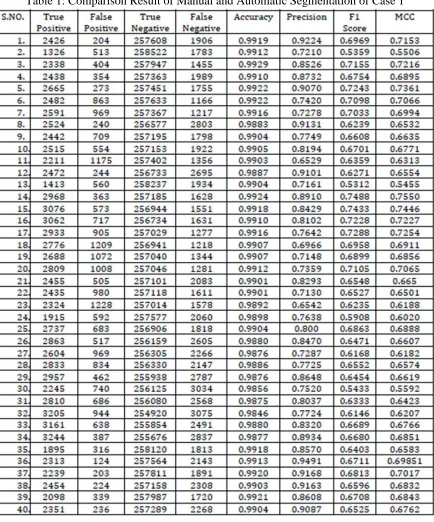
segmented automatically by region growing algorithm. The accuracy of the compared images is 0.99, it seems better but it is not good because from the definition of accuracy it is the ratio of true positives and true negative values so, in the table you can see that the true negative values are greater than the true positive values, the precision of images is varying because it depends upon the true positive and false positive values, F1 score and MCC results have greater than 0.5 values, and it also shows the reliable comparison results. Table.1
Http://www.ijetmr.com©International Journal of Engineering Technologies and Management Research [98]
Histogram of accuracy of case 1, which is computed from the comparison. In which you can see that 0.991 is accuracy of 9 compared images, 0.992 is accuracy of 8 compared images and 0.993 is accuracy of 5 compared images and so, on. Figure 1.
Figure 1: Histogram of Accuracy of Case 1
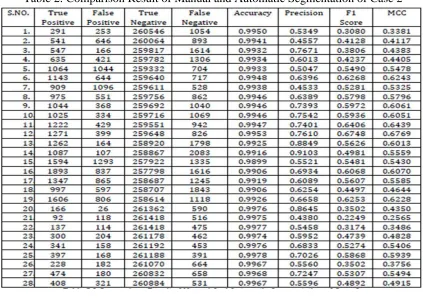
The case 2 consist of 28 scanned CT images, the comparison of manual and automatic segmented images is shown in Table 5.2. As you can see in the table that some images have true positive values are less than the false positive values like in S.no 2, 7, 21 this is because of our automated segmentation image is not much have pleural effusion data as compared to the manual one. The accuracy ratio of the data is 0.99, same problem as discussed earlier in table 5.1 but the precision, F1 score and MCC are varying and some have below 0.5 values because of less difference in the true positive and false positive values. Table.2
Http://www.ijetmr.com©International Journal of Engineering Technologies and Management Research [99]
histogram of accuracy of case 2, which is computed from the comparison table 5.2. In which you can see that between 0.997-0.998 is accuracy of 6 compared images, and between 0.993 -0.994 is accuracy of 4 compared images and 0.99 is accuracy of 3 compared images and so, on.Figure 2.
Figure 2: Histogram of Accuracy of Case 2
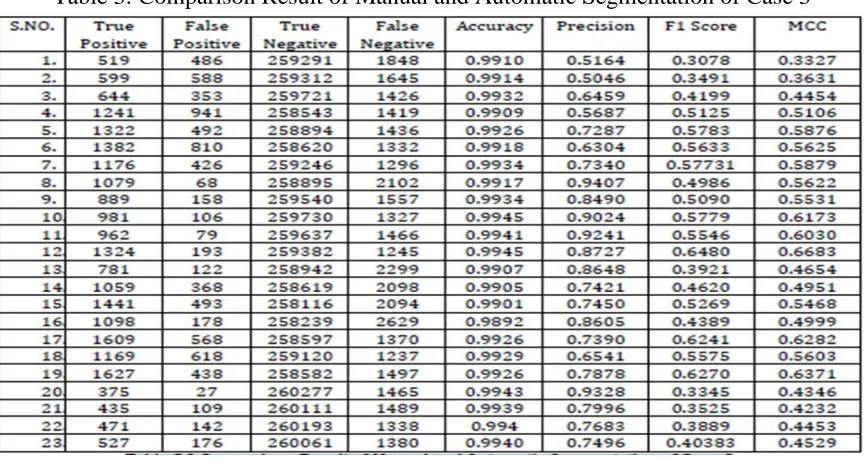
The case 3 consist of 23 scanned CT images, the comparison of manual and automatic segmented images is shown in Table 5.2. As you can see in the table that true positive values are greater than the false positive values but mostly are lesser than the false negative. This is because of automated segmentation, which is not done accurately due to the selection of seed points and thresholds. The accuracy is same but again same problem because of true negative values are higher than the true positive values and precision ratio of the data is alright but F1 score and MCC are varying and some have below 0.5 values due to the true positive values are lesser than the false negative vales. Table.3
Table 3: Comparison Result of Manual and Automatic Segmentation of Case 3
Http://www.ijetmr.com©International Journal of Engineering Technologies and Management Research [100] 4. Conclusion
Quantification of pleural effusion has been in research over several decades. Both the manual and automatic segmentation of CT images have been used and advantages of one over the other are discussed by researchers. The work presented in this thesis provides analysis of automatic and manual segmentations. Observations based on three different cases of pleural effusion each have 40, 28 and 23 CT scans are provided. The manual segmentation is performed using GIMP software and histograms and PDF are plotted. Automatic segmentation is performed using region growing images processing algorithm. Morphological filter is also implemented to improve the results obtained by automatic segmentation. The results in table 5.9 shows that the volumetric quantification of pleural effusion in manual segmentation is better than the automatic segmentation because the image segmented by automated technique has less number of pixels therefore it provides less information compared to image segmented by manual segmentation. The same table also indicates that the results obtained by applying morphological filter on automated segmented images is statistically closest to the results obtained of manually segmented images. The performance of automatic segmentation can be improved by using different image processing algorithm such as thresholding.
References
[1] R. W. Light, Pleural diseases. Lippincott Williams & Wilkins, 2007.
[2] J. M. Porcel and R. W. Light, “Pleural effusions due to pulmonary embolism.,” Curr. Opin. Pulm. Med., vol. 14, no. 4, pp. 337–42, Jul. 2008.
[3] T. Laisaar, “Life expectancy of patients with malignant pleural effusion treated with video-assisted thoracoscopic talc pleurodesis,” Interact. Cardiovasc. Thorac. Surg., vol. 5, no. 3, pp. 307–310, Feb. 2006.
[4] J. C. Shank and R. F. Latshaw, “Pleural effusion.,” Am. Fam. Physician, vol. 17, no. 3, pp. 143– 149, 1978.
[5] “Body CT (CAT Scan).” [Online]. Available:
https://www.radiologyinfo.org/en/info.cfm?pg=bodyct. [Accessed: 09-Jan-2019].
[6] M. Hazlinger, F. Ctvrtlik, K. Langova, and M. Herman, “Quantification of pleural effusion on CT by simple measurement,” Biomed. Pap., vol. 158, no. 1, pp. 107–111, 2014.
[7] S. Exhibit, M. I. Kalokairinos, S. G. Vassiliadis, C. G. Vossou, A. I. Ciurea, and C. Ciortea, “Estimation of the volume of the pleural effusion by computed tomography,” Eur. Congr. Radiol., pp. 1–12, 2010.
[8] M. P. Moy, J. M. Levsky, N. S. Berko, A. Godelman, V. R. Jain, and L. B. Haramati, “A new, simple method for estimating pleural effusion size on CT scans,” Chest, vol. 143, no. 4, pp. 1054– 1059, 2013.
[9] J. Yao, W. Han, and R. M. Summers, “Computer aided evaluation of pleural effusion using chest ct images,” Proc. - 2009 IEEE Int. Symp. Biomed. Imaging From Nano to Macro, ISBI 2009, pp. 241–244, 2009.
[10] J. Yao, J. Bliton, and R. M. Summers, “Automatic segmentation and measurement of pleural effusions on CT,” IEEE Trans. Biomed. Eng., vol. 60, no. 7, pp. 1834– 1840, 2013.
*Corresponding author.