www.theoryofgroups.ir
ISSN (print): 2251-7650, ISSN (on-line): 2251-7669 Vol. 6 No. 4 (2017), pp. 7-33.
c
⃝2017 University of Isfahan
www.ui.ac.ir
ON ALMOST RECOGNIZABILITY BY SPECTRUM OF SIMPLE CLASSICAL GROUPS
ALEXEY STAROLETOV
Communicated by Evgeny Vdovin
Abstract. The set of element orders of a finite group G is called the spectrum. Groups with coinciding spectra are said to beisospectral. It is known that ifGhas a nontrivial normal soluble subgroup then there exist infinitely many pairwise non-isomorphic groups isospectral toG. The situation is quite different ifGis a nonabelain simple group. Recently it was proved that ifLis a simple classical group of dimension at least 62 andGis a finite group isospectral toL, then up to isomorphismL≤G≤AutL. We show that the assertion remains true if 62 is replaced by 38.
1. Introduction
Given a finite groupG, the spectrum ofG is the set of its element orders and is denoted byω(G). Finite
groups are said to be isospectral if their spectra coincide. It is known that if a finite groupGhas a nontrivial
normal soluble subgroup then there exist infinitely many pairwise non-isomorphic groups isospectral toG(see
[9,11]). In contrast, there are a lot of finite nonabelian simple groups that are uniquely determined by their
spectra in the class of finite groups. Such groups are said to berecognizable(by spectrum). Moreover, recently
it was proved that every ”sufficiently large” nonabelain simple group Lis almost recognizable(by spectrum),
that is there are finitely many pairwise non-isomorphic finite groups isospectral toL. Namely, the following
holds (see [6,12,16]).
Theorem A.Let L be one of the following nonabelian simple groups:
(1) a sporadic group other thanJ2;
(2) an alternating groupAn, wheren̸= 6,10;
(3) an exceptional group of Lie type other than3D 4(2);
(4) Ln(q), wheren≥45orq is even;
(5) Un(q), wheren≥45, orq is even and(n, q)̸= (4,2),(5,2);
MSC(2010): Primary: 20D06; Secondary: 20D20.
Keywords: Simple classical groups, Element orders, Prime graph of a finite group, Almost recognizable group. Received: 11 August 2016, Accepted: 11 December 2016.
(6) S2n(q),O2n+1(q), wheren≥29, orq is even,n̸= 2,4, and(n, q)̸= (3,2);
(7) O+2n(q), wheren≥31, orq is even and(n, q)̸= (4,2); (8) O−2n(q), wheren≥30or qis even.
Then every finite group isospectral toLis isomorphic to some group Gwith L≤G≤AutL. In particular,
there are only finitely many pairwise non-isomorphic finite groups isospectral to L.
Remark 1.1. In the statements of Theorem2 and Theorem3 in[12], the condition for S2n(q)andO2n+1(q)
isn≥28, but in fact these theorems are proved forn≥29.
Besides the theorem, A. Vasil′ev and M. Grechkoseeva in [6] formulated the following.
Conjecture B.Let L be one of the following groups:
(1) Ln(q), wheren≥5;
(2) Un(q), wheren≥5 and(n, q)̸= (5,2);
(3) S2n(q), wheren≥3,n̸= 4 and(n, q)̸= (3,2);
(4) O2n+1(q), whereq is odd,n≥3,n̸= 4 and(n, q)̸= (3,3);
(5) Oε
2n(q), wheren≥4 and(n, q, ε)̸= (4,2,+),(4,3,+).
Then every finite group isospectral to Lis isomorphic to some group Gwith L≤G≤AutL.
In Theorem A, Conjecture B, and throughout the paper, we use single-letter names for simple classical
groups, following [3]. Also we use the standard abbreviation Lε
n(q), where ε∈ {+,−}, L+n(q) =Ln(q), and
L−n(q) =Un(q). We continue investigation of the recognition problem for simple classical group and weaken restrictions on classical groups in Theorem A.
Theorem 1.2. LetLbe one of the simple groupsLε
n(q)withn≥27,S2n(q),O2n+1(q)withn≥16,L=O+2n(q)
with n≥ 19, andL = O−2n(q) with n ≥18. Then every finite group isospectral to L is isomorphic to some groupGwithL≤G≤AutL. In particular, there are only finitely many pairwise non-isomorphic finite groups
isospectral to L.
In fact, as we will show in the last section, Theorem 1.2 is a straightforward consequence of a series of
previous results and the following theorem whose proof is the main goal of this paper.
Theorem 1.3. Let q be a power of an odd primep, and let Lbe one of the groups Lε
n(q) with27≤n≤44,
S2n(q),O2n+1(q)with 17≤n≤28,O+2n(q)with 19≤n≤30, andO−2n(q)with 18≤n≤29. Ifω(G) =ω(L)
for a finite groupG, thenGhas a unique nonabelian composition factorS, andS is not isomorphic to a group
of Lie type over a field of characteristic distinct from p.
Observe that Theorems 1.2 and 1.3 resemble Theorem 2 and Theorem 3 in [12] but their hypotheses are
weaker. No wonder the structure of the present paper is similar to that of [12]. Moreover, we use a series of
lemmas from [12] and either give a new proof to enhance their assertions or explain how to change the original
proof to obtain required conclusions under weaker assumptions.
2. Preliminaries: arithmetic of Zsigmondy primes
Given a set of nonzero integersn1, . . . , nk, we denote by (n1, . . . , nk) and [n1, . . . , nk] their greatest common divisor and least common multiple, respectively. Given a nonzero integern, we putφ(n) for the Euler totient
function of n, π(n) for the set of prime divisors of n, and if Gis a finite group then, as usual, π(G) stands
π(k)⊆π; andnπ′ denotes theπ′-part ofn, that is, the ratio|n|/nπ. Ifnis a nonzero integer andris an odd prime with (r, n) = 1, thene(r, n) denotes the multiplicative order ofnmodulor. Given an odd integern, we
put e(2, n) = 1 ifn≡1 (mod 4), and e(2, n) = 2 otherwise.
Fix an integerawith |a|>1. A primeris said to be a primitive prime divisor ofai−1 ife(r, a) =i. We
write ri(a) to denote some primitive prime divisor of ai−1, if such a prime exists, and Ri(a) to denote the
set of all such divisors. Zsigmondy [24] proved that primitive prime divisors exist for almost all pairs (a, i).
Lemma 2.1. (Zsigmondy [24]) Let a be an integer and|a|>1. For every natural number i the setRi(a) is
nonempty, except for the pairs (a, i)∈ {(2,1),(2,6),(−2,2),(−2,3),(3,1),(−3,2)}.
Let i ̸= 2 be a positive integer. Then the product of all primitive prime divisors of ai−1 taken with
multiplicities is denoted by ki(a). Put k2(a) =k1(−a). The numberki(a) is said to be thegreatest primitive
divisor of ai−1. It follows from the definition that (k
i(a), kj(a)) = 1 if i ̸= j. It is easy to check that
k1(a) = |a−1| if a ̸≡ 3 (mod 4), and k1(a) = |a−1|/2 if a ≡ 3 (mod 4), as well as k2(a) = |a+ 1| if a̸≡1 (mod 4), andk2(a) =|a+ 1|/2 ifa≡1 (mod 4). It follows from [10] that for i >2,
(2.1) ki(a) = |
Φi(a)| (r,Φi{r}′(a))
,
where Φi(x) is the ith cyclotomic polynomial andris the largest prime dividingi; moreover, ifi{r}′ does not divide r−1 then (r,Φi{r}′(a)) = 1.
Lemma 2.2. ([12, Lemma 1.3])Letaandibe integers with|a|>1andi >0. Ifiis odd thenki(−a) =k2i(a),
and if iis a multiple of4 thenki(−a) =ki(a).
Lemma 2.3. Let n <105. Then all coefficients of Φn(x) belong to the set {−1,0,1}. In particular, for all
x >0 it is true thatxφ(n)−xφ(n)−1−...−x−1≤Φ
n(x)≤xφ(n)+xφ(n)−1+...+x+ 1. As a consequence
we have that if x≥2 thenΦn(x)≤2xφ(n) and if x≥3 thenxφ(n)/2≤Φn(x).
Proof. The fact that all coefficients of Φn(x) belong to the set{−1,0,1}ifn <105 is well-known and mentioned
for example in [4]. Also it is known that deg(Φn(x)) =φ(n), whence xφ(n)−xφ(n)−1−...−x−1≤Φn(x)≤
xφ(n)+xφ(n)−1+...+x+ 1 for all x > 0. If x ≥ 2 then xφ(n) ≥ xφ(n)−1 +xφ(n)−2+... +x+ 1, so
Φn(x)≤2xφ(n). Ifx≥3 thenxφ(n)≥3xφ(n)−1≥2xφ(n)−1+xφ(n)−1≥2xφ(n)−1+ 2xφ(n)−2+xφ(n)−2≥...≥ 2xφ(n)−1+ 2xφ(n)−2+...+ 2x+ 2, soxφ(n)/2≤Φ
n(x).
□
Lemma 2.4. ([12, Lemma 1.5]) Let a and i be integers, and ε ∈ {+,−}. If a ≥ 2, i ≥ 3, and (a, i) ̸∈
{(2,3),(2,6)}, thenki(εa)> aφ(i)/2.
Lemma 2.5. Let q andube prime powers, whereq̸=uandqis odd. Then the following hold.
(i)If k2i(q)divides k2i(u)andi∈ {8,12} theniqi< ui. (ii)If k9(q)k18(q)divides k9(u)k18(u)then 3q12< u12.
(iii) Ifk9(εq)divides k9(τ u), where ε,τ ∈ {+,−}then3q6< u6.
(iv)If k7(εq)divides k7(τ u), whereε,τ∈ {+,−}, and(q−ε1,7) = 1then3q6< u6.
Proof. Let k16(q) divides k16(u). First we prove that k16(q)̸= k16(u). Assume the contrary. According to
(2.1), we obtain that (q8+ 1)/2 = (u8+ 1)/(u−1,2). If (u−1,2) = 2 then u = q; a contradiction. So
hence 2u8+ 1≡3 (mod 5). It is clearly thatq8≡0,1 (mod 5), so we get a contradiction. Thusk
16(u)/k16(q)>
1. By Fermat’s little theorem, we have that r16(u) ≡ 1 (mod 16), therefore 17k16(q) ≤ k16(u), and hence
(17/2)(q8+ 1)≤u8+ 1. So 8q8< u8−7< u8.
Letk24(q) dividesk24(u). Since for an integerxit is true thatk24(x) = Φ24(x) =x8−x4+ 1, the equality k24(u) = k24(q) is equivalent tou=q. Note that r24(u)≡1 (mod 24), so 25k24(q)≤k24(u). It is clear that k24(u)< u8 andq8/2< k24(q), whence 12q8< u8, as required.
Now we prove (ii). Assume thatk9(q)k18(q) divides k9(u)k18(u). If x is an integer then k9(x)k18(x) =
x6+x3+1
(x−1,3)
x6−x3+1
(x+1,3) =
x12+x6+1
(x−1,3)(x+1,3) and clearly (x−1,3)(x+ 1,3) ∈ {1,3}. Suppose that k9(q)k18(q) = k9(u)k18(u). If (q−1,3)(q+ 1,3) = (u−1,3)(u+ 1,3) then q12+q6+ 1 =u12+u6+ 1, and hence u=q;
a contradiction. So we may assume that (q−1,3)(q+ 1,3) = 1, (u−1,3)(u+ 1,3) = 3, the other case is
considered similarly. Then 3(q12+q6+ 1) = u12+u6+ 1, and hence 3q6(q6+ 1) = (u6+ 2)(u6−1). Since
(u6+ 2, u6−1)∈ {1,3}, we have that either u6+ 2 oru6−1 is divisible by q6. It is clear thatu6+ 2̸=q6
and u6−1 ̸= q6, therefore (u6+ 2)(u6−1) ≥ 2q6(2q6−3). So 3(q12+q6+ 1) ≥ 4q12−6q6, and hence
q12 ≤9q6+ 3; a contradiction since this inequality is not true ifq≥2. Thusk
9(q)k18(q) is a proper divisor
of k9(u)k18(u). Since r9(u)≡1 (mod 18) andr18(u)≡1 (mod 18), we have that k9(u)k18(u)≥19k9(q)k18(q),
and hence 2u12> u12+u6+ 1≥(19/3)(q12+q6+ 1)>6(q12+q6+ 1). Thereforeu12>3q12, as claimed. Now we prove (iii). Assume that k9(εq) divides k9(τ u), where ε, τ ∈ {+,−}. Note thatk9(εq) = (q6+ εq3+ 1)/(q−ε1,3),k
9(τ u) = (u6+τ u3+ 1)/(u−τ1,3). Assume at first that (q−ε1,3) = (u−τ1,3). Then q6+εq3+ 1 divides u6+τ u3+ 1. Note that q6+εq3+ 1 ̸=u6+τ u3+ 1, since otherwise eitheru =q or u3±q3 =±1, which is impossible. Since r9(τ u)≥19, we have that 19(q6+εq3+ 1)≤u6+τ u3+ 1. Now
(19/2)q6≤19(q6+εq3+1)≤u6+τ u3+1≤2u6, and hence 4q6< u6, in particular, 3q6< u6, as required. So we
may assume that (q−ε1,3)̸= (u−τ1,3). We have that((uq−−τε11,,3)3)(q6+εq3+1) divides (u6+τ u3+1). First we prove
that these numbers are not equal. Assume the contrary and consider the case (q−ε1,3) = 1, (u−τ1,3) = 3,
since the other case is symmetric to this one. So 3q3(q3+ε1) = (u3−τ1)(u3+τ2). Now (u3−τ1, u3+τ2) = 3,
so only one of them is divisible byq3. Sinceu3−τ1̸=q3 andu3+τ2̸=q3, we have that eitheru3−τ1≥2q3
or u3+τ2 ≥ 2q3. Therefore (u3−τ1)(u3+τ2) ≥ 2q3(2q3−3). So 3q3(q3+ε1) ≥ 4q6−6q3, and hence (6 +ε3)q3≥q6; a contradiction, sinceq≥3. In the symmetric case (q3−ε1)(q3+ε2) = 3u3(u3+τ1) and we
obtain that (6+τ3)u3≥u6. Whenceu= 2 andτ= +, and hence (q3−ε1)(q3+ε2) = 216; a contradiction, since q≥3 and (q3−ε1)(q3+ε2)>216. So we obtain that ((uq−−τε11,,3)3)(q6+εq3+ 1) is a proper divisor of (u6+τ u3+ 1). Sincer9(τ u)≥19, we have that 19((qu−−ε1τ,13),3)(q6+εq3+1)≤(u6+τ u3+1). So (19/3)(q6+εq3+1)≤(u6+τ u3+1).
Observe that 18q6<19(q6+εq3+ 1), sinceq≥3. Thus 6q6≤(u6+τ u3+ 1)≤2u6, and hence 3q6< u6, as
required.
Now we prove (iv). Assume thatk7(εq) divides k7(τ u), where ε, τ ∈ {+,−}, and (q−ε1,7) = 1. Then k7(εq) =q6+εq5+q4+εq3+q2+εq+ 1 andk7(τ u) = u
6+τ u5+u4+τ u3+u2+τ u+1
(u−τ1,7) . Suppose thatk7(εq) =k7(τ u).
Since u ̸= q, either q ≥ u+ 1 or u ≥ q+ 1 and hence if (u−τ1,7) = 1 then we obtain that either
k7(εq) > k7(τ u) or k7(τ u) > k7(εq) respectively. So (u−τ1,7) = 7, and hence u ≥ 8. Since q ≥ 3, we
have that k7(εq) ≥ q6−q5+q4−q3+q2−q+ 1 > (2/3)q6, and since u ≥ 8, we obtain that k7(τ u) ≤
(u6+u5+u4+u3+u2+u+ 1)/7≤(3/14)u6. Therefore (28/9)q6 ≤u6, and hence 3q6 < u6, as required.
Thus k7(εq) is a proper divisor of k7(τ u). By Fermat’s little theorem, for any primer dividingk7(τ u), we
Define the following function on positive integers:
(2.2) η(k) =
{
k, ifkis odd,
k/2, ifkis even.
Lemma 2.6. Let n be a positive integer. Then φ(n) = 6 is equivalent to n∈ {7,9,14,18} and φ(n) = 8 is
equivalent to n∈ {15,16,20,24,30}.
Proof. Letnbe a positive integer withφ(n) = 6 andrbe a prime divisor ofn. Thenr−1 divides 6, and hence
r= 2,3 or 7. Ifr= 7 thenr2 does not dividen, and hence φ(n/7) = 1, son= 7 orn= 14. Therefore r= 2
orr= 3. Ifn=rαfor an integerα≥1 then n= 9. It remains to consider the casen= 2α3β forα, β≥1. In
this situation φ(n) = 2α3β−1. Soα= 1,β = 2, and hencen= 18. Since 6 =φ(7) =φ(14) =φ(9) =φ(18), the case φ(n) = 6 is done.
Let φ(n) = 8 and r be a prime divisor ofn. Then r−1 divides 8, and hence r= 2,3 or 5. Let n=rα,
where α≥1 andr∈ {2,3,5}. Then r= 2, and hencen= 16. Ifnis divisible by both 3 and 5 thenn{3}= 3
and n{5} = 5. So φ(n/15) = 1, and hencen ∈ {15,30}. Therefore either n = 2α3β or n = 2α5β for some
integers α, β≥1. Thenβ = 1 and eitherα= 3 orα= 2 respectively. So n= 24 or n= 20. Moreover, it is
clear that ifn∈ {15,16,20,24,30} thenφ(n) = 8. The lemma is proved. □
Lemma 2.7. Let j and u be integers, u ≥ 3, and either j ≥ 15 or η(j) ≥ 9. Then either η(j) = 9 or
kj(u)≥u8/6.
Proof. Suppose at first that j <105. By the lemma assumption, we have thatφ(j)≥6. Letφ(j) = 6. Then
j ∈ {7,9,14,18} due to Lemma2.6. Since either j ≥15 or η(j)≥9, we obtain that η(j) = 9. So we may
assume that φ(j)>6, and henceφ(j)≥8. Letr be the greatest prime divisor ofj. Suppose that φ(j) = 8.
By Lemma 2.6, we obtain that j ∈ {15,16,20,24,30}. If j ̸= 16,20 then j{r}′ does not divide r−1, and hencekj(u) = Φj(u) due to (2.1). Lemma2.3 implies that Φj(u)≥u8/2> u8/6, as required. Ifj= 20 then
kj(u) =u
8−u6+u4−u2+1
(5,u2+1) ≥(u
8−u6+u4−u2+ 1)/5> u8/6. Ifj= 16 thenk
j(u) = (u8+ 1)/(u−1,2)≥u8/2. So we may assume that φ(j)≥10. Observe thatkj(u)≥Φj(u)/r≥uφ(j)/(2r) due to Lemma 2.3. Ifr≤17 then uφ(j)≥u10 ≥9u8, and hencek
j(u)≥u8/4. It remains to treat the caser >17. Sinceφ(j) is divisible byr−1, we have the inequalityφ(j)≥r−1. Therefore kj(u)≥ur−1/(2r)≥3r−9u8/(2r). So it is sufficient to show that 3r−9/(2r)≥1/6 or equivalently 3r−8≥r. This inequality is clearly true forr= 19, and hence it holds for allr≥19 because the next prime afterris less than 2r.
Let nowj≥105. We prove thatφ(j)≥16. Ifjis divisible byrs, wherer, sare prime greater than or equal
to 5, then either r̸=s, and hence (r−1)(s−1) dividesφ(j) orr=s, and hencer(r−1) dividesφ(j). It is
clear that in the both casesφ(j)≥16. Let j has exactly one prime divisorr such thatr≥5. Ifr≥17 then
obviouslyφ(j)≥16. Ifr≤13 thenj/r >8, and henceφ(j) =φ(r)φ(j/r)≥4·4 = 16. Thus we may assume
that j = 2α3β, where α, β are integers. Observe that α, β ≥1, since otherwise the inequality φ(j) ≥16 is
clear. Nowφ(j) = 2α3β−1. So ifφ(j)<16 then α <4 andβ <3. Whencej ≤8·9<105; a contradiction.
Therefore we have thatφ(j)≥16, and hence by Lemma2.4 we obtain thatkj(u)> uφ(j)/2 ≥u8> u8/6, as
3. Preliminaries: the prime graph and the spectrum of a finite group
LetGbe a finite group. Observe that the spectrum ofGis completely determined by the setµ(G) consisting
of all maximal elements ofω(G) with respect to divisibility. Theprime graphGK(G) ofGis defined as follows:
its vertices are elements ofπ(G), and two distinct verticesrandsare adjacent if and only ifrs∈ω(G). Recall
that a subset of vertices of a graph is called a coclique, if every two vertices of this subset are nonadjacent.
Denote by t(G) the greatest size of a coclique in GK(G). We refer to a coclique containing r as an {r}
-coclique. If r∈π(G) thent(r, G) denotes the greatest size of {r}-cocliques andρ(r, G) is a set of vertices in
some {r}-coclique of sizet(r, G).
Lemma 3.1. ([13, Proposition 2], [14, Theorem 2]) Let L be a finite nonabelain simple group witht(L)≥3
andt(2, L)≥2, and letGbe a finite group isospectral to L. Then the following hold.
(i)There exists a nonabelain simple groupS such thatS≤G=G/K≤AutS for the soluble radicalK ofG.
(ii) For every coclique ρ of GK(G)containing at least three elements, at most one prime from ρ divides the
product|K| · |G/S|. In particular,t(S)≥ t(L)−1.
(iii)Every prime r∈π(G)nonadjacent to 2 in GK(G) does not divide |K| · |G/S|. In particular, t(2, S)≥
t(2, L).
Alongside with the functionη(k) (see (2.2)), we define several functions of natural argument that were used
in [20] for formulation an adjacency criterion in the prime graph of a simple classical group.
(3.1) ν(k) =
k, ifk≡0 (mod 4),
k/2, ifk≡2 (mod 4),
2k, ifkis odd.
Forε∈ {+,−}, put
(3.2) νε(k) =
{
k, ifε= +,
ν(k) ifε=−.
For linear and unitary groups, we exploit also a reformulation of an adjacency criterion (see [19, Lemmas
2.1–2.3]), if it is more convenient for our goals than an initial formulation from [20] which used the functionνε.
This reformulation is based on the equalitykνε(i)(q) =ki(εq), which follows from Lemma2.2and the definition
ofνε.
Now we introduce a functionφwhich was defined in [12] in order to unify further arguments. Namely, given
a simple classical groupLover a field of orderqand a primercoprime toq, we put
(3.3) φ(r, L) =
{
e(r, εq), ifL=Lε n(q),
η(e(r, q)), ifLis symplectic or orthogonal.
(3.4) e(r, q) =
2φ(r, L), if eithere(r, q) is even andLis symplectic or orthogonal,
ore(r, q)≡2 (mod 4) andLis unitary;
φ(r, L)/2, ife(r, q)≡1 (mod 2) andL is unitary;
φ(r, L) otherwise.
Observe thate(r,−q) =φ(r, L) in the case ofe(r, q) =φ(r, L)/2.
Following [12], for a classical groupL, we write prk(L) to denote its dimension ifL is a linear or unitary
group, and its Lie rank if Lis a symplectic or orthogonal group. Observe thatn= prk(L) in Theorems1.2,
1.3in Introduction.
Lemma 3.2. Let L be a finite simple group of Lie type over a field of characteristic pandn= prk(L). Let
r,s be odd primes withr,s∈π(G)\ {p}. Putk=e(r,−q)andl=e(s,−q)ifL≃Ln−(q)andk=e(r, q)and
l=e(s, q)otherwise. Suppose that 2≤φ(r, L)≤φ(s, L). Then the following hold.
(i)If L=Lε
n(q) thenrands are nonadjacent inGK(L) if and only ifφ(r, L) +φ(s, L)> n, and l k is not
a natural number.
(ii)If L∈ {O2n+1(q), S2n(q)} thenrandsare nonadjacent inGK(L)if and only ifφ(r, L) +φ(s, L)> n,
and kl is not an odd natural number;
(iii) If L=Oε
2n(q)then rand sare nonadjacent in GK(L)if and only if2φ(r, L) + 2φ(s, L)>2n−(1−
ε(−1)k+l), kl is not an odd natural number, and, if ε= +, then the chain of equalities: n=l = 2φ(s, L) = 2φ(r, L) = 2kis not true.
Proof. An adjacency criterion for two odd vertices in GK(L) was obtained in [20, 21]. In particular, the
statement (i) follows from [20, Propositions 2.1,2.2] and the statements (ii), (iii) follow from [21, Propositions
2.4,2.5]. □
Lemma 3.3. ([12, Lemma 2.3]) LetL be a simple classical group over a field of orderq and characteristicp.
If r is an odd prime from π(L)\ {p} then φ(r, L) divides r−1, and ifL is a symplectic or orthogonal group
then2φ(r, L)dividesr−1.
Lemma 3.4. ([12, Lemma 2.4]) LetL be a simple classical group over a field of orderq and characteristicp,
and letprk(L) =n≥4.
(i)If r∈π(L)\ {p}, thenφ(r, L)≤n.
(ii) Ifr ands are distinct primes from π(L)\ {p} withφ(r, L)≤n/2 andφ(s, L)≤n/2, thenr ands are
adjacent in GK(L).
(iii) If r ands are distinct primes fromπ(L)\ {p} withn/2< φ(r, L)≤nand n/2< φ(s, L)≤n, thenr
ands are adjacent inGK(L)if and only if e(r, q) =e(s, q).
(iv)Ifrandsare distinct primes fromπ(L)\{p}ande(r, q) =e(s, q), thenrandsare adjacent inGK(L).
Let L be a simple classical group over a field of order q and characteristic p. For σ ⊆ π(L)\ {p}, put
E(σ, L) ={e(r, q)|r∈σ}. If prk(L) =n≥13 then, by [21], every cocliqueρof greatest size inGK(L) does
not containp, so the setE(ρ, L) is well-defined forρ. DefineJ(L) as the union of setsE(ρ, L), andE(L) as
the intersection of these sets, whereρruns over all cocliques of greatest size inGK(L).
Lemma 3.5. ([12, Lemma 2.5, Table 1]) Let L be a simple classical group over a field of order q and
E(ρ, L) = E(L). If J(L) ̸= E(L) then E(ρ, L) = E(L)∪ {j} for some j ∈ J(L)\E(L). In particular,
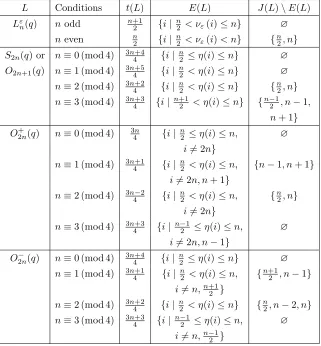
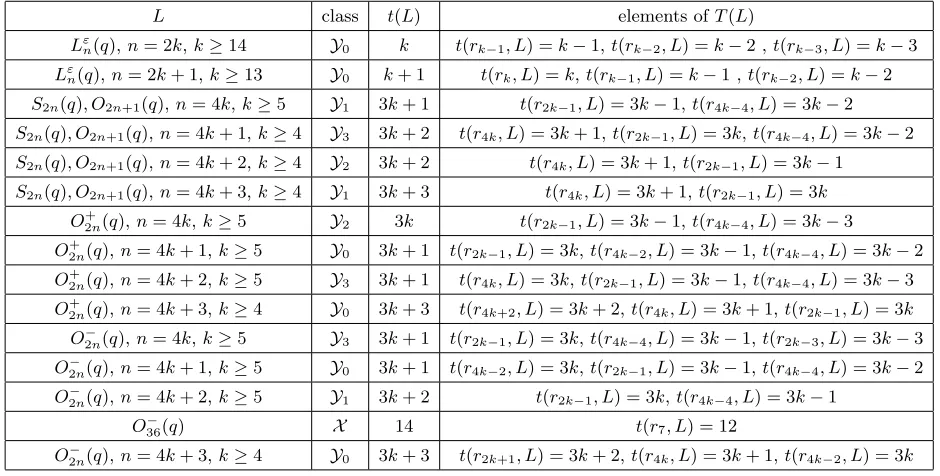
|E(L)| ≤t(L)≤ |E(L)|+ 1. The setsE(L),J(L)\E(L)and numberst(L) are listed in Table 1.
Table 1. Cocliques of greatest size (n≥13)
L Conditions t(L) E(L) J(L)\E(L)
Lε
n(q) nodd
n+1 2 {i|
n
2 < νε(i)≤n} ∅ neven n2 {i| n2 < νε(i)< n} {n2, n}
S2n(q) or n≡0 (mod 4) 3n4+4 {i| n2 ≤η(i)≤n} ∅
O2n+1(q) n≡1 (mod 4) 3n4+5 {i| n2 < η(i)≤n} ∅ n≡2 (mod 4) 3n4+2 {i| n2 < η(i)≤n} {n2, n} n≡3 (mod 4) 3n4+3 {i| n+12 < η(i)≤n} {n−21, n−1,
n+ 1}
O+2n(q) n≡0 (mod 4) 34n {i| n2 ≤η(i)≤n, ∅ i̸= 2n}
n≡1 (mod 4) 3n4+1 {i| n2 < η(i)≤n, {n−1, n+ 1}
i̸= 2n, n+ 1}
n≡2 (mod 4) 3n−2 4 {i|
n
2 < η(i)≤n, {
n
2, n} i̸= 2n}
n≡3 (mod 4) 3n4+3 {i| n−21 ≤η(i)≤n, ∅ i̸= 2n, n−1}
O−2n(q) n≡0 (mod 4) 3n+4 4 {i|
n
2 ≤η(i)≤n} ∅ n≡1 (mod 4) 3n4+1 {i| n2 < η(i)≤n, {n+12 , n−1}
i̸=n,n+12 }
n≡2 (mod 4) 3n4+2 {i| n2 < η(i)≤n} {n2, n−2, n} n≡3 (mod 4) 3n4+3 {i| n−21 ≤η(i)≤n, ∅
i̸=n,n−21}
Following [12], we call a primer∈π(L)large(with respect toL), ifr lies in some coclique of greatest size
in the prime graphGK(L), andsmall(with respect toL) otherwise.
Lemma 3.6. ([12, Lemma 2.7])Let Lbe a simple classical group and n= prk(L)≥13.
(i)If φ(r, L)≥n/2, then ris large with respect toL.
(ii)If r is large with respect toL, thenφ(r, L)≥n/2−1.
(iii) If ρis a coclique in GK(L) andn/2 < φ(r, L) for every r∈ρ, thenGK(L) has a coclique σ of size
t(L)withρ⊆σ.
Lemma 3.7. ([12, Lemma 2.8])LetLbe a simple classical group over a field of orderqandn= prk(L)≥13.
Let L be a simple classical group and n = prk(L) ≥ 13. Let r be small with respect to L and ρ be an
{r}-coclique of greatest size. By Lemma3.7, the setE(ρ\ {r}, L) is contained inJ(L) and does not depend on a choice ofρ, so we denote it byJ(r, L).
It follows from Lemma3.1that primes nonadjacent with 2 in GK(L) are important forL. Let
m(L) ={n∈µ(L)|there existsr∈π(n) such that 2 and rare nonadjacent inGK(L)}.
Lemma 3.8. Let L be a simple classical group over a field of orderqandn= prk(L)≥13.
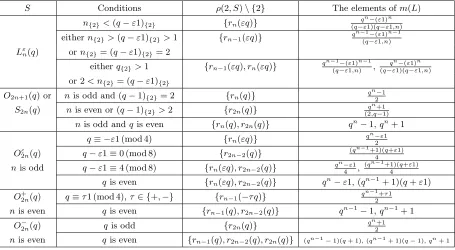
(i)The set m(L)is as in Table 2, in particular, this set is nonempty.
(ii) If r∈ π(L)is nonadjacent with 2 in GK(L)then there exists a unique number x∈m(L) such thatr
divides x.
(iii) IfL=Lε
n(q)andx∈m(L)then
qn−1−ε1 2(n,q−ε1) ≤x≤
2qn−1
(n,q−ε1).
(iv)If L∈ {S2n(q), O2n+1(q)} andx∈m(L)then q
n−1
(2,q−1) ≤x≤
qn+1
(2,q−1).
(v)If L=O2+n(q),nis even, andx∈m(L), then 2(2qn,q−−11) ≤x≤ (22q,qn−−1)1 . (vi)If L=O2−n(q),n is even, andx∈m(L), then 2(2q,qn−1)≤x≤(22,qq−n1). (vii)If L=Oε2n(q),n is odd, andx∈m(L), then 2(4,qqn−ε1) ≤x≤(4,q2q−nε1).
Proof. It follows from [20, Propositions 6.3, 6.6], that if r ∈ π(L) is nonadjacent with 2 in GK(L) then
there exists a maximal {2}-coclique ρ(2, L) containing r. A description of sets ρ(2, L) for a finite simple
classical groupLis contained in [20, Tables 4, 6]. Moreover, information from these tables implies that ifr is
nonadjacent with 2 thenris nonadjacent with the characteristic of the underlying field ofL. So orders inµ(L)
not divisible byrare orders of semisimple elements ofL. Spectrum descriptions of simple classical groups are
contained in [1, 2], in particular, for everyr nonadjacent with 2 in GK(L), there exists exactly one element
in µ(L) dividing onr. We combine mentioned descriptions ofρ(2, L) andm(L) into Table2. Further in this
proof we use the description ofm(L) from Table 2. Denote byxan element fromm(L).
Let L = Lε
n(q). If ε = + then qn−1−1
(n,q−1) ≤ x ≤
qn−1
(q−1)(n,q−1). So x >
qn−1−1
2(n,q−1). Moreover,
qn−1 (q−1)(n,q−1) =
qn−1+qn−2+...+1
(n,q−1) ≤ 2qn−1
(n,q−1), and hence the required inequalities hold for x in this case. If ε = − then
qn−(−1)n
(q+1)(n,q+1) ≤ x ≤
qn−1−(−1)n−1
(n,q+1) . Obviously, we have that
qn−1−(−1)n−1 (n,q+1) ≤
2qn−1
(n,q+1). It remains to check
that (qq+1)(n−(−n,q1)+1)n ≥ 2(qnn,q−1+1)+1. This is equivalent to 2(qn−(−1)n)≥(qn−1+ 1)(q+ 1) which is obviously true
due to n≥13.
Now we prove statements (iv) and (v). If L ∈ {S2n(q), O2n+1(q)} then x= q
n±1
(2,q−1). IfL =O +
2n(q) with evennthenx= q(2n,q−1−±1)1. Obviously required inequalities hold in these cases.
LetL=O2−n(q), wheren is even. If qis odd then x= (qn+ 1)/2 and qn/4< x < qn, as required. Ifq is even then (qn−1+ 1)(q−1)≤x≤(qn−1−1)(q+ 1). Since (qn−1+ 1)(q−1) =qn−qn−1+q−1> qn/2 and (qn−1−1)(q+ 1) =qn+qn−1−q+ 1<2qn, we obtain required inequalities forx.
Let finally L = Oε
2n(q) and n is odd. If ε = + then we have that qn−1
(4,q−1) ≤ x ≤
(qn−1+1)(q+1)
(4,q−1) and the
inequalities for x hold due to (qn−1+ 1)(q+ 1) ≤ 2qn and qn−1 > qn/2. If ε = − then (qn−1+1)(q−1)
(4,q+1) ≤ x≤ (4q,qn+1+1) and the inequalities forxhold due to (qn−1+ 1)(q−1)> qn/2 andqn+ 1<2qn. The lemma is
Table 2. The setm(L), prk(L)≥13
S Conditions ρ(2, S)\ {2} The elements ofm(L)
n{2}<(q−ε1){2} {rn(εq)} q
n−(ε1)n
(q−ε1)(q−ε1,n) eithern{2}>(q−ε1){2}>1 {rn−1(εq)} qn−(q−ε1,n)1−(ε1)n−1
Lεn(q) orn{2}= (q−ε1){2}= 2
eitherq{2}>1 {rn−1(εq), rn(εq)} q
n−1−(ε1)n−1
(q−ε1,n) ,
qn−(ε1)n (q−ε1)(q−ε1,n) or 2< n{2}= (q−ε1){2}
O2n+1(q) or nis odd and (q−1){2}= 2 {rn(q)} q
n−1
2
S2n(q) nis even or (q−1){2}>2 {r2n(q)} q
n+1
(2,q−1) nis odd andqis even {rn(q), r2n(q)} qn−1,qn+ 1
q≡ −ε1 (mod 4) {rn(εq)} q
n−ε1
2
Oε2n(q) q−ε1≡0 (mod 8) {r2n−2(q)} (q
n−1+1)(q+ε1)
4
nis odd q−ε1≡4 (mod 8) {rn(εq), r2n−2(q)} q
n−ε1
4 ,
(qn−1+1)(q+ε1) 4
qis even {rn(εq), r2n−2(q)} qn−ε1, (qn−1+ 1)(q+ε1)
O+2n(q) q≡τ1 (mod 4),τ ∈ {+,−} {rn−1(−τ q)} q
n−1+τ1
2
nis even qis even {rn−1(q), r2n−2(q)} qn−1−1,qn−1+ 1
O−2n(q) qis odd {r2n(q)} q
n+1
2
nis even qis even {rn−1(q), r2n−2(q), r2n(q)} (qn−1−1)(q+ 1), (qn−1+ 1)(q−1),qn+ 1
Lemma 3.9. Let L, S be finite simple classical groups such that prk(L)≥13, prk(S)≥13. Assume that G
is a finite group isospectral toL andS ≤G/K≤AutS, whereK is the soluble radical of G. Then for every
m1∈m(L) there existsm2∈m(S)such thatm2 dividesm1.
Proof. Let m1 ∈m(L). Then there exists r such thatr is nonadjacent with 2 in GK(L) and r divides m1.
Lemma 3.1implies that r∈π(S), and ris nonadjacent with 2 inGK(S). Therefore there exists m2∈m(S)
dividing by r. Applying Lemma3.8(ii), we obtain thatm2 dividesm1, as required. □
Lemma 3.10. Let Lbe a simple classical group over a field of orderq and characteristic p.
(i) IfL=Lε
n(q)andn≥23, then ω(L) contains a numberk withk≥q4t(L)/3 and all prime divisors ofk
are large with respect to L.
(ii)If L∈ {S2n(q), O2n+1(q)} andn≥17, orL=Oε2n(q)andn≥18, thenω(L)contains a numberkwith
k≥qt(L)/2 and all prime divisors ofkare large with respect to L.
(iii) Ifprk(L)≥14then the numbers from ω(L)do not exceedq2t(L)/(q−1).
Proof. The statement (i) is exactly [12, Lemma 2.14 (i)]. It is also proved in [12, Lemma 2.14 (ii)] that ifL∈ {S2n(q), O2n+1(q)}andn≥29, orL=O2εn(q) andn≥30, thenω(L) contains a numberkwithk≥q10t(L)/9 and all prime divisors of k are large with respect to L. So we may assume that if L ∈ {S2n(q), O2n+1(q)}
then n ≤ 28, and if L = Oε
2n(q) then n ≤ 29. It is easy to see that under these assumptions there exists
j such that rj(q) is large with respect to L, j is prime, t(L) < j ≤prk(L), and j ̸= prk(L) if L =Oε2n(q). Then r2j(q) is also large with respect to L. Remind that r2j(q) = rj(−q) and choose ε ∈ {+,−} such that (q−ε1, j) = 1. Now we prove that k = kj(εq) is required. It is clear that all prime divisor of k are
large with respect to L, so it is sufficient to show that k ≥ qt(L)/2. Since (q−ε1, j) = 1, we have that
Now we prove (iii). It follows from [17, Lemma 1.3] that elements ofω(L) do not exceedqm+1/(q−1), where mis the Lie rank ofL. IfLis linear or unitary then by Table1, we obtain thatt(L) ≥ prk(L)/2 = (m+ 1)/2,
and hence elements of ω(L) do not exceed q2t(L)/(q−1), as claimed. If L is symplectic or orthogonal then
by Table 1 we have that t(L) ≥(3m−2)/4. So it is sufficient to prove that (3m−2)/2 ≥ m+ 1. This is
equivalent tom≥4. The lemma is proved. □
Lemma 3.11. ([12, Lemma 2.12])Let Lbe a simple classical group over a field of order qand characteristic
p, and letprk(L) =n⩾4. Ifr∈π(L)\ {p},i=e(r, q), andn/2< φ(r, L)⩽n, thenLincludes a cyclic Hall
subgroup of orderki(q).
4. Proof: restrictions on K and G/S
LetL be the class of simple classical groups whose dimension are as in the hypothesis of Theorem1.3. It
is not hard to check using information in Table1that L∈ Lif and only if 14≤t(L)≤22.
LetLbe a simple classical group over a field of orderq and characteristicpandL∈ L. Suppose thatGis
a finite group isospectral toL. By [20, Theorem 7.1], we have that t(2, L)≥2. Lemma3.1implies that there
exists a nonabelain simple groupS such thatS≤G/K≤AutS, whereKis the soluble radical ofG. Further
in this section we fix groupsG,K, andS. Moreover, we suppose thatS is a simple classical group over a field
of orderuand characteristicv.
The following three propositions are the analogies of the [12, Propositions 3, 4, 5]. There are only two
differences. First, we requireL∈ Linstead of dimL≥40 and, second, there are no exceptions in Proposition
4.2 in contrast to [12, Proposition 4], where there are some additional restrictions in cases of linear and unitary
groups.
Proposition 4.1. Suppose that L ∈ L and q is odd. Then the soluble radical K of G is nilpotent. If
r∈π(K)\ {v}, thent(r, L) = 2, and(s,|K| · |G/S| · |P|) = 1 for everys∈π(L)nonadjacent to r inGK(L)
and every proper parabolic subgroupP of S.
Proposition 4.2. Suppose that L∈ L and q is odd. If a prime r not equal to pdivides the order of G/S,
thenφ(r, L)≤n/3. In particular,ris small with respect toL.
Proposition 4.3. Suppose thatL∈ Landqis odd. If a primeris large with respect toL, then(r, pv|K| · |G/S|) = 1
andke(r,q)(q)∈ω(S). In particular,t(S)≥t(L).
Proposition 4.2will follow from Lemma4.5 and Lemma3.6. Proposition4.1 is proved as [12, Proposition
3] with Lemma 4.5in place of [12, Lemma 4.1]. The proof of [12, Propositon 5] uses [12, Proposition 4], and
the condition dimL≥ 40 is used to conclude that pis not large with respect to L. Actually it is sufficient
to have that t(L) ≥6, which is true since L ∈ L. So the proof of Proposition 4.3 goes as the proof of [12,
Propostion 5] with the changes pointed above.
Lemma 4.4. Let L∈ L, q is odd, r ∈π(L), and r divides |G/S|. Suppose that there exist i, j, i̸=j such
that {r, ri(q), rj(q)} is a coclique in GK(L). Then rdivides eitherki(q)−1 orkj(q)−1.
Proof. Put m = prk(S). Since r divides |G/S|, Lemma3.1(ii) implies that (ri·rj,|G/S| · |K|) = 1 and ri,
rj∈π(S). Assume that φ(ri, S)≤m/2. By Lemma3.4(ii), for allrj∈Rj(q) we obtain thatφ(rj, S)> m/2.
a cyclic Hall subgroup of order kt(u) due to Lemma3.11. Let s ∈π(kj(q)) and P ∈ Syls(S). By Frattini
argument,rdivides|NG(P)|. Letx∈NG(P) and|x|=r. ThenS⟨x⟩is a Frobenius group with kernel S and
complement⟨x⟩, and hence|S| ≡1 (modr). Note that Sylow s-subgroup ofGandSare isomorphic and since
s is an arbitrary element of π(kj(q)) we obtain thatkj(q)−1 is divisible by r. The case φ(ri, S) > m/2 is
exactly the same.
□
Lemma 4.5. Let L∈ Landq is odd. Ifr∈π(L)\ {p}andφ(r, L)> n/3, thenrdoes not divide |G/S|.
Proof. Assume the contrary and let there exists r such that r divides |G/S| and φ(r, L) > n/3. First, we
consider the case L ≃ Lε
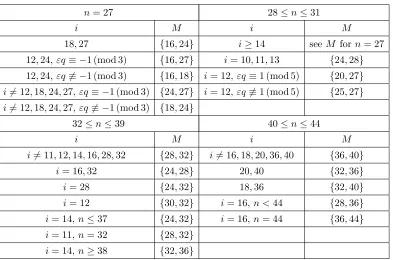
n(q), n ≥27. Put i = e(r, εq) = φ(r, L) and soi > n/3. Let M be the set from Table 3 which depends on n and i. The set consists of two elements that we denote by i1, i2. It is ease to
see thatn/2< i1, i2≤n, sori1(εq),ri2(εq) are large with respect toLby Lemma 3.6(i). Moreover, we have
that i1+i > n,i2+i > n and i1, i2 are not divisible by i. Lemma 3.2 implies thatri1(εq) and ri2(εq) are
nonadjacent withrinGK(L), so{r, ri1(εq), ri2(εq)}is a coclique of size 3 in this graph. By Lemma4.4, there
exists j∈M such thatrdivideskj(εq)−1. Now we prove that it is impossible.
Table 3. SetM forLεn(q)
n= 27 28≤n≤31
i M i M
18,27 {16,24} i≥14 seeM forn= 27
12,24,εq≡ −1 (mod 3) {16,27} i= 10,11,13 {24,28}
12,24,εq̸≡ −1 (mod 3) {16,18} i= 12,εq≡1 (mod 5) {20,27}
i̸= 12,18,24,27, εq≡ −1 (mod 3) {24,27} i= 12,εq̸≡1 (mod 5) {25,27}
i̸= 12,18,24,27, εq̸≡ −1 (mod 3) {18,24}
32≤n≤39 40≤n≤44
i M i M
i̸= 11,12,14,16,28,32 {28,32} i̸= 16,18,20,36,40 {36,40}
i= 16,32 {24,28} 20,40 {32,36}
i= 28 {24,32} 18,36 {32,40}
i= 12 {30,32} i= 16,n <44 {28,36}
i= 14,n≤37 {24,32} i= 16,n= 44 {36,44}
i= 11,n= 32 {28,32}
i= 14,n≥38 {32,36}
Assume thatn= 27. Then i≥10. By the definition ofM, we have thatj∈ {16,18,24,27}. Ifj= 16 then
kj(εq)−1 = (q8−1)/2, and hencei≤8; a contradiction. Ifj = 24 thenkj(εq)−1 =q4(q4−1), and hencei≤4; a contradiction. Ifj= 18 then by Table3, we have thatεq̸≡ −1 (mod 3), and hencekj(εq)−1 =εq3(εq3−1),
i≤3; a contradiction. Finally, ifj = 27 thenεq≡ −1 (mod 3),kj(εq)−1 =εq9(εq9+ 1), and hencei= 18; a contradiction with the choice ofM.
Assume that 28≤n≤31, and hence i≥10. If i≥14 thenM is the same as in the previous case, so this
case j = 24 is regarded as forn = 27. If j = 28 then r divides k28(εq)−1 =q12−q10+q8−q6+q4−q2,
and hence r divides q10−q8+q6−q4+q2−1 = (q2−1)(q8+q4+ 1). Therefore r divides q8+q4+ 1,
and hence q12−1 is divisible by r; a contradiction. So i= 12 and r divides k
j(εq)−1 where j = 20,25 or 27. If j = 20 then εq ≡ 1 (mod 5), and hence k20(εq)−1 = q8−q6+q4−q2 =q2(q2−1)(q4+ 1). So r
divides eitherq2−1 orq4+ 1; a contradiction sincee(r, εq) = 12. Letj= 25 thenεq̸≡1 (mod 5), and hence k25(εq)−1 =εq5(εq5+ 1)(q10+ 1). Sor divides eitherεq5+ 1 orq10+ 1; a contradiction. Thusj = 27. In
this case rdivides k27(εq)−1 = q
18+εq9+1
(q−ε1,3) −1. If (q−ε1,3) = 1 then rdivides q
9(εq9+ 1); a contradiction.
Let (q−ε1,3) = 3 thenk27(εq)−1 = (q9−ε1)(q9+ε2)/3. Sincee(r, εq) = 12, we have thatq9≡ −ε2 (modr).
Then 1 ≡q12 ≡ −ε2q3(modr), and hence 1 ≡ −ε8q9 ≡16 (modr). So r divides 15; a contradiction since e(3, εq), e(5, εq)≤4.
Assume that 32≤n≤39, and hence i≥11. Observe thati= 11 only whenn= 32. By the definition of
M, we have that j ∈ {24,28,30,32,36}. If j= 24 thenr divides kj(εq)−1 =q4(q4−1); a contradiction. If
j= 28 thenkj(εq)−1 =q2(q3−1)(q3+ 1)(q4−q2+ 1). Since (q4−q2+ 1)|(q12−1) andi̸= 12, we obtain a contradiction. If j = 32 then by definition of M we have i̸= 16 and rdivides kj(εq)−1 = (q16−1)/2; a contradiction. if j= 36 thenri(εq) divideskj(εq)−1 =q6(q3−1)(q3+ 1); a contradiction. Thusj= 30, and hencei = 12 by Table3. Sincek30(εq)−1 = εq(q4−1)(εq3+q2−1), we have thatr divides εq3+q2−1.
However, r divides k12(εq) =q4−q2+ 1. Sor dividesεq(εq3+q2−1)−(q4−q2+ 1) =εq3+q2−1−εq.
Thereforerdividesεq; a contradiction.
Finally we assume that 40 ≤ n ≤ 44, and hence i ≥ 14. By the definition of M, we have that j ∈ {28,32,36,40,44}. If j = 28 thenkj(εq)−1 =q2(q3−1)(q3+ 1)(q4−q2+ 1). We get a contradiction, since
i≥14. Ifj= 32 then by Table3, we have thati̸= 16. Thenrdivideskj(εq)−1 = (q16−1)/2; a contradiction. If j = 36 then ri(εq) divides kj(εq)−1 = q6(q3−1)(q3+ 1); a contradiction. If j = 40 then by Table 3,
j ̸= 16 andrdivides k40(εq)−1 =q4(q4−1)(q8+ 1); a contradiction. Thusj = 44, and hencei= 16. Then kj(εq)−1 =q2(q5+ 1)(q5−1)(q8−q6+q4−q2+ 1); a contradiction, since (q8−q6+q4−q2+ 1)|(q10+ 1). ThusLis not a linear or unitary group.
Assume thatLis a symplectic or orthogonal group. We have the similar proof as in the case of linear and
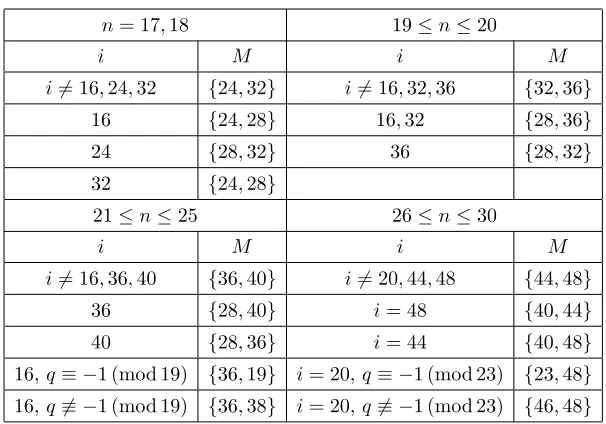
unitary groups. Puti=e(r, q). Thenφ(r, L) =η(i) (see (3.3)). LetM be the set from Table4which depends
onn,i. We have the similar properties ofM as early: M consists of two numbersi1,i2such thatφ(ri1(q), L) =
η(i1)> n/2,φ(ri2(q), L) =η(i2)> n/2,φ(ri(q), L) +φ(ri1(q), L)> n,φ(ri(q), L) +φ(ri2(q), L)> nandi1/i,
i2/iare not odd integers. So{ri, ri1, ri2} is a coclique inGK(L). Lemma4.4 implies that there existsj∈M
such thatrdivideskj(εq)−1. Now we prove that it is impossible sorting out values ofn. By the assumption
of Theorem 1.3, we have that 17≤n≤30. Assume at first thatn= 17 orn= 18. Thenη(i)≥6 orη(i)≥7