Iranian journal of educational Sociology
(Interdisciplinary Journal of Education)Available online at: http://www.iase-idje.ir/ Volume 1, Number 3, October 2017
The effect of Diamond Levitt and knowledge Management on
Organizational Effectiveness
Hossein Khaleghi1, Peyman Akbari2*, Kamran Nazari3
1. Department of Management, Payame Noor University, I.R of IRAN 2. Department of Management, Payame Noor University, I.R of IRAN 3. Department of Management, Payame Noor University, I.R of IRAN
Article history:
Received date: 10 April 2017 Review date: 24 May 2017 Accepted date:22 July 2017 Printed on line: 18 December 2017
Abstract
Purpose: The aim of this study was to examine the impact of Diamond-Levitt and knowledge management, organizational effectiveness, in PNU Kermanshah province. The study was a descriptive - survey. The population of the study, 470 employees of Payame Noor University in Kermanshah province, are included. Using Cochran formula, 212 people were selected.
Methodology: Data collection tools, questionnaires Diamond Levitt, and knowledge management researcher, and organizational effectiveness Parsons (1969). Questionnaire, approved three professors, and reliability with Cronbach's alpha for diamonds Levitt, knowledge management and organizational effectiveness, respectively (86%, 82% and 77%) are. Findings: By SPSS and LISREL, research data were analyzed. The results of the analysis and stepwise linear regression, 95% indicated that the diamond Levitt knowledge management variables (0.226), and organizational effectiveness (0.227) and knowledge management and organizational effectiveness (0.178), have a significant positive effect. The results of the study showed that, in effect Diamond Levitt knowledge management, organizational effectiveness as a mediator (0.263) is. Conclusion: Also in this study to test the conceptual model, structural equation modeling was used, the results of direct effects diamond variable Levitt, knowledge management, (0.87) and organizational effectiveness (0.66), and the direct effect of knowledge management on organizational effectiveness (0.52), and the indirect effect and the effect of variable diamond-Levitt, organizational effectiveness, respectively (0.69) and (0.11) is indicated and the t-statistic is also witness to the significance of the results is. Finally, the mediating role of knowledge management, the relationship between the Diamond-Levitt, and was supported organizational effectiveness, so that the diamond Levitt indirect impact on organizational effectiveness, with the role of knowledge management (indirect effect = 0.69), Levitt diamonds larger than the direct impact on organizational effectiveness (direct effect = 0.66) is. The above results indicate fit (RMSEA = 0.072 and GFI=0.93) was the optimal mode.
Keywords:
Diamond Levitt, knowledge management, organizational effectiveness.
Please cite this article as: Khaleghi H, Akbari A, Nazari K. (2017). The effect of Diamond Levitt and knowledge Management
on Organizational Effectiveness. Iranian journal of educational Sociology. 1(3), 149-160.
* Corresponding Author e-mail: [email protected]
1. Introduction
The organizational theory, Harold Levitt, Levitt, as a complex system, consists of at least four highly dependent variables, which include: (staff, goals/tasks, organizational structure, and information technology). (Joseph & Christopher). It supposed Henry & Baroudi (2014), in this model, showed that each element of the elements of an organization system is interdependent. That is, the change in each of these four elements does not occur alone, and the change in each part of the organization affects the entire system. Quoting in Moradzadeh et al. (2006), on the other hand, today, all working and scientific groups acknowledge that, in order for organizations to have a continuous and stable presence in the world of commerce and competition, they should be around the axis of science and knowledge work. As Peter Drucker also states, "The secret of the success of organizations in the 21st century is the same knowledge management." On the other hand, Nonaka and Takeuchi (1995) argue that knowledge leads to an increase in potential potentials of phenomena for effective actions and decisions within the organization. As Adli (2007) finds that knowledge management is a comprehensive approach to drawing a broad, comprehensive outlook for the organization, with its main focus on creating and applying knowledge, and ultimately, achieving organizational effectiveness.
Therefore, in this age, attention to Diamond Levitt is imperative and inevitable in order to achieve organizational goals. As the organization's success in the implementation of KM is largely dependent on the support and support of Diamond Levitt, which has led to organizational change in the face of dramatic changes, and this itself, profound changes in the type of skill The requirements of individuals, and members of organizations, and will make the organization's effectiveness more effective. On the other hand, the correct implementation of knowledge management will be of great help to organizational effectiveness. Finally, it should be noted that Diamond Levitt will boost the organization's way of doing things, which affects people's perception of the creation and sharing of knowledge in the organization, and thus, the performance of all members of the organization, which is the result of this can be seen in the overall efficiency and effectiveness of the organization. Therefore, the main question of this research is, is Diamond Levitt and knowledge management affect organizational effectiveness at Payame Noor University of Kermanshah?
2. literature Review
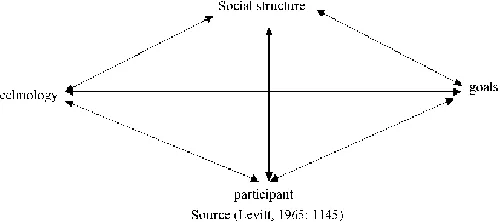
Diamond or lozenge Levitt, as a classic model of an organization, has been emphasized by most scholars. The components of this model are: 1. Social structure; 2. Organizational community; or social actors or participants; 3. Goals; 4. Technology, which is depicted in Chart 1 of this model. Levitt (1965) described the complexity and diversity of organizations by identifying four socio-technical variables (structure, goals, technology, and people), which requires interaction, in a balanced way, to bring about organizational change.
Fig 1. Diamond or Levitt
Barkhoda and Rahimi (2013) define the social organization as "a structure, system, and processes" to create synergies between people and work for achieving strategic goals ", which includes formal education, written procedures, Parts of work, and the organization's physical plan. Jo Hatch (2007), the term "individuals or participants," is used to describe the characteristics of people employed in the organization to produce output, these features include experience, knowledge, skills, and The motivation is that technology, as an available resource, is defined by an organization to carry out its mission. In fact, as a tool, c Assistance is provided to the organization to carry out tasks, as well as mechanisms for converting inputs to outputs. Objectives, as the essential and essential activities that are performed by the organization, unit, individuals to achieve the strategy, define The environment affects demand, and limits, and provides opportunities for the organization. These opportunities, based on market operations, economic conditions and technology, competition, and credible institutions, provide rules and regulations They are supervised. The environment includes available technologies for implementation of the operation. Given the impact of the environment on the organization and its processes, it was not a one-sided influence, but the organization also affected the environment. Each of these organizational elements (social structure, organizational individuals, goals, technology and environment) plays an important role in organizations. In fact, each element of one or more organizational analysts has been considered as the top factor (Scott, 2008).
knowledge management
Knowledge management, as a systematic and coherent process of coordination at the organization level, has been proposed to achieve the major organizational goals. As stated in knowledge-based economy development, knowledge management is one of the cornerstones of competitive advantage (Cowan and paal, 2000). But one of the key challenges in knowledge management is the precise understanding of its concept (Alavi and Leidner, 2005). Because many years after the start of the KM discussions, many people have given various definitions of their work field, but a single definition of knowledge management has not yet been stated in the scientific community. So what should you say is Knowledge Management, Yogesh (2009), KM to create, share and influence knowledge on people's thoughts, minds and imagination, and strive to make scattered knowledge in the organization's people to collect and manage in a way to create new knowledge. Shankar and Gupta (2005) Knowledge Management The collection, organization, categorization and distribution of information within an organization is also defined. Hasanzadeh (2006), Knowledge Management, the ability of an organization to use its collective knowledge, through the process of creating, sharing and extracting knowledge, using technology to achieve the goals of the organization. Ramasami et al. (2005), KM, develops easy, systematic, measurable, and easy to maintain work practices. Daft, (1995), KM, involves management efforts in facilitating the acquisition, creation, storage, sharing, dissemination, development, and dissemination of knowledge by individuals and groups. According to the above definitions, organizations need knowledge to increase their ability to improve their services and, as a result, their clients' benefits (Hatami Nasab and Zingjirchi, 2011).
Heng et al. (2005), while knowledge is not easily measurable, organizations need to effectively manage knowledge in order to gain the benefits of the skills, experience and tacit knowledge of employees in the system and their structure. Many frameworks are known for knowledge management processes. In this study, we examine the three stages of knowledge acquisition, knowledge sharing and distribution, and knowledge responsiveness. Cooke (2005), knowledge acquisition, the process of interpreting knowledge is a special field, with which the individual performs the activities of that field. One of the main goals of managers in the use of knowledge management in organizations is the improvement of knowledge sharing among individuals in the organization, as well as between individuals and organizations, in order to create a competitive advantage. Lee (2001), the effective sharing of knowledge among members of the organization, leads to cost reductions, to the production of knowledge, and to ensuring the dissemination of best practices, internally organized, and enables the organization to solve its problems. Hsieh (2007), so all activities related to the transfer, or distribution of knowledge from one person or organization to an
individual, group or organization, are known as the process of disseminating or sharing knowledge. Manavarian et al. (2007), in an organization that has a knowledge sharing culture, people share their ideas and insights with others, because instead of having to do this, they consider it a natural process. Therefore, it is necessary to create among the members of the organization the motivation to share knowledge in the organization without fear of losing their position. Adli (2007), knowledge accountability means that knowledge, with its innovative and dynamic features, enables the ability to respond to the features of the new environments.
Forbes (1998), Organizational Effectiveness is the degree to which the organization achieves its goals. Organizational effectiveness is a powerful and problematic concept. Effectiveness, as a powerful concept, is a useful tool for evaluating, and definitively improving the work of the organization, and problematic in the sense that you can have a different meaning for different people. Ardalan et al. (2012), organizational effectiveness plays an important role in organizational development. Zheng et al. (2010), Organizational Effectiveness is the extent to which an organization fulfills its goals by utilizing certain resources, without waste of its resources, and without exhausting the unnecessary members of its community. In fact, organizational effectiveness shows the degree of the organization's proximity to its goals. In other words, the extent to which an organization achieves its goals. Given the above, you must say that the first point to be received is that, with efficacy, an organization achieves its goals. But what's more important is the organization's survival in the beam of the same effectiveness. But we must remember that we should not assume that organizations that are not effective are not seeking survival (Akbri et al., 2015). In this study, organizational effectiveness evaluation measures, derived from Parsons (1969), include innovation = adaptability, organizational commitment = goal gains; job satisfaction = unity and organizational health (morale) = maintaining patterns. Ardalan et al. (2012) 1) adaptation means the acquisition of sufficient resources, (2) achieving the goal, ie, targeting and implementing it, (3) coherence, namely the establishment and maintenance of cooperation and coordination between sub-systems of the system, and (4) continuity and preservation of patterns Culture, which means creating, preserving and transferring the culture and values of the system.
Ali Ahmadi et al. (2014) investigated and explained the role of knowledge management in the effectiveness of the learning organization, Case Study, University of Science and Technology. The results showed that knowledge management is effective in the effectiveness of the learning organization. Reisi et al. (2013) examined the role of knowledge management on organizational effectiveness in selected sport organizations of the country. The results showed that knowledge management is effective on organizational effectiveness. Dalavi et al. (2013) examined the role of knowledge management mediation in the relationship between diamond-levitate variables and organizational effectiveness (Case: Governmental systems of Isfahan). The results showed that there is a significant relationship between knowledge management, the relationship between diamond variables and the effectiveness of Levite. Omidi et al. (2012) examined the relationship between organizational culture, the effectiveness of knowledge management, and organizational effectiveness in some Iranian sports organizations. The results showed that organizational culture affects the effectiveness of knowledge management and organizational effectiveness as well as the effectiveness of knowledge management on organizational effectiveness. Sepehri Far (2012), in a study, investigated the relationship between knowledge management and organizational effectiveness in employees of the General Office of Sports and Youth in Yazd province. The results showed that knowledge management has a significant relationship with organizational effectiveness. Rahman et al. (2013) examined the relationship between knowledge management and organizational effectiveness. The results showed that knowledge management has a meaningful relationship with effectiveness. Natasha and Violeta (2012) examined the relationship between knowledge management and organizational effectiveness. The results showed that knowledge management has a significant relationship with effectiveness. Ewest (2010) examined the relationship between knowledge management and organizational effectiveness. The results
showed that knowledge management has a significant relationship with organizational effectiveness. Smith and Mills (2010) investigated the impact of knowledge management on organizational effectiveness. The results showed that knowledge management is effective in the effectiveness of the organization. Zheng et al. (2010) examined the impact of organizational culture, organizational strategy and effectiveness, with regard to the role of the mediator of knowledge management. The results showed that knowledge management, there is a significant relationship between the variables of Diamond Levitt and its effectiveness, organizational structure culture, and organizational strategy and effectiveness, with respect to the role of mediator of knowledge management.
So, finally, it should be said that, with the studies, and previous research records in similar fields, doing research that, in this way, relates the criteria set out in the management literature in terms of Diamond Levitt, and knowledge management on effectiveness Organizational, in universities and higher education institutions of the country, has not been studied, and in other words, this research is the first research in this field.
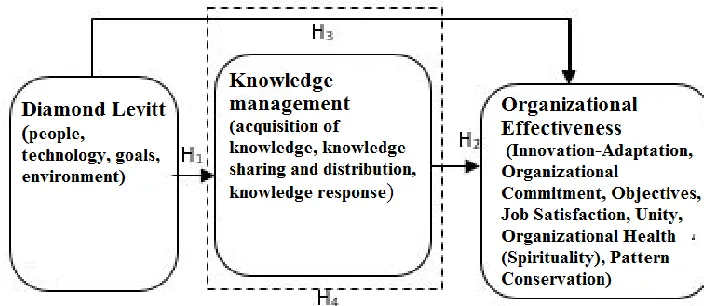
According to the research model, the research hypotheses are as follows. It should be noted that, in the following hypotheses, the dimensions of variables are also individually examined.
Hypothesis 1: Diamond Levitt has an impact on knowledge management.
Hypothesis 2: Knowledge management has an impact on organizational effectiveness.
Hypothesis 3: Diamond Levitt has an impact on organizational effectiveness.
Fourth hypothesis: Diamond Levitt has a mediator role in influencing knowledge management on organizational effectiveness.
Fig 2. Conceptual Model of Research
3. Methodology
This research is descriptive-survey. The statistical population of this research includes 470 employees of Payame Noor University in Kermanshah province. The statistical sample, according to Cochran formula, was determined 212 people, and the subjects were selected by simple random sampling method. To collect data, a researcher-made Diamond-Lewitt questionnaire, consisting of 10 questions, and a researcher-made knowledge management questionnaire, containing 15 questions, and the Parsons organizational effectiveness inventory (1969), which included 28 questions have been used. In this study, in order to determine the validity of the measurement tool, content validity was first used by other studies, and the literature related to the subject of the research was localized, and then the ability to measure the desired attributes in the questionnaire Was approved by a group of university professors. Then, for confirming the construct validity, a confirmatory factor analysis was used. The results indicated that the factor load of all
items was above 0.5, which indicated the proper validity of the instrument. In order to determine the reliability of the questionnaire, its internal consistency, with the help of SPSS software and with Cronbach's alpha coefficient, was presented for the various factors of the questionnaire.
Table 1. Calculate the results of the alpha coefficient
Table 2. Demographic characteristics of the sample
feature Group(percent) gender Female (25%) Man (75%) Age 30-40 (85%) 41-50 (14%)
older than 51 years (1%)
Job post Officers and Vice-Presidents (7%)
Faculty (17%) Staff (76%)
4. Finding
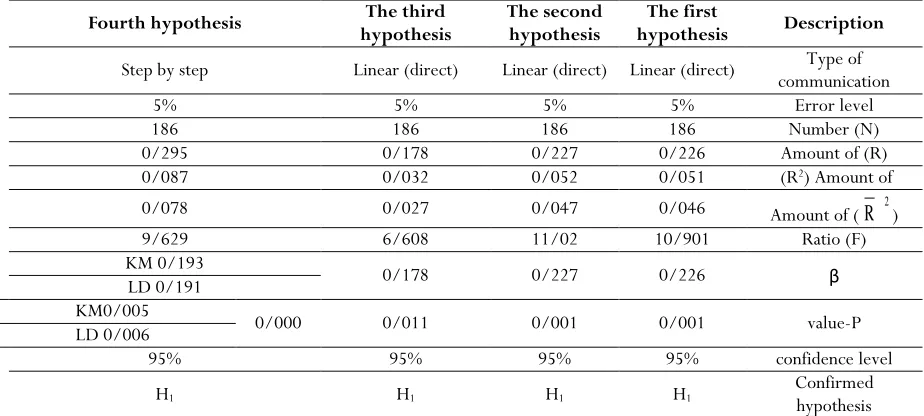
In this research, SPSS software (linear and stepwise regression) was used to analyze the hypotheses of the research, and to test the conceptual model of the research, Liserel software was used.
Table 3. Relations between variables and examining assumptions
Description The first hypothesis The second hypothesis The third hypothesis Fourth hypothesis Type of communication Linear (direct) Linear (direct) Linear (direct)
Step by step
Error level 5% 5% 5% 5% Number (N) 186 186 186 186
Amount of (R) 0/226
0/227 0/178
0/295
(R2) Amount of 0/051
0/052 0/032
0/087
Amount of ( ) 0/046 0/047 0/027 0/078 Ratio (F) 10/901 11/02 6/608 9/629 β 0/226 0/227 0/178 KM 0/193 LD 0/191 value-P 0/001 0/001 0/011 0/000 KM0/005 LD 0/006 confidence level 95% 95% 95% 95% Confirmed hypothesis H1 H1 H1 H1
The findings of the first hypothesis study indicate that Diamond Levitt has a significant effect on knowledge management, with a significance level of 0.001, and an acceptable error level (5%), and 95% You are That is, the H1 hypothesis, which expresses the existence of an effect, is confirmed.
The findings of the second hypothesis study indicate that knowledge management has a significant effect on organizational effectiveness, with a significance level of 0.001, and an acceptable level of error (5%), with a 95% confidence. Be That is, the H1 hypothesis, which expresses the existence of an effect, is confirmed.
The findings of the third hypothesis show that Diamond Levitt has a significant effect on organizational effectiveness, with a significance level of 0.11 and an acceptable level of error (5%), and 95% confidence in the meaning of the effect You Are That is, the H1 hypothesis, which expresses the existence of an effect, is confirmed. 2 R Diamond-Lewitt knowledge management organizational effectiveness All factors Cronbach's alpha 0/86 0/82 0/77 0/82
Findings from the study of the fourth hypothesis indicate that knowledge management in the influence of Diamond Levitt has an intermediary role on organizational effectiveness?
According to the first hypothesis, Diamond Levitt entered the equation alone, its effect on KM is 0.26, and is statistically significant. According to the second hypothesis, knowledge management alone enters into the equation, its effect on organizational effectiveness is 0.227, and is statistically significant. And according to the third hypothesis, Diamond Levitt entered the equation alone, its effect on organizational effectiveness is 0/178, and is statistically significant. Finally, knowledge management, along with Diamond Levitt, enters into an equation that their effects on organizational effectiveness is 0/295, on the other hand, it is statistically significant, on the other hand, these two variables indicate They are interconnected because and since each one has the highest and the least effect on organizational effectiveness, respectively, KM (0/193), and Diamond Levitt (0/191). So, it should be said that knowledge management can have an impact on organizational effectiveness (0.193) (0/193), but while Levitt Diamond can affect the organizational effectiveness by a factor of (0/191) Have Therefore, the knowledge management variable, as a mediator role, can increase the effectiveness of Levitt diamonds, and will increase to 0/295.
Therefore, the fourth hypothesis is confirmed.
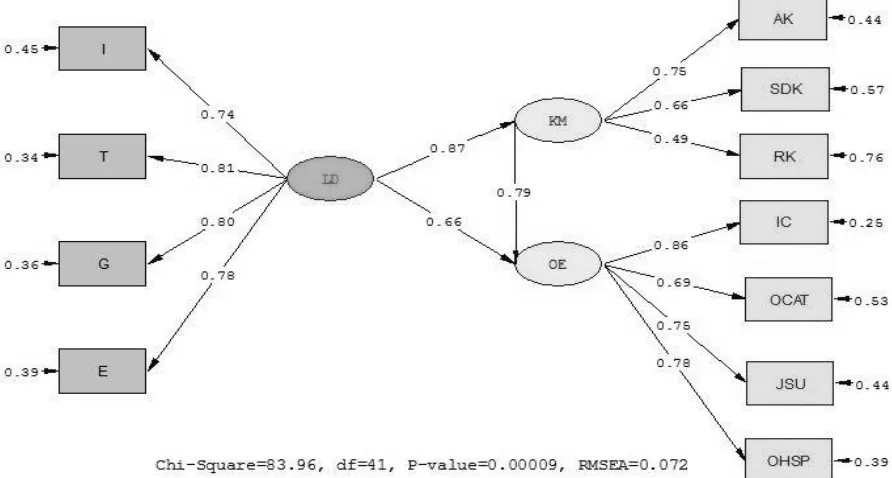
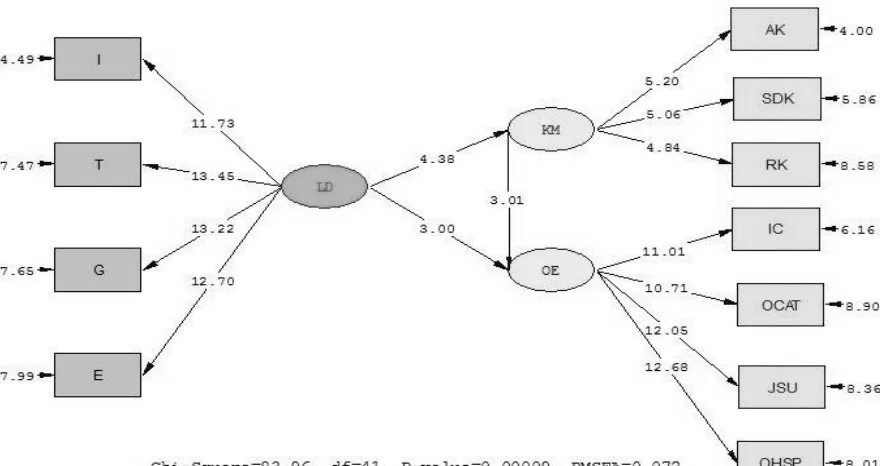
Fig 3. Standard Structural Equations: Diamond Levitt (LD), Knowledge Management (KM), and Organizational Effectiveness (OE)
Fig 4. Significant coefficients between Diamond Levitt (LD), Knowledge Management (KM), and Organizational Effectiveness (OE)
Analysis of data 3 and 4 shows that the value of the squares is 91.96 and the significance level of 0.05 was not significant, considering that if the value of the squares is meaningful, the difference between the model and the data is indicative of poor fit of the model (Kalantari, 2009); therefore, in this study, considering the insignificance of the squared test, it can be concluded that the model has a good fit. Is. Similarly, the root mean square error estimate (RMSEA) and the fitting goodness index (GFI), respectively, with a value of 0.072 and 0.93, indicate a good fit between the structured model (the model is conceived), with Empirical data has been provided, and a suitable template can be found for the structure related to employee empowerment. Thus, emphasizing on structural equations, an appropriate model for organizational effectiveness has been designed, and optimal fit is a representation of the modeling of structural equations with an emphasis on the dimensions of Levitt diamond and knowledge management with organizational effectiveness at Payame Noor University of Kermanshah. Other fitting model indicators include: NFI (Fitness Smooth Index), NNFI (Unfinished Fitness Index), RMSR (Root Mean Squares Remaining Index) and RFI (Suitable Index), and CFI (Comparative Index Fitting), so that the model has the proper fit that the RFI, CFI, NNFI, NFI is 90% greater, as well as RMSR less than 5%, and
the lower the χ 2 / df index It is better (Kalantari, 2009). The results of this amount of indicators are
presented in Table 4.
Table 4. Fit indexes of research model
index Benchmarking
current situation
χ2 Expected Frequency Difference And observed
83.96
df Larger than zero
41
χ2/df 0≤ χ2/df ≤ 2
2.04
RFI more than 90%
94%
CFI more than 90%
98%
NNFI more than 90%
97%
NFI more than 90%
95%
RMSR less than 5%
2%
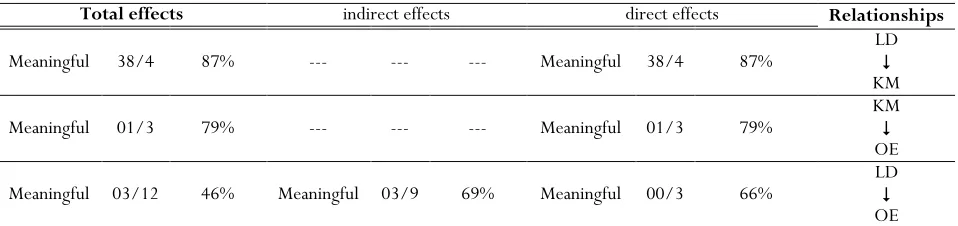
Table 5. Direct and indirect effects, and all variables on each other Relationships direct effects indirect effects Total effects S t r u c t u r a l c o e f f i c i e n
tf g n i n a et M
u
l l a r u t c u r t S
c o e f f i c i e n
t f g n i n a et M
u
l l a r u t c u r t S
c o e f f i c i e n
t f g n i n a e t M
u l LD KM 87% 38/4 Meaningful --- --- --- 87% 38/4 Meaningful KM OE 79% 01/3 Meaningful --- --- --- 79% 01/3 Meaningful LD OE 66% 00/3 Meaningful 69% 03/9 Meaningful 46% 03/12 Meaningful
According to Table 5, the direct effect of Diamond Levitt's variables on knowledge management is 0.87, and t's statistic is a significant coefficient. It should be noted that the diamond-levitate variable does not have an indirect effect on knowledge management. In addition, direct effect on knowledge management was measured on organizational effectiveness of 0.52, which is statistically significant. However, it is also noted that knowledge management has no indirect effect on organizational effectiveness. Finally, the direct effect of Diamond Levitt's variable on organizational effectiveness is 0.66, which is statistically significant for this coefficient. On the other hand, it can be seen that the indirect effect of Diamond-Levitt variable on organizational effectiveness is 0.69, which, according to t, is a significant coefficient. The overall effect of Diamond Levitt's variable on organizational effectiveness is 0.19, which is significant. For the fourth hypothesis, it should be said that since the results of structural model analysis have shown, Diamond Levitt has a direct and significant effect on knowledge management, and also knowledge management has a direct and significant effect on organizational effectiveness. has it. As a result, the role of mediation in knowledge management was supported in the relationship between Diamond Levitt and organizational effectiveness, so that the indirect effect of Levitt diamond on organizational effectiveness, with the presence of the role of knowledge management (indirect effect = 0.69), Greater than the direct effect of Diamond Levitt, on organizational effectiveness (direct effect = 0.66).
5. Discussion
Diamond Levitt has been highly regarded in many countries. As most countries have invested heavily in this field. The present research is an attempt to analyze the effect of Levitt diamond and knowledge management on organizational effectiveness at Payame Noor University of Kermanshah. The results of the first hypothesis study showed that Levitt diamond has a significant effect on knowledge management. So, you should say that the organization must pay attention to the dimensions of lozenge Levitt, in order to apply knowledge in the organization correctly. In other words, considering the dimensions of lozenge Levitt, the relevant organization today can be proud in a competitive environment, because it will manage knowledge well, which is why, in today's competitive environment, organizations need to manage Knowledge has become more. The results of this hypothesis are also consistent with Dalavi et al. (2013). In the second hypothesis of the research, the significant effect of knowledge management on organizational effectiveness was confirmed. Therefore, the organization should emphasize on the learning, production and application of knowledge and information in the university, along with attention to emotions, feelings, intimacy, support and influence on employees, in order to increase organizational effectiveness. In other words, if the organization, today wants to survive in a climate full of survival and continuity, must be concerned with managing the knowledge of its employees, in this way, it will also contribute to the organizational effectiveness. The results of this hypothesis are also related to the researches of Ali Ahmadi
et al. (2014), Raisi et al. (2013), Dalavi et al. (2013), Omidi et al. (2012), Sepehri Far (2012), Rahman et al. (2013), Natasha and Violeta (2012), Ewest (2010) Smith and Mills (2010), Zheng et al. (2010). By examining the third hypothesis of the research, the role of Diamond Levitt on organizational effectiveness was examined, which showed that they had a significant effect on each other. According to this finding, it can be concluded that Payame Noor University of Kermanshah should pay much attention to organizational effectiveness, taking into account the role of the knowledge management, because it takes into account the dimensions of lozenge Levitt an organization, well-managed knowledge, and managed knowledge will increase its effectiveness. The results of this hypothesis are also consistent with Dalavi et al. (2013).
In the fourth hypothesis of the research, the role of the mediator of knowledge management in the influence of Diamond Levitt was examined on organizational effectiveness, and the results showed that, in the influence of Diamond Levitt, on the organizational effectiveness, knowledge management has a mediating role, that is, variable knowledge management It can increase the positive effect that Diamond Levitt has on organizational effectiveness. Therefore, Payame Noor University of Kermanshah, to enhance the organizational effectiveness of diamond surfaces, must pay particular attention to knowledge management, and this can also be achieved through the consideration of Diamond Levitt. Since, in the conclusion of the first hypothesis, diamond- Levitt can have a significant effect on knowledge management. In the end, and according to the results of the structural equation model, we can say that these results are consistent with the regression test, and again the hypotheses of the research are confirmed. In other words, the direct influence of Diamond Levitt on knowledge management, and organizational effectiveness, and the direct impact of knowledge management on organizational effectiveness, as well as the indirect impact of Diamond Levitt, have been confirmed on organizational effectiveness. And by approving this conceptual model of research, it can be considered as an empirical model that can be used as a guide and basis for future scientific and practical research.
Proposals related to the first hypothesis: The first hypothesis is Diamond Levitt, which affects knowledge management. Since this hypothesis is confirmed, it is suggested that: 1. The organization's emphasis on the dimensions of lozenge Levitt, in this way, applies knowledge in the organization correctly. 2. Given the size of the organization's lozenge Levite, today it can be proud in a competitive environment, because it will manage knowledge well, which is why, in today's competitive environment, organizations have become more knowledge management.
Proposals related to the second hypothesis: Second hypothesis: knowledge management affects organizational effectiveness. Since this hypothesis is confirmed, it is suggested that: 1. The organization will emphasize the learning, production and application of knowledge and information at the university, along with attention to emotions, feelings, intimacy, support and influence on employees, in order to increase organizational effectiveness. 2. The organization, if it wants to survive and survive in a climate of change, must now be mindful of the management of its employees' knowledge, and will also contribute to its organizational effectiveness.
Proposals related to the third hypothesis: Hypothesis 3: Diamond Levitt has an impact on organizational effectiveness. Since this hypothesis is confirmed, it is suggested that: 1. Considering the dimensions of the organization's lozenges, well-managed knowledge, and manageable knowledge will increase effectiveness. This article is from a research project sponsored by Payame Noor University. (Executor: Peyman Akbari).
References
Adli F. (2007). From Knowledge Management to Enabling Knowledge Creation, Rahyaft Monthly. p: 47.
Akbari P, Safarian M, Dolatyari F. (2015). of Organizational Effectiveness. Journal of Productivity and Development (JPD). 2 (1). pp: 29-32.
Alavi M, Leidner D. (2005). Knowledge management and knowledge management systems. MIS Quarterly,25(1). pp:107-136. Ali Ahmadi A, Akhavan P, Bagheri M. (2009). Investigating and explaining the role of knowledge management in the
effectiveness of the learning organization (Case study; Iran University of Science and Technology), Management Research Journal, 13 (38). pp: 5 -22
Ardalan M R; Eskandari A, Gilani M. (2012). Knowledge Leadership, Organizational Intelligence, and Organizational Effectiveness. Strategic Management Studies, No. 12. pp: 100-71
Barkhoda S J, Rahimi A. (2013). Educational Management Educational Complex 1, Tehran, Mehr Sobhan Publication, Second Edition. p: 13
Cooke J N. (2005). Knowledge elictitation, Chapter submitted to Handbook of Applied Cognition.
Cowan R, Paal G V D. (2000). Innovation Economy, publication no. Eur 17023 of the commission of European communities Luxembourg. pp: 43
Daft R L. (1995). Organizational theory and design. St. Paul: West Publishing.
Dalavi M R, Ghorbani H, Kadkhodaee M. (2013). Investigating the role of mediation of knowledge management in the relationship between diamond variables of Levitt and organizational effectiveness (Case: Isfahan state-owned machinery), 1st National Conference on Accounting and Management.
Danaeefar H, Khaef ellahi A, Hoseini S M. (2011). A reflection on the promotion of knowledge sharing in the light of organizational citizenship behavior (Case Study: Ministry of Housing and Urban Development, and the Ministry of Roads and Transportation), Public Management Research, 4 (14). pp: 84-63.
Ewest T. (2010). Knowledge Management and Organizational Effectiveness: Considering Applications for Leadership. Journal of Business & Economics Research (JBER). 8 (9). PP: 137-140
Forbes D. (1998). Measuring the unmeasurable: Empirical studies of nonprofit organization effectiveness from 1977 to 1997. Nonprofit & Voluntary Sector Quarterly. 27(2): 183-202.
Hasanzadeh M. (2006). Knowledge management in the public sector. Iranian newspaper, Thursday, February 12, 2006, thirteenth, No. 3561. p: 8.
Hatami Naseb S H, Zanjirchi S M. (2011). The role of infrastructure and the knowledge management process in the path of agility of the textile industry of the country. Industrial Management Outlook, 1. pp: 135-151
Henry C, Lucas Jr, Jack baroudi. (2014)."The Role of Information Technology in Organization Design” Center for Digital Economy Research Stern School of Business working Paper IS-93-48
Hsieh H J. (2007). Organizational characteristics. Knoeledg management strstegy. Enables, and process capability: knowledge management performance in U.S. software.
Hung Y C, Huang S M, Lin Q P, Tsai M L. (2005). Critical factors in adopting a knowledge management system for the pharmaceutical industry. Industrial Management & Data Systems; 105(2). pp:164-83.
Joach M. (2007). Organization Theory (Modern Symbolic and Transformational) "Translated by Danaee Far., Tehran, Publication of Afkar.
Joseph J, Sundland Christopher J, Carrol. (2008).” Thesis: Transforming Data and Metadata into Actionable Intelligence and Information Within the Maritime Domain” Naval Postgraduate School.
Kalantari K. (2009). Modeling of structural equations in socioeconomic research. Tehran: Publishing of Farhang Saba.
Leavitt H J. (1965). Applied organizational change in industry: structural, technical and humanistic approaches, in March, J. G. (ed.), Handbook of Organizations. 1144-1170.
Lee J N. (2001). The impact of knowledge sharing. Organizational capability and partnership quality on is outsourcing success. Information and management. 38 (5). PP: 5323-35.
Manavarian A, Asgari N, Ashna M. (2007). The structural dimensions and content of knowledge-based organizations. First National Knowledge Management Conference.
Moradzadeh M, Karimi B, BehAzin F. (2006). Ten Success Factors in Knowledge Management in Organizations. Tadbir Monthly, 13 (69). pp: 32-36
Natasha BT, Violeta M. (2012). Influence of knowledge management system on organization effectiveness in Macedonian organization. Computing Technology and Information Management (ICCM), 2012 8th International Conference on.Vol (1), PP: 299-304
Nonaka E, Takeuchi. (1995). The Knowledge Creation Company How Japanies Companies Create the Dynamics of Innovation. Oxford University Press.
Omidi A, Tondnavis F, Ahmad Mozafari S A. (2012). The Relationship between Organizational Culture, Effectiveness of Knowledge Management, and Organizational Effectiveness, in some Iranian Sports Organizations, Two Research Papers on Sport Management and Motor Behavior, 2 (4). pp: 87-104
Rahman AA, Imm Ng S, Sambasivan M, Wong F. (2013). "Training and organizational effectiveness: moderating role of knowledge management process", European Journal of Training and Development, 37 (5). pp: 472 – 488
Ramasamy Bala, Goh K W, Yeung Matthew C H. (2005). "Guanxi (relationship) a bridge to knowledge transfer", Journal of Business Research, 1 April.
Reisi M, Hoseini E, Talabpoor M, Nazari V. (2013). The fitting of the regression equation of knowledge management, and organizational effectiveness, in selected sport organizations of the country, sports management, 5 (4), pp: 47-65.
Scott R. (2008). Organizations: Rational Systems, Open Natural, Hassan Mirzaee Ahrenjani Translation. Tehran Publication Department.
Sepehrifar N. (2012). The relationship between knowledge management and organizational effectiveness in the staff of the General Office of Sports and Youth in Yazd province. Master's Thesis, Payame Noor University of Tehran - Faculty of Physical Education and Sport Sciences.
Shankar A, Gupta. (2005). "Towards Framework for Knowledge Management Implementation", Knowledge and Process Management. 12 (4). pp: 77-259.
Smith A T, Mills M A. (2010). “Exploring the impact of knowledge management capabilities on organizational effectiveness”. International conference on information.
Yogesh M. (2009). "Knowledge Management for E-Business Performance: Advancing Information Strategy to ‘Internet Time’", Information Strategy: The Executive's Journal, 16 (4). pp: 5-16.
Zheng W, Yang B, McLean N G. (2010). “Linking organizational culture, structure, strategy and organizational effectiveness: mediating role of knowledge management”. Journal of business research. 63 (7). pp:763-771.