REVIEW
Quantitation of Fiber Quality and the Cotton Production-Processing Interface:
A Physiologist's Perspective
Judith M. Bradow* and Gayle H. Davidonis
INTERPRETIVE SUMMARY
Two simple words, fiber quality, mean quite different things to cotton growers and to cotton processors. Growers think about those words when the USDA classing office tells them that bale averages for one or more of the fiber properties fall into the price-discount (penalty) range. Processors think about those words when they incur costly disruptions in yarn-spinning processes and when significant defects appear in yarn and finished fabrics because the fiber-property ranges in the bale laydown mix fell outside the non-penalty ranges.
Bales of low-quality cotton fibers that cannot be processed successfully can be returned to the producers, who have no means available for recovering the production costs of rejected cotton. No after-harvest mechanisms are available to either growers or processors that can improve intrinsic fiber quality.
Most cotton production research by physiologists and agronomists has been directed toward improving yields, so the few cultural-input strategies suggested for improving fiber quality during the production season are of limited validity. Thus, producers have limited alternatives in production practices that might result in fibers of acceptable quality and yield without increased production costs.
Fiber processors seek to acquire the highest quality cotton at the lowest price, and attempt to meet processing requirements by blending bales with different average fiber properties. Of course, bale averages for fiber properties do not describe the fiber-quality ranges that can occur within the bales
or the resulting blends. Further, the natural variability among cotton fibers unpredictably reduces the processing success for blends made up of low-priced, lower-quality fibers and high-priced, higher-quality fibers.
Blends that fail to meet processing specifications show marked increases in processing disruptions and product defects that cut into the profits of the yarn and textile manufacturers. Mill owners do not have sufficient knowledge of the role classing-office fiber properties play in determining the outcome of cotton spinning and dyeing processes. This lack of knowledge leaves them with no way to explain, let alone avoid, defective yarn or fabric. The result is that they must sell defective fibers at a deep discount, if at all.
Even when a processor is able to make the connection between yarn and fabric defects and increased proportions of low-quality fibers, producers have no way of explaining why the rejected bales failed to meet processing specifications when the bale averages for important fiber properties fell within the acceptable ranges.
If, on the other hand, the causes of a processing defect are unknown, neither the producer nor the processor will be able to prevent or avoid that defect in the future. Any future research that is designed to predict, prevent, or avoid low-quality cotton fibers that cause processing defects in yarn and fabric must address the interface between cotton production and cotton processing.
Every bale of cotton produced in the USA crosses that interface via the USDA-AMS classing offices, which report bale averages of quantified fiber properties. Indeed, fiber-quality data reports from classing offices are designed as a common quantitative language that can be interpreted and understood by both producers and processors. But the meaning and utility of classing-office reports can vary, depending on the instrument used to evaluate J.M. Bradow and G.H. Davidonis, USDA-ARS, Southern
the fibers and on the perspectives of those discussing or applying the fiber-quality reports.
For example, fiber maturity is a composite of factors, including inherent genetic fineness compared with the perimeter or cross section achieved under prevailing growing conditions and the relative fiber cell-wall thickness and the primary-to-secondary fiber cell-wall ratio, and the time elapsed between flowering and boll opening or harvest. While all the above traits are important to varying degrees in determining processing success, none of them appear in classing-office reports.
Micronaire, which is often treated as the fiber maturity measurement in classing-office data, provides an empirical composite of fiber cross section and relative wall thickening. But laydown blends that are based solely on bale-average micronaire will vary greatly in processing properties and outcomes.
Cotton physiologists who follow fiber development can discuss fiber chronological maturity in terms of days after floral anthesis. But, they must quantify the corresponding fiber physical maturity as micronaire readings for samples pooled across several plants, because valid micronaire determinations require at least 10 g of individualized fiber.
Some fiber properties, like length and single fiber strength, appear to be simple and easily understood terms. But the bale average length reported by the classing office does not describe the range or variability of fiber lengths that must be handled by the spinning equipment processing each individual fiber from the highly variable fiber population found in that bale. Further, after more than 70 yr of research, single fiber strength data have yet to be correlated with yarn strength. Yarn strength is the processing result of greatest interest to yarn and textile manufacturers (Bradow, 1999a).
Even when a processing problem can be linked directly to a substandard fiber property, surprisingly little is known about the causes of variability in fiber shape and maturity. For example:
ü Spinners can see the results of excessive variability in fiber length or strength when manifested as yarn breaks and production halts.
ü Knitters and weavers can see the knots and slubs or holes that reduce the value of fabrics made
from defective yarns that were spun from poor-quality fiber.
ü Inspectors of dyed fabrics can see the unacceptable color streaks and specks associated with variations in fiber maturity and the relative dye-uptake success.
ü The grower, ginner, and buyer can see variations in color or trash content of ginned and baled cotton.
But there are no inspectors or instruments that can see or predict any of the above quality traits of fibers while they are developing in the boll.
There is no definitive reference source, model, or database to which a producer can turn for information on how cultural inputs could be adapted to the prevailing growth conditions of soil fertility, water availability, and weather (temperature, for example) to produce higher quality fiber. The scattered research publications that address fiber quality, usually in conjunction with yield improvement, are confusing because their measurement protocols are not standardized and results are not reported in terms that are meaningful to either producers or processors. Thus, physiological and agronomic studies of fiber quality frequently widen, rather than bridge, the communication gap between cotton producers and processors.
This overview assembles and assesses current literature citations regarding the quantitation of fiber quality (specifically, those fiber properties reported by USDA classing offices) and the manner in which irrigation, soil fertility, weather, and cotton genetic potential interact to modulate fiber quality. The ultimate goal is to provide access to the best answers currently available to the question of what causes the annual and regional fiber quality variations that are so apparent in the yearly charts of fiber properties provided in the Fiber Quality section of the Cotton Inc. Web site. (http://www.cottoninc.com).
ABSTRACT
Traditionally, ideal cotton (Gossypium ssp.) fibers are said to be as white as snow, as strong as steel, as
fine as silk and as long as wool. It is difficult to
early 1980s in the USA, the USDA-AMS cotton classing offices have become the primary connection for fiber quality between cotton producers and processors. The high volumes of cotton passing through the classing offices every year have forced workers there to make compromises for the sake of speed and productivity, and to develop rapid, semiautomatic classing techniques that have blurred some fiber-quality definitions in ways that may favor one industry segment over another. The vertical integration of the U.S. cotton industry from field to fabric depends on efficient use and cooperative refinement of the existing line of communication. Fiber-classing technologies now in use and under development and evaluation allow quantitation of fiber properties, application of improved standards for end-product quality, and, most importantly, creation of a fiber-quality language and a system of fiber-quality measurements that can be meaningful and useful to producers and processors alike. A cotton physiologist working in production research examines the interface between cotton production and processing in terms of the fiber properties currently quantified by the USDA-AMS cotton-classing offices, describes the measurement protocols available, and investigates possible environmental sources of the significant variations in fiber quality that reduce grower and processor profits. The interaction of growth environment, genetic potential, and fiber properties quantified at harvest are discussed where appropriate data or references exist.
F
rom the physiologist’s perspective, the fiber quality of a specific cotton genotype is a composite of fiber shape and maturity properties that depend on complex interactions among the genetics and physiology of the plants producing the fibers and the growth environment prevailing during the cotton production season.Fiber shape properties, particularly length and diameter, are largely dependent on genetics. Fiber maturity properties, which are dependent on deposition of photosynthate in the fiber cell wall, are more sensitive to changes in the growth environment. The effects of the growth environment on the genetic potential of a genotype modulate both shape and maturity properties to varying degrees.
Anatomically, a cotton fiber is a seed hair, a single hyperelongated cell arising from the protodermal cells of the outer integument layer of the seed coat. Like all living plant cells, developing cotton fibers respond individually to fluctuations in
the macro- and microenvironments. Thus, the fibers on a single seed constitute continua of fiber length, shape, cell-wall thickness, and physical maturity (Bradow et al., 1996b,c, 1997a). Environmental variations within the plant canopy, among the individual plants, and within and among fields ensure that the fiber population in each boll, indeed on each seed, encompasses a broad range of fiber properties and that every bale of cotton contains a highly variable population of fibers.
Successful processing of cotton lint depends on appropriate management during and after harvest of those highly variable fiber properties that have been shown to affect finished-product quality and manufacturing efficiency (Bradow et al., 1996b). If fiber-blending strategies and subsequent spinning and dyeing processes are to be optimized for specific end-uses and profitability, production managers in textile mills need accurate and effective descriptive and predictive quantitative measures of both the means and the ranges of these highly variable fiber properties (Moore, 1996).
In the USA, the components of cotton fiber quality are usually defined as those properties reported for every bale by the classing offices of the USDA-AMS, which currently include length, length uniformity index, strength, micronaire, color as reflectance (Rd) and yellowness (+b), and trash content, all quantified by the High Volume Instrument (HVI) line. The classing offices also provide each bale with the more qualitative classers’ color and leaf grades and with estimates of preparation (degree of roughness of ginned lint) and content of extraneous matter.
The naturally wide variations in fiber quality, in combination with differences in end-use requirements, result in significant variability in the value of the cotton lint to the processor. Therefore, a system of premiums and discounts has been established to denote a specified base quality. In general, cotton fiber value increases as the bulk-averaged fibers increase in whiteness (+Rd), length, strength, and micronaire; and discounts are made for both low mike (micronaire less than 3.5) and high mike (micronaire more than 4.9).
specifications are extremely difficult to incorporate into a breeding program or to set as goals for cotton producers. Fiber-classing technologies in use and being tested allow quantitation of fiber properties, improvement of standards for end-product quality, and, perhaps most importantly, creation of a fiber-quality language and system of fiber-fiber-quality measurements that can be meaningful and useful to producers and processors alike.
GENETIC POTENTIAL, GENETIC CONTROL,
AND ENVIRONMENTAL VARIABILITY
Improvements in textile processing, particularly advances in spinning technology, have led to increased emphasis on breeding cotton for both improved yield and improved fiber properties (Meredith and Bridge, 1972; Green and Culp, 1990; Patil and Singh, 1995). Studies of gene action suggest that, within upland cotton genotypes there is little non-additive gene action in fiber length, strength, and fineness (Meredith and Bridge, 1972); that is, genes determine those fiber properties. However, large interactions between combined annual environmental factors (primarily weather) and fiber strength suggest that environmental variability can prevent full realization of the fiber-quality potential of a cotton genotype (Green and Culp, 1990).
More recently, statistical comparisons of the relative genetic and environmental influences upon fiber strength suggest that fiber strength is determined by a few major genes, rather than by variations in the growth environment (May, 1999). Indeed, spatial variations of single fertility factors in the edaphic environment were found to be unrelated to fiber strength and only weakly correlated with fiber length (Bradow et al., 1999b,c; Johnson et al., 1999).
Genetic potential of a specific genotype is defined as the level of fiber yield or quality that could be attained under optimal growing conditions. The degree to which genetic potential is realized changes in response to environmental fluctuations such as application of water or fertilizer and the inevitable seasonal shifts such as temperature, day length, and insolation.
Season-related shifts in cotton plant metabolism and fiber properties take the form of higher levels of
fiber maturation in upland and pima bolls from July flowers, compared with the maturity levels of fibers in bolls from August flowers on the same plants (Sassenrath-Cole and Hedin, 1996; Bradow et al., 1996c; Bradow et al., 1997a). Similar effects of environment on genetic potential have been quantified in plant and field maps of micronaire and maturity (Bradow et al., 1996b, 1999b; Johnson et al., 1999).
In addition to environment-related modulations of fiber quality at the crop and whole-plant levels, significant differences in fiber properties also can be traced to variations among the shapes and maturities of fibers on a single seed and, consequently, within a given boll.
Comparisons of the fiber-length arrays from different regions on a single seed have revealed that markedly different patterns in fiber length can be found in the micropylar, middle, and chalazal regions of a cotton seed - at either end and around the middle (Delanghe, 1986). Mean fiber lengths were shortest at the micropylar (upper, pointed end of the seed) in G. hirsutum, G. barbadense, and G. arboreum genotypes (Vincke et al., 1985). The most mature fibers and the fibers having the largest perimeters also were found in the micropylar region of the seed. After hand ginning, the percentage of short fibers less than 0.5 inch or 12.7 mm long on a cotton seed was extremely low. It has been reported that, in ginned and baled cotton, the short fibers with small perimeters did not originate in the micropylar region of the seed (Vincke et al., 1985; Delanghe, 1986). Further, AFIS-A21 (Advanced Fiber Information System, Model A-2, Zellweger, Knoxville, TN) measurements of fibers from micropylar and chalazal regions of seeds revealed that the location of a seed within the boll was related to the magnitude of the differences in the properties of fibers from the micropylar and chalazal regions (Davidonis and Hinojosa, 1994).
Significant variations in fiber maturity also can be related to the seed position (apical, medial, or
1 Trade names are necessary for reporting
basal) within the boll and locule. Degree of secondary wall thickening (quantified by the AFIS-A2 as the fiber cell-wall maturity measurement, degree of thickening, or æ) is lowest in seeds at the apex (Seed Location 1) of the locule and highest in seeds at the peduncle or basal end (Seed Location 7 or higher) of the locule (Table 1).
Fiber length and maturity also exhibit both seed and locule location effects. Porter (1936) examined fiber length in relation to seed location in the locule and found that seeds near the apical or basal end of the boll produced the shortest fibers. In Table 1, the least mature fibers were found closest to the boll apex, regardless of fruiting site (boll position on the plant). Fibers from fruiting branches 9, 10, and 11 or higher were consistently longer and more mature than fibers from fruiting branch 7 (lower on the plant). Thus, the different microenvironments within the boll and within the plant canopy had significant effects on the properties of fibers produced within the same macroenvironment, that is, on the same plant in the same field in the same crop year.
VARIATIONS IN FIBER QUALITY RELATED TO PLANT ARCHITECTURE
AND SUBOPTIMAL GROWTH ENVIRONMENTS
Canopy Architecture and Fiber Quality
Cotton canopy architecture, particularly with respect to plant height and branch formation, is modified by such environmental factors as temperature (Hanson et al., 1956; Reddy et al., 1990; Hodges et al., 1993); growth-regulator application (Reddy et al., 1990; Cadena and Cothren, 1996; Legé et al., 1996); light intensity (Hanson et al., 1956; Sassenrath-Cole, 1995); and
herbivory by insects and other animals (Terry 1992; Rosenthal and Kotanen, 1994; Sadras, 1996).
Genotype canopy characteristics, such as solar tracking and leaf shape, and macro- and microenvironmental factors interact to modulate canopy light distribution, which, in turn, alters photosynthetic activity within the canopy and the crop (Wells et al., 1986; Reddy et al., 1991; Sassenrath-Cole, 1995; Sassenrath-Cole and Heitholt, 1996). Thus, reduced photosynthetic rates and the modulation of other metabolic factors, in association with lower light intensities, may result in lower micronaire, fiber strength, and yield (Pettigrew, 1996).
Boll Retention Patterns and Fiber Quality
Another obvious architectural linkage among environment, yield, and fiber quality is seen in boll retention patterns. Environmental conditions that induce boll drop significantly alter the fiber quality in the remaining bolls by modifying partitioning of assimilates and metabolic resources within the reduced boll population. A clear connection between boll retention and micronaire distribution patterns can be seen in Figs. 1 and 2.
Irrigation method was the macroenvironment treatment in a study of Pee Dee 3 (PD3) grown in Florence, SC, in 1992 (Bradow et al., 1997a,b). The irrigation treatments were natural rainfall or rainfall plus water added through micro-irrigation tubing laid in the root zone under each row (in-row) or between alternate rows (alternate-row). Both the in-row and alternate-row irrigation treatments delivered a season total of 90 mm of additional water in nine irrigation events.
In comparison to both the rainfed and alternate-row treatments, the in-alternate-row irrigation treatment
Table 1. Effect of seed location within the locule on upland Deltapine 51 cotton fiber properties quantified by AFIS-A2. Seed nearest the peduncle (basal) end of the locule is designated as location 7. Each value is an average of three bolls containing no motes (underdeveloped, low weight seeds). All data are from first branch position bolls. Data from nodes 9, 10, and 11 were pooled to obtain statistically valid populations. Cotyledonary node = 0. (Davidonis, unpublished.)
Seed Location
Fiber Property Node no. 1 2 3 4 5 6 7
Fig. 1. Boll retention patterns at harvest in rainfed, in-row, and alternate-row micro-irrigated PD3 cotton. Number of bolls = mean at each node across branch positions from all plants in 1-m rows (with four replications). (Bradow et al., 1997b)
Fig. 2. Node-by-node micronaire distributions from plant maps of PD3 upland cotton irrigated by natural rainfall or in-row or alternate-row micro-irrigation (Bradow et al., 1997b, 1997c).
skewed boll retention toward the lower nodes (Fig. 1). Both micro-irrigation methods increased boll retention on the upper branches, a trend that was even more evident in the alternate-row treatment. Overall, the rainfed plants retained 15% fewer bolls than did the plants in the micro-irrigation treatments, and irrigation method modulated the resulting boll retention patterns. Alternate-row irrigation resulted in greater boll retention at Nodes 15 and above. The increase in rainfed boll number at Node 14 was associated with increased rainfall associated with a hurricane in 1992.
The irrigation treatments did not significantly affect seed cotton yields or crop-average micronaire (Bradow et al., 1997a,b), but the macroenvironment effects on the micronaire distribution patterns within the crop averages were apparent when micronaire was mapped according to node (Fig. 2). The micronaire distribution for rainfed bolls was bimodal with higher micronaire values occurring at the lower nodes within the main-crop Nodes 7 through 18. A second high-micronaire peak corresponded to the top of the main crop at nodes where only a single boll per plant persisted to harvest.
Increased boll retention associated with in-row irrigation was correlated with marked decreases in micronaire. The low-micronaire bolls from Nodes 13 and 14 were in the peak stage of fiber cell-wall deposition during a prolonged period of low
insolation and increased rainfall associated with a hurricane in 1992.
Micronaire distributions in Fig. 2 show the effects on an economically important fiber property of both macro- and microenvironment (boll position and node number). Fluctuations in the environment increased fiber-property variability and both the frequency and the proportion of fibers falling outside the fiber-quality range required by cotton processors, which is micronaire between 3.5 and 4.9. Similar environment-related modulations of fiber maturity, cross-section, and length distributions also have been mapped within the whole-plant architectural framework (Bradow et al., 1996b, 1997b,c).
FIBER LENGTH AND SHORT-FIBER CONTENT
Due to the variability inherent in cotton fiber, there is no absolute value for fiber length within a genotype or within a test sample (Behery, 1993). Even on a single seed, fiber lengths vary significantly because the longer fibers occur at the chalazal (cup-shaped, lower) end of the seed and the shorter fibers are found at the micropylar (pointed) end. Coefficients of fiber-length variation, which also vary significantly from sample to sample, are on the order of 40% for upland cotton.
macroenvironment (Bradow et al., 1997a,b). Environmental changes occurring around the time of floral anthesis may limit fiber initiation or retard the onset of fiber elongation. Suboptimal environmental conditions during the fiber elongation phase may decrease the rate of elongation or shorten the elongation period so that the genotypic potential for fiber length is not fully realized (Hearn, 1976). Further, the results of environmental stresses and the corresponding physiological responses to the growth environment may become evident at a stage in fiber development that is offset in time from the occurrence of the stressful conditions.
Measurement of Fiber Length
Fiber lengths on individual seeds can be determined while the fibers are still attached to the seed (Gipson and Joham, 1969; Munro, 1987), by hand stapling or by photoelectric measurement after ginning (Munro, 1987; Behery, 1993). Traditionally, staple lengths have been measured and reported to the nearest 32nd of an inch or to the nearest millimeter. The four upland staple classes are: short (<21 mm), medium (22–25 mm), medium-long (26–28 mm) and long (29–34 mm). Pima (Gossypium barbadense L.) staple length is classed as long (29–34 mm) and extra-long (>34 mm). Additionally, short fiber content is defined as the percentage of fiber less than 12.7 mm.
Cotton buyers and processors used the term staple length long before development of quantitative methods for measuring fiber properties. Consequently, staple length has never been formally defined in terms of a statistically valid length distribution (Munro, 1987; Behery, 1993).
Historically, fiber length was measured using the Baer diagram or Suter-Webb array method. Both methods are based on sorting fibers within a defined sample according to length and/or weight. Banks of parallel combs segregate the fibers into length arrays (length groupings) at 1/8-in. intervals. In Suter-Webb testing, fibers in each length group are accurately weighed. The resulting length-weight distribution is used in calculating various fiber length properties, including the mean fiber length and upper quartile length by weight, which is the fiber length exceeded by 25% of the fiber lengths by weight in the test specimen.
Construction of Baer fiber-length diagrams must be done by hand. Consequently, the method is prohibitively labor- and time-intensive, particularly for classing office use. Array construction with the Suter-Webb Duplex Cotton Fiber Sorter has been accepted as a standard test method for length and length distribution of cotton fibers (ASTM, 1994, D 1440-90). The Suter-Webb array method physically sorts fibers of different lengths and serves as a benchmark to which other methods for fiber-length measurement are compared. However, Test Method D 1440-90 is not commonly used for acceptance testing in commercial shipments. The Peyer-Almeter Al-101, which reports fiber lengths by weight and by number (ASTM, 1994, D 5332-92), is also used in the U.S., European, and Pacific Rim cotton industries (Bargeron, 1986; Behery, 1993).
Fiber length is directly related to yarn fineness, strength, and spinning efficiency (Moore, 1996). Consequently, rapid, reproducible instrumental methods for fiber-length measurement have been developed. Both length and length uniformity can be measured with the Fibrograph (ASTM, 1994, D 1447-89).
In Fibrograph testing, fibers are randomly caught on combs, and the beard formed by the captured fibers is scanned photoelectrically from base to tip (Behery, 1993). The amount of light passing through the beard is a measure of the number of fibers that extend various distances from the combs. Data are recorded as span length (the distance spanned by a specific percentage of fibers in the test beard). Span lengths are usually reported as 2.5 and 50%. The 2.5% span length is the basis for machine settings at various stages during fiber processing.
The uniformity ratio is the ratio between the two span lengths expressed as a percentage of the longer length. The Fibrograph provides a relatively fast method for reproducibility in measuring the length and length uniformity of fiber samples. Fibrograph test data are used in research studies, in qualitative surveys such as those checking commercial staple-length classifications, and in assembling cotton bales into uniform lots.
determines length parameters by photoelectrically scanning a test beard that is selected by a specimen loader and prepared by a comber/brusher attachment (Spinlab HVI, ASTM, 1994, D 4605-86). (The Motion Control HVI, for which production ceased in 1995, pneumatically scans the test beard [ASTM, 1994, D 4604-86]).
The fibers in the test beard are assumed to be uniform in cross-section, but this is a false assumption because the cross section of each individual fiber in the beard varies significantly from tip to tip. The HVI fiber-length data are converted into the percentage of the total number of fibers present at each length value and into other length parameters, such as mean length, upper-half mean length, and length uniformity (Behery, 1993). This test method for determining cotton fiber length is considered acceptable for testing commercial shipments when the testing services use the same reference standard cotton samples (Moore, 1996).
All fiber-length methods discussed above require a minimum of 5 g of ginned fibers and were developed for rapid classing of relatively large, bulk fiber samples. For analyses of small fiber samples (e.g., the single-seed or single-locule samples collected in plant-mapping and boll-mapping studies), fiber property measurements with an electron-optical particle-sizer, the Zellweger Uster AFIS-A2 (Advanced Fiber Information System, Zellweger Uster, Inc., Knoxville, TN) have been found to be acceptably sensitive, rapid, and reproducible. The AFIS-A2 Length and Diameter module (Bragg and Shofner, 1993) generates values for mean fiber length by weight and mean fiber length by number, fiber length histograms, and values for upper quartile length, and for short-fiber contents by weight and by number (the percentages of fibers shorter than 12.7 mm). The AFIS-A2 Length and Diameter module also quantifies mean fiber diameter by number (Behery, 1993).
Although short-fiber content is not currently included in official USDA-AMS classing office reports, short-fiber content is increasingly recognized as a fiber property comparable in importance to fiber fineness, strength, and length (Deussen, 1992; Behery, 1993). The importance of short-fiber content in determining fiber-processing success, yarn properties, and fabric performance has led the post-harvest sector of the U.S. cotton industry to assign
top priority to minimizing short-fiber content, whatever the causes (Rogers, 1997; Wakelyn et al., 1998).
The perceived importance of short-fiber content to processors has led to increased demands for development and approval of a standard short-fiber content measurement that would be added to classing office HVI systems (Alverson, 1997; Ramey, 1997; Rogers, 1997; Wakelyn et al., 1998). This accepted classing office-measurement would allow inclusion of short-fiber content in the cotton valuation system. Documentation of post-ginning short-fiber content at the bale level is expected to reduce the cost of textile processing and to increase the value of the raw fiber (Behery, 1993; Wakelyn et al., 1998). However, modulation of short-fiber content before harvest cannot be accomplished until the causes of increased short-fiber content are better understood.
Fiber length is primarily a genetic trait, but short-fiber content is dependent upon genotype, growing conditions, and harvesting, ginning, and processing methods. Further, little is known about the levels or sources of pre-harvest short-fiber content (Fransen and Verschraege, 1985; Behery, 1993; Bradow et al., 1999c). Based on length measurements of hand-ginned fibers from three genotypes, fibers attached to cotton seeds before harvest are said to account for 11.5% of the total short-fiber content in the bale (Fransen and Verschraege, 1985; Alverson, 1997). However, these same literature sources show that total short-fiber content in mechanically ginned lint ranged from 6.1 to 9% (Fransen and Verschraege, 1985). More recently, the average short-fiber content (by weight) of fiber finger-ginned from normal (full-weight) Deltapine 51 seeds was reported to be 6.2% (Davidonis et al., 1996). Because these Deltapine 51 bolls were hand-harvested, post-harvest methods like spindle-picking, stripper-harvesting, mechanical ginning, or lint cleaning were not factors contributing to the higher short-fiber content percentages in the more recent reports (Davidonis et al., 1996; Rogers, 1997).
Fig. 3. Relationships between upland short-fiber contents by weight and total annual cumulative heat units (degree-day 60) from a planting date study of four Deltapine genotypes, Deltapine 20, 50, 90, and 5690. Planting and harvest dates were staggered so that the heat unit data on the X-axis correspond, in descending order, to early planting date in 1991, normal planting date in 1991, late planting date in 1991, early planting date in 1993, normal planting date in 1993, and late planting in 1992 (Bauer and Bradow, 1996).
temperatures and water or nutrient deficiencies. Genetic improvement of fiber length is fruitless if the responses of the new genotypes to the growth environment prevent full realization of the enhanced genetic potential or if the fibers produced by the new genotypes break more easily during harvesting or processing. The reported effects of several environmental factors on fiber length and short-fiber content, which are assumed to be primarily genotype-dependent, are discussed in the subsections that follow.
Fiber Length and Temperature
Maximum cotton fiber lengths were reached when night temperatures were around 19 to 20 °C, depending on the genotype (Gipson and Joham, 1968; Gipson and Ray, 1970). Early-stage fiber elongation was highly temperature dependent; late fiber elongation was temperature independent (Gipson and Joham, 1969; Xie et al., 1993). Fiber length (upper-half mean length) was negatively correlated with the difference between maximum and minimum temperature (Hanson et al., 1956).
Field experiments on the Texas High Plains showed that a night temperature of 15 °C, compared with a night temperature of 25 °C, caused a 4 to 5 d delay in fiber elongation (Gipson and Ray, 1968, 1969). Although the observed effects of cool night temperatures were not categorized as delays in fiber initiation or in fiber elongation, field studies in India showed that fibers grown at 15 °C took 3 to 5 d longer to reach 2 mm in length than did control fibers grown at 24 °C (Thaker et al., 1989).
Modifications of fiber length by growth temperatures also have been observed in planting-date studies in which the later planting planting-dates were associated with small increases in 2.5 and 50% span lengths (Aguillard et al., 1980; Greef and Human, 1983). If the growing season is long enough and other inhibitory factors do not interfere with fiber development, early-season delays in fiber initiation and elongation may be counteracted by an extension of the elongation period (Bradow et al., 1997c).
In addition to field studies, cotton ovule cultures have provided models for fiber growth and development (Meinert and Delmer, 1977; Haigler et al., 1991; Xie et al., 1993). For example, ovule cultures have been used to differentiate the effects of
cool temperatures on fiber initiation and early elongation. Ovules cultured under a 34/15 (C diurnal cycle showed delays in fiber initiation and early fiber elongation. After fibers were 0.5 mm long, rates of elongation were similar under the 34 (C constant and the 34/15 (C cycling temperature regimes (Xie et al., 1993).
Variations in fiber length and the elongation period also were associated with relative heat-unit accumulations. Regression analyses showed that genotypes that produced longer fibers
from AFIS A-2) across genotypes and years was 21.6 ± 0.4 mm, and the corresponding mean short-fiber content by weight across genotypes and years was 13.8 ± 2.7%.
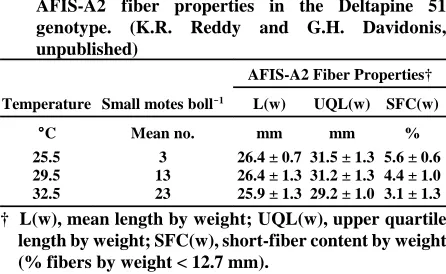
High temperatures can promote the abscission of small bolls. This abscission is more pronounced when the boll load is heavy. When DES 119 cotton plants were grown in closed-environment, sunlit, soil-plant-atmosphere-research (SPAR) growth chamber units, boll retention decreased significantly at temperatures above 29 (C (Phene et al., 1978; Reddy et al., 1992; Reddy et al., 1995). As temperature increased, the number of small motes per boll also increased. Fertilization efficiency, which was negatively correlated with small-mote frequency, also decreased (Table 2). Although fiber length did not change significantly with increasing temperature, the percentage of short-fibers was lower when temperatures were higher. The apparent improvement in fiber length uniformity may be related to increased assimilate availability to the fibers because there were fewer seeds per boll.
Fiber Length and Water
Cotton water relationships and irrigation traditionally have been studied with respect to yield (Hearn, 1976, 1994; Ramey, 1986; Radin et al., 1992). Grimes and Yamada (1982) concluded that fiber length was not affected unless the water deficit was great enough to lower the yield to 700 kg ha$1. Fiber elongation was inhibited when the midday water potential was –2.5 to –2.8 mPa. Occurrence of moisture deficits during the early flowering period did not alter fiber length. However, when drought occurred later in the flowering period, fiber length
was decreased (Marani and Amirav, 1971; Shimishi and Marani, 1971; Hearn, 1976).
Severe water deficits during the fiber elongation stage reduce fiber length (Hearn, 1994), apparently due simply to the direct mechanical and physiological processes of cell expansion. However, water availability and the duration and timing of flowering and boll set can result in complex physiological interactions between water deficits and fiber properties including length. For example, water deficits regularly occur during the mid- to late-flowering periods in the Texas Coastal Plain. When cotton is grown in that region, fiber-length means for bolls containing zero to two small short-fiber motes were lower in the mid-season population of rainfed bolls than in the mid- to late-season irrigated bolls (Davidonis et al., 1996). In other studies, irrigation increased mean fiber length and upper-half mean length (Grimes et al., 1969; Spooner et al., 1958).
Drip irrigation and placement of the drip-irrigation tubing under or between the plant rows also modulated fiber length (Bradow et al., 1997b,c). The rainfed-only mean fiber length was 24.5 ± 1.6 mm, and the drip-irrigated fiber length-by-weight mean was 23.3 ± 2.6 mm when the irrigation tubing was buried in the row under the plant roots. The mean fiber length was 23.5 ± 2.6 mm when the tubing had been buried between the plants in every other row. Fiber length distributions, both according to fruiting site and within the locules, were also modified by the irrigation method used.
The higher fiber-length mean for the rainfed plants was related to greater boll retention on Nodes 13 and below (Fig. 1). In India, moisture conservation practices (mulching) increased fiber length and yield (Singh and Bhan, 1993). However, under irrigated conditions, conservation tillage surface residues did not affect any fiber property, including length (Bauer et al., 1995; Bauer and Busscher, 1996).
Fiber Length and Light
Changes in the growth environment also alter canopy structure and the photon flux environment within the canopy. For example, loss of leaves and bolls from unfavorable weather (wind, hail), disease, or herbivory and compensatory regrowth can greatly affect both fiber yield and quality (Sadras, 1995).
Table 2. Effects of temperature on mote formation and AFIS-A2 fiber properties in the Deltapine 51 genotype. (K.R. Reddy and G.H. Davidonis, unpublished)
AFIS-A2 Fiber Properties†
Temperature Small motes boll$$$$1 L(w) UQL(w) SFC(w)
((((C Mean no. mm mm % 25.5 3 26.4 ± 0.7 31.5 ± 1.3 5.6 ± 0.6 29.5 13 26.4 ± 1.3 31.2 ± 1.3 4.4 ± 1.0 32.5 23 25.9 ± 1.3 29.2 ± 1.0 3.1 ± 1.3
The amount of light within the crop canopy is an important determinant of photosynthetic activity (Sassenrath-Cole, 1995) and, therefore, of the source-to-sink relationships that allocate photoassimilate within the canopy (Pettigrew, 1994, 1995). Eaton and Ergle (1954) observed that reduced-light treatments increased fiber length. Shading during the first 7 d after floral anthesis resulted in a 2% increase in the 2.5% span length of the DES 119, Deltapine 5690, and Prema genotypes (Pettigrew, 1995).
Shading (or prolonged periods of cloudy weather) and seasonal shifts in day length also modulate temperature, which modifies fiber properties, including length.
Commercial cotton genotypes are considered to be day-length neutral with respect to both flowering and fruiting (Lee, 1984). However, incorporation of day-length data in upland and pima fiber-quality models, based on accumulated heat units, increased the coefficients of determination for the length predictors from 30 to 54% for the upland model and from 44 to 57% for the pima model (Bradow et al., 1997c; Johnson et al., 1997).
Kasperbauer (1994) also found that the light wavelengths reflected from red and green mulches increased fiber length, even though plants grown under those mulches received less reflected photosynthetic flux than did plants grown with white mulches. The longest fiber was harvested from plants that received the highest far red/red ratios.
Fiber Length and Mineral Nutrition
Studies of the mineral nutrition of cotton and the related soil chemistry usually have emphasized increased yield and fruiting efficiency (Waddle, 1984; Joham, 1986; Radin and Mauney, 1986; Radin et al., 1991; Bisson et al., 1995). More recently, the effects of nutrient stress on boll shedding have been examined (Jackson and Gerik, 1990; Heitholt, 1994). Also, several mineral-nutrition studies have been extended to include fiber quality (Cassman et al., 1990; Minton and Ebelhar, 1991; Bauer et al., 1993; Matocha et al., 1994; Bauer and Busscher, 1996; Pettigrew et al., 1996). These studies investigated the effects of either K or N on fiber properties, including span length.
Reports of fiber property trends following nutrient additions are often contradictory due to the interactive effects of genotype, climate, and soil conditions. Potassium added at the rate of 112 kg K ha$1yr$1 did not affect the 2.5% span length of DES 119 and Stoneville 825 when genotype was a significant factor in determining both 2.5 and 50% span lengths (Minton and Elbehar, 1991). Genotype was not a significant factor in Acala fiber length, but an additional 480 kg K ha$1yr$1 increased the mean fiber length of the two Acala genotypes, SJ-2 and GC-510, when the K-by-genotype interaction was significant (Cassman et al., 1990). Foliar applications of KNO3 did not affect either yields or fiber length in Corpus Christi, TX (Matocha et al., 1994). Soil-applied KNO3 increased yields in two years out of three, but no effects of K on fiber length were observed. In a Mississippi Delta study of eight genotypes (Pettigrew et al., 1996), an additional 112 kg K ha$1yr$1 increased the length uniformity ratio and increased 50%, but not 2.5% span length. Genotype and the interaction, genotype-by-environment, determined the 2.5% span length.
Added N and the N-by-genotype and N-by-K interactions had no effect on fiber span length or length uniformity (Pettigrew et al., 1996). Environmental factors other than added N determined fiber span length in a South Carolina study of the effects of N and green manure on cotton fiber yield and quality (Bauer et al., 1993). Nitrogen released from decomposing legume cover crops also had no effect on fiber span length (Bauer and Busscher, 1996).
As mentioned above, fiber length is assumed to be genotype-dependent, but growth-environment fluctuations - both those resulting from seasonal and annual variability in weather conditions and those induced by cultural practices and inputs - modulate the range and mean of the fiber length population at the test sample, bale, and crop levels.
fiber-breaking strength, which has become a crucial fiber property due to changes in spinning techniques.
FIBER STRENGTH
The inherent breaking strength of individual cotton fibers is considered to be the most important factor in determining the strength of the yarn spun from those fibers (Munro, 1987: Patil and Singh, 1995; Moore, 1996). Recent developments in high-speed yarn spinning technology, specifically open-end rotor spinning systems, have shifted the fiber-quality requirements of the textile industry toward higher-strength fibers that can compensate for the decrease in yarn strength associated with open-end rotor spinning techniques (Patil and Singh, 1995).
Compared with conventional ring spinning, open-end rotor-spun yarn production capacity is five times greater and, consequently, more economical. Rotor-spun yarn is more even than the ring-spun, but is 15 to 20% weaker than ring-spun yarn of the same thickness. Thus, mills using open-end rotor and friction spinning have given improved fiber strength (together with fiber fineness) highest priority. Length and length uniformity, followed by fiber strength and fineness, remain the most important fiber properties in determining ring-spun yarn strength (Patil and Singh, 1995; Moore, 1996).
Estimating Fiber Strength
Historically, two instruments have been used to measure fiber tensile strength, the Pressley apparatus and the Stelometer (Munro, 1987; ASTM, 1994, D 1445-90). In both of these flat-bundle methods, a bundle of fibers is combed parallel and secured between two clamps. A force to try to separate the clamps is applied and gradually increased until the fiber bundle breaks. Fiber tensile strength is calculated from the ratio of the breaking load to bundle mass. Due to the natural lack of homogeneity within a population of cotton fibers, bundle fiber selection, bundle construction and, therefore, bundle mass measurements, are subject to considerable experimental error (Taylor, 1994).
Fiber strength, that is, the force required to break a fiber, varies along the length of the fiber, as does fiber fineness measured as perimeter, diameter, or cross section (Hsieh et al., 1995). Further, the
inherent variability within and among cotton fibers ensures that two fiber bundles of the same weight will not contain the same number of fibers. Also, the within-sample variability guarantees that the clamps of the strength testing apparatus will not grasp the various fibers in the bundle at precisely equivalent positions along the lengths. Thus, a normalizing length-weight factor is included in bundle strength calculations.
In the textile literature, fiber strength is reported as breaking tenacity or grams of breaking load per tex, where tex is the fiber linear density in grams per kilometer (Munro, 1987; Taylor, 1994). Both Pressley and stelometer breaking tenacities are reported as 1/8 in. gauge tests, the 1/8 in. (or 3.2 mm) referring to the distance between the two Pressley clamps. Flat-bundle measurements of fiber strength are considered satisfactory for acceptance testing and for research studies of the influence of genotype, environment, and processing on fiber (bundle) strength and elongation.
The relationships between fiber strength and elongation and processing success also have been examined using flat-bundle strength testing methods (Dever et al., 1988). However cotton fiber testing today requires that procedures be rapid, reproducible, automated, and without significant operator bias (ASTM, 1994, D 4604-86, D 4605-86; Taylor, 1994). Consequently, the HVI systems used for length measurements in USDA-AMS classing offices are also used to measure the breaking strength of the same fiber bundles (beards) formed during length measurement.
The HVI bundle-strength and elongation-percent testing methods are satisfactory for acceptance testing and research studies when 3.0 to 3.3 g of blended fibers are available and the relative humidity of the testing room is adequately controlled. A 1% increase in relative humidity and the accompanying increase in fiber moisture content will increase the strength value by 0.2 to 0.3 g tex$1, depending on the fiber genotype and maturity.
Further, classing-office HVI measurements of fiber strength do not adequately describe the variations of fiber strength along the length of the individual fibers or within the test bundle. Thus, predictions of yarn strength based on HVI bundle-strength data can be inadequate and misleading (Taylor, 1994; Suh et al., 1996). The problem of fiber-strength variability is being addressed by improved HVI calibration methods (Taylor, 1994) and by computer simulations of bundle-break tests in which the simulations are based on large single-fiber strength databases of more than 20 000 single fiber long-elongation curves obtained with MANTIS (Suh et al., 1996).
Fiber Strength, Environment, and Genotype
Reports ofstelometer measurements of fiber bundle strength are relatively rare in the refereed agronomic literature. Consequently, the interactions of environment and genotype in determining fiber strength are not as well documented as the corresponding interactions that modulate fiber length. Growth environment, and genotype response to that environment, play a part in determining fiber strength and strength variability (Sasser and Shane, 1996).
Early studies showed fiber strength to be significantly and positively correlated with maximum or mean growth temperature, maximum minus minimum growth temperature, and potential insolation (Hanson et al., 1956). Increased strength was correlated with a decrease in precipitation. Minimum temperature did not affect fiber strength. All environmental variables were interrelated, and a close general association between fiber strength and environment was interpreted as indicating that fiber strength is more responsive to the growth environment than are fiber length and fineness. Other investigators reported that fiber strength was
correlated with genotype only (MacKenzie and Van Schaik, 1963; Greef and Human, 1983; Green and Culp, 1990; Smith and Coyle, 1997).
Square removal did not affect either fiber elongation (Pettigrew et al., 1992) or fiber strength (Terry, 1992; Pettigrew et al., 1992). Shading, leaf-pruning, and partial fruit removal decreased fiber strength (Pettigrew, 1995). Selective square removal had no effect on fiber strength in bolls at the first, second, or third position on a fruiting branch (Heitholt, 1997). Fiber strength was slightly greater in bolls from the first 4 to 6 wk of flowering, compared with fibers from bolls produced by flowers opening during the last 2 wk of the flowering period (Jones and Wells, 1997).
In that study, fiber strength was positively correlated with heat unit accumulation during boll development, but genotype, competition among bolls, assimilatory capacity, and variations in light environment also helped determine fiber strength. Early defoliation, at 20% open bolls, increased fiber strength and length, but the yield loss due to earlier defoliation offset any potential improvement in fiber quality (Snipes and Baskin, 1994).
In a study of six diverse cotton genotypes, complex linkages between lint yield and fiber strength (and length) were confirmed and elucidated (Coyle and Smith, 1997; Smith and Coyle, 1997). Fiber strength and length were negatively associated with basic within-boll yield components so that the production of stronger fibers appeared to cost the plant both in fiber weight and fiber numbers. Growth environment was not included in the experimental designs for these genetics studies, which were conducted 3 yr apart in the same location. Fiber strength was closely and negatively correlated with yield in these studies, and the authors suggest that this linkage must be broken before acceptable improvements in fiber strength can be made through genetics, either by classic breeding or at the molecular level.
Fiber Strength, Mineral Nutrition, and Conservation Tillage
significant genotypic effects or interactions between genotype and K addition rates. However, the genotype main effect was significant for fiber elongation.
Addition of K increased DES 119 and Stoneville 825 fiber strength significantly and had a nonsignificant, but positive, effect on fiber elongation (Minton and Ebelhar, 1991). There were also strong genotype differences in the fiber strength and elongation of these two upland genotypes. Added K and N did not affect fiber strength, but added K increased fiber elongation (Pettigrew et al., 1996). Genotype differences in fiber strength were judged to be far more important than the level of N fertilization (MacKenzie and Van Schaik, 1963). Supplemental B had no effect on upland fiber properties, including strength (Heitholt, 1994). No meaningful correlations were found between fiber strength and spatial variations in the levels of P, K, Ca/Mg, or percent organic matter (Bradow et al., 1999b).
Use of cover crops and tillage method had no effect on fiber strength, but significant differences in elongation were associated with winter cover type (rye) and/or tillage method (Bauer and Busscher, 1996). The influence of green manures on fiber strength tended to be small and inconsistent from year to year (Bauer et al., 1993), but these authors reported that cotton crops planted in rye and fallow plots tended to reach cutout earlier and were ready for harvest before other plots in the study.
Linkages among maturation rate, planting date, and fiber strength also were reported when delayed planting resulted in increased fiber strength (Aguillard et al., 1980; Greef and Human, 1983; Heitholt, 1993). During Acala SJ-2 fiber maturation in the greenhouse, single-fiber breaking force and fiber linear density increased markedly and in parallel at approximately 35 d post floral anthesis (Hsieh et al., 1995). No boll-position effects on single-fiber strength were observed above the fourth fruiting branch.
FIBER MATURITY
Of the fiber properties reported by USDA-AMS classing offices for use by the textile industry, fiber maturity is probably the least well-defined and most misunderstood. The term, fiber maturity, used in
cotton marketing and processing is not an estimate of the time elapsed between floral anthesis and fiber harvest (Lord and Heap, 1988). However, such chronological maturity can be a useful concept in studies that follow fiber development and maturation with time (Ramey, 1982; Bradow et al., 1996c). On the physiological and the physical bases, fiber maturity is generally accepted to be the degree (amount) of fiber cell-wall thickening relative to the diameter or fineness of the fiber (Perkins et al., 1984; Munro, 1987).
Definitions and Related Estimates of Fiber Maturity
Classically, a mature fiber is a fiber in which two times the cell wall thickness equals or exceeds the diameter of the fiber cell lumen, the space enclosed by the fiber cell walls (Ramey, 1982). However, this simple definition of fiber maturity is complicated by the fact that the cross section of a cotton fiber is never a perfect circle; the fiber diameter is primarily a genetic characteristic (Ramey, 1982; Lord and Heap, 1988; Matic-Leigh and Cauthen, 1994).
Further, both the fiber diameter and the cell-wall thickness vary significantly along the length of the fiber. Thus, attempting to differentiate, on the basis of wall thickness, between naturally thin-walled or genetically fine fibers and truly immature fibers with thin walls greatly complicates maturity comparisons among and within genotypes. For example, the mean fiber diameters of upland genotypes range from 21 to 29 )m, and the diameters of genetically finer pima fibers range from 17 to 20 )m (Ramey, 1982). On a locule-average basis and across fruiting sites within a single crop, Pee Dee 3 upland cotton fiber diameters ranged from 1.2 to 18.7 )m within a crop mean of 2.1 to 12.4 )m (Bradow and Bauer, unpublished mean diameter-by-number distribution obtained using the AFIS-A2 Length and Diameter module.)
Within a single fiber sample examined by image analysis, cell-wall thickness ranged from 3.4 to 4.9
)m when lumen diameters ranged from 2.4 to 5.2
there had been no fiber-selection bias in the measurements.
Unfortunately, none of the available methods for quantifying cell-wall thickness is sufficiently rapid and reproducible to be used by agronomists, the classing offices, or fiber processors. Fiber diameter can be quantified, but diameter data are of limited use in determining fiber maturity without estimates of the relationship between lumen width and wall thickness. Instead, processors have attempted to relate fiber fineness to processing outcome.
Estimating Fiber Fineness
Fiber fineness has long been recognized as an important factor in yarn strength and uniformity, properties that depend largely on the average number of fibers in the yarn cross section. Spinning larger numbers of finer fibers together results in stronger, more uniform yarns than if they had been made up of fewer, thicker fibers (Ramey, 1982). However, direct determinations of biological fineness in terms of fiber or lumen diameter and cell-wall thickness are precluded by the high costs in both time and labor, the noncircular cross sections of dry cotton fibers, and the high degree of variation in fiber fineness (Ramey, 1982; Munro, 1987).
Advances in image analysis have improved determinations of fiber biological fineness and maturity (Matic-Leigh and Cauthen, 1994), but fiber image analyses remain too slow and limited with respect to sample size for inclusion in the HVI-based cotton-classing process.
Originally, the textile industry adopted gravimetric fiber fineness or linear density as an indicator of the fiber-spinning properties that depend on fiber fineness and maturity combined (ASTM, 1997, D 1769-77; Ramey, 1982). This gravimetric fineness testing method was discontinued in 1989, but the textile linear density unit of tex persists. Tex is measured as grams per kilometer of fiber or yarn, and fiber fineness is usually expressed as millitex or micrograms per meter (Ramey, 1982; Munro, 1987). Earlier, direct measurements of fiber fineness (either biological or gravimetric) subsequently were replaced by indirect fineness measurements based on the resistance of a bundle of fibers to airflow.
The first indirect test method approved by ASTM for measurement of fiber maturity, linear
density, and maturity index was the causticaire method. In that test, the resistance of a plug of cotton to airflow was measured before and after a cell-wall swelling treatment with an 18% (4.5 M) solution of NaOH (ASTM, 1991, D 2480-82). The ratio between the rate of airflow through an untreated and then treated fiber plug was taken as indication of the degree of fiber wall development. The airflow reading for the treated sample was squared and corrected for maturity to serve as an indirect estimate of linear density. Causticaire method results were found to be highly variable among laboratories, and the method never was recommended for acceptance testing before it was discontinued in 1992.
The arealometer was the first dual-compression airflow instrument for estimating both fiber fineness and fiber maturity from airflow rates through untreated raw cotton (ASTM, 1976, D 1449-58; Lord and Heap, 1988). The arealometer provides an indirect measurement of the specific surface area of loose cotton fibers, that is, the external area of fibers per unit volume (approximately 200-mg samples in four to five replicates). Empirical formulae were developed for calculating the approximate maturity ratio and the average perimeter, wall thickness, and weight per inch from the specific surface area data. The precision and accuracy of arealometer determinations were sensitive to variations in sample preparation, to repeated sample handling, and to previous mechanical treatment of the fibers, e.g., conditions during harvesting, blending, and opening. The arealometer was never approved for acceptance testing, and the ASTM method was withdrawn in 1977 without replacement.
Micronaire, an Indirect Estimate of Fiber Fineness and Maturity
Micronaire is the most commonly used instrumental fiber-quality test (Lord and Heap, 1988; Moore, 1996). Micronaire is an indirect measure of the air-permeability of a test specimen of known mass enclosed in a container of fixed dimensions. Initially, air-permeability of the sample was thought to depend on fiber linear density, and the empirically derived curvilinear micronaire scale was set in gravimetric fineness units of fiber weight per inch (Ramey, 1982; Lord and Heap, 1988). However, basic fluid-flow theory states that air permeability is inversely dependent on the square of the fiber surface area, and linear density units were subsequently dropped from the micronaire scale. Now micronaire (also, mike or mic.) is treated as a dimensionless fiber property quantified against an empirically derived scale and standardized for each annual crop. Under standardized testing and calibration conditions, the micronaire test method, which has been incorporated into the HVI systems (ASTM, 1994, D 4604-86, D 4605-86), is considered satisfactory for acceptance testing if users of the test results consider micronaire readings as estimates of both fiber fineness and maturity. The micronaire test in the HVI system is relatively insensitive to sample preparation and to small variations in relative humidity and temperature during testing. Standardized preconditioning is, therefore, required at the USDA-AMS classing offices. For micronaire determinations by the HVI system, the minimum sample size is currently 10 g (ASTM, 1994, D 4604-86, D 4605-86), but use of 50-gram samples is advised as a means of improving random sampling and decreasing sampling bias.
In the USA, the acceptable upland micronaire range for which no price penalty is assessed is 3.5 to 4.9, with a premium range of 3.7 to 4.2. Empirical relationships have been developed between micronaire and cotton-fiber processing properties, and bale-average micronaire readings are used by mills in bale selection and blending (Chewning, 1995; El Moghazy and Gowayed, 1995a,b).
The fineness factor in micronaire is considered more important in spinning, and fiber maturity is thought to have more effect on dye-uptake success. However, the finer the fiber, the higher the number
of reflective surfaces per unit area and, consequently, the higher the luster of the dyed fabric (Ramey, 1982). Immature fibers have thinner walls and are finer than mature fibers of the same genotype. However, lower micronaire fibers stretch, tangle, and break more easily and do not impart the greater yarn strength and uniformity expected of genetically finer, but still mature, fibers.
The complex interactions among fiber fineness, fiber maturity, fiber spinning properties, and fiber dye-uptake characteristics are difficult to interpret or predict and can cause confusion and frustration for breeders and physiologists who engage in research designed to improve fiber quality (Cooper et al., 1996; Palmer et al., 1996a,b; Pellow et al., 1996).
The Fiber Fineness/Maturity Complex
Various methodologies and instruments have been used to separate the causes and effects of cotton fiber fineness and maturity. In addition to the previously discussed microscopic and image-analysis assays of fiber biological fineness and estimates of fiber linear density, near-infrared transmission spectroscopy (NITS) has been used to describe a linear relationship between fiber fineness and the amount of light scattered (Montalvo et al., 1989). The distribution of cotton fiber fineness as diameter by number also can be determined rapidly and can be reproducibed by the AFIS-A2 Length and Diameter (L&D) module (Bragg and Wessinger, 1993; Yankey and Jones, 1993).
Fiber Maturity and Dye Testing
In cotton processing, fiber fineness is most closely associated with spinning characteristics and the properties of the resulting yarn (Ramey, 1982). However, fiber maturity affects the color of the fiber, both before and after dye application (Lord and Heap, 1988; Smith, 1991). Indeed, the anisotropic nature of the fibrillar cell walls of cotton fibers suggested the use of plane-polarized light microscopy for assessing cell-wall developmental maturity (Lord and Heap, 1988). However, sorting fibers into maturity classes of thin-walled (violet-indigo), immature (blue), and thicker walled/more mature (yellow) is slow, strongly biased by the differential color sensitivity of the classer, and insufficiently sensitive to the differences between mature fibers of small-perimeter genotypes and immature fibers of larger-perimeter genotypes.
Differential dye tests for assessing fiber maturity, including the Goldthwaite red-green dye test, are similarly biased and are further confounded by differences in sample fiber fineness and affinity for the dyes used (Milnera, 1987; Lord and Heap, 1988). The Goldthwaite red-green dye test, in which redness is assumed to be associated with maturity and an increasingly greenish coloration connotes decreasing fiber maturity is still used (Pellow et al., 1996). However, red-green dye-test results are qualitative, not quantitative, and are highly subjective because most dyed samples appear as a mat of mixed red and green fibers, with the green coloration being strongly associated with the boll suture lines. Boll suture lines are readily apparent when intact, mature bolls are dyed with the Goldthwaite reagent or other dyes. In dye-uptake tests using a single dye, fibers appressed to boll sutures were dye-resistant and, by inference, immature (Bradow et al., 1996a).
Fiber Maturity and Circularity
As an estimate of fiber maturity, direct measurement of average cell-wall thickness in traverse fiber sections is subject to numerous and serious biases that result from insufficient sample size and non-circularity of cotton fibers (Lord and Heap, 1988; Matic-Leigh and Cauthen, 1994). Consequently, degree of thickening, æ, was defined
as a measure of fiber maturity based on fiber cross-section and perimeter (Lord and Heap, 1988).
Degree of thickening is the cross-sectional area of the fiber wall divided by the area of a circle of the same perimeter. Thus, completely circular fibers of any perimeter would have degree of thickening values equal to one. When AFIS-A2 was used to quantify degree of thickening, mature, thick-walled fibers (56 d post floral anthesis) collapsed into cross-sections shaped like kidney beans with degree of thickening means approximating 0.576 for upland genotypes and 0.546 for pima (Bradow et al., 1996c). Immature, thin-walled fibers (21 d post floral anthesis) collapsed into flattened elliptical shapes with upland degree of thickening means of 0.237 and pima degree of thickening means of 0.221. Fruiting site and seed location within the locule modulated fiber circularity and the degree of wall thickening (Table 1). In microscopic determinations of formalin-treated, air-dried Gossypium hirsutum Gujaret 67 fibers, the circularity at 35 d post floral anthesis was 0.215 and the circularity at 63 d post floral anthesis was 0.685 (Petkar et al., 1986). In the same report, G. barbadense ERB4530 fiber circularity was 0.180 at 35 d post floral anthesis and 0.567 at 56 d post floral anthesis.
Degree of thickening can be directly quantified by image analysis (Matic-Leigh and Cauthen, 1994) or by AFIS-A2 particle sizing (Bradow et al., 1996b; Williams and Yankey, 1996). The AFIS-A2 F&M module also provides immature fiber fraction (percent of fibers with degree of thickening < 0.25) (Bradow et al., 1996b). The AFIS-A4 L&M module reports immature fiber content (defined as for immature fiber fraction from the AFIS-A2 F&M module) and immaturity ratio, which is the ratio of fibers with degree of thickening > 0.5 divided by the number of fibers with degree of thickening < 0.25 (Williams and Yankey, 1996).
in the near infrared (NIR or near-infrared reflectance) has also been used to quantify fiber maturity (Gordon, 1995; Thomasson et al., 1995).
Fiber Maturity and Environment
Whatever the direct or indirect method used for estimating fiber maturity, the fiber property being assayed remains the thickness of the cell wall. The primary cell wall and cuticle (together 10.1 )m thick) make up about 2.4% of the total wall thickness (14.1 )m of the cotton fiber thickness at harvest) (Ramey, 1982; Ryser, 1985; Matic-Leigh and Cauthen, 1994). The rest of the fiber cell wall (198%) is the cellulosic secondary wall, which thickens significantly as polymerized photosynthate is deposited during fiber maturation. Therefore, any environmental factor that affects photosynthetic C fixation and cellulose synthesis will also modulate cotton fiber wall thickening and, consequently, fiber physiological maturation (Sassenrath-Cole and Hedin, 1996; Bradow et al., 1996c; Murray, 1996; Murray and Brown, 1996, 1997).
Fiber Maturity and Temperature and Planting Date
The dilution, on a weight basis, of the chemically complex primary cell wall by secondary-wall cellulose has been followed with X-ray fluorescence spectroscopy. This technique determines the decrease, with time, in the relative weight ratio of the Ca associated with the pectin-rich primary wall (Wartelle et al., 1995; Bradow et al., 1996c,b, 1997a). Growth-environment differences between the two years of the studies cited significantly altered maturation rates, which were quantified as rate of Ca weight-dilution, of both upland and pima genotypes. The rates of secondary wall deposition in both upland and pima genotypes were closely correlated with growth temperature; that is, heat-unit accumulation (Johnson et al., 1997; Bradow et al., 1996a).
An early study of the effects of suboptimal temperatures on fiber development used micronaire fineness to quantify the effects of heat-unit deficits (Hessler et al., 1959). Temperature deficiencies (degree-hours per week below 21.1 (C) in mid- or late season reduced micronaire means so that
late-season micronaire was in the penalty range below 3.5. Cell-wall thickness was not measured in this study, but cool night temperatures (22–28 (C) modulated cellulose synthesis and secondary wall deposition (Haigler et al., 1991, 1994, 1996).
Hessler and co-authors (1959) documented increases in micronaire with time in maturing fibers. Micronaire (micronAFIS) also was found to increase linearly with time for upland and pima genotypes (Bradow et al., 1996c,b). The rates of micronaire increase were correlated with heat-unit accumulations (Johnson et al., 1997; Bradow et al., 1997c). Rates of increase in fiber cross-sectional area were less linear than the corresponding micronaire-increase rates, and rates of upland and pima fiber cell-wall thickening (quantified as degree of thickening by AFIS-A2) were linear and without significant genotypic effect (Bradow et al., 1996c).
Environmental modulation of fiber maturity (micronaire) by temperature was most often identified in planting- and flowering-date studies (Aguillard et al., 1980; Greef and Human, 1983; Porter et al., 1996; Bradow et al., 1997c). Micronaire of four upland genotypes decreased as the planting date advanced from early April to early June in Louisiana (Aguillard et al., 1980). The effects of planting date on micronaire, Shirley FMT fiber maturity ratio, and fiber fineness (in millitex) were highly significant in a South African study (Greef and Human, 1983). Although genotypic differences were detected among the three years of that study, delayed planting generally resulted in lower micronaire. The effect on fiber maturity of late planting was repeated in the Shirley FMT maturity ratio and fiber fineness data.