Iranian journal of educational Sociology
(Interdisciplinary Journal of Education)Available online at: http://www.iase-idje.ir/
Volume 1, Number 3, June 2017
Identify and Develop Effective Components on Competency Model of Elementary
School Principals in Tehran
Baitollah Ebrahimzadeh1
, Fattah Nazem2*
and Khadija Abolmaali3
1. Department of Education, Islamic Azad University, Roudehen Branch, Roudehen. Iran 2. Department of Education, Islamic Azad University, Roudehen Branch, Roudehen. Iran 3. Department of Psychology, Islamic Azad University, Roudehen Branch, Roudehen. Iran
Article history:
Received date: 28 September, 2016 Review date: 7 October 2016 Accepted date:25 November 2016 Printed on line: 15 July 2017
Abstract
Purpose: The aim of the present study is Identify and develops effective components on competency model of elementary school principals in Tehran. Method: This study is combinations type that discovery in the form of mixed research. The study population included all managers and assistants Tehran elementary schools in the qualitative section using theoretical sampling 35 subjects and in quantity section, using simple random sampling method, 250 managers and deputies managed primary schools were selected as samples. The data collected from semi-structured interviews and standardized questionnaires. The data were analyzed using content analysis and structural equation modeling. Findings: The obtained results indicate four components eligibility of the individuals, competence, interpersonal, managerial competencies and academic merit and expertise with the index 137. That in order of priority managerial competencies 32 index, Eligibility of the individuals with 54 indexes, Interpersonal competencies 24 Index and academic and professional qualifications of with 17 indicators, Scientific competence and expertise with 10 indexes, career and professional qualifications of the 27 indicators competency model are as the most important components of the country's education system elementary school principals. Conclusion: And these components have a significant positive effect on the competence of elementary school principals and managerial competencies.
Keywords:
competency model, administrators, elementary schools
Please cite this article as: Ebrahimzadeh,B.4, Nazem,F.2*
, Abolmaali, Kh.3
(2016). Identify and Develop Effective Components on Competency Model of Elementary School Principals in Tehran. Iranian journal of educational sociology, 1(3), 73-82
*Corresponding Author Address: Department of Educational Sciences, Islamic Azad University, Roodehen Branch, Roodehen, Iran [email protected]
4. Introduction
Today, the evolution of institutions, organizations based on job analysis, merit-based organizations has changed so that today a large number of organizations, competency-based human resource management methods to apply (Prald and Hamel, 1990). The term competence in the public dictionary means competence, professionalism, skill and specialized dictionary, management means, competence, qualifications, competency, ability come. In slang, it means having the ability, skill, knowledge and competence, and the term, means according to the labor and employment environment the person (Abertsdon and Cal Yndan, 2012). Forenham (1990), quoting from Cooper (1998) states that the term merit, a new term and related to the present age but it is an old concept. Although the exact date and recognized competence approach it is little consensus among experts but they all agree that in this case its emergence in the last decades of the twentieth century. In fact, the company "Mac's" merit-based identification methods were pioneered and David Mac Kland, a psychologist at Harvard University in the late 1960s and early 1970s, it was founded.
5. Research Background
Psychologists, competencies have defined to stimulus, the character or skills highlight that leading to better job performance. Mrabil and Richard (1997) say that the selection the worthiest must attention to abilities, indicators of attitudes, beliefs, personality traits, attitudes and skills. Competency, as defined by the international community, the performance of knowledge, skills and attitudes that enable employees to effectively, activities related to occupation or job performance standards expected (Oreizi, 2005). Competency is basic characteristics of a person that generally effective performance criteria for circuit or superior performance in a job or situation, relationship (Spencer and Spencer, 1993). Competency is focus on characteristics and the basic characteristics of a person Boyatzis, 1982, and 1995).
These traits can be motivation, behavior, skill and imagination of the individual, social role or set of knowledge, the person Use them in carrying out tasks and activities. This approach with an approach Robertson, Colin and Bartram (2003) contrasts that competency is a set of behaviors as a means to achieve the desired results or outcomes used. Horenbai and Thomas (1989) states that competency is a set of knowledge, skills, attributes and behavioral characteristics and personal characteristics (Horenbai and Thomas, 1989). Spencer (1993), competency classifies into two categories:
The required competencies, that skills necessary in a work for minimum performance or perform a task, specifies and superior competency on the basis of the results above average and higher performance. In general definitions of competence can be divided into two categories. The first approach in the definitions Spencer and Spencer (1993) and others are also seen. Approach trait circuit and the second approach circuit behavioral approach is named. In other words, the first approach competency is equivalent to basic features and the second set of behaviors. Results of studies in the field of personal characteristics for managers suggests the most important personal characteristics needed by managers include eager to manage the ability to connect with people through empathy with them, honest and personal experience of past performance directory (Sifrid, 2009).
In reviewing the literature, (Gould-Williams, 2003, Berger & Berger, 2004) stated a variety of approaches and the division of competence that include: Views Rothwell: This view is based on several strategies that some of the proposed strategies in this area include: A strategy of borrowing: Borrowing on the approach of another organization's competency model. This approach is cheap and does not need to methodology. A disadvantage of this approach, it is not considered the culture of the organization and the external environment that is important to the organization. (B) Borrowing strategy and native: the basis of this approach, the competency model from another organization and rearrange it according to your organization's culture
This approach requires a minimum of the methodology; because once the necessary studies have been conducted to formulate the model by a previous organization. This approach can be used for interviews or research on a small group. An appropriate model for your strategy: According to this approach, a proper competency model, designed and created for an organization. This approach requires research and when used that competency models as a basis for hiring, performance evaluation or promotion used (Kanzanas Rothwel, 1991).
At least five approaches to Strategy an appropriate model is used: The process-driven approach: This name was chosen because in this way, the weight of a lot of work processes by employees. The outputs-driven approach: This name because of the focus on key outcomes jobs, professional, team or working group aims. The competence is extracted in testing results. The invented approach: While the validity and reliability of this approach is low, it is faster than other methods; decision-makers are guided by a systematic process of developing competency models. When officer’s job done the best source of information about the desired changes for what they are not, this approach gives the best answer. This approach is also more appropriate time to use that job or target group should accept these changes, believe these changes are not useful. Of course, options for innovative approaches may rely on experts or the possible scenarios of future conditions that may be associated with conditions similar job (Kerry and Goldman, 2001).
The trends-driven approach: This approach focuses on future issues or trends affecting the profession, work, or professional team is. This approach focuses on what people need to know, do or to arrange feel that they are responsive to changes in the environment. To do this first approach "to determine the key trends affecting changes on organization, work, job or career is essential. Secondly, "determine what people need to know, do or feel in their work to manage this process. The work responsibilities-driven approach: The approach Concludes output, qualifications, roles and quality requirements your responsibilities or work activities.
Briscoe and Hall Views consist of three principal approaches that include: A research-based approach: an approach based on research on behavior. Portfolio Manager of high performance, selection and interviews will be done with them through interviews conducted with them and behaviors to be extracted. Then, at a meeting of the executive team, these behaviors can be reviewed and necessary changes and determined core competence after 4 to 8 and 12 to 24 sub core competence and 50 to 100 indexes. A limitation of this approach is that it is based on past merits not future (Stone, 2001).
A Strategy- based approach: In this approach to extrapolate the strategy. This approach, unlike the previous approach, future-oriented and when used with executives do not have attitudes and skills required for future development of the organization. The advantage of this approach is that business can change the organization and support organization. (Mansfield, 2003).
A Value-based approach: If the value formed of cultural competency based organization, called value-based approach. The researchers focused on the effectiveness of the potential of this approach, because it can provide a powerful stimulus. The weaknesses of this approach, the lack of precision in the development process and translate cultural values into real behavior; it is very difficult (Briscoe and Hall, 1999).
The views expressed in addition, a series of competency models have been proposed that some of the models offered in this area include: model Fridenberg (2004), Kirp and card Owens et al. (2003).
Without having the necessary qualifications and competence, it should not expect of managers extraordinary things and be creative (Jameson, 1980). In this regard, Human resources quality is very important. Therefore, identification and development of skills and leadership competencies, Identifying talented people to assume higher responsibilities, and enable them to training programs and educational and notifying them of the latest scientific and technical and managerial skills for many experts in the field of management is emphasized (Sifrid, 2009).
Given that the administrative system of Iran and its general policies is specific the need for institutional reform, improving weak school administrators, technological advances and globalization,
the country need to change the model for education based on school principal’s countries. Identify competency management Elementary school principals due to the importance and sensitivity of their activities
And the need to adopt a consistent approach and scientific activities of the Group and
The absence of comprehensive studies on elementary school principals in education, is of particular importance. So the main issue of this study is to identify competency model elementary school principals based on those competencies, capacities, knowledge, skills and competencies needed for its elementary school principals to identify scientific and systematic way.
6. Methodology
The aim of this study was to identify and develop competency models for elementary school principal’s country for this purpose, a sample size of 35 subjects of the elite chosen for the interviews and just planned to interview and then refined and encoded using grounded theory and analysis of the interview results, codes of conduct were extracted. In the quantitative section using simple random sampling 250 managers and deputies managed primary schools were selected as sample. In this study, to collect data from semi-structured interviews and standardized questionnaires Neo, the EQ Bar - (1980), leadership style questionnaire Clark (1991) and a standard questionnaire used to analyze the components of professional skills and career. The questionnaire has three parts (Introduction, demographic variables of the study and research questions) and 5-point Likert. The validity and reliability have been recognized in numerous studies.
7. Findings
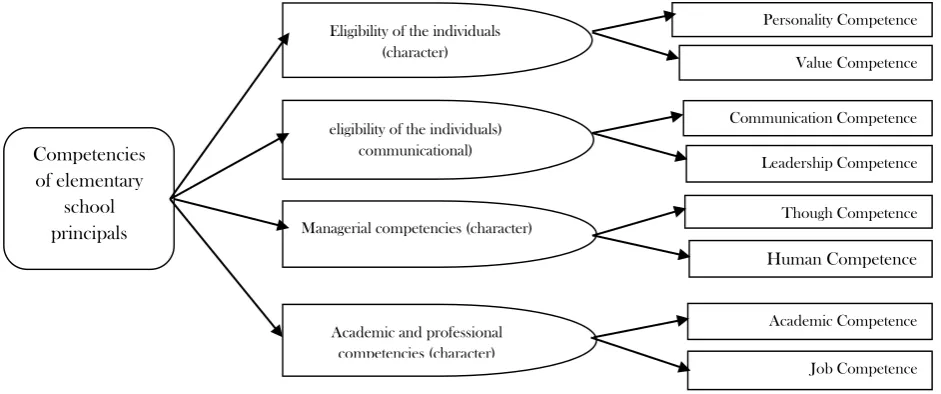
To identify the competencies needed for careers in state elementary school principals, semi-open interviews with a group of educational experts and university in the country with questions about the required competencies of elementary school principals was conducted. At this point, the data collected by the 20 semi-structured interviews and the themes were extracted inductive teaching methods, Using the method of grounded theory, coding and interpretation methods were analyzed Finally, the findings showed that elementary school principals expected competencies can be classified into four main categories.
Figure 1. Schematic of the final model Competencies
of elementary school principals
Eligibility of the individuals (character)
Personality Competence
eligibility of the individuals) communicational)
Managerial competencies (character)
Academic and professional competencies (character)
Value Competence
Communication Competence
Leadership Competence
Though Competence
Human Competence
Academic Competence
Job Competence
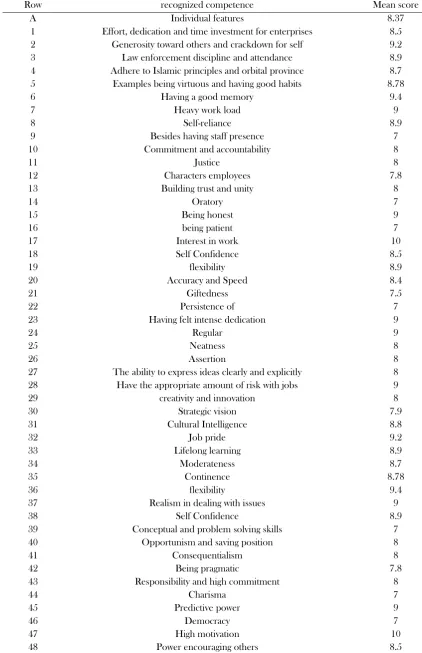
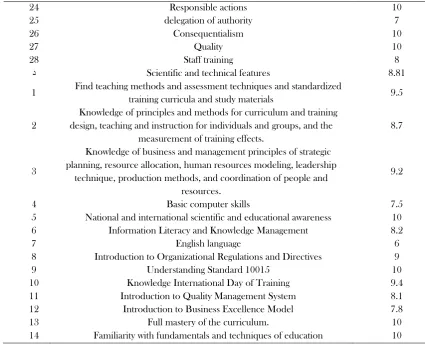
Table 1. The mean scores by competency
Row recognized competence Mean score
A Individual features 8.37
1 Effort, dedication and time investment for enterprises 8.5 2 Generosity toward others and crackdown for self 9.2
3 Law enforcement discipline and attendance 8.9
4 Adhere to Islamic principles and orbital province 8.7 5 Examples being virtuous and having good habits 8.78
6 Having a good memory 9.4
7 Heavy work load 9
8 Self-reliance 8.9
9 Besides having staff presence 7
10 Commitment and accountability 8
11 Justice 8
12 Characters employees 7.8
13 Building trust and unity 8
14 Oratory 7
15 Being honest 9
16 being patient 7
17 Interest in work 10
18 Self Confidence 8.5
19 flexibility 8.9
20 Accuracy and Speed 8.4
21 Giftedness 7.5
22 Persistence of 7
23 Having felt intense dedication 9
24 Regular 9
25 Neatness 8
26 Assertion 8
27 The ability to express ideas clearly and explicitly 8 28 Have the appropriate amount of risk with jobs 9
29 creativity and innovation 8
30 Strategic vision 7.9
31 Cultural Intelligence 8.8
32 Job pride 9.2
33 Lifelong learning 8.9
34 Moderateness 8.7
35 Continence 8.78
36 flexibility 9.4
37 Realism in dealing with issues 9
38 Self Confidence 8.9
39 Conceptual and problem solving skills 7
40 Opportunism and saving position 8
41 Consequentialism 8
42 Being pragmatic 7.8
43 Responsibility and high commitment 8
44 Charisma 7
45 Predictive power 9
46 Democracy 7
47 High motivation 10
48 Power encouraging others 8.5
49 Foresight 8.9
50 Strategic thinking and holism 8.4
51 Participatory Management 7.5
52 Forerun 7
53 non tradtion and innovative 9
54 Goal orientation 9
ب Interpersonal features 9.31
1 Active listening 9.3
2 Talking to others to convey information effectively 9.6
3 Overcome your ego, conquering others get 9.3
4 For ideas of others, Valuing 8.5
5 According to spiritual material needs teachers 9
6 The freedom to take risks, to the scholars 10
7 Teamwork skills at school 10
8 Organizational climate friendly 10
9 Participation and teamwork 10
10 Interest in others 8.6
11 Create positive energy 9.2
12 Communication skills 9
13 Communication between the forces of good human relations 10
14 Encourage others to be creative 8
15 Establishing supportive relationships with others 9 16 Be negotiated in writing and verbally with others 10
17 Emotional Intelligence 8.4
18 Can communicate with students' parents 10
19 Helping others, they do 9
ج Management Features 9.39
1 With teachers to develop and maintain curriculum standards, develop
mission and set goals 9
2 Provide a joyful and effective education in school 10
3 Optimization of organizational culture 9
4 The desire to succeed 9.5
5 Tend to self-evaluation 9
6 Foresight and risk-taking 9
7 Slow but steady steps 8.3
8 Good active management group meetings 10
9 Wise decisions 10
10 Integrity-based insights dealt 8
11 Time management 9
12 Resource Management 10
13 Talent Management 10
14 Communication Management 10
15 Coaching and problem solving. 9
16 planning 10
17 Intelligent monitoring 10
18 Adherence to laws 10
19 Coordinating and organizing 10
20 The analysis of situation 9
21 World's ideas 9
22 change management 10
23 Development of corporate vision 10
24 Responsible actions 10
25 delegation of authority 7
26 Consequentialism 10
27 Quality 10
28 Staff training 8
د Scientific and technical features 8.81
1 Find teaching methods and assessment techniques and standardized
training curricula and study materials 9.5
2
Knowledge of principles and methods for curriculum and training design, teaching and instruction for individuals and groups, and the
measurement of training effects.
8.7
3
Knowledge of business and management principles of strategic planning, resource allocation, human resources modeling, leadership
technique, production methods, and coordination of people and resources.
9.2
4 Basic computer skills 7.5
5 National and international scientific and educational awareness 10 6 Information Literacy and Knowledge Management 8.2
7 English language 6
8 Introduction to Organizational Regulations and Directives 9
9 Understanding Standard 10015 10
10 Knowledge International Day of Training 9.4
11 Introduction to Quality Management System 8.1
12 Introduction to Business Excellence Model 7.8
13 Full mastery of the curriculum. 10
14 Familiarity with fundamentals and techniques of education 10
In order to investigate the suitability of data for factor analysis KMO test was used that a significant number (KMO) was more than 8 competencies for all. So it can be concluded that the data is suitable for factor analysis. Also, to ensure proper analysis of data is regarding the correlation matrix that, the society is not equal to zero, the Bartlett test was used that results of this analysis showed ensure the adequacy of sampling. Bartlett test a significant number greater than zero (Sig <0.05) Confirmatory factor analysis results of each study variables were obtained by software LISREL the results in Table 2 are shown.
Table 2. Results of confirmatory factor analysis
Latent variable Chi square DF Chi-square proportions DF P-Value RMSEA
eligibility of the individuals 1257.23 382 3.29 0.001 0.82
Interpersonal competencies 18.12 10 1.81 0.001 0.71
Managerial competencies 1685.64 814 2.08 0.001 0.91
Academic and professional
qualifications 69.94 27 2.59 0.001 0.51
Table (2) show a suitability indicator; according to the results of LISREL, in ARMSE by dividing the chi-square degrees of freedom equal to the number of less than 3, and the ARMSE, is in the range of 0.8 the range is acceptable. In order to rank the competencies utilizes a combination of Friedman test and taxonomy method is used the results below are reported.
Table 3. Results Ranking Friedman and taxonomy, for the ranking the components
Row Variable
Rank
Ideal situation Available situation
Friedman Taxonomy Total rank Friedman Taxonomy Total rank 1 eligibility of the
individuals 3 2 2 3 1 2
2 Interpersonal
competencies 1 4 3 4 3 4
3 Managerial
competencies 2 1 1 1 2 1
4
Academic and professional qualifications
4 3 4 2 4 3
Results Table 3 indicates that between four core competence, managerial competencies in the first place, Eligibility of the individuals in second place, Interpersonal competency in third and also academic and professional competencies in the fourth is located.
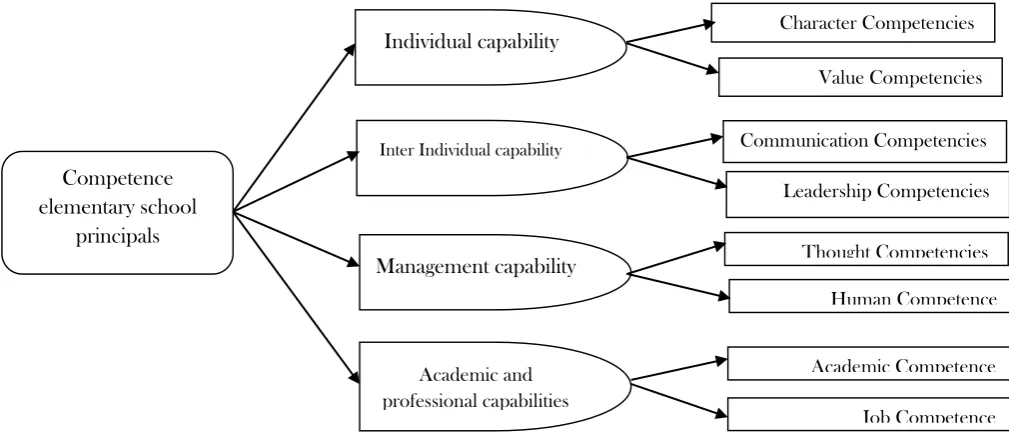
Figure (2). Final model competencies of elementary school principals
Estimate the structural model in standard mode, indicate the path coefficients between research; For example, the path coefficients between merit and competency of school principals is 81%; in other words eligibility of the individuals, on merit affect 81% of school principals.
8. Discussion
The purpose of this study is to identify and develop competency models for elementary school principals. The results of structural equation modeling analysis shows, competency management, communication, scientific expertise, leadership and value is a positive and significant effect on the competency elementary school principals. And managerial competence at the level of 97% is in the highest degree of competence. The results of this study consistent with results (Abtahi, 1998), (Kiev, 1993), (Abolalaie and Ghaffari, 2006), (Department of Industrial Development and Renovation Organization of Iran Human Resources, 2005), (Fridenberg, 2004), (Carey and Gelman , 2001), (cart Owens et al., 2003) (Cartwright, 2007), (Alipoor and Dargahi 2007), (Holi and English, 1998), (Noorani
Competence elementary school
principals
Individual capability Character Competencies
Inter Individual capability
Management capability
Academic and professional capabilities
Value Competencies
Communication Competencies Leadership Competencies
Thought Competencies Human Competence
Academic Competence Job Competence
2000), (Abbas Zadeh, 1997), (Porter and Miller , 1998), (project management Institute, 2004), (Institute of competency 2005), Everd Venz and lovas 2008), (Aurmajin, 2005), (Helen Abel, 2008), (FARAHI Buzjani, 2005). Friedman test and taxonomy suggests that that competency in the final model order is Management competencies, Eligibility of the individuals, competency interpersonal and also academic and professional competencies.
A formal competency-based training program can be designed and conducted as a one or two-day classroom course led by a trainer, using adult experiential learning inputs: reading, lectures, live or video demonstrations, instrumented feedback, role plays and simulations, and self-assessment reflection exercises (Spencer & Spencer, 1993). An action-learning based program is another way of motivating employee competency enhancement through the development of experience-based training that offers a more meaningful result than other training and development options. Action-learning can be carried out by letting job holders perform meaningful tasks and sharing the learning experiences. The design of an action-learning format should accommodate the competencies needed both in the present and in future. Determining probable future organizational scenarios and the competencies needed to manage them will be the product of the business strategist (Tas et al., 1996).
References
Aarabi, SM, Manti, H. (2010). Technology strategy. Tehran: Mohakemeh.
Abeli, Kh, 1997. Model development of middle managers Tehran's oil industry. Journal of Educational Research, first year, first issue, Page 70.
Abolalaie, b. And Ghaffari, A.., Managers of the future. Publishing Industrial Management Institute 2.
Abtahi, S.h. And Montazeri, M, competency-based management and its role in human resource management. Journal of Management Studies, No. 57, pp. 16.
Alipur, M. H. and Dargahi, H., managerial competencies identified cultural center in Tehran based on Competence, Master's thesis, Industrial Management Institute, 2007.
Anderson, R. (2007), Thematic Content Analysis (TCA): Descriptive Presentation of Qualitative Data, Institute of Transpersonal Psychology, Retrieved from http://www. Well knowing consulting. Org /publications/pdfs/ Thematic Content Analysis. Pdf
Armstrong, M. (2006). A Handbook of Human Resource Management Practice. 10th
Edition. London: Kogan page. Armstrong, Michael; performance management) individual, team, organization (Translated by B. Qlychl and D.
GHOLAMZADEH; 2006; Iran Industrial Training Research Center.
Bartram, D. (2004). Assessment in Organizations. Applied Psychology: An International
Berger, L., & Berger, D. (2004). The Talent Management Handbook. Creating Organizational Excellence by Identifying, Developing, and Promoting Your Best People. New York: McGraw-Hill.
Boyatzis, R. E. (2008). Competencies in the 21st century. Journal of Management Development. Vol 27 NO 1. pp. 5-12 Boyatzis, R. E., Goleman, D., & Hay Group. (2001). the Emotional Competence Inventory (ECI). Boston: Hay Group. Boyatzis, R., (1982) the competent manager. New York; Wiley.
Boyatzis, R., (1982). The competent manager: A model for effective performance. New York: Wiley-Interscience Publication.
Boyatzis, R.E., Goldman, D. and Rhee, K., (2000.) Clustering competence in emotional intelligence: Insights from the emotional competence inventory (ECI), Handbook of Emotional Intelligence, and pp. 343-362.
Bramson, R.N., (2000). HR’s role in mergers and acquisitions. Training & Development, 54(10), p. 159.
Cave, E&Mc Keown, P (1993).Managerial Effectiveness: The Identification of Need Management Education and Development, Vol 24, No 2 pp122-137.
Cohen, J. M. (1995). Le development des competency dau le secteur public. Renue International des administrative, 73(3), 469-488.
Cooper, D. R. )2006(, “Marketing Research”, Boston: McGraw-Hill.
Cooper, R.K. (2005). Executive EQ: Emotional intelligence in leadership and organizations New York.
Curriculum for Technical Programs. National Symposium on Engineering Education. /India Institute of Science, Bangalore.
Dehghanan, H. management merit, Parliament and Research Journal, Vol. 13, No. 53, Majlis Research Center, 2007. Dindarfarkoush, F, Sadri Nia, H. (2009), Public and Media Relations, Third Edition, Tehran: The Saye roushan.
FARAHI Buzjani, B. (2005). Development of managerial skills needed by manager’s administrative role model. Knowledge. Management eighteen years, (68).
Fathi N., Shabani Ravari, AR (2011), empirical scientific model and nurture future leaders Saipa Tehran, Saipa. Goleman, D. (1998). Working with emotional intelligence. New York: Bantam. INR. Bar-on & J. Parker (EDS). Goleman, D. (2001). Emotional intelligence. Issue in paradigm building, 39, 33-40.
Gould-Williams, J. (2003). The Importance of HR Practices and Workplace Trust in Achieving Superior Performance: A Study of Public-Sector Organizations. International Journal of Human Resource Management, 14:1 February, p. 28-54. Hoffeman, M. M. and Flood, P. C. (2000). An Exploration of the Relationships Between the Adoption of Managerial
Competencies, Organizational Characteristics, Human.
Industrial Management Institute, report of Mapnaturbine design assessment center, senior corporate executives (Tuga), and 2006.
Industrial Training, · pp. 128-136.
Iran Khodro Training Center, evaluated 360 degrees from theory to practice, 2007. Fathi N., Shabani Ravari, AR, scientific and experimental model Saipa nurture future managers, 2007.
Katz, L. R. (1974). Skills of an Effective Administrator. Harvard Business Review.
Kupper Hendrik A. E, Palthe Wulfften(2005).Competency-Based Curriculum Development. Lowenstein University of Applied Sciences, The Netherlands.
Le Deist, F. D. & Winter ton, J. (2005). What Is Competence? Human Resource Development International, 8(1), 27-46. Lucia, A. D. & Lapsing, R. (1999). The art and Science of Competency Models: Pinpointing Critical Success Factors in
Organizations. San Francisco: Jossey-Bass/Pfeiffer.
Mansfield, R.S. (2005). Practical Questions in Building Competency Models. Retrieved from:http://www.workitect.com. Mc.Clelland, D. (1973), Testing for Competence Rather than for Intelligence, American Psychologist, and Vol. 28, pp.
1-14.
Moyer, R (2001). Defining and measuring competencies: An overview of Approaches. (http://www. Click2learn.com). Nasehi Far and et al. (2010). Assessment of capabilities and Competence of the Director of the Department of Commerce.
Business surveys, 1-18.
Niroomand, P, Ranjbar, M. (2010). The role of training Competence and skills in technology development capabilities based technology companies. Fourth National Conference on Technology Management. Tehran: Technology Management Association.
Oliver, Sandra (2009), public relations strategy, translation Aarabi and Fayyazi, Tehran: Office of Cultural Research. Oraizi, H. R., the proposal, Industrial Development and Renovation Organization of Iran, 2005.
Porter, M.E. (1985), Competitive Advantage, New York: Free Press.
Resource Sophistication and Performance in Irish Organizations. Journal of European Review, 53(2), p. 237-259.
Rothwell, W.J. and Kazanas, H.C. (1993), The Complete AMA Guide to Management Development. American Management Association, New York.
Saemian, S. (2008), the new competencies of the organization leading human capital, manufacturing and service organizations, education administrators Conference, Tehran (pp. 20-30).
Sheikh, A. (2010). Competence models. (C. Niroomand, Interviewer).
Singla P.K,Rastogi K.M,Sunita Rani Jain(2005).Developing Competency-Based
Spencer, L. M. & Spencer, S. M. (1993). Competence at Work: Models for Superior Performance. New York: John Wiley & Sons.
Turan, H., the quality of education in primary school ..., 2000.
United States Office of Personnel Management (2002) Assessment Decision Guide. Retrieved from:http://www.opm.gov. Wilcox, Dennis, Cameron, Klant. T., Olten, Philip H., Agee, Warren K. (2011), public relations role, process and strategy,
translation Seyed Mohammad Arabi and David Divine, Volume I, Tehran: Office of Cultural Research.
Yang, Bai-Chuan; Wu, Bing-Eng; Shu, Pei-Gi; Yang, Ming-Hsien; on establishing the core competency identifying model (A value-activity and process oriented approach); Industrial Management & Data Systems; Vol. 106 No. 1, 2006. Zaklili, MA, b. (1998). Shadow managers' assessment of Competence assessment of talent managers "," Regional Electricity
Company of Tehran. Tehran: Institute for Research and Education