DEMOGRAPHIC RESEARCH
VOLUME 32, ARTICLE 53, PAGES 1435
−
1468
PUBLISHED 9 JUNE 2015
http://www.demographic-research.org/Volumes/Vol32/53/ DOI: 10.4054/DemRes.2015.32.53
Research Article
Engendering the fertility/migration nexus:
The role of women’s migratory patterns in the
analysis of fertility after migration
Livia Elisa Ortensi
©2015 Livia Elisa Ortensi.
This open-access work is published under the terms of the Creative Commons Attribution NonCommercial License 2.0 Germany, which permits use, reproduction & distribution in any medium for non-commercial purposes, provided the original author(s) and source are given credit.
1 Introduction 1436
2 Theoretical background 1437
3 Contribution of the current study: Conceptualizing women’s migration patterns
1440
4 Data and methods 1445
4.1 Data 1445
4.2 Method 1447
4.3 Measures 1447
5 Results 1449
5.1 Characteristics by migratory pattern 1449
5.2 Multivariate analysis 1452
5.2.1 Quantum hypothesis 1452
5.2.2 Tempo hypothesis 1454
6 Acknowledgements 1456
7 Conclusion 1459
Engendering the fertility/migration nexus: The role of women’s
migratory patterns in the analysis of fertility after migration
Livia Elisa Ortensi1
Abstract
BACKGROUND
Although women currently constitute half of the international migrant population, most theoretical frameworks used in the study of migration are still gender-neutral. Surprisingly, this is also true of the study of migrant fertility. In particular, the main theories regarding migration and fertility do not take into account the impact of the role of women in emigration in the analysis of fertility after migration.
OBJECTIVE
This paper proposes a conceptualization of women’s migratory patterns and tests the impact of this gendered dimension on fertility after migration. A survey of migrants conducted in Italy will be used as a case study. Based on our results, the role of the migratory pattern will be incorporated into the framework of mainstream hypotheses about migration and fertility.
METHODS
The analysis is based on a retrospective cross-sectional survey of about 2,500 women living in Italy in 2010. Censored Poisson regression and event history analysis will be applied in the analysis.
RESULTS
Women’s migratory patterns emerge as a key variable in the timing of the first birth and in the overall number of births after migration. Compared to independent and first migrants, family migrants tend to have a first child more quickly after migration, and they have a higher overall number of children after migration.
CONCLUSIONS
The migratory patterns of women represent a key dimension which has not yet been properly included in the study of migrants’ fertility. I propose some hypotheses regarding the incorporation of this topic into the framework of the study of fertility and migration. These hypotheses may be tested in future studies.
1 Università degli Studi di Milano Bicocca, Department of Sociology and Social Research, Italy.
1. Introduction
Long-distance, and particularly international migration has traditionally been regarded as a predominantly male phenomenon. As a consequence, migration studies have long been largely gender-blind; focusing on men as the main actors of migration, while paying little attention to the role of women after migration and to women’s agency. In the dominant model, a female migrant was often characterized as the “trailing wife.” Thus, women were almost always conceptualized as being the accompanying dependents of secondary importance in the migration project. Even when it was recognized as an empirical phenomenon, little attention was paid to female independent migration for work (Salih 2011; King et al. 2004; Cooke 2008, 2013; Carling 2005; Kofman 1999; Pessar 1999). The eventual acknowledgment of gender as a dimension of interest, which started in the mid-1970s, resulted in a large number of publications on female migration (Mahler and Pessar 2006). However, most theoretical frameworks or analytical explanations of international migration currently used are still male-centered or gender-neutral (Pessar and Mahler 2003; Salih 2011; Kofman 1999). Surprisingly, this is also true of the study of migrant fertility. Thus, while studies of native women or couples in low-fertility settings are increasingly incorporating key themes such as the trade-off between work and fertility (Adserà 2011), power relations within couples (Testa, Cavalli, and Rosina 2014), and women’s personal preferences and lifestyles (Hakim 2000, 2004), theoretical hypotheses regarding fertility and migration do not explicitly conceptualize the role of women after migration as being a consequence of their specific migratory patterns. Most studies on migrant fertility still tend to assign major importance to macro-level explanations − like the “temporal, contextual and cultural factors” suggested as long ago as 1983 by Goldstein and Goldstein − while making no explicit reference to the specific patterns of female migration, or to the post-migration roles of women as wage earners, caregivers, or both.
empowerment, female labor market participation, and women’s migration strategies (Boyd and Grieco 2003).
The thesis of this paper is that migratory patterns are extremely important in determining the timing and spacing of births and the final number of children born to a woman after migration.
The aim of this paper is twofold. The first goal is to underline the importance of taking into account the role of migratory patterns when seeking to determine migrants’ fertility outcomes after migration. To this end, I will analyze and test the impact of this dimension on the number of children ever born and on the transition to the first birth after migration, using the Italian region of Lombardy as a case study, and data from the 2010 ORIM survey of immigrants (see footnote 2).
The second goal is to re-conceptualize the relationship between migration and fertility from a gender perspective by including the migratory pattern as a variable that mediates the reproductive behavior after migration. This will generate a series of new hypotheses which may be tested in future research.
The paper is organized as follows. In the next section, I outline the theoretical and empirical background of this research. In the third section, I clarify the contribution of the current paper to the field of study. I then present the data and the methods used for the analysis. In the final three sections, I present and discuss in detail my results and main findings, providing a series of new hypotheses which may be tested in future research.
2. Theoretical background
The study of the interaction of migration and fertility is extremely challenging. Several serious problems have been highlighted by scholars over the more than 100 years of research on this topic (Wilson and Sigle-Rushton 2014). These problems include the lack of suitable or sufficient official data, dependence on inadequate cross-sectional surveys (Haug, Compton, and Courbage 2002; Kulu and Milewski 2007; Glick 2010; Mussino and Strozza 2012; Adserà and Ferrer 2014), difficulties associated with the application of standard demographic measures to a mobile population (Andersson 2004; Parrado 2011; Toulemon and Mazuy 2004; Toulemon 2004), the lack of a conceptual
2
framework which rigorously defines the frequently used core concepts (Zarate and de Zarate 1975; Wilson and Sigle-Rushton 2014), and the analytic dangers involved in comparing fertility before and after geographic migration (Hoem 2014).
One of the main characteristics of this field of studies is the recurrent discussion of different hypotheses regarding the fertility/migration nexus. While many hypotheses − partly complementary, partly contradictory − have been proposed, none has been conclusively accepted or rejected (Kulu and Milewski 2007, Kulu 2005). One of the first papers which explicitly discussed important theoretical concepts − including assimilation, acculturation, and convergence − was produced by Goldscheider and Uhlenberg (1969). They observed that most of the previously published studies had implicitly assumed that a process of convergence of fertility behavior and attitudes among the minority and the majority populations would occur resulting from an assumed effect of acculturation. They defined as the characteristics hypothesis the idea that differences between the minority and the majority could be fully explained simply by controlling for their socio-economical composition. Goldscheider and Uhlenberg rejected this assumption, and formulated an alternative hypothesis based on a supposed independent effect of the “minority group status” on fertility. The unexplained differences between the minority and the majority groups were attributed to “the insecurities associated with minority group status” when minority groups had lower fertility, and to “specific norms regarding family size and birth control” when minority groups had higher fertility (this is sometimes referred to as the cultural hypothesis; Forste and Tienda 1996). As in the case of many later studies, this first hypothesis failed to consider the impact of gender and the role of women after migration.
In the next stage of the development in the literature a range of new hypotheses were proposed. These hypotheses are applied to and continue to be tested among different migrant populations and settings up to the present day. In a recent attempt to systematize these theories, Wilson (2013) observed that they deal with either the level of completed fertility (quantum hypotheses) or the timing of births (tempo hypotheses). The quantum hypotheses are those of socialization, cultural entrenchment, selection, and adaptation; while the tempo hypotheses are those of disruption, interrelation of events, and family formation.
similar idea underlies the cultural entrenchment hypothesis. This theory asserts that fertility preferences are driven by culture and values, which can be maintained after migration through the existence of subcultures (Coleman 1994).
By contrast, the selection hypothesis is generally used to explain why migrants sometimes have lower fertility levels than those of the population in the country of origin. But, as in the case of the socialization hypothesis, it neglects to consider any aspect of life in the new setting. Migrants are seen as being a specific group of people in their home country whose fertility preferences are more similar to those of the population of the destination country than to those of the dominant population in their country of origin. Accordingly, the observed fertility behavior is not attributed to conditions or roles in the new setting, but rather to the non-random process which determines who migrates. (Kulu 2005).
Unlike the approaches outlined above, the adaptation hypothesis assumes that the individual’s social context after relocation matters more than his or her childhood environment. This theory predicts a convergence over the medium term to the behavior of the natives, triggered mainly by cultural factors or socioeconomic conditions (Kulu 2005; Kulu and Milewski 2007). Although the effect of women’s migratory patterns is not taken into account explicitly, this is the quantum hypothesis which is most closely aligned with the thrust of the present paper, as it emphasizes the importance of the adaptation of behavior to the social, political, and labor market conditions in the host society.
Of the hypotheses which deal with the tempo dimension, the disruption hypothesis most strongly suggests that migrants tend to have particularly low levels of fertility immediately after migration due to the disruptive factors and difficulties related to the migration itself or to the new environment. Meanwhile, according to this hypothesis, the elevated birth rates which are frequently observed shortly after migration represent a process of catching up on childbearing which was postponed or interrupted in the phase shortly before migration (Kulu 2005). The two partners may have to live separately for a time, and fertility levels may decrease preceding the migration in anticipation of the relocation. Other studies have, however, proposed that high fertility after migration occurs because several events take place at the same time (Mulder and Wagner 1993). This explanation is generally referred to as the “interrelation of events” (Milewski 2007) or the “family formation” hypothesis (Sobotka 2008).
migrants and of family migrants among the women in the population under study may bias conclusions about the validity of hypotheses from the literature, leading to inconsistent results.
3. Contribution of the current study: Conceptualizing women’s
migration patterns
The main thesis of this paper is that the complex and gendered dimension related to female migratory patterns has a key role in shaping fertility after migration.
It is now widely accepted that taking gender into account is essential in migration studies. The literature on gender and migration has shown that women and men tend to have very different migration experiences (Boyd and Grieco 2003; Curran and Saguy 2001). It is, however, important to note that these different experiences are influenced not only by the gender of the migrants, but also by differences between the women who migrate.
Gender relations at the individual, familial, and societal levels strongly influence the migration process, producing differences in women’s opportunities to migrate. For example, gender roles may determine whether a woman is allowed to leave independently or only for the purposes of family reunification; and whether post-migration she is expected to focus on caring for her family, or has the option of entering the labor market (Boyd and Grieco 2003). Gender norms about the inappropriateness of women migrating autonomously, the constraining effects of traditional family roles, and the extent to which women are allowed to have social and economic independence are all factors which shape women’s participation in international migration, as well as their different outcomes in the new country of settlement (Strauss 2010).
First, however, it is necessary to clarify the definitions of the terms “first or independent migrant” and “family migrant” as they are used in this paper. According to the “new economics of migration” approach (Stark and Bloom 1985; Stark 1991), the household is the relevant decision-making unit in most migratory projects, not the individual. Thus, virtually all migrants could be considered “family migrants,” even when the family is not present in the new country of settlement. However, the definition used in this paper is not based on the role of the family of origin, but focuses instead on the nuclear family; i.e., the woman and her partner (if any). The starting point is the typology of migratory patterns that was suggested first by Kofman (2004), and then by King et al. (2004).
generally considered an effective mechanism for integration (Forbes Martin 2004; Bonjour and Kraler 2014). Flows of migrants for the purposes of family reunion increased in western countries starting in the second half of the 1970s, when labor migration became increasingly constrained. Family reunion still represents an important channel of immigration (39.7% of the new resident permits issued in the European Union in 2013 were for purposes of family reunion; Eurostat 2014). I will, consequently, define as family migrants women who arrived with their entire family (“whole-family migration”), women who rejoined their husband after a period of separation (“migration of family reunion”), or women who migrated to marry (“marriage migration”).
Meanwhile, I will define as “independent or first migrants” all of the women who migrated while leaving the rest of the family behind, at least initially (“split-family migration”). The first flows of independent female migrants started as a consequence of an increase in the job opportunities available to women in highly gendered niches. The importance of these niches has been growing even during the recent economic crisis, as in many countries unemployment levels in the occupations dominated by female migrants were lower than those of male-dominated occupations (IOM 2010). Overseas domestic service is a common occupation for migrant women of all skill levels, while sizeable numbers of skilled migrant women are employed in the health professions, particularly in nursing and physical therapy (Forbes Martin 2004; Boyd and Grieco 2003; Morrison, Schiff, and Sjöblom 2008). These women are typically full-time workers and/or female breadwinners (see footnote 3).
As a consequence of the complex interaction of gendered processes, family migrants and first or independent migrants differ in both their characteristics and their migration experiences. Scholars have emphasized that newcomers and followers tend to have dramatically different experiences of migration. The risks associated with migration decline for individuals as more of their family and friends migrate (Massey 1990). Because of this process, the profile of the migrant may shift over time, from that of an innovative, risk-taking young adult to that of a more typical individual (Tacoli 1995). Thus, is very likely that first or independent migrants and family migrants differ in terms of education, age, and position in the family.
Most independent or first migrants migrate with the intention to work. On the positive side, being a wage earner, and in some cases the family breadwinner, may allow the migrant to achieve economic independence and relative personal autonomy. The migrant’s assumption of new economic and social responsibilities may change the
3 The term “breadwinner” is used here as synonymous with a first or a solo migrant, and thus refers to women
distribution of power within the family, leading the migrant to have more authority and ability to participate in household decision-making, and more control over the family's resources. This new earning power may also lead to positive shifts in the relationship between a woman and her husband and children. However, compared to followers, independent or first migrants face higher risks related to migration. These risks include the dangers which can arise when crossing state boundaries (e.g., the risk of violence or trafficking), and in the post-migration stage (e.g., poverty or exploitation). Sex roles and stereotypical images regarding the place of women in society can influence the type of work for which migrant female workers are recruited (Boyd and Grieco 2003). Occupational segregation and concentration in low-skilled, underpaid jobs have been researched widely in connection with both gender and ethnic inequalities in the labor force. Studies on labor migration have shown that the majority of female migrants are employed in service sector occupations (e.g., domestic, catering, and health care occupations) or in the manufacturing sector. Significant numbers of migrant women are also involved in prostitution and the sex industry − some of them involuntarily, as victims of sex trafficking (Rubin et al. 2008). Participation in the labor force does not automatically lead to equality between a migrant and her husband. For some migrant women, labor force participation may increase their burdens unless can they find ways to shift some of their traditional responsibilities for child care and housework (Boyd and Grieco 2003).
By contrast, family migrants are less exposed to the risks and difficulties associated with the first phases of migration, and benefit from the experiences and achievements of family members − especially of the partner − who are already established in the new country of settlement. However, if they restrict themselves to the role of dependent and full-time caregiver in the destination country, they are at risk of isolation and of a low degree of integration (Bonjour and Kraler 2014; Choi, Cheung, and Cheung 2012; Gijsberts 2004). Indeed, some family migrants decide to participate in the labor market, taking on the dual role of family caregiver and paid worker. However, for female migrants of some nationalities the transition to work rarely occurs even when their children are grown up, as community norms and cultural values tend to prevent these women from being involved in paid work. In some communities participation in the job market is discouraged based on the belief − which may be held by the women themselves as well as by their husbands and families − that the male partner should be the breadwinner (Dale et al. 2002; Aston et al. 2007; Read 2004).
her fertility: i.e., if a woman migrates to maximize her chances of earning money, then childbearing will be seen as a secondary goal, or as not possible. The job conditions for female migrants in the country of immigration should also be taken into account. Foreign women are often employed in time-consuming, low-skilled jobs that are generally not compatible with childbearing or having a large family. Previous studies have shown that first-generation migrant workers suffer from the absence of close kin networks to provide child care. These migrants may also face strong pressure to earn and additional pressure from their employer, who might demand that they work long or atypical hours (Wall and São José 2004). Large numbers of migrant women who have children are forced to leave their job because they have limited maternity rights, irregular working hours (holidays, evenings, or nights), or obligatory live-in arrangements. However, leaving the labor force may not be an option for independent women, who may need proof of a regular income in order to maintain their work permit, or who need a full-time job to support their family abroad (Bonizzoni 2014). This is especially the case for female breadwinners and for women who move, either temporarily or permanently, after the break-up of a partnership, perhaps leaving some of their children in the country of origin. Kofmann (2011) has pointed out that there is still too little research on the strategies migrant families use to balance their work and care commitments. It may, however, be assumed that migrants face work-family challenges similar to or greater than those faced by non-migrants.
Family migrants are, conversely, less or not at all affected by the pressure to balance work and family. Since, based on our definition, their migration would have occurred with their family or after the migration of their partner, they can rely partially or entirely on their partner’s wages. Especially among women who have chosen not to enter the job market, commitment to family life is likely to be among their main aims after migration. Having a child may also strengthen and legitimize the position of an immigrant wife, increasing her “symbolic capital” (Milewski 2007; Kulu and Milewski 2007). Female family migrants may therefore find themselves in a better position than their independent counterparts to have babies. This is especially likely to be the case for migrants who had been temporarily separated from a partner who emigrated first. Because the partner is established in the destination country, these female migrants tend to have a number of advantages relative to other kinds of migrants, including better housing and a higher income, as well as a more secure legal status and other benefits (Milewsky 2007).
A failure to control for the composition of the flows associated with different migratory patterns may also lead to an overestimation of the importance of the country of origin for the number and timing of births, especially if the proportion of women in each category is not the same in each community.
The issues of circularity and short-term migration should also be taken into account: independent or first migrant women, especially when they leave children behind, may be engaged in short-term forms of migration in which the goal is to maximize income. These women may be expected to have very low levels of fertility after migration.
It should be noted that the role of women migrants and the effect of gender roles on post-migration fertility has not been completely neglected in the literature. For example, Nedoluzhko and Andersson (2007) and Mussino and Strozza (2012) have examined the effects of different types of female migratory patterns. They found that women who migrate for family reasons exhibit different fertility behaviors than first mover women who migrate to work. Moreover, Andersson and Scott (2005, 2007) looked explicitly at the extent to which the labor market conditions of the destination country explain the differences in fertility among foreign women. Milewski (2007) used information about working conditions and the timing of migration within the couple, considering them as control variables. While these authors did not explicitly re-conceptualize the fertility/migration nexus from a gender perspective, they included variables which accounted for it in their analysis. Their research confirmed that when variables which can be considered proxies for women’s migratory patterns are included in empirical studies of fertility after migration, these factors are generally found to be important in shaping fertility outcomes. However, this paper suggests that researchers turn their attention to the relationship between gender and migratory patterns, as this issue is central to testing hypotheses regarding fertility among migrants.
Given these considerations, the contribution of this paper to the current debate is the following:
1. To show differences between women based on their migratory patterns, and how this variable can be considered a proxy for wider gendered differences (paragraph 5.1).
2. To test the significance of a variable accounting for women’s migratory patterns in determining the quantum and tempo effects on migrants’ fertility, controlling for other key variables commonly used in the study of fertility (paragraph 5.2).
4. Data and methods
4.1 Data
Our analysis is based on data annually produced by the Regional Observatory for Integration and Multi-Ethnicity of Lombardy (ORIM), one of the most cited sources for information and data on immigration in Italy (Fondazione ISMU 2015).
This particular source of data was chosen because it contains information that is usually not collected by standard surveys of immigrants, such as data on non-cohabitant children and the dynamics of couple formation.
The ORIM survey is an annual face-to-face PAPI (paper and pencil interviewing) retrospective multipurpose survey which was started in 2001 by the Foundation for Initiatives and Studies on Multi-Ethnicity (ISMU). The survey was designed explicitly to be representative at the regional level, and includes different questions each year on demographic, social, and economic events; as well as questions in which the interviewees are asked about their opinions, values, and attitudes.
The survey used for this study was conducted during 2010 on 8,033 migrants aged 14 and over from the main sending countries4 living in the Italian region of Lombardy at the time of the interview, including undocumented migrants and naturalized citizens (Blangiardo 2011). Foreign populations are quite difficult to manage using standard statistical sampling methods. To overcome these problems, the interviewees were randomly selected using the center sampling method (Baio, Blangiardo, and Blangiardo 2011). This method offers researchers the opportunity to draw representative samples of the foreign population living in a particular area, regardless of whether they have permanent residency or legal status. It has been adopted in the field of migration studies in both Italian and European projects (e.g., Eurostat 2000; Huddleston and Dag Tjaden 2012; Accetturo and Infante 2013). The underlying hypothesis is that in everyday life migrants interact with a range of “aggregation centers” (such as immigrant-specific services, phone centers, church, markets, places of worship, and ethnic shops) and that information about the number of people who frequent these centers can be used to correct the sample, giving each interviewee a different weight according to how likely it is that the person would have been found by the interviewers.
The method is based on a three-stage design. The 2010 ORIM survey questionnaires were distributed across all of the 12 provinces of Lombardy (first-level units) and in 373 of the 1,530 municipalities in the region (second-level units), which were selected based on the differences between these municipalities in terms of their share of migrants in the population, their socioeconomic situation, and their
4 The term “main sending countries” here refers to all countries except the former EU15 countries, Malta,
representativeness regionally. Migrants (third-level units) were randomly selected among those who frequent a set of aggregation centers previously identified in each of the second-level units. Interviews were performed in Italian or in a foreign language by interviewers with a foreign background, most of whom were cultural-linguistic mediators who had undergone specific training. Rates of refusal to be interviewed varied from 15% to 37%, according to the center where the interview was proposed. This sampling scheme allows us to weight the original biased sample in order to provide a consistent estimate of the overall characteristics of the migrant population (Blangiardo 2011).
Only first-generation women were included in the analysis of the impact of migratory patterns on fertility. Women who migrated with their parents as children or adolescents (while under age 18), who were not following a migration project of their own, or who were born in Italy were excluded from the analysis (16.8% of the original sample). For the same reason and because of their negligible presence in the sample (0.8%), forced migrants, such as asylum or protection seekers, were also excluded. While there are several reasons for using age 18 to distinguish between the migrant generations, the main one is that 17 is the maximum age for family reunion admittance to Italy. This choice is also reasonable in the current Italian context, where most of the women older than age 18 are first-generation migrants. I also excluded from the analysis women who arrived in Italy after the age of 49 (2.1%) and women in mixed couples (10.6%), as the influence of their Italian partner may bias the results. The final subsample is made up of 2,530 subjects, or 69.7%, of women in the original sample. The analyses and results which follow apply only to the women in this subsample.
Before proceeding, it seems wise to point out some of the limitations of the present study.
Second, since we are using retrospective data, we should take into account the possibility of bias due to the selection effect (Andersson and Sobolev 2013). Only women who survived and did not re-emigrate could be included in the sample. Although a recent study of the re-emigration intentions of migrants living in Italy showed that female workers have a lower incidence of re-emigration (Barbiano di Belgiojoso and Ortensi 2013), we can speculate that our study might miss some of the effects of short-term migration or of new patterns of circular migration (Triandafyllidou and Marchetti 2013) which might be related to very low birth rates in Italy.
4.2 Method
Although I had information on the children born to respondents before migration, I chose to analyze only the births which occurred after migration, as this allowed me to avoid uncontrolled estimation bias resulting from conditioning the analysis of pre-migration fertility on the later pre-migration (Hoem 2014).
Due to the right-censored nature of the data used for the analysis, a censored Poisson model was used to test the quantum hypothesis (Caudill and Mixon 1995; McIntosh 1999; Winkelmann and Zimmerman 1994, 2000). While women who had already reached age 45 were considered uncensored and their number of children was considered exactly known, younger women were considered right censored and their outcome was considered known only up to the time of the interview.
To test the tempo hypothesis, a discrete-time survival model was used (Rabe-Hesketh and Skrondal 2012). This was done because the data provide only the year of each birth, which means that there were only a few times when a first birth in Italy was possible, and each was shared by many women. In the analysis a complementary log-log model was used as the survival times were interval censored.
4.3 Measures
The dependent variable in the censored Poisson model is the self-reported number of children born in Italy at the time of the interview. In the event history model I take into account the first birth which occurred following the relocation to Italy.
country of origin, or a woman who was single or who met her partner after migration is considered an independent or first migrant.
The other covariates capturing migrant-specific characteristics in quantum analysis are as follows: religion (Muslim, Christian, other, none), age at arrival in Italy, number of children born abroad, marriage duration (unmarried, <5 years, 5–9, 10–14, >15 years), a dummy variable for women married before migration (yes, no), age at the time of the survey and level of education upon arrival in Italy (none or primary, junior high school, high school and university) and country of origin (Albania, Romania, Ukraine, China, Egypt, Morocco, Peru, other countries).
To avoid anticipatory analysis, education at arrival was reconstructed and computed as suggested by Hoem and Kreyenfeld (2006). The number of fertile years spent in Italy was used as an offset variable, as suggested by Mayer and Riphahn (2000).
Due to the large number of citizenships included in the sample (89), which mirrors the wide varieties of citizenships present in Italy, including the country of origin in the analysis was quite difficult. In the final model, presented in Table 3, the indication of the country of origin was coded using the seven citizenships held by more than 100 women in the sample (50.7% of the total sample), with a residual category. Other recodings were used during the analysis the test the reliability of the results. Four additional models were fitted as a consistency check. The first compared the 17 citizenships held by more than 50 women in the sample (75.2% of the sample) with the residual category of other women. The second used broad areas of origin (Eastern European EU citizens, Eastern European non-EU citizens, Asia, Northern Africa, Sub-Saharan Africa, Latin America). The final models were fitted on the two subsamples: the first seven countries of origin (N=1,272) and the first 17 countries of origin (N=1,888). These last two sub-models permitted me to test the significance of the variable accounting for the country of origin, while excluding the blurred category accounting for “residual countries of origin.”
The results of this analysis was very similar to those shown in the next section. This analysis was therefore used as a check, and is not shown in the output for the sake of synthesis.
Again, education was computed as suggested by Hoem and Kreyenfeld (2006), and was therefore used as a time-varying covariate.
Controls for the model including the country of origin were also performed for the tempo analysis, fitting consistency check sub-models and confirming the results shown in the text.
5. Results
5.1 Characteristics by migratory pattern
A brief look at the main characteristics of women based on their migratory patterns confirms the existence of different profiles in terms of country of birth, legal status, marriage status, median number of years spent in Italy, education and fertility outcomes. Detailed information is provided in Table 1.
The independent or first migrants had higher education levels overall: i.e., compared to family migrants, a higher proportion of these women graduated from university and a lower proportion had only primary or no formal education. This finding confirms the assumption that independent and first migrants are more subject to selection than migrants who follow their partner.
While married was the largest marital status category among women with both migratory patterns, more than half of the first and independent migrant group were unmarried or divorced/widowed.
Compared to first and independent migrants, family migrants were more likely to have unlimited residence permits, though they were less likely to be living permanently in Italy. This is probably because these migrants were able to benefit from entitlements earned by the partner.
strategies (Wall and São José 2004) involving employment as a daytime domestic worker or as an employee of a cleaning service, a restaurant, or a hotel.
At the time of the interview 77.6% of the first and independent women, but only 10% of the family migrants, were the main earner in their family (i.e., their monthly wage accounted for the majority of their family’s monthly income).
Information about family formation and children ever born shows that, on average, family migrants married at a younger age than the independent and first migrants who were married. They were also less likely to have had children before migration, but they had a higher mean number of children ever born and a lower prevalence of childlessness (among women aged 40 and over).
Table 1: Women’s main characteristics by migratory pattern*
Migratory Pattern Independent or first migrants Family migrants
% among all women 54.0% 46.0%
Mean age at arrival 29.2 27.6
Mean age 37.0 34.9
Main categories of legal status Limited residence permit (38.5), Unlimited residence permit (20.8)
Unlimited residence permit (39.2) Limited residence permit (37.8) Main category of residence permit Labor (78.1%) Family (81.6%) Marriage duration Unmarried (36.4%), <5 years (8.2%),
5–9 years (7.9%), 10–14 years (5.8%), more than 15 years (13.3%) Widowed or separated (28.4%)
Unmarried (4.7%), <5 years (13.3%), 5–9 years (22.5%), 10–14 years (25.0%),
more than 15 years (33.7%) Widowed or separated (0.8%)
% Married at arrival 18.9% 82.5%
Mean number of years in Italy 7.8% 7.3%
% 10 years or more in Italy 24.2% 21.9%
% Less than 2 years in Italy 7.5% 9.4%
% University graduate 21.5% 16%
% University graduate at arrival 18.5% 13.7%
% Primary or no education 4.6% 9.2%
Main religion Christian (75.5%), Muslim (16.1%)
Muslim (48.1%), Christian (36.2%) Working condition Employed (80.7%). Unemployed (10.1%).
Housewife (6.4%) Student (2.1%) Other (0.7%)
Housewife (52.1%). Employed (39.2%) Unemployed (8.1%) Student (0.3%)
Other (0.3%) Most popular jobs Caregiver for the elderly (23.6%) Live-out
housekeeper (14.7%) Live-in housekeeper (11.8%)
Live-out housekeeper (18.8%). Employed in a cleaning company (12.6%). waitress
(9.3%) Woman is the main earner in her family 77.6% 10.0% % Living with the employer (own/partner’s) 22.4% 0.6%
% Had children before migration 30.9% 10.3%
Age at marriage 26.1 22.6
Age at first birth 27.2 28.7
Age at first birth (in the country of origin) 25.8 26.9
Age at first birth (in Italy) 30.8 29.6
Mean number of children 1.2 1.9
Mean number of children (age >39) 1.9 2.3
% Childless at 40 14.9% 5.7%
The proportion of each migratory pattern by country of origin deserves a particular attention (Table 2). The countries of origin with the highest incidence of independent and first migrants are from non-EU Eastern Europe (excluding Albania), the Philippines, and Latin American countries. The highest proportions of family migrants are from countries in which the male breadwinner model is dominant, and particularly from the Indian subcontinent, Northern Africa, and Senegal. While in some cases, like Russia or India, the migratory patterns and the country of origin are nearly overlapping; in other cases, like Ghana and, notably, Romania and China, the two patterns are nearly equally represented among women.
Table 2: Women’s main characteristics by migratory pattern at the moment of the survey
Migratory Pattern Independent and first
migrants
In paid job at the time of the interview
Main earner in their family
Russia 94.3 92.3 78.1
Moldova 88.5 89.1 73.2
Ukraine 87.3 97.5 75.7
Philippines 79.2 97.8 67.8
Ecuador 78.7 91.2 62.7
Peru 77.9 94.1 71.5
Ivory Coast 61.6 74.5 45.4
China 57.4 87.2 49.1
Romania 57.0 84.8 45.5
Ghana 48.4 88.5 47.3
Morocco 36.4 50.0 31.7
Albania 32.3 60.3 29.7
Senegal 27.9 69.4 12.3
Pakistan 23.2 25.0 14.9
Tunisia 22.7 49.1 38.5
Egypt 16.3 34.6 17.0
India 12.3 24.7 12.1
Other nationalities* 64.5 72.1
Note: *This residual category is for women from countries whose presence in the sample was lower than 35.
5.2 Multivariate analysis
5.2.1 Quantum hypothesis
I achieved results based on the censored Poisson model by stepwise modeling. Table 3 presents partial results of the five main steps of the analysis.
Model 1.1 This first constrained model displays a simple comparison between women with different migratory patterns, controlling for the women’s age at the interview and age at arrival. The coefficient for family migrants is nearly three times higher (2.918) than for independent and first migrants. All of the coefficients are significant.
Model 1.2 The second step adds a control for the number of children born abroad. Controlling for this covariate, the coefficient for family migrants becomes 23% higher than it was in the constrained model. This is attributable to the compositional differences in the number of children born before migration to the two groups, as highlighted in Table 1.
Model 1.3 The third step controls for marriage duration and for being married before arrival in Italy. Controlling for these covariates reduces the effect of the migratory pattern. This is unsurprising because the migratory pattern indirectly incorporates part of the effects of marriage status and of the differences in couple formation. However, the effect of the difference in women’s migratory pattern is still significant and the coefficient for family migrants is twice as high as that of the first and independent migrants.
Model 1.4.The last step controls for education and religion, but these variables are not significant.
Table 3: Factors influencing the number of children born in Italy for
immigrant women. Parameter estimates for censored Poisson model.
Model 1.1 Model 1.2 Model 1. 3 Model 1.4 Model 1.5
First or independent migrant 1 1 1 1 1
Family migrant 2.918*** 3.596*** 2.150*** 1.975*** 1.955***
Number of children born abroad 0.476*** 0.450*** 0.466*** 0.464**
Marriage Duration: Unmarried 1 1 1
Marriage Duration: <5 years 0.462** 0.499** 0.485**
Marriage Duration: 5–9 years 0.325* 0.339* 0.327*
Marriage Duration: 10–14 years 1.030 1.093 1.062
Marriage Duration: >15 years 2. 423*** 2. 456*** 2.431***
Marriage Duration:
Widowed/divorced 2.098*** 2.161*** 2.261***
Married before migration 0.863 0.846 0.834
Religion: None 1 1
Religion: Muslim 1.440 1.129
Religion: Christian 0.982 0.830
Religion: Other 0.806 0.697
Education at arrival: University 1.268 1.269
Education at arrival: High school 1.168 1.205
Education at arrival: Junior high
school 1.285 1.351
Education at arrival: Primary or
none 1 1
Country of origin: Albania 0.839
Country of origin: Romania 0.926
Country of origin: Ukraine 0.445
Country of origin: China 0.812
Country of origin: Egypt 0.867
Country of origin: Morocco 1.162
Country of origin: Peru 1.485
Country of origin: Other 1
Age at arrival 1.346*** 1.399*** 1.436*** 1.436*** 1.399***
Age at arrival (squared term) 0.994*** 0.994*** 0.994*** 0.994*** 0.994***
Age 1.164*** 1.175*** 1.156*** 1.154*** 1.150***
Log-likelihood -733.369 -661.611 -621.335 -609.464 -595.724
AIC 0.584 0.528 0.501 0.499 0.495
Number of obs 2,530 2,530 2,530 2,510 2,510
5.2.2 Tempo hypothesis
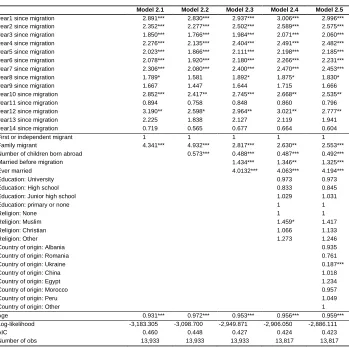
As for the first series of models, I achieved results based on the complementary log-log model by stepwise modeling. Table 4 presents estimates of the five main steps of the analysis.
Model 2.1 The constrained model includes dummy variables for the time intervals that correspond to the number of years elapsed since migration and to the migratory pattern. It also controls for the woman’s age. A much higher intensity (or transition rate, see footnote 5) of first births in Italy can be seen for family migrants (4.341).
Model 2.2 As was already observed in the quantum analysis, the addition of a control for the number of children born before migration causes an increase of 13% in the intensity of first births in Italy for family migrants. This is due to their overrepresentation among women without children born abroad, as shown in Table 1.
Model 2.3 The next step includes a control for covariates related to marriage. Again, these controls reduce the intensity of childbearing related to the migratory pattern, but this dimension remains significant, with a coefficient for family migrants which is more than twice as high as that of the independent and first migrants. It is also interesting to note that women who were already married before migration have a higher degree of intensity, showing more relevant catch-up behaviors.
Model 2.4 This model controls for education and religion. While no effect of education is found, a slight positive effect of being of the Muslim faith is observed compared with having no religious belief.
Model 2.5 This model controls for the country of origin. The only effect found to be significant is for Ukrainian women, who show a lower childbearing intensity. Adding more details for the country of origin (see the section 4.3 for more details) did not generate other significant results.
Table 4: Factors influencing the transition to first birth for immigrant women. Maximum likelihood estimates for complementary log-log models
Model 2.1 Model 2.2 Model 2.3 Model 2.4 Model 2.5
year1 since migration 2.891*** 2.830*** 2.937*** 3.006*** 2.996*** year2 since migration 2.352*** 2.277*** 2.502*** 2.589*** 2.575*** year3 since migration 1.850*** 1.766*** 1.984*** 2.071*** 2.060*** year4 since migration 2.276*** 2.135*** 2.404*** 2.491*** 2.482*** year5 since migration 2.023*** 1.866*** 2.111*** 2.198*** 2.185*** year6 since migration 2.078*** 1.920*** 2.180*** 2.266*** 2.231*** year7 since migration 2.306*** 2.080*** 2.400*** 2.470*** 2.453*** year8 since migration 1.789* 1.581 1.892* 1.875* 1.830* year9 since migration 1.667 1.447 1.644 1.715 1.666 year10 since migration 2.852*** 2.417** 2.745*** 2.668** 2.535** year11 since migration 0.894 0.758 0.848 0.860 0.796 year12 since migration 3.190** 2.598* 2.964** 3.021** 2.777** year13 since migration 2.225 1.838 2.127 2.119 1.941 year14 since migration 0.719 0.565 0.677 0.664 0.604
First or independent migrant 1 1 1 1 1
Family migrant 4.341*** 4.932*** 2.817*** 2.630** 2.553*** Number of children born abroad 0.573*** 0.488*** 0.487*** 0.492***
Married before migration 1.434*** 1.346** 1.325***
Ever married 4.0132*** 4.063*** 4.194***
Education: University 0.973 0.973
Education: High school 0.833 0.845
Education: Junior high school 1.029 1.031
Education: primary or none 1 1
Religion: None 1 1
Religion: Muslim 1.459* 1.417
Religion: Christian 1.066 1.133
Religion: Other 1.273 1.246
Country of origin: Albania 0.935
Country of origin: Romania 0.761
Country of origin: Ukraine 0.187***
Country of origin: China 1.018
Country of origin: Egypt 1.234
Country of origin: Morocco 0.957
Country of origin: Peru 1.049
Country of origin: Other 1
Age 0.931*** 0.972*** 0.953*** 0.956*** 0.959***
Log-likelihood -3,183.305 -3,098.700 -2,949.871 -2,906.050 -2,886.111
AIC 0.460 0.448 0.427 0.424 0.423
Number of obs 13,933 13,933 13,933 13,817 13,817
6. Discussion and future research
The present analysis focuses on the childbearing behavior displayed after migration to Italy by immigrant women from the main sending countries. The first aim of this paper was to test whether the migratory pattern affected fertility behavior, a hypothesis which was confirmed by all of the models. In fact, the migratory pattern was found to have been significant in shaping both the tempo and the quantum dimensions of fertility. The models showed that family migrants had a higher overall number of births and a higher intensity of transition to the first birth after migration than independent and first migrants. Indeed the migratory pattern appears to have been a key determinant of the opportunity costs and the timing of a birth after migration.
Furthermore, the analysis suggests that, after controlling for covariates including the migratory pattern and the number of children born before migration, the effect of the country of origin is scarcely significant. The only effect found to have been significant was the tempo effect in the transition to the first birth after migration among Ukrainian women, who were particularly likely to have engaged in circular or temporary migration aimed at maximizing their earnings, and to have had transnational families with grown-up children (Fedyuk 2011; Marchetti and Venturini 2014). According to a recent study, 80% of the Ukrainian women present in Italy are circular migrants (Vianello 2013). This finding confirms the assumption that the new and expanding forms of circular, seasonal, and short-term migration are characterized by different fertility outcomes after migration (i.e., lower or very postponed fertility). Similarly, after controlling for the migratory pattern, education did not appear to have been a determinant. As the effect of women’s education on working rates and earnings, personal autonomy, and views on gender roles has been very well established in the literature (Morrison, Schiff, and Sjöblom 2008), this result should be tested in future studies in which the effect of the migratory pattern is taken into account.
None of these findings regarding the relevance of the migratory pattern in shaping fertility after migration contradict the main hypotheses in the existing literature on fertility among migrants. Rather, the migratory pattern appears to be a gendered dimension that mediates reproductive behavior after migration. The contradictory findings of some studies may therefore be partly explained by the fact that they were based on populations with different proportions of female migratory patterns. A similar observation was made by Kulu and Milewski (2007), who speculated that when marriage migrants make up a significant share of the migrant population, they may mask the childbearing behavior of other groups.
further studies addressing this question are needed. In the area of tempo hypotheses, I was able to assess the effect of the migratory pattern within the migrant population, but a comparison with native women was not possible. Some hypotheses for future study can, however, be ventured.
Quantum hypotheses.
Selection hypothesis: Migrant women are a selected subpopulation who differ from the profile of most sending countries, and a kind of selection is likely to occur for all categories of migrants. It is, however, likely that family migrants are less selected than independent and first migrants, as other studies have observed (Chiswick 1999; Curran and Saguy 2001). In our sample, the level of education was higher among the independent and first migrants than among the family migrants. As was already noted, model 1.5 shows that after controlling for key variables, the differences in the number of children born after migration between women with different citizenships and levels of education are scarcely significant. This can be seen as an indication that a selection hypothesis is at work, and that migrants are quite a homogeneous group, despite having different backgrounds.
Integrating migratory pattern within the framework of the selection hypothesis suggests that a higher degree of selection is likely to be found among independent and first migrants, who may display patterns and have an ideal number of children closer to the numbers typical of low fertility settings.
Cultural entrenchment and socialization hypotheses: Family migrants expect to assume the role of caregiver after moving. They are less exposed to problems related to balancing the demands of work and family. Furthermore, studies have shown that family migrants tend to have higher levels of isolation stemming from self-segregation within their community (Smith 2011; Merali 2008; Bonjour and Kraler 2014) and low rates of participation in the job market (Read 2004; Morrison, Schiff, and Sjöblom 2008). These conditions may favor the higher levels of fertility among these migrants which were observed in this study. We can assume that the hypotheses related to higher levels of fertility, such as family formation and cultural entrenchment, will fit this subgroup better than the other subgroup. Non-working migrant women have lower levels of contact with the host society, which may increase the likelihood that they will continue to adhere to the norms and behaviors internalized in their country of origin, according to the socialization hypothesis.
Family migrants who enter the labor market may also experience disruption. Not all family migrants remain outside of the job market in their new country of settlement. As many studies have highlighted, some women who migrated as dependents subsequently entered the labor market (King et al. 2004). In managing their work and care responsibilities, they are likely to pursue “mother-centered” strategies, which typically involve limiting their working hours and organizing their work around the children’s nursery/school timetables (Wall and São José 2004). Working family migrants may find themselves in a halfway position between first migrants, who have a clear goal of pursuing full-time work; and family migrants, who have chosen the role of full-time caregiver. To assess this hypothesis, and particularly the differences between working family migrants and other women, detailed information about job participation over time, which is unavailable from our data, is needed.
I anticipate that full-time caregiver family migrants would also show adaptive behaviors. A higher degree of control of fertility may be expected at higher parities in single-income families, leaving room for “adaptation at higher parities.” This behavioral pattern helps to explain the fact that, in the present study, the mean number of children among family migrant women over age 35 was less than three. This interpretation is also consistent with the findings of previous studies of abortion data, which showed that among migrants from countries where family migration is the more common pattern, rates of abortion are relatively low, and abortion occurs mainly among women with four or more children (Farina and Ortensi 2011).
Tempo hypotheses.
Family formation and interrelation of events hypotheses: A higher likelihood of having a first birth after migration is expected for family migrants, as giving birth after migration may be crucial to the role of the woman within the family. As family migrants may sometimes wait for the male breadwinner to achieve satisfactory living conditions before migrating, they are not expected to experience high levels of disruption. Family migrants are therefore more likely to display behaviors in line with those predicted by the family formation and the interrelation of events hypotheses.
Disruption hypothesis: Independent and first migrant women are more prone to hardship after migration, and may therefore delay giving birth. This can result in a final family size which is smaller than expected or desired. Accordingly, the present study shows that among independent or first migrants the mean age at the first birth after migration is higher than that of family migrants. The observed proportion of women who were childless women at age 40 was also higher.
job mobility for migrants, and occupational gender segregation (Fullin and Reyneri 2011). A family-centered welfare regime which suffers from rigidity, inappropriateness, and a limited availability of services for children under age three are conditions which strongly affect women’s fertility outcomes, and especially those of female workers, irrespective of their migration background (Ferrera 2006; OECD 2012; Bonizzoni 2014). It may be the case that in countries where there is no negative association between a woman’s involvement in the labor market and having larger numbers of children, and where it is relatively easy to combine childrearing and employment (Andersson and Scott 2007), the differences between these categories are less evident.
7. Conclusion
This paper shows that the migratory pattern is a gendered key dimension which has not yet been explicitly incorporated into the study of fertility among migrants.
The migratory pattern is a key dimension and a proxy for complex gender-related dimensions which act in both the countries of origin and of destination, and at the societal, familial/household, and individual levels. Thus, the pattern affects the composition of migration flows and the situations faced by female migrants (Boyd 2006). The degree of agency and the opportunities for empowerment migrants experience in the new country of settlement, as well as the risks they face during the transition across state boundaries and in the post-migration stage, also differ according to the migratory pattern. These factors have clear consequences for fertility after migration, in terms of both the compatibility of the migration project and childbearing goals, and women’s perceptions regarding the cost and desirability of having children.
This study shows that women differ based on their migratory pattern in terms of education, number of children born before migration, marriage status, level of job market participation, and type of job. It also confirms the assumption that compared to first and independent migrants, family migrants have an overall higher number of births after migration and a higher childbearing intensity in the first birth after migration.
References
Accetturo, A. and Infante, L. (2013). Skills or culture? An analysis of the decision to work by immigrant women in Italy. IZA Journal of Migration 2: 2. doi:10.1186/ 2193-9039-2-2.
Adserà, A. (2011). Where Are the Babies? Labor Market Conditions and Fertility in Europe. European Journal of Population 27(1): 1–32. doi:10.1007/s10680-010-9222-x.
Adserà, A. and Ferrer, A. (2014). Immigrants and Demography: Marriage, Divorce, and Fertility. Bonn: Institute for the Study of Labor (IZA Discussion Paper Series No. 7982).
Andersson, G. (2004). Childbearing after Migration: Fertility Patterns of Foreign-born Women in Sweden. International Migration Review 38(2): 747–774. doi:10.111 1/j.1747-7379.2004.tb00216.x.
Andersson, G. and Scott, K. (2005). Labour-market status and first-time parenthood: The experience of immigrant women in Sweden, 1981–97. Population Studies 59(1): 21-38. doi:10.1080/0032472052000332683.
Andersson, G. and Scott, K. (2007). Childbearing dynamics of couples in a universalistic welfare state: the role of labormarket status, country of origin, and gender. Demographic Research 17(30): 897–938. doi:10.4054/DemRes.2007.17. 30.
Andersson, G. and Sobolev, B. (2013). Small Effects of Selective Migration and Selective Survival in Retrospective Studies of Fertility. European Journal of Population 29: 345–354. doi:10.1007/s10680-013-9293-6.
Aston, J., Hooker, H., Page, R., and Willison, R. (2007). Pakistani and Bangladeshi women’s attitudes to work and family. Leeds, UK: Department for Work and Pensions (Research Report No. 458).
Baio, G., Blangiardo, G.C., and Blangiardo, M. (2011). Centre Sampling Technique in Foreign Migration Surveys: a Methodological Note. Journal of Official Statistics 27(3): 451–465.
Blangiardo, G.C. (2011). L’immigrazione straniera in Lombardia. La decima indagine regionale. Anno 2010. Milan: Osservatorio Regionale per l’Integrazione e la Multietnicità.
Bonizzoni, P. (2014). Immigrant Working Mothers Reconciling Work and Childcare: the Experience of Latin American and Eastern European Women in Milan. Social Politics: International Studies in Gender, State & Society 21(2): 194–217.
doi:10.1093/sp/jxu008.
Bonjour S. and Kraler, A. (2014). Introduction: Family Migration as an Integration Issue? Policy Perspectives and Academic Insights. Journal of Family Issues: 1– 26. doi:10.1177/0192513X14557490.
Boyd, M. (2006). Women in International Migration: The Context of Exit and Entry for Empowerment and Exploitation. Paper presented at the ‘Commission on the Status of Women’ Fiftieth session, New York, February 27–March 10 2006. [http://www.un.org/womenwatch/daw/csw/csw50/statements/CSW%20HLP%20 Monica%20Boyd.pdf]
Boyd, M. and Grieco, E. (2003). Women and Migration: Incorporating Gender into International Migration Theory. Migration Information Source. [http://www.
migrationpolicy.org/article/women-and-migration-incorporating-gender-international-migration-theory]
Campani, G. (2007). Gender and migration in Italy: State of art. Florence: University of Florence (Working paper N.6, WP4).
Carling, J. (2005). Gender dimensions of international migration. Oslo: PRIO International Peace Research Institute.
Castagnone, E., Salis, E., and Premazzi, V. (2013). Promoting integration for migrant domestic workers in Italy. Geneva: International Labour Organization (International Migration Papers 115).
Caudill, S.B. and Mixon, F.G.Jr. (1995). Modeling household fertility decisions: Estimation and testing of censored regression models for count data. Empirical Economics 20: 183–196. doi:10.1007/BF01205434.
Chiswick, B.R. (1999). Are Immigrants Favorably Self-Selected? The American Economic Review 89(2): 181–185. doi:10.1257/aer.89.2.181.
Coleman, D. (1994). Trends in fertility and intermarriage among immigrant populations in Western Europe as measures of integration. Journal of Biosocial Science 26(1): 107–136. doi:10.1017/S0021932000021106.
Cooke, T.J. (2008). Migration in a Family Way. Population, Space and Place 14(4): 255–265. doi:10.1002/psp.500.
Cooke, T.J. (2013). All tied up: Tied staying and tied migration within the United States, 1997 to 2007. Demographic Research 29(30): 817–836. doi:10.4054/De mRes.2013.29.30.
Curran, S.R. and Saguy, C.A. (2001). Migration and Cultural Change: A Role for Gender and Social Networks? Journal of International Women's Studies 2(3): 54–77.
Dale, A., Fieldhouse, E., Shaheen, N., and Kalra, S. (2002). The Labour Market Prospects for Pakistani and Bangladeshi Women. Work Employment & Society 16(1): 5–25. doi:10.1177/09500170222119227.
Eurostat (2000). Push and Pull factors of international migration. A comparative report. Theme 1 General Statistics. Brussels: European Communities.
Eurostat (2014). Immigration in The EU [electronic resource]. [http://ec.europa.eu/dgs/ home-affairs/e-library/docs/infographics/immigration/migration-in-eu-infographi c_en.pdf]
Farina P. and Ortensi, L.E. (2011). Induced abortion, contraception and unmet need for family planning among African immigrants in Italy. Paper presented at the Sixth African Population Conference, Ouagadougou, Burkina Faso, December 5–8 2011.
Fedyuk, O. (2011). Beyond Motherhood: Ukrainian female labour migration to Italy. [Ph.D. Thesis]. Budapest: Central European University.
Ferrera, M. (2006). Le politiche sociali. Bologna: Il Mulino.
Fondazione ISMU (2012). The Eighteenth Italian Report on Migrations 2012. Milan: Mc Graw Hill.
Fondazione ISMU (2014). Twenty years of migrations in Italy: 1994–2014. Milan: Mc Graw Hill.
Forbes Martin, S. (2004). Women and Migration. New York: United Nations (Working Paper CM/MMW/2003/WP.1) [http://www.un.org/womenwatch/daw/meetings/ consult/CM-Dec03-WP1.pdf]
Forste, R. and Tienda, M. (1996). What’s Behind Racial and Ethnic Fertility Differentials? Population and Development Review 22: 109–133. doi:10.2307/28 08008.
Fullin, G. and Reyneri, E. (2011). Low Unemployment and Bad Jobs for New Immigrants in Italy. International Migration 49(1): 118–147. doi:10.1111/j.1468 -2435.2009.00594.x.
Ghosh, J. (2009). Migration and Gender Empowerment: Recent Trends and Emerging Issues. New York: United Nations (United Nations Development Programme Human Development Reports Research Paper 2009/4).
Gijsberts, M. (2004). Ethnic Minorities and Integration. Outlook for the Future. The Hague: Social and Cultural Planning Office.
Glick, J.E. (2010). Connecting Complex Processes: A Decade of Research on Immigrant Families. Journal of Marriage and Family 72(3): 498–515. doi:10.11 11/j.1741-3737.2010.00715.x.
Goldscheider, C. and Uhlenberg, P.R. (1969). Minority Group Status and Fertility. American Journal of Sociology 74(4): 361–372. doi:10.1086/224662.
Goldstein, S. and Goldstein, A. (1983). Migration and Fertility in Peninsular Malaysia. A Rand Note, Prepared for The Agency for International Development. [http://www.rand.org/pubs/notes/N1860.html]
Hakim, C. (2000). Work-Lifestyle Choices in the 21st Century. Oxford: Oxford University Press.
Hakim, C. (2004). Models of the Family in Modern Societies. Aldershot: Ashgate. Haug, W., Compton, P., and Courbage, Y. (2002). The demographic characteristics of
immigrant populations. Brussels: Council of Europe.
Hervitz, H.M. (1985). Selectivity, adaptation, or disruption? A comparison of alternative hypotheses on the effects of migration on fertility: The case of Brazil. International Migration Review: 293–317. doi:10.2307/2545774.
Hoem, J.M. (2014). The dangers of conditioning on the time of occurrence of one demographic process in the analysis of another. Population Studies 68(2): 151– 159. doi:10.1080/00324728.2013.843019.
Hoem, J.M. and Kreyenfeld, M.(2006). Anticipatory analysis and its alternatives in life-course research. Part 1: The role of education in the study of first childbearing. Demographic Research 15(6): 461–484. doi:10.4054/DemRes.2006.15.16. Huddleston, T. and Dag Tjaden, J. (2012). Immigrant Citizens Survey. Bruxelles: King
Baudouin Foundation and Migration Policy Group.
IOM (2010). Migration and the Economic Crisis in the European Union: Implications for policy. Brussels: IOM.
King R., Thomson, M., Fielding, T., and Warnes, T. (2004). Gender, Age and Generations. Sussex, UK: University of Sussex, SCMR-Sussex Centre for Migration and Population Studies.
Kofman, E. (1999). Birds of passage a decade later: gender and immigration in the European Union. International Migration Review 33(2): 269–99. doi:10.2307/25 47698.
Kofman, E. (2004). Family-Related Migration: A Critial Review of European Studies. Journal of Ethnic and Migration Studies 30(2): 243–262.
Kofman, E. (2011). Gendered migrations and care: diversifying its sites and circuits. In: Caponio, T., Giordano, F., Manetti, B., and Ricaldone, L. (eds.). World Wide Women. Turin: Cirsde: 15–28.
Kulu, H. (2005). Migration and Fertility: Competing Hypotheses Re-examined. European Journal of Population / Revue européenne de Démographie 21(1): 51–87.
Kulu, H. and Milewski, N. (2007). Family change and migration in the life course. Demographic Research 17(19): 567–590. doi:10.4054/DemRes.2007.17.19. Mahler, S.J. and Pessar, P.R. (2006). Gender Matters: Ethnographers Bring Gender
from the Periphery toward the Core of Migration Studies. International Migration Review 40(1): 27–63. doi:10.1111/j.1747-7379.2006.00002.x.
Massey, D. (1990). Social Structure, Household Strategies, and the Cumulative Causation of Migration. Population Index 56(1): 3–26. doi:10.2307/3644186. Mayer, J. and Riphahn, R.T. (2000). Fertility assimilation of immigrants: Evidence
from count data models. Journal of Population Economics 13: 241–261. doi:10. 1007/s001480050136.
McIntosh, J. (1999). An analysis of Reproductive behavior in Canada: Results from Intertemporal Optimizing Model. Journal of Population Economics 12: 451– 461. doi:10.1007/s001480050108.
Merali, N. (2008). Theoretical Frameworks for Studying Female Marriage Migrants. Psychology of Women Quarterly 32(3): 281–289. doi:10.1111/j.1471-6402.2008. 00436.x.
Milewski, N. (2007). First child of immigrant workers and their descendants in West Germany: interrelation of events, disruption, or adaptation? Demographic Research 17(19): 859–896. doi:10.4054/DemRes.2007.17.29.
Morrison, A.R., Schiff, M., and Sjöblom, M. (2008). The international migration of women. New York: The World Bank and Palgrave McMillan.
Mulder, C.H. and Wagner, M. (1993). Migration and marriage in the life course: a method for studying synchronized events. European Journal of Population / Revue européenne de Démographie 9: 55–76.
Mussino, E. and Strozza, S. (2012). The fertility of immigrants after arrival: The Italian case. Demographic Research 26(4): 99–130. doi:DemRes.2012.26.4.
Nedoluzhko, L. and Andersson, G. (2007). Migration and first-time parenthood: Evidence from Kyrgyzstan. Demographic Research 17(25): 741–774. doi:10.40 54/DemRes.2007.17.25.
OECD (2012). Closing the Gender Gap: Act Now. Paris: OECD Publishing.
Parrado, E.A. (2011). How High is Hispanic/Mexican Fertility in the United States? Immigration and Tempo Considerations. Demography 48(3): 1059–1080. doi:10 .1007/s13524-011-0045-0.