The Influence of Some Parameters on the Flow Properties of
Bulk Solids
Damjan Hann
University of Ljubljana, Faculty of Natural Sciences and Engineering, Slovenia
Numerous studies in the past attempted to characterize bulk solids. However, some characteristics of bulk solids still remain insufficiently understood. This paper presents some interesting results about the influence of the particle size distribution and moisture content on the unconfined yield strength of bulk solids. Since characterization of bulk solids goes beyond determining the above mentioned properties, a novel attritor which was designed and used in our laboratory as a significant part of a new method for determining the influence of particle shape on the unconfined yield strength of a bulk solid, is presented.. © 2009 Journal of Mechanical Engineering. All rights reserved.
Keywords: bulk solids, flow properties
0 INTRODUCTION
Characterisation of bulk solids is a complex task which involves more than just determining the coefficient of internal friction, particle size and size distribution [1]. These primary characteristics are not sufficient for a complex treatment of the flow of bulk solids. Many characteristics, particularly the time-dependent and random changes of properties, frequently remain undefined. For this reason, there are still gaps in the knowledge related to the influence of some parameters that define the flow properties of bulk solids. New perspectives have opened up by combining the classical theory of bulk solids with modern technology. The classical theory of bulk solids was mainly developed through empirical and applied research based on experiments, using Jenike's shear cell. Nowadays, a variety of equipment and measurement techniques are used to experimentally determine the properties of bulk solids.
Bulk solids are usually stored in silos. A discharge from the silo does not usually occur spontaneously; it needs to be triggered by a correct design of the silo in order to avoid problems which can block the production process, causing enormous technical and financial problems [2]. For this reason, knowing the characteristics of bulk solids is very important in order to obtain the data required to plan the geometry of the silo.
The focus of this paper is to study the influence of particle size, size distribution, moisture content and particle shape on the unconfined yield strength of bulk solids. Here we present some interesting results related to the
influence of particle size distribution on the unconfined yield strength of a bulk solid and a new method for determining the influence of particle shape on the unconfined yield strength of a bulk solid. The latter was made possible by designing our novel attritor mill.
1 PARTICLE SIZE AND SIZE DISTRIBUTION AS INFLUENTIAL PARAMETERS FOR THE
FLOW OF BULK SOLIDS
The influence of particle size and size distribution on the flow of bulk solids is undoubtedly significant [3]. Many problems that occur in practice can be ascribed to an unplanned particle size and/or particle size distribution. These characteristics are some of the most important, however, not the only ones:
σc = f (d50, F, M, …) (1) where:
σc unconfined yield strength [Pa] d50 median particle size [m] F particle shape factor (0 < F ≤ 1,
for spherical particle F = 1) [/] M moisture content [%].
A common way for studying the influence of different parameters on the flow of bulk solids is to measure unconfined yield strength, σc, [4] using indirect uniaxial shear tester.
For better understanding of the parameter
exposed to an increasing compressive stress until the specimen breaks or flows. The stress acting at the failure point is called the unconfined yield strength, σc.
A1⋅ Ac⋅
Fig. 1. Uniaxial compression test Explanation of symbols in Fig. 1 :
A surface of the specimen [m2]
σ1 consolidation stress [Pa]. In practice, such a test cannot easily be used in the manner described for bulk solids. In order to measure the flow properties of bulk solids, the so-called shear testers are used. According to Johanson, the unconfined yield strength, σc, measured with a Johanson hang-up indicizer is calculated from [5]:
j
c s
u l
2.2 2.2
π
2
F
D D
H
σ
≈ ⋅ ≈τ
⋅+ ⋅ ⋅
[Pa]
(2)
Where the symbols mean:
τs average shear stress at failure [Pa] Fj force measured with shear tester
Johanson Indicizer [N]
π a constant, relating the diameter and the circumference of a circle [/] H height of the sample [m] Du diameter of the inner upper piston [m] Dl diameter of the inner lower piston [m].
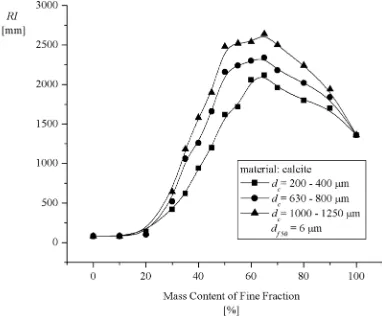
Figure 2 presents the results of research on the influence of particle size and particle size distribution. To measure the rathole index (RI) [6] for different mixtures of coarse and fine fractions we used a Johanson hang-up indicizer. The rathole index (Fig. 3) is the outlet diameter needed to ensure a rathole failure and cleanout in a funnel-flow bin. In general, a higher RI indicates poorer flow, and a lower RI indicates better flow. By measuring this index it has been shown that fine particles have a dominating influence on the flow of bulk solids.
Fig. 2. Influence of the mass content of the fine fraction on the mixture – comparison of the
rathole indices [7]
Explanation of symbols in Fig. 2 :
RI rathole index [m] dc granulation of coarse fraction [m] df 50 median particle size of fine fraction [m].
We used calcite for the preparation of the samples. The fine fraction had a median particle size df 50 ≈ 6 μm, which was measured with a Microtrac FRA 9200 particle size analyser, while the coarse fraction was prepared in three different ranges, as shown in Figure 2. The criterion for selecting the fractions was that the maximum diameter, df m, of a sphere that represents the fine fraction passing through the most dense packing of spheres of diameter dc m as a coarse fraction is defined with df m/dc m≤ 0.155 [8], where:
dc m diameter of a sphere in coarse fraction [m] df m maximum diameter of a sphere in fine
fraction [m].
Below the findings, based on experimental data obtained with calcite are presented:
• The broader the distribution, the bigger the yield strength of the bulk solid.
• Within the range of 20 to 45% of the fine fraction content, the influence on yield strength starts to increase steeply, and the strength reaches its maximum in the range between 45 to 60%. The larger the particles of the coarse fraction, the greater the maximum value.
• The unconfined yield strength of the mixture reaches similar values as the fine fraction itself within the 35 to 50% fine-particle-content range.
2 INFLUENCE OF MOISTURE CONTENT ON THE FLOW OF BULK SOLIDS
The moisture content is one of the most important parameters determining the properties of bulk-solid flow [9].
The capacity of bulk solids to absorb and retain moisture depends to a great extent on the amount of fine particles. Moisture is expressed as the ratio between the weight of the removed moisture and the weight of the dried sample. The moisture in bulk solids is usually unwanted: surface moisture leads to the formation of cohesive forces between the particles and adhesive forces between the particles and the walls of the silo. Both phenomena hinder the flow of bulk solids and can completely obstruct the flow under certain conditions.
Specific surface area of bulk solid is larger if particles are smaller. Moreover, smaller particles ensure more contact points per area thus, the unconfined yield strength increases due to more fluid bridges. The gravity flow of bulk solids is thus, controlled to a great extent by both, the amount of fine particles and moisture.
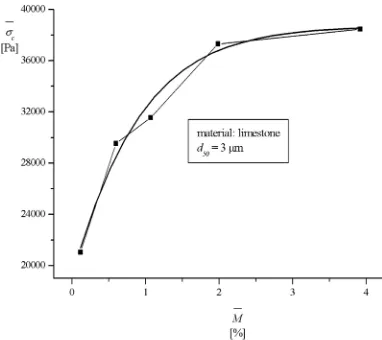
To determine the influence of moisture content on the unconfined yield strength of a bulk solid (Fig. 4) limestone was ground in a rod mill to d50 = 3 μm (measured with an FRA 9200 analyser). The samples were then wetted by adding water in different ratios, while the moisture content of the initial sample was 0.115 mass %. The samples were homogenized after two hours of rotation on a ball-mill drive. Approximately 10 g of each sample was taken to determine the moisture content, while the rest was
used for two tests using the Johanson hang-up indicizer. To determine the moisture content, the samples were oven-dried for two hours at 105°C, and subsequently cooled in a desiccator for 30 to 45 min before being weighed.
Fig. 4. Influence of moisture content on the unconfined yield strength of limestone (compaction pressure 150 kPa, angle of internal
friction 25°, 4 measurements per sample) Explanation of symbols in Fig. 4 :
σc average unconfined yield strength [Pa] M average moisture content [%].
3 INFLUENCE OF PARTICLE SHAPE ON THE FLOW OF BULK SOLIDS
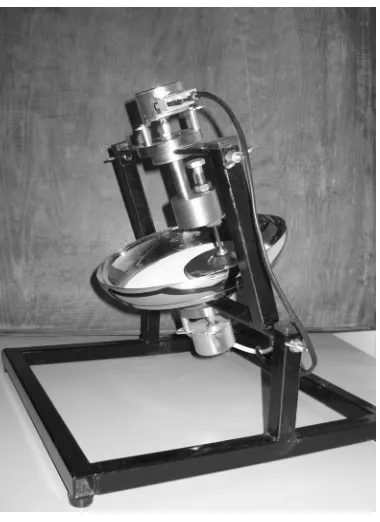
When studying the influence of particle shape on the flow of bulk solids we took into consideration the fact that it is unrealistic to compare the flow properties of bulk solids that have different shapes if they also differ in terms of other properties, and then ascribe the different flow characteristics to the shape of the particles. For the purpose of changing the shape of the particles of a single bulk solid we designed and used a novel laboratory device (Fig. 5) for attritor milling the bulk solid [10]. Dry attrition was a precondition since wetting and subsequent drying would cause considerable changes in the bulk-solid properties, which, of course, was not acceptable.
allows the head to scoop up the bulk solid at the edge of the vessel.
Fig. 5. Attritor mill
The bottom of the head has a tough, abrasion-resistant rubber and is in contact with the bulk solid. The rotation frequency of the attritor head is 20 min-1. The head rotates in the opposite direction to the vessel.
The bottom drive to which the vessel is attached, rotates around the axis, which makes it possible to adjust the tilt of the vessel. The pressure exerted on the head is provided by a spring, regulated by a screw. Macroscopic changes of particle shape can be observed after approximately 20 hrs.
The selection of the proper granulation of samples was on the one hand limited by the requirements for measuring the unconfined yield strength with the Johanson hang-up indicizer, and on the other, by the fact that too fine particles would hinder effective attrition. In this research, limestone of 200 to 500 μm was used, with the parameter d50 ≈ 320 μm, measured with an FRA 9200 analyser. Following the attrition, granulometric analysis was performed. Based on the results of the analysis, non-attritor-milled limestone with equal shares of individual fractions as the attritor-milled limestone was prepared. Table 1 presents the results of the sieving analysis after 50 hours of attrition.
Table 1. Granulometric composition of the attritor-milled limestone
Mesh size
[mm] [mm] Δx
Fraction mass (residue on the sieve) [g]
ΔR
[%] ΣΔR [%] ΣΔD [%]
0.5 + 0.5 0 0 0 100.000
0.4 0.4 – 0.5 22.44 22.772 22.772 87.228 0.315 0.315 – 0.4 30.93 31.389 54.161 45.839 0.250 0.250 – 0.315 20.71 21.017 75.178 24.822 0.200 0.200 – 0.250 14.79 15.009 90.187 9.813 0.160 0.160 – 0.200 7.07 7.174 97.361 2.639 0.125 0.125 – 0.160 2.20 2.233 99.594 0.406 0.071 0.071 – 0.125 0.23 0.233 99.827 0.173
0 0 0.17 0.173 100.000 0
Σ = 98.54 Σ = 100.000
Explanation of symbols in Table 1. :
Δx granulation interval [mm]
ΔR fraction percentage [%]
ΣΔR cumulative residue on the sieve [%]
ΣΔD cumulative pass [%]
camera we obtained photographs of the particles before and after the attritor milling. The photographic images were processed for further research using ACDSee 7.0 software. The mean factor of the shape was determined by using Leica Image Manager IM 50. The shape factor (F) of the particles was calculated using the following equation [11]:
2
4
π
A
pF
P
⋅ ⋅
=
(3)where:
Ap surface of the particle [m2] P circumference of the particle [m].
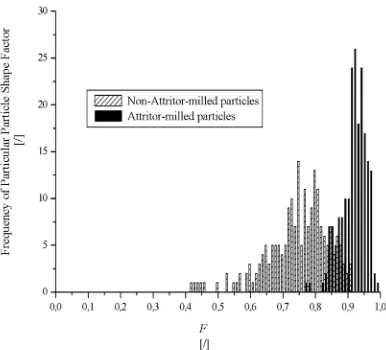
The mean shape factor of the particles before the attrition was approximately 0.75. After the attrition it was approximately 0.9 [12] (Fig. 6).
Fig. 6. Frequency of particular shape factor
In addition to the analyses of unconfined yield strength of attrited and non-attrited bulk material, we also performed analyses of mixtures where fine limestone with a median particle size of 4 μm (df 50 = 4 μm) was mixed with attrited and non-attrited limestone (Table 2). The analyses showed that the mixtures with attrited particles had up to 50 % higher unconfined yield strength than those with non-attrited particles (Fig. 7).
Fig. 7. The influence of particle shape on the unconfined yield strength of mixtures (compaction pressure 150 kPa, angle of internal
friction 25°) Explanation of the symbol in Fig. 7 :
dc 50 median particle size of coarse fraction [m].
Table 2. Analyses of the influence of particle shape on the unconfined yield strength of mixtures (compression pressure 150 kPa, angle of internal friction 25º)
Mass percentage of coarse fraction
[%]
σc
[Pa]
(mixtures with attritor-milled particles)
σc
[Pa]
(mixture with non-attritor- milled particles)
20 24173 24000 30 23362 23180 40 21113 21237 50 17120 16077 60 12418 10590
70 7520 4862
80 2858 1930
4 RESULTS AND DISCUSSION
Narrower particle size distributions show better flow behaviour than broader distributions, even if the mass median of the narrower distribution is somewhat smaller than that of the broader distribution. Moisture content is one of the most important parameters which determine the properties of bulk-solid flow. Even small changes in the moisture content can significantly affect the bulk-solid flow. Research on the influence of the particle shape on bulk-solid flow allowed us to conclude the following: if the particles of a bulk solid have round edges, then the sample can have a more even space distribution under compaction, and thus better contact between the particles and a greater density when compacted. Therefore, bulk solids with round-edged particles under pressure result in a greater unconfined yield strength than the bulk solids with sharp-edged particles. In other words, smoother particle surfaces allow the particles to approach each other so that smaller particle-particle distances are found. Thus, cohesive forces become larger and the strength increases. This fact was also confirmed when attrited or non-attrited material formed only a part of the sample. Analyses of unconfined yield strength of mixtures of fine and coarse-grained limestone showed an increase of strength up to 50 % for mixtures with attrited particles in comparison to the samples with non-attrited particles. A significant part of the research on the influence of particle shape was the design of our novel attritor which allowed for preparing samples which differed only in terms of shape from the same bulk solid.
5 CONCLUSIONS
When dealing with bulk solids, excessive crushing, attrition, or wetting of the particles needs to be eliminated. Such approach can reduce unwanted effects that will result in increased values of the shear parameters of the bulk solid, and consequently lead to problems of discharge from silos, thus causing hold-ups in the production process.
6 REFERENCES
[1] De Silva, S.R. Characterization of Particulate Materials. Powder Handling & Processing, October/December 2000, vol. 12, no. 4, p. 355-363.
[2] Peschl, I. Arching and Ratholing in Silos. Powder Handling & Processing, October/December 2001, vol. 13, no. 4, p. 357-363.
[3] Arnold, P.C. Some Observations on the Importance of Particle Size in Bulk Solids Handling. Powder Handling & Processing, January/March 2001, vol. 13, no. 1, p. 35-40. [4] Schulze, D. Flow Properties of Powders
and Bulk Solids and Silo Design for Flow. http://www.dietmar-schulze.de/fre.html/. [5] Schwedes, J. Testers for Measuring Flow
Properties of Particulate Solids. Powder Handling & Processing, October/ December 2000, vol. 12, no. 4, p. 337-354. [6] Johanson Innovations Inc, official site:
http://www.indicizer.com
[7] Hann, D., Kranjc, M., Stražišar, J. Particle Size and Distribution of Bulk Solids as Parameters that Significantly Influence their Flow Behaviour. RMZ Materials and Geoenvironment, December 2004, vol. 51, no. 4, p. 2135-2143.
[8] Molerus, O., Nywlt, M. The Influence of Fine Particle Content on the Flow Behaviour of Bulk Materials. Powder Technol., 1984, vol. 37, p.145-154.
[9] Stepanoff, A.J. Gravity Flow of Bulk Solids and Transportation of Solids in Suspensions, New York: Wiley, 1969. 191 p. ISBN 471-82202-7.
[10] Hann, D., Stražišar, J. Laboratory device for preparing round particles. 11th European symposium on comminution, Book of Abstracts, Budapest, October 9.-12., 2006.
[11] Kališnik, M., Eržen, I., Smolej, V. Temelji stereologije, 3rd ed. Ljubljana: DSKAS, 2002. 133 p. (In Slovene). ISBN 961-90933-1-3.