Patience and its components in predicting bullying among primary
school students
Farhad Khormaei
1, Azam Farmani
21Department of Psychology, Faculty of Psychology and Educational Sciences, Shiraz University,
Shiraz, Iran
2Department of Psychology, Payame Noor University, Tehran, Iran
Submitted: 7 June 2015 Accepted: 12 October 2015
Int J Behav Sci. 2016; 9(4): 215-219
Corresponding Author: Azam Farmani, MSc Department of Psychology, Payame Noor University, Tehran,
Iran
E-mail: [email protected]
Abstract
Introduction: The main purpose of this study was to investigate the role of patience and its components (Transcendence, Tolerance, Contentment, Persistence, and Hesitation) in predicting bullying among primary school children in Shiraz, Iran. Another purpose was to compare patience and bullying between male and female students.
Method: The statistical population of the present study was all elementary school students of Shiraz, Iran. The participants were 317 elementary school students (169 females and 148 males) selected through cluster random sampling. The sample group completed the Child/Adolescence Patience Scale and Revised Olweus Bullying/Victim Questionnaire.
Results: The results showed that the total score of patience and its components including Contentment, Persistence, and Hesitation had a significant negative correlation with bullying. The total score of patience negatively and significantly predicted bullying. Hesitation and Contentment could also negatively and significantly predict bullying. In addition, there was a significant difference in the total score of patience between males and females with females obtaining a higher mean on this variable. Also, there was a significant difference between male and female students in Contentment, Persistence, and Hesitationwith females obtaining a higher mean on these variables.
Conclusion: Based on the findings of this study, it is suggested that counselors or psychologists use educational strategies of patience in order to treat and prevent the phenomenon of bullying among students.
Keywords: Transcendence, Tolerance, Contentment, Persistence, Hesitation
Introduction
Bullying has a lot of socio-psychological consequences for both the bully and the victims [5].
Hence, due to its high prevalence and its negative short-term and long-short-term consequences, further examination of this issue and taking preventive steps to reduce or prevent it seems necessary. Few studies have examined this socio-psychological pathology in schools with regard to religion and spirituality. Patience is one of the religious-psychological variables that appears to be associated with bullying. Patience is a moral virtue which invites an individual to persistence, tolerance, self-restrain, contentment and transcendence in situations which are difficult and unpleasant to him [6]. Using factor analysis, Khormaei, Farmani and Soltani [7] identified five components in patience. The researchers reviewed all the verses of Quran about patience and their implied meanings to develop a scale to measure patience. The results of their analysis identified five components including Transcendence (enduring hardships and adversities to achieve divine revelation and spiritual growth), Tolerance (enduring suffering and hardships), Contentment (accepting the present situation without complaining and accepting what one has), Persistence (stability and persistence in doing the affairs), and Hesitation (restraint against the internal wishes and desires).
Studies have examined the importance of the role of patience in reducing aggression [8, 9], anxiety and depression [10, 11], and psychological well-being [12]. Other studies have also investigated the relationships of this religious-psychological structure to hopelessness[13], hope [14, 15], personality [6], marital satisfaction[16], general health [17], coping strategies [18], and suicide ideation [19]. In all these studies, the importance of patience in promoting mental health is approved, but no research is conducted in the area of patience and bullying among children. Students who bully other students seem to have less patience. Investigating the relationship between patience and bullying opens a new door for psychologists and counselors on the prevention and treatment of the phenomenon of bullying in schools. This type of study can help employing educational strategies of patience in schools. Therefore, due to the lack of articles on the relationship between patience and bullying and the necessity of religious interventions in the treatment of socio-psychological pathologies, the main purpose of this study was to investigate the role of patience and its components in predicting bullying among primary school children in Shiraz, Iran. Another purpose of this study was to compare patience and bullying among male and female students.
Method
This study has a descriptive- correlational design. The predictive variable in this study is the patience components that include Transcendence, Tolerance, Contentment, Persistence and Hesitation. The criterion variable is bullying. The population of the study consisted of all elementary school students in Shiraz, Iran, of which 317 students (169 females and 148 males) were selected
using cluster sampling method. To elaborate, among the four educational districts, one district, and of the primary schools located in the district, a number of male- and female-attending primary school were selected randomly. Then, among the selected schools, some classes were randomly selected and all the students in these classes were asked to complete the Child/Adolescence Patience Scale and Revised Olweus Bullying/Victim Questionnaire.
Child/Adolescence Patience Scale: The scale was constructed in the present study using what the holy Quran and the hadith stated about patience. The scale has 36 items based on Likert rating scale ranging from strongly agree to strongly disagree. The psychometric properties of the scale were examined on elementary, guidance and high school students. The results of factor analysis by principal component analysis method with varimax rotation indicated five components of patience,
respectively called Transcendence, Tolerance,
Contentment, Persistence and Hesitation. To assess the reliability of the scale, Cronbach's alpha coefficients were calculated. Cronbach's alpha was from 0.85 to 0.50 for the subscales, and .0.88 for the total scale.
Revised Olweus Bullying/Victim Questionnaire: The questionnaire is constructed by Olweus [20]and has 39 items which measure the amount and type of bullying, bullying place, the bully, the rate of bullying reported to teachers and families, and the level of teacher’s intervention. The findings of Kyriakides, Kaloyirou and Lindsay's study provided support for the construct validity, internal consistency and reliability of the instrument [21]. Moreover, the results of the research conducted by Zandvandian, Daryapour and Jabarifar [22] confirmed the reliability of this instrument. In their study, Cronbach's alpha for the victimization and bullying items were 0.79 and 0.86, respectively. In the present study, in order to evaluate bully, only the bully items were used. The Cronbach's alpha for the bullying items was 0.85.
To analyze the data, descriptive statistics of mean, standard deviation and Pearson correlation coefficient were run. Also, in order to investigate the role of patience and its components in
predicting bullying, simultaneous multiple
regression analysis was performed. To compare the components of patience and bullying among males and females, the independent T-test was used.
Results
The descriptive findings of the variables are shown in Table 1. In Table 2, the results of the correlation between patience and its components and bullying are presented. According to the results of Table2, the total scores of patience and the components of Contentment, Persistence and Hesitation had a significant negative correlation with bullying (P<0.01). Table 3 shows the results of predicting bullying based on the patience’s total score. According to the table, the total score of patience negatively and significantly predicted bullying (β = -0.31;
of Hesitation (β= -0.18; P<0.01] and Contentment (β
=-0.21; P<0.01) negatively and significantly predicted bullying.
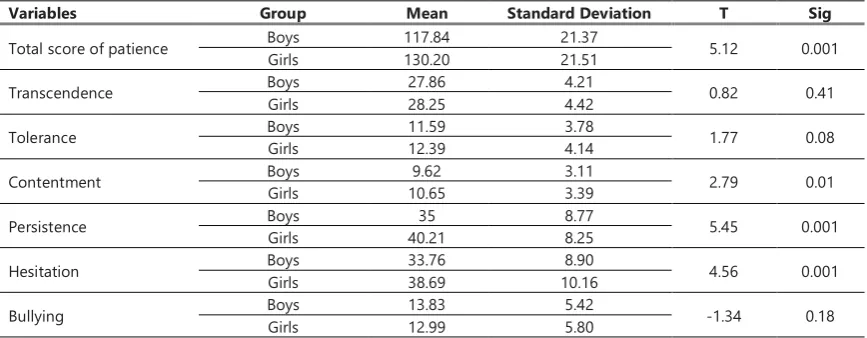
The results of comparing the variables between male and female students are presented in Table 5. According to the results, there was a significant difference in the patience’s total score between females and males (t =2.79;
P <0.01) with females obtaining a higher mean. A significant difference was also found between males and females in the component of Contentment (t=2.79; P<0.01) with females having a higher mean. Similarly, in the component of Persistence (t =5.45; P<0.001) and Hesitation (t=4.56; P<0.001), females obtained a significantly higher mean than males did.
Table 1. Descriptive findings for the variables
Standard Deviation Mean
Variables
22.28 124.43
Total score of patience
4.32 28.07 Transcendence 3.99 12.02 Tolerance 3.30 10.17 Contentment 8.87 37.78 Persistence 9.89 36.39 Hesitation 5.64 13.38 bullying
Table 2. Correlation coefficients between patience and its components and bullying
Hesitation Persistence
Contentment Tolerance
Transcendence Total score of
patience Variables -0.30** -0.27** -0.30** -0.06 -0.09 -0.31** Bullying
** P< 0.01
Table 3. Prediction of bullying on the basis of the patience’s total score
Sig t F R R2 B β Criterion Variable Predictive Variable 0.001 -5.86 34.39 0.31 0.10 -0.08 -0.31 Bullying
Total score of patience
Table 4. Prediction of bullying based on components of patience
R2 R F Sig t B β Criterion Variable Predictive Variables 0.13 0.36 9.39 0.71 -0.37 -0.03 -0.02 Bullying Transcendence 0.14 1.48 0.12 0.09 Tolerance 0.001 -3.35 -0.36 -0.21 Contentment 0.41 -0.83 -0.04 -0.06 Persistence 0.01 -2.42 -0.10 -0.18 Hesitation
Table 5. Results of independent T-test to compare the variables between male and female students Sig T Standard Deviation Mean Group Variables 0.001 5.12 21.37 117.84 Boys
Total score of patience Girls 130.20 21.51
0.41 0.82
4.21 27.86
Boys
Transcendence Girls 28.25 4.42
0.08 1.77 3.78 11.59 Boys Tolerance 4.14 12.39 Girls 0.01 2.79 3.11 9.62 Boys
Contentment Girls 10.65 3.39
0.001 5.45 8.77 35 Boys Persistence 8.25 40.21 Girls 0.001 4.56 8.90 33.76 Boys
Hesitation Girls 38.69 10.16
0.18 -1.34
5.42 13.83
Boys
Bullying Girls 12.99 5.80
Discussion
Patience is an active process causing an individual not to complain when confronting difficult and sometimes unchangeable situations, to have stability and persistence in doing affairs and activities, and to resist against his inner wishes and desires, and view hardship and adversities as a means to achieve transcendence. The results of this study showed that patience and its
to tease and make fun of them and avoids spreading rumors or having physical confrontation with his classmates.
Izadi Tameet al.’s study [9] also showed that the use of educational strategies of patience is effective in reducing aggression. Also, Shekoufe-Fard & Khormaei [8] indicated the role of patience in negatively predicting aggression. These results are consistent with the present results.
In addition to what was discussed, the results of this study showed that the component of Contentment negatively and significantly predicted bullying. In other words, an increase in student’s Contentment is associated with a decrease in bullying. So, it is obvious that the students who are satisfied with the behavior of their friends and classmates, do not complain, and bully much less. Therefore, discontentment is one of the most important factors causing students to bully towards their classmates and friends.
The results also indicated that the Hesitation component predicted bullying negatively. In other words, self-restraint against inner desires and passions is associated with a reduction in bullying. This finding is quite expectable. Hesitation describes people who can resist against temptations, desires, demands, and unreasonable expectations which are contrary to their own social expectations. When faced with situations that are not as desired, these students do not get angry and do not compensate in response to their classmate’s bad behavior. Obviously, these features are accompanied by a reduction in bullying. Also, Chiu and Chan’s study [23] indicated a significant negative correlation between bullying and self-control. Likewise, in Farrington and Baldry’s study [24], an increase in impulsiveness was a major risk factors for bullying. The findings of the present study are consistent with these studies.
Another finding of this study is that there is a significant difference between male and female students in the total score of patience and its components. Female students scored higher in patience’s total score and the components of Contentment, Persistence, and Hesitation. In other words, females are more patient than males, are more contented, show more stability and persistence in their work, and have more self-restraint. According to a study conducted by Duckworth and Seligman [25], females possessed more ability to discipline and self-control compared to males. Although patience and its components are different from discipline and self-control, given the similarities existed among these variables, the results of this study can be considered as in line with those of their study. Also, according to these findings, further investigation of how and why gender differences occur in patience seems essential.
Despite significant differences between males and females in the scores of patience and its components, no significant differences were found between them in terms of the bullying variable. Most studies [2, 26-29] have shown that bullying is more seen among males than females but the results of the present study is inconsistent with them. Social and cultural differences can probably explain the differences observed in the findings. It should
be noted that to confirm this issue, in response to the question of whether males are more aggressive or females, researchers provide no definite ‘yes’ answer. Instead, they believe that the answer depends on context and situational variables. In other words, in order to respond to this question, the definition of aggression, methods of measuring it, and age of child or adolescent need to be considered [30].
Conclusion
The results of this study showed that patience and its components significantly predicted bullying. Based on these findings, it is recommended to researchers to investigate the role of meditational variables such as cognitive flexibility, parenting styles, and social skills in the relationship between patience and bullying. Moreover, investigating the mechanisms by which patience affects bullying can open a new door to the deeper researches on this field. Finally, counselors and psychologists working in schools and those dealing with students are recommended to use educational strategies of patience for the treatment and prevention of the phenomenon of bullying among students.
References
1. Mount GR. Bullying: Characteristics, Consequences and Interventions. J Police Crisis Negotiations. 2005;5(2):125-9. 2. BarzegarBafrooei K, khezri H. Prevalence of types of bullying in
schools in Yazd city from the perspective of teachers. Except Educ. 2013:15-26. [Persian]
3. Glover D, Gough G, Johnson M, Cartwright N. Bullying in 25 secondary schools: Incidence, impact and intervention. Educ Res. 2000;42(2):141-56.
4. Rigby K, Smith PK. Is school bullying really on the rise? Soc Psychol Educ. 2011;14(4):441-55.
5. Gini G, Pozzoli T. Association between bullying and psychosomatic problems: A meta-analysis. Pediatrics. 2009;123(3):1059-65. 6. Khormaei F, Farmani A. Investigating the role of the Big Five
personality factors in predicting patience and its components among university students. J Clin Psychol Pers. 2015;2(11):11-24. [Persian] 7. Khormaei F, Farmani A, Soltani E. The Patience Scale: Instrument
development and estimates of psychometric properties. Educ Meas. 2014;5(17):50- 67.[Persian]
8. ShokoofehFard S, Khormaie F. An inquiry into the predictive role of components of patience in students' aggressive behavior. Psychol Religion. 2012;5(2):99- 112. [Persian]
9. Izadi-Tame A, Borjali A, Delavar A, Eskandari H. Effects of patience and problem solving training on aggressiveness and selecting contrastive strategies in police university students. Danesh-e-Entezami. 2010;11(3):182-207. [Persian]
10. Sadat-Husseini-Sultan-Nasir M, Alizadeh-Assar A, Rahmati A. Educating the spritual skills of patience and prayer in reducing depressive symptoms among university students. University students' mental health conference; Isfahan, Iran 2014 . [Persian] 11. Hossein- Sabet F. Effectiveness of patience training in anxiety,
depression and happiness. Stud Islamic Psycholol. 2008;1(2):79- 92. [Persian]
12. Schnitker SA. An examination of patience and well-being [Dissertation]. Davis, CA. University of California. 2010. 13. Khormaei F, Farmani A. Patience and the role of its components in
predicting hopelessness among university students. University students' mental health conference; Isfahan, Iran. 2014. [Persian] 14. Khormaei F, Farmani A, Soltani E. Investigating the prediction role
of patience as a moral construct and personality characteristics in the hopelessness of university students. J Med Ethics. 2014;7(28):167-99. [Persian]
15. Ghobari-Bonab B, Khodayari-Fard M. The relationships of trust in God, anxiety, patience and hope in distressed situations. First International Conference of Religion and Mental Health; Tehran: Iran: University of Medical Sciences. 2000. [Persian]
patience and its components in predicting the marital satisfaction of the elementary school students’ parents in Shiraz. Sixth National Congress of Family Pathology; Tehran: Shahid Beheshti University ; 2014.[Persian]
17. Farmani A, Khormaei F, Baneshi F. Investigating the role of patience components in predicting mental health among university students. National Conference of Quran, Health and Life Style; Fasa: Iran: Fasa University of Medical Sciences. 2015. [Persian] 18. Keyhanfar R. Study of relationship between patience and stress in
students of Shiraz University [Dissertation]. Shiraz: Shiraz University; 2010. [Persian]
19. Haghjoo S. Prediction of suicidal ideation based on components of patience and emotion regulation [Dissetattion]. Shiraz: Shiraz University; 2013. [Persian]
20. Olweus D. The revised Olweus Bully/Victim Questionnaire for Student. Bergen, Norway: University of Bergen. 1996.
21. Kyriakides L, Kaloyirou C, Lindsay G. An analysis of the Revised Olweus Bully/Victim Questionnaire using the Rasch measurement model. Brit J Educ Psychol. 2006;76(4):781-801.
22. Zandvandian A DE, Jabarifar T. The relationship between school climate and bullying behavior in high school students of Yazd. J Educ. 2014;20(2):45- 62. [Persian]
23. Chui WH, Chan HCO. Association between self-control and school bullying behaviors among Macanese adolescents. Child Abuse Neglect. 2013;37(4):237-42.
24. Farrington D, Baldry A. Individual risk factors for school bullying. J Aggression, Conflict Peace Res. 2010;2(1):4-16.
25. Duckworth AL, Seligman ME. Self-discipline gives girls the edge: Gender in self-discipline, grades, and achievement test scores. J Educ Psychol. 2006;98(1):198.
26. Iossi Silva MA, Pereira B, Mendonça D, Nunes B, Oliveira WAd. The involvement of girls and boys with bullying: an analysis of gender differences. Int J Environment Res Public Health. 2013;10(12):6820-31.
27. Griezel L, Finger LR, Bodkin-Andrews GH, Craven RG, Yeung AS. Uncovering the structure of and gender and developmental differences in cyber bullying. J Educa Res. 2012;105(6):442-55. 28. Cheraghi A, Piskin M. A comparison of peer bullying among high
school students in Iran and Turkey. Procedia-Soc Behav Sci. 2011;15:2510-20.
29. Baldry AC, Farrington DP. Bullies and delinquents: Personal characteristics and parental styles. J Commun Appl Soc Psychol. 2000;10(1):17-31.