• No results found

MOA 2007 BLG 197 : exploring the brown dwarf desert

N/A
N/A
Protected

Academic year: 2020

Share "MOA 2007 BLG 197 : exploring the brown dwarf desert"

Copied!
16
0
0

Loading.... (view fulltext now)

Full text

(1)

DOI:10.1051/0004-6361/201525791 c

ESO 2015

Astrophysics

&

MOA-2007-BLG-197: Exploring the brown dwarf desert

?

C. Ranc

1,§

, A. Cassan

1,??,§

, M. D. Albrow

2,§

, D. Kubas

1,§

, I. A. Bond

3,¶

, V. Batista

1,§

, J.-P. Beaulieu

1,§

,

D. P. Bennett

4,¶

, M. Dominik

5,§

, Subo Dong

6,k

, P. Fouqué

7,8,§

, A. Gould

9,k

, J. Greenhill

†,10,§

, U. G. Jørgensen

11,§

,

N. Kains

12,5,§

, J. Menzies

13,§

, T. Sumi

14,¶

, E. Bachelet

15,§

, C. Coutures

1,§

, S. Dieters

1,§

, D. Dominis Prester

16,§

,

J. Donatowicz

17,§

, B. S. Gaudi

9,k

, C. Han

18,k

, M. Hundertmark

5,11

, K. Horne

5,§

, S. R. Kane

19,§

, C.-U. Lee

20,k

,

J.-B. Marquette

1,§

, B.-G. Park

20,k

, K. R. Pollard

2,§

, K. C. Sahu

12,§

, R. Street

21,§

, Y. Tsapras

21,22,§

, J. Wambsganss

22,§

,

A. Williams

23,24,§

, M. Zub

22,§

, F. Abe

25,¶

, A. Fukui

26,¶

, Y. Itow

25,¶

, K. Masuda

25,¶

, Y. Matsubara

25,¶

, Y. Muraki

25,¶

,

K. Ohnishi

27,¶

, N. Rattenbury

28,¶

, To. Saito

29,¶

, D. J. Sullivan

30,¶

, W. L. Sweatman

31,¶

, P. J. Tristram

32,¶

,

P. C. M. Yock

33,¶

, and A. Yonehara

34,¶

(Affiliations can be found after the references)

Received 2 February 2015/Accepted 15 May 2015

ABSTRACT

We present the analysis of MOA-2007-BLG-197Lb, the first brown dwarf companion to a Sun-like star detected through gravitational microlensing. The event was alerted and followed-up photometrically by a network of telescopes from the PLANET, MOA, andµFUN collaborations, and observed at high angular resolution using the NaCo instrument at the VLT. From the modelling of the microlensing light curve, we derived basic parameters such as, the binary lens separation in Einstein radius units (s'1.13), the mass ratioq=(4.732±0.020)×10−2and the Einstein radius

crossing time (tE'82 d). Because of this long time scale, we took annual parallax and orbital motion of the lens in the models into account, as well

as finite source effects that were clearly detected during the source caustic exit. To recover the lens system’s physical parameters, we combined the resulting light curve best-fit parameters with (J,H,Ks) magnitudes obtained with VLT NaCo and calibrated using IRSF and 2MASS data. From

this analysis, we derived a lens total mass of 0.86±0.04Mand a lens distance ofDL =4.2±0.3 kpc. We find that the companion of

MOA-2007-BLG-197L is a brown dwarf of 41±2MJobserved at a projected separation ofa⊥=4.3±0.1 AU, and orbits a 0.82±0.04MG-K dwarf

star. We then placed the companion of MOA-2007-BLG-197L in a mass-period diagram consisting of all brown dwarf companions detected so far through different techniques, including microlensing, transit, radial velocity, and direct imaging (most of these objects orbit solar-type stars). To study the statistical properties of this population, we performed a two-dimensional, non-parametric probability density distribution fit to the data, which draws a structured brown dwarf landscape. We confirm the existence of a region that is strongly depleted in objects at short periods and intermediate masses (P.30 d,M∼30−60MJ), but also find an accumulation of objects aroundP∼500 d andM ∼20MJ, as well as another

depletion region at long orbital periods (P &500 d) and high masses (M & 50MJ). While these data provide important clues on the different

physical mechanisms of formation (or destruction) that shape the brown dwarf desert, more data are needed to establish their relative importance, in particular as a function of host star mass. Future microlensing surveys should soon provide more detections, in particular for red dwarf hosts, thus uniquely complementing the solar-type host sample.

Key words.planets and satellites: detection – gravitational lensing: micro – brown dwarfs

1. Introduction

Gravitational microlensing is a powerful technique for detecting extrasolar planets (Mao & Paczynski 1991), and it holds great promise for detecting populations of brown dwarf companions to stars. Compared to other detection techniques, microlensing provides unique information on the population of exoplanets, be-cause it allows the detection of very low-mass planets (down to the mass of the Earth) at long orbital distances from their host stars (typically 0.5 to 10 AU). It is also the only technique that allows discovery of exoplanets and brown dwarfs at distances from the Earth greater than a few kiloparsecs, up to the Galactic bulge, which would have been hard to detect with other methods.

? Figures 9–12 are available in electronic form at

http://www.aanda.org

??

Corresponding author: A. Cassan, e-mail:[email protected]

§

PLANET/RoboNET Collaboration.

MOA Collaboration.

k µFUN Collaboration.Deceased.

Exoplanets are found to be frequent by all detection tech-niques (e.g.,Cassan et al. 2012;Bonfils et al. 2013;Mayor et al. 2011; Sumi et al. 2011; Gould et al. 2010b), and recent sta-tistical microlensing studies even imply that there are, on av-erage, one or more bound planets per Milky Way star (Cassan et al. 2012). Conversely, brown dwarfs appear to be intrinsically rare, to the point that shortly after the first exoplanet detections, it led to the idea of a “brown dwarf desert” (Marcy & Butler 2000) bridging the two well-defined regions of binary stars and planetary systems. While in the past, brown dwarfs were de-fined as objects of mass within the deuterium- and hydrogen-burning limits (13−74MJ,Burrows et al. 2001), it appears today that different formation scenarios can build objects with similar masses but with different natures (super-massive planets, or low-mass brown dwarfs). An object formed via core accretion and reaching 13MJ would, for example, be able to start deuterium burning, as would an object of same mass formed by gravita-tional collapse of a cloud or in a protoplanetary disk (Mollière & Mordasini 2012).

(2)

Despite their low occurrence, a number of brown dwarf com-panions to stars have been discovered by different methods: ra-dial velocity and transit (e.g., Moutou et al. 2013; Díaz et al. 2013;Sahlmann et al. 2011;Johnson et al. 2011;Deleuil et al. 2008), direct imaging (e.g., Lafrenière et al. 2007) and mi-crolensing. With regards to microlensing, there are still a few brown dwarf detections, but this is mainly because until now observing priority has been given to exoplanets. Nevertheless, these detections are of particular interest because they provide a unique view of brown dwarfs around low-mass stars (mainly M dwarfs), which complements the currently available sample mostly composed of solar-type stars.

Microlensing detections so far include isolated brown dwarfs, brown dwarfs hosting planets, and brown dwarf com-panions to stars. The first isolated brown dwarf detected through gravitational microlensing (a 59±4MJbrown dwarf located at 525±40 pc in the thick disk of the Milky Way) was reported by Gould et al. (2009) in microlensing event OGLE-2007-BLG-224. Two brown dwarfs with planetary-mass companions were discovered in events OGLE-2009-BLG-151/ MOA-2009-BLG-232 and OGLE-2011-BLG-0420 byChoi et al.(2013). In both cases, the planets were super Jupiters (7.9±0.3MJ and 9.9±0.5MJ, respectively) with the hosts being low-mass brown dwarfs (19±1MJand 26±1MJ, respectively), with very tight orbits (below 0.4 AU). Similarly, Han et al. (2013) report a 23±2MJfield brown dwarf hosting a 1.9±0.2MJplanet in a tight system after the analysis of the event OGLE-2012-BLG-0358.

The first published microlensing detection of a brown dwarf companion to a star is OGLE-2008-BLG-510/ MOA-2008-BLG-369, which was first reported byBozza et al.(2012) as an am-biguous case between a binary-lens and a binary-source event. The data were reanalysed by Shin et al. (2012a), who con-cluded that the binary-lens model involving a massive brown dwarf orbiting an M dwarf was preferred. Shin et al.(2012b) conducted a database search for brown dwarf companions by focusing on microlensing events that exhibit low mass ratios. Among seven good candidates with well-determined masses (combination of Einstein radius and parallax measurements), they found two events that involve brown dwarfs: OGLE-2011-BLG-0172/MOA-2011-BLG-104 with mass 21±10MJaround an M dwarf, and MOA-2011-BLG-149, a 20±2MJbrown dwarf also orbiting an M dwarf. Similarly, Bachelet et al.(2012) re-ported the detection of another ∼52MJ brown dwarf orbiting an M dwarf in MOA-2009-BLG-411, although the lens mass could not be determined exactly, and was estimated through sta-tistical realisations of Galactic models. In microlensing event MOA-2010-BLG-073, Street et al. (2013) find that the lens was composed of a 11.0±2.0 MJ companion (hence near the planet/brown boundary) orbiting an M dwarf of 0.16±0.03M. Jung et al.(2015) report the detection of a star at the limit of the brown dwarf regime hosting a companion at the planet/brown dwarf boundary (13±2MJ). More recently,Park et al.(2015) have reported the discovery of a binary system composed of a 33.5±4.2MJ brown dwarf orbiting a late-type M dwarf in mi-crolensing event OGLE-2013-BLG-0578.

Here we report the first microlensing discovery of a brown dwarf orbiting a Sun-like star. This new brown dwarf has a mass of 42MJand it was observed at a projected separation of 4.3 AU from its G-K dwarf host star.

In Sect. 2, we present photometric data collected on MOA-2007-BLG-197L by several round-the-world telescopes, as well as high resolution adaptative optics images taken with NaCo at VLT. In Sect. 3, we present the full analysis of the light curve and in Sect. 4 we derive the physical parameters of the

lens by combining all independent informations. In Sect. 5, we adopt a statistical point of view to analyse the current popula-tion of brown dwarfs detected with different methods using non-parametric probability density estimation tools. In Sect. 6 we summarise our results, and underline the importance of future microlensing observations to characterise the populations of ob-jects in the mass region between planets and stars.

2. Observational data

2.1. Alert and follow-up

MOA-2007-BLG-197 (l = 359.711, b = −5.509, or RA (J2000)=18:07:04.729, Dec (J2000)=−31:56:46.77) is a microlensing event that was alerted by the MOA collaboration (1.8 m telescope located in Mount John, New Zealand) in 2007 May 28 (or THJD'42491on the photometric light curve shown Fig.1). Soon after, between 1−5 June (THJD'4251−4255), a very cloudy weather in New Zealand seriously affected the qual-ity and reliabilqual-ity of the photometry, resulting in gaps in the time series. A magnification peak in the MOA light curve was passed around June 6 (THJD'4258). On June 8 (THJD'4259.7), the PLANET collaboration added the event to its target list as a reg-ular mid-magnification object. Follow-up observations include data from the PLANET network using the Danish telescope 1.54 m at La Silla (Chile), Canopus 1m in Hobart (Tasmania), SAAO 1 m in Sutherland (South Africa) and Perth 0.6 m tele-scope (Australia), while theµFUN collaboration collected data from CTIO 1.3 m in Mount Cerro Tololo (Chile).

On June 19 (THJD ' 4272), PLANET observers noticed that a few MOA data points were slightly above the standard single-lens theoretical curve. As this usually happens quite often in microlensing data, no alert was released. Indeed SAAO soon revealed that the alleged deviation was a false alert, but follow-up observations were continued. On July 5 (THJD ' 4287), even though the full moon affected the quality of the observa-tions, a public alert was issued after Danish 1.54 m data were found to be above the single lens curve by more than 0.2 mag for more than five consecutive days. Intensive follow-up obser-vations from SAAO confirmed the rise in brightness, announcing a caustic crossing. While Perth was overclouded, Canopus then took over, and was the only telescope to densely cover the caus-tic exit, which took place during the night of July 4 in Australia (THJD'4287.0−4287.4, see inset of Fig.1).

2.2. Photometric light curve

The photometric data was reduced several times using different software to check their consistency. The final lightcurve data from all telescopes were extracted with the PLANET pipeline PySIS (Albrow et al. 2009), which is a DIA-based algorithm (Difference Image Analysis,Alard 2000;Alard & Lupton 1998). For images taken in particularly bad weather conditions, we ex-amined by eye each image in order to check whether the sub-traction was correct or not. In the latter case we had to ex-clude them, but on the basis of image quality only. In the post-processing of the reduced data, we applied a cut in seeing and sky background, although in a very conservative way so that pos-sible low-amplitude signals were not rejected. Not surprisingly, most of the data taken by MOA during the very bad weather period mentioned before (THJD ' 4251−4255) had to be dis-carded. Unfortunately, a critical light curve feature is thereby not

(3)

4220 4240 4260 4280 4300 4320 4340 4360

HJD−2, 450, 000 -0.1

0.0 0.1

residuals

(mag)

14.8

15.0

15.2

15.4

magnitude

I

(MO

A)

•SAAO

•CTIO

•MOA

•Canopus •Perth •Danish

E1 E2 E3 E4

4287.0 4287.3 14.6

14.8

15.0

15.2 0.0 0.2 0.4

[image:3.595.51.548.76.384.2]

-0.2 0.0 0.2

Fig. 1.Upper panel: the light curve of MOA-2007-BLG-197 and the best-fit model (solid line) with a zoom on the caustic exit on the right-hand side. On the left-hand side, the structure of the resonant caustic is drawn in red, as well as the trajectory of the source, in black (axes are in Einstein radius units). The source is too small to be distinguished. The four intervalsE1−4 indicate time intervals where possible source caustic crossing

(caustic entry) have been investigated.Lower panel: the residuals of the best-fit model.

Table 1.Telescopes and photometric data sets.

Telescope Location Filter Dataa fb

MOA (1.8 m) Mount John, New Zealand RMc 504 1.4

PLANET Danish (1.54 m) La Silla, Chile I 167 1.7 PLANET Canopus (1.0 m) Mount Canopus, Tasmania I 45 3.0 PLANET SAAO (1.0 m) Sutherland, South Africa I 43 1.6 µFUN CTIO (1.3 m) Mount Cerro Tololo, Chile I 28 1.3 PLANET Perth (0.6 m) Perth, Australia I 15 1.4

Notes.(a)Number after data cleaning.(b)Error bar rescaling factor (Sect.2.2).(c)MOA broadR/Ifilter.

covered (which has important consequences, see Sect.3), how-ever there was no other choice but to remove these data, as they might otherwise have affected the reliability of our models.

The final light curve data amounts to a total of 802 data points. They are summerised in Table 1. As seen in the table, all telescopes use a similar I-band filter, apart from the MOA 1.8 m telescope which is equipped with a broad R/I filter (re-ferred to asRM). Additionally, a fewV-band images were taken

by PLANET andµFUN to produce colour-magnitude diagrams (see Sect.4.1).

The last concern about the photometry was the estimation of the error bars of the data. Galactic bulge fields are highly crowded with stars, and during a microlensing event, the flux variation can easily span two order of magnitudes for high-magnification events. These pose severe challenges to manage a good estimation of the error bars. As a matter of fact, in mi-crolensing experiments it is long known that data reduction soft-ware usually underestimates error bars. Furthermore, error bars

can vary significantly from one data set to another, with the risk that one data set dominates over the others at the modelling stage. A relatively robust method to prevent these drawbacks is to rescale the error bars, based on the best model fitting the data. For each data set, the (classical)χ2is set up to the number of

de-grees of freedom by adjusting a rescaling factorf in the formula σ02 = f2σ2+σ2

0, whereσ

0andσare respectively the rescaled and initial error bars on the magnitudes, andσ0 = 4 ×10⁻⁴

a constant accounting for the data most highly magnified. The

f factors are given in Table1for each data set.

2.3. VLT NaCo high resolution images

[image:3.595.145.452.466.545.2]
(4)
[image:4.595.50.283.75.219.2]

Fig. 2.Left: sub-region (9400×

7700

) of an original 30×

30

Ks-band IRSF

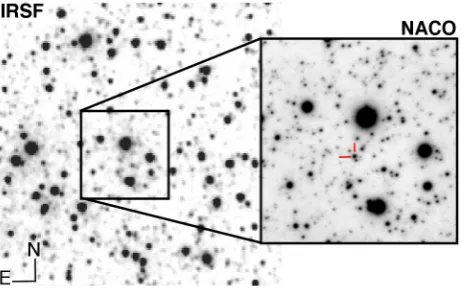
image used to calibrate the NaCo magnitudes. Right: corresponding Ks-band NaCo image (2700×2500) used to cross-identify the stars.

the NaCo instrument, mounted on 8.2 m ESO VLT Yepun tele-scope (Fig.2). The source star was then still magnified by a fac-tor of about A ' 1.30. A year later, on the night 2008 August 3/4 (THJD ' 4682.1), we carried out second epoch observa-tions3while the event was back to baseline magnitude. In

princi-ple, when two epochs are obtained at different magnifications, it should be possible to directly disentangle the lens flux from the source flux. In our case, however, the combination of a relatively high blending factor and low magnification did not support this direct measurement. Therefore, in the global analysis we used only the first epoch images. We reduced and calibrated the NaCo images following the general method outlined in Kubas et al. (2012) and briefly described below.

The night was clear and stable according to the observatory night logs, and the target was observed at low airmass and in good seeing conditions (<0.800). The data were taken in auto-jitter mode within a 1000 jitter box including the target in or-der to be able to correct for bad pixels and sky background. The AO correction was done using a K = 11.17±0.02 mag star (2MASS 18070464-3156423) at an angular separation of about 500from the microlensing target. The data were dark sub-tracted, flat-fielded and co-added with the tools underlying the NaCo pipeline software (Devillard 1999).

To derive the photometry from the reduced data, the first step was to compute the zeropoints for the conversion of instrumental magnitudes to calibrated magnitudes. A first possibility was to use catalogued stars within the target frame field-of-view (FOV), in our case 2800×2800. While several cross-matches between the NaCo frames and the 2MASS catalogue were identified, only 2MASS 18070520-3156409 (J=14.24±0.05,H=13.69±0.05,

K = 13.48±0.05) turned out as suitable (other potential cali-brators in the NaCo images were either saturated or in the non-linear regime of the detector). We finally checked that this star was not variable, by comparing a series ofH-band images taken with Andicam at CTIO, which is well calibrated to 2MASS thanks to its 2.40×2.40 FOV. A second option for calibration was to use the zeropoints derived from the photometric standards taken with NaCo directly before the observations on the night 20/21 of August and at similar airmass. For calibration we used

J,H,Kmagnitudes4of star 9160-S870-T in the listed standards of Persson et al.(1998), which had the following advantages: this star was brighter than the previous 2MASS reference, and

3 ESO Programme ID 381.C-0425(A).

4 Note that the difference in the transmission profile betweenKand

Ksbands is less than 1%, so negligible in the present case.

Table 2.Derived NaCo magnitudes of the microlensing event target in the (J,H,Ks) filters for the two epochs 2007 August 20/21 (epoch 1)

and 2008 August 3/4 (epoch 2).

Band Epoch Magnitude Date [THJD] FWHM J 1 17.68±0.06 4333.03906250 0.1900

J 2 17.67±0.05 4682.12500000 0.1700

H 1 17.05±0.05 4333.05468750 0.1400

H 2 17.04±0.04 4682.14453125 0.1100

Ks 1 16.87±0.05 4333.02343750 0.1100

Ks 2 16.89±0.04 4682.10546875 0.1100

Notes. The values of Epoch 1 are used to constrain the lens mass-distance relation.

the smaller pixel scale made it less sensitive to blending con-tamination in our crowded field. For consistency, however, we measured the magnitude of 2MASS 18070520-3156409 in the NaCo frame, and found an agreement to better than 3%.

The second step was to extract accurate photometry from AO images in the infrared. This was not a straightforward task, since the shape of the point-spread function (PSF) often is not well fit-ted by analytical profiles, and also depends on the position of the target with respect to the star used for AO correction. Following Kubas et al. (2012), we constructed a PSF reference directly from stars in the NaCo frame, using the StarFinder package (Diolaiti et al. 2000). This software was especially designed for AO images of crowded stellar fields. We foundJ=17.68±0.06,

H = 17.05±0.05 and Ks = 16.87±0.05. The quoted error

bars are dominated by the uncertainties in determining the true PSF shape and the scatter of the sky and unresolved background sources. The measurements obtained with StarFinder are sum-marised in Table2.

The final step consisted in correcting the target for interstel-lar extinction, by fitting the position of the red clump giants (RCG) in the three colour-magnitude diagrams (CMD) involv-ing the measured J,H,Ks reddened magnitudes. Because the nominal range in magnitudes from NaCo is above the 2MASS faint limit, we performed InfraRed Survey Facility (IRSF) ob-servations at SAAO to extend the available 2MASS star list into the regime of stars measured within the NaCo frame. We used Kato et al. (2007) to obtain the calibration of IRSF im-ages with respect to the 2MASS reference-star catalogue, noting thatJanczak et al.(2010) found that no additional colour term is needed between NaCo and IRSF filters (the full process to build the calibration ladder is detailed inKubas et al. 2012). Data to construct the NaCo+IRSF CMD are extracted from 2304 stars identified within a 30 circle around the target in IRSF images, and 135 stars identified in the NaCo images (Fig.2). The result-ing de-reddened and calibrated CMD is plotted in Fig.3, with a fit of the Red Clump Giant (RCG) position using a 10 Gyr,

Z =0.019 isochrone fromBressan et al.(2012), and assuming a RCG distance modulus ofµ = 14.6 mag. This distance mod-ulus is longer than the value used inKubas et al.(2012) since the event is located in the Galactic bar (see Sect.4.1for a de-tailed discussion). From this analysis, we derived the following extinctions:AJ =0.51±0.05 mag,AH = 0.33±0.05 mag and

AKs =0.22±0.05 mag. These data are used in Sect.4.2to

con-strain the lens and mass distance. 3. Light curve modelling

3.1. Binary lens parameters

[image:4.595.312.549.115.200.2]
(5)

0.0 0.4 0.8 1.2 1.6 2.0

J−Ks

10

12

14

16

18

20

22

J

[image:5.595.50.280.76.312.2]

NACO IRSF

Fig. 3.(J,J−Ks) colour–magnitude diagram in the 2MASS system

com-bining NaCo and IRSF data (respectively, in blue and black). The red dot is the magnitude/colour of the source derived from the source char-acterisation (Sect.4.1). The values are not corrected for interstellar ex-tinction. The red clump (RCG) is fitted by the red over-plotted 10 Gyr, solar-metallicity isochrone fromBressan et al.(2012).

of possible solutions. In this model, the lens is characterised by its binary mass ratio q, and s, the projected separation of the binary lens in angular Einstein radius unitsθE. Here,

θE=

s

4GM c2DS

DS

DL −1

!

, (1)

whereGis the gravitational constant,cthe speed of light, DL

and DS are respectively the observer-lens and observer-source distances and M the total mass of the lens. Four additional pa-rameters describe the source mean rectilinear motion: the mini-mum impact distanceu0between the source and the origin (here, the centre of mass of the system, with the more massive body on the right-hand side),t0, the date at which the source reachesu0,

tE, the time it takes for the source to travel one Einstein angular radius, and α, the angle between the source trajectory and the lens symmetry axis.

When the source approaches a caustic, finite-source effects cannot be neglected and substantial deviations from a point-source model are expected. Finite-point-source effects are included in the modelling through

ρ= θS θE

, (2)

where θS is the angular radius of the source, and ρ the same

quantity but in Einstein radius units. Here and in the following, a point-source model is used when the source is far enough from the caustics (t≤4240.0 andt≥4300.0); closer to the caustics, a hexadecapole approximation to the finite-source magnification (Gould 2008) is used (t∈[4240.0,4247.9]∪[4260.0,4286.0]∪ [4287.5,4300.0]), until it breaks down, approximately when the source is closer than∼3ρfrom the caustics. In this case, a full integration along the source images contours (Dominik 2007; Bozza 2010;Gould & Gaucherel 1997) or ray-shooting of the

images are required (Dong et al. 2006, 2009; Bennett 2010) to compute the magnification. Since finite-source effects dra-matically increase the computational cost, these time intervals are reduced as much as possible (here,t ∈ [4247.9,4260.0]∪ [4286.0,4287.5]).

Microlensing light curves are usually sensitive to stellar limb darkening (e.g.,Albrow et al. 1999b;Cassan et al. 2006). We thus model the source as a linear limb-darkened disk (An et al. 2002; Zub et al. 2011) described by the intensity-normalised profile

I(r)= 1 π

"

1−Γ 1−3 2

√ 1−r2

!#

, (3)

where 0 ≤ r ≤ 1 is the fractional radius, and Γ the linear limb-darkening (LLD) coefficient. While in special cases limb-darkening laws beyond the linear law may slightly improve the model (e.g.,Cassan et al. 2004;Kubas et al. 2005), in the case of MOA-2007-BLG-197L (relatively sparse data coverage of the caustic crossings) it is an excellent approximation. As seen in the right inset of Fig.1, only Canopus data are sensitive to limb darkening, although the light curve sampling is not dense enough to provide strong constraints on the LLD coefficient. We there-fore useClaret & Bloemen(2011) for the source surface grav-ity and effective temperature found in Sect.4.1(logg ∼ 4.47,

Teff ∼5350 K) to estimate MOA-2007-BLG-197L LLD coeffi -cients, and found∼0.4 for theIfilter and∼0.5 for theRfilter. We checked that refining the Canopus-ILLD coefficient with a fit to the data leads toΓI =0.48. We then adoptedΓI =0.48 for all

I-band data andΓRM =0.5 (MOAΓRMfilter is a broadR/Ifilter). Finally, two additional parameters,FSi (source flux) andFBi

(blended flux), are included per individual observatory or filter, so that for a given individual data setithe total flux of the mi-crolensing target reads

Fi(t)=A(t)FSi +FiB, (4)

whereA(t) is the time-dependent source flux magnification fac-tor. The blending flux FB accounts for all luminous contribu-tions other than the source, in particular, it includes the flux from the lens. For the best model presented in Table3, the blending flux ratiosFB/FSare respectively 17.79 (MOA), 38.14 (SAAO), 12.85 (CTIO), 3.97 (Canopus), 66.97 (Perth), 12.10 (Danish). The high value for Perth is easily explained by the fact that the aperture of the telescope is small and the seeing was relatively high, which results in a higher blend fraction.

3.2. Caustic-crossing parametrisation

The shape of the MOA-2007-BLG-197 light curve (Fig. 1) clearly indicates that the source crosses (i.e., exits) a fold caus-tic at THJD '4287.2, mainly thanks to Canopus data densely covering this part of the light curve. On the other hand, the date of the caustic entry is ambiguous. In fact, for such a small angu-lar source size as suggested by the caustic exit, the caustic entry could easily fit in one of the several gaps in the data coverage, in particular those marked asE1−4in Fig.1.

One of the modelling challenges for this event was to find all possible local minima involving all possible caustic entry dates. The problem with the set of parameters (u0, α,tE,t0)

(6)
[image:6.595.56.542.97.273.2]

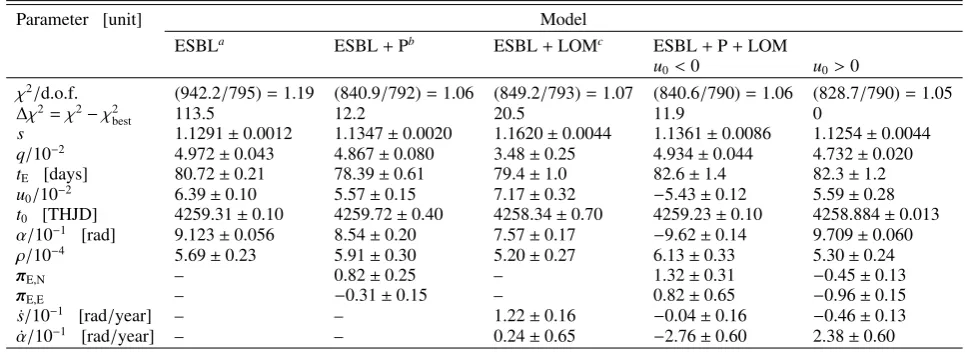
Table 3.Best-fit solutions for the different models of MOA-2007-BLG-197.

Parameter [unit] Model

ESBLa ESBL+Pb ESBL+LOMc ESBL+P+LOM

u0<0 u0>0

χ2/d.o.f. (942.2/795)=1.19 (840.9/792)=1.06 (849.2/793)=1.07 (840.6/790)=1.06 (828.7/790)=1.05 ∆χ2=χ2χ2

best 113.5 12.2 20.5 11.9 0

s 1.1291±0.0012 1.1347±0.0020 1.1620±0.0044 1.1361±0.0086 1.1254±0.0044

q/10−2 4.972±0.043 4.867±0.080 3.48±0.25 4.934±0.044 4.732±0.020

tE [days] 80.72±0.21 78.39±0.61 79.4±1.0 82.6±1.4 82.3±1.2

u0/10−2 6.39±0.10 5.57±0.15 7.17±0.32 −5.43±0.12 5.59±0.28

t0 [THJD] 4259.31±0.10 4259.72±0.40 4258.34±0.70 4259.23±0.10 4258.884±0.013

α/10−1 [rad] 9.123±0.056 8.54±0.20 7.57±0.17 9.62±0.14 9.709±0.060

ρ/10−4 5.69±0.23 5.91±0.30 5.20±0.27 6.13±0.33 5.30±0.24

πE,N – 0.82±0.25 – 1.32±0.31 −0.45±0.13

πE,E – −0.31±0.15 – 0.82±0.65 −0.96±0.15

˙

s/10−1 [rad/year] 1.22±0.16 0.04±0.16 0.46±0.13

˙

α/10−1 [rad/year] 0.24±0.65 2.76±0.60 2.38±0.60

Notes.(a)Extended-source binary-lens model.(b)Microlensing parallax.(c)Lens orbital motion.

model a caustic crossing.Cassan (2008) developed further this approach, and generalised it to a pair of caustic crossings (entry and exit) by introducing a specific parametrisation of the caus-tic curves. This method is parcaus-ticularly efficient for an event like MOA-2007-BLG-197.

In this formalism, two alternative parameterstinandtoutare used to fit for the dates of the source entry (in) and exit (out), while two other parameters sin and sout (which are curvilin-ear distances along the caustic curve) are used to fit for the source centre ingress and egress points on the caustic. It has been demonstrated that this parametrisation is more efficient in locating all possible fitting source-lens trajectories (Kains et al. 2009,2012), because they all produce caustic-crossing features at the observed dates.Cassan et al.(2010) later derived Bayesian priors on parameters (tin,tout,sin,sout) to explore even more effi -ciently the parameter space. The best-fit values derived from the minimisation process are finally converted back to the classical parameters.

We explored5 all static binary-lens models using this

parametrisation for all possible source caustic crossing dates within theE1toE4intervals displayed in Fig.1, and for a regular

(logs,logq) grid of 30×30 spanning log(0.4)≤logs≤log(4) and −4 ≤ logq ≤ 0. The minimisation was performed us-ing a classical Markov Chain Monte Carlo (MCMC) algorithm. The best model involves a caustic entry in the time intervalE1, the longest of the four gaps explored. The best-fit values of the model parameters and the correspondingχ2are listed in column

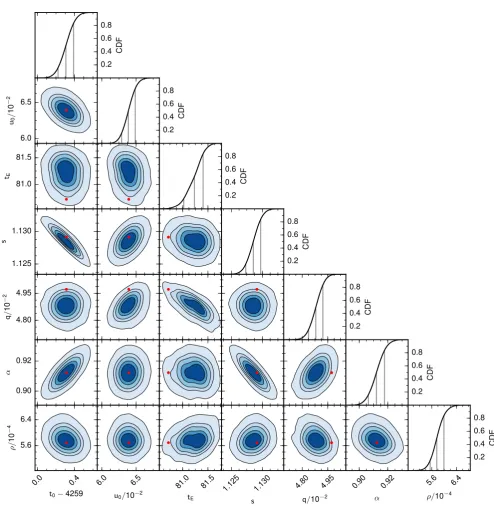
ESBL (Extended-Source, Binary-Lens) of Table3, and posterior probability densities (correlation plots) are presented in Fig.9.

3.3. Annual parallax

Given the long timescale found previously for the static binary lens model (tE ∼80 days), this event is a priori likely to exhibit annual parallax effects. The relative lens-source (annual) paral-lax is expressed as

πrel=

AU

DL

−AU

DS

, (5)

5 These very intensive computations were performed on the Tasmanian

cluster TPAC (Tasmanian Partnership for Advanced Computing).

so that the Einstein angular radius Eq. (1) also reads θE=

p

κMπrel, (6)

whereκ '8.144 mas/M. The Einstein parallax vectorπE has

an amplitude πE =

πrel θE

, (7)

and a direction along the lens-source proper motion. As fitting parameters, it is convenient to decomposeπEinto a northwards

component πE,N and an eastwards component πE,E (An et al. 2002), with advantages discussed inGould(2004).

The best-fit model including parallax only (besides the pa-rameters described in Sect.3.1) is presented in column ESBL+P of Table3, and correlation plots are shown in Fig.10. It can be noticed that the binary mass ratioqand separationschange lit-tle by including parallax compared to ESBL, resulting in a very similar resonant caustic structure. As expected, including paral-lax in the model improves theχ2, by around 100. Nevertheless,

we found that several solutions with very different values of par-allax (between 0.8 to 1.5) give almost identicalχ2 differing by

only one or two units. The differences between these models come from differences in the caustic entry datetin, i.e. precisely where no data are available to constrain the model. Hence, al-though parallax improves the fit, it is unlikely that a workable measurement can be obtained (we discuss this further later).

3.4. Orbital motion

Orbital motion of the lens is also a priori likely to produce no-ticeable effects, because the event is fairly long and the caustic resonant. The orbital rotation of the two lens components affects the caustic in two ways: it changes the projected binary separa-tionsand the orientation of the caustic in the plane of the sky. To first order, one can writes(t)'s+s˙(t−tr) andα(t)'α+α˙(t−tr), wheretris an arbitrary reference date chosen close or equal tot0. These two effects are included in the model through parameters γk=s˙/sandγ⊥=α˙, withγ2=γ2k+γ2⊥.

(7)

signature on the light curve. Therefore, while this model also provides a better fit than ESBL alone (∆χ2 =93), it is unlikely

to give a good constraint on the lens orbital motion. Furthermore, the∆χ2between this model and ESBL+P (parallax alone) is only

lower than 10 although two more parameters have been included in the model. We conclude that the key time intervals for dis-entangling orbital motion from parallax are not covered densely enough by the data.

3.5. Annual parallax and orbital motion

As (annual) parallax and orbital motion individually lead to a similar improvement of the ESBLχ2, we now include both

ef-fects in the model to check whether a better χ2 can be found.

Parallax and orbital motion are known to be very correlated (Batista et al. 2011;Skowron et al. 2011).

We investigate the two casesu0 > 0 and u0 < 0 (columns ESBL+P+LOM of Table 3) to check for possible ecliptic de-generacy (Skowron et al. 2011), and find that u0 > 0 is pre-ferred by ∆χ2 = 11.9. The ESBL best-fit parameters, again,

are relatively stable. The correlation plots of the best model are shown in Fig.12. As expected, the overall fit is not signifi-cantly better than ESBL+P (∆χ2 =12.2) or ESBL+LOM alone (∆χ2 = 20.5). This is consistent with a strong degeneracy

be-tween these parameters, that cannot be reliably broken in the case of MOA-2007-BLG-197.

3.6. Summary and conclusions from the modelling

A model with (annual) parallax improves the goodness-of-fit by

∆χ2 100 compared to a static binary lens, but several models

with very different values ofπE give comparable values of χ2.

Moreover, models with parallax or orbital motion alone lead to comparableχ2. This is not surprising for two reasons. Firstly, the

caustic entry is not well covered by the data and it appears that a high value of parallax tends to change substantially the time of the caustic entry insideE1. Secondly, parallax effects are partly degenerate with lens orbital motion, and the available data sets are not sufficient to disentangle these two effects.

We therefore adopt the ESBL parameters (s,q,u0, α,tE,t0) found for model ESBL+P+LOM andu0 >0. Following the ar-guments summarised in the previous paragraph, other parame-ters such as parallax or orbital motion parameparame-ters cannot be used to constrain the lens mass and distance.

4. Physical parameters

4.1. Mass-distance relation from the source radius

Combining Eqs. (2) and (6) yields the following mass-distance relation for the lens

M= θS

2

ρ2κ

1 πrel

, (8)

whereMis the lens mass andπrelis a proxy to lens distanceDL

according to Eq. (5). In this equation,ρis measured from the light curve modelling (Sect.3.6) andθSis derived below.

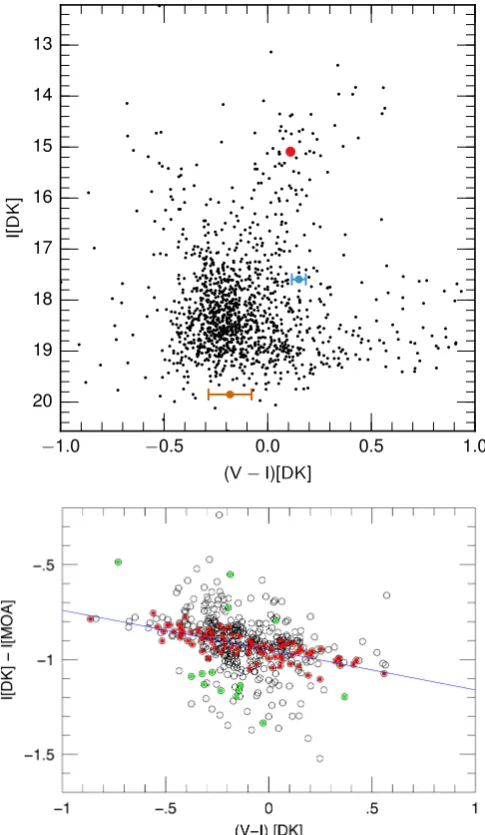
To characterise the source, we use a DoPHOT-based data re-duction (Schechter et al. 1993) of DanishIandV data to build an instrumental (I,(V−I)) CMD (Fig.4). Fitting theI-band data for the best-fit model parameters providesIS,DK=19.85±0.01. We use the RCG method to measure the interstellar extinction. Red clump giant stars are found to be relatively sparse, which

−1.0 −0.5 0.0 0.5 1.0

(V−I)[DK] 13

14

15

16

17

18

19

20

I

[

DK

[image:7.595.309.552.82.500.2]

]

Fig. 4.Upper panel: (I,V−I) Danish instrumental CMD of the field around MOA-2007-BLG-197, not corrected for interstellar extinction. The red point marks the position of the RCG. The magnitude of the microlensing target is in blue (i.e. magnified source, lens and blended light). The orange point corresponds to the source alone.Lower panel: empirical linear relation between instrumental colours (IDK−IMOA) and

(V−I)DK (red and green points are astrometric matches that are

un-crowded in the MOA image; after sigma-clipping, only red points are used for the fit).

makes it difficult to locate precisely the mean instrumental RCG position, (IRCG,DK,(V−I)RCG,DK). To overcome this problem, we

cross-calibrate the Danish CMD with a CMD obtained at CTIO in a very similarIfilter, by cross-identifying a few clump stars. We then measureIRCG,DK=15.09 and (V−I)RCG,DK=0.11. The values ofMI,RCG=−0.12±0.09 and (V−I)RCG,0=1.06±0.12

are taken fromNataf et al.(2013) at the coordinates of MOA-2007-BLG-197. Measuring the dereddened apparent magnitude of the red clump stars located in the Galactic bulge,Nataf et al. (2013) found a distance to the Galactic centreDGC= 8.20 kpc and an angle between the Galactic bar and the line of sight from the Sunφ=40◦. From these values, the distance to the RCG is

DRCG= DGCsinφ

(8)

0.24 0.32 0.40 0.48 0.56 0.64 0.72 0.80 (J−Ks)0

[image:8.595.310.552.80.231.2]

2.5 3.0 3.5 4.0 4.5 5.0 5.5 MJ

Fig. 5.Colour–magnitude diagram (MJ,(J−Ks)0) of the lens. The curves

are a set of isochrones from 2 Gyr (in pink) to 8 Gyr (in blue) with solar metallicity (Bressan et al. 2012). The black cross indicates the range of colours and magnitudes explored by the MCMC at the 1σlevel.

For the Galactic coordinates of MOA-2007-BLG-197, the RCG is in the far side of the bar at a distanceDRCG =8.29 kpc. We adopt a source at the same distance, corresponding to a distance modulus ofµ=14.6±0.3 mag, where the error bars also account for the uncertainty in the position of the RCG.

We then calculateIS,0 = IS,DK+MI,RCG+µ−IRCG,DK and

obtain IS,0 = 19.24±0.31, which gives an absolute magnitude of MI = 4.65±0.31. We use a 10 Gyr and solar metallicity

isochrone from Bressan et al.(2012) to get the corresponding absolute magnitude MV of the source from which we derive an

intrinsic source colour of (V−I)S,0 =0.88±0.1. This value can be compared to an independent estimate of the source colour based on the method ofGould et al. (2010a). MOARM-band images

are reduced with DoPHOT, and stars are cross-matched between Danish I,V and MOARM frames (lower panel of Fig.4). We

obtain

IS,DK−IS,MOA=−(0.950±0.006)−(0.21±0.02)×(V−I)S,DK, (10) whereIS,MOA =20.76±0.02 from the fit of theRMlight curve

using the best-fit parameters. Hence,IS,DK−IS,MOA = −0.91± 0.02, which yields (V −I)S,DK = −0.18±0.10. It follows that the estimated de-reddened source colour is (V −I)S,0 = (V − I)S,DK+(V−I)RCG−(V−I)RCG,DK = 0.77±0.2, which is in

good agreement with the previous estimate. In the following, we adopt (V−I)S,0 =0.88±0.1 (most robust estimate) andIS,0 =

19.24±0.31. The source is thus a G6-K0 Main Sequence star. FromKervella & Fouqué(2008) brightness-colour relations, we estimate the angular radius of the source,

log(θS)=3.198−0.2IS,0+0.4895(V−I)S,0−0.0657(V−I)2S,0, (11)

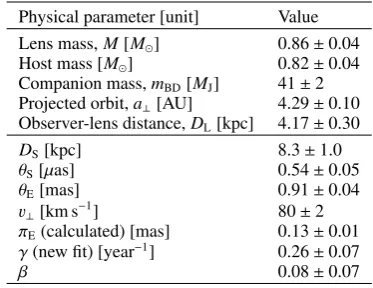
which yieldsθS=0.54±0.05µas. With a source atDS=8.3 kpc,

the physical source radius isRS=DSθS=0.96R. FromCarroll & Ostlie (2006), this radius is that of G8 Main Sequence star, which is in very good agreement with the constraint from the colour.

The lens mass-distance relation obtained from Eq. (8) where θS=0.54µas andρ=5.30×10⁻⁴is plotted in Fig.6.

4.2. Mass-distance relation from NaCo data

Calibrated (J,H,Ks) NaCo magnitudes (Sect.2.3) provide in-dependently from Eq. (8) further lens mass-distance relations (written below forJonly) through

mJ(L)=MJ+5 logDL−5+AJ, (12)

3.0

3.5

4.0

4.5

5.0

D

L

(kpc)

0.6

0.7

0.8

0.9

1.0

1.1

M

/

M

¯

colors

[image:8.595.40.283.80.230.2]

source size

Fig. 6.Lens mass-distance relations derived from the source sizeρ(1σ around the best value shown by the green shadow limited by the dashed lines) and NaCo (J,H,Ks) colours constrains (respectively yellow,

or-ange, red from top to bottom below the label “colours”). The blue con-tours (1−4σ) represent the joint posterior probability densityP(M,DL)

from the MCMC run.

wheremJ(L) is the lens apparent reddened magnitude of the lens,

AJ the interstellar absorption (given in Sect.2.3), and MJ the

lens absolute magnitude (which is a function of its mass M). The source (J,H,Ks) magnitudes are expressed as (e.g., forJ)

mJ(S)=MJ+5 logDS−5+AJ−2.5 log(A), (13)

whereA =1.3 is the magnification of the source at the time of the NaCo observations, and assuming that the absorption mostly occurs in the first kiloparsecs towards the bulge. The result-ing (J,H,Ks) magnitudes are then computed from the previous equations.

The absolute magnitudes MJ,H,Ks are computed using the

isochrones byBressan et al.(2012) for both the source and lens. For the source we use the same isochrone as in Sect.4.1. For the lens, we assume an age of 2.5 Gyr and solar metallicity. In fact, as seen in Fig.5, the lens lies in a region of the isochrones where the age has only very small impact on the magnitudes. The choice of metallicity has slightly more impact, but keeps the variation lower than the magnitude error bars for metallicity changes as large asZ±0.02.

We then use a MCMC algorithm (Sect.4.4) to match the ob-served NaCo magnitudes listed in Table2(Epoch 1) to the the-oretical magnitudes, using the lens massM and distanceDLas fitting parameters. The observed magnitudes serve as Gaussian prior distributions with standard deviation equal to the magni-tudes error bars; they are shown as filled curves in Fig.7. In the same figure, posterior distributions for the resulting magnitudes (lens, and source+lens) are shown in solid and dashed lines re-spectively. The final lens mass-distance relations are plotted in Fig.6. It can be seen that while in principle three relations are obtained, they are very strongly correlated and thus only corre-spond to one effective independent mass-distance relation.

4.3. Mass-distance relation from parallax or orbital motion

In principle, when parallax is measured, a further independent lens mass-distance relation can be obtained by combining Eq. (7) with Eq. (6),

M = πrel

π2 Eκ

(9)

16.5

17.0

17.5

18.0

18.5

magnitudes

0

2

4

6

8

density

J H

[image:9.595.46.287.79.230.2]

Ks

Fig. 7. Probability densities of NaCo (J,H,Ks) magnitudes, not

cor-rected for interstellar extinction. Filled curves are Bayesian Gaussian priors based on the NaCo measurements, which are compared to pos-terior distributions (solid lines). The dotted pospos-terior distributions are those of the lens magnitudes alone (i.e., disentangled from the source; respectivementJ,H,Ksfrom the right to the left).

where πE is derived from the light curve modelling.

Nevertheless, as discussed in Sect. 3.6, the parallax is degen-erate with the lens orbital motion, which prevent us from using this constraint. We however plot on Fig.6the typical behaviour of the mass-distance relation obtained from parallax measure-ments, ifπEhad been measured. We discuss this problem further

below.

4.4. Combination of the constraints and physical parameters

We combined the different mass-distance relations discussed in the previous sections (and shown in Fig. 6) in a MCMC min-imisation process to recover the lens mass Mand the observer-lens distanceDL. We use the measurement and error bars forρ, (J,H,Ks) andπE to build up Gaussian priors for the Bayesian

analysis, and flat (uninformative) priors forMandDL. The val-ues of the parameters correspond to the solution u0 > 0, as discussed in Sect. 3.6. We used the convergence criterion of Geweke (1992) to stop the MCMC and compute the posterior probability densities.

As seen in Fig. 6, in principle this problem is over-constrained, with three relations for only two fitting parame-ters. This enabled us to check the consistency of the different measurements, and investigate further the degeneracy between parallax and lens orbital motion, which preventsπEfrom being

used as a constraint. We first noticed a clear discrepancy between the value of πE derived from the fit (the prior) and the

poste-rior value. This pointed out a strong tension between the three constraints from parallax, source size and infrared colours. We then successively removed the parallax, source size or colours constraints from the MCMC runs. Without the source size con-straint, a model with parallax values as large asπE ∼ 1.1 was

found. This would require a much closer lens (DL ∼0.6 kpc), a longer Einstein radius (θE ∼1.6 mas) and consequently a much

smaller source size (ρ ∼ 3.3×10⁻⁴). This value ofρis many

sigma away from that measured from the light curve modelling. Such a difference is very unlikely given the very strong con-straint onρobtained from the caustic exit modelling. This there-fore confirmed previous concerns that in this case, the degen-eracy between parallax and lens orbital motion does not allow us to use the parallax mass-distance relation. Consequently, the parallax constraints are removed from the MCMC to derived the

Table 4. Physical parameters of MOA-2007-BLG-197L and its companion.

Physical parameter [unit] Value Lens mass,M[M] 0.86±0.04

Host mass [M] 0.82±0.04

Companion mass,mBD[MJ] 41±2

Projected orbit,a⊥[AU] 4.29±0.10

Observer-lens distance,DL[kpc] 4.17±0.30

DS[kpc] 8.3±1.0

θS[µas] 0.54±0.05

θE[mas] 0.91±0.04

v⊥[km s−1] 80±2

πE(calculated) [mas] 0.13±0.01

γ(new fit) [year−1] 0.26±0.07

β 0.08±0.07

final values forM andDL, thus constrained by the source size and the colours.

The final values forMandDLare given in Table4, with the correlation plot shown in Fig.6. We also compute the mass of the lens companion,mBD = qM, and findmBD = 41±2MJ. The host mass is 0.82±0.04M. The companion is thus a brown dwarf orbiting a solar-type star.

We finally perform additional consistency checks on the overall parameters of MOA-2007-BLG-197L. First, we compute the projected lens-source relative velocity

v⊥=θEDL

tE , (15)

and findv⊥ '80 km s−1, which is in very good agreement with probability densities predicted byDominik (2006) for the de-rived values of tE and DL. Moreover and as a supplementary check, we computed the probability distribution ofπEfrom the

distributions ofMandDLusing Eq. (14), and derived its maxi-mum a posteriori (MAP) value. We then ran again the light curve modelling with this value ofπEkept fixed. For the overall

consis-tency, all the parameters are fixed as well, except ˙sand ˙α(values are given in Table3, model withu0 >0) which yields the value of the orbital motion parameterγ(see Table4). From this, we compute

β=

Ekin,⊥ Epot,⊥

=2AU2

c2

πEs3γ2 θE(πE+πS/θE)3

, (16)

the ratio of the apparent kinetic to potential energy for the binary lens orbit projected onto the plane of the sky (An et al. 2002). Gravitationally bound systems should exhibit 0 < β < 1 (for face-on circular orbits,β = 0.5). UsingπS = AU/DS, we find β '0.08, which is a value consistent with a bound system. In contrast, high parallax values of e.g., πE = 1.1 lead to much

lower values ofβ'4.5×10⁻³. As argued byBatista et al.(2011), a scenario withβ1 would require highly improbable orbital parameters or projections, such as a very close-in companion seen on a nearly edge-on circular orbit, which is excluded here.

5. MOA-2007-BLG-197Lb in the brown dwarf landscape

While around 1900 exoplanets have been detected so far6, less than a hundred brown dwarfs orbiting stars are known today. The

[image:9.595.337.524.110.254.2]
(10)

100 101 102 103 104

Period (days) 0

10 20 30 40 50 60 70

Mass

(

MJ

)

100 101 102 103 104

Period (days) 0

10 20 30 40 50 60 70

Mass

(

MJ

)

0.9

0.8 0.7

0.6

0.5

0.5

[image:10.595.40.286.80.388.2]

0.4 0.3

Fig. 8. Upper panel: mass-period diagram with brown dwarfs com-panions detected through radial velocity, transit and direct imaging (blue filled circles for measured masses, and open circles for minimum masses; list adapted fromMa & Ge 2014), and microlensing (green di-amonds). For reference, exoplanets detected so far are also displayed (small black circles,http://exoplanets.org). The red dotted line indicates the global radial velocity completeness limit, while the red dashed line marks the region above which data are included to per-form the non-parametric, two-dimensional probability density distribu-tion shown in thelower panel.

lack of brown dwarf companions to solar-type stars was noticed early after the first exoplanets detections, and referred to as a “brown dwarf desert”. Using the radial velocity method,Marcy & Butler(2000) noted that at tight orbital separations (a<3AU), companions more massive than 8MJrepresented only a very low fraction of the detected objects. This was not expected from the relatively high frequency (∼13%) of binary stars found earlier byDuquennoy & Mayor(1991), also at close separation.

This lack of brown dwarf companions compared to plane-tary companions has since been confirmed by all detection meth-ods. For instance, Lafrenière et al. (2007) found a frequency of 1.9+8.31.5% for 13−75 MJ companions located in the range 25−250 AU from the Gemini Deep Planet Survey. Similarly, Metchev & Hillenbrand(2009) derived a frequency of 3.2±3.1% for brown dwarfs orbiting young solar-type stars in the range 28−1590 AU using adaptive optics direct imaging.McCarthy & Zuckerman(2004) also found a higher proportion of stellar com-pared to substellar companions to stars, and derived a frequency ratio of∼3−10 at wide separations.Luhman et al.(2007) found that this ratio is comparable to the relative abundance of stars to substellar objects when they are found single, either in star forming regions or in the solar neighbourhood.

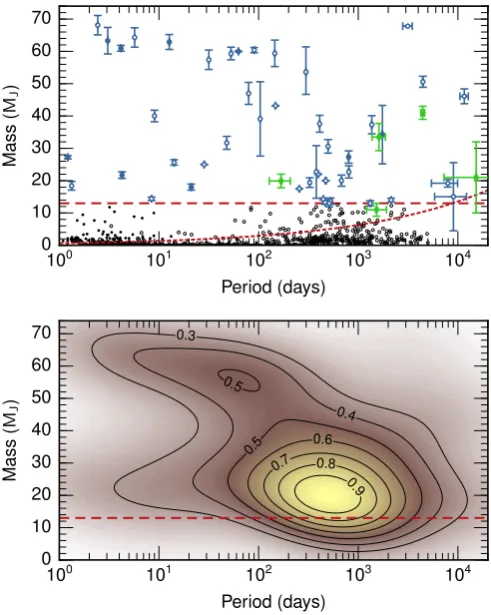
The upper panel of Fig. 8 is a mass vs. period diagram which diplays the known brown dwarf companions of solar-type stars detected through microlensing, radial velocimetry, transit

and direct imaging. For radial velocimetry and transit, we in-cluded objects from Ma & Ge (2014) catalogue with (mini-mum) masses in the range 13−74 MJ and orbital periods be-low 2× 10⁴d. Furthermore, we have excluded objects with

mass uncertainties above 25MJ, and deleted (false positive) TYC 1240-945-1. Microlensing brown dwarfs are shown as green points, they are: MOA-2011-BLG-149 and OGLE-2011-BLG-0172/MOA-2011-BLG-104 (Shin et al. 2012b), MOA-2010-BLG-073 (Street et al. 2013), OGLE-2013-BLG-0578 (Park et al. 2015) as well as MOA-2007-BLG-197 (this paper). For consistency with Doppler and transit data, we did not in-clude MOA-2009-BLG-411 (Bachelet et al. 2012) which has a large uncertainty in the mass. In the case of microlensing objects for which only projected separationsa⊥were measured (all ob-jects in this case), we estimate the (physical) semi-major axisa

as the median of the probability distribution ofGould & Loeb (1992), which we find to be equal toa =(2/√3)a⊥ ≈1.15a⊥. Kepler’s third law is then used to yield the estimated period. The error bar on measureda⊥is propagated toafollowing the previ-ous equation, and the error bar on the period is obtained through a MCMC run including uncertainties onaand primary massM

(Gaussian distributions are assumed).

As seen in Fig.8, the distribution of brown dwarfs is not uni-form, in particular it exhibits an increasing frequency of objects with increasing orbital period. Furthermore, Ma & Ge (2014) argue that the driest part of the brown dwarf desert seems to be confined within a region at close separation, namely within

P < 100 d and for masses within 30−55 MJ for Sun-like host

stars. They subsequently split the objects into two distinct pop-ulations, whether their mass is higher or lower than 42.5MJ: the more massive brown dwarfs would mainly be the outcome of gravitational fragmentation and collapse of a molecular cloud (star-like formation scenario, corroborated by an eccentricity distribution similar to binary stars), while brown dwarfs below 42.5MJwould mainly result from gravitational instability within

the proto-planetary disk. But other authors such asGuillot et al. (2012), however, argue that the depletion of objects at tight or-bits may as well be explained by a loss of an initial population of close-in brown dwarfs due to tidal interactions with their host stars. In this scenario, close-in, massive objects lose angular mo-mentum due to the slower rotation of the star relative to the plan-ets orbital motion, spiral in and fall into the star. This effect is predicted to peak for G-dwarf primaries and should not be im-portant for earlier-type stars, which is supported by the detection of close-in brown dwarfs around F-type stars.

Different mechanisms may overlap to shape the brown dwarfs landscape, and lead to a more complex structure than previously discussed. To analyse it further, we performed a non-parametric, two-dimensional probability density distribution fit to the data, only for objects above the red dashed line (i.e., above the radial velocity completeness limit, based onMayor et al. 2011, and marked by the red dotted line in Fig.8). The prob-ability density estimation is based onScott(1992); in practice we used a Gaussian kernel, and followSilverman (1986) rule to estimate the bandwidth parameter. The resulting probability density is shown in the lower panel of Fig.8. We used two dif-ferent methods to compute the bandwidth parameter,Silverman (1986) orScott(1992), and found that the resulting probability density is relatively stable, even if a few data points are removed from sparsely sampled regions.

(11)

dwarf desert according toMa & Ge(2014). Second, an accumu-lation of objects can be seen aroundP ∼500 d andM ∼20MJ

(following the apparent trend observed for giant planets, black data points in Fig. 8). Third, we find another depletion of ob-jects at long orbital periods (P & 500 d) and high masses (M&50MJ). Since the brown dwarf sample is drawn from vari-ous surveys (mainly from radial velocities), the interpretation of these features should be taken with caution. Although all brown dwarfs in Fig.8are chosen above the radial velocity complete-ness limit from Mayor et al. (2011), it is not guaranteed that these objects are not affected by observational biases. In par-ticular, a degeneracy between mass and period is increasingly affecting very long-period brown dwarfs, and the different sur-veys should be corrected from their sample size. Hence, while a thorough analysis of all these factors is necessary to assess the exact shape of the brown dwarfs distribution, the gross features emerging from the lower panel of Fig.8may well be real. If we split the density profile into two regions of masses above and be-low 42.5MJas discussed byMa & Ge(2014), the distribution of high-mass objects can be seen as shifted towards shorts orbital periods (P∼30 d), while less massive objects appear to pile up at longer orbital periods (P ∼ 500 d). This supports the claim of Ma & Ge (2014) that massive objects would accumulate at short periods as a result of gravitational collapse of a molecular cloud, contrary to less-massive objects built up by gravitational instability in the disk which would accumulate at longer periods. Nevertheless, the depletion at intermediate masses and short pe-riods would as well be affected by a star-engulfing mechanism advocated byGuillot et al.(2012), in particular because almost all brown dwarfs included here orbit Sun-like stars, for which this effect peaks.

The distribution of brown dwarfs as a function of mass and period still remains uncertain because of a lack of detec-tions. It is thus difficult to distinguish between the different mechanisms which shape the brown dwarf desert. Moreover, these detections are mostly objects orbiting Sun-like stars, which makes it difficult to study their distribution as a function of host star mass. While the MOA-2007-BLG-197L companion or-bits a G-K dwarf host, microlensing hosts are most frequently M-K dwarfs. Hence, future microlensing surveys will provide unique information on the brown dwarf distribution for low-mass hosts, thus offering a complementary mass bin to other methods.

6. Summary and prospects

We have presented MOA-2007-BLG-197Lb, the first brown dwarf discovered around a Sun-like star through gravitational microlensing. The system is located at 4.2±0.3 kpc from the Earth, the brown dwarf companion has a mass of 41±2MJand was observed at a projected distance of 4.3±0.1 AU from a K dwarf host star. We have performed a non-parametric prob-ability density distribution fit to the population of brown dwarf companions detected so far. The resulting density profile has a complex structure, leading to abrown dwarf landscapemost likely shaped by different (and perhaps competitive) formation or destruction mechanisms. While it seems difficult with the cur-rent data set to distinguish observationally which are the domi-nant mechanisms, an answer to this question appears to within the reach of further observations in the near to mid-term future.

Gravitational microlensing is an exceptional tool to detect brown dwarfs as free-floating objects, companions to stars or as brown dwarfs binaries. It has a unique sensitivity to detect brown dwarfs companions to stars of any type, in particular at long

orbital periods. Recent advances in using networks of robotic telescopes (e.g.,Tsapras et al. 2009) will provide in a near future an order of magnitudes more brown dwarfs detections through microlensing. Future microlensing space missions (Penny et al. 2013;Yee et al. 2014;Beaulieu et al. 2010) also carry important promises for providing unique information on the populations of brown dwarfs in their different configurations.

Acknowledgements. A.C. acknowledges financial support from the Emergence

UPMC 2012 grant. C.R. and A.C. are grateful to Bo Ma for providing us with the brown dwarfs catalogue used in Ma & Ge(2014). We especially thank the University of Tasmania for granting us access to their TPAC super-computer facilities where part of the calculations were carried out. Work by C.H. was supported by Creative Research Initiative Program (2009-0081561) of National Research Foundation of Korea. K.H., M.D. and M.H. are supported by NPRP grant NPRP-09-476-1-78 from the Qatar National Research Fund (a member of Qatar Foundation). M.H. acknowledges support from the Villum foundation. S.D. is supported by “the Strategic Priority Research Program- The Emergence of Cosmological Structures” of the Chinese Academy of Sciences (grant No. XDB09000000).

References

Alard, C. 2000,A&AS, 144, 363

Alard, C., & Lupton, R. H. 1998,ApJ, 503, 325

Albrow, M. D., Beaulieu, J.-P., Caldwell, J. A. R., et al. 1999a,ApJ, 522, 1022

Albrow, M. D., Beaulieu, J.-P., Caldwell, J. A. R., et al. 1999b,ApJ, 522, 1011

Albrow, M. D., Horne, K., Bramich, D. M., et al. 2009,MNRAS, 397, 2099

An, J. H., Albrow, M. D., Beaulieu, J.-P., et al. 2002,ApJ, 572, 521

Bachelet, E., Fouqué, P., Han, C., et al. 2012,A&A, 547, A55

Batista, V., Gould, A., Dieters, S., et al. 2011,A&A, 529, A102

Beaulieu, J. P., Bennett, D. P., Batista, V., et al. 2010, in Pathways Towards Habitable Planets, eds. V. Coudé du Foresto, D. M. Gelino, & I. Ribas,ASP Conf. Ser., 430, 266

Bennett, D. P. 2010,ApJ, 716, 1408

Bonfils, X., Delfosse, X., Udry, S., et al. 2013,A&A, 549, A109

Bozza, V. 2010,MNRAS, 408, 2188

Bozza, V., Dominik, M., Rattenbury, N. J., et al. 2012,MNRAS, 424, 902

Bressan, A., Marigo, P., Girardi, L., et al. 2012,MNRAS, 427, 127

Burrows, A., Hubbard, W. B., Lunine, J. I., & Liebert, J. 2001,Rev. Mod. Phys., 73, 719

Carroll, B. W., & Ostlie, D. A. 2006, An introduction to modern astrophysics and cosmology (Addison-Wesley)

Cassan, A. 2008,A&A, 491, 587

Cassan, A., Beaulieu, J. P., Brillant, S., et al. 2004,A&A, 419, L1

Cassan, A., Beaulieu, J.-P., Fouqué, P., et al. 2006,A&A, 460, 277

Cassan, A., Horne, K., Kains, N., Tsapras, Y., & Browne, P. 2010,A&A, 515, A52

Cassan, A., Kubas, D., Beaulieu, J.-P., et al. 2012,Nature, 481, 167

Choi, J.-Y., Han, C., Udalski, A., et al. 2013,ApJ, 768, 129

Claret, A., & Bloemen, S. 2011,A&A, 529, A75

Deleuil, M., Deeg, H. J., Alonso, R., et al. 2008,A&A, 491, 889

Devillard, N. 1999, in Astronomical Data Analysis Software and Systems VIII, eds. D. M. Mehringer, R. L. Plante, & D. A. Roberts,ASP Conf. Ser., 172, 333

Díaz, R. F., Damiani, C., Deleuil, M., et al. 2013,A&A, 551, L9

Diolaiti, E., Bendinelli, O., Bonaccini, D., et al. 2000, in Adaptive Optical Systems Technology, ed. P. L. Wizinowich,Proc. SPIE, 4007, 879

Dominik, M. 2006,MNRAS, 367, 669

Dominik, M. 2007,MNRAS, 377, 1679

Dong, S., DePoy, D. L., Gaudi, B. S., et al. 2006,ApJ, 642, 842

Dong, S., Bond, I. A., Gould, A., et al. 2009,ApJ, 698, 1826

Duquennoy, A., & Mayor, M. 1991,A&A, 248, 485

Geweke, J. 1992, in Bayesian Statistics, eds. J. M. Bernardo, J. O. Berger, A. P. Dawid, & A. F. M. Smith (New York: Oxford University Press), 169 Gould, A. 2004,ApJ, 606, 319

Gould, A. 2008,ApJ, 681, 1593

Gould, A., & Gaucherel, C. 1997,ApJ, 477, 580

Gould, A., & Loeb, A. 1992,ApJ, 396, 104

Gould, A., Udalski, A., Monard, B., et al. 2009,ApJ, 698, L147

Gould, A., Dong, S., Bennett, D. P., et al. 2010a,ApJ, 710, 1800

Gould, A., Dong, S., Gaudi, B. S., et al. 2010b,ApJ, 720, 1073

Guillot, T., Lin, D. N. C., & Morel, P. 2012, inAAS Meet. Abstr., 220, 121.03

Han, C., Jung, Y. K., Udalski, A., et al. 2013,ApJ, 778, 38

Janczak, J., Fukui, A., Dong, S., et al. 2010,ApJ, 711, 731

(12)

Jung, Y. K., Udalski, A., Sumi, T., et al. 2015,ApJ, 798, 123

Kains, N., Cassan, A., Horne, K., et al. 2009,MNRAS, 395, 787

Kains, N., Browne, P., Horne, K., Hundertmark, M., & Cassan, A. 2012,

MNRAS, 426, 2228

Kato, D., Nagashima, C., Nagayama, T., et al. 2007,PASJ, 59, 615

Kervella, P., & Fouqué, P. 2008,A&A, 491, 855

Kubas, D., Cassan, A., Beaulieu, J. P., et al. 2005,A&A, 435, 941

Kubas, D., Beaulieu, J. P., Bennett, D. P., et al. 2012,A&A, 540, A78

Lafrenière, D., Doyon, R., Marois, C., et al. 2007,ApJ, 670, 1367

Luhman, K. L., Joergens, V., Lada, C., et al. 2007,Protostars and Planets V, 951, 443

Ma, B., & Ge, J. 2014,MNRAS, 439, 2781

Mao, S., & Paczynski, B. 1991,ApJ, 374, L37

Marcy, G. W., & Butler, R. P. 2000,PASP, 112, 137

Mayor, M., Marmier, M., Lovis, C., et al. 2011, A&A, submitted

[arXiv:1109.2497]

McCarthy, C., & Zuckerman, B. 2004,AJ, 127, 2871

Metchev, S. A., & Hillenbrand, L. A. 2009,ApJS, 181, 62

Mollière, P., & Mordasini, C. 2012,A&A, 547, A105

Moutou, C., Bonomo, A. S., Bruno, G., et al. 2013,A&A, 558, L6

Nataf, D. M., Gould, A., Fouqué, P., et al. 2013,ApJ, 769, 88

Park, H., Udalski, A., Han, C., et al. 2015,ApJ, 805, 117

Penny, M. T., Kerins, E., Rattenbury, N., et al. 2013,MNRAS, 434, 2

Persson, S. E., Murphy, D. C., Krzeminski, W., Roth, M., & Rieke, M. J. 1998,

AJ, 116, 2475

Sahlmann, J., Ségransan, D., Queloz, D., et al. 2011,A&A, 525, A95

Schechter, P. L., Mateo, M., & Saha, A. 1993,PASP, 105, 1342

Scott, D. W. 1992, Multivariate Density Estimation: Theory, Practice, and Visualization (New York, Chicester: John Wiley & Sons)

Shin, I.-G., Han, C., Choi, J.-Y., et al. 2012a,ApJ, 755, 91

Shin, I.-G., Han, C., Gould, A., et al. 2012b,ApJ, 760, 116

Silverman, B. W. 1986, Density Estimation for Statistics and Data Analysis (London: Chapman and Hall)

Skowron, J., Udalski, A., Gould, A., et al. 2011,ApJ, 738, 87

Street, R. A., Choi, J.-Y., Tsapras, Y., et al. 2013,ApJ, 763, 67

Sumi, T., Kamiya, K., Bennett, D. P., et al. 2011,Nature, 473, 349

Tsapras, Y., et al. 2009,Astron. Nachr., 330, 4

Yee, J. C., Albrow, M., Barry, R. K., et al. 2014, ArXiv e-prints

[arXiv:1409.2759]

Zub, M., Cassan, A., Heyrovský, D., et al. 2011,A&A, 525, A15

1 Sorbonne Universités, UPMC Univ Paris 6 et CNRS, UMR 7095,

Institut d’Astrophysique de Paris, 98 bis bd Arago, 75014 Paris, France

2 University of Canterbury, Dept. of Physics and Astronomy, Private

Bag 4800, 8020 Christchurch, New Zealand

3 Institute of Natural and Mathematical Sciences, Massey University,

Private Bag 102-904, North Shore Mail Centre, Auckland, New Zealand

4 Department of Physics, University of Notre Dame, Notre Dame,

IN 46556, USA

5 SUPA, School of Physics & Astronomy, North Haugh, University of

St Andrews, KY16 9SS, Scotland, UK

6 Kavli Institute for Astronomy and Astrophysics, Peking University,

Yi He Yuan Road 5, Hai Dian District, 100871 Beijing, PR China

7 IRAP, CNRS – Université de Toulouse, 14 av. E. Belin, 31400

Toulouse, France

8 CFHT Corporation, 65-1238 Mamalahoa Hwy, Kamuela, Hawaii

96743, USA

9 Department of Astronomy, Ohio State University, 140 W. 18th Ave.,

Columbus, OH 43210, USA

10 School of Math and Physics, University of Tasmania, Private

Bag 37, GPO Hobart, 7001 Tasmania, Australia

11 Niels Bohr Institutet, Københavns Universitet, Juliane Maries Vej

30, 2100 København Ø, Denmark

12 Space Telescope Science Institute, 3700 San Martin Drive,

Baltimore, MD 21218, USA

13 South African Astronomical Observatory, PO Box 9, Observatory

7935, South Africa

14 Department of Earth and Space Science, Graduate School of

Science, Osaka University, Toyonaka, Osaka 560-0043, Japan

15 Qatar Environment and Energy Research Institute, Qatar

Foundation, PO Box 5825, Doha, Qatar

16 Department of Physics, University of Rijeka, Radmile Matej vci´c 2,

51000 Rijeka, Croatia

17 Technical University of Vienna, Department of Computing,Wiedner

Hauptstrasse 10, 1040 Wien, Austria

18 Department of Physics, Chungbuk National University, 371-763

Cheongju, Korea

19 Department of Physics and Astronomy, San Francisco State

University, 1600 Holloway Avenue, San Francisco, CA 94132, USA

20 Korea Astronomy and Space Science Institute, 776 Daedukdae-ro,

Daejeon, Korea

21 Las Cumbres Observatory Global Telescope Network, 6740 Cortona

Drive, suite 102, Goleta, CA 93117, USA

22 Astronomisches Rechen-Institut, Zentrum für Astronomie der

Universität Heidelberg (ZAH), Mönchhofstraße 12-14, 69120 Heidelberg, Germany

23 Perth Observatory, Walnut Road, Bickley, 6076 Perth, Australia 24 International Centre for Radio Astronomy Research, Curtin

University, Bentley, WA 6102, Australia

25 Solar-Terrestrial Environment Laboratory, Nagoya University,

464-8601Nagoya, Japan

26 Okayama Astrophysical Observatory, National Astronomical

Observatory of Japan, 3037-5 Honjo, Kamogata, Asakuchi, 719-0232 Okayama, Japan

27 Nagano National College of Technology, 381-8550 Nagano, Japan 28 Department of Physics, University of Auckland, 92019 Private Bag,

1010 Auckland, New Zealand

29 Tokyo Metropolitan College of Aeronautics, 116-8523 Tokyo, Japan 30 School of Chemical and Physical Sciences, Victoria University,

6147 Wellington, New Zealand

31 Institute of Information and Mathematical Sciences, Massey

University at Albany, Private Bag 102904, 0745 North Shore, Auckland, New Zealand

32 Mt. John University Observatory, PO Box 56, 8770 Lake Tekapo,

New Zealand

33 Department of Physics, University of Auckland, Private Bag 92019,

1010 Auckland, New Zealand

34 Department of Physics, Faculty of Science, Kyoto Sangyo

University, 603-8555 Kyoto, Japan

(13)

0.0 0.4

t0−4259 5.6

6.4

ρ/

10

4

0.90 0.92

α

4.80 4.95

q

/

10

2

1.125 1.130

s

81.0 81.5

tE 6.0 6.5

u0

/

10

2

0.2 0.4 0.6 0.8

CDF

6.0 6.5

u0/10−2 0.2 0.4 0.6 0.8

CDF

81.0 81.5

tE

0.2 0.4 0.6 0.8

CDF

1.125 1.130

s

0.2 0.4 0.6 0.8

CDF

4.80 4.95

q/10−2

0.2 0.4 0.6 0.8

CDF

0.90 0.92

α

0.2 0.4 0.6 0.8

CDF

5.6 6.4

ρ/10−4

0.2 0.4 0.6 0.8

[image:13.595.51.546.72.579.2]

CDF

(14)

0.0 0.5

t0−4259

−0.5 0.0 πE,E

0.8 1.6

πE,N 5 6 7

ρ/

10

4

0.80 0.88

α

4.50 4.75

q

/

10

2

1.134 1.140

s

77.5 80.0

tE 5.5 6.0

u0

/

10

2

0.2 0.4 0.6 0.8

CDF

5.5 6.0

u0/10−2 0.2 0.4 0.6 0.8

CDF

77.5 80.0

tE

0.2 0.4 0.6 0.8

CDF

1.134 1.140

s

0.2 0.4 0.6 0.8

CDF

4.50 4.75

q/10−2 0.2 0.4 0.6 0.8

CDF

0.80 0.88

α

0.2 0.4 0.6 0.8

CDF

5 6 7

ρ/10−4 0.2 0.4 0.6 0.8

CDF

0.8 1.6

πE,N 0.2 0.4 0.6 0.8

CDF

−0.5 0.0 πE,E

0.2 0.4 0.6 0.8

[image:14.595.51.551.72.582.2]

CDF

(15)

−1 0 1 t0−4259

−0.2 0.0

˙

α

0.10 0.15

˙s

4.8 5.6

ρ/

10

4

0.76 0.80

α

3.5 4.0

q

/

10

2

1.15 1.16 1.17

s

76 80 tE

6.4 7.2

u0

/

10

2

0.2 0.4 0.6 0.8

CDF

6.4 7.2

u0/10−2 0.2 0.4 0.6 0.8

CDF

76 80

tE

0.2 0.4 0.6 0.8

CDF

1.15 1.16 1.17

s

0.2 0.4 0.6 0.8

CDF

3.5 4.0

q/10−2 0.2 0.4 0.6 0.8

CDF

0.76 0.80

α

0.2 0.4 0.6 0.8

CDF

4.8 5.6

ρ/10−4 0.2 0.4 0.6 0.8

CDF

0.10 0.15

˙s

0.2 0.4 0.6 0.8

CDF

−0.2 0.0 ˙ α

0.2 0.4 0.6 0.8

[image:15.595.51.547.70.584.2]

CDF

Figure

Table 1. Telescopes and photometric data sets.
Table 2. Derived NaCo magnitudes of the microlensing event target inthe (J, H, Ks) filters for the two epochs 2007 August 20/21 (epoch 1)and 2008 August 3/4 (epoch 2).
Fig. 3. (acterisation (Sect.tinction. The red clump (RCG) is fitted by the red over-plotted 10 Gyr,solar-metallicity isochrone frombining NaCo and IRSF data (respectively, in blue and black)
Table 3. Best-fit solutions for the different models of MOA-2007-BLG-197.
+7

References

Related documents

Employee’ opinion towards motivation in the private sector banks, Organizational commitment of the employees, Employees’ opinion towards career planning and development

Chromatin preparations showed that similar to BJ fibroblasts, RAF-senescent RPEh- TERT cells contained lower levels of HMGA2 than RAF- senescent WI-38hTERT or RAS-senescent IMR-90

Through the documents of Mesopotamia and archaeological sites in Kuwait, and Bahrain with the spread of Dilmun seals in many regions such as, the Indus Valley,

In conclusion, our data demonstrate that in an in vitro sys- tem of alveolar macrophages, Ebola virus infection induced a transient, early increase in proinflammatory cytokine and

Of course, particular post business impact can also comprise such type of business degradations entailed directly from resource degradations: For instance this is the case if

It is possible to estimate the total primary cost of delay by taking the mid-point of each range and multiplying this by the cost per minute for passenger hard and soft costs,

The rates of increase in producer prices have again varied very widely from one Member State to another but in general price pressure on the pro- ducer side is

Methods We used average life expectancy lost per death as a measure of total inequality in mortality derived from death rates from the Human Mortality Database for 37 countries in