in the population sciences published by the Max Planck Institute for Demographic Research Doberaner Strasse 114 · D-18057 Rostock · GERMANY www.demographic-research.org
DEMOGRAPHIC RESEARCH
VOLUME 7, ARTICLE 7, PAGES 343-364
PUBLISHED 14 AUGUST 2002
www.demographic-research.org/Volumes/Vol7/7/
DOI: 10.4054/DemRes.2002.7.7
Descriptive Findings
Children's experience of family
disruption and family formation:
Evidence from 16 FFS countries
Gunnar Andersson
1 Introduction 344
2 Data and methods 345
3 Results 348
3a Distribution of births 348
3b Children’s experience of family formation 349 3c Children’s experience of family dissolution 351 3d A summary of children’s experience of living
outside the union of their parents
354
3e Children’s experience of family reconstitution 355 3f A summary measure of children’s experience of
living in different types of families
357
4 Conclusions 359
Acknowledgments 360
Notes 361
Descriptive Findings
Children’s experience of family disruption and family formation:
Evidence from 16 FFS countries
1Gunnar Andersson2
Abstract
In this paper, we present a number of descriptive measures on children’s experience of family disruption and family formation. We use data from the Fertility and Family Surveys of 15 European countries and corresponding data from the USA in order to find out what kind of family circumstances children are born into and what experience they subsequently have of various family-transformation events of their mothers. Our presentation reveals some similarities but also striking differences in the family-demographic experience of children in different countries. The USA stands out as one extreme case with its very high proportion of children born to a lone mother, with a higher probability of children who experience a union disruption of their parents than anywhere else, and with many children having the experience of living in a stepfamily. Italy stands out at the other end of the scale. Practically all children here are born to a married mother and very few of them experience the dissolution of their parents’ union before they turn 15.
1 Paper presented at the XXIVth IUSSP General Population Conference in Salvador, Brazil, 18-24 August 2001.
1. Introduction
The last three decades have witnessed an upsurge in research on various aspects of the family dynamics of people in developed countries. An increased attention to changes in patterns of family formation and family dissolution, and to consequences of such changes, follows the observed increase in the variation of how people tend to organize their family lives. Attention has, for example, been given to the fact that people in many European countries today, often live together in unions without being married (Murphy 2000, Prinz 1995, Toulemon 1997). Consequently, the marital status of people is far from sufficient if one wants to get an accurate picture of their family status (Bumpass and Raley 1995).
A starting point for our study is that we think there is still a need for more and better descriptions of the present state of family-demographic affairs in contemporary European countries. It is indeed important to first know exactly how the situation looks before one tries to explain it, and it is particularly important to get a better picture of various differences and similarities in demographic behavior between the different countries in Europe. In some cases, the perception of a very volatile situation in the domains of family-demography might turn out to be slightly exaggerated. Perhaps, the situation is not always as dynamic as one might think it is when one reads research material stemming from, for example, the US.
There are not that many large-scale cross-country comparisons available in this field of research. However, Kiernan (2000, 2001) provides such comparisons when she focuses on the status of unions in Western Europe and the context of childbearing there. Klijzing and Macura (1997) provide another example of an overview of the family context for childbearing in Europe. Finally, Heuveline and Timberlake (2000) and Heuveline, Timberlake, and Furstenberg (2001) present a set of family-demographic cross-country comparisons when examining the experiences of different living arrangements and family types of children in a wide range of European countries. The previous lack of studies that describe the family-demographic situation from the point of view of children is otherwise regrettable, since researchers’ attention on processes such as divorce is often motivated by the concern for children involved. When studying the family dynamics from children’s perspective, it is of course particularly important to be able to get a picture of their parents’ actual living arrangements rather than just that of their marital status (Bumpass and Raley 1995, Bumpass and Hsien-Hen 2000).
We use data as reported by children’s mothers from 16 countries – from countries in Western and Eastern Europe and from the USA – in order to estimate to what extent children experience events like a union disruption of their parents or a union formation of their lone mother. We present separate calculations for children born to a lone mother, children born to a cohabiting mother, and children born in marriage, so that we can depict the different family-transformation events that can occur in each type of family. For children who experience their parents’ union disruption, we examine to what extent they experience the formation of a new union of their mother. In our comparison, we present results for different ages of children so that we can follow a typical child from its birth to the 15th birthday.
2. Data and methods
but also cases when the father dies or the child moves away from its parents. We censor any observation at the rare event of a death of a child. In addition, all observations are censored at a child’s 15th birthday or at the age the child had at the time of the mother’s interview.
Our life tables are based on the idea of a synthetic cohort. They are calculated from reported events of a specific kind and exposures to that event (for children at different ages) during a period of six years immediately before each survey date so that they describe the patterns of family-demographic affairs during that calendar period (Note 2). As any synthetic-cohort measure, our life tables thus give information on the demographic patterns that would arise if the calculated age-specific transition rates prevail during a generation or so. We have calculated life tables for the following countries (Note 3): Sweden, Norway, Finland, France, the USA, Austria, Germany, Flanders (Note 4), Italy, Spain, the Czech Republic, Hungary, Slovenia, Latvia, Lithuania, and Poland. East and West Germany are treated separately. For East Germany (referred to as the former GDR), we use the six-year term immediately before the political turnaround in November 1989 as our study period. Before calculating the various life-table measures that we present here, we needed to perform a considerable amount of data cleaning. The raw data for Austria and Germany, just to mention one example, contained a large number of observations with missing dates of union formation and union dissolution of respondents so we had to exclude them from our calculations. Table 1 contains the total number of female respondents, mothers, and all children of these respondents that, for each country, remain in our data set after our cleaning procedures. Female respondents come from the populations “at reproductive ages” but the upper age limit of these respondents varies slightly between countries (Note 5). In our calculations, we have subsequently used all information that refers to the experience of children aged 0-15 years during the calendar periods upon which we base our synthetic cohorts. We have applied weights in our calculations of life-table estimates for France and the US since the sampling procedures in these countries were performed in a way that were dependent on the outcomes we want to study.
Table 1: Number of female respondents, mothers, and children of respondents, by country
country women mothers children ages of respondents
time of survey
"West" Sweden 2986 2247 4638 23-43 1992/93
Norway 3969 2367 4523 20-43 1988/89
Finland 4040 2895 6043 22-51 1989/90
France 2930 2194 4527 20-49 1994
USA 10510 6609 14357 15-44 1995
Austria 4260 3217 6485 20-54 1995/96
W Germany 2743 1223 2113 20-39 1992
Flanders 3143 1911 3602 20-40 1991/92
Italy 4745 2858 5410 20-49 1995/96
Spain 3981 2450 4991 18-49 1994/95
"East" E Germany 2810 2025 3437 20-39 1992
Hungary 3498 2622 4908 19-40 1992/93
Czech Rep 1719 1222 2331 15-44 1997
Slovenia 2761 2116 3953 15-45 1994/95
Latvia 2622 2080 3787 18-49 1995
Lithuania 2924 2113 3742 18-49 1994/95
3. Results
We begin with a presentation of the distribution of births over different types of families in the various countries under investigation. We then proceed with a description of the various family-transformation events that children born in different family-types experience from their birth to the month they turn 15.
3a. Distribution of births
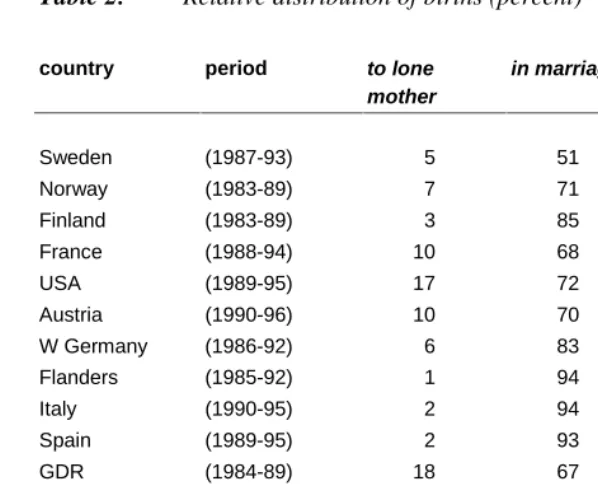
Table 2 contains the relative distribution of births during our period(s) of interest that were reported as occurring while the mothers were not living in a union, and while they were living with a partner in a consensual union, or in a marriage, respectively. We note that two countries stick out with an exceptionally high proportion of births to lone mothers: the USA with 17 percent of reported births and the former GDR with a figure of 18 percent. As we will see in our next table, substantial fractions of such children in the GDR soon found themselves living together with their mother and a partner of hers. We have no information on whether such a partner was their father, but other information tells us that most births to lone mothers in the GDR occurred to women living in so-called living-apart-together relationships. These were typically mothers who had not yet managed to find proper housing for themselves and their partner (Alt 2001: 89; see also Dennis 1999 for a discussion of the phenomena of lone motherhood in East Germany). Relatively high proportions of births to lone mothers, around 10 percent of newborn children, are also reported for France, Austria, Latvia, and Poland. In the rest of Europe, such events are fairly uncommon. For a few Catholic countries in Western/Southern Europe, notably Italy, Spain, and the Flemish parts of Belgium, we find that no more than 1-2 percent of reported births occur to lone mothers.
Table 2: Relative distribution of births (percent)
country period to lone mother
in marriage in
consen-sual union
Sweden (1987-93) 5 51 45
Norway (1983-89) 7 71 22
Finland (1983-89) 3 85 13
France (1988-94) 10 68 23
USA (1989-95) 17 72 11
Austria (1990-96) 10 70 19
W Germany (1986-92) 6 83 11
Flanders (1985-92) 1 94 4
Italy (1990-95) 2 94 4
Spain (1989-95) 2 93 4
GDR (1984-89) 18 67 15
Hungary (1988-93) 3 90 6
Czech Rep (1992-97) 4 89 7
Slovenia (1989-95) 6 78 16
Latvia (1989-95) 11 79 11
Lithuania (1989-95) 5 93 2
Poland (1986-91) 9 89 2
3b. Children’s experience of family formation
observations then are so few that they do not allow for reliable estimation. A particularly fast process of family formation of lone mothers is also found in the GDR and Slovenia. The prevalence of childbearing to lone women is higher here, so we have the opportunity to obtain sufficient observations to follow their children up to higher ages. We discover that as many as 85-87 percent of them would have had the experience of living in a two-parent family when they turned nine – if the patterns observed in 1984-89/1989-95 had prevailed.
Table 3: Cumulative percent ever in union, by exact age of child, for children born to a lone mother
country period age 1 age 3 age 9
Sweden (1987-93) 19 29 52
Norway (1983-89) 29 54
--Finland (1983-89) 25 39 64
France (1988-94) 8 13 38
USA (1989-95) 18 37 65
Austria (1990-96) 19 44 73
W Germany (1986-92) 12 32
--Flanders (1985-92) 5 --
--Italy (1990-95) 48 --
--Spain (1989-95) 46 --
--GDR (1984-89) 37 63 87
Hungary (1988-93) 23 52
--Czech Rep (1992-97) 17 --
--Slovenia (1989-95) 42 66 85
Latvia (1989-95) 25 52 69
Lithuania (1989-95) 21 32
--Poland (1986-91) 17 25 32
3c. Children’s experience of family dissolution
Table 4 tells us what happens with the children who are born in a union, which in all countries is the dominating group of children, when it comes to their experience of any dissolution of their family of origin. The percent of such children who have ever experienced a family dissolution is reported by the exact ages 1, 3, 9, and 15 years. Two countries show up as having particularly high levels of disruptions of child families: the USA and Latvia. The USA has higher proportions of children with an experience of family dissolution than any other country; 40 percent of children born in a union there have had such an experience when they turn 15. Sweden and the two parts of Germany also have relatively high levels of child-family dissolution; around 30 percent of corresponding children there have such an experience before they turn 15. At the other extreme, we find Italy. Only seven percent of children born in a union there would experience a family dissolution during childhood, if the patterns observed in 1990-95 had prevailed. Such an event is also fairly uncommon for corresponding children in Spain, Slovenia, and Poland, where the comparable figures all stand at a moderate 10 percent. Elsewhere in Europe, it is common to find a national figure of around 20 percent. A separate calculation of mean ages of the children that experience a family dissolution of their original parents (not shown here) reveals that the average age of the child at such an event is 6-8 years, no matter how high the general level of child-family disruption is in the country.
presented separately (Table 5). In both cases, we find that the USA is the country where children are most likely to experience a family disruption before they turn 15, closely followed by Latvia. In both cases, we also find Italy as the country where children have the lowest propensity for experiencing a family disruption. The patterns for Sweden turn out to be interesting. When children born in consensual unions and those born in marriage are treated separately, it no longer stands out as a country with particularly high levels of child-family disruptions. The relatively common experience of Swedish children of family dissolution, as indicated by Table 4, comes rather from the fact that so many children there are born to a cohabiting but not married couple.
Table 4: Cumulative percent ever out of union, by exact age of child, for children born in a union
country period age 1 age 3 age 9 age 15
Sweden (1987-93) 2 9 21 30
Norway (1983-89) 2 6 15 21
Finland (1983-89) 1 6 14 20
France (1988-94) 2 6 16 23
USA (1989-95) 5 14 29 40
Austria (1990-96) 2 6 18 26
W Germany (1986-92) 2 6 16 29
Flanders (1985-92) 1 3 10 15
Italy (1990-95) 0 1 4 7
Spain (1989-95) 1 3 7 10
GDR (1984-89) 2 8 24 34
Hungary (1988-93) 1 4 14 22
Czech Rep (1992-97) 2 7 17 25
Slovenia (1989-95) 1 2 6 10
Latvia (1989-95) 5 13 28 38
Lithuania (1989-95) 2 5 16 25
Poland (1986-91) 1 2 6 10
Table 5: Cumulative percent ever out of union, by exact age of child, for children born in a:
consensual union marriage
country period age 1 age 3 age 9 age 15 age 1 age 3 age 9 age 15
Sweden (1987-93) 4 13 27 38 1 5 15 24
Norway (1983-89) 8 18 30 36 1 4 12 18
Finland (1983-89) 4 19 35 39 1 4 11 17
France (1988-94) 5 16 35 58 1 3 11 17
USA (1989-95) 18 39 64 78 3 10 24 35
Austria (1990-96) 6 13 31 43 1 4 15 23
W Germany (1986-92) 4 16 37 -- 1 5 13 26
Flanders (1985-92) 4 15 34 -- 1 2 9 14
Italy (1990-95) 0 2 7 -- 0 1 4 7
Spain (1989-95) 9 24 -- -- 1 2 6 9
GDR (1984-89) 6 19 38 -- 1 6 21 31
Hungary (1988-93) 7 17 48 58 1 4 12 20
Czech Rep (1992-97) 9 27 -- -- 1 5 15 24
Slovenia (1989-95) 3 8 14 19 0 1 5 8
Latvia (1989-95) 16 36 58 69 3 10 24 34
Lithuania (1989-95) 15 -- -- -- 1 5 15 24
Poland (1986-91) 0 12 26 -- 1 2 5 10
3d. A summary of children’s experience of living outside the union of their parents
Figure 1: Cumulative percent ever out of union, by age of child
Table 6 and Figure 1 summarizes the information gathered from Tables 2 and 4 in that they report the cumulative percent of all children who ever have the experience of living outside a union of their two parents by the exact ages 0, 1, 3, 9, and 15. (Figure 1 displays the results for a select group of countries.) Children who are born to a lone mother enter already at age 0, i.e., at birth, while children who are born in a union, and then at some point in time experience a union dissolution of their parents, subsequently add to this initial fraction of children. The high proportion of births to a lone mother in the USA and the former GDR (Table 2) shows up in the first column of Table 6. The last column of the same table shows that the USA has the highest proportion of children, as much as 50 percent, with any experience of living outside a two-parent family when they turn 15. The USA is closely followed by the GDR and Latvia, while in many Western and Eastern European countries it is more common to find that around a fourth or a third of all children have an experience of that kind, at some time during childhood. A number of Catholic countries in various parts of Europe again stand out with lower levels than the
0
10
20
30
40
50
60
0
3
6
9
12
15
age of child
USA GDR
Sweden W Germany France
Hungary Poland
Table 6: Cumulative percent ever out of union, by exact age of child
country period at birth age 1 age 3 age 9 age 15
Sweden (1987-93) 5 7 13 24 34
Norway (1983-89) 7 9 13 21 26
Finland (1983-89) 3 4 8 16 22
France (1988-94) 10 12 15 24 31
USA (1989-95) 17 21 28 41 50
Austria (1990-96) 10 12 15 26 34
W Germany (1986-92) 6 8 12 21 34
Flanders (1985-92) 1 2 4 11 17
Italy (1990-95) 2 2 3 6 9
Spain (1989-95) 2 3 5 9 13
GDR (1984-89) 18 19 25 37 46
Hungary (1988-93) 3 5 8 17 24
Czech Rep (1992-97) 4 6 11 20 29
Slovenia (1989-95) 6 7 8 12 15
Latvia (1989-95) 11 15 22 35 44
Lithuania (1989-95) 5 7 10 20 29
Poland (1986-91) 9 10 11 14 18
The estimates pertain to synthetic cohorts experiencing the transition rates prevailing six years prior to the survey date
3e. Children’s experience of family reconstitution
stepfamilies than other countries do. The lowest propensities of children to enter a new two-parent family are found in Italy and Poland. A calculation of mean values of the durations when children enter a stepfamily, calculated for the children who have had such an experience (not shown here), reveals that this event, on the average, takes place around 3-4 years after the dissolution of the parental union.
Table 7: Cumulative percent ever again in a union, by time since union disruption, for children experiencing parental separation
duration
country period 1 year 3 years 6 years 10 years
Sweden (1987-93) 11 32 51 62
Norway (1983-89) 17 41 57
--Finland (1983-89) 15 31 45 64
France (1988-94) 10 23 35 47
USA (1989-95) 21 47 67 78
Austria (1990-96) 18 30 47 54
W Germany (1986-92) 8 29 50
--Flanders (1985-92) 21 37 54
--Italy (1990-95) 2 8 28
--Spain (1989-95) 5 25 37 47
GDR (1984-89) 28 55 65
--Hungary (1988-93) 15 39 57 68
Czech Rep (1992-97) 32 61 71 77
Slovenia (1989-95) 14 36 62 71
Latvia (1989-95) 16 32 43 60
Lithuania (1989-95) 9 25 43 57
Poland (1986-91) 7 19 25 38
3f. A summary measure of children’s experience of living in different types of families
We conclude our presentation with a crude summary of the fractions of time that respondents’ children spent in various family types (Table 8). These percentages have simply been calculated from the family states that mothers reported for their children during the six-year period that came immediately prior to the interview date. We distinguish between time spent with a lone mother (with time spent after a family disruption and time spent immediately after childbirth given separately) and time that occurred after a child left its mother in order to live on its own or with someone else (Note 1). We also report the proportions of childhood experience with the original parents living in a consensual union and in a marriage, respectively. Finally, we report the percentages of time that refer to children in a stepfamily. All summaries cover the experience of children aged 0-14 (Note 6).
As we might expect, we find the highest proportion of children living with a lone mother, or not with a mother at all, in the USA. On average, as much as 22 percent of children here live in a one-parent family (or in any family without their mother). Common averages for children in Europe stand, rather, at around 10 percent of childhood time in such families. Latvia is found at the top with a figure of 15 percent while children in Flanders, Slovenia, Spain, and Italy only contribute 3-6 percent of their childhood to the one-parent family type. The USA also stands out as the country where it is most common for children to live in a stepfamily; 10 percent of all childhood time there is accountable to that family type. In Europe, on the other hand, it is common to find that around 5 percent of childhood time belong to stepfamilies. The highest levels are recorded for children in the GDR, the Czech Republic, and Latvia (7-8 percent), while the lowest values are found for children in Italy, Spain, Slovenia, and Poland (0-2 percent).
marriage. The big difference is that in Sweden, most of the remaining children live with their original parents in a consensual-union family, while in the USA they live, rather, with a lone mother or in a stepfamily.
Table 8: Percent of time spent in different family types at ages 0-14 years
time with lone mother: time with both parents: time in
step family:
country period - from birth - after disruption
with no mother
==> total lone/no m.
cohabita-tion
marriage ==> total both parents
(with mother)
(Note 1)
Sweden (1987-93) 2 9 2 12 17 64 81 6
Norway (1983-89) 2 5 0 7 5 84 89 4
Finland (1983-89) 1 6 1 8 4 84 88 4
France (1988-94) 4 7 0 11 8 78 86 3
USA (1989-95) 7 13 2 22 4 64 67 10
Austria (1990-96) 4 8 1 12 6 79 84 4
W Germany (1986-92) 2 8 1 12 5 78 83 5
Flanders (1985-92) 0 4 0 5 1 91 92 3
Italy (1990-95) 0 2 0 3 1 95 97 0
Spain (1989-95) 1 3 0 4 1 93 94 1
GDR (1984-89) 5 8 1 13 6 73 79 8
Hungary (1988-93) 1 6 0 8 2 86 87 5
Czech Rep (1992-97) 1 6 0 8 2 84 85 7
Slovenia (1989-95) 2 3 1 6 6 86 92 2
Latvia (1989-95) 3 11 0 15 3 75 79 7
Lithuania (1989-95) 2 8 0 10 1 85 86 3
4. Conclusions
Our presentation has revealed both striking differences and strong similarities between countries when it concerns patterns of family-demographic affairs of children. The USA stands out as an extreme case with its very high proportion of children born to a lone mother, with a higher probability that children experience a union disruption of their parents than anywhere else, and with many children having the experience of living in a stepfamily. Italy stands out at the other end of the scale. Practically all children here are born to a married mother and very few of them experience dissolution of their parents’ union before they turn 15. The vast majority of children in Europe are born in a union and spend their entire childhood living with both of their original parents. The differences in family conditions between children in the USA and children in Europe, is impressive but important variation also exist between countries in Europe. Our study covers the family-demographic situation in a relatively large number of countries in Europe, from both sides of the former Iron Curtain. We do not find any systematic differences between countries in Eastern Europe and countries in Western Europe but rather a variation between countries within each sphere of the continent. Some European countries are characterised by particularly stable family patterns from the point of view of children. These countries are found in different areas of Europe but all have the trait in common of being strongly dominated by the Catholic confession. European countries with a higher degree of volatility in their family-demographic affairs are all characterised by a less influential role of religion in general and of Catholicism in particular. With the exception of Sweden, it is not really common for children to grow up in families with cohabiting but not married parents. Children born in cohabitation are exposed to higher disruption risks than children born in marriage, so the general level of child-family disruption is also related to the level of childbearing to cohabiting couples.
picture, in particular Russia and the various successor states of the former Soviet Union. In addition, it would be interesting to include Britain and further Anglo-Saxon countries into our cross-country comparison.
Acknowledgments
Notes
1. The proportions of childhood spent in families where the mother is not present are generally very low and can actually be disregarded. They amount to a maximum of two percent in the USA and Sweden, and even less than that in the other countries considered. For Lithuania and Poland, we have no information on children’s actual living arrangements, so here we assume that they continue to live with their mother in the case of, for example, a family disruption. For Norway, we know if a child has left its mother but we have no information about the date of that event so we choose to exclude such children completely from our calculations. For France, we cannot distinguish if a child has died or moved away from its mother, and here we censor our observation at the point when such an event occurs. In summaries, as in Table 8, these four countries thus show up with 0 percent of children living away from their mother, a feature that they actually share with many countries where we indeed have the full information on the residential histories of children.
2. Each life table is based on the probabilities that a child at age x moves from a specific family-demographic state to another state of interest by exact age x+1. The probabilities are calculated from all reported events of a specific kind, by age, and all recorded months of exposure to that event, by age, during our study period.
3. The FFS data from the Netherlands are not available to researchers outside that country. Data from Bulgaria and Portugal do not contain union histories of respondents and cannot be used for calculations like ours.
4. The Belgian FFS only covers the Flemish-speaking parts of the country. 5. The surveys conducted in the Czech Republic, Norway, Slovenia, Sweden, and
the USA cover female respondents up to an age of around 45 years. The surveys in Finland, France, Italy, Latvia, Lithuania, Poland, and Spain include respondents aged up to around 50 years. The Austrian FFS deviates in including respondents as old as 54-55 years, while those of Flanders, Germany, and Hungary only include respondents up to approximately age 40.
References
Alt, C., 2001. Kindheit in Ost und West: Wandel der Familialen Lebensformen aus Kindersicht. Leske+Budrich, Opladen, Germany.
Andersson, G., and Philipov, D., 2002. “Life-table representations of family dynamics in Sweden, Hungary, and 14 other FFS countries: A project of descriptions of demographic behavior”. Demographic Research [Online] 7: 67-270. Available http://www.demographic-research.org/Volumes/Vol7/4. Bumpass, L., and Hsien-Hen Lu, 2000. “Trends in cohabitation and implications for
children's family contexts in the United States”. Population Studies 54: 29-41.
Bumpass, L., and Raley, K., 1995. “Redefining single-parent families: Cohabitation and changing family reality”. Demography 32: 97-109.
Dennis, M., 1999. “The East German family: Change and continuity”. In Flockton, I., et al. (eds), Recasting East Germany: Social Transformation after the GDR: 83-101. Frank Cass, London.
Heuveline, P., and Timberlake, J., 2000. “Towards a child-centered life course perspective on family structures: Multi-state early life tables using FFS data”. Paper presented at the FFS Flagship Conference, Brussels, 29-31 May 2000.
Heuveline, P., Timberlake, J., and Furstenberg, F., 2001. “An international comparison of children’s experience of family structure”. Paper presented at the IUSSP XXIV General Population Conference, Salvador, Brazil, 18-24 August 2001.
Kiernan, K., 2000. “The state of European unions: An analysis of FFS data on partnership formation and dissolution”. Paper presented at the FFS Flagship Conference, Brussels, 29-31 May 2000.
Kiernan, K., 2001. “The rise of cohabitation and childbearing outside marriage in Western Europe”. International Journal of Law, Policy, and the Family 15: 1-21.
Murphy, M., 2000. “The evolution of cohabitation in Britain, 1960-95”. Population
Studies 54: 43-56.
Prinz, C., 1995. Cohabiting, Married or Single: Portraying, Analyzing and Modeling New Living Arrangements in the Changing Societies of Europe. Ashgate Publishing Co, Brookfield, Vermont.
Toulemon, L., 1997. “Cohabitation is here to stay”. Population: An English