RESEARCH PAPER
Effect of Structural Change on Corrosion Inhibition
Behavior of Synthesized N2O4 Imine Compounds for Steel
Pipelines in Oil and Gas Wells
Niloufar Bahrami panaha, Iman Danaeeb,*
a. Department of Chemistry, Payame Noor University, Tehran, Iran
b. Abadan Faculty of Petroleum Engineering, Petroleum University of Technology, Abadan, Iran
Received: 5 May 2017, Revised: 8 December 2018, Accepted: 22 May 2019 © University of Tehran 2019
Abstract
The inhibition properties of synthesized imine compounds N,Nʹ-bis(2,4-dihydroxyhydroxybenzaldehyde)-1,3-Propandiimine, N, N′-bis(2,4-dihydroxypropiophenone)-2,2-dimethylpropandiimine, N,Nʹ-bis(2,4-dihydroxyacetophenone)-1,3-Propandiimine has been investigated for API-5L-X65 steel corrosion in hydrochloric acid by scanning electron microscopy, potentiodynamic polarization and impedance spectroscopy. Aqueous hydrochloric acid was applied to simulate the oil and gas well acidizing fluid. Potentiodynamic polarization studies indicated that compounds retard both the anodic and cathodic reactions through adsorption and blocking the active corrosion sites. The inhibition efficiency increased with inhibitor concentration. Electrochemical impedance spectroscopy data were studied by equivalent circuit and showed that with increasing inhibitor concentration, the resistance of charge transfer enhanced and the capacitance of double layer reduced. The measured data proposed that the inhibition efficacy was increased for inhibitor in the absence of alkyl addition. The geometrical steric hindrance offered by the alkyl groups in the imine compounds plays an important role in its corrosion inhibition properties. Scanning electron microscopy was used to study the steel surface with and without inhibitors.
Keywords:
Corrosion,
Imine Compounds, Impedance, Inhibitor,
Well Acidizing Fluid
Introduction
Acid solutions are extensively applied in industry, including industrial acid cleaning, acid pickling, acid descaling and oil well acidizing. Well stimulation or acidizing is a process to improve oil and gas production that throughout this procedure, aggressive fluids are introduced into contact with metal structure. Acid is forced over the well for reacting with rocks (dolomite, calcite, and limestone) through chemical reactions and dissolving them, opening new flow channels and enlarging bores [1,2]. The most frequently utilized acid in the acidizing process is Hydrochloric acid (HCl) [3,4]. Compared to other acids, HCl is more cost-effective and reacts quickly with the rocks, but it is extremely corrosive for metal structure. Therefore, the acid has
* Corresponding author
to be combined with corrosion inhibitors in such a way that the surface of the material can be preserved against corrosion. Consequently, corrosion inhibitors are one of the main groups of chemicals materials used as additives for acidic recovery fluids in the oil industry. Numerous corrosion inhibitors have been introduced to be useful in many acid solutions with diverse levels [5-10].
Inhibition of organic materials is related to the interaction and adsorption between the metal surface and molecules of inhibitor. The adsorption of inhibitor is affected by its interaction type with the surface of the metal as well as factors like the nature of the metal, the surface charge, the structure of inhibitor, aggressive medium type and its aggressiveness [8,9]. In general, the organic materials containing N, O, P and S are reported to act as active inhibitors in corrosion [10-14]. All inhibitors are selected considering two aspects, firstly economical and environmental aspect and secondly, high inhibition efficacy. Both aspects clearly are mixed in a similar compound like imine [14,17].
According to the literature, numerous imine base compounds have been introduced as efficient inhibitors in corrosion for diverse materials in the acid medium [18-21]. Growing application of imine compounds in the area of inhibition is because of their easy production from comparatively low-cost primary-materials and low toxic or environmental-friendly features [22]. The great inhibition efficiency of these compounds is because of the existence of a –C=N– group in these molecules. The planarity (π) and lone pairs of electrons on N atoms are the main structural properties determining that these molecules are adsorbed on the surface of the metal.
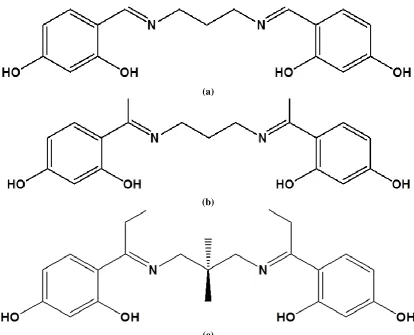
American Petroleum Institute model API 5L Carbon steels are used in high amounts in chemical processing, marine uses, construction, petroleum fabrication, and purification and metal-processing apparatus [1,2]. The objective of this work is to study the effect of alkyl in the structure of synthesized imine compounds synthesized imine compounds N, Nʹ-bis (2, 4-dihydroxyhydroxybenzaldehyde)-1, 3-Propandiimine (DHBP), N, N′-bis (2, 4-dihydroxypropiophenone)-2, 2-dimethylpropandiimine (DHPP), N, Nʹ-bis (2, 4-dihydroxyacetophenone)-1, 3-Propandiimine (DHAP) on corrosion inhibition properties for API 5L Carbon steels in acid solution. Potentiodynamic polarization, impedance spectroscopy, and scanning electron microscopy were used to compare the inhibition ability of these N2O4
imine compounds.
Experimental
Materials
American Petroleum Institute model API-5L-X65 specimens were prepared commercially. The samples with a dimension of 1 cm × 1 cm × 4.3 mm were mounted in polyester resin with an exposed area of 1 cm2 and applied in electrochemical approaches. They were polished
mechanically by means of diverse grade emery papers up to 2000, rinsed with distilled water, and then degreased using acetone prior immersion into the corrosive medium. Corrosion studies were carried out in 1 M HCl solution in different temperatures of 20, 40, 60 and 80 °C. Hydrochloric acid solution 1 M was provided by diluting 37% HCl (Merck).
elemental analysis. Two concentrations of 3 × 10⁻⁴ and 2 × 10⁻³ M were selected for different inhibitors in hydrochloric acid solution.
(a)
(b)
(c)
Fig. 1. The chemical structure of the imine compounds: a) DHBP, b) DHAP, and c) DHPP
Instrumentation
Electrochemical studies were performed using PGSTAT302N Auto Lab potentiostat/galvanostat electrochemical measurement instrument. Corrosion tests were performed by a three-electrode cell of the potentiostat. Polarization experiments were performed by applying cathodic and anodic potentials on steel working electrode in the potential range -0.7 to -0.25 V at a scan rate of 1 mV s-1. An SCE was applied as the reference electrode and Pt foil was utilized as a counter electrode. The calomel reference electrode was prepared from AZAR Electrode. Impedance tests were performed in the frequencies between 100 kHz and 0.01 Hz at open circuit potential at 20 ± 2 °C. The AC sinusoidal potential amplitude 10 mV was applied on the DC open circuit potential of the working electrode. The applied AC potential is low and therefore electrochemical impedance is almost a nondestructive method for electrode surface. The EIS data were fitted to the suggested equivalent circuit and impedance parameters were calculated.
Results and Discussions
Electrochemical Results
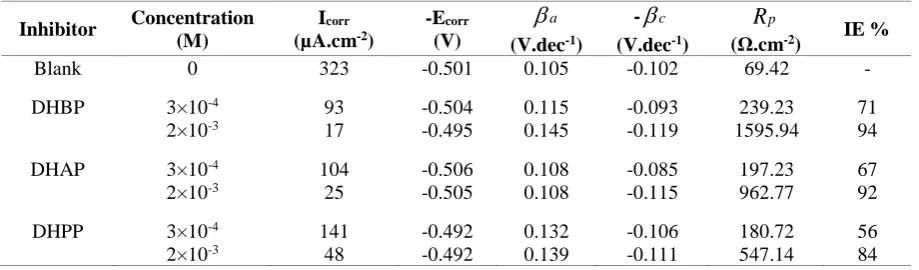
Figs. 2 and 3 demonstrate potentiodynamic polarization curves in the corrosive medium in the existence of 3×10⁻⁴ and 2 ×10⁻³ M of DHBP, DHAP, and DHPP. Table 1 indicates the corrosion factors like corrosion potential (Ecorr vs. SCE), cathodic and anodic Tafel slopes (βa, βc), the degree of surface coverage (θ), corrosion current density (Icorr), and inhibition efficiency (IE%= θ×100) achieved through Tafel extrapolation. The surface coverage for diverse levels of inhibitor is computed through the subsequent equations [24,25]:
(1)
where, Icorr and İcorr represent the corrosion current densities without and with corrosion inhibitor measured via intersecting the extrapolated Tafel lines at the corrosion potential of steel, respectively.
Fig. 2. The chemical structure of the imine compounds: a) DHBP, b) DHAP, and c) DHPP
Fig. 3. Tafel polarization curves for steel in 1 M HCl (1), in the presence of 1×10⁻⁴ M of DHPP (2), DHAP (3), and DHBP (4)
-= I İ
Table 1. Potentiodynamic polarization parameters for the corrosion of carbon steel in 1 M HCl solution in the absence and presence of different concentrations of inhibitors at 20 °C
As would be predicted, the inhibition of both the cathodic H+ reduction reaction and anodic Fe oxidation reaction occurs by adding imine compounds to the corrosive medium. This outcome is revealing the adsorption of inhibitor on the active sites on the surface of metal [26]. In addition, inhibition of cathodic and anodic currents enhances by enhancing the amount of inhibitor.
The cathodic current–potential curves having an increase up to parallel lines for all inhibitors indicates that these imine compounds have the same behavior and does not change the reduction mechanism [27]. The corrosion potentials display small change towards the negative direction indicate that inhibitors can be categorized as mixed type inhibition effect, as the movement of electrode potential in any direction is less than 85 mV [27]. The polarization resistance (Rp) was computed by the Stern–Geary relation [28].
1
= ×
2.303
a c
p
a c corr
β .β R
(β + β ) I (2)
By enhancing the amount of imine compounds, the polarization resistance rises in the existence of these compounds, signifying that the inhibitor is adsorbed on the surface of the metal and as a result, the active sites are competently blocked and corrosion is inhibited [29]. DHAP and DHPP have higher molecular weight but lower corrosion current is resulted for DHBP. Consequently, DHBP is more beneficial rather than DHAP and DHPP. The inhibition efficacy is nearly 94% at the level of 2×10⁻³ M for DHBP. It is proposed that the geometrical steric hindrance offered by the alkyl groups in the imine compounds such as DHAP and DHPP plays an important role in decreasing its corrosion inhibition properties [30-32]. This steric hindrance makes a sheer physical blockage to the attack of the nucleophile groups to the surface of the metal and decreases inhibition efficiency.
Figs. 4 and 5 present impedance curves of API-5L-X65 in the corrosive medium in the absence and the existence of 1×10⁻⁴ and 2 ×10⁻³ M of DHBP, DHAP, and DHPP. The plots display a depressing arc resulted from the time constant corresponding to the resistance of charge transfer and capacitance of electrical double layer. The impedance corresponding to the inhibited steel raises by enhancing inhibitors concentrations for all imine compounds and therefore the inhibition efficacy enhances. Fig. 6 shows the electrical equivalent circuit suitable with the impedance curves plotted in the absence and existence of studied inhibitors. The simplest method needs the theoretical transfer function Z (ω) using a parallel hybrid of a capacitance C and a resistance Rct:
(3) 1 = + + s ct Z(ω) R 1 iωC R
Inhibitor Concentration (M)
Icorr (µA.cm-2)
-Ecorr
(V) (V.dec-1)
-(V.dec-1) (Ω.cm-2) IE % Blank 0 323 -0.501 0.105 -0.102 69.42 -
DHBP 3×10⁻⁴ 93 -0.504 0.115 -0.093 239.23 71
2×10⁻³ 17 -0.495 0.145 -0.119 1595.94 94
DHAP 3×10⁻⁴ 104 -0.506 0.108 -0.085 197.23 67
2×10⁻³ 25 -0.505 0.108 -0.115 962.77 92
DHPP 3×10⁻⁴ 141 -0.492 0.132 -0.106 180.72 56
2×10⁻³ 48 -0.492 0.139 -0.111 547.14 84
a
where ω=2π f refers to the frequency in rad/s, and f represents frequency in Hz. In most cases, to achieve acceptable impedance fitting, it is needed to substitute the capacitance element (C) with a constant phase element CPE (Q) in the electrical circuit. In these situations, the description for depressed semicircles and the existence of CPE element in the equivalent circuit for solid surfaces is the micro and nano-roughness, resulting in the inhomogeneous dispersion for the resistance of solution and thus in the capacitance of double layer.
Rs, constant phase element Qdl and Rct can be related to solution resistance, the capacitance of double layer, Qdl=Rn-1Cdl and resistance of charge transfer, respectively. Fitting of the impedance curves to the electrical circuit is performed and the impedance parameters are achieved to verify the electrical circuit. Table 2 indicates the impedance elements for steel corrosion in acidic medium. As observed, the charge transfer resistance is higher in the existence of DHBP due to the lower steric hindrance. The data show that enhancing the resistance of charge transfer is related to a reduction in the capacitance of the double layer. Therefore, the organic inhibitor adsorption on the surface of the metal is performed through decreasing Cdl. The reduced values of Cdl may be because of replacing water molecules adsorbed on the metal surface by organic materials which have low dielectric constant and indicates that imine inhibitors play a role through adsorbing at the solution-metal interface.
Fig. 4. Nyquist plots for steel in 1M HCl (1) in the presence of 1×10⁻⁴ M of DHPP (2), DHAP (3), and DHBP (4)
Fig. 6. Equivalent circuits compatible with the experimental impedance data for corrosion of steel electrode in various inhibitor concentrations
Table 2. Impedance data for carbon steel in 1 M HCl solution without and with different concentrations of inhibitors at 20 °C
The obtained inhibition efficiencies in this work can be compared with similar literature for corrosion inhibition of metals by imine compounds. Corrosion inhibition of carbon steel pipelines during acidizing treatment of oil wells was studied by different imine compounds containing benzene rings [33]. Different electrochemical and surface methods including electrochemical impedance spectroscopy, potentiodynamic polarization, and SEM were applied for this purpose. The results showed that the inhibitors are efficient mixed-type corrosion inhibitors and the inhibition efficiencies were about 90-95% in HCl solution. The high inhibition efficiencies of these inhibitors were due to the nitrogen atom and benzene ring in molecules and spherical structure. Tezcan et al. (2018) [34] investigated the synthesized imine compound containing thiophene as an effective corrosion inhibitor for mild steel in HCl solution. They analyzed the inhibition efficiency of inhibitors using electrochemical analysis. These sulfur containing imine compounds showed a high inhibition efficiency of 96% for mild steel corrosion in acidic solution. This high inhibition efficiency was related to the effect of both the imine functional group and a sulfur atom in the molecule. Elemike et al. [35] synthesized and studied the adsorption and inhibition properties of two chlorobenzylidene and nitrobenzylidene imine compounds for steel corrosion in acidic solution. Electrochemical impedance spectroscopy and Tafel diagrams were employed in order to analyze the inhibition and corrosion rate. Low inhibition efficiencies around 75-81% were calculated for these benzylidene inhibitors. El-Lateef et al. [36] investigated synthesized cationic diimine base surfactants as a corrosion inhibitor for steel in sulfuric acid solution. SEM and electrochemical techniques were used in corrosion inhibition study of steel for industrial applications, especially in refineries, petrochemical, and petroleum. Diimine group in the molecule and cationic surfactant influenced adsorption and inhibition behaviors such that a very high inhibition efficiency up to 99% was obtained.
Surface Analysis
The SEM micrograph in Fig. 7 shows a corroded steel specimen surface after immersing in 1M HCl for 6 h with or without. The SEM reveals the existence of corrosion damage and several surface pits for steel in HCl solution however such damages are diminished in the existence of inhibitors. Therefore, the surface is more uniform in the existence of inhibitors. This is completely in accordance with the outcomes achieved from potentiodynamic polarization and impedance measurements.
Inhibitor Concentration (M)
Rs
(Ω.cm2)
Rct
(Ω.cm2)
Qdl
(F.cm2)
Cdl
(F.cm2) n blank 1.6 99.1 0.583 0.214 0.74 DHBP 3×10⁻⁴ 1.9 285 0.0014 0.0012 0.87
2×10⁻³ 2.1 781 0.0010 0.0009 0.91
DHAP 3×10⁻⁴ 1.9 264 0.0014 0.0012 0.89
2×10⁻³ 2.1 621 0.0009 0.0008 0.93
DHPP 3×10⁻⁴ 2 195 0.0016 0.0013 0.87
(a) (b)
(c) (d)
Fig. 7. The surface of steel electrode by SEM microscope of carbon steel exposed to 1 M HCl solution (a), in the presence of 2×10⁻³ M of DHPP (b), DHAP (c), and DHBP (d)
Conclusions
Three imine compounds were prepared and studied as a corrosion inhibitor for steel in 1M HCl solution with diverse levels using several methods. The following points can be emphasized:
1. The prepared imine plays a role as an effective inhibitor for the acidic corrosion of carbon steel.
2. The inhibition efficacies enhanced with enhancing inhibitor level and higher inhibition efficiency was obtained for inhibitor without alkyl part.
3. The corrosion inhibition corresponding to the synthesized inhibitors is mainly due to their adsorption on the surface of carbon steel.
4. Tafel measurements indicated that inhibitors acted as hybrid kind corrosion inhibitor through inhibition of both cathodic reactions and anodic metal dissolution.
5. Nyquist data show that with rising inhibitor level, the resistance of charge transfer enhanced, however the capacitance of double-layer capacitance.
Reference
[1] Hegazy MA, El-Etre AY, El-Shafaie M, Berry KM. Novel cationic surfactants for corrosion inhibition of carbon steel pipelines in oil and gas wells applications. Journal of Molecular Liquids. 2016 Feb 1;214:347-56.
[2] Deyab MA, Eddahaoui K, Essehli R, Rhadfi T, Benmokhtar S, Mele G. Experimental evaluation of new inorganic phosphites as corrosion inhibitors for carbon steel in saline water from oil source wells. Desalination. 2016 Apr 1;383:38-45.
[3] Ituen E, Akaranta O, James A. Green anticorrosive oilfield chemicals from 5-hydroxytryptophan and synergistic additives for X80 steel surface protection in acidic well treatment fluids. Journal of Molecular Liquids. 2016 Dec 1;224:408-19.
[4] Ituen EB, James AO, Akaranta O. Fluvoxamine-based corrosion inhibitors for J55 steel in aggressive oil and gas well treatment fluids. Egyptian Journal of Petroleum. 2017 Sep 1;26(3):745-56.
[5] Hu J, Koleva DA, De Wit JH, Kolev H, Van Breugel K. Corrosion performance of carbon steel in simulated pore solution in the presence of micelles. Journal of the Electrochemical Society. 2011 Mar 1;158(3):C76-87.
[6] Döner A, Solmaz R, Özcan M, Kardaş G. Experimental and theoretical studies of thiazoles as corrosion inhibitors for mild steel in sulphuric acid solution. Corrosion Science. 2011 Sep 1;53(9):2902-13.
[7] Keleş H. Electrochemical and thermodynamic studies to evaluate inhibition effect of 2-[(4-phenoxy-phenylimino) methyl]-phenol in 1 M HCl on mild steel. Materials Chemistry and Physics. 2011 Nov 1;130(3):1317-24.
[8] Alaneme KK, Olusegun SJ, Adelowo OT. Corrosion inhibition and adsorption mechanism studies of Hunteria umbellata seed husk extracts on mild steel immersed in acidic solutions. Alexandria Engineering Journal. 2016 Mar 1;55(1):673-81.
[9] Guo L, Obot IB, Zheng X, Shen X, Qiang Y, Kaya S, Kaya C. Theoretical insight into an empirical rule about organic corrosion inhibitors containing nitrogen, oxygen, and sulfur atoms. Applied Surface Science. 2017 Jun 1;406:301-6.
[10] Ha JH, Cho JH, Kim JH, Cho BW, Oh SH. 1-Butyl-1-methylpyrrolidinium chloride as an effective corrosion inhibitor for stainless steel current collectors in magnesium chloride complex electrolytes. Journal of Power Sources. 2017 Jul 1;355:90-7.
[11] Sasikala T, Parameswari K, Chitra S, Kiruthika A. Synthesis and corrosion inhibition study of benzodiazepines on mild steel in sulphuric acid medium. Measurement. 2017 Apr 1;101:175-82. [12] Chevalier M, Robert F, Amusant N, Traisnel M, Roos C, Lebrini M. Enhanced corrosion resistance
of mild steel in 1 M hydrochloric acid solution by alkaloids extract from Aniba rosaeodora plant: Electrochemical, phytochemical and XPS studies. Electrochimica Acta. 2014 Jun 10;131:96-105. [13] Farag AA, Ismail AS, Migahed MA. Inhibition of carbon steel corrosion in acidic solution using
some newly polyester derivatives. Journal of Molecular Liquids. 2015 Nov 1;211:915-23. [14] Gowraraju ND, Jagadeesan S, Ayyasamy K, Olasunkanmi LO, Ebenso EE, Subramanian C.
Adsorption characteristics of Iota-carrageenan and Inulin biopolymers as potential corrosion inhibitors at mild steel/sulphuric acid interface. Journal of Molecular Liquids. 2017 Apr 1;232:9-19.
[15] Ghazoui A, Benchat N, El-Hajjaji F, Taleb M, Rais Z, Saddik R, Elaatiaoui A, Hammouti B. The study of the effect of ethyl (6-methyl-3-oxopyridazin-2-yl) acetate on mild steel corrosion in 1M HCl. Journal of Alloys and Compounds. 2017 Feb 5;693:510-7.
[16] Douadi T, Hamani H, Daoud D, Al-Noaimi M, Chafaa S. Effect of temperature and hydrodynamic conditions on corrosion inhibition of an azomethine compounds for mild steel in 1 M HCl solution. Journal of the Taiwan Institute of Chemical Engineers. 2017 Feb 1;71:388-404.
[17] Loto RT. Study of the synergistic effect of 2-methoxy-4-formylphenol and sodium molybdenum oxide on the corrosion inhibition of 3CR12 ferritic steel in dilute sulphuric acid. Results in Physics. 2017 Jan 1;7:769-76.
Schiff base on the corrosion of steel in 1 M HCl. Protection of Metals and Physical Chemistry of Surfaces. 2015 Sep 1;51(5):899-907.
[19] Zakaria K, Negm NA, Khamis EA, Badr EA. Electrochemical and quantum chemical studies on carbon steel corrosion protection in 1 M H2SO4 using new eco-friendly Schiff base metal complexes. Journal of The Taiwan Institute of Chemical Engineers. 2016 Apr 1;61:316-26. [20] Dasami PM, Parameswari K, Chitra S. Corrosion inhibition of mild steel in 1MH2SO4 by
thiadiazole Schiff bases. Measurement. 2015 Jun 1;69:195-201.
[21] Gupta NK, Verma C, Quraishi MA, Mukherjee AK. Schiff's bases derived from l-lysine and aromatic aldehydes as green corrosion inhibitors for mild steel: experimental and theoretical studies. Journal of Molecular Liquids. 2016 Mar 1;215:47-57.
[22] Chaitra TK, Mohana KN, Tandon HC. Thermodynamic, electrochemical and quantum chemical evaluation of some triazole Schiff bases as mild steel corrosion inhibitors in acid media. Journal of Molecular Liquids. 2015 Nov 1;211:1026-38.
[23] JefferyáLeigh G, RogeráSanders J. Non-planar co-ordination of the Schiff-base dianion N, N′-2, 2-dimethyltrimethylenebis [salicylideneiminate (2–)] to vanadium. Journal of the Chemical Society, Dalton Transactions. 1995(3):321-6.
[24] Gürten AA, Keleş H, Bayol E, Kandemirli F. The effect of temperature and concentration on the inhibition of acid corrosion of carbon steel by newly synthesized Schiff base. Journal of Industrial and Engineering Chemistry. 2015 Jul 25;27:68-78.
[25] Negm NA, Elkholy YM, Zahran MK, Tawfik SM. Corrosion inhibition efficiency and surface activity of benzothiazol-3-ium cationic Schiff base derivatives in hydrochloric acid. Corrosion Science. 2010 Oct 1;52(10):3523-36.
[26] El-Lateef HM, Abu-Dief AM, Abdel-Rahman LH, Sañudo EC, Aliaga-Alcalde N. Electrochemical and theoretical quantum approaches on the inhibition of C1018 carbon steel corrosion in acidic medium containing chloride using some newly synthesized phenolic Schiff bases compounds. Journal of Electroanalytical Chemistry. 2015 Apr 15;743:120-33.
[27] Boumhara K, Tabyaoui M, Jama C, Bentiss F. Artemisia Mesatlantica essential oil as green inhibitor for carbon steel corrosion in 1 M HCl solution: Electrochemical and XPS investigations. Journal of Industrial and Engineering Chemistry. 2015 Sep 25;29:146-55.
[28] Keleş H. Electrochemical and thermodynamic studies to evaluate inhibition effect of 2-[(4-phenoxy-phenylimino) methyl]-phenol in 1 M HCl on mild steel. Materials Chemistry and Physics. 2011 Nov 1;130(3):1317-24.
[29] El Hamdani N, Fdil R, Tourabi M, Jama C, Bentiss F. Alkaloids extract of Retama monosperma (L.) Boiss. seeds used as novel eco-friendly inhibitor for carbon steel corrosion in 1 M HCl solution: Electrochemical and surface studies. Applied Surface Science. 2015 Dec 1;357:1294-305. [30] Awad MK. Semiempirical investigation of the inhibition efficiency of thiourea derivatives as
corrosion inhibitors. Journal of Electroanalytical Chemistry. 2004 Jun 15;567(2):219-25.
[31] Al-Sarawy AA, Fouda AS, El-Dein WS. Some thiazole derivatives as corrosion inhibitors for carbon steel in acidic medium. Desalination. 2008 Sep 15;229(1-3):279-93.
[32] Morad MS, Sarhan AA. Application of some ferrocene derivatives in the field of corrosion inhibition. Corrosion Science. 2008 Mar 1;50(3):744-53.
[33] El-Lateef HM, Abu-Dief AM, Mohamed MA. Corrosion inhibition of carbon steel pipelines by some novel Schiff base compounds during acidizing treatment of oil wells studied by electrochemical and quantum chemical methods. Journal of Molecular Structure. 2017 Feb 15;1130:522-42.
[34] Tezcan F, Yerlikaya G, Mahmood A, Kardaş G. A novel thiophene Schiff base as an efficient corrosion inhibitor for mild steel in 1.0 M HCl: electrochemical and quantum chemical studies. Journal of Molecular Liquids. 2018 Nov 1;269:398-406.
[35] Elemike EE, Nwankwo HU, Onwudiwe DC. Experimental and theoretical studies of (Z)-N-(2-chlorobenzylidene) naphthalen-1-amine and (Z)-N-(3-nitrobenzylidene) naphthalen-1-amine, and their corrosion inhibition properties. Journal of Molecular Structure. 2018 Mar 5;1155:123-32. [36] El-Lateef HM, Soliman KA, Tantawy AH. Novel synthesized Schiff base-based cationic gemini