Journal of Human Resources Management and Labor Studies March 2014, Vol. 2, No. 1, pp. 01–16 ISSN: 2333-6390 (Print), 2333-6404 (Online) Copyright © The Author(s). 2014. All Rights Reserved. American Research Institute for Policy Development 42 Monticello Street, New York, NY 12701, USA. Phone: 1.347.757.4901 Website: www.aripd.org/jhrmls
Methodology for Hierarchization of Competences: A Fast Decision-Making Algorithm Applied to Organizations in Brazil
Brillo de Carvalho, J.B1. and Cosenza C.A.N1
Abstract
This study is dedicated to adapting the COPPE/COSENZA model, an information program that permits the creation of a multi-criteria ranking that considers preferred industrial activities in specific regions. Our aim was to apply this model to rank competences in Brazilian organizations based on the Triaxial Model of Values (Dolan and Garcia) and to work through the direct match between the supply profile of the market and the demand profile of the organizations. By verifying the market supply with the model, we can obtain a profile of the supply, which covers the different market segments. At the same time, we can verify the demand from the organizations in a detailed manner to obtain the demand profile. These profiles are subsequently compared through a mathematical analysis that employs matrix operations; the result, therefore, is expressed in the form of a matrix of indexes that translates the competence development opportunities for each market segment. The search for an appropriate methodology for quantifying the impacts of the supply and demand of the competences was primarily motivated by the desire to support companies, aiding them in making decisions with the multi-criteria ranking methodology. This support is accomplished through the direct match between the competence demand profile and the competence supply profile of the market. The work described in this report resulted in a tool for decision-making support that is not restricted in its applications and that could be useful whenever one wishes to create a ranking of factors or potential in a multi-criteria manner in any type of supply and demand relationship.
Keywords: values, competences, management, multi-criteria, fuzzy sets,
Introduction
The acceleration of changes at the beginning of this century challenges organizations to develop competences with regard to uncertainties, dualities and paradoxes. As much as Management by Objectives and Instructional Management have been fundamental in the last century to address complexity within organizations, Value-Based Management is the main basis for addressing the current instability.
We have inverted coeteris paribus conditions, where values must remain constant while everything else changes, with an incessant seeking of product quality and customer satisfaction; these actions are for managers turning into leaders and facilitators, for autonomy and professional responsibility, for the development of high performance teams, and for learning networks and plain-shaped structures. The development of multicultural competences that reflect the central values of an organization becomes a critical success factor that is endorsed by the organization; in addition, it is possible to quantify more precisely the operational impacts of competence developments that fit exactly the necessities of each company.
This difficulty has motivated research to find a solution, called Methodology for Hierarchization of Competences; this approach contributes to the decision-making process in organizations by drawing a hierarchization methodology while considering the set of factors that are conditions for the demand and supply of competences on the market. The research in this study resulted in a new model that is scientifically founded and sufficiently flexible to be applied successfully regardless of the entrepreneurial segment.
Values and organizational competences
The Triaxial Model (Dolan and Garcia) suggests that central values, goals and strategic objectives be circumscribed within the triangle that is formed by the
following three axes: ethical-social, economic-pragmatic and
Carvalho & Cosenza 3
Figure 1.Triaxial Model of Values – Dolan and Garcia
According to Hamel and Prahalad (HBR/1990/05) in “The Core Competence of the Corporation”, the majority of entrepreneurial strategies attempt to emphasize the development of the company’s competences. In this attempt, companies pay more attention to market tendencies, to develop organizational competences for the purpose of guaranteeing success and maintaining success over a long period of time.
In a general way, in spite of technological evolution, we witness more and more companies that depend on people, on their alignment with organizational values and on those who are experienced in the set of competences that they show. In this business environment, customers pay increasingly less consideration to the difference between products and services. In this way, the construction of a policy on the development of competences reflects the values of the companies, which are based upon scientific quantification and an opportunity hierarchization; this approach might become a competitive plus in the related market segment.
The development of competences that exactly fit the necessities has been, among companies, a primary goal as well as a challenging puzzle. Despite the large number of theories on the subject and a myriad of consultancy firms that offer options for this question, it becomes difficult to hierarchize the exact short-term competences and especially the long-term competences.
Degree in which one experiences these values: it represents the organizational culture.
Corporative Core (key values)
In this way, as much as this work is concerned, three competences have been defined for each value axis, namely:
(i) Economic-pragmatic competences:
Focus on Results – Systematically generate good results. Define goals and objectives that are aligned with the strategy of the Organization. Guarantee excellence in the execution of the projects. Demonstrate simplicity and practicality in their activities. Perform with autonomy, discipline and agility in the execution of the processes.
Strategic Vision – Know and understand the impact of the actions, in the short and long term, on other areas of the organization and on parties that are interested in the business. Employ the information network to create a connection in favor of the business. Develop strategic actions that will increase the satisfaction within the value chain of the company.
Leadership – Influence people to produce good results based on and aligned with the strategy of the company. Know yourself and work with complementary forces. Finish what has been planned and follow everything to the end. Enhance and recognize good results, and do not tolerate low performance. Serve as a positive model.
(ii) Ethical-social competences:
Responsibility – Make what is to be made, respectfully and at the right time. Shoulder responsibility for one’s own actions, always respecting other people. Involve people in clear and consistent ideas, based on facts and data. Demonstrate openness for changes and adaptation to new situations.
Carvalho & Cosenza 5
Partnership – Show genuine behavior of transparency and openness with all of the parties who are interested in the business through trustful relations, which last despite difficulties and eventually mistakes between the parties. Show coherence between speech and action.
(iii) Emotional-developmental competences
Self-motivation – Maintain a high level of commitment and of pride, and feel an integral part of the organization and of its results. Give your best while on duty, transmitting energy and disposition to people. Take care of the organization’s things as if they were your own. Maintain motivation when facing frustration.
Constant improvement – Seek references on excellence, identify opportunities for improvement and put them into practice. Question the status quo, and put forward innovative solutions in the process. Take on new challenges, being ready to face them at any time.
Self-development –Take on oneself the initiative for the refinement of one’s knowledge, with respect to knowledge that is related to the work. Show a positive disposition toward the learning of new topics, to be applied on the job and to be shared with other people. Seek constant feedback related to professional upgrading and refinement.
Coppe/Cosenza Model
To address human behavior means to tackle something intangible: yet, we know that even intangible things can be measured through methods other than classical mathematical methods. Unlike probability theory, which addresses random variables that depend on future uncertain events, the fuzzy set theory that is employed in this work operates with nebulous variables, which are vaguely understandable and, nonetheless, are bound to occur with certainty. Fuzzy Logic expands the application of mathematical concepts from a defined to an undefined domain, making it possible to better represent vague and uncertain concepts as well as to serve as a basis for qualitative modeling that addresses linguistic variables, including verbal expressions that synthesize thoughts, feelings and emotions.
We adopted this strategy as a starting point for solving the problem. This study was dedicated to adapting the COPPE/Cosenza Model, which is an information program that can hierarchize in a multi-criteria way the industrial disposition of geographic areas, to build a competences hierarchy in companies that is based on the Triaxial Values Model (Dolan and Garcia) through a direct comparison between the supply market profile and the company demand profile. Over the past two years, this approach has involved transporting a theory that is widely developed and that has proven to be effective, which is from the field of industrial location and is taken to an entrepreneurial setting, more specifically, to the field of competences development.
The development of models for the multi-criteria hierarchization of potentialities stems from a real necessity for turning information that is methodologically organized into an efficient operational instrument for decision-making support. Originally, this model was developed to compare the demand and supply of several factors, to arrive at a better industrial location in a given influential region. In fact, its applications have been extended to other fields, such as oil prospecting, systems engineering, civil construction and medicine.
Carvalho & Cosenza 7
This work is based on the COPPE/Cosenza Model, which was developed inside COPPE/UFRJ and comprises the evolution of an Italian model called MASTERLI, from which it differs in that it presents a more rigorous mathematical formulation to address the level of demand and supply of industrial location factors.
Applying the COPPE/Cosenza Model to an entrepreneurial environment allows us to compare the supply of competences that arise from different market segments with the necessities of the companies.
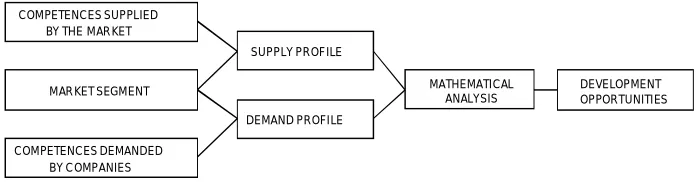
From verifying the offers on the market, we obtain the supply profile, which is characterized by the availability of competences that are related to each market segment or business area. Similarly, by verifying thoroughly the demand for the competences in the companies, we obtain the demand profile.
These profiles are, then, compared through a mathematical analysis that employs matrix operations, which results in an index matrix that represents opportunities for the development of competences for each market segment.
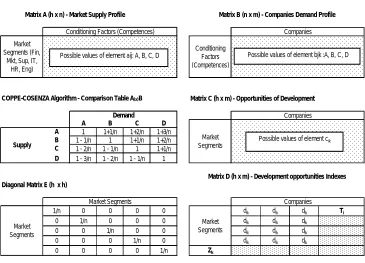
The scheme of the model is illustrated in Figure 2 below:
Figure 2: Scheme of the Model for Competences Hierarchization
Research
After developing the theoretical model, we dedicated the second part of this study to proving the feasibility of a practical application, through a field survey that was realized on the customer portfolio of DBM, career transition and talent development company, which took place in three stages.
MARKET SEGMENT
COMPETENCES DEMANDED BY COMPANIES COMPETENCES SUPPLIED
BY THE MARKET
SUPPLY PROFILE
MATHEMATICAL ANALYSIS DEMAND PROFILE
In the first stage, we attempted to identify, through several market studies that were available, the set of competences that were aligned with the three axes of the Triaxial Values Model (Dolan and Garcia) as conditioning factors of demand and supply, which have been verified on the Brazilian market. In the second stage, the primary data were collected on the basis of questionnaires that were filled out by companies and head-hunters. These data have been inserted into the composition of the primary matrices of the model. Finally, in the third stage, the model algorithms were tested, and we chose the algorithm that had the highest level of precision in the results.
Thirteen head-hunters and fifty-nine companies answered the questionnaire; among them are Alpargatas, Coca-Cola, L’Oréal, Globo, Mangels, Parker, Shell, Stiefel, Toyota, and Unimed. The distribution of the supply of competences by the
respective market segments or business areas is shown in figure 3 below:
Figure 3: Level of Competences Supply by Market Segment or Business Area
17% 18% 20% 21% 25%
32% 68% 66% 72% 59% 62% 56% 15% 16% 9% 20% 14% 12% 0% 20% 40% 60% 80% 100%
Supply Chain and Procurement Financial , Accounting and Tributary Engineering and Manufacturing Information Technology Human Resources Sales and Marketing Market Segments
Supply Distribution x Market Segments
C - Reduced B - Appropriate A - Excellent
Carvalho & Cosenza 9
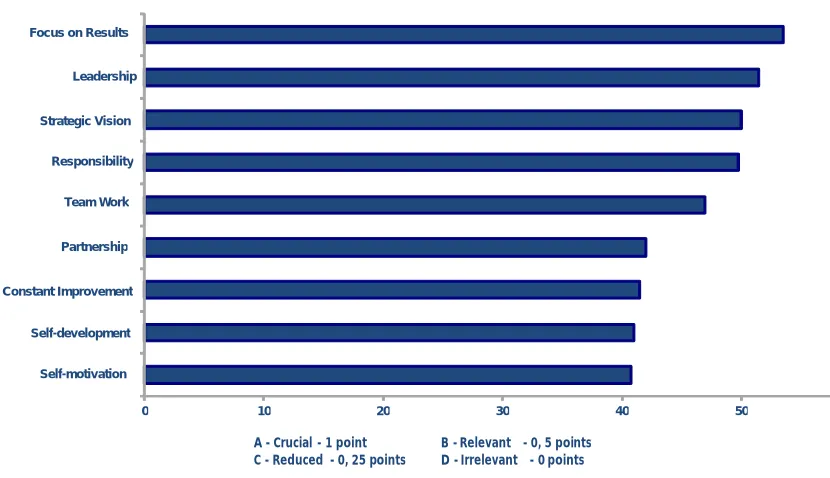
Regarding the companies’ demand for competences, we can say that Focus on Results Competence stands out in the ranking, in line with the “management intensity” approach, which is from Charan (HBPW/2009/03) in “Head in, hands on”, and from Goleman (HBR/2004/01) in “What makes a Leader?”, as shown in figure 4 below:
Figure 4: Competences Demand Level by Set of Companies
Application of the triaxial values model – Dolan and Garcia
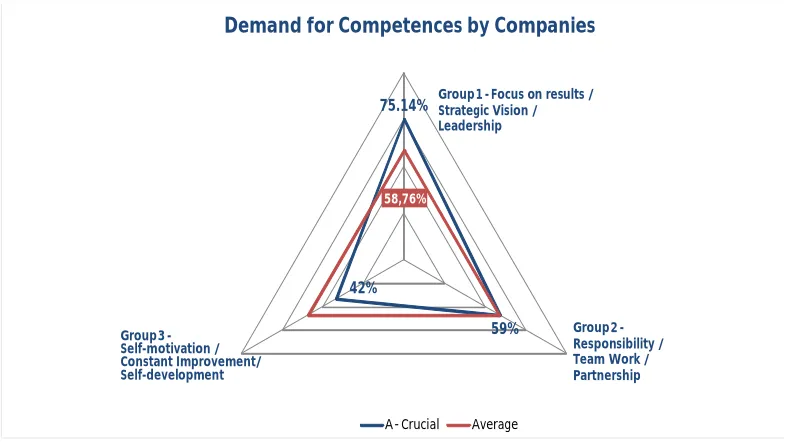
The results of this research makes it clear that there is some emphasis on Economical-Practical Competences, with 75% in relation to an average of 58.76%, followed by Ethical-Social Competences (59%) and Emotional and Developmental (42%), as shown in figure 5 below:
0 10 20 30 40 50 60
Self-motivation Self-development Constant Improvement Partnership
Team Work Responsibility Strategic Vision Leadership Focus on Results
Ranking of Competences
Figure 5: Companies’ Demand for Competences Aligned with Values
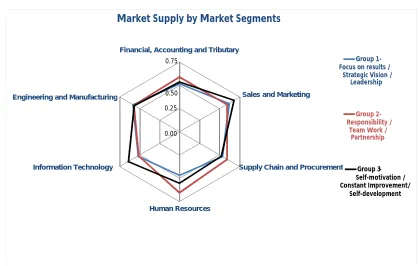
These groups of competences are aligned with values that can be verified in the market supply for each market segment. The HR segment has the lowest Economical-Practical Competences supply in the market and has some preponderance in Ethical-Social Competences. Sales/Marketing and IT segments stand out in the market supply in relation to the Emotional and Developmental Competences, as shown in figure 6 below:
75.14%
59% 42%
58,76%
Demand for Competences by Companies
A - Crucial Average
Group1 - Focus on results / Strategic Vision / Leadership
Group2 -Responsibility / Team Work / Partnership Group3
Carvalho & Cosenza 11
Figure 6: Market Supply for Competences Aligned with Values by Market Segments
Application of the COPPE/Cosenza Model
This model comprises a comparison of two matrices: the Supply Matrix of the type h x n, where h = the number of market segments (Financial, Accountancy and Tributary; Sales and Marketing; Supply Chain and Procurement; Human Resources; Information Technology; Engineering and Manufacturing), and n = the number of conditioning factors (competences), and the Demand Matrix of the type n x m, where n = the number of conditioning factors (competences) and m = the number of companies.
A scale of attributes is used for the Demand, where A = crucial, B = relevant, C = reduced, and D = irrelevant. As a scale for the Supply, we adopted A = excellent, B = appropriate, C = reduced and D = absent.
0.00 0.25 0.50 0.75
Financial, Accounting and Tributary
Sales and Marketing
Supply Chain and Procurement
Human Resources Information Technology
Engineering and Manufacturing
Market Supply by Market Segments
Group 1 -Focus on results /
Strategic Vision / Leadership
Group 2 -Responsibility / Team Work /
Partnership
Group 3 -Self-motivation / Constant Improvement/
The comparison follows the logic of a matrix product. However, instead of operating each product (aij x bjk), their values have been compared through a
comparison table that employs the COPPE/Cosenza algorithm, to determine the portions of the sums of the element (cik), obtaining in this way the results that are
used in the construction of the matrix of opportunities of competences development.
Indexes of this matrix indicate three possibilities. When an entry is equal to one (dik = 1), then the company (i) has its demand satisfied by the level that is offered
in the market segment. When the index is less than one (dik< 1), we know that at least
one of the factors that is demanded by the company has not been satisfied by the market segment. Finally, when the index is greater than one (dik> 1), then the market
segment offers more than what is required by the company.
Furthermore, we have two more indexes. One of the indexes is called Zk and
indicates how a company i is attended by the set of market segments. The other index is called Ti and shows how the set of companies are attended by the market segments.
The matrices that compose the model are shown in Figure 7 below:
COPPE-COSENZA Algorithm - Comparison Table A(x)B Matrix C (h x m) - Opportunities of Development
A B C D
A 1 1+1/n 1+2/n 1+3/n B 1 - 1/n 1 1+1/n 1+2/n C 1 - 2/n 1 - 1/n 1 1+1/n D 1 - 3/n 1 - 2/n 1 - 1/n 1
Diagonal Matrix E (h x h)
1/n 0 0 0 0 dik dik dik Ti
0 1/n 0 0 0 dik dik dik
0 0 1/n 0 0 dik dik dik
0 0 0 1/n 0 dik dik dik
0 0 0 0 1/n Zk
Companies
Companies Conditioning Factors (Competences)
Companies
Matrix A (h x n) - Market Supply Profile Matrix B (n x m) - Companies Demand Profile
Matrix D (h x m) - Development opportunities Indexes
Market Segments
Market Segments (Fin,
Mkt, Sup, IT, HR, Eng) Supply Conditioning Factors (Competences) Demand Market Segments Market Segments Market Segments
Possible values of element aij: A, B, C, D Possible values of element bjk :A, B, C, D
Possible values of element cik
Carvalho & Cosenza 13
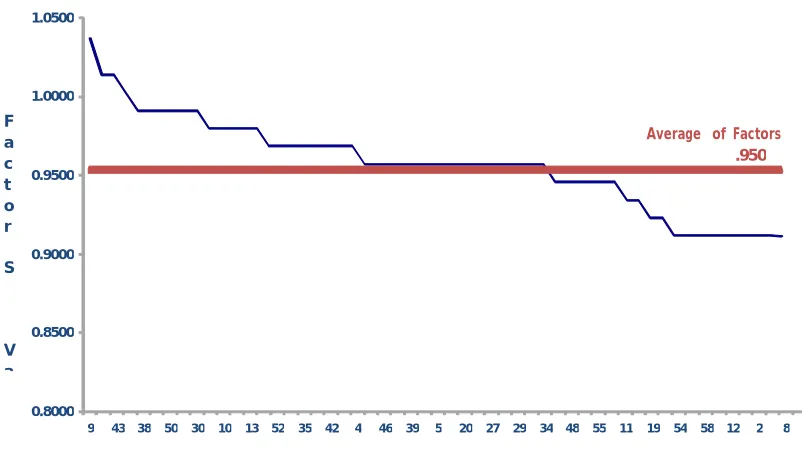
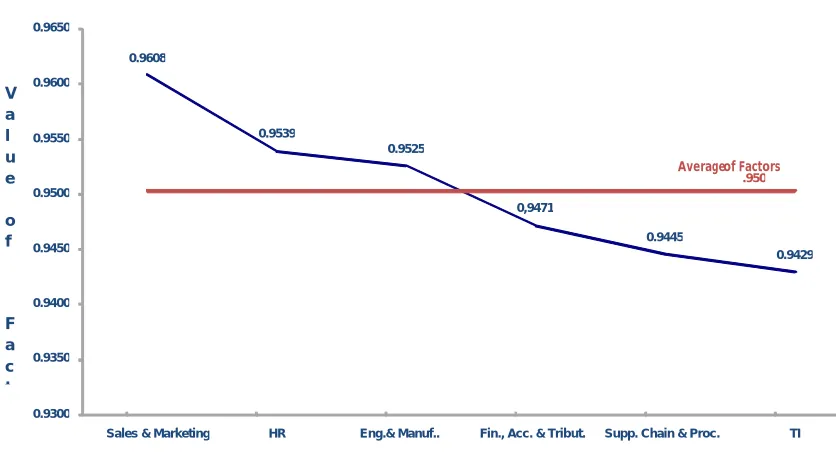
The results of the application of the model are shown in Figures 8 and 9, below:
Figure 8.: Indexes of Opportunity for the Development of Competences by Company
.950
0.8000 0.8500 0.9000 0.9500 1.0000 1.0500
9 43 38 50 30 10 13 52 35 42 4 46 39 5 20 27 29 34 48 55 11 19 54 58 12 2 8 24 37 59
Companies
Factors X Companies
39% Above the average - 27% On average - 34% Below the average
Average of Factors
F a c t o r
S
Figure 9: Indexes of Opportunity for the Development of Competences by Market Segment
Conclusions
In the application of the COPPE/Cosenza Model, only 5% of the companies register an index Zk > 1; in other words, 95% of the organizations present a demand
for competences that is above the market supply, with 39% of the companies staying above the average, 27% staying on the average and 34% staying below the average. This fact demonstrates a general necessity for investment in the development of competences. Among the most frequently demanded competences are those that are related to Economic-Pragmatic, which are Focus on Results, Leadership and Strategic Vision. The index Ti means that organizations must invest mainly in the development of competences in the segments/areas of Finance, Accountancy and Tributary, Supply Chain and Procurement and IT.
0.9608
0.9539
0.9525
0,9471
0.9445
0.9429
.950
0.9300 0.9350 0.9400 0.9450 0.9500 0.9550 0.9600 0.9650
Sales & Marketing HR Eng.& Manuf.. Fin., Acc. & Tribut. Supp. Chain & Proc. TI
Market Segments
Factors X Market Segments
Average of Factors
V a l u e
o f
Carvalho & Cosenza 15
With respect to the Triaxial Values Model (Dolan/Garcia), the demand for competences that are symmetric to the values has a strong predominance of Economic-Pragmatic competences, 75% compared to an average of 58.76%, while Ethical-Social competences stay on average.
Special attention is required for Emotional-Developmental competences (42%), which are below the average, because of the enhancement that these competences provide to innovation, learning and critical factors for the success of the organizations.
The search for an appropriate methodology to quantify the impact of the demand and supply of the competences has been motivated first by the will to contribute to decision-making support for companies, in the area of multicultural competences development. The employment of competences hierarchizing tools promotes a consistent way to choose the best economic alternatives for developing multicultural competences as a competitive advantage.
Additionally, this study can contribute to guiding companies’ investment policies, taking advantage of the knowledge of the set of factors that involve the supply of competences in the market and taking advantage of the demand factors by companies as well as comparisons with other companies.
References
Barrett, R., Building a values-driven organization: a whole system approach to cultural transformation, Butterworth-Heinemann, Boston, 2006.
Brillo de Carvalho, J., Hierarquização de Produtos e Serviços. Master Thesis, COPPE/UFRJ, Rio de Janeiro, 2000.
Charan, R. “Head in, hands on”, Harvard Business Publishing Newsletters, 2009/03.
Cosenza, C.A.N., Localização industrial: delineamento de uma metodologia para hierarquização das potencialidades regionais. COPPE/UFRJ, Rio de Janeiro, 1998. Dolan, S., Garcia, S. Gestão por valores. Rio de Janeiro: Qualitymark, Rio de Janeiro, 2006. Goleman, D., What Makes a Leader?, Harvard Business Review, 2004/01.
Prahalad, C. K., Hamel, G., The Core Competences of the Corporation, Harvard Business Review, 1990/05.