INTRUSION PROTECTION AGAINST SQL
INJECTION AND CROSS SITE SCRIPTING
Rutika Dhapte, Divya Nadanasundaram, Saif Shaikh, Chaitali Mankar,
Prof. Prashant Kumbharkar
Department Of Computer Engineering
Dr. D Y Patil School Of Engineering
Charoli(Bk), Via Lohgaon, Pune, Maharashtra 412105
Abstract: In this era where the internet is a part of our daily lives, data security in web applications has become very important. Web application vulnerabilities like SQL injection
and cross site scripting have become very prevalant. These attacks pose serious risks to
confidential database contents. The attackers scope web applications for vulnerabilities and
once detected exploit these vulnerabilities to their benefit. The attackers inject SQL
statements into the input fields of web application and get access to the application's
database. This allows them easy access to sensitive information and lets them modify the
database. Another form of attack i.e. XSS attack involves injecting malicious script into a
trusted website that executes on a visiting person's browser without their knowledge and
thereby making them vulnerable and enables the attacker to access confidential user data,
such as session tokens and cookies that are stored on the browser. Reverse Proxy is a
technique that we propose to prevent intrusion attacks through input fields by first sanitizing
the inputs of web application before being used by them. Once the input is checked and
deemed clean it is sent back to the web application for its intended usage. Thus the proxy
reduces the burden of the developer to incorporate security measures in the code and helps
them focus on creating an application with advanced specifications and leave the issue of
checking the inputs for attacks on the proxy server.
Keywords: Web vulnerabilities, SQL Attacks, XSS, Reverse Proxy
Journal homepage: www.mjret.in
1. INTRODUCTION
Many developers don’t realize that by leaving their websites vulnerable to security issues in
their code they may be making a hacker rich. Consider the example: The French company
Vupen develops and acquires zero-day vulnerabilities and does not make the vendors aware
of it. Instead, they share this information of theirs for their well-paying customers, Forbes
reported. At a certain point in 2012, according to X-Force research, SQL injection attacks
were the culprit for more than 50% of the data breach where the attack type had been made
available. While that number has decreased in 2015, it is still one of the major attack vectors
that are in use even now. It is no wonder that SQL injection is at the top of the two most
highly recognized lists of software vulnerabilities i.e. OWASP Top 10 and SANS Top
25.Almost every week, we get to hear about a new data breach in the news that reports to
us about major companies losing huge amounts of usernames, passwords, credit card
numbers, banking transactions i.e. sensitive data, after falling victims to a cyber attacks.
According to a recent report by Imperva on attacks on Web Application, SQL Injection (SQLi)
saw the biggest rise when being compared to last year with a typical web application
suffering 3 times more SQLi attacks. SQLi attacks are very common and stay in the top spot
in the OWASP Top 10. It was originally discovered and discussed about publicly during
1998. That is one reason why it can be called an ancient problem. Although SQLi flaws have
always been considered to be an easily fixable problem in web application security, they’ve
also been neglected or have gone unnoticed by many web developers. The issue we are
dealing with is the rising number of SQL injection attacks. Manual SQLi attacks are time
consuming and therefore can lead to scenarios where the attacker intercepts packets and
sends it different SQL payload – most hackers prefer automated tools to carry out their SQLi
attacks that will scan the application for SQLi vulnerabilities.A person also does not have to
be a coder to run these automated tools; it only requires to be given few set of commands to
initiate the attack on the target site.It is one of reasons why many “script kiddies” go for
automated SQLi tools.XSS vulnerabilities are definitely here to stay and not going away as
many attacks are getting more sophisticated and trickier to detect. The golden age of
penetration testing, when penetration testers could readily disclose XSS vulnerabilities just
by inserting malicious code into a search box, is over. Now it often takes more skill and effort
than that for them to discover the XSS vulnerabilities they need to protect against. In the
past several months, it has come to light that Yahoo and Facebook have patched two critical
XSS vulnerabilities. It clearly shows that XSS vulnerabilities continue to plague the modern
and mature web applications, even for the renowned Internet companies. The XSS
vulnerability in Yahoo email was pretty straightforward: the input validation was not robust
The one that was patched by Facebook was a little more trickier because it exploited a bug
which was in the file upload function to upload malicious JavaScript code and it then invoked
the code by calling it from a different application. Also, insufficient input validation XSS
vulnerability has been disclosed in the Word Press plug in Ninja Form. Letting third-party
libraries to encode input during the development phase and using a web application firewall
in the deployment phase fools web security managers into thinking that their web
applications are totally safe from Cross-Site Scripting (XSS) attacks. And while it is a good
idea to adopt these techniques, it could prove costly. These protection methods do not
actually guarantee that the developed web applications are 100% free of XSS vulnerabilities,
and XSS attacks that use more advanced techniques still occur, so when employing third
parties care should be taken.There are few types of XSS attacks that are difficult for
penetration testers and tools to discover. It is not easy to develop new techniques to fight
these, other than enhancing security implementation during the web development and
conducting regular security audits to make sure to catch any that were unknowingly included
in the code .As we have written attackers use attacks like SQL injection and Cross site
scripting which are one of the many attacks to exploit the vulnerabilities of websites and web
applications. Therefore in this paper we propose a defense mechanism against them. But
before devising a way to prevent these attacks we must have knowledge about these
attacks. Therefore we present a brief description on these attacks and their types in our
paper.
2. RELATED WORK
SQLrand [3 ] technique appends random token to SQL keywords in code of the application
thus creating random instances of the SQL query language, by randomizing the template
query inside the the database parser. D-randomizing proxy allows easy installation of their
solutions into existing systems, which converts randomized queries to suitable SQL queries.
A proxy server then checks that all keywords and operators have the token. If token is not
present then attacks can be recognised. The disadvantage is the token can be easily
guessed.The grammar that accepts only legal queries are checked at runtime in SQL Guard
and SQL Check [8 ] and [9]. It is used for detection of SQL injection attacks and marking
mechanism is used for differentiating suspected input. The structure of the query is checked
by SQL Guard before and after the addition of user-input.
In CANDID [5 ] technique , user input query structure is taken and attacks are guessed by
comparing it with the actual query .User given queries are mined by dynamically evaluating
runs over benign candidate inputs. This method is theoretically well established. A very
AMNESIA [7] combines static analysis and runtime monitoring. In static analysis model is
constructed by various queries which can be created by application at database’s access
point. They intercept the queries before sending them to the database and checking is done.
In dynamic phase ,queries that violate the model are not allowed to access the database. The
drawback of this technique is it is dependent on its static analysis for building accurate query
models.
The required syntactic structure of SQL statements are developed by SQLIDS[11] for
security purpose. SQL statements that does not match the specifications are blocked from
there execution. Specifications are most important in SQLIDS technique. Specifications are a
set of rules that illustrates the expected structure of SQL statement. The original SQL
statement is executed in the back end database. The specification is created by the syntactic
structure Interception of SQL statements. Filtering is done and the SQL statements produced
by the application are not directly sent for execution to the database. Assumption based
detection of injected SQL statements id done. Therefore, if the intended structure of the
expected SQL commands has been mentioned previously then it becomes easy to detect
malicious alterations of this structure.
For detection and prevention of SQL Injection attacks in database using web services,
XPATH authentication Technique [2] is used. The login page is redirected to their checking
page. In this technique two modules are used i.e. Active Guard and Service Detector. Active
Guard, is used as to detect and prevent characters that are suspicious. The validated user
input is sent to the Service Detector. SOAP protocol (Simple Object Access Protocol) is used
to send the user input to the web service. The user input data is compared with
XML_Validator. If the data is matched, the XML_Validator sets a flag value to 1 to Service
Detector and valid user can access the web application. If the data is not matched, the flag
value is set to 0 and invalid user cannot access the web application. The Service Detector
filtration model validates user input from XPATH_validator where the private data is stored.
Comparison of user input with data in XPATH_validator is done and if it is same then
authorized user is allowed for further processing. Direct access to the database is not allowed
by Web Service Oriented XPATH Authentication.
SQLProb [6] is a new approach. In this technique the extracted user input data in syntactic
structure of the query can be evaluated. Source code of the application or the database is not
required. Also the system can be easily deployed on the any environments without
modifications. The SQL proxy-based Block (SQLProb) system has four main components i.e.
validator. The query collector is collection phase where all the queries are processed. The
user input extractor implements a global pair wise alignment algorithm to identify user input
data. Then the parse tree for the queries are generated. The User Input Validator checks the
user input whether it is malicious or not by using the user input validation algorithm. SQLProb
is used in two phases i.e. the data collection phase and the query evaluation phase. In the
data collection phase, queries are collected by user input validator and are saved. In the
query evaluation phase, when a query is given to proxy it is forwarded to the user input
extractor and the parse tree generator simultaneously. Reasonable performance overhead is
achieved making the system ideal for environments where software or architecture changes
are not considered.
A client side technique includes Detecting malicious JavaScript code in Mozilla[13]. Mozilla
Firefox web browser is required. All user input is intercepted and logged by the auditing
system. Audit system is created for JavaScript code execution for detection of vulnerabilities
in browsers like Spider Monkey and Mozilla Firefox. The auditing system continuously checks
the implementation of JavaScript . At the time of execution of JavaScript, various function
retracts are registered in the JavaScript engine. These are used when a malicious script tries
to access specific information that does not exist in the JavaScript engine.
For detection of cross site scripting attack vulnerabilities [14] in the web applications a multi
agent scanner is used. Thus multiple agents can operate the system individually. Source
code is not required. The system has three modules – web page parser agent, script injector
agent and verificator agent. Web page parser agent explores the injection point of stored XSS
attack in the web site. The parsing process retrieves information from the web pages it visits
and searches the web site following the hyperlinks it finds. There are two different
characteristics than the web crawler. First, it follows the hyper-links, targeting the scanned
web sites. Second, the information which we get are the forms which are main points for the
attacks. Links containing parameters are not stored as entry points as they are not used to
insert new information hence they cannot be used for stored XSS attacks. Script injector
agent uses collection of web pages discovered by the web page parser agent. In the attack
list, different attacks gets listed. The agent injects a set of XSS attack vectors into the various
input fields of all the injection points. The next module is verificator agent, it uses the
performed attacks list of script injector agent and analyses the application. Input validation
errors are checked by this module.
Cross-Site Scripting Prevention with Dynamic Data Tainting and Static Analysis [15] states
Dynamic recording of sensitive data is done when scripts are running. When malicious data is
being transferred to a third party then avoiding it by logging, preventing the transfer and
stopping the program with an error can be done. Dynamic taint and static analysis module are
developed for recording the sensitive data in the web browser and intrusion prevention
against cross site scripting attack. When the cookies of user is about to be transferred to a
possible attacker, the user can stop the connection. Based on automatic browsing, validation
of different technique can be done.
Internet Explorer and Google Chrome have built-in XSS filters. Firefox has a plug-in called
Noscript which blocks scripts on all domains. It also uses regular expressions to detect and
encode malicious data in URL. IE8's filter [16] uses regular expressions (called heuristics) to
identify XSS attack vectors. The HTTP request are first scanned and then checked whether it
matches the heuristics or not. If matched, then it creates a signature. The response is
scanned to search for scripts that matches with such signatures. For each matching script, a
matched character is replaced by another character in order to prevent execution is such
script.
Chrome's filter called XSS Auditor [17]mediates between the HTML parser and the JavaScript
engine. Only the intercepted part is examined. A script is delivered to the JavaScript engine
only if it does not match script found in any input parameter. Chrome filter fails to prevent
partial script injection. XSSFilt [18 ] is similar to XSS Auditor, but has fewer false negatives as
it does not check exact string matching .It goes for approximate matching which acts as a
drawback.
Stephen W. Boyd and Angelos D. Keromytis [19] in year 2004 proposed an approach based
on Instruction Set-Randomization. In this technique, the predefined SQL keywords are
changed by adding any integer between them before they are sent to the database. Integers
are added in such a way that attackers are not be able to guess but can be recognised by the
database. To overcome this problem, a proxy is developed which decodes keywords into
original data before giving it to the database server. There is negligible performance
overhead found but this method is capable of detecting only tautology type of SQLIA.
Russell A. McClure and Ingolf H. Krüger [20] in year 2005 proposed an approach, based on
the concept of Object Oriented Programming. Their solution consists of an executable
Sqldomgen which is executed against a database. The output generated by sqldomgen is a
Dynamic Link Library (DLL), containing classes which are strongly typed . These classes are
called as SQL Domain Object Model (SQL DOM). With the help of this a developer can make
by object data model and then the schema of the database is generated automatically. Next ,
the tables and columns contained in the schema are iterated and output is generated. Output
developed are the number of files containing a strongly typed instances of the abstract object
model. This approach detects the attack in the code at compile time.
William G.J. Halfond and Alessandro Orso [21 ] in 2005, proposed a technique, which uses a
Model-based Approach (AMNESIA).It is used to detect illegal queries before they get execute
on the database. AMNESIA is based on both static and dynamic analysis of queries. Using
runtime monitoring static queries are compared with dynamic ones. It identifies the spot in
SQL query and then design a SQL query model in order to compute the values of query string
given to a database. When Hotspot is reached, then the runtime monitoring starts. If the
query is compatible with the model, query gets executed. This method detected 1470 attacks
performed for 3500 legitimate accesses to the applications.
Shaukat Ali, Azhar Rauf, Huma Javed [22] gave a method in year 2009. Hash values of
username and password for authenticating users to the database is done in this method to
protect it against SQLIA. These hash values for username and password are generated
automatically when the user enters into database. Authentication of a user is done by his
username, password and hash values for username and password. The time overhead of the
approach is too small and is 1.3 milliseconds. But this method detected only tautology type
SQLIA.
Rattipong Putthacharoen, Pratheep Bunyatnoparat [23] in 2011 uses the method of rewriting
the cookies. In this method we have to make the cookies useless for XSS attacks. A proxy
agent between user’s browser and web server is used, which changes the value of name
attribute in the cookies field. The returned cookies are again written at original value before
being forwarded to web server. Now even if attackers steal cookies from the database, they
cannot be used to get correct user information. The tool detected both categories of XSS
attack without having any changes made at the client and server site. But the proxy failed to
intercept https requests coming from the client.
SQLGuard [12] and SQLCheck [8] checks the queries at runtime .Taint based approaches
like the WebSSARI [24] detects input-validation related errors using information flow analysis.
In this approach, static analysis is used to check taint flows. Livshits and Lam [25] use
information flow technique to detect when tainted input has been used to construct a SQL
Security gateway [26] is a proxy filtering system. It applies input validation rules on the data
which is sent to a web application. SQLRand [12] is an approach based on instruction-set
randomization. Queries are developed using randomized instruction and not normal SQL
keywords. A proxy-filter intercepts queries to the database and keywords are de-randomised.
David Litchfiled [27], introduced techniques to determine the structure of the database
application using SQL injection. Chris Anley [28 ], has stated ‘the various ways in which SQL
can be 'injected' into the application and noted few data validation and database lockdown
issues that are related to this class of attack’. In his other work “(More) Advanced SQL Injections” [28] explains that time delays can be used as transmission channels for accessing
data.
Cesar Cerrudo [29], in his white paper demonstrates ‘how an attacker could use a SQL
Injection vulnerability to retrieve the database content from behind a firewall and penetrate
the internal network’. Ofer Maor and Amichai Shulman [30], in their paper, show that SQL
Injection could be performed even without any detailed error messages from the server. Ofer
Maor and Amichai Shulman [31] in their paper gave report of all the techniques used to
manipulate SQL Injection signatures. Signatures are standard forms in which an SQL
manipulation could be done. It is basically done to dynamically change the meaning of the
query in the application. They give an overview of all the signatures used to protect the server
from SQLIA and its techniques.
3. SQL ATTACKS
An SQL Injection Attack (SQLIA) takes place when an attacker changes the intended effect
of a SQL query by inserting new SQL keywords or operators into the input. Now, we define
two important characteristics of SQLIAs that for describing attacks: Injection mechanism and
Attack intent.
3.1 INJECTION MECHANISMS
It describes the various ways through which we can introduce malicious Sql query into
vulnerable web application. Below we explain the most common mechanisms.
1) Injection of malicious statement through user input
2) Injection of malicious statement through cookies
3) Injection of malicious statement through server variables
3.2 ATTACK INTENT
It explains the various intents for which the attacker attacks the application. Some of the
1) Extracting data
2) Adding or modifying data
3) Evading detection
4) Bypassing authentication
5) Executing remote commands
6) Performing privilege escalation
3.3 SQLIA TYPES
Given below are the types of Sql attacks.
1) Tautologies
2) Illegal/Logically Incorrect Queries
3) Union Query
4) Piggy-Backed Queries
5) Stored Procedures
6) Inference
7) Alternate Encodings
Readers who are interested can refer [2] for further in depth explanation on the Sql attacks.
4. CROSS-SITE SCRIPTING
XSS attack can be of three types persistent or non-persistent, or it can be based on a
document object model (DOM).
1) Persistent XSS
2) Non persistent XSS
3) DOM-based
Readers who are interested can refer [32] for further in depth explanation on the Cross site
scripting attacks.
5. PROPOSED WORKFLOW
As we have explained earlier many websites suffer from SQL injection and cross site
scripting attacks. Not many developers take care to make their code secure and their
applications becomes vulnerable. There are developers that prefer to concentrate on
developing their applications and not on the security aspects making them an easy target for
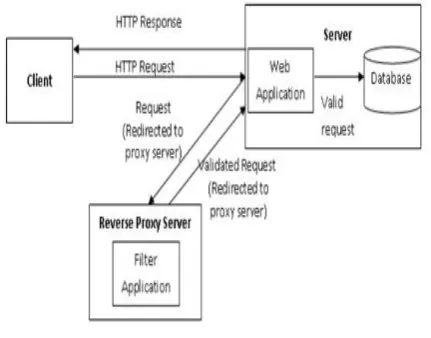
attackers. Therefore we propose a Reverse Proxy Server which will take care of the security
aspect of the web application. The application only has to redirect their user inputs to the
intercepted using a HTML filter and after encryption they are sent to the reverse proxy server
for sanitization and to make sure they are clear of any intended attacks. Once the proxy
checks it, it will either deem it clean and redirect it to the application for further use or discard
it on finding any malicious attacks that might compromise the application. A more detailed
description of the modules of the reverse proxy server is given below.
1. SQL Injection Detector
2. Cross-site Scripting Detector.
The general work of the system is as follows:
1. The client sends the login information to the bank.
2. The request is redirected to the reverse proxy.
3. The filter encrypts the user data using theAES Algorithm.
4. The reverse proxy server decrypts the user data.
5. It performs checks to check whether the data is valid or not.
6. The reverse proxy server gives the access to the account only to the legitimate users.
7. Else the user is denied access.
Fig 1. Proposed Workflow
5.1 AES Algorithm
Encryption Procedure:
You take the following AES steps of encryption for a 128-bit block:
1. Derive the set of round keys from the cipher key.
2. Initialize the state array with the block data (plaintext).
3. Then we have to add the initial round key to the starting state array.
5. Perform the tenth and final round of state manipulation.
6. Copy the final state array out as the encrypted data (This is cipher text).
Each round of the encryption process will require a series of steps to alter the state array.
These steps involve four types of operations called:
1. Sub-Bytes
2. Shift-Rows
3. Mix-Columns
4. Xor-Round Key
Sub-Bytes: This operation is a simple substitution that converts every byte into a different
value.
Shift-Rows: As the name suggests, Shift-Rows operates on each of the row of the state
array. Each of the rows are then rotated to the right by a certain number of bytes as follows:
1st Row is rotated by 0 bytes ( this row remains same)
2nd Row is rotated by 1 byte
3rd Row is rotated by 2 bytes
4th Row is rotated by 3 bytes
Mix-Columns:
This operation is the most difficult, both to explain and perform.Each column of the state
array is then processed individually to produce a new column.The produced new column
replaces the old one. The processing procedure involves a matrix multiplication.
Xor-Round Key:
After the Mix-Columns operation, the Xor-Round Key is very simple and will hardly need its
own name. This operation takes the existing state array, then XORs the value of the
appropriate round key, and replaces the state array with the result. It’s done once before the
rounds start and then it's done once per round, using each of the round keys in turn.
Decryption Procedure :
As you might expect, decryption involves reversing all the steps taken in encryption using
inverse functions:
1. InvSub-Bytes
2. InvShift-Rows
3. InvMix-Columns
1. Operation in decryption is:
● Xor-Round Key
● InvShift-Rows
● InvSub-Bytes
2. Perform nine full decryption rounds:
● Xor-Round Key
● InvMix-Columns
● InvShift-Rows
● InvSub-Bytes
3. Perform final Xor-Round Key
The same round keys are used in the same order.
5.2 Script Detector
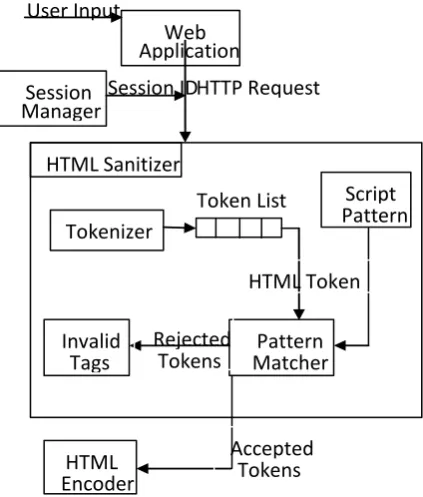
Script detector is used to detect the malicious script embedded in the web application.
Sanitization process is done which removes all the invalid and unwanted tags,then
encodes the remaining input into simple text to avoid any malicious script.
HTMLSanitizer:
HTML Sanitizer removes unsafe tags. It takes a string with HTML code and strips all the
treatment to remove URLs that trigger JavaScript code execution and line breaks.HTML
string in tokens are handled by HTML tokenizers.
Tokenizer:
Tokenizer divides the HTML text within user input into tokens. A token is a single atomic
unit of supplied text. As a result of this a list of tokens will be created, and every token in
this list is matched with the forbidden tags. Then the HTML Sanitizer forward’s the user
request to HTML Encoder.
HTMLEncoder:
The Html Encode method is useful for displaying text that contain "special" HTML
characters such as quotes, angular brackets and other characters by the HTML
language. List of some of these special characters and their equivalent encoded value is
given below which is used by the HTML Encoder to encode the input.
Special
Characters
Equivalent
Encoded value
“ {double quote} "
'{apostrophe /
single quote }
'
& &
< <
> >
{space}
{tab} &n
bsp
ScriptPattern:
This contains all the tags and patterns that are used to match with the tokens which are
formed by the tokenizer.
PatternMatcher:
It just takes the input from the list of tokens and match them with the Script Patterns. All the
tags that are rejected are stored in the invalid tags list and all the tags are accepted are
Fig. 2 Block diagram of Script detector
5.3 Query Detector
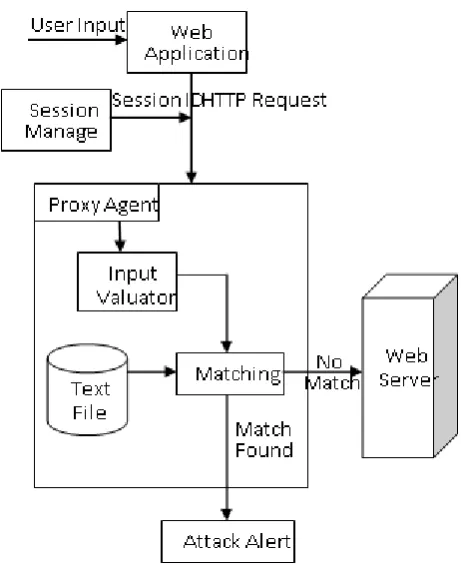
A Query Detector is a simple tool which is used to test the precision of SQL Queries. It
takes request coming from any user and validates the request .
Session Manager:
When HTTP request goes to the web server and the session remains in the active state
until the connection is active. As soon as the connection is terminated the session will
also terminate accordingly.
Input Valuator:
Any request going on the web server is first validated at the Input_Valuator. It has some
stored special characters (e.g. ' - ;) which are often used in writing malicious code for SQL
Injection attack. It matches user data in HTTP request with the stored characters. If no
pattern is matches with those that are in storage then the request is treated as valid and
is forwarded to the next module.
User Input
Session ID HTTP Request
Fig. 3 Block diagram of Query detector.
The next module means it will be given back to the application if it is valid otherwise it will be
discarded.
6.
CONCLUSIONIn this paper, we have discussed various methods for detection and prevention of SQL
injection attacks and Cross site scripting attacks in brief. The goal of the proposed Reverse
Proxy is to handle the security issues of a web application. The reverse proxy framework for
intrusion prevention uses sanitization technique for discovering SQLIA and XSS attacks. The
system will be very effective in detecting and preventing the attacks from intruding the web
application. With the help of SQL injection preventer module and Cross site scripting
preventer module, we can protect web application against the SQLI and XSS attacks.
Reverse proxy prevents the malicious script without making any changes to the source code
of the web application. It uses AES encryption while sending the confidential user data to the
reverse proxy server, thereby keeping the sensitive information safe from hackers.
ACKNOWLEDGEMENT
We would like to express our gratitude to our internal project guide Prof. Prasanth
Kumbharkar and H.O.D Prof. Soumitra Das for giving us an opportunity and providing us
REFERENCES
[1] Stephen W. Boyd and Angelos D. Keromytis, “SQLrand: Preventing SQL Injection Attacks,” Applied
Cryptography and Network Security (ACNS) Conference, LNCS 3089, 2004
[2] W. G. J. Halfond, et al., “A Classification of SQLInjection Attacks and Countermeasures,” IEEE
International Symposium on Secure Software Engineering, Arlington, VA, USA, 2006
[3] IndraniBalasundaram 1 Dr. E. Ramaraj, “An Approach to Detect and Prevent SQL Injection Attacks in
Database Using Web Service”, IJCSNS International Journal of Computer Science and Network
Security, January, 2011.
[4] ShaimaaEzzatSalama, Mohamed I. Marie, Laila M. El-Fangary&Yehia K. Helmy, “Web Anomaly Misuse
Intrusion Detection Framework for SQL Injection Detection”, International Journal of Advanced
Computer Science and Applications,2012.
[5] VeeraVenkateswaramma P, “An Effective Approach for Protecting Web from SQL Injection Attacks”,
International Journal of Scientific & Engineering Research, Volume 3, 2012.
[6] Anyi Liu, Yi Yuan, DumindaWijesekera, “SQLProb: A Proxy-based Architecture towards Preventing SQL
Injection Attacks”, SAC’09, Honolulu, Hawaii, U.S.A, 2009.
[7] William G.J. Halfond and Alessandro Orso “Preventing SQL Injection Attacks Using AMNESIA,” ICSE’06, Shanghai, China, 2006.
[8] Zhendong Su, Gary Wassermann,” The Essence of Command Injection Attacks in Web Applications”,
Charleston, South Carolina, USA, 2006.
[9] Gregory T. Buehrer, Bruce W. Weide, and Paolo A. G. Sivilotti, “Using Parse Tree Validation to Prevent SQL Injection Attacks”, Lisbon, Portugal, 2005.
[10] Anil Kumar Mandapati, Adilakshmi. Yannam, “Web Application Vulnerability Analysis Using Robust SQL Injection Attacks”, International Journal of Engineering Trends and Technology, 2012.
[11] KonstantinosKemalis and TheodorosTzouramanis, “IDS: A Specification-based Approach for
SQL-Injection Detection”, Fortaleza, Ceará, Brazil, 2008.
[12] Gregory T. Buehrer, Bruce W. Weide, and Paolo A. G. Sivilotti, “Using Parse Tree Validation to Prevent SQL Injection Attacks”, Lisbon, Portugal, September-2005.
[13] OysteinHallarakar and Giovanni Vigna, “Detecting Malicious JavaScript code in Mozilla”, IEEE
International Conference on Engineering of Complex Computing System(ICECCS), 2005.
[14] E. Galan, A. Alcaide, A. Orfila, J. Blasco, “A Multi Agent Scanner to Detect Stored XSS Vulnerabilities,”
IEEE, ICITST, 2010.
[15] P. Vogt, F. Nentwich, N. Jovanovic, C. Kruegel, E. Kirda, G. Vigna, “Cross Site Scripting Prevention with Dynamic Data Tainting and Static Analysis,” Network and Distributed System Security Symposium,
2007.
[16] David Ross. IE 8 XSS Filter Architecture/Implementation.
blogs.technet.com/srd/archive/2008/08/19/ie-8-xss-filter-architectureimplementation.aspx.
[17] Daniel Bates, Adam Barth, and Collin Jackson. “Regular expressions considered harmful in client-side XSS filters” WWW‟10, Raleigh, North Carolina USA, 2010
[18] R. Pelizzi and R. Sekar “Protection, usability and improvements in reflected XSS filters” Proc. of the 7th ACM Symposium on Information, Computer and Communication security, ASIACCS‟12, Seoul, Korea
[19] S. W. Boyd and A. D. Keromytis. SQLrand: Preventing SQL Injection Attacks. In Proceedings of the 2nd Applied Cryptography and Network Security Conference, pp 292–302, June 2004
[20] R.A. McClure, and I.H. Kruger, "SQL DOM: compile time checking of dynamic SQL statements,"
Software Engineering, 2005. ICSE 2005. Proceedings. 27th International Conference on, pp. 88- 96,
15-21 May 2005.
[21] William G.J. Halfond, Alessandro Orso, “AMNESIA: Analysis and Monitoring for NEutralizing SQL-Injection Attacks”, ACM-05 USA, November 7-11, 2005, pp 174183 Long Beach, California.
[22] S. Ali, SK. Shahzad and H. Javed, “SQLIPA: An Authentication Mechanism against SQL Injection,”
European Journal of Scientific Research ISSN 1450216X Vol.38 No.4 (2009), pp 604-611.
[23] Rattipong Putthacharoen, Pratheep Bunyatnoparat, “Protecting Cookies from Cross Site Script Attacks
Using Dynamic Cookies Rewriting Technique”, ICACT 2011 pp 1090-1094
[24] Y.Huang, F.Yu, C. Hang,C.H. Tsai, D.T.Lee and S.Y.Kuo, (2004) “Securing Web Application Code by
Static Analysis and Runtime Protection”, Proc. International World Wide Web Conference ’04, pp. 40-52.
[25] V.B. Livshits and M.S. Lam, (2005) “Finding Security Errors in Java Programs with Static Analysis”, Proc. Usenix Security Symposium ‘05, pp. 271-286.
[26] D.Scott and R.Sharps, (2002) “Abstracting Application-level Web Security”, Proc. International Conference on the World Wide Web ‘02, pp. 396-407.
[27] David Litchfield, (2001) “Web Application Disassembly with ODBC Error Messages,” Blackhat group,
White Paper.
[28] Chris Anley, (2002) “Advanced SQL injection in SQL server applications”, Next Generation Security
software Ltd., White Paper.
[29] Cesar Cerrudo, (2002) “Manipulating Microsoft SQL Server Using SQL Injection”, Application Security
Inc., White Paper.
[30] Ofer Maor and Amichai Shulman, (2002) “Blindfolded SQL injection”, Imperva Inc., White paper.
[31] Ofer Maor and Amichai Shulman, (2003) “SQL injection signature evasion”, Imperva Inc., White paper.