Energy Efficient Secure Routing Protocol
(EESRP) in Wireless Sensor Network
Manoj Mehra Poonam Dabas
M. Tech Student Faculty
Department of Computer Science & Engineering Department of Computer Science & Engineering U.I.E.T, Kurukshetra University, Kurukshetra, Haryana,
India
U.I.E.T, Kurukshetra University, Kurukshetra, Haryana, India
Abstract
Wireless sensor networks (WSNs) consisting of various sensor nodes which are distributed autonomously over the network. These sensor nodes can sense, measure and collect information from the environment. Every sensor node is having its own energy source and it is non-rechargeable battery. Therefore the network must be designed in such a way that they can be able to make use of energy source in an efficient manner. These information are sometime very confidential and need to be secured e.g. in military applications. So, the security model of the network must be efficient enough to provide security in the same. In this paper, we have presented an Energy Efficient Secure Routing Protocol. This scheme introduces a new concept of „status‟ for each cluster formed. The lower status means the cluster is at a farther distance from the base station. To prevent attacks on data during transmission, every transmission of data is preceded by sending of a check packet to the destination. Proposed scheme reduces the intra-cluster communication distance. Simulation shows that proposed scheme has better energy efficiency than EECHS scheme.
Keywords: wireless sensor network, energy efficient, secure routing, malicious node detection
_______________________________________________________________________________________________________
I.
I
NTRODUCTIONWireless sensor networks (WSNs) consisting of tiny and light weighted sensing devices, dispersed over a specific target area, which is used to monitor physical or environmental conditions (e.g. pressure, temperature and sound).These information are passed among various sensors in the network to reach sink node, which will further send these information to user through internet shown in Fig. 1. Applications of wireless sensor network are industrial, military, health and commercial applications. [16] The key challenge in sensor networks is extending longevity of the network, as it is impossible to replace batteries of thousands of sensor nodes. The energy requirement is one of the major constraints while working with wireless sensor networks. Energy is dissipated mainly because of the communication between nodes which includes the transfer of messages between the nodes present in the network. Sometime malicious nodes enters into the network and become a part of it by showing a fake identity, the network must be designed in a way that are capable enough to prevent itself against these kinds of attacks. Here, we are dealing with malicious node detection where attacker node drop all the packets like in packet drop/black hole attack. [15]
Fig. 1: Typical wireless sensor network [1]
this way, the distance of intra-cluster communication of the nodes decreases, which makes it much more energy efficient than LEACH. Border area are distant by some partitioning distance 'd' from the boundary of the field, remaining inside area is known as Inner Area. Cluster Head is always close to the center of the cluster, as only inner area nodes are eligible to be participate as a cluster head. This will increase the lifetime of the border area nodes.
This scheme is facing the following issues which decrease its performance on being deployed in the network. Only inner area nodes can participate as cluster head of the network. If all the inner nodes were dead, the border nodes become isolated because of no cluster head. This will decrease the lifetime of the network. Constant broadcasting of messages (transfer of messages between the nodes) also adds up some extra energy requirement in the network. This scheme follows single hop network. So, the proposed work of EESRP protocol is to make the desired improvements in the EECHS scheme and also make the system more secured from various types of attacks.
II.
R
ELATED WORKIn [9] the modified algorithm of LEACH chose the first cluster head node on the basis of its location and it must satisfy minimum threshold energy of the cluster. The proposed scheme is much more energy efficient as compared to LEACH. C-LEACH [14] uses a concept of "adoption" of isolated neighboring nodes which made cluster reformation and enhancement in the lifetime of the network than the traditional LEACH algorithm. This scheme followed multi-hop routing network.
In the presented protocol iLEACH [14], dissipation of energy was controlled to some extent enhancing the lifetime of network. The simulation results have shown that the energy distribution amongst the sensing devices were good. First Node Dies (FND) and half of the Nodes Dies (HND) are the metrics used for comparing the proposed scheme with the LEACH.
In LEACH-SM protocol [7], a spare selection phase was added to LEACH. During this phase, each node is having power to decide whether it should become a spare node (go asleep) or an active node. The spare ones were awakened when the primary node's energy is below threshold. This scheme reduced the energy consumed by cluster head, as they don't have to receive messages from the spare nodes which overall increased the lifetime of the power source. EER method was developed in [2]. In this scheme, all the sensor nodes are arranged in an efficient tree structured routing path. Sub tree nodes chose as cluster head. A Child node sends data to its root node which collects and aggregates it. This data was aggregated to the base station with an efficient tree structured routing path.
[15] Proposed a scheme to identify black hole attack and provides a better security model to increase the successful delivery of data or messages to the BS. Sometimes confidentiality of data is our main concerned in WSN. Malicious node can easily re-program or tamper raw data, if there is poor security model in the network.
In [4] combination of relay nodes with the location of sink increased the prolonging lifetime of the network. An algorithm named PSO was used to locate the position of sink. [5] Shows us various Energy efficient clustering algorithm for WSNs, in which main focus is on maximizing the network lifetime due to limited power source. This paper also presented a comparative study amongst different LEACH descendant.
[3] Introduced a probability of failure to the target coverage problem to improve and control the system reliability, without not much sacrificing the energy constraints. This paper also overcomes the problem of maximum sensor covers by the network. In Modified QoS [6], dynamic clustering protocol was controlled by base station. This proposed scheme shows convincing results than existing conventional techniques.
En-LEACH [11] produces an energy efficient way of collecting information about the environment. All the cluster members are aware about the energy left in its cluster head, which helps in finding the probability of failure of cluster head during the data transmission. Its simulation results show better results than LEACH. This paper [12] presented a scheme which reduces the amount of energy consumed by the sensing device. This is done by the distribution of equal load balance in the network. This scheme did it and showed better results than LEACH. In the proposed scheme [8], the base station collects the information regarding location of the nodes (logical structure of the network) and then on the basis of that information clusters were formed by the base station. In SEECH formation of cluster heads were assisted by BS rotation of cluster heads were performed.
III.
P
ROPOSED SCHEMEAn Energy Efficient Secure Routing Protocol is developed to efficiently utilizing the energy in a secured manner. The proposed algorithm is used to remove the drawbacks of the previous algorithms and compare it with the already existing centralized hierarchical routing protocol. This algorithm extends the lifetime of the network and consumes less energy. Additionally it detects the presence of any malicious nodes in the network. The algorithm demonstrates the change of states undergoing in the network and how the energy level of each node changes with time. It shows the number of nodes dead in each round and energy consumed in each round. The proposed algorithm is as follows:
EESRP Algorithm A.
Phase 1: Initiation Phase 1)
1) Initialize Simulation Parameters.
do=sqrt(Efs/Emp); 4) Find maximum rows and maximum columns in the network field.
cols= width/do; rows=height/do;
5) Define cols*rows clusters in the shape of a grid and find center point of each cluster and assign cluster number on each node based on its position on field.
6) Repeat steps 7 to 12, rmax times (maximum rounds).
Phase 2: CH Selection Phase 2)
7) Find average energy of each cluster.
8) Find node in each cluster having energy greater than average energy and which is at nearest average distance from other nodes of the cluster. Designate this as a cluster head.
9) Choose a random set of nodes in network to participate in current round. Find sets of all cluster heads of these nodes. Find cluster heads lying between each of these heads and base station.
Phase 3: Attacker Node Detection Phase 3)
10) Send a check packet from each node to its cluster head and then from cluster head to intermediatory cluster heads between itself and base station. The Receiver node send check packet back to receiver.
11) If check packet is not returned then node sends the information of the cluster head being a faulty node to all the neighboring nodes in its cluster.
Phase 4: Energy Dissipation Phase 4)
12) Reduce Energy of each participating node and participating cluster heads. Check for Nodes with, E<=0. Plot these nodes as dead nodes.
13) Plot number of nodes dead in each round versus number of rounds. 14) Plot energy dissipated each round to round.
IV.
R
ESULT AND ANALYSISThe analysis of the proposed system is done using MATLAB. The performance of the proposed system is estimated by comparing it with the already existing technique for the detection of the attacker node at the first stage. The main motive of the work is to compare the two systems on the basis of their energy conservation and security requirement on being deployed in the network. In a network, the major part of the energy of a network depends upon the selection of cluster head and energy dissipated by the attacker node. So the results are evaluated on the basis of two parameters: Rate of Energy Consumption and Number of Secured nodes.
In this section, proposed scheme (EESRP) and EECHS are simulated in MATLAB for comparison of energy efficiency, security enhancement and node death scenario. A sensor network topology of 100 by 100 m2 area having 100 nodes is considered. Base station is located inside the field at the center (50, 50). Initial energy of each node is 0.05 Joules shown in Table 1.1. Here partition distance 'd' is at 10 m. So the proposed scheme outperforms the energy efficiency of EECHS.
Performance Evaluation A.
The simulation results are shown in the form of tables and various comparison graphs. The comparison is made between the number of nodes and number of rounds. Table 1.2 shows the comparison between the proposed scheme (EESRP) and EECHS scheme. Here number of rounds in which different percentage of node is dead. Here initial energy is taken as 0.05 Joule.
Table 1.1:
Showing different parameters of this proposed system (EESRP scheme) Sensor Network Dimension 100 x 100 sq. mt.
Base Station Location 50,50
Initial Sensor Energy 0.05
Transmission Power(etx ) 50x10-9 Joule
Reception Power(erx ) 50x10 -9
Joule
Sleep Power(efs ) 1x10-12 Joule
Amplification Power (EMP) 1.3x10⁻⁵ Joule
Data Aggregation Energy (EDA) 5x10⁻⁹ Joule
Number of Rounds 500
Table 1.2:
Number of rounds different percentage of Nodes is dead % age of node dead EECHS EESRP
1% 40 46
20% 65 93
50% 106 139
100% 137 170
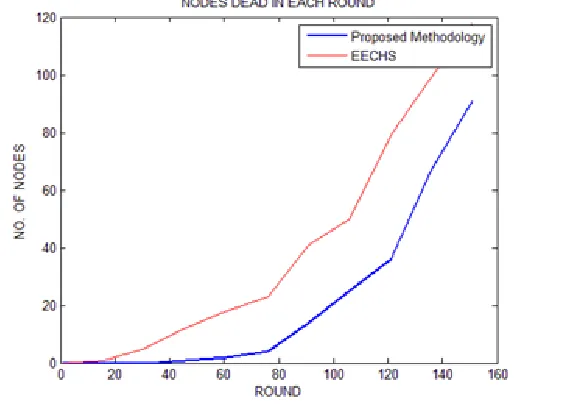
Graph 1: This graph 1.1 shows the comparison between the number of nodes dead in each round both with the existing 1)
system and the proposed one. It is clearly seen that the proposed system shows better result.
Fig. 2: Graph 1.1 Comparison of number of nodes dead in each round.
Graph 2: This graph1.2 shows the energy consumed after each round by the proposed scheme (EESRP). 2)
Fig. 3: Graph 1.2 Energy consumed after each round.
V.
C
ONCLUSIONR
EFERENCES[1] Martin Enzinger, "Energy-efficient communication in Wireless Sensor Networks", Seminar on Network Architectures and Services, pp. 25-31, 2012. [2] Indrajit Banerjee, Prasenjit Chanak, Biplab Kumar Sikdar and Hafizur Rahaman ," EER: Energy Efficient Routing in Wireless Sensor Networks ",
Proceeding of the 2011 IEEE Students Technology Symposium, pp. 92-97, 2011.
[3] Jing He, Schouling Ji,” Reliable & Energy Efficient Target Coverage for Wireless Sensor Network", Tsinghua Science and Technology, volume 16, number 5, pp. 464-474, 2011.
[4] Md Nafees Rahman and M A Martin,” Efficient Algorithm for Prolonging Network Lifetime of Wireless Sensor Networks,” Tsinghua Science and Technology, vol. 16, no. 6, pp. 561-568, 2011.
[5] Vinay Kumar and Sanjeev Jain,” Energy Efficient Clustering Algorithms in Wireless Sensor Network : A Survey”, International Journal of Computer Science, vol. 8, issue 5, no. 2, pp. 259-268, 2011.
[6] M Sheik Dawood , S. Sadasivam,” Energy Efficient Wireless Sensor Network Based on QOS Enhanced Base Station Controlled Dynamic Clustering Protocol, International Journal of Computer Applications, vol. 13, no. 4, pp.44-49, 2011.
[7] Bilal Abu Bakr and Leszek Lilien, “Extending Wireless Sensor Network Lifetime in the LEACH-SM Protocol by Spare Selection”, Fifth International Conference on Innovative Mobile and Internet Services in Ubiquitous Computing IEEE, pp. 277-282, 2011.
[8] Devendra Prasad & Reema Goyal,” SEECH: Secure & Energy Efficient Centralized Routing Protocol for Hierarchical WSN,” International Journal of Engineering Research & Development, vol. 2, issue 9, pp. 41-45, 2012.
[9] Liu Jun, Qi Hua and Li Yan,” A Modified LEACH Algorithm in Wireless Sensor Network Based on NS2,” International Conference on Computer Science & Information Processing IEEE, pp. 604-606, 2012.
[10] Vipin Pal, Girdhari Singh and R. P. Yadav, “Energy Efficient Cluster Head Selection Scheme: A Change in Node Death Scenario of LEACH for Surveillance Wireless Sensor Networks”, 2nd IEEE International Conference on Parallel, Distributed and Grid Computing, pp. 865-869, 2012.
[11] Suyog Pawar and Prabha Kasliwal," Design and Evaluation of En-LEACH Routing Protocol for Wireless Sensor Network", International Conference on Cyber-Enabled Distributed Computing and Knowledge Discover IEEE, pp. 489-492, 2012.
[12] Thu Ngo Quynh, Kieu-Ha Phung and Hoan Vu Quoc, “Improvement of Energy Consumption and Load Balance for LEACH in Wireless Sensors Networks”, ICTC IEEE, pp. 583-588, 2012.
[13] Rupesh Mehta, Abhishek Pandey and Pratik Kapadia, “Reforming Clusters Using C-LEACH in Wireless Sensor Networks”, International Conference on Computer Communication and Informatics IEEE, 2012.
[14] Ashish Christian and Himanshu Soni, “Lifetime prolonging in LEACH Protocol for Wireless Sensor Networks”, International Conference on Intelligent Systems and Signal Processing IEEE, pp. 350-355, 2013.
[15] Binod Kumar Mishra, Mohan C. Nikam and Prashant Lakkadwala ,"Security Against Black Hole Attack In Wireless Sensor Network–A Review" , International Conference on Intelligent Systems and Signal Processing IEEE, pp 615-620, IEEE , 2014 .
![Fig. 1: Typical wireless sensor network [1]](https://thumb-us.123doks.com/thumbv2/123dok_us/8870494.1813608/1.612.149.466.500.690/fig-typical-wireless-sensor-network.webp)