A Hybrid PSO-GA Algorithm for Energy
Efficient Routing in AMMNET
Niji. R Vineeth. D. Nair
M. Tech Scholar Assistant Professor
Department of Electronics & Communication Engineering Department of Electronics & Communication Engineering M.E.A Engineering College Kerala, India M.E.A Engineering College Kerala, India
Abstract
A mobile ad hoc network (MANET) is an infrastructure less network with autonomous mobile nodes. The easily configurable and deployable properties of MANET make it suitable for the situations were a fixed infrastructure is not available or infeasible. However the dynamic movements of the mobile clients may disconnects the connectivity of the network frequently. This disconnection reduces the data accessibilities and later results in partitioning of the network. Thus the network partition problem makes the MANET unsuitable for the mission critical applications were the team members need to work in group and scattered in the application terrain. To overcome this principle challenge here introduces a new class of ad hoc network called Autonomous Mobile Mesh Network (AMMNET). AMMNET consist of mobile mesh nodes that can dynamically adapt to all topological changes of client movements. Since this network is infrastructure less, the performance and lifetime of the network depends on energy level of the nodes. Also the depletion of energy of the intermediate node may disrupt the entire communication of the network. This paper proposes a hybrid PSO-GA algorithm for finding an energy efficient path for routing in AMMNET. The simulation results shows that this hybrid algorithm provides better throughput and are more efficient than the standard PSO and genetic algorithms.
Keywords: MANET, Network partition problem, AMMNET
_______________________________________________________________________________________________________
I. INTRODUCTION
The Advent of wireless technology brought tremendous changes in the field of communications. Of these one of the major contributions of wireless technology is MANET [1]. Mobile ad hoc networks are infrastructure less networks with mobile nodes. Nodes in MANET also act as a router and helps in forwarding the data packets from one node to another. These networks are easily deployable and self-forming and are suitable for the situations were a fixed infrastructure is infeasible. Due to these characteristics MANET founds application in many fields such as military, rescue operations, emergency operations...etc. in case of battlefield and rescue operations clients’ needs to works in group and has to occupy different locations at different time. Since the communication ranges of each node in an MANET are limited, clients when moved to a large distance can’t communicate with each other. This problem is called the partition problem. To overcome this problem there by maintaining inter group communications an autonomous mobile mesh network was introduced.
AMMNET is similar to a wireless mesh networks (WMN) [2]. In an wireless mesh network mesh nodes are stationary and provides services to the clients within their sensing range were as in an AMMNET the mesh nodes are mobile with autonomous movement capabilities [3].These mobile mesh nodes acts as a router and moves along with the movements of clients .The global and local adaptation mechanisms of AMMNET provides intelligence to this network to adapt to all topological changes due to client mobility. The performance and life time of these networks depends mainly on the energy level of the mobile mesh nodes. Therefore to extend the lifetime an energy efficient routing is necessary.
Particle swarm optimization (PSO) and Genetic algorithm (GA) are two popular Meta heuristic evolutionary algorithms. PSO was a swarm intelligence based technique and it is inspired from the social behavior of birds flocking and fish schooling. And it is the most commonly evolutionary algorithm due to its simplicity and convergence speed. The main drawback of PSO is its premature convergence of the swarm to a solution which is not necessarily the optimum. To overcome this limitation a hybrid approach with GA is proposed in this work. The cross over and mutation in GA introduces diversity in the population and control the convergence.
II. AMMNET OVERVIEW
[8], [9]. These mobile mesh nodes carry an RFID reader so that the clients having the RFID tag only need to probe the beacon messages to indicate their presence. It also carries a GPS system for navigational aid. The mobile mesh nodes act as a router. Depending upon the mode of routing each mobile mesh node can switches their mode of routing as
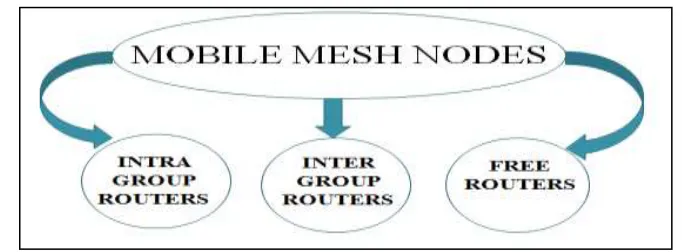
Intra group router Inter group router Free router
Fig. 1: classification of mobile mesh nodes
A mobile mesh node will act as an intra-group router if it detects at least on client in its sensing range. An intra-group router monitors the movements of clients in its range and provides routing within a group. A mobile mesh node will acts as an inter group router if it has the role the role of inter connecting two different groups. And a mobile mesh node will acts as a free router if it is neither an inter group router nor an intra-group router.
Each client continuously broadcasts beacon message to notify its presence within the radio range of an intra-group router. When a router detects a missing client, it will trigger the free routers in search of the missing client. The free router on detecting the missing client switches their mode of routing to free router. AMMNET also includes a global and local adaptation mechanisms to reduce the delay in the data transmission and to free up more inter group routers. The figure 3 shows how a partitioned group is interconnected using AMMNET network. Each partitioned group is serviced by some local intra group routers and the partitioned groups are interconnected with the main group with the help of some inter-group routers and bridge routers
Fig. 2: AMMNET network
III. STANDARD PARTICLE SWARM OPTIMIZATION (PSO)
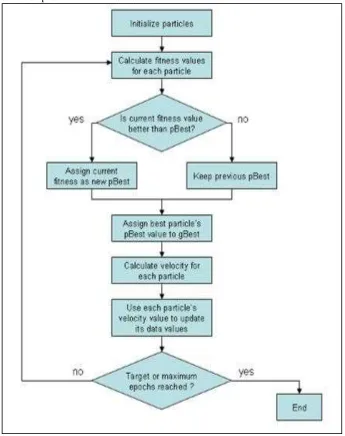
Particle swarm optimization (PSO) [10] is a swarm intelligence [11] based optimization technique. This algorithm exploits the social behavior of the birds flocking and the fish schooling. In PSO each feasible solution is called a particle. These particles fly through the multidimensional search space and adjust their positions and velocities based on the experience of its own and based on the experience of neighboring particles. These particles finally converge to an optimum solution based on the fitness value.
fitness value obtained by particle to particle interaction called the g-best (global best) value. This process iteratively continues until a desirable solution or computational limit is achieved.
Fig 3: Flow Chart of PSO
IV. STANDARD GENETIC ALGORITHM
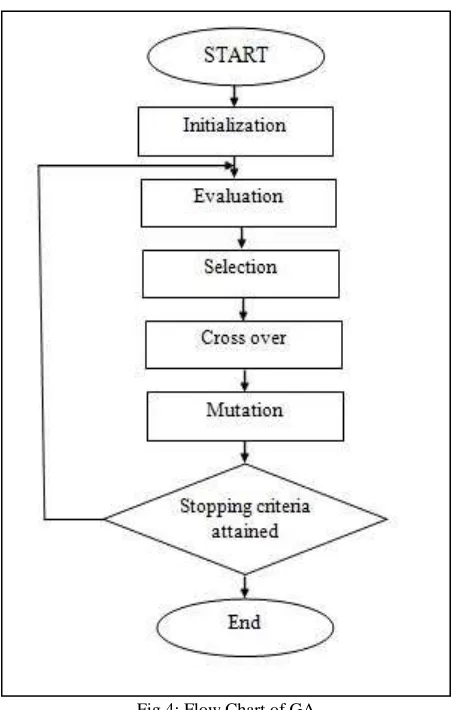
Genetic algorithms are heuristic search and optimization techniques based on the concept of natural genetics and natural selection [12]. The idea of evolutionary computing was introduced by Rechenberg in 1960 and the concept of these algorithms are developed by Prof. John Holland of University of Michigan in 1975.GA is an iterative procedure ,were instead of a single solution GA works with a group of solutions (collectively called population) in each iterations.
Fig 4: Flow Chart of GA
V. PROPOSED METHOD
Routing of a data packet from source to destination needs to consider several aspects such as security, delay, distance, energy consumption etc. Since AMMNET is an infrastructure less network energy level of each node is important to maintain the lifetime of the network. So in order to increase the lifetime of a network an energy efficient routing is necessary. There are several optimization techniques to find an energy efficient path for routing. Because of the simplicity and computational efficiency PSO is most commonly used for optimization.
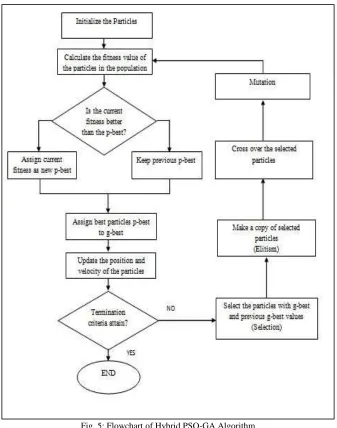
Fig. 5: Flowchart of Hybrid PSO-GA Algorithm
A hybrid PSO-GA algorithm starts with randomly selected solutions in the problem space. Initially the g-best fitness of the solution is evaluated through PSO algorithm. Here the fitness is the energy level of the path. And each path is considered as a particle. The g-best value of the particle will get updated in each iteration. From which the path corresponding to the final g-best value and the next previous g-best value (fitness having the second rank) is selected and are undergone cross over and mutation to create a new population. Here in order to avoid the destruction of the best solution a copy of the selected paths are preserved in the population pool. And this mechanism is called elitism. Then newly generated population is again evaluated through PSO algorithm. The process continues until a desired fitness is attained or if the termination time attains.
VI. SIMULATION ENVIRONMENT AND RESULTS
The simulations are done under Ns2 version 2.35. The parameter settings of the simuation are described in the table. Table – 1
Simulation parameters Simulator NS2 MAC Protocol 802.11
No. of nodes 50 Basic data rate 2Mbps
Simulation is done under 50 nodes of which it includes 11 intra-group routers, 6 free routers and 33 mobile clients with an initial energy of 100 joules. Here the client follows a random way point mobility model [15]. Two point cross over and a swap mutation is considered in this simulation. The Fig 6 shows the fitness value comparison of Hybrid PSO-GA algorithm with that of standard PSO and GA algorithm. From the graph it is clear that the fitness value of Hybrid PSO-GA is always higher than that of GA and PSO algorithm,
Fig. 6: Fitness value comparison
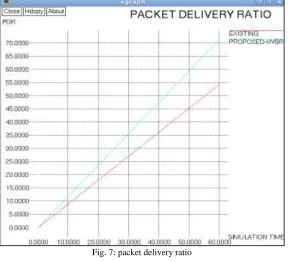
The figure shows the average packet delivery ratio of existing AMMNET network with that of proposed method. The PDR of the proposed hybrid method is about 35% higher than the existing method.
Fig. 7: packet delivery ratio
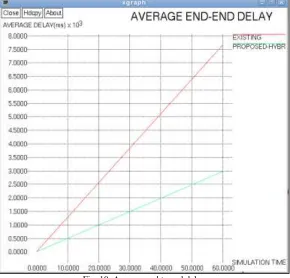
Fig. 10: Average end to end delay
Fig. 9: Throughput
VII.CONCLUSION
avoid the premature convergence .Simulation results shows that this hybrid algorithm can reduce the delay in data transmission and can increases the throughput and packet delivery ratio of the network. Thereby the lifetime of this algorithm can be improved.
REFERENCES
[1] Chlamtac, M Conti, JJN Liu “Mobile ad hoc networking: imperatives and challenges” - Ad hoc networks, 2003 - Elsevier [2] F. Akyildiz, X. Wang, and W. Wang, “Wireless Mesh Networks A Survey,” Computer Networks, vol. 47, no. 4, pp. 445-487, 2005. [3] Quadrocopter LLC,” http://quadrocopter.us/, 2013.
[4] Wei-Liang Shen, Chung-Shiuan Chen,Kate ChingJu Lin,” Autonomous Mobile Mesh Networks”,ieeetransactions on mobile computing,2014. [5] R. Roy, Handbook of Mobility Models and Mobile Ad Hoc Networks. Springer, 2010.
[6] Y.-C. Chen, E. Rosensweig, J. Kurose, and D. Towsley, “Group Detection in Mobility Traces,” Proc. Sixth Int’l Wireless Comm. And Mobile Computing Conf. (IWCMC ’10), 2010.
[7] T. Camp, J. Boleng, and V. Davies, “A Survey of Mobility Models for Ad Hoc Network Research,” Wireless Comm. and Mobile Computing, vol. 2, no. 5, pp. 483-502, 2002.
[8] X. Hong, M. Gerla, G. Pei, and C. Chiang, “A Group Mobility Model for Ad Hoc Wireless Networks,” Proc. Second ACM Int’l Workshop Modeling, Analysis and Simulation of Wireless and Mobile Systems (MSWiM ’99), 1999.
[9] K. Blakely and B. Lowekamp, “A Structured Group Mobility Model for the Simulation of Mobile Ad Hoc Networks,” Proc. Second Int’l Workshop Mobility Management & Wireless Access Protocols (MobiWac), 2004.
[10] Zheng Jianchao, Jie Jing, Cui Zhihua. (2004). Particle swam optimization Algorithm[M].Science Publishing Company of Beijing, 2004.(In Chinese) [11] A. P. Engelbrecht, Fundamental of Computational Swarm Inteligent, First ed. The atrium, Southern Gate, Chichester, West Sussex PO19 8SQ, England:
John Wiley & Sons Ltd, 2005.
[12] Wenliang G., Huichang S., Jun Y., Yifei Z. (2009), ”Application of Genetic Algorithm in Energy- Efficient Routing” China-Japan Joint Microwave Conference, Page(s): 737 – 740.
[13] Koza, J. R. 1991. Genetic evolution and co-evolution of computer programs. In Langton, C. G. C. Taylor, J. D. Farmer and S. Rasmussen (Eds) Artificial Life II: SFI Studies in the Sciences of Complexity.
[14] Q. Bai, "Analysis of Particle Swarm Optimization Algorithm," Computer and Information Science, vol. volume 3 No 1, Pebruari 2010 2010.