Account and Financial Management Journal ISSN: 2456-3374 Impact Factor: 4.614
1064
Demonetization and Its Impact - A Study
K. Ramya
Assistant ProfessorDepartment of CommerceSri Akiladeswari Women’s College
Wandiwash-604408
ARTICLE INFO
ABSTRACT
Corresponding Author: K.Ramya
Asst. Prof. Department of Commerce Sri Akiladeswari Women’s College
Wandiwash-604408
The Indian Economy which was billed as the “fastest growing major economy” in the world and the “only bright spot” among Emerging Markets seems to have slowed down even before the latest “shock therapy” of “demonetization”. With demonetization effort 86% of India’s currency was nullified that aimed to wash the stock of ‘black market's cash supply’ and counterfeit notes out of the economy and convert it into the licit, banked and taxable, part of the economy. In a remarkable move, the Government of India declared that the five hundred and one thousand rupee notes will no longer be legal tender from midnight, 8th November 2016. The RBI will issue Two thousand rupee notes and new notes of Five hundred rupees which will be placed in circulation from 10th November 2016. Notes of one hundred, fifty, twenty, ten, five, two and one rupee will remain legal tender and will remain unaffected by this decision. This measure has been taken by the PM in an attempt to address the resolve against corruption, black money and counterfeit notes. This move is expected to cleanse the formal economic system and discard black money from the same.
KEYWORDS: Demonetization, Indian economy, Black money, corruption
Introduction
Demonetization is a generations’ memorable experience and is going to be one of the economic events of our time. Its impact is felt by every Indian citizen. Demonetization affects the economy through the liquidity side. Its effect will be a telling one because nearly 86% of currency value in circulation was withdrawn without replacing bulk of it. As a result of the withdrawal of Rs 500 and Rs 1000 notes, there occurred huge gap in the currency composition as after Rs 100; Rs 2000 is the only denomination.
Demonetization is the process of removing currency from general usage or circulation. In India’s case Government completely withdrawn
the currency with the denomination of 1000. Along with 1000 currency notes 500 rupee notes were also withdrawn from circulation. For the old 500 currency notes new 500 rupee notes will be issued and a new currency note of 2000 denomination has been introduced in the economy. New currency notes issued to the public through commercial banks and post offices across India by depositing the demonetized currency notes by the people.
Demonetization in India
1065
time demonetization took place in pre
independence period. In January 1946, for the first time demonetization took place in India. During this demonetization currency notes of Rs 1000 and Rs 10000 rupees were withdrawn from the circulation and new currency notes of 1000, 5000 and 10000 denomination rupees were introduced in the year 1954. On The second phase of demonetization was done on 16th January 1978 when an ordinance was promulgated to phase out notes with denomination of Rs. 1000, Rs 5000 and Rs. 10000. On 12th January 1946 demonetization was resorted to but the Direct Tax Enquiry Committee in its interim report observed, “Demonetization was not successful then, because only a very small proportion of total notes in circulation were demonetized in 1946 and its worth was Rs. 1,235.93 crores”. On 16th January 1978, demonetization of high denomination notes was introduced. The high demonetization notes as on that day amounted to Rs. 146 crore and total notes tendered to RBI amounted to Rs. 125 crore as per data available till August 1981.
With effect from 8th Nov. 2016 Tuesday Midnight PM Shri Narendra Modi Ji Banned the Currency notes of 500 and 1000. It is a strict decision of banning regular 500 and 1000 rupee notes from circulation which is a result of finding 1.25 lakh crore black money. Within 3 days of that striking decision: - 35000 Crore Rs. Deposited in banks and approximate 1500 Crore Rs Black Money were destroyed. According to the RBI‘s (Reserve Bank of India) Annual Report for April 2015 to March 2016, the value of the currency notes at the end of March 2016 was 16.42 trillion Indian rupees. The 500 rupee and 1,000 rupee currency notes formed 86.4% of the value. In one stroke, the government removed 86.4% of the currency in circulation by value. In terms of volume, the currency notes of these two denominations formed 24.4% of a total 90.27 billion pieces.
Demonetization technically is a liquidity shock; a
sudden stop in terms of currency availability. It creates a situation where lack of currencies jams
consumption, investment, production,
employment etc. In this context, the exercise may
produce following short term/long term/,
consumption/investment, welfare/growth impacts
on Indian economy. The intensity of
demonetization effects clearly depends upon the duration of the liquidity shocks. Following are the main impacts. Demonetization is not a big disaster like global banking sector crisis of 2007; but at the same time, it will act as a liquidity shock that disturbs economic activities.
Effect on parallel economy
The removal of these 500 and 1000 notes and replacement of the same with new 500 and 2000 Rupee Notes is expected to
remove black money from the economy as
they will be blocked since the owners will not be in a position to deposit the same in the banks,
Temporarily stall the circulation of large volume of counterfeit currency and
curb the funding for anti-social elements like smuggling, terrorism, espionage, etc.
Effect on Money Supply
With the older 500 and 1000 Rupees notes being scrapped, until the new 500 and 2000 Rupees notes get widely circulated in the market, money supply is expected to reduce in the short run. To the extent that black money (which is not counterfeit) does not re-enter the system, reserve money and hence money supply will decrease permanently. However gradually as the new notes get circulated in the market and the mismatch gets corrected, money supply will pick up.
Liquidity crunch (short term effect):
1066
favourable denomination in daily life. It constituted to nearly 49% of the previous currency supply in terms of value. Higher the time required to resupply Rs 500 notes, higher will be the duration of the liquidity crunch. Current reports indicate that all security printing press can print only 2000 million units of RS 500 notes by the end of this year. Nearly 16000 mn Rs 500 notes were in circulation as on end March 2016. Some portion of this was filled by the new Rs 2000 notes. Towards end of March approximately 10000 mn units will be printed and replaced. All these indicate that currency crunch will be in our economy for the next four months.
Welfare loss for the currency using population: Most active segments of the population who constitute the ‘base of the pyramid’ uses currency to meet their transactions. The daily wage earners, other labourers, small traders etc. who reside out of the formal economy uses cash frequently. These sections will lose income in the absence of liquid cash. Cash stringency will compel firms to reduce labour cost and thus reduces income to the poor working class.
There will be a trickle up effect of the liquidity chaos to the higher income people with time.
Consumption will be hit:
When liquidity shortage strikes, it is consumption that is going to be adversely affected first.
Consumption ↓→ Production ↓→
Employment ↓→ Growth ↓→ Tax revenue ↓
Effect on GDP
The GDP formation could be impacted by this measure, with reduction in the consumption demand. However with the recent rise in festival demand is expected to offset this fall in overall impact. Moreover, this expected impact on GDP may not be significant as some of this demand will only be deferred and re-enter the stream once the cash situation becomes normal.
Table 1: revised growth expectation of Indian economy
Original 2017
Revised
2017 2018
RBI 7.6% 7.1% -
World bank 7.6% 7.0% 7.6%
IMF 7.6% 6.6% 7.2%
Rabo bank 7.0% 5.5% 8.2% Source: IMF, World Bank, RBI, Rabobank
Loss of Growth momentum:
India risks its position of being the fastest growing
largest economy: reduced consumption,
income, investment etc. may reduce India’s GDP growth as the liquidity impact itself may last three -four months.
Impact on bank deposits and interest rate: Deposit in the short term may rise, but in the long term, its effect will come down. The savings with the banks are actually liquid cash people stored. It is difficult to assume that such ready cash once stored in their hands will be put into savings for a long term. They saved this money into banks just to convert the old notes into new notes. These are not voluntary savings aimed to get interest. It will be converted into active liquidity by the savers when full-fledged new currency supply takes place. This means that new savings with banks is only transitory or short-term deposit. It may be encashed by the savers at the appropriate time. It is not necessary that demonetization will produce big savings in the banking system in the medium term. Most of the savings are obtained by biggie public sector banks like the SBI. They may reduce interest rate in the short/medium term. But they can't follow it in the long term.
Impact on black money:
1067
money countered by demonetization depends upon the amount of black money held in the form of cash and it will be smaller than expected. But more than anything else, demonetization has a big propaganda effect. People are now much convinced about the need to fight black income. Such a nationwide awareness and urge will encourage government to come out with even strong measures.
Impact on counterfeit currency:
The real impact will be on counterfeit/fake currency as its circulation will be checked after this exercise. Demonetization as a cleaning exercise may produce several good things in the economy. At the same time, it creates unavoidable income and welfare losses to the poor sections of the society who gets income based on their daily work and those who doesn’t have the digital transaction culture. Overall economic activities will be dampened in the short term. But the
immeasurable benefits of having more
transparency and reduced volume of black money activities can be pointed as long term benefits.
Effect on Banks
As directed by the Government, the 500 and 1000 Rupee notes which now cease to be legal tender are to be deposited or exchanged in banks (subject to certain limits). This will automatically lead to more amounts being deposited in Savings and Current Account of commercial banks. This in turn will enhance the liquidity position of the banks, which can be utilized further for lending purposes. However, to the extent that households have held on to these funds for emergency purposes, there would be withdrawals at the second stage.
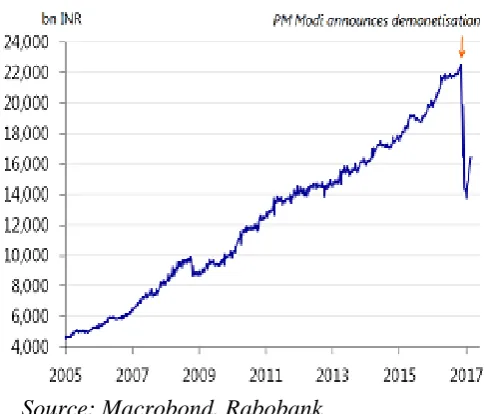
Figure 1: The big squeeze: monetary base declined from INR 22.5trn to 13.7 trn
Source: Macrobond, Rabobank
Effect on Online Transactions and alternative modes of payment:
With cash transactions facing a reduction, alternative forms of payment will see a surge in demand. Digital transaction systems, E wallets and apps, online transactions using E banking, usage of Plastic money (Debit and Credit Cards), etc. will definitely see substantial increase in
demand. This should eventually lead to
strengthening of such systems and the
infrastructure required.
Effect on Various Economic Entities:
With cash transaction lowering in the short run, until the new notes are spread widely into circulation, certain sections of the society could face short term disruptions in facilitation of their transactions. These sections are: Agriculture and related sector
Small traders
SME
Services Sector
Households
Political Parties
Professionals like doctor, carpenter, utility service providers, etc .
Retail outlets
1068
sections of the economy necessitate cash transactions on more frequent basis. Thus, these segments are expected to have the most significant impact post this demonetization process and the introduction of new notes in circulation.
Positive impact:
A good part of black money is eliminated from the economy. This money can be spent by Indian government for the development of country.
Post-demonetization, Indian
government blocked many routes for black money formation.
With increased transparency, trust on
Indian Economy is increased. Thereby foreign investments poured in.
Amid the fears of government moves,
everyone is now ready to pay the taxes.
Hence more revenue for Indian
government.
Due to the heavy usage of cash
transactions, informal sector is the worst hit by demonetization move. Though it
suffered at first, many informal
organizations are now turning into formal
organizations, which mean more
transparency and more taxes for Indian Economy.
Demonetization move encouraged cashless
transactions, which is a boost to Economy. As people are more likely to keep their
money in banks, savings will be increased. With more money in banks, loans will be
available to more people. With increased loans, banks will be benefited by interests.
Negative impact:
GDP growth was earlier estimated as
7.8%. Post-demonetization, estimates are lowered to 7.1%.
Agriculture sector, small and medium
scale businesses and informal sectors are
the worst hit by demonetization. It takes a lot of time for them to recover from the losses. This has a negative effect on Economy.
There is no guarantee that demonetization move will turn India into a cashless economy.
Consumer demand was hit by
demonetization, hence retail inflation fell to 3.17% – a multi year low. With this, growth of economy wills slowdown.
Conclusion
Central government’s recent decision to demonetize the high value currency is one of the major step towards the eradication of black money in India. The demonetization drive will affect some extent to the general public, but for larger interest of the country such decisions are inevitable. Also it may not curb black money fully, but definitely it has major impact in curbing black money to large extent.
Demonetizations in Indian economy is having negative impact on the different sectors of the economy. Majority of the negative effect are short run effects. All these effects are solved when the new currency notes are widely circulated in the economy. On the other hand people are facing some problems in the exchange of currency notes. Even though people are facing such a problem people are ready to bear these problems for its positive effect on the economy. If government successfully clears all the problems, drawbacks
associated with the demonetization, this
demonetization will become the successful economic revolution in India and we can expect a better tomorrow with corruption free India.
1069
1. Jayanti Kumari (2017), Demonetization and its impact on Indian Economy
2. Lokesh Uke (2017),‘Demonetization and its effects in India’, SSRG International Journal of Economics and Management Studies,Vol. 4, pp. 18-23.
3. Partap Singh and Virender Singh (2016), ‘ Impact of Demonetization on Indian Economy’, International Journal of science Technology and Management, Vol. 5, Issue 12, pp. 625-635.
4. Sabnivas Madan, Sawarkar Anushka,
Mishra Mradul, (2016) Economic
consequences of demonetisation of 500 and 100 rupee notes.
5. http://www.businessstandard.com/article/e conomy-policy/five-likely-effects-of-demonetisation-on-economy-
116110901411_1.html
6. http://www.business-standard.com/article/ economy-policy/five-likely-effects-of-demonetisation-on-economy-
116110901411_1.html
7. http://indianexpress.com/article/india/india -news-india/bothsides-of-the-coin-what-top-economists-thinkaboutdemonetisation/
8.
http://www.economist.com/news/finance- andeconomics/21711035-withdrawing-86- value-cash-circulationindia-was-bad-idea-badly
9. http://www.forbes.com/sites/timworstall/2 016/11/19/effectsof-demonetisation-on- indias-gdp-difficult-to-calculate-wedont-even-know-the-sign/#46a52f184a1a 10. http://www.moneycontrol.com/news/econ
omy/impactanalysisdemonetizationindia_8 044821.html
11. http://www.investopedia.com/terms/d/dem onetization.asp
12. http://marketrealist.com/2016/11/great-indian-demonetization/
13. http://www.hindustantimes.com/india-
news/india-will-feelthe-effects-of-
demonetisation-till-next-financial-year/storyJ3wUq2ULS5CuLX1rVQyHaK. html
14. http://www.business-standard.com/article/ economypolicy/note-ban-has-negatively-impacted-auto-asset-backedloan-moody-s 117021300217_1.html
15. http://www.businessstandard.com/article/c ompanies/housingsales-fell-40-in-nov-dec-
on-demonetisation-proptiger-117021200188_1.html
16. http://economictimes.indiatimes.com/indus try/consproducts/
17. fmcg/demonetisation-erodes-over-rs-3-8k-crorefmcgsales/articleshow/56155024.cms 18.
http://www.dnaindia.com/money/report- demonetisation-tohave-positive-impact-on-economy-godrej-2282372
19. http://indianexpress.com/article/business/e conomy/positiveeffects-of-demonetisation-