Jayachandran 2015 ISSN: 2349 – 4891
Correlations of Biomechanical Characteristics with Ball Speed in Penalty Corner Push-In
Analysis of Physical Performance between Trained Sprinters and Weight Lifters
K. Jayachandran
Director of Physical Education, Arulmurugan College of Engineering and Technology, Karur, Tamilnadu, India.
Received 15th June 2015, Accepted 24th August 2015
Abstract
The purpose of the study was to compare the selected physical performance variables among trained sprinters and weight lifters. To achieve these purpose twenty trained sprinters and twenty weight lifters from the department of physical education and sports sciences, Annamalai University were randomly selected as subjects. The age of the selected subjects were ranged from 18-22 years. The purpose of the study and the role of the subjects were clearly explained with demonstration To find out the significant difference between trained sprinters and weight lifters in physical performance, descriptive statistics and ‘t’ ratio was determined. The confidence interval was fixed at 0.05 level of significance. Needed values were taken from the table of correlation coefficients at the 0.05 level of significance for given degrees of freedom. The result obtained from this comparative study of physical performance (speed, agility, explosive power and muscular strength endurance,) between trained sprinters and weight lifters clearly shows that the trained sprinters have better than the weight lifters in respect of speed, agility and explosive power. The result of the study also shows that the weight lifters have better than the trained sprinters in respect of muscular strength endurance.
Keywords: Speed, Agility, Explosive Power, Muscular Strength Endurance.
© Copy Right, IJRRAS, 2015. All Rights Reserved.
Introduction
Sport in an institutionalized competitive activity that involves vigorous physical exertion or the use of relatively complex physical skills by individuals whose participation is motivated by the combination of intrinsic satisfaction associated with the activity itself and the external rewards earned through participation. “Sport is about realizing one's potential, keeping people in sport longer are a huge gain for society. Less talented athletes are essential for keeping the talent honest”. Sport is a process that is a means for self-realization; the athlete is the key element of this process. There is nothing good or bad, merely opportunities to learn, a victory or a loss is merely one moment in time. A victory disappears as soon as you cross the line. We are defined in terms of the dynamic summation of our lives. One moment can never summarize an individual. There are consequences to every action, if you define sport in terms of process, then the fact that the path is difficult is the whole point! All athletes have assets and liabilities - the only path to true satisfaction is by striving to achieve 100% of our potential.
Physical fitness is more than „being well‟ or „not being sick‟ and extends on a scale form abundant life to death. Physical fitness is the prime requisite to lead an optimum life and to live most and serve best in
the modern. A sound mind and a sound body are man‟s most precious possessions. There are numerous factors, which are responsible for the performance of a sports person. The physique and body composition including the size, shape and form are known to play a significant role in this regard. The performance of the sports men in any game depends on skill training, motivation and on various other physiological and biochemical factors. Age, sex and physical growth have also been noticed to influence a person‟s capacity for physical activities. Motor fitness is actually broader and less definitive in scope. It includes both physical fitness and motor ability factors and includes not only strength and endurance components, but also factors of speed, power and agility. The seven components used to measure motor fitness are muscular strength, muscular endurance, cardio respiratory endurance, muscular power, agility, speed and flexibility. Speed, is the fifty physical fitness components which is essential for many physical activities. Without speed there is no sports and physical education. Speed of muscle contraction is an innate quality but speed of movement can be gained through movements. Speed is a valuable factor in games like football, basketball, hockey and track events. Strength is highly related to the speed. General the higher team wins because it is the faster team. Strength and speed are integral components of fitness found in
ISSN: 2349 - 4891
International
Journal of Recent Research and Applied Studies
48 International Journal of Recent Research and Applied Studies, Volume 2, Issue 8 (12) August 2015
requiring extreme and rapid force production.
Maximal strength and power are not distinct entities; they have a hierarchical relationship with one another. Maximum strength is the basic quality that influences power performance. Power performance is affected by the interaction between agonist, antagonist, and synergic muscles involved in joint movements. Strength the third physical fitness components, is the ability or capacity of muscle or muscle group for exerting force against resistance. Strength in needed in all kinds of work physical activity. Muscles that are strong result to better are strong results in better protection of body joints fewer sprains, strains and other muscular difficulties. Furthermore, muscle strength helps to maintain proper posture and provides for greater endurance, power and resistance to fatigue. Strength is also a very important element in the field of sports. The best athletes pay particulars attention to develop strength in various muscle groups. Power the fourth physical fitness component, is seen in quick movements when body weight is propelled either upward or forward. It is characterized b one short burst of energy and is seen in such test as the standing long jump, vertical jump and shorts runs. Muscular endurance, the second physical fitness component, is a university accepted component of physical performance. In practice, most physical fitness test include running over a distance to measure aerobic capacity and a test (usually sit/ups) to measure muscular endurance. Muscular endurance and aerobic endurance are important components of performance. Researchers do not agree as to which components are involved in all the physical performance common to sports, physical fitness testing and heavy industrial occupations. The
interacting functions of physiological system contribute to the difficulty.
Methodology
The purpose of the study was to compare the selected physical performance variables among trained sprinters and weight lifters. To achieve these purpose twenty trained sprinters and twenty weight lifters from the department of physical education and sports sciences, Annamalai University were randomly selected as subjects. The age of the selected subjects were ranged from 18-22 years. The purpose of the study and the role of the subjects were clearly explained with demonstration. Standard measuring tape and high quality split timers were used. Since the reliability of instruments used ensured by their manufactures, they were considered adequately reliable and valid for this study. Among the physical performance variables the following variables such as speed, agility, muscular strength endurance and explosive power were selected. The present study was undertaken to find significant differences, among trained sprinters and weight lifters on selected criterion variables such as speed, agility, muscular strength endurance and explosive power. To find out the significant difference between trained sprinters and weight lifters in physical performance, descriptive statistics and „t‟ ratio was determined. In applying the null hypothesis, the confidence interval was fixed at 0.05 level of significance. This was considered adequate for the purpose of this study. Needed values were taken from the table of correlation coefficients at the 0.05 level of significance for given degrees of freedom.
Results
Table I. Computation of data on speed between trained sprinters and weight lifters
Group N
x
DM DM ‘t’ ratio
Trained
Sprinters 20 5.89 0.31 0.93 0.138 6.74*
Weight Lifters 20 6.82 0.46
* Required table value for significance at 0.05 level of confidence for df of 38 is 2.024
Since the obtained „t‟ value of 6.74 on speed was greater than that of the required table value of 2.024 for significant level with 38 degrees of freedom, the research hypothesis is accepted, and the null hypothesis
Figure I. Bar diagram showing the mean values on speed between trained sprinters and weight lifters
Table II. Computation of data on agility between trained sprinters and weight lifters
Group N
x
DM DM ‘t’ ratio
Trained
Sprinters 20 8.78 0.18 0.71 0.048 14.79
Weight Lifters 20 9.49 0.12
* Required table value for significance at 0.05 level of confidence for df of 38 is 2.024
Since the obtained „t‟ value of 14.79 on agility was greater than that of the required table value of 2.024 for significant level with 38 degrees of freedom, the research hypothesis is rejected, and the null hypothesis is
accepted. As the obtained „t‟ value is greater than the table value in case of agility, it may be concluded that, there is significant level of difference in the performance of agility between trained sprinters and weight lifters.
Figure II. Bar diagram showing the mean values on agility between trained sprinters and weight lifters
Table III. Computation of data on explosive power between trained sprinters and weight lifters
Group N
x
50 International Journal of Recent Research and Applied Studies, Volume 2, Issue 8 (12) August 2015
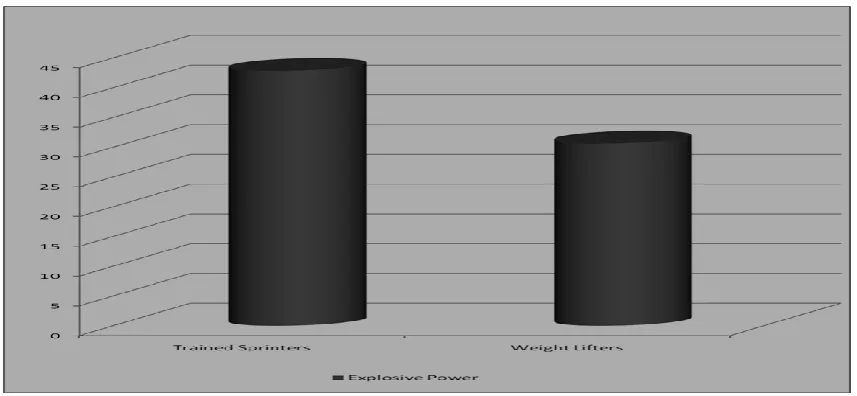
Since the obtained „t‟ value of 7.82 on explosive power was greater than that of the required table value of 2.024 for significant level with 38 degrees of freedom, the research hypothesis is accepted, and the null hypothesis is rejected. As the obtained „t‟ value is
greater than the table value in case of explosive power, it may be concluded that, there is significant level of difference in the performance of explosive power between trained sprinters and weight lifters.
Figure III. Bar diagram showing the mean values on explosive power between trained sprinters and weight lifters
Table IV. Computation of data on muscular strength endurance between trained sprinters and weight lifters
Group N
x
DM DM ‘t’ ratioTrained Sprinters 20 26.18 3.25
1.13 0.47 2.40*
Weight
Lifters 20 29.47 2.36
* Required table value for significance at 0.05 level of confidence for df of 38 is 2.024 The mean values on muscular strength
endurance of trained sprinters and weight lifters are 26.16 and 29.47 respectively. Since the obtained „t‟ value of 2.40 for muscular strength endurance is greater than that of the required table value of 2.024 for significant level with 38 degrees of freedom, it may be
concluded that there is significant level of difference in muscular strength endurance between trained sprinters and weight lifters. The mean values on muscular strength endurance between trained sprinters and weight lifters have been graphically represented in figure-VI.
Discussion on Findings
The result obtained from this comparative study of physical performance (speed, agility, explosive power and muscular strength endurance,) between trained sprinters and weight liftersclearly shows that the trained sprinters have better than the weight liftersin respect of speed, agility and explosive power. The result of the study also shows that the weight liftershave better than the trained sprinters in respect of muscular strength endurance.
Conclusions
The following conclusions were made based on the analysis and results of the data.
1. It was concluded that the trained sprinters have better than the weight lifters in respect of speed, agility and explosive power.