ISSN: 2279-087X (P), 2279-0888(online) Published on 25 November 2014
www.researchmathsci.org
Double Layered Fuzzy Graph
T. Pathinathan1 and J. Jesintha Rosline2 Department of Mathematics, Loyola College, Chennai – 34 1
Email: [email protected]; 2Email: [email protected]
Received 29 October 2014; accepted 5 November 2014
Abstract. An interesting and new type of fuzzy graph can be obtained from a fuzzy graph whose crisp graph is a cycle. In this paper, we define a new fuzzy graph named Double Layered Fuzzy Graph (DLFG) and we have discussed some of its properties using order, size, µ - complement of fuzzy graphs, etc.
Keywords: Order, Size, vertex degree, µ - Complement, strong fuzzy graph, double layered fuzzy graph.
AMS Mathematics Subject Classification (2010): 94D05
1. Introduction
Fuzzy graph theory was introduced by Azriel Rosenfeld in 1975 [5]. Though introduced recently, it has been growing fast and has numerous applications in various fields. During the same time Yeh and Bang have also introduced various concepts in connectedness with fuzzy graphs [7]. Mordeson and Peng introduced the concept of operations on fuzzy graphs, Sunitha and Vijayakumar discussed about the operations of union, join, Cartesian product and composition on two fuzzy graphs [4]. The degree of a vertex in some fuzzy graphs was discussed by Nagoorgani and Radha [6]. Nagoorgani and Malarvizhi have defined different types of fuzzy graphs and discussed its relationships with isomerism in fuzzy graphs [3]. In this paper we define double layered fuzzy graph (DLFG) or 3 – D Fuzzy graph which gives a 3-D structure in fuzzy graph theory and some of its properties were discussed.
Section two contains the basic definitions in fuzzy graphs, in section three we introduce a new fuzzy graph called a double layered fuzzy graph, section four presents the theoretical concepts of DLFG and finally we give conclusion on DLFG
2. Preliminaries
Definition 2.1. [5] A fuzzy graph G is a pair of functions G:(σ,µ) where σ is a fuzzy subset of a non empty set S and µ is a symmetric fuzzy relation on σ . The underlying crisp graph of G:(σ,µ) is denoted by G*: (
σ µ
*, *)Definition 2.2. [8] Let
G
: ( , )
σ µ
be a fuzzy graph, the order of G is defined as( ) ( )
u V
O G
σ
u∈
Definition 2.3. [8] Let G: ( , )
σ µ
be a fuzzy graph, the size of G is defined as,
( ) ( , )
u v V
S G
µ
u v∈ =
∑
Definition 2.4. [10] Let G: ( , )
σ µ
be a fuzzy graph, the degree of a vertex u in G is defined as G( ) ( , )v u v V
d u
µ
u v≠ ∈
=
∑
and is denoted as d uG( ).Definition 2.5. [9] A fuzzy graph G: ( , )
σ µ
is said to be a strong fuzzy graph if ( , )u v ( )u ( )vµ
=σ
∧σ
for all (u,v) inµ
*.Definition 2.6. [4] Let G be a fuzzy graph, the µ - complement of G is denoted as
: ( , )
Gµ
σ µ
µ µ whereσ
*∪µ
* and ( , ) ( ) ( ) ( , ) if ( , ) 0 0 if ( , ) 0u v u v u v
u v u v µ
σ
σ
µ
µ
µ
µ
∧ − = = ≻3. Double layered fuzzy graph (DLFG) 3.1. Definition
Let G: ( , )
σ µ
be a fuzzy graph with the underlying crisp graphG*: (σ µ
*, *). The pair( )
: ( DL, DL)DL G
σ µ
is defined as follows. The node set of DL G( )
beσ
*∪µ
*. Thefuzzy subset
σ
DLis defined as*
* ( ) if
( ) if DL u u uv uv
σ
σ
σ
µ
µ
∈ = ∈ The fuzzy relation
µ
DLonσ
*∪µ
* is defined as* ( ) if ,
( ) ( ) if the edge e and e a node in common between them
* *
( ) ( ) if and e and each e is incident with single u
either clockwise or anticlockwise. 0 otherwi
uv u v
e e have i j i j u e u
DL i i i i i i
µ σ µ µ µ σ µ σ µ ∈ ∧ = ∧ ∈ ∈ se
By definition
µ
DL( , )
u v
≤
σ
DL( )
u
∧
σ
DL( ) for all u,v in
v
σ
*∪
µ
*. Hereµ
DL is a fuzzy relation on the fuzzy subsetσ
DL. Hence the pair DL G( )
: (σ µ
DL, DL) is defined asdouble layered fuzzy graph (DLFG) or 3 – D Fuzzy Graph. We prefer to label the
graph as DLFG.
vertices.
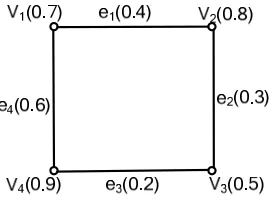
Figure 1: A Fuzzy graph G:(,µ)
Figure 2: Double layered fuzzy graph ,
Consider the fuzzy graph with n = 4 vertices.
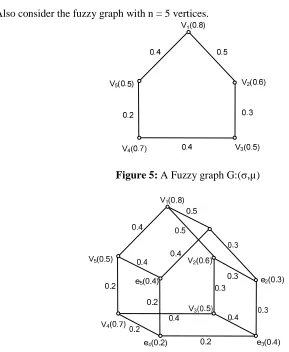
Figure 4: Double layered fuzzy graph ,
Also consider the fuzzy graph with n = 5 vertices.
Figure 5: A Fuzzy graph G:(,µ)
whose crisp graph is a cycle.
4. Theoretical concepts
Theorem 4.1. Order DL(G) = Order(G) + Size(G), where G is a fuzzy graph. Proof: As the node set of DL(G) is
σ
*∪µ
*and the fuzzy subsetσ
DLon* *
σ
∪µ
isdefined as
*
* ( ) if
( ) if DL u u uv uv
σ
σ
σ
µ
µ
∈ = ∈ Order DL(G) = DL( ) u VUE
u
σ
∈
∑
(by definition 2.2)
= DL( ) DL( )
u V u E
u u
σ
σ
∈ ∈ +∑
∑
= ( ) ( )u V u E
u u
σ
µ
∈ ∈
+
∑
∑
(by definition ofσ
DL( )u ) = Order (G) + Size (G).Theorem 4.2.
( )
( )
,
2 ( ) ( )
i j
i j
e e E
Size DL G Size G
µ
eµ
e∈
= +
∑
∧ , where G is a fuzzygraph and i, j ∈N.
Proof:
( )
,
( , ) DL u v VUE
Size DL G
µ
u v∈
=
∑
(by defenition 2.3), , ,
( , ) + ( , ) ( , )
i j i i
DL DL i j DL i i
u v V e e E u V e E
u v e e u e
µ
µ
µ
∈ ∈ ∈ ∈
=
∑
∑
+∑
(ui is in one of the end node of ei in the third summation)
, ,
= size (G) + ( ) ( ) ( ) ( )
i j i i
i j i i
e e E u V e E
e e u e
µ
µ
σ
µ
∈ ∈ ∈ ∧ + ∧∑
∑
,= size (G) + ( ) ( ) ( ) i j
i j
e e E e E
e e e
µ
µ
µ
∈ ∈
∧ +
∑
∑
Since in the third summation, we are considering only one vertex in each edge either clockwise or anticlockwise direction, its membership value is less than the value of the vertices.
( )
Size DL G
,
= size (G) + ( ) ( ) (G) i j
i j
e e E
e e size
µ
µ
∈ ∧ +∑
,= 2size (G) + ( ) ( ) i j
i j
e e E
e e
µ
µ
∈
∧
∑
Theorem 4.3. EDL( )G =2 E G( ) + E L G( ( ))
Proof: Each edge in G is replaced by a new vertex in DL(G). The pair of adjacent edges
Thus, we have EDL( )G =2 E G( )+ no of pairwise adjacent edges in G*
= E G( ) + E L G( ( )) .
Theorem 4.4. If G is a strong fuzzy graph then DL(G) is also a strong fuzzy graph.
Proof: By the definition of strong fuzzy graph we have
µ
( , )u v =σ
( )u ∧σ
( )v for all (u,v) inµ
*.Assume G is a strong fuzzy graph. we need to prove DL(G) is a strong graph. Consider an edge (u,v) in DL(G). Then
* ( ) if ,
( ) ( ) if the edge e and e a node in common between them
* *
( ) ( ) if and e and
each e is incident with single u either clockwise or anticlockwise.
uv u v
e e have i j i j DL
u e u
i i i i
i i µ σ µ µ µ σ µ σ µ ∈ ∧ = ∧ ∈ ∈
Case i: It is trivial from our assumption that G is a strong graph. Thus
( , )u v ( )u ( )v
µ
=σ
∧σ
for all (u,v) inµ
DL* .Case ii: If
µ
DL( , )u v =µ
( )ei ∧µ
( )ej if u = , e vi = ej ∈µ
* are adjacent in in G *then
µ
DL( , )u v =σ
DL( )ei ∧σ
DL( )ej (by the definition ofσ
DL)Case iii: If
µ
DL( , )u v =σ
( )ui ∧µ
( ) ei and each ei is incident to single ui in G *. Then
( , ) ( ) ( )
DL u v DL ui DL ej
µ
=σ
∧σ
(by the definition ofσ
DL)Hence if G is a strong fuzzy graph, by case i, ii and iii we have
( , ) ( ) ( )
DL u v DL u DL v
µ
=σ
∧σ
for all (u,v) inµ
DL* .Theorem 4.5. Let G be a fuzzy graph then
*
*
* ( )
( ) ( ( ) ( )) if
( ) ( ) ( ) ( ( ) ( )) if u
i
G i i
DL G
i j i i
e
d u u e u
d u e e u e
µ
σ
µ
σ
µ
µ
σ
µ
µ
∈ + ∧ ∈ = ∧ + ∧ ∈ ∑
Proof: By definition 1.10, we have G( ) ( , )
v u v V
d u
µ
u v≠ ∈ =
∑
Case i: Let u∈σ*, then
*
( )( ) ( , ) + ( , )
DL G DL DL i i
v
d u u v u e
σ
µ
µ
∈
=
∑
*
( , ) + (u )i ( )i v
u v e
σ
µ
σ
µ
∈
=
∑
∧ (∵in the first summation the verticesG
σ
iµ
i= + ∧
Case ii: Let u∈
µ
*, then*
( ) ,
( ) ( , ) + ( , )
i j
DL G DL i j DL i i
e e
d u e e u e
µ
µ
µ
∈
=
∑
*
,
( ) ( ) + (u ) ( )
i j
i j i i
e e
e e e
µ
µ
µ
σ
µ
∈
=
∑
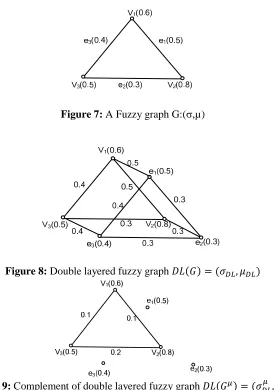
∧ ∧Remark 4.1. The µ-complement of DL(G) is the fuzzy graph G with its edge
membership value is always less than G.
Figure 7: A Fuzzy graph G:(,µ)
Figure 8: Double layered fuzzy graph ,
Figure 9: Complement of double layered fuzzy graph ,
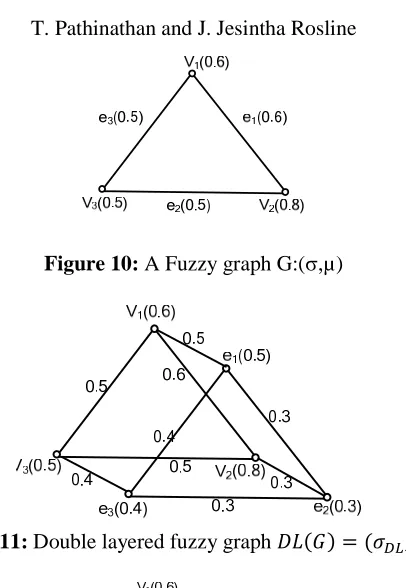
Remark 4.2. If G is a strong fuzzy graph then the µ - complement of DL(G) is isolated
vertices. Thus dDL( )u =0 for all
Figure 10: A Fuzzy graph G:(,µ)
Figure 11: Double layered fuzzy graph ,
Figure 12: Complement of double layered fuzzy graph ,
5. Conclusion
In this paper, we have defined a new fuzzy graph namely double layered fuzzy graph and illustrated with some examples. Further structures can be developed by increasing number of vertices and embedded cycles. These structural patterns with the inherent cycles give us an indicator to prove further into different patterns in networking models or classification tools.
Acknowledgements
1. A.Nagoorgani and J.Malarvizhi, Some aspects of total fuzzy graph, Proceedings of International Conference on Mathematical Methods and Computation, Tiruchirappalli, (2009) 168 – 179.
2. A.Nagoorgani and J.Malarvizhi, Some aspects of neighbourhood fuzzy graph, Inter. Journal of Bulletin Pure and Applied Sciences, 29E(2010) 327 – 333.
3. A.Nagoorgani and J.Malarvizhi, Properties of µ - complement of a fuzzy graph, Inter. Journal of Algorithms, Computing and Mathematics, 2(3) (2009) 73 - 83. 4. M.S.Sunitha and A.Vijayakumar, Complement of a fuzzy graph, Indian Journal of
Pure and Applied mathematics, 33(9) (2002) 1451-1464.
5. A.Rosenfeld, Fuzzy graphs, in: L.A. Zadeh, K.S. Fu, K. Tanaka and M. Shimura,(editors), Fuzzy sets and its application to cognitive and decision process, Academic press, New York (1975) 77 – 95.
6. A.Nagoorgani and K.Radha, The degree of a vertex in some fuzzy graphs, Inter. Journal of Algorithms, Computing and Mathematics, 2(3) (2009) 107 - 116.
7. R.T.Yeh and S.Y.Bang, Fuzzy relations, fuzzy graphs and their applications to clustering analysis, in: L.A. Zadeh, K.S. Fu, K. Tanaka and M. Shimura,(editors), Fuzzy sets and its application to cognitive and decision process, Academic press, New York (1975) 125 – 149.
8. A.Nagoorgani and M.Basheed Ahamed, Order and size in fuzzy graphs, Bulletin of Pure and Applied Sciences, 22E(1) (2003) 145 – 148.
9. J.N.Mordeson, Fuzzy line graphs, Pattern Recognition Letter, 14(1993) 381–384. 10. J.N.Mordeson and P.S.Nair, Fuzzy graphs and Fuzzy Hypergraphs, Physica Verlag
Publication, Heidelbserg, Second edition 2001.
11. T.Pathinathan and J.Jesintha Rosline, Characterisation of Fuzzy graphs into different categories using arcs in Fuzzy Graphs, Journal of Fuzzy Set valued Analysis (accepted for publication).
12. S.Samanta and M.Pal, Fuzzy tolerance graphs, International Journal of Latest Trends in Mathematics, 1(2) (2011) 57-67.
13. S.Samanta and M.Pal, Irregular bipolar fuzzy graphs, International Journal of Applications of Fuzzy Sets, 2 (2012) 91-102.
14. H.Rashmanlou and M.Pal, Isometry on interval-valued fuzzy graphs, International Journal of Fuzzy Mathematical Archive, 3 (2013) 28-35.