The IPO Underpricing Impact Analysis of Split Share
Structure Reform in China
Xiang Yingxuea, Huang Honglanb, Zhao Peibiaoa12
aDepartment of Applied Mathematics, Nanjing University of Science and Technology,
Nanjing 210094, Jiangsu, P. R. China
bWuhan Financial Trend Technology Co., Ltd.,
Wuhan 430000, P. R. China
Abstract When all the stocks are circulating in a hot market, Ljungqvist, Nanda, Singh(2003)(referred to as LNS model) first researched the IPO underpricing based on investor sentiment and proved that the optimal decision of underwriter is to offer stocks by many times. IPO underpricing is to compensate for the risk that the hot market will end too early. Combining LNS model with the split share structure in China, this paper researches the impact of split share structure on IPO underpricing, and poses a systematic theoretical model and proves the rationality of theoretical model through analysis of empirical. First, we analyze the case that the issuer sells IPO stock directly (direct selling) based on split share structure. The issuer is best to offer shares with many times to get a higher profit. Second, we also analyze the case that the issue chooses underwriter to sell IPO stock (under-writing) when the stock market exists split share structure. This case is divided into two cases: the underwriter has no non-tradable shares or has some non-tradable shares. The underwriter is also best to offer shares with many times. Compute the models of IPO underpricing of the two cases with maximum profit of the issuer and underwriter’s participation constraint. Through the models, we can see that the reform of split share structure does reduce the size of IPO underpricing with some requirements on the price and quantity of non-tradable shares. This also promotes Chinese stock market to further developing and mature.
KeywordsSplit share structure; IPO underpricing; Hot market; Investor sentiment
MR(2000)92F20, 53D11.
1
Introduction
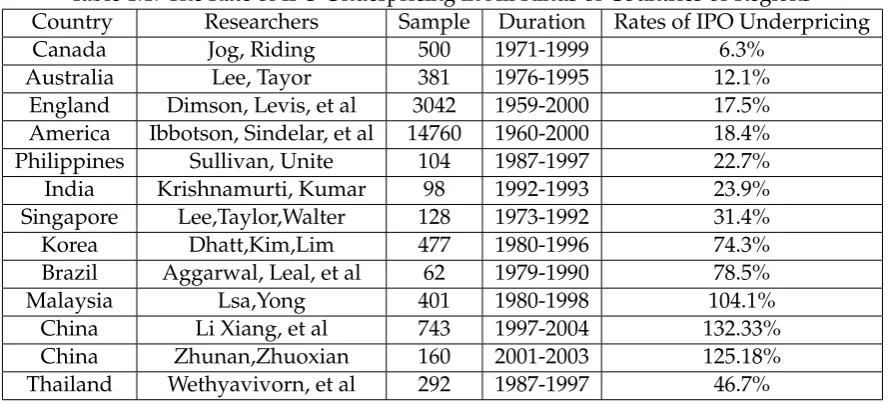
IPO underpricing (initial public offering) is a phenomenon that the initial issue price of newly issued shares in the primary market is lower than its listing price (the closing price on the first day) in the secondary market. Also, some researchers said it is IPO overpricing, which is a phenomenon that the listing price of newly issued shares in the secondary market is higher than its initial issue price in the primary market. Some researchers do the study to the ratio in a few areas, which are shown in table 1.1 below.
1Supported by NNSF of China(No.11871275; No.11371194), and by a Grant-in-Aid for Scientific Research from Nanjing University of Science and Technology (KN11008)
Table 1.1. The Rate of IPO Underpricing in All Kinds of Countries or Regions Country Researchers Sample Duration Rates of IPO Underpricing
Canada Jog, Riding 500 1971-1999 6.3%
Australia Lee, Tayor 381 1976-1995 12.1%
England Dimson, Levis, et al 3042 1959-2000 17.5%
America Ibbotson, Sindelar, et al 14760 1960-2000 18.4%
Philippines Sullivan, Unite 104 1987-1997 22.7%
India Krishnamurti, Kumar 98 1992-1993 23.9%
Singapore Lee,Taylor,Walter 128 1973-1992 31.4%
Korea Dhatt,Kim,Lim 477 1980-1996 74.3%
Brazil Aggarwal, Leal, et al 62 1979-1990 78.5%
Malaysia Lsa,Yong 401 1980-1998 104.1%
China Li Xiang, et al 743 1997-2004 132.33%
China Zhunan,Zhuoxian 160 2001-2003 125.18%
Thailand Wethyavivorn, et al 292 1987-1997 46.7%
In Table 1.1, the external data comes from Jay, R. Ritter ”Investment Banking and Se-curities Issuance” inHandbooko f Economicso f Financeedited by George Constantinides; Milton Harris and Rene Stulz, forthcoming. The domestic data comes from the relevant references. The special factors of systems in China have a great impact on IPO underpricing, and it leads to a higher IPO underpricing in China than other countries. The factors of systems include the split share structure, government regulation and so on. In this paper, we only study the influence of the split share structure. The split share structure means that the stock in the listing firms is divided into two kinds (tradable shares and non-tradable shares). The tradable shares refer to the stock in the listing firms that is offered publicly and the shareholder can transact in the bond exchange. On the contrary, the non-tradable shares which can not be transacted in the secondary market refer to the stock that the publisher sell to the investors through private transfer agreement signed, and it includes the country share, legal person’s, the inside staff’s and so on. Most shares of firms are non-tradable and these non-tradable shares account for two thirds of all the stocks. However, the shares of public offering are only a few parts. The non-tradable shares can affect the value of the shareholders because the cost of the two kinds of stocks is different. The split share structure only exists in China. The split share structure results in that the price of the non-tradable shares is far below the price of the tradable shares in the secondary market, because which the investors are indifferent to the tradable shares and the investors to buy public offering shares will suffer a loss. The structure has a great impact on the issued firms which always achieve the asset allocation through annexing the transaction of stock right in the secondary market and is harmful to the stock market in China which wants to be maturer. To solve the factor, the split share structure reform was carried out in Chinese market in 2005.The government transform the transaction from the non-tradable shares to the tradable shares. Then, the value of tradable shares is protected and the evidence of progress in the stock market of China is also evident.
1.2 The Current Research Situations of Domestic and External
primary market through researching the stock price of initial public offering from 1960 to 1969. In addition, he did the careful research on both the price and put forward 6 reasons to explain this phenomenon. Later, the phenomenon was called ”the riddle of new-stocks”. In recent decades, there are many foreign researchers doing theoretical analysis to this phenomenon. Of these, the system research is various models based on the information asymmetry between issuers, underwriters and investors. Generally, it can be divided into the following categories:
(1) The information asymmetry between issuers and underwriters ”Investment banking monopoly information hypothesis” is put forward by Baron [3]. He think that because of the information asymmetry between issuers and underwriters, the issuers are willing to underprice issue stock to the underwriters. The investment banks (underwriters) can exposure more directly to the stock market and know more about the demand information in the stock market than the issuers. In the course of pricing, the issuers can not see if the underwriters try their best to promote the stock to the secondary market, so the risk averse (the underwriters) hope the issuers can issue the stock in more underpricing to ensure the stocks in the secondary market are issued smoothly and they can capture more profits.
(2) The information asymmetry between investors The most classical study in this part is ”Winners’ Curse” which is posed by Rock [4]. He thinks that the information which is mastered by the investors is asymmetry. Some investors who are called ”the investors in the know” or ”the investors rich in information”, know about the prospect of the company and the information of the quality overall. Other investors are not comprehensive and called ”the unknown investors” or ”the investors short of information”. The first investors only buy the cheap stocks, but the second investors may buy the expensive stocks because of the incomprehensive information. It will bring in a risk or loss. The unknown investors may not buy stocks even there is not enough compensation to the risk of information. Based on this, the issuers are awaiting the two kinds of investors to buy the stocks to have enough demand on the market. The issuers compensate the information risk which the unknown investors bear, so that the unknown investors can be attracted to buy the stocks. Later, some researchers also make further study based on the Rock’s model, Betty and Ritter [5] found that there is a significant relationship between IPO Underpricing rate and the uncertainty of the stocks’ intrinsic value on the issuing company. Benveniste L. M. and P. A. Spindt [6], Benveniste and Wilhelm [8] put forward the Information Extraction Theorem and established a Book-building Model. They thought that the issuers underprice the stock in order to make the known investors inform the others to know the prospect and quality about the issue firm once they know the relative information about the company. Habib and Ljungqvist [9] put forward that the issuers tried to formulate the costs level which affected underpricing reasonably to have the smallest profit loss based on the Rock’s model.
the investors to buy the stocks through underpricing because this makes the investors know about the prospect of the company until enough knowing. Then they can estimate the inherent value of the stock to find that it is higher than the issue price. Afterwards, the issued company again issues the stock with the higher price in the later stage to compensate the loss in the initial stage. However, the later one only issues once in consideration of the little funds. Based on the model of Welch’s, Allen and Faulhaber [11] thought that the issued firm is willing to issue with the higher price, so that the investors regard this company as having the better prospect and invest this company. Crinblatt and Hwang [12] also thought so, because only the company with better quality can remedy the cost in the first stage. Brennan and Franks [13] again pointed out the investors which are attracted by underpricing are more than in the anticipation, so the investors on the large-scale institution would not affect the right of management and the right is still controlled by the issuers. Even though many researchers think the important factor of underpricing is the information asymmetry, later others put forward the opposite ideas. Cartter and Manaster [14] posed that the quality of the invested bank is in negative relation with IPO underpricing through studying in the medium institution. Koh and Walter [16] hold that the firms attract more investors to participate in the market through underpricing through studying the popular effect. Ritter [17] found that the information asymmetry might not be the estimate factor of underpricing. Later, a great deal of researchers analyzed underpricing from other factors. Jenkinson, Jones [19] considered the distributed field of the initial issued stock to receive that the information asymmetry have little effect on underpricing. Loughran and Ritter [20] considered the prospect of the company and the psychological accounting. The traditional financial theories are almost studied from the market information. In recent years, some researchers come to study the effect of investor sentiment. Ljungqvist, Nanda, Singh [21] proved there is also IPO underpricing from the aspects to consider investor sentiment under the assumption of market participants’ information symmetry, when the price is used to compensate the risk of the underwriters that the hot market will end ahead of time and the issued shares are to delay. Rajan and Servaes [22] found that irrational investors make the stock closing price is much higher than the intrinsic value of the stock and IPO underpricing increases obviously through studying the optimistic investors. Derrien [23] also thought the stock closing price is too high because of investor optimism.
From Table 1.1, we can also see that the rate of IPO underpricing in Chinese stock market is much higher than many other countries or regions. Many researchers analyzed this serious phenomenon and mainly considered from the distribution, pricing and Chinese special institutional factors.
(1) Issuing Mode. Chinese stock mostly issued in the way of underwriters underwriting. There is the time difference between the released stocks in the primary market and the existed stock in the secondary market, which will produce certain effect on the IPO price. Su, Fleisher [24] explained the IPO underpricing based on the waiting time and signal theory and thought that the company underprice shares in order to allow investors to gain value signal. They found the underpricing rate is high up to 949% through studying the newly issued 308 shares in A stock market from 1990 to 1995. Su [25] discovered that IPO underpricing in Chinese A stock market can be explained by the ”winners’ curse” and ”signal model” through empiric in general which were proposed by the foreign researchers. Li [26] posed that the size of underpricing was not affected by the influence of the system in the company, but had negative correlation with the issue price of the stock in the primary market and the number
of distribution and decreased with the increase of issue price and issue number. Mok, Hui [27] found the average IPO underpricing rate of 101 companies of initial public offering is 289.2% from 1990 to 1993 when making Shanghai A stock market as an example and the reason is that the stocks in the secondary market need a waiting time to issue. Chen, Firth, Kim [28] thought IPO underpricing in domestic stock market may have resulted from the following aspects: the issuers do not have enough experience, the investors do not have either, the waiting time between issue in the initial market and list in the secondary market. Chan, Wei, Wang [29] put forward that the more the waiting time and IPO quota system, the more IPO underpricing and decreased as they decreased. Fei Y., Li H. and Liu Y. [30] discussed the reasons of IPO underpricing from the initial market and the secondary market through combining the IPO theory knowledge with the market behavior.
(2) Pricing Model. At present, the pricing modes of Chinese IPO underpricing include inquiry system, control earnings etc. Wang Haifeng et al [31] thought the underpricing rate determined by inquiry system is lower than by control earning, which is because the issuers and the underwriters can more accurately determine the IPO price in the process of inquiry. Yang Jijun, Zhao Changwen and Yang Dan [32] found the IPO indirect cost in the inquiry system reduced namely IPO underpricing rate decreased through the comparison in the point of the issuing company (means the size of underpricing is also an indirect cost). Ma Junlu and Liu Jia [33] proved the correlation of the underpricing rate and the pricing mode through compering the stocks under the inquiry system.
(3) Institutional Factors. The institutional factors in China include the split share struc-ture, government regulation and so on, which all enlarge the rate of underpricing. Xiao Shuguang and Jiang Shuncai [35] analyzed the effect on IPO underpricing from the aspect of institutional changes. Liu Yuhui and Xiongpeng [36] posed the basic factor that the domestic IPO underpricing is higher than external is the institutional factor in China. Only make improved measures in the aspect of the split share structure and government regulation, can the serious phenomenon of Chinese IPO underpricing change. Boji and Zhou Xiaohua [37] divided IPO underpricing into two parts: the underpricing in the market and in the rules. And the underpricing in the market can be used to explain the underpricing in various countries or areas, whereas the underpricing in the rules is resulted in the special rules in China, and the reform of the split share structure can bring in defined effects and changes. Throughout the research situation at home and abroad, it is not difficult to find that the researchers at abroad mainly explain underpricing in the information asymmetry and few studies have considered the whole process of issuance. However, the researchers at home are almost based on the external theoretical model, and assume IPO underpricing factors from empiricism, then prove the validity of the results through analyzing the empiric. In 2005, there are institutional changes in Chinese stock market, which is the split share structure reform. The reform has executed for 6 years, but a lot of Chinese listed company stocks are still belong to non-circulation shares and the reform still have not been solved completely. A lot of scholars have discussed the effects of equity division reform on IPO underpricing in response to this change which is mostly empirical analysis and not given a complete model to prove the specific effects to IPO underpricing. This paper builds the IPO underpricing models based on the equity division reform from the angle of quantitative analysis and provides the optimization strategy of IPO, and tests the feasibility and the stability of the model through the empirical analysis.
In Section 1, we briefly introduce IPO and compare the rate of underpricing in some countries or regions, and describes the research status of the IPO underpricing at home and abroad.
In Section 2, we firstly offer the assumptions of the underpricing model and establish the relationship between the price, quantity of the non-tradable shares and the tradable stocks, and distribute the whole process of the circulation stock into different stages, then the emotional and rational investors value the intrinsic value of each of the stock based on their own ideas before the stocks are listed.
In third Section, we mainly establish the underpricing model of two stages issued stocks based on the equity division. Firstly, we establish the issuer profit maximization model when directly sale to know the number of issued stocks in two stages of the secondary market. Then, we consider the participation constraint when the single underwriter underwrites all the circulating stocks. The individual underwriter in the market can be divided into two categories: the underwriters do not hold non-tradable shares and hold parts. And we determine the total circulation and the IPO price of the circulation stock accordingly draw the underpricing formula. Finally, we study the effects to the underpricing on the number of the issued shares, the ratio of the price and the quantity between the non-tradable and the tradable stocks, the long-term gains.
The forth Section extents from two aspects based on the third section: the two stages extended into multiple stages; the single underwriters changed into a plurality of underwrit-ers. Then, we offer the optimal issuance strategy the underwriters should take in different situations.
In fifth Section, according to the conclusions in the front chapters, we validate the model in the third section according to the data of the initial public offering companies of A shares on Shanghai stock exchange market from 2000 to 2010. The results posed here show that the proposed theoretical model is applicable and has a certain reference value.
The solved problems and innovation of this paper are as follows
(1) Compared with the previous literature based on the market information, this article considers all the IPO distribution process from the aspect of the investor sentiment in the hot market. And we put forward the optimal issuance strategy of the issuers and the underwriters is going to issue the stock in stages to obtain higher profit based on the share of the market.
(2) This paper considers the underwriters as the investors participating in the market compared with the previous articles which only consider the underwriters as the agency. Based on the equity division, respectively discuss the underwriters do not hold non-tradable shares and hold portion, obtain the theory model of the IPO underpricing, study the effects to the underpricing on the various factors of the equity division, and consider the market effect after the reform of the equity division.
(3) The two stages extended into multiple stages and the single underwriters changed into a plurality of underwriters, then we obtain the IPO underpricing.
(4) This paper tests the feasibility and the correctness of the offered models and the theoretical results according to the empirical analysis.
2 Preliminaries
2.1 The Model Assumption Conditions
In terms of issuances and market participants, the model admits the following several assumptions:
Hypothesis 1: The issued company only issues the initial public offerings of shares in hot markets within the short term.
Hypothesis 2: The emotions of all the participants in the IPO market and the secondary market are divided into two kinds, namely the perceptual and the rational. The perceptual investors think the next phase of the market will continue to be the status, in which the market is the hot market, the next phase will also be the hot market and the opposite is also. However, the rational investor is not so, they can estimate rationally the fundamental value of the asset. As is now the hot market, the rational investor will think the next stage may be the hot market, also may no longer be the hot market. Similarly, as is now a bear market, the rational investors are not convinced that the next phase is still a bear market.
Hypothesis 3: The retail investor is sensible, and in hot market, they always estimate over the assets. Other participates (the issuers, the underwriters, the institutional investors) are all rational, and they can make unbiased appraisal assets according to the future of the company.
Hypothesis 4: There is not the private or asymmetric information in the market. All the information on the market is public and the participants all know each other’s view. That is, in the IPO stock valuations, the perceptual and rational investors all know each other’s valuation size, but they all insist on their own point of view, and their own view is more correct.
Hypothesis 5: All the participants in the market (issuers, underwriters, institutional investors, retail investors) are risk neutral.
only when the stock is in great demand, the stock is very good, and the spirit is very high. Therefore, the assumptions above are reasonable.
Due to the existence of equity division, there are many non-circulation stocks in Chinese A-share market. Assuming all the circulation shares are publicly and completely sold out in the secondary market. All the non-tradable shares are completely sold out in relatively lower prices and people can transfer agreement privately.
Let denote the total circulation of the stock byQ, of which, the number of non-tradable shares is denoted byQFLT, the number of the overall tradable shares isQLT, soQ=QFLT+QLT. Let the ratio of non-tradable shares and tradable shares beθ, that is, QFLT
QLT = θ, it is obvious
thatQ=(1+θ)QLT.
The model posed in this paper should be divided the whole issued process of IPO stock in primary and secondary market into four stagest=0,1,2,3.
(1) When t = 0, the stock will be issued in the primary market and the issuers will determine the quantity and the price of the current stock.t=1,2,3, three stages are the stage where all the current stock is issued in the secondary market.
(2) When t = 1, the current stock began to public offer in the secondary market. This stage is the certain bull market in which the stock is sold like hot cakes. In short-term issue, t=1 can also be the first issued day of the circulated stock in the secondary market. After the issuance in the secondary market, that is the back of the stage, the market may continue to the bull market according to the expectation of the perceptual investors, may also no longer be the hot market, but whatever the case is, the prices in the bull market will eventually have a clear end.
(3) Whent=2, this is a period of time fromt=1 to the clear end of the hot market, that is, the market is uncertain in this stage, and it may be like the expectation of the perceptual investors for the hot market, but can also dodge quickly and is no longer a hot market.
(4) Whent=3, this is the time of the end of the hot market when all the stocks issued in the secondary market. In this time the perceptual and rational investors all know the stock price is down to the intrinsic value points, and the valuation of the stock is the intrinsic value.
Denote the IPO price byP0, the prices of the current stock int = 1,2,3, respectively, by
P1,P2,P3, and write PFLT
P1 =γ.
Since the market is uncertain in the stage oft=2, the market may continue to bullish on the front stage, and may also be the weakened market and no longer a hot market. Noteµas the probability of the end of the hot market att=2. Two kinds of participants have different opinions to the stock value, in essence, are holding the different opinions to the size ofµ. The perceptual investors think that the hot market will certainly continue tot =2, namely the hot market will end in the probability ofµ=0 att =2. However, the rational investors do not think so, they think that the hot market will end in the probability ofµ >0 att=2.
2.2 The Valuations of Stocks Before Listing
t = 3 is the clear end time of the hot market, this time the stock price is down to intrinsic value point, namelyP3 =VL.
For convenience, the hypotheses in this paper that the perceptual investors are con-strained by budget and their appraisal of the IPO are quite different from the rational investors’ view before IPO listing in the secondary market. Because their budget demand of IPO is the current stock in the secondary market, the total demand curve to IPO can be recorded as:
QdLT= VL+a
b −
VG b .
The perceptual investors’ valuation to each of the IPO intrinsic value is:
VG=VL+a−bQdLT (2.2.1)
whereais constant and is the overestimated part caused by the perceptual investors optimism than the rational investors, also is the protruding part to each IPO appraisal by the perceptual investors whenQdLT =0. bis the slope of the function, and indicates the opposite change of VGcaused byQdLT when it changes a unit.
WhenVG=VL, thenQLTd = ab, one can define ¯Q= abas the general optimal demand; For anyQd
LT<Q¯, there isVG>VL, that is, for each IPO, the valuations of the perceptual investors is higher than the rational investors’;
For anyQd
LT>Q¯, there isVG<VL, that is, for each IPO, the valuations of the perceptual investors is lower than the rational investors’;
WhenQd
LT =Q¯, there isVG = VL, that is, for each IPO, the valuations of the perceptual investors is equal to the rational investors’.
Since there is no private or asymmetric information, the perceptual investors and the rational investors all know each other’s valuations of IPO. But they estimate the intrinsic value of each stock according to their own respective idea. This hypothesis is not to say all the perceptual investors take participate in the market int =1, so that we can easily set up a dynamic model in which the hot market may be ended before t = 2. If the market continues to be the good market (the hot market) on the front stage int = 2, there will be other perceptual investors who see the good prices to participate in this market. Therefore, the demand of the perceptual investors is in two sessions oft=1 andt=2. The perceptual investors value the stock before buying the stock, and they can buy the stock whose price is lower than their valuations. Because of their perceptual mood, they think the next stage will surely be a hot market, and they will value to each stock based on the forecasts of the IPO demand int=2. The perceptual investors’ forecast of the demand includes not only the perceptual demand int=1, but also the demand of all the perceptual investors int=2. The demand in the whole process of the issue will bring a certain change toVGin type (2.2.1).
3 IPO Underpricing Models Based on Two Stage Issuances With
Splitting Share Structure Reform
3.1 IPO Sold Directly
a combination of the optimal issue strategy when direct marketing. To obtain the issue price of the IPO shares int =0 and their listed price int =1, it is necessary to calculate the transaction price of each IPO shares int=2. If the bull market continued untilt=2 based on the expectation of the emotional investors, then the price will be determined by the valuation of the emotional investors to the intrinsic value of each stock in formula (2.2.1). If the bull market is ahead of the end, the trading price of each stock int =2 will be the valuation of the rational investors to the intrinsic value of each stock before listing, i.e., the intrinsic value of a clear end of the bull market, that isP2=VL. Set the initial public offering circulation of the tradable sharesQLT <Q¯, and then there will be an optimal solution ofQLTto maximum the profits of the issuers (see below). Int = 0, the total number of the tradable stocks and the non-tradable shares determined by the issuers isQ, of which the number of the tradable shares isQLT = 1+θQ , the rational investors and emotional investors int = 1 respectively do the following estimates according to their own point of view to the transaction price of each IPO stock int=2:
The rational investors: EL(P2)=µVL+(1−µ)EG(P2); The perceptual investors: EG(P2)=VL+a−bQdLT.
Since the emotional investors believe that the bull market will certainly continue tot=2, they forecast the demand int =2 is the total emotional demand at the two time periods of t=1,2. So their expected price int=2 is consistent withVG, that isEG(P2)=VL+a−bQd
LT. Emotional investors’ and rational investors’ expected price in t = 2 is also the price they were willing to buy the stock int=1, because if they purchase the stocks in accordance with the price oft =1, they believe that they can sell them at this price int =2, at least without loss. When the market achieved a balanced status, the demand is equal to the issuance, that isQdLT=QLT, thus there are
EG(P2) = VL+a−bQdLT = VL+a−bQLT EL(P2) = µVL+(1−µ)EG(P2)
= µVL+(1−µ)(VL+a−bQLT) = VL+(1−µ)(a−bQLT).
On the other hand, there is VG > VL if QLT < Q¯, that is, a −bQLT > 0, so EL(P2) > VL. The expected price of the rational investors int=2 is higher than its intrinsic value, which is because the expectation of the participants in a rational market (such as the issuer, the underwriters) is that if the market continued to be a hot market int =2 in accordance with the probability of (1−µ), then they will sell the remaining stocks to the perceptual investors. LetP1be the trading price int=1, for investors, the price they are willing to pay int=1 is their expected trading price of the stocks int =2. Let ¯Q1 ≤Q¯ be the optimal demand of
the emotional investors int =1. Whenq1 ≤ Q¯1, the circulation is less than the demand of
the emotional investors int=1, the emotional investors is optimistic to the market and their valuation of each stock is higher than the rational investors’, so the issuers sell stocksq1 to the emotional investors with the price ofEG(P2) int = 1. Whenq1 > Q¯1, the circulation is
emerge int=2. That is
P1=
(
EL(P2)=µVL+(1−µ)EG(P2)=VL+(1−µ)(a−bQLT),i f q1>Q¯1
EG(P2)=VL+a−bQLT, i f q1≤Q¯1 (3.1.1)
Suppose the issuer determine the circulation and the price of the IPO shares to get the most profit for their own. Assume that the issuanceQof the stocks is given, and then the number of the tradable sharesQLTis also identified. Recordedq1as the sold number of IPO shares on
the secondary market int=1, andq2as the sold number of the IPO shares on the secondary
market int =2. Assume the issuer is rational, and his expected price int=2 isEL(P2). For the issuers his proceeds include the proceeds of all the sold tradable shares and non-tradable shares, that is, there exists
Ψ = q1P1+q2EL(P2)+QFLTPFLT
= q1P1+q2[µVL+(1−µ)EG(P2)]+θQLTγP1.
The issuer’s profit function is the part of the earnings over its intrinsic value after the stock issued, that isπ= Ψ−VLQ. The optimal circulation (q∗
1,q∗2) int = 1,2 is the optimal
solution of the following constraint problem
max q1,q2
π= Ψ−VLQ
=q1P1+q2(µVL+(1−µ)EG(P2))+θQLTγP1−VLQ
=q1P1+q2(µVL+(1−µ)EG(P2))+θQLTγP1−VL(1+θ)QLT s.t. q1+q2 =QLT.
Theorem 3.1.1. Assume that the total amount Q of all the tradable stocks and non-tradable stocks, and the number of the tradable shares QLT = 1+θQ are given, then the optimal circulation(q∗
1,q∗2)in
t=1,2is given by
(q∗1,q∗2)= (
(QLT,0), i f QLT≤Q¯1
( ¯Q1,QLT−Q¯1), i f QLT>Q¯1 (3.1.2)
Proof. By using the formula (3.1.1), we get
1) WhenQLT>Q¯, a) ifq∗1>Q¯1, thenP1 =EL(P2)=VL+(1−µ)(a−b(q1+q2)). Let ˆq1=ˆQ¯1,
the circulationq2 = qˆ2=ˆQLT−Q¯1, in t =2, for ˆq1 < q∗
1. It is easy to see that from the above
equationP1is decreasing with respect toq1, that is, P1( ˆq1) >P1(q∗1), and one can also have
the following
π = q1P1+q2EL(P2)+θγQLTP1−VL(1+θ)QLT = q1P1+q2+P1+θγQLTP1−VL(1+θ)QLT = QLTP1+θγQLTP1−VL(1+θ)QLT.
Thus we know thatπ( ˆq1)> π(q∗1).
b) Ifq∗
1 =Q¯1, thenP1=EG(P2). Set ˆq1=ˆQ¯1, the circulationq2=qˆ2 =QLT−Q¯1, int=2, for
ˆ
q1>q∗1. By a direct computation, it is easy to show that there holds the following
π = q1P1+q2EL(P2)+θγQLTP1−VL(1+θ)QLT
This shows in this case thatπis an increased function ofq1.
In summary, whenQLT>Q¯1, only whenq∗
1=qˆ1 =Q¯1,πis achieved the maximum.
2) WhenQLT ≤Q¯1,P1 = EG(P2). Similarly, we know thatπ=QLT[EG(P2)+θγEG(P2)−
VL(1+θ)]−µ(QLT−q1)(EG(P2)−VL). πis an increased function ofq1. That is to say,πis
achieved the maximum whenq∗
1 =QLT. The proof of Theorem 3.1.1 is completed.
From Theorem 3.1.1, it can be seen that the issuer who sold all the IPO shares in the market at once will not have more profit than that with two phases issued. In order that the buyers int=1 are all the emotional investors, the issuers can control the circulationq1≤Q¯1 to make the supply be less than the demand of emotional investors. Intuitively, it can be easily seen that if the number of the total circulation QLT < Q¯1, the optimal distribution
strategy of the issuers is to sell all the tradable shares to the perceptual investors at a higher price att =1, such that the circulation int=2 isq∗
2 =0. If the issuers can sell the stocks to
the emotional investors at a higher price int = 1, whereas deliberately delayed untilt= 2, they will not have the above advantages of the price. If the bull market ends ahead of time in t=2, the sold-delay will make the issuer face a greater market cash flow risk. If the number of total circulation of sharesQLT > Q¯1, the optimal distribution strategy of the issuer is to sell parts of the stocks to the emotional investors int = 1 by using their emotional mood to make such a misconception that the bull market will continue tot =2, and then sell the remaining shares to the emotional investors in the next phase at a higher price.
3.2 Individual Underwrite IPO Shares
Underwriting the IPO shares is the phenomenon that the issuing company sells all the stocks which will be issued and listed to issue listed to the securities intermediaries (namely the underwriters) in the initial market with a certain price, then the underwriters trade these stocks in the secondary market. The securities intermediaries underwriting IPO shares can be divided into two categories: underwriters do not hold the non-tradable shares and the underwriters hold parts of the non-tradable shares. Here IPO underpricing problem are discussed based on the two cases.
3.2.1 Underpricing When Underwriters No-holding Non-tradable Shares
Assume that prohibit buying and selling stocks among the underwriters, and allowsthe underwriters to sell the stocks in stages. If the underwriter does not hold non-tradable shares, only underwriting all of the outstanding shares, once the demand function of the emotional investor is created, the underwriters buy all the tradable stocks QLT from the issuer with the price ofP0in the primary market, and then sellq1,q2, int=1,t=2. When the stock is sold, the problem of the underwriters in the secondary market is the same with the previous problem of the issuer’s direct marketing. The revenue function of the underwriters: Ψ0 =q
1P1+q2EL(P2). When the underwriters determine the circulation in two time periods
oft=1,t=2, the problem is given as follows
max q1,q2
Ψ0=q
1P1+q2EL(P2)
Theorem 3.2.1. The optimal circulation of the underwriters in t=1,t=2is given by
(q∗1,q∗2)= (
(QLT,0), i f QLT≤Q¯1
( ¯Q1,QLT−Q¯1), i f QLT>Q¯1 (3.2.1)
Proof. According to Formula 3.1.1, one gets the following 1) In caseQLT >Q¯1.
a) Ifq∗
1 > Q¯1, thenP1 = EL(P2) = VL+(1−µ)[a−b(q1+q2)]. Set ˆq1=ˆQ¯1, the circulation
in t = 2 q2 = qˆ2 = QLT−Q¯1 for ˆq1 < q∗1. It can be seen from the above equation thatP1 is
a decrease function with respect toq1, that is, P1( ˆq1) > P1(q∗1). On the other hand, there is
Ψ0 =q−1P
1+q−2EL(P2)=(q1+q2)P1=QLTP1, then we knowΨ0( ˆq1)>Ψ0(q∗1).
b) Ifq∗
1 <Q¯1, thenP1 =EG(P2). Set ˆq1 =Q¯1, the circulation int =2q2qˆ2 =QLT−Q¯1for
ˆ
q1>q∗1. At the same time, there holds
Ψ0 = q1P1+q2EL(P2)
= q1EG(P2)+q2[µVL+(1−µ)EG(P2)] = q1EG(P2)+q2µVL+q2EG(P2)−q2µEG(P2)
= (q1+q2)EG(P2)+µq2VL−µq2EG(P2)
= QLTEG(P2)+µq2(VL−EG(P2))
= QLTEG(P2)+µ(QLT−q1)(VL−EG(P2)) = QLT[EG(P2)−µ(QLT−q1)(E(P2)−VL)].
This implies thatΨ0 is an increased function ofq
1. That is to say,Ψ0(q∗1)< ψ0( ˆq1).
In summary, whenQLT>Q¯1, and only ifq∗
1 =qˆ1=Q¯1,Ψ0 is achieved the maximum.
2) WhenQLT≤Q¯1,P1=EG(P2). Similarly, we getΨ0 =QLTEG(P2)−µ[(QLT−q1)(EG(P2)−
VL)] andΨ0is an increased function ofq1. Thus, we know thatΨ0is achieved the maximum
whenq∗
1=QLT. The ends the proof of Theorem 3.2.1.
Remark 3.2.1. It is obvious that the optimal distribution strategy of the underwriters is to sell q∗1,q∗2, in t=1,t=2. This strategy also requires that when the number of the circulation shares QLT >Q¯1,
the underwriters must remain q∗
2copies of the outstanding shares until t=2. It can be seen from the
payofffunction of the underwriters that the underwriters have no motivation to comply with the sales strategy.
In order to achieve a balanced state, the underwriters will underwrite the IPO shares only when their own profit is not less than 0. If the underwriters purchase all the outstanding shares from the issuer according to the priceP0 of each IPO stock in the primary market, and sellq∗
1with the priceP1 of int = 1 and soldq2∗ with the priceEL(P2) int = 2, then the
underwriter’s profit function isπ0 = q∗
1P1+q∗2EL(P2)−QLTP0, whereq∗1,q∗2 are the optimal
solution of (3.2.1). q∗
1P1+q∗2EL(P2) is the benefits which the underwriters sell stocks in the
secondary market int =1,t =2 to get. QLTP0is the costs that the underwriters buy all the
IPO tradable stocks in the primary market.
The constraints the underwriters involved in the market are as follows
π0 = q∗1P1+q2∗EL(P2)−QLTP0
= q∗P1+q∗2[µVL+(1−µ)EG(P2)]−QLTP0 (3.2.2)
As in the previous assumptions, the goal of the issuer is to make the profit functionπ that the price to sell the stock exceed to its intrinsic value achieves the maximum, coupled with the constraints of the above (3.2.2). The problem that the issuers determine the issue number and issue price is exactly as
max Q,P0
π=QLTP0+QFLTPFLT−QVL
s.t. π0 ≥0.
Lemma 3.2.1. The constraints the underwriters involved in the market do always exist.
Proof. If there is no such constraints, then the issue numberQLTand the issue priceP0of the tradable shares does not have any restrictions. The issuers can be unrestricted to improve QLT and P0 to increase their profits, which is conflicted with the existence of the optimal
solution toQLTandP0. Therefore, the constraint is always there.
Based on Formula (3.2.2), it is known
π0=q∗1P1+q∗2[µVL+(1−µ)EG(P2)]−QLTP0≥0.
That is
q∗1P1+q∗2[µVL+(1−µ)EG(P2)]≥QLTP0.
The issuer’s profit function can be written as
max Q,P0
π = QLTP0+QFLTPFLT−QVL
= q∗1P1+q2∗[µVL+(1−µ)EG(P2)]+θγQLTP1−(1+θ)QLTVL.
whereq∗
1,q∗2are the optimal solution in front equation (3.2.1). q∗1P1+q2∗(µVL+(1−µ)EG(P2))
is the expected return of the issuers to the IPO shares sold in two phases. θQLTγP1 is the
proceeds that the issuers sell all the non-tradable shares. (1+θ)QLTVLis the intrinsic value of all the tradable shares and non-tradable shares. By Theorem 3.2.1, we can getq∗1 ≤Q¯1, so
P1is the expected price of the emotional investors int=2, that is,P1=EG(P2). Then, we get
the issuer’s profit function as
max QLT
π = q∗1P1+q∗2(µVL+(1−µ)EG(P2))+θγQLTP1−(1+θ)QLTVL
= q∗1EG(P2)+q∗2(µVL+(1−µ)EG(P2))+θQLTγEG(P2)−(1+θ)QLTVL.
whereq∗1,q∗2are the optimal solution of (3.2.1), which are the function of the circulationQLT of the outstanding shares.
Theorem 3.2.2. If there is only one underwriter in the stock-market without holding any non-tradable shares, then the optimal choice of the issuers to the number of the outstanding shares is
Q∗LT =
θ(γ−1)VL+Aa−µbQ1
2b(1+γθ−µ) , i f Q1 < θ(γ−1)BVL+Aa,
(1+γθ)a+θ(γ−1)VL
2b(1+γθ) , otherwise
The optimal sold quantity q∗
1and q∗2in t=1,t=2are
(q∗1,q∗2)=
(Q1,θ(γ−1)VL+Aa−µbQ1
2b(1+γθ−µ) ), i f Q1 < θ(γ−1)BVL+Aa, ((1+γθ)a+θ(γ−1)VL
2b(1+γθ) ,0), otherwise
The optimal number of tradable shares and non-tradable shares issued by the issuer are as follows
Q∗=
(1+θ)θ(γ−1)VL+Aa−µbQ1
2b(1+γθ−µ) , i f Q1 < θ(γ−1)BVL+Aa, (1+θ)(1+γθ)a+θ(γ−1)VL
2b(1+γθ) , otherwise
The price of the IPO stocks is
P0=
QLTP1+µq∗2VL−µq∗2P1
QLT
.
The IPO underpricing is
R=P1−P0= µq
∗
2(P1−VL)
QLT .
Proof. 1) WhenQLT >Q1, there hold the followingq∗1 =Q1,q∗2=QLT−Q1, and
max QLT
π = q∗1P1+q∗2(µVL+(1−µ)EG(P2))+θQLTγP1−(1+θ)QLTVL
= q∗1EG(P2)+q∗2[µVL+(1−µ)EG(P2)]+θQLTγEG(P2)−(1+θ)QLTVL = q∗1EG(P2)+q∗2µVL+q∗2(1−µ)EG(P2)+θQLTγEG(P2)−(1+θ)QLTVL = (q∗1+q∗2)EG(P2)+µq∗2(VL−EG(P2))+θγQLTEG(P2)−(1+θ)QLTVL = (1+θγ)QLT(VL+a−bQLT)+µ(QLT−Q1)(bQLT−a)−(1+θ)QLTVL.
By a direct computation, we get
dπ
dQLT = (1+θγ)(VL+a−2bQLT)+µ(bQLT−a+bQLT−bQ1)−(1+θ)VL = 2bQLT(µ−1−θγ)+(γ−1)θVL+(1+θγ−µ)a−µbQ1.
Set dπ
dQLT =0, one gets
Q∗LT= θ(γ−1)VL+(1+γθ−µ)a−µbQ1 2b(1+γθ−µ) .
In this case, there isQ∗
LT >Q1, that is,Q∗LT =
θ(γ−1)VL+(1+γθ−µ)a−µbQ1
2b(1+γθ−µ) >Q1, thus we have
Q1 < θ(γ−1)VL+(1+γθ−µ)a 2b+2bγθ−bµ .
2) WhenQLT ≤Q1, we haveq1∗ =QLT,q∗2=0, and
max QLT
π = q∗1P1+q∗2(µVL+(1−µ)EG(P2))+θQLTγP1−(1+θ)QLTVL
Similarly we arrive at
dπ
dQLT = (1+θγ)(VL+a−2bQLT)−(1+θ)VL = −2bQLT(1+θγ)+(1+θγ)a+θ(γ−1)VL.
Put dQdπ
LT =0, we obtain
Q∗LT = θ(γ−1)VL+(1+γθ)a 2b(1+γθ) .
When the number of total issued shares and the number of the outstanding shares have been identified, again calculate the IPO price. Then, we get
π0=q∗1P1+q∗2[µVL+(1−µ)EG(P2)]−QLTP0≥0
The equality holds if the profits of the issuers to achieve the maximum. In this case, one has
P0=
QLTP1+µq∗2VL−µq∗2P1
QLT
.
The IPO underpricing is
R=P1−P0=
µq∗
2(P1−VL)
QLT .
This implies that Theorem 3.2.2 is proved.
If you only consider the sentiment of the investors, then if QLT > Q1, i.e., Q1 < θ(γ−1)VL+(1+θγ−µ)a−µb
2b+2bγθ−µb , the issuer gets the most profits when q∗2 > 0. In stock-underwriting,
the issuer hopes that the underwriters hold part of the outstanding shares until t = 2. At t=2, if the market continues to be the hot market, then the underwriter can sell the stock to the perceptual investors at higher prices at this time; if the market is no longer a hot market, then the stock price will be reduced to its rational intrinsic valueVL. For the underwriters, they need to take the risk of the end of the hot market and the reduced stock, so when they buy the tradable stocks from the issuer, the price that is the issue price at the first time needs a discount, related to the first trading price in the secondary market, P0 < P1. WhenQ1is
large enough, in this model, withQ1 ≥ θ(γ−1)VL+(1+γθ−µ)a−µb
2b+2bθγ−bµ ,q∗2 =0. Int =1, the
underwrit-ers can sell all the outstanding shares at the higher valuation of the emotional investors to the emotional investors. In this case, the underwriters will no longer bear the risk of the termination of the hot market int = 2. For the issuers, the underpricing will only reduce their own profits, and no benefits are available. It does not exist underpricing,P0=P1.
4 The Expanded Model Based On Two Stage Issuances and On A
Single Underwriter Of Split Share Structure Reforms
4.1 The Expanded Multiple-Term Models
to more time 0,1,2,· · ·,T. But as the market is gradually faded, the need of the perceptual investors is less and less gradually. Especially, note: Qt+1=kQt,0<k<1. Other conditions are same with the model hypothesis of the first two stages issuance, the hot market in each next period will end in probabilityµand is to be continued with the probability (1−µ) for the following hot market. The general circulation of the tradable stock is big enough to meet the needs of the perceptual investors to the stock in T stage. The best strategy to sell is issuing all the tradable stocks into T periods, to make the perceptual investors participate in the market in each time period, until all the current stocks have been sold or the hot market has a clear end time. The valuation of the perceptual investors to each stock before listing is stillVL+a−bQLT. The general circulation of the tradable stock is
QLT=Q1+Q2+· · ·+QT = 1−k T
1−k Q1.
The total circulation of the tradable stocks and the non-tradable stocks in the issuing company is
Q=QLT+QFLT=(1+θ)1−k T
1−k Q1.
The underwriters buy current stocksQLT with the priceP0in initial market, and sellQ1 in
t=1. If the hot market is still in next period, then sellQ2att=2, in turn so on, until all the
current stocks are sold. The profit function of the issuer is
π=QLT(P0−VL)+θQLT(γP1−VL).
The participated constraint condition of the underwriters is as follows
Q1P1+Q2EL(P2)+Q3EL(P3)+· · ·+QTEL(PT)−QLTP0≥0.
Then, we arrive at the problem below (
max π=QLT(P0−VL)+θQLT(γP1−VL)
s.t. Q1P1+Q2EL(P2)+Q3EL(P3)+· · ·+QTEL(PT)−QLTP0≥0.
Similar to the model of the front two-period, when the market has enough circulations, the price EL(Ps) that the underwriter sell the stocks in t = s(1 ≤ s ≤ T−1d) is the valuation EG(Ps+1) that the perceptual investors estimate in next times+1. So we get
EG(P2)=P1,EG(P3)=EL(P2),· · ·,EG(PT)=EL(PT−1)
EL(P2)−VL = µVL+(1−µ)EG(P2)−VL = (1−µ)(P1−VL)
EL(P3)−VL = µVL+(1−µ)EG(P3)−VL = (1−µ)2(P1−VL)
· · ·
EL(PT)−VL = (1−µ)T−1(P1−VL).
When the profit of the issuer achieves the maximum, in this case, there holds
By a direct computation, we have
QLT(P0−VL) = QLTP0−QLTVL
= Q1P1+Q2EL(P2)+· · ·+QTEL(PT)−(Q1+Q2+· · ·+QT)VL = Q1(P1−VL)+kQ1(1−µ)(P1−VL)+· · ·+kT−1(1−µ)T−1(P1−VL)
= Q1(P1−VL)1−k
T(1−µ)T 1−k(1−µ) .
SinceP1=EG(P2)=VL+a−bQLT,QLT= 1−k
T
1−kQ1, then we arrive at
QLT(P0−VL) = Q1(a−b1−k
T
1−k Q1)
1−kT(1−µ)T 1−k(1−µ) . π = QLT(P0−VL)+θQLT(γP1−VL)
= Q1(a−b1−kT 1−k Q1)
1−kT(1−µ)T 1−k(1−µ) +θ
1−kT
1−k Q1[γ(VL+a−b 1−kT
1−k Q1)−VL].
Let dπ
dT =0, we obtainT∗(γ, θ). Thus we know that the optimal amount of the current stock issuance is
QLT= 1−kT ∗
1−k Q1,
and the total circulation of the tradable stocks and the non-tradable stocks in the issuing company is
Q=(1+θ)1−k T∗
1−k Q1. The price of the stock int=1 is
P1=EG(P2)=VL+a−b1−k T∗
1−k Q1. The price of IPO stock is
P0 =VL+a−b1−kT ∗
1−k Q1
1−kT∗
(1−µ)T∗ 1−k(1−µ)
1−k 1−kT∗.
The suppression price of IPO stock is
R=P1−P0=a−b1−kT ∗
1−k Q1
1−1−k
T∗
(1−µ)T∗ 1−k(1−µ)
1−k 1−kT∗
.
Similarly, we can get the relation between the ratioγof the IPO price with the price of the non-tradable and tradable stocks and the ratioθof the number of the non-tradable stocks with the tradable stocks.
Assume that the probability for a hot market in each period is (1−µ), and the probability of the termination for the hot market isµ, then the length of the expected time of the hot market is
Theorem 4.1.1. When the circulation of the current stock is big enough to meet the perceptual demand in every period, then the length of the expected time of the hot market is E(T)= 1
µ.
Proof. By usingE(T)=1·µ+2(1−µ)µ+3(1−µ)2µ+· · · and a direct computation, it is not
hard to show thatE(T)= µ1.
Remark 4.1.1. Theorem 4.1.1 implies that the length of the hot market is less than 2 years in the sense of expected times.
4.2 The Model Expands To Multiple Underwriters
If there areN(N> 1)-underwriters simultaneously underwriting the IPO shares on the market, then each of the underwriters is free to choose its own issuance strategy on the stock. Regarding all of the underwriters as a unit, then its optimal strategy is consistent with only one underwriter’s, and is still holding some shares until t = 2. However, for each of the underwriters is a separate individual, he is more willing to privately sell all the stocks int=1 to avoid the risk of the termination of the hot market int= 2. To prohibit privately selling all the stock in t = 1, which is the phenomenon of affecting the profits of the issuers, the issuers must take a mechanism of reward or punishment, which will award the underwriters who comply with the commitments, and punish the underwriters who are contrary to the commitments. Assume the award of the issues to the underwriters for the price of each IPO stock is lower, and then the issue price of the IPO shares in the initial market is
ˆ
P0=P0−.
whereP0is the IPO price that the underwriters do not hold the non-tradable shares. If the
expectations of the additional profit which the average of the each underwriters are expected to abide by the commitment isλ, whereλhas a relation with the number of the stocks the underwriters maintain tot=2 and the market-behavior int=2. If the underwriters comply with the commitments, they can sell q∗
1-shares with the price P1 in t = 1, and expect the
trading price of the stock int =2 isEL(P2). If the underwriters break their promises, all of
the stocks will be sold int=1, then the average extra profits each underwriter obtained is
q2
N(P1−EL(P2)).
Therefore, in order to make the underwriters comply with their promises, it must have the following constraints
λ≥ q2
N(P1−EL(P2)).
The revenue function the underwriters complying with the commitments is
π0 =q1(P1−VL)+q2[(µVL+(1−µ)EG(P2))−VL].
The problem the underwriters determine the circulation in two periods turns into
max q1,q2
π0=q
1(P1−VL)+q2[(µVL+(1−µ)EG(P2))−VL] s.t. λ≥ q2
Theorem 4.2.1. If there are N-underwriters involved in the market, and the underwriters do not hold the non-tradable shares, then the optimal circulations of the underwriters in t=1,t=2are
q∗
1 =Q1
q∗
2 =
µ(a−bQ1)−
√
µ2(a−bQ
1)2−4µbNλ
2µb
Proof. The income function of the underwriters, in fact, by a direct computation, is
π0 = q1(P1−VL)+q2[(µVL+(1−µ)EG(P2))−VL] = (q1+q2(1−µ))(a−b(q1+q2)).
The constraints the underwriters involved in the market are simplified as
λ≥ µq2
N (a−b(q1+q2)).
So, the equality holds if the revenue function of the underwriters takes the maximum, that is, we get
λ= µq2
N (a−b(q1+q2)). (4.2.1)
Similarly, let the optimal demand of the emotional investors int = 1 beQ1, then it is easy to see that the optimal circulation int =1 isQ1, i.e. q∗1 =Q1. Substituting it into (4.2.1), we have
λ = µq2
N (a−b(Q1+q2))
q∗2 = µ(a−bQ1)± q
µ2(a−bQ
1)2−4µbNλ
2µb .
Ifq∗
2=
µ(a−bQ1)+
√
µ2(a−bQ
1)2−4µbNλ
2µb , one substitutes it into (4.2.1), and gets
a−b(q∗1+q∗2) = a−bhQ1+ µ(a−bQ1)+ q
µ2(a−bQ
1)2−4µbNλ
2µb
i
= a−bµ(a+bQ1)+ q
µ2(a−bQ
1)2−4µbNλ
2µb
= − µbQ1+
q
µ2(a−bQ
1)2−4µbNλ
2µb < 0.
This implies thatλ = µq2
N (a−b(q1+q2)) <0. This is contradicted with the hypothesis!. In other words, we arrive at
q∗2= µ(a−bQ1)− q
µ2(a−bQ
1)2−4µbNλ
2µb .
Remark 4.2.1. From Theorem 4.2.1, we know, when more underwriters involved in the market, the optimal strategy of the issuers is also to issue the stocks in phases. This also calculates the issue number of the tradable stocks, the issue price of IPO and the underpricing size of IPO.
5 Empirical Analysis
5.1 Empirical Preparations
5.1.1 Data Sources
Because Chinese split share structure reform is into effect in 2005, we select the data of the several years before and after the reform to compare and analyse. The title is to select the data of 436 initial public offering companies inA-share market of Shanghai Stock Exchange from January 1, 2000 to December 31, 2010. Here collects the number of the tradable shares and the non-tradable shares, the first day closing price of the listed tradable stocks, the listing net assets per share, the issue price of per share of all the company’s initial public offering and so on. Individual data has large differences with the routine situations, so exclude it in the regression analysis.
5.1.2 Hypothesis
The theoretical model in Section 3 discussed the relationship between the underpricing of the initial public offering stock and the circulation of the tradable stocks, the long-term gains of the stocks, the ratio of the price and the number of the non-tradable shares and the tradable shares when the split share structure exists. There are the following assumptions
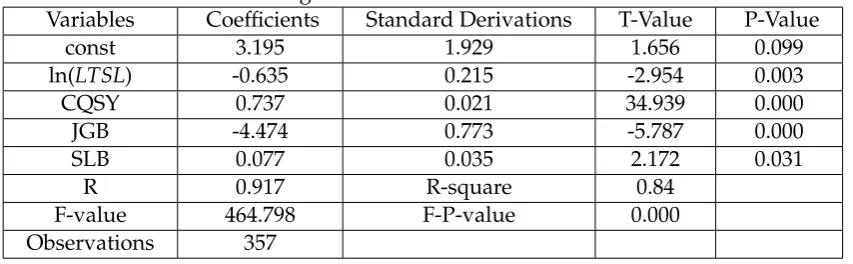
1. Before the split share structure reform, because of the existence of a large number of non-tradable shares, the IPO underwriting has a negative relationship with the ratioγof the price of the non-tradable shares and the tradable shares, and has an uncertain relationship with the ratioθof the number of the non-tradable shares and the tradable shares; at the same time, has a negative relation with the circulation of the tradable shares, and has a positive ratio with the long-term gains (P1−VL) of the stocks.
2. After the split share structure reform, the non-tradable shares become the tradable shares and the domestic market is similar to the foreign market. The IPO underpricing has a relation with two factors, and has a negative relation with the circulation of the tradable shares, and has a positive ratio with the long-term gains (P1−VL) of the stocks.
5.1.3 The Analysis of The Sample
the first two years after the split share structure reform (2006 and 2007) is unusual, which may because of the non-thorough or non-overall achievement of the systems at the beginning of the reform and parts of the non-tradable shares becoming limit-sold shares. However, the reform has a great influence on the underpricing rate on the whole, which also explains the set of data can be used to verify the effect of the different factors of this reform to the underpricing rate.
Table 5.1.1 The average IPO underpricing rate in every year from 2000 to 2010.
year 2000 2001 2002 2003 2004 2005 2006 2007 2008 2009 2010
aur 1.524 2.256 1.832 0.732 0.713 0.85 0.354 1.162 0.499 0.559 0.286
ipon 86 75 67 66 61 3 14 24 5 9 26
where ”aur” denotes for the average underpricing rate, ”ipon” denotes for the number of IPO companies. The number of the initial public offering companies in Shanghai Stock Exchange from 2000 to 2010 is 436.
By using Table 5.1.1, we know that the average IPO underpricing rate from 2000 to 2004 is 1.316; The average IPO underpricing rate from 2006 to 2010 is 0.572.
5.1.4 The Description of Variables
When we design the variability, the Ministry of Finances in China ruled the exchanged price of the non-tradable stocks is not less than the net asset per share, so most of the trading price is equal to the net assets per share when the issuers sell the non-tradable shares. Therefore, the net assets per share are as the trading price of the non-tradable share.
1. The circulation of the tradable stocks and the IPO underpricing. Typically, the more the circulation of the tradable stocks, the greater the size of the company, it also will be more attractive to the investors on the market. Therefore, each department will make more stringent regulatory measures to the companies, to ensure the fair and validity of the stock issued. Then, the more the circulation of the tradable stocks, the lower the IPO underpricing. 2. The long-term gains and the IPO underpricing. The greater the long-term gains (P1 −VL) of the stocks, the higher the closing priceP1 of the first day or the smaller the intrinsic valueVLof the stocks. And the higher the closing priceP1of the first day, the bigger
the IPO underpricingP1−P0. If the stock’s intrinsic valueVLis smaller, the trading price of the non-tradable shares will be smaller, the interests of the holders with the tradable shares will have greater losses, the IPO underpricing will be greater. So the greater the long-term gains, the greater the IPO underpricing.
3. The ratio of the price of the non-tradable shares with the tradable shares and the IPO underpricing. The higher the price of the non-tradable shares, the closer to the price of the tradable shares, the more relatively fair the holders of the tradable shares, the smaller the loss of the interests of the investors to buy the tradable shares, and the lower the IPO underpricing. Therefore, the higher the ratio of the price of the non-tradable shares with the tradable shares, the smaller the IPO underpricing.