28 International Journal of Recent Research and Applied Studies, Volume 4, Issue 10 (6) October 2017
Correlations of Biomechanical Characteristics with Ball Speed in Penalty Corner Push-In
Effect of Varied Packages of Yogic Practices on Selected Motor Ability and Physiological
Variables among College Level Hockey Players
Dr.V.Vallimurugan1 & S. Sivasankar2
1Asst. Professor. Department of Physical Education, Bharathiar University, Coimbatore, Tamilnadu, India. 2Director of Physical Education, S. I. V. E. T College, Gowrivakkam, Chennai, Tamilnadu, India.
Received 1st September 2017, Accepted 1st October 2017
Abstract
The purpose of the study was to find out the effect of varied packages of yogic practices on selected motor ability and physiological variables among college level hockey players. To facilitate the study, 90 subjects were selected at random from S.I.V.E.T College Gowrivakkam TamilNadu. Their age was ranged between 18-25 years. They were assigned into three groups Group 1 served as Swami Satyananda Saraswati Yogic Practices group (EX GP1), Group 2 served as Swami Vishnudevananda Yogic Practices group (EX GP 2) and third one as control group. All the subjects were tested prior to and immediately after the six weeks treatment in progression motor ability such as muscular strength and cardio vascular endurance and physiological variables such as vital capacity and VO2 Max. The initial and final scores in selected motor ability, physiological, variables were put in-to statistical treatment using Analysis of Covariance (ANCOVA) to find out the significant mean differences. Scheffe s post hoc test was used to find out the paired mean differences. In all the cases the 0.05 level of confidence was fixed.
Keywords: Yoga; motor ability, physiological and hockey players.
© Copy Right, IJRRAS, 2017. All Rights Reserved.
Introduction
“Each soul is potentially divine. The goal is to manifest this divinity within by controlling nature, external and internal. Do this either by work, or worship or psychic control, or philosophy -by one or more or all of these and be free. This is the whole of religion”
-Swami Vivekananda Yoga is usually defined as union: union between the limited self (jiva) and the cosmic self (atman). Without trying to confuse things any further, we would like to point out that there is an anomaly in this definition. For there to be an aim or goal of union there must first be a state of separation. And in fact this separation does not exist. At this very moment you are united with the cosmic consciousness. Even this statement is not true, for you actually are the cosmic consciousness. So the aim of yoga is not really to unite you with greater self, to make you are already united. It is to make you realize your identity with the greater self, to make you know and tune in with your existing inner nature. (Swami Satyananda Saraswati, 1981).
Yoga is a way of life. It is predominantly concerned with maintaining a state of equanimity at all costs. All yoga schools of thought emphasize the importance of the mind remaining calm, because as the
Correspondence S.Sivasankar
E-mail: [email protected], Ph. +9173580 61528
saying goes, only when the water is still can you see through it. Yoga Darshan or Yoga Philosophy also happens to be a valid discipline of Indian metaphysics (Brahma Vidya). It is the result of human wisdom and insight on physiology, psychology, ethics and spirituality collected together and practiced over thousands of years for the well being of humanity. The basic idea of yoga is to unite the atma or individual soul with the paramatma or the Universal Soul. According to Yoga philosophy, by cleansing one‟s mind and controlling one‟s thought processes one can return to that primeval state, when the individual self was nothing but a part of the Divine Self. This is the sense encapsulated in In Sanskrit, the term „yoga‟ stands for „union‟. A yogi‟s ultimate aim is to be able to attain this „union‟ with the Eternal Self with the help of certain mental and physical exercises. It is often said that Hiranyagarbha (The Cosmic Womb) Himself had originally advocated the traditional system of yoga, from which all other yoga schools have evolved. But for all extant knowledge of yoga and its practices, such as yogasanas and pranayama, the entire credit goes to Maharishi Patanjali.
Statement of the Problem
The purpose of the study was to find out the effect of varied packages of yogic practices on selected motor ability and physiological variables among college level hockey players.
International
Journal of Recent Research and Applied Studies
Vallimurugan et al. 2017 ISSN: 2349 – 4891
Hypotheses
It was hypothesized that
1. There would be significant improvement difference in the selected motor ability and physiological variables due to the influence of varied packages of yogic practices than the control group among college level hockey players.
2. There would be significant improvement difference between the (varied packages of yogic practices) Satyananda Saraswati yogic practices and Swami Vishnudevananda yogic practices group on selected motor ability and physiological variables among college level hockey players.
Methodology
The purpose of the study was to find out the effect of varied packages of yogic practices on selected motor ability, physiological variables among college men
students. To facilitate the study, 90 subjects were selected at random from S.I.V.E.T College Gowrivakkam TamilNadu during the academic year 2017 - 2018. The subject‟s age ranged between 18-25 years only. They were randomly divided into three equal groups. Swami Satyananda Saraswati Yogic Practices group, Swami Vishnudevananda Yogic Practices group were considered as two experimental groups and the other group was control group. All the subjects were healthy and physically fit. The nature and importance of the study was explained to the subjects and subjects expressed their willingness to serve as subjects in this study. The experimental groups participated in their respective Swami Satyananda Saraswati Yogic Practices and Swami Vishnudevananda Yogic Practices group for a period of six weeks. The post test was conducted on the above said dependent variables after a period of six weeks in the respective treatments. The training Program was scheduled at 4 to 5p.m and 5 to 6p.m from Monday to Friday in progression.
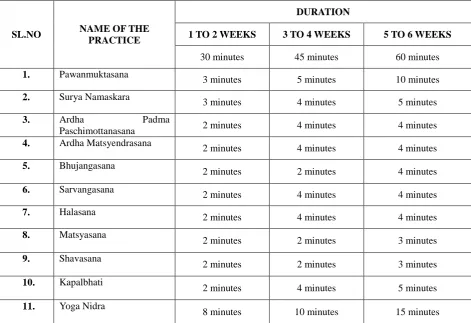
Table 1
Training schedule for package yogic practices – swami satyananda saraswati yogic practices duration
SL.NO NAME OF THE PRACTICE
DURATION
1 TO 2 WEEKS 3 TO 4 WEEKS 5 TO 6 WEEKS
30 minutes 45 minutes 60 minutes
1. Pawanmuktasana
3 minutes 5 minutes 10 minutes
2. Surya Namaskara
3 minutes 4 minutes 5 minutes
3. Ardha Padma
Paschimottanasana 2 minutes 4 minutes 4 minutes
4. Ardha Matsyendrasana
2 minutes 4 minutes 4 minutes
5. Bhujangasana
2 minutes 2 minutes 4 minutes
6. Sarvangasana
2 minutes 4 minutes 4 minutes
7. Halasana
2 minutes 4 minutes 4 minutes
8. Matsyasana
2 minutes 2 minutes 3 minutes
9. Shavasana
2 minutes 2 minutes 3 minutes
10. Kapalbhati
2 minutes 4 minutes 5 minutes
11. Yoga Nidra
30 International Journal of Recent Research and Applied Studies, Volume 4, Issue 10 (6) October 2017
Table 2
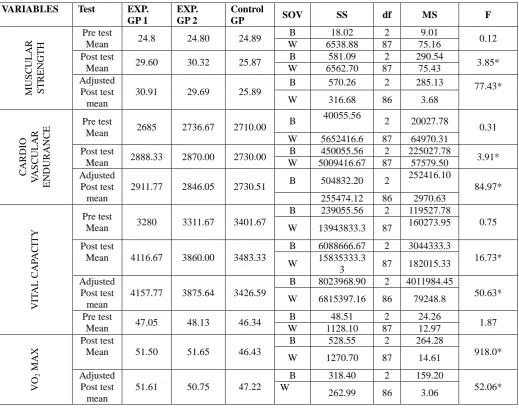
Computation of analysis of covariance of motor ability and physiological variables
VARIABLES Test EXP. GP 1
EXP. GP 2
Control
GP SOV SS df MS F
MU SC UL AR STRENGT H Pre test
Mean 24.8 24.80 24.89
B 18.02 2 9.01
0.12
W 6538.88 87 75.16
Post test
Mean 29.60 30.32 25.87
B 581.09 2 290.54
3.85*
W 6562.70 87 75.43
Adjusted Post test mean
30.91 29.69 25.89
B 570.26 2 285.13 77.43*
W 316.68 86 3.68
C AR DI O V AS C UL AR E NDURAN C
E Pre test Mean 2685 2736.67 2710.00 B
40055.56
2 20027.78
0.31
W 5652416.6 87 64970.31
Post test
Mean 2888.33 2870.00 2730.00
B 450055.56 2 225027.78
3.91*
W 5009416.67 87 57579.50
Adjusted Post test mean
2911.77 2846.05 2730.51 B 504832.20 2
252416.10
84.97*
255474.12 86 2970.63
VI T AL C AP AC IT Y Pre test
Mean 3280 3311.67 3401.67
B 239055.56 2 119527.78
0.75
W 13943833.3 87 160273.95
Post test
Mean 4116.67 3860.00 3483.33
B 6088666.67 2 3044333.3
16.73*
W 15835333.3
3 87 182015.33
Adjusted Post test mean
4157.77 3875.64 3426.59
B 8023968.90 2 4011984.45
50.63*
W 6815397.16 86 79248.8
Pre test
Mean 47.05 48.13 46.34
B 48.51 2 24.26
1.87
W 1128.10 87 12.97
VO
2
MA
X
Post test
Mean 51.50 51.65 46.43
B 528.55 2 264.28
918.0*
W 1270.70 87 14.61
Adjusted Post test mean
51.61 50.75 47.22
B 318.40 2 159.20
52.06* W
262.99 86 3.06
As shown in table 2, obtained F value on the scores of the pretest means 0.12, 0.31, 0.75 & 1.87 was lesser than the required F value of 3.103, which proved that the random assignment of the subject were successful and their scores in Muscular Strength, cardio vascular endurance, vital capacity & VO2 Max before the
training were equal and there was no significant differences. The analysis of post test means proved that the obtained F value 3.85, 3.91, 16.73 & 918.0 was greater than the required F value of 3.103 to be
Vallimurugan et al. 2017 ISSN: 2349 – 4891
Table 3
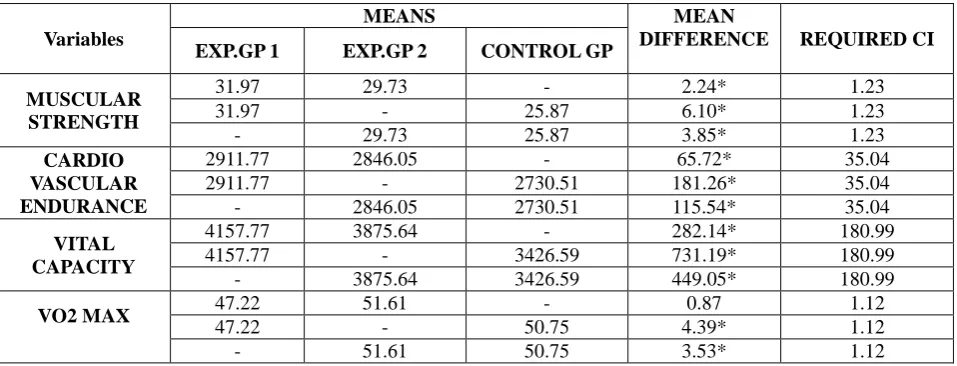
Scheffe’s confidence interval test scores
Variables
MEANS MEAN
DIFFERENCE REQUIRED CI EXP.GP 1 EXP.GP 2 CONTROL GP
MUSCULAR STRENGTH
31.97 29.73 - 2.24* 1.23
31.97 - 25.87 6.10* 1.23
- 29.73 25.87 3.85* 1.23
CARDIO VASCULAR ENDURANCE
2911.77 2846.05 - 65.72* 35.04
2911.77 - 2730.51 181.26* 35.04
- 2846.05 2730.51 115.54* 35.04
VITAL CAPACITY
4157.77 3875.64 - 282.14* 180.99
4157.77 - 3426.59 731.19* 180.99
- 3875.64 3426.59 449.05* 180.99
VO2 MAX 47.22 51.61 - 0.87 1.12
47.22 - 50.75 4.39* 1.12
- 51.61 50.75 3.53* 1.12
Discussion on Hypotheses
1. It was hypothesized that there would be significant improvement difference in the selected motor ability and physiological variables due to the influence of varied packages of yogic practices than the control group among college level hockey players. The results of the study indicated that there was a significant improvement in all the selected dependent variables due to the effect of varied packages of yogic practices than the control group. Hence the first hypothesis was completely accepted at 0.05 level of confidence with respect to all the motor ability and physiological variables.
2. It was hypothesized that there would be significant improvement difference between the (varied packages of yogic practices) Swami Satyananda
Saraswati yogic practices and Swami
Vishnudevananda yogic practices group on selected motor ability and physiological variables among college level hockey players. The second hypothesis was partially accepted at 0.05 level of confidence as there was a significant improvement difference between the Satyananda Saraswati and Swami Vishnudevananda yogic practice groups, with respect to variables such as muscular strength, cardio vascular endurance, vital capacity and VO2MAX
count and platelets, there was no significant difference between the Satyananda Saraswati and Swami Vishnudevananda yogic practice groups. In these cases the null hypothesis was accepted at 0.05 level of confidence.
Conclusions
Within the limitations and delimitations set for the present study and considering the results obtained, the following conclusions were drawn: 1. Two different yogic practice methods (Swami
Satyananda Saraswati and Swami Vishnudevananda yogic practices) helped to improve the muscular
strength, cardio-vascular endurance, vital capacity, VO2 Max.
2. Systematic Six weeks of Swami Satyananda Saraswati yogic practice system improves the muscular strength, cardio-vascular endurance, vital capacity and VO2 Max more than the Swami Vishnudevananda yogic practices.
3. Swami Satyananda Saraswati yogic practice system was a suitable training system to improve the muscular strength, cardio- vascular endurance, vital capacity and VO2 Max increased among the college level hockey players.
Bibliography
1. Bagby G.C. Leukopenia and leukocytosis In: Goldman L, Ausiello D, eds. (2007), Cecil Medicine. 23rd ed. Philadelphia, Pa: Saunders Elsevier; chap 173.
2. Barry Johnson L. and Nelson, Jack K (1982), Practical Measurement in Evaluation in Physical Education, Delhi: Surjeet Publication.
3. Clarke, Harrison.H, and Clarke, H.David, (1972), Advanced Statistics with Application to Physical Education, New Jersey: Englewood Cliffs, Prentice Hall, Inc.
4. David R. Coldmann (1998), American College of Physicians Complete Home Medical Guide, New York: D.K. Publishing, P.696.
5. Deb A.C. (1990), Fundamentals of Biochemistry, Calcutta: New Central Book Agency‟s P. 55 6. Hagins M, Moore W, and Rundle A(2007), “Does
practicing hatha yoga satisfy recommendations for intensity of physical activity which improves and
maintains health and cardiovascular
fitness?”.Journal of BMC Complementary Alternative Medicine, 30:7, P.40.