HIGH RELIABILITY PRIVATE CLOUD STORAGE WITH MINIMAL OPERATION COST USING MULTI-OBJECTIVE OPTIMIZATION
MUHD HANIS BIN HARUN
A thesis submitted in
fulfillment of the requirement for the award of the Master of Computer Science (Software Engineering)
Faculty of Computer Science and Information Technology Universiti Tun Hussein Onn Malaysia
ii
ABSTRACT
ABSTRAK
iv
CONTENT
ACKNOWLEDGEMENT i
ABSTRACT ii
ABSTRAK iii CONTENT iv
LIST OF TABLE viii LIST OF FIGURE ix
CHAPTER 1: INTRODUCTION 1
1.1 Background ……… 1
1.2 Problem Statement ……… 2
1.3 Objective of Study ……… 3
1.4 Scope of Study ……… 4
1.5 Thesis Outline ………. 4
CHAPTER 2: LITERATURE REVIEW 6
2.1 Introduction ……… 6
2.2 Storage Reliability ……… 7
2.3 Previous Study ……… 7
2.4 Research Gap ………. 10
2.5 Failure Rate ………. 11
2.5.1 Failure Rate for Serial System ……… 12
2.5.2 Failure Rate for Parallel System …………. 12
2.5.3 Identical and Different Failure Rate …….. 13
2.6 Bathtub Curve ……… 13
2.7 Power Consumption………. 14
2.8 Carbon Dioxide Emission ……… 15
2.9 Summary ………. 15
CHAPTER 3: METHODOLOGY 16
3.1 Introduction……… 16
3.2 Operational Framework ……… 17
3.3 Failure Rate Calculation ……… 18
3.4 Reliability Calculation ………. 18
vi
3.5 Multi Objective and Linear Prog ……….. 21
3.6 Application Development ……… 23
3.7 Summary ……….. 23
CHAPTER 4: IMPLEMENTATION AND TESTING 24
4.1 Introduction ……… 24
4.2 Program Implementation ………. 24
4.2.1 Flow Chart ……… 25
4.2.2 Flow Chart Explanation ……… 26
4.3 Data and Testing Element ……… 26
4.4 Expected Output ……….. 27
4.5 Summary ………. 28
CHAPTER 5: RESULT AND DISCUSSION 29 5.1 Introduction ……… 29
5.2 Optimization Result………. 29
5.2.1 Testing Result ………. 31
5.3 Result Discussion ……… 34
5.3.1 Result for Target Duration ………... 34
5.5 Summary ………. 37
CHAPTER 6: CONCLUSION AND RECOMMENDATION 38
6.1 Introduction ……… 38
6.2 Contribution ……… 39
6.3 Future Work ……… 39
viii
LIST OF TABLES
3.1 Variable for Reliability Calculation 20 4.1 Input, Process, and Output for Application 26
4.2 Expected Output 27
LIST OF FIGURES
2.1 Serial Storage Connection 12
2.2 Parallel Storage Connection 12
2.3 Bathtub Curve 13
3.1 Relation between Server Storage in Cloud 17
4.1 Implementation Flow Chart 25
5.1 Result Analysis 31
5.2 Graph Comparison Analysis 32
CHAPTER 1
INTRODUCTION
1.1 Background
provide those services (Fox et al., 2009). By using the cloud, an organization does not have to deal with the technical issues on the infrastructure and does not have to invest the budget on buying and maintaining their vault of data. They will have to outsource their data to the cloud provider’s server and need to pay for the size of data stored. They can also enlarge the storage size every time they need to. That is why the term “pay-per-use” was very synonymous with the cloud service. It is as if we have to pay for what we have used only. In general, there are three common service models offered in a cloud environment, namely: Application as a Service (AaaS), Platform as a Service (PaaS) and Infrastructure as a Service (IaaS) (Sourabh, 2012). As part of cloud computing, IaaS plays important features of its thriving compared to the other two services. This is because infrastructure serves as a third party provider for organization’s hardware and operations. All of the company’s confidential data will be outsourced to the provider and will reside outside their premises. The capability of a service provider to manage and handle huge amount of data is very crucial. At the same time, the providers have to manage their storage server and maintain the data to make sure it is available anytime when being requested by the organization. To maintain the storage reliability and the data availability, cloud offers the best framework with massive scalability, 99.99% reliability, high performance, and specific configuration by using multiple redundancy solution (Wu, 2010).
1.2 Problem Statement
3
huge resource allocation will indirectly increase the energy consumption to power up the storage server for 24/7 a week that will indirectly affect the operational cost.
Organizations today tend to keep all of their business activity and data on an online server, which enables them and their customer to access the resource anytime, anywhere. Organization’s size often affects the storage amount for their data. Most cloud storage providers nowadays provide various storage packages for consideration, but the main consideration is: in order for a certain amount of data to be stored for a particular period of time, how much storage would be required? Was the amount of storage able to maintain the reliability of storage in a certain amount of time? If it does, how long will it take before it changes to a failed state?
Having additional servers to maintain storage reliability will increase the electricity consumption to power up and cooling down the server. According to Barett (2011) in his article on eHow.com, a server consumes electricity from 500 to 1200watt per hour. A server powered up by using natural gas, produced approximate 0.553kg carbon dioxide per hour (Carbon Fund, 2012). If an organization needs five servers to operate twenty-four hours a year to serve their customers for 10 years, the operational server itself will produce at least 242,214kg carbon dioxide. Even worst, twenty-four hours operated servers require a good cooling system that might double up the electricity usage. Therefore, reducing the number of servers without compromising the system reliability will save the service provider’s operational cost and at the same time save the earth.
1.3 Objectives Of Study
In order to achieve the research aim, few objectives has been set which are:
I. To obtain highest reliability based on target and minimum storage based on the budget allocated.
1.4 Scope Of Study
Nowadays, large-scale cloud-based applications have put forward a higher demand for storage ability of data centers. Data in the cloud storage system needs to be stored with high efficiency and cost-effectiveness while meeting the requirement of reliability. In order to ensure data reliability in private cloud, cloud storage environment offers replication that sometimes is not needed by organizations. To achieve the cost-effectiveness in storage infrastructure, strategies to minimize a storage system without compromising its reliability is the focus of this research. This will be the key factors of effective storage strategies in order to save high cost on large storage centers. The focus of this research is on the storage environment itself without considering the virtualization of the storage structure.
1.5 Thesis Outline
5
1.6 Summary
CHAPTER 2
LITERATURE REVIEW
2.1 Introduction
7
2.2 Storage Reliability
A simple definition of storage is a place or locations where users save and manage data. In order to do such operations, users need to frequently access the storage device. In the internet era, the storage enables user to share its content through a network as a server. While the evolution of internet plays an important part in managing and improving businesses online, the server capability has become a great concern. As we know that the server stores vital organizational data which are being accessed frequently, hence the reliability of a server becomes a major concern.
As we know that all electronic components in one way or another will exhaust its lifetime and therefore tend to crash by any factor. This keeps researchers working hard to find a solution to the problem. By implementing backups of current server with additional servers, they help organizations maintain the reliability of the cloud storage system. At the same time, the growths of data each day will also affect the cost of storage itself. Therefore, we found that, adding multiple backup servers without appropriate strategies is not a good solution to overcome storage reliability issue. In order to handle massive amounts of data with minimal cost, the appropriate storage reliability model needs to be implemented. Since the performance changes during the product's storage period, it has nothing to do with stress of storage servers. The main reasons responsible for the failure are the release of stress, which is created during the processing and assembling stages, the decay of materials, corrosion of electronic products, open and short circuit, and the material aging (Hong, 2012)
2.3 Previous Study
9
In the research proposed by Feng et al., (2012) he was more focused on finding a solution to make a trade-off between high reliability and low space overhead for cloud storage systems. High reliability and low space cost are always contradictory in existing storage systems. This research paper introduces Magicube, a storage architecture with high reliability and low space overhead for cloud computing. To reduce the space overhead of file storage, Magicube keeps only one copy of each file in HDFS (Feng et al., 2012), and to achieve high reliability, it uses a special encoding algorithm for fault-tolerance. Once the system parameters (n,k) have been set, the source file will be encoded and the chipper text will be split into n splits, then stores the corresponding file splits in the cluster (Feng et al., 2012). If the source file is lost, Magicube can repair the lost file from any k (k < n) of splits of that encoded file. It also allows users to adjust the system the system’s fault-tolerance level and space cost by changing the setting of (n,k). Based on the research paper, to achieve high reliability and low space coast, there are several methods that can be used, which are Triplication at the beginning, File splitting and distribution, Extra replication deletion and File repair. All experiments were carried out on a cluster of nine nodes, where a node served as a master and the others as client and slaves for MapReduces and HDFS (Feng et al., 2012). Each node has two quad-core 2.40GHz Xeon processors, 11GB of memory and two disks. The experiment result shows that the (n,k) coding introduced negligible influence on the performance of Magicube, and the file repairing performance was also acceptable.
the requirement of most intermediate data in scientific applications without extra data replication. Thus, in order to reduce the storage cost and fully utilize the storage resource in current cloud systems, researchers propose a strategy named Cost-effective Incremental Replication (CIR). It is an incremental replication approach that works by calculating the replica creation time based on prediction, which indicates the storage duration to meet the reliability. To evaluate the performance of the proposed model, there are a few parameters which are being used, namely: number of data instance, storage unit number, reliability assurance, storage duration and cost. Based on the evaluation, the CIR strategy can reduce the data storage cost substantially, especially when the data is only stored for short duration or have a lower reliability requirement.
2.4 Research Gap
The storage reliability of components is especially important to the electronic products which store for a long-term and are used at one time (Yang, 2011). Based on the previous studies, the main issues in the research are reliability and cost. Most of the researches focus on finding minimal redundancy using erasure code, increasing the storage reliability from time to time by creating an additional replica to current nodes. By doing these, redundancy issues are yet to be resolved because the existing storage size will keep on increasing over time. What will happen to the existing storage nodes if it failed to operate in a certain amount of time? Moving replicas from the existing server to another is a good solution as a backup, but for how long will the recovery process take to ensure the reliability of the storage.
11
the reliability of the storage is equal to 1 – q3 reliability. The basic storage rules provide good data access to the organization, but it will become insufficient if the data keep increasing from time to time. If a certain amount of data is to be stored in a certain amount of time, the exact number of storage system needs to minimize the server cost. Most applicable methods to improve storage reliability and availability is by using redundancy scheme. Redundancy scheme is divided two classes: Replication and Erasure codes. Replication works by replicating original data into n copies and distribute to different nodes in or outside the network while erasure codes split the original data into k blocks, and encode them into (n-k) blocks with n blocks in total, then distribute these n blocks into different network nodes. From this solution, reliability equation Rs=1-qc will be used to
i. determine how many storage will be used,
ii. predict how long it will be operated until it gets to the next failure state, iii. how long it will take to recover and
iv. how many storage nodes are required to ensure reliability.
2.5 Failure Rate
Failure rate (λ) is a number of failures per unit depending on operating hours. Each of storage devices consists of a failure rate during its operation, which is the number of units failing per time. Therefore, the failure rate is used to measure the reliability of a storage based on the probability of the storage itself. In the meantime, lower failure rates indicate higher reliability of storage. According to Rooney (1989), failure rates of storage are estimated at 2.64 and up to 5.90 failures per million hours.
system reliability is the failure rate of each of the storage contained in the system. Each of the storage device contained in the system might have different failure rate or might not i.e. the system might contain identical or different storage failure rate.
2.5.1 Failure Rate for Serial System
Serial systems work with two or more storage combination operating in series. The failure of either storage will result in failure of the combination. The failure rate of combined storage in the series is shown as follows:
Rs = FRA * FRB (2.1)
Figure 2.1: Serial Storage Connection
2.5.2 Failure Rate for Parallel System
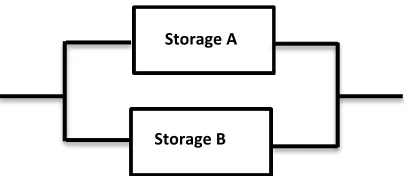
Parallel systems work with two or more storage combination operating in side by side in parallel. The system remains operable unless all storages fail. The failure rate of parallel system shows as follows:
13
[image:22.612.224.426.103.191.2]Rs = 1 – (1 – FRA)(1 – FRB) (2.2)
Figure 2.2: Parallel Storage Connection
2.5.3 Identical and Different Storage Failure Rate
Cloud servers consist of multiple storage units, and in order to identify its reliability, the failure rate of the system is calculated by finding the failure rate of each storage unit. A set of storage units in a server that have the same failure rate is called identical failure rate, and a set of storage that have varying failure rates is called different failure rate.
2.6 BATHTUB CURVE
Every single device comes with a lifespan. Failure rates and time are used to determine the reliability of a device during its life span. Normal life span for electronic device can be divided into three distinct periods (Klutke, 2003). Bathtub curve is used to show how the failure rates vs. time for each of an electronic device to help users predict the actual failure before it is happening. This helps a lot in managing user access and retrieval to the device.
Storage A
Figure 2.3: Bathtub Curve (Klutke, 2003)
The bathtub curve consists of three periodic stages which are infant mortality period (first stage) with a decreasing failure rate followed by normal operating stage period with a low, relatively constant failure rate and concluding with aging stage that exhibits an increasing failure rate. Bathtub curve does not depict the failure rate of a single device, but describes the relative failure rate of an entire population of devices over time. Some individual units will fail relatively early, the other will last until wear-out and some will fail during normal operating state.
2.7 Power Consumption
15
2.8 Carbon Dioxide Emission
Every electric device emits carbon dioxide (CO2) for every kilowatts of usage. According
to Barett (2011) in his article on eHow.com, a server system consumes electricity from 500 to 1200 watts per hour. According to Carbon Fund (2012), on average electricity usage emits 1.222lbs per kilowatts (kWh) or approximate 0.5533827kg per kWh. If on the average, a server used 850 watts per hour, and about 7,446 kilowatts per year, that means more than 4120kg carbon dioxide (CO2) is released into the atmosphere. In order
to reduce the carbon dioxide emissions, less storage system is required without compromising the system reliability.
.
2.9 Summary
CHAPTER 3
METHODOLOGY
3.1 Introduction
17
3.2 Operational Framework
The aim of this research is to get high reliability for cloud storage framework subject to minimal cost allocated. In order to achieve the objective, multi-objective optimization will be used to solve multi criteria decision making involving more than one objective function to be optimized simultaneously. At the end of this research, a table consisting of comparison from the selected variable will be published as analysis result and determine the best storage implementation depending on the number of servers required to maximize the system reliability.
[image:26.612.225.431.409.557.2]In order to maintain its reliability, cloud storage uses replication strategies to ensure that all of its servers are operating using the latest updated data whenever one or more of its server fails. To avoid wasting storage resource during replication strategies, an exact calculation on estimation of when and how many times the server will fail in certain period is needed. To achieve these objectives, storage failure rates are used.
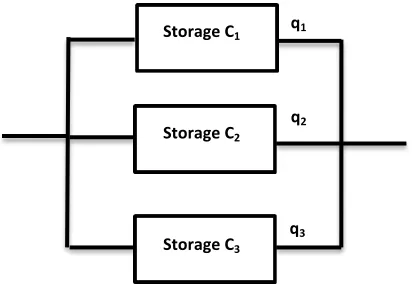
Figure 3.1shows the relation between servers in cloud storage:
Figure 3.1: Relation between Servers in Cloud Storage Storage C1
Storage C2
Storage C3
q1
q2
the servers has a reliability of q. The overall storage framework reliability is represented as Rs = 1 – q3, that is achieved from the equation of R = 1-q1q2q3 or R i qi
3 1
1−∏= =
In order to determine the reliability of the storage, unreliability of each of the storage will have to be identified. The unreliability of each of the storage is calculated using failure rate (λ) or q.
3.3 Failure Rate Calculation
The failure rate of a storage device can be found from the hardware itself, which is provided by the device manufacturer. Failure rate enable user to identify how reliable the device is based on number of predicted fail per certain of times. For example, a device having 0.2%/1000 hours, which means the device will fail to operate two times within one million hours. This can be expressed on the following equation:
6 10 2 1000 1 * 100 2 . 0 = = q
From the failure based on failure rate per 1000 hours, the probability of failures per year could be calculated as:
01752 . 0 365 * 24 * 1000 1 * 100 2 . 0 = = q
3.4 Reliability Calculation
Based on the failure rate, the reliability of a device with 0.2% of failure rate per 1000 hours can be express as:
(3.1)
19 98248 . 0 01752 . 0 1 1 = − = − = Rs Rs q Rs
That means, if a device with such failure rate operates 24 hours a day for one year, the probability of a device will be reliable is 98%. In order to increase the reliability to 99%, one additional server with such failure rate is required.
999693049 . 0 ) 01752 . 0 ( 1 1 2 2 = − = − = Rs Rs q Rs
The reliability will decrease by 1% for every server over a year and will require additional server to maintain the reliability. With minimum two servers, the storage reliability, maintained at 99% at least for five years.
If an organization need to set up a storage system using three servers for the duration of three years, using the previous failure rate for each server, the following calculation applies.
Year 1:
Failure rate: *24*365 0.01752 1000 1 * 100 2 . 0 = = q Reliability: 999994622 . 0 ) 01752 . 0 ( 1 1 3 3 = − = − = Rs Rs q Rs Year 2:
999956977 . 0 ) 03504 . 0 ( 1 1 3 3 = − = − = Rs Rs q Rs Year 3:
Failure rate: *24*365*3 0.05256 1000 1 * 100 2 . 0 = = q Reliability: 9998548 . 0 ) 05256 . 0 ( 1 1 3 3 = − = − = Rs Rs q Rs
3.4.1 Variable and Calculation Formula
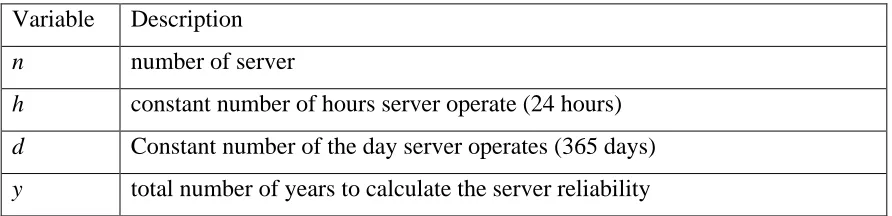
[image:29.612.102.548.589.697.2]In order to identify the reliabilities of a storage system for certain duration, there are few variable are used. The variable listed as follows:
Table 3.1: Variable for Reliability Calculation
Variable Description n number of server
21
mh million time is set to 10-6
nF number of failed per million hours b budget of the organization
Sc cost per server Mc Minimum cost Tr Target reliability Rs System reliability
Number of possible server (n) will be calculated from the organization budget (b) and cost per server (Sc) based on market price.
n = b/Sc
Reliability calculation formula Rs = 1-[(nF*mh)*(h*d*y)]n
Reliability of the system will be calculate by using the formula to identify what is the reliability of the storage based on variables that were listed previously. The result will be displayed is the system reliability (%) based on year and the number of storage used.
3.5 Multi Objective and Linear Programming
In order to find system reliability, there are several objectives used as the constraint. Thus, the multi-objective optimization is used. Multi-objective optimization involves more than one objective function in order to optimize the result (Deb, 2014). Multi objective optimization is used to find minimum and maximum value from multi variable constraint. In this thesis, reliability is calculated using the constraint from cost and duration to find maximum reliability with lowest cost allocated.
(3.4)
organizations if they want to create cloud storage environment. For this purpose, several constraints are count for calculation. The focus is to find maximum server reliability based on target reliability and the minimum numbers of server involve in order of achieving maximum reliability in target duration. Number of server involve is relate to budget allocated.
In order to achieve result base on several objective, optimization technique is required. In this problem, linear programming is use to find the maximum and minimum point in each calculation The following formula shows the relation of multi objective variable based on constraint below:
(3.6) Let,
i is the number of server,
p
q =1− is the probability of failure,
The maximum reliability is given as,
Maximum Rs =(1−∏ni=1qi)
Subject to:
budget i
n
i ≤
∑
=1
and
duration i
n
i ≥
=
23
3.6 Application Development
Based on reliability calculation formula, we were able to calculate the system reliability for a given number of servers and duration. In order to find the system reliability based on certain duration, an application is needed to automate the calculation.
3.7 Summary
CHAPTER 4
IMPLEMENTATION AND TESTING
4.1 Introduction
With the detailed explanation about the formula in previous chapter, this chapter will conduct an implementation and testing in order to find the storage reliability based on few variables selected. The objective of this chapter is to apply what have been described in previous chapter which is the formula to find the system reliability and execute it in a program in order to find the reliability based on variables set by user.
4.2 Program Implementation
40
REFERENCES
Bakshi, K. (2011, March). Considerations for cloud data centers: Framework, architecture and adoption. In Aerospace Conference, 2011 IEEE (pp. 1-7). IEEE.
Borthakur, D. (2007). The hadoop distributed file system: Architecture and design.
Carbon Fund (2012), “How We Calculate”, Retrieve October 13, 2013, from URL:
http://www.carbonfund.org/how-we-calculate
Deb, K. (2014). Multi-objective optimization. In Search methodologies (pp. 403-449). Springer US.
Feng, Q., Han, J., Gao, Y., & Meng, D. (2012, June). Magicube: High Reliability and Low Redundancy Storage Architecture for Cloud Computing. In Networking, Architecture and Storage (NAS), 2012 IEEE 7th International Conference on(pp. 89-93). IEEE.
Fox, A., Griffith, R., Joseph, A., Katz, R., Konwinski, A., Lee, G., ... & Stoica, I. (2009). Above the clouds: A Berkeley view of cloud computing. Dept. Electrical Eng. and Comput. Sciences, University of California, Berkeley, Rep. UCB/EECS, 28.
in reliability-aware cloud systems. In Communication Software and Networks (ICCSN), 2011 IEEE 3rd International Conference on (pp. 275-279). IEEE.
J.T Barett (2011), “How Much Electricity Does a Computer Use Per Hour?”, Retrieve October 13, 2013, from URL: http://www.ehow.com/info_8763694_much-computer-use-per-hour.html
Klutke, G. A., Kiessler, P. C., & Wortman, M. A. (2003). A critical look at the bathtub curve. Reliability, IEEE Transactions on, 52(1), 125-129.
Li, W., Yang, Y., & Yuan, D. (2011, December). A novel cost-effective dynamic data replication strategy for reliability in cloud data centres. In Dependable, Autonomic and Secure Computing (DASC), 2011 IEEE Ninth International Conference on (pp. 496-502). IEEE.
Rooney, J. P. (1989, January). Storage reliability. In Reliability and Maintainability Symposium, 1989. Proceedings., Annual (pp. 178-182). IEEE.
Sourabh (2012), “What is Cloud Computing”, Retrieve March 10, 2013 from
http://sourcedigit.com/41-what-is-cloud-computing.
Torell, W., & Avelar, V. (2004). Mean time between failure: Explanation and standards. White Paper, 78.
Wu, J., Ping, L., Ge, X., Wang, Y., & Fu, J. (2010, June). Cloud storage as the infrastructure of cloud computing. In Intelligent Computing and Cognitive Informatics (ICICCI), 2010 International Conference on (pp. 380-383). IEEE.