10
An Enhanced AOMDV Protocol for Internet of
Things
KOMAL
Department of Electronics And Communication
Engineering
MVVEC, Jagadhri
Yamuna Nagar, India
KAMAL KHAJURI
Department of Electronics And Communication
Engineering
MVVEC, Jagadhri
Yamuna Nagar, India
Abstract-The Internet of Things is a new concept in IT field. But the research of routing protocols of Internet of Things is still blank, while designing of routing protocols of internet of things is an important part in the research of Internet of Things. In this paper, we designed a routing method that can take as routing destination not just like nodes. This type of improvement is more suitable for the use in internet of things, by connecting to the internet. By comparing with AOMDV in the internet of things, simulation results shows that AOMDV-IOT achieves better results in average end-to- end delay, packet loss and discover frequency. We are working on the implementation to improve the algorithm through optimizing the protocol, such as we combine together routing table and internet connecting table. Except, the improvement protocols are not only used in internet of things, but also used in another fields.
Keywords: Internet of Things (IOT); routing protocol, AOMDV, IPV6, Resolution
1.INTRODUCTIONOFIOT
1.1 Definitions
Many definitions of IoT are presented by different researchers. Some of the definitions are presented below:-
Internet of Things (IOT) is the process in which we study about the network interconnection between humans & objects. It is generally known as a self-configure wireless network in which sensors acts whose purpose is to connect all things.
The Interconnection between sensing and actuating devices provides the ability to share information across everywhere through a standard framework. By developing a common operating system between human & objects for providing latest applications.
The Technology which always allows the people and objects is to be connected with anytime, anyplace, and anyone, by using any type of network and service.
1.2 History
According to new concepts, IoT has come back at the Auto-ID Center. In 1999, this group was working in field of network radio frequency identification (RFID) and emerged sensing technologies. The work is done by seven research universities. These research institutes were choosing by the Auto-ID Center for designing the architecture for internet of things
(Wikipedia, 2014). In 2003, approximately 6.3 billion people were living on the planet and devices connected to the Internet. According to Cisco IBSG’s definition, internet of things does not exist in 2003 because the number of things which connected to internet was relatively small such as smart-phones were just being introduced. Sensors were introduced to improve the modern life. Key industry players and prominent market analysts, have knowledge of the importance of IoT and its economic impact. Rapid growth of mobile phones, android phones, tablets, laptops, and computers increased the number of devices connected to the Internet, while the world population increased less than the devices connected to internet, making the number of connected devices per person more than one first time in the history.
1.3 Architecture of IOT
This technology is made by using two words i.e. “Internet” which give a look of interconnected networks and “Things” which clearly shows some objects. But when these two type of words join together it means “a world-wide network between humans & objects which is unique fully addressed based on standard communication protocols”. Internet of things is not have a proper definition but there are various definitions depends on research groups in the world, but there are common definitions arise which tells us about the concept as, when objects can sense and communicate, the decision making and management is possible without human effort with machine activity. Below it present the architecture in figure 1.3.1
11
Working of this technology is possible through the integration of various technologies. Xiong Li, Zhou Xuan described the general issues for trusted security system based on IOT. Here, we study about the architecture of IOT. This architecture of IOT contains different parts: Perception layer, Network layer, and Application layer. All of these three layers have large area of information with different level of technologies and their features.
Perception layer: This is the first layer of IOT. The main working of IOT is based on this layer is i.e information is collects at the perception layer with the help of different devices like smart card, RFID tag, reader and sensor networks, etc. It has a quality of sensing through the RFID system to get the information of object anytime and anywhere. Each RFID system has a unique ID called Electronic Product Code (EPC) which is the searchable ID allotted to each physical object.
Network layer: This is the second layer of IOT which is used for data gathering by sensors which are used for sent the data to the internet via this layer with the help of computers, wireless/ wired network and other components. So network layer is mainly worked for the transmission of information with the feature of reliable delivery so network layer is includes the functions and working of transport layer.
Application layer: This is the third type of layer known as application layer. This layer possess the received information and makes the right decisions to get its feature of intelligence means by connection between objects and devices. Intelligence means right use of intelligent computing technology such as cloud computing and process for control like what to do and when to do right things that is why this layer is also known as process layer.
1.4 Applications
“It makes me happy when I getting a short message that the kids get off the school bus and they reach home safely” One of the best applications of the Internet of Things is focused on revolutionizing the Homes or Home Automation industry. Home Automation is the technology which has been a dream for decades with the idea of smart homes by which we do lots of things automatically, predict our needs,. According to Sterling, one could track the full information about an object, from their existing time for example before its manufacturing, physical location and all external factors which can affect over it. According to Sterling, we could track the entire history of an object, from their initial time like before when it was made, through its manufacturing process, their ownership history, its physical location and its conversion back into raw material for new instantiations of objects. The Hydra made developers includes the heterogeneous physical sensing devices into their applications in which they offering easy-to-use web service for controlling physical sense. It also used in device for service and security discovery in semantic model In 2006
NIKE+ a GPS chip fits into the sole of many NIKE shoes, which is used for sending data to an application on your iPod or Iphone that further allows you to track your running performances on the track by set personal training goal etc. Also in 2009 –NIKE starts the online service in which they allows to the customers for modify the colors and materials of their NIKE shoes and also they promise to them for delivered to their door. The first applications of the IoT which is used in business is the maintenance of industrial machinery by using remote system, supply-chain and management.
1.5 Security and Privacy
Proliferations of Internet of Things worldwide are awesome. The Internet of Things technology has changed interaction within the world. The Internet of Things finds its significant application for information analysis and automation advance in agriculture, healthcare, manufacturing, finance and insurance. Internet of Things applications benefits ensuring in safety, security, efficiency, decision making, and critical infrastructure protection. Every increasing connectivity is one of the latest reasons for security and privacy challenges. Authentication, authorization, transport encryption, cloud services, web interfaces, software, firmware are some security challenges of Internet of Things. To fully realize the great potential of Internet of Things, it is essential to address these security concerns. Security and Privacy issues arise from interference by embedded based intelligent interconnected devices. Every Internet user connected with another door for the cyber criminals which can access and misuse their information. Vulnerability is a growing issue. Poor design and security can make attacks. We cannot separate security from safety of human life. Unauthorized access of personal and critical uses, it causes attacks on other systems can create risks to personal safety. Collection of sensitive & personal information without the awareness of individual and consent creates serious privacy Challenge. The Implementation in Internet of Things promises to smart world peoples and it threats to privacy and security challenges. In the implementations of Internet of Things it encourages many security and privacy challenges along with the ability to infer incredibly detailed information. Sensors are continuous collecting data on their surroundings for increases privacy concerns. The massive volume of data about Internet of Things devices can collect and analyze is outstanding. These devices can also collect behavioral information. This information can be misused by unauthorized persons. Use of this data makes money, and some users can create privacy challenge. Privacy and security challenge can lower the user confidence. Internet of Things device collect data for individual & they share it with third parties and the individual is unaware about the device is a privacy challenge.
2.RELATEDWORK
The research work performed in this field by different researchers is presented as follows:
12
vision of the future Internet where connecting physical objects to each other or, from banknotes to bicycles, through a network which is an active part in the Internet, exchange information of themselves and information of things happens around their. With this the immediate exchange of information about the physical things and the objects leading to improve services and increase in efficiency and productivity. Here we study about the importance of internet of things and presents the technologies, potential applications, challenges and future research areas of IoT. Definitions of IoT definitions from different papers, different sources discussed and compared. Finally some major security issues and privacy, technologies and applications are discussed briefly.
Dr. P. B. Pathak et .al 2016 Internet connectivity, data collection and analytics combined together forms basics of Internet of Things. They provides beneficial services in many important areas. In the terms of machines they replacing human decision for making security and privacy which are significant challenges. Unless we tell about security and privacy issues we can realize the importance of Internet of Things. The present paper introduces the concept of Internet of Things and discusses some security and privacy issues.
Mayuri A. Bhabad et .al 2015 Internet of things (IOT) is widely distributed networks in which all the useful information is sent to the another person’s with the help of sensing devices and Radio Frequency Identification (RFID) known as tagging system. As IOT does not need any human to introduce machine interaction, it seems to be one of the largest way of revolution as per the research going on, security is needed. But the rapid development of IOT has introduced with the challenges in terms of security of things. This paper is mainly focus on the concept of IOT, architecture and security issues with advance features and suggested for advance it.
Govinda K. et .al 2016 The term Internet of Things refers to the use of Internet protocols for the human-to-human or thing-to-thing communication in area of networks. The main aim of IoT is to create a virtual footprint of all the devices so as all the people connected to each other. It provides a new method of communication between all the things and the people. . This paper explains all the concepts based on IoT and their mechanism in brief. The important technologies of IoT are Sensor networks and intelligence technologies.
Omar Said et .al 2013 Internet of things is a great research due to its importance in many area like commerce, industries, and also in education departments. Recently, new area of applications and their research are challenges in the areas of Internet of things. In this paper, we discuss about the history of Internet of things which proposed different various applications about Internet of things. We also know about this concept and discuss about the future vision of Internet of things. These are the guidelines used as a standard template for all journal applications.
Ray Beaulieu et .al 2015 The U.S. National Security Agency (NSA) introduce the Simon and Speck families of lightweight block ciphers as an aid for securing applications in various environments where AES may not be suitable. This
paper contains the algorithms, their design, along with current status and results.
Paweł Tadejko et .al 2015 Here, we discuss about the new issues of Internet of Things. Internet of Things is used in areas of logistics, for example their monitoring, production management, and efficiency of logistics operations also include, information, exchange supply chains and security. This paper tells us about the principles and their characteristics of Internet of Things, and give total information about them. With the help of IOT we introduce the new version of modern Logistics. The current application areas and their future prospects are analyzed in this paper. But there are various difficulties arises for doing implementation but they show that the IoT technology needed much more improvement. However, experts believe that the key are not problems of cost, but the formation of business model in the area of logistic is based on it.
Parajkta et .al 2014 Internet, the widest network inform us about the world in less than one second. This paper is a survey based on Internet of Things which is believed in the next generation of Internet. The main goal of this technology is to make the objects relates in the same way as the computers acts. This implementation requires the use of some special hardware and software but, there face many challenges but still this concept can be applied in many areas of internet.
3.PROPOSEDWORK
3.1 Problem Analysis
Internet of Things (IOT) is the network in which the different things and objects are connects. It is viewed as a self-configuring wireless network with sensors whose purpose is interconnection of all things. The Internet of Things is a new concept in the IT field. But the research of protocols of routes of Internet of Things is blank, while designed the routing protocol of IOT is an important part in the research of Internet of Things. The improvement is very necessary in the use of internet of things, which is a unique character is connects to the internet. Compared with AOMDV in the internet of things, the results show that AOMDV-IOT achieves better performance in average end-to end delay, packet loss and discovery frequency.
3.2 Problem to Be Formulate
1. To study how to improve the AOMDV routing protocol for the Internet of things.
2. To study how to compared AOMDV with internet of things, simulation results show that AOMDV-IOT achieves better performance in average end-to end delay, packet loss and discovery frequency.
3.3 Proposed Work
13
the internet. By Comparing AOMDV with the internet of things, their simulation results show that AOMDV-IOT achieves better performance in average end-to end delay, packet loss and discover frequency. AOMDV means it is a protocol which is an extension based on Ad hoc on demand Distance Vector (AODV). So that the performance of AOMDV is much better than AODV. AOMDV is using for finding node-disjoint paths and link-disjoint paths when discovering the routes due to the conditions of node disjoint paths are much stricter than that of link-disjoint paths also the number of node-disjoint paths is less than that of link-disjoint paths.
This dissertation performs following tasks to working on the implementation to
Improve the algorithm through optimizing the protocol, such as routing table and internet connecting table will combine into one:
Study of AOMDV and IOT protocol
Implementation of AOMDV and IOT protocol Compare the results of AOMDV and AOMDV IOT
in NS2
In this dissertation we have proposed a protocol which is based on AOMDV and AOMDV IOT whose aim is to improve the routing of AOMDV for Internet of things. In this section we represent all the operation details using in routing protocol. It is modified AOMDV to adopt with the usage in internet of things. The principal objective of AOMDV is to find and create the right connection between nodes and internet efficiently. The function of routing protocol is to find the most appropriate link automatically, and record it with other links for as back up. If a node wants to create a link to the internet, it should first check its internet connecting table, if the information found to be OK, then the node will choose the that node which hops count is the lowest then the node start the routing finding process. Then it will follow the found node as destination node for sending message.
4. RESULT
In this dissertation works on how to improve the AOMDV routing protocol for the Internet of things. To improve the algorithm through optimizing the protocol, such as routing table and internet connecting table will combine into one. The results are shown below.
There are we compare the results of AOMDV and AOMDV IOT. The comparison is done for 50 nodes.
The comparison of performance matrices for AOMDV and AOMDV IOT for nodes 50 is shown in table 4.1
Table 4.1: Performance Matrices for nodes (n) = 50
PARAMETERS AOMDV AOMDV IOT
Total packet send 37571 37571
Total packet received
34190 37571
Total packet dropped
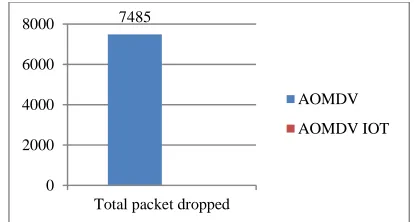
7485 0
Packet delivery ratio
91.00% 100.00%
Throughput of network (kbps)
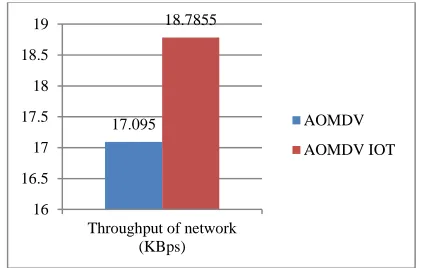
17.095 18.7855
Average end to end delay
0.024838866 ms 0.001686445
ms
4.1 Total Packet Sent
In figure 4.1.1 show that Total Packet Sends by AOMDV – 37571 and Total Packet sends for AOMDV IOT – 37571
Figure -4.1.1 Total Packet Send by AOMDV and AOMDV IOT
4.2 Total Packet Received
In figure 4.1.2 show that Total Packet received by AOMDV – 34190 and Total Packet received for AOMDV IOT – 37571
Figure -4.1.2 Total Packet Received by AOMDV and AOMDV IOT
4.3 Total Packet Dropped
In figure 4.1.3 show that Total Packet dropped by AOMDV – 7485 and Total Packet dropped by AOMDV IOT – 00
Figure -5.1.3 Total Packet Dropped by AOMDV and AOMDV IOT
4.4 Packet Delivery Ratio
In figure 4.1.4 show that Packet delivery ratio by AOMDV 37571 37571
0 5000 10000 15000 20000 25000 30000 35000 40000
Total packet send
AOMDV
AOMDV IOT
34190 37571
32000 33000 34000 35000 36000 37000 38000
Total packet received
AOMDV
AOMDV IOT
7485
0 2000 4000 6000 8000
Total packet dropped
AOMDV
14
– 91.00% and Packet delivery ratio by AOMDV IOT – 100.00%
Figure -4.1.4 Packet Delivery Ratio by AOMDV and AOMDV IOT
4.5 Throughput of Network
In figure 4.1.5 show that Throughput of network by AOMDV – 17.095 and Throughput of network by AOMDV IOT – 18.7855
Figure-4.1.5 Throughput of network by AOMDV and AOMDV IOT
5.CONCLUSION
Internet of Things has the wide future with providing applications with many benefits to users. Internet of Things has great potential of benefits over the worldwide. As every new technology have some challenges, Internet of Things have also some challenges .The present has discussed routing protocols of Internet of Things. Here improve the algorithm through optimizing the protocol, such as routing table and internet connecting table will combine into one. Additionally, the improvement protocol not only can used in internet of things, but also some other fields.
REFRENCES
[1]. Ahmed Khalid, (2016). Internet of Thing Architecture and Research Agenda. Computer Science and Mobile Computing, 5(3), 351-356. [2]. Amardeep Borgohain , Tuhin Borgohain Uday Kumar (2015).
Authentication Systems in Internet of Things. Advanced Networking and Applications, 6(4), 2422-2426.
[3]. Andrea Zanella, Angelo Castellani, Lorenzo Vangelista 2014. Internet of Things for Smart Cities. DOI: 10.1109/JIOT.2014.2306328, 1(1), 1-12 [4]. Ashvini Balte, Asmita Kashid, Balaji Patil (2015). Security Issues in
Internet of Things (IoT): A Survey. Advanced Research in Computer Science and Software Engineering, 5(4), 450-455.
[5]. C.A.U. Ugboaja, K.K. Okwara, M.A.Ezechina (2015). The Internet of Things (Iot): A Scalable Approach to Connecting Everything. Engineering And Science, 4(1), 09-12.
[6]. C.Chatrapathi, M.Newlin Rajkumar, V.Venkatesakumar (2014). Internet of Things :A vision, technical issues, applications and security. Computer Science, 2(8), 20-27.
[7]. Debasis Bandyopadhyay (2011). Internet of Things - Applications and Challenges in Technology and Standardization. arXiv:1105.1693v1 [cs.CY] ,1-24.
[8]. Dr. P.B.Pathak (2016). Internet of Things: An Overview of the Emerging Technology. Research in Computer Science and Software Engineering, 3(1), 167-170
[9]. Dr.P.B.Pathak (2016). The Internet of Things: Study of Security and Privacy Considerations. Engineering Technology Science and Research, 3(4) 50-52.
[10].Govinda K., Saravanaguru R.A.K (2016). Review on IOT Technologies. Applied Engineering Research, 11(4), 2848-2853.
[11].Heba Aly (2015) .Big Data on Internet of Things: Applications, Architecture, Technologies, Techniques, and Future Directions. Computer Science Engineering , 4(6), 300-313
[12].Hussain Talpur, Mir Sajjad (2012). Relevance of Internet of Things in Animal Stocks Chain Management in Pakistan’s Perspectives. Information and Education Technology, 2(1) 29-32.
[13].Jyotiranjan Hota, Pritish Kumar Sinha (2015). Scope and challenges of Internet of Things : An Emerging Technological Innovation. DOI: 10.13140/RG.2.1.1012.6241, [ 978-1-4799-8433].
[14].Laisheng Xia, Zhengxia Wang (2011). Internet of Things: a New Application for Intelligent Traffic Monitoring System. Doi:10.4304/jnw 6 (6).887-894.
[15].Luigi Atzori (2010). The Internet of Things: A survey. doi:10.1016/j.comnet.2010.05.010
[16].Mamata Khatu , Neethu Kaimal , Pratik Jadhav (2015). Implementation of Internet of Things for Home Automation. Emerging Engineering Research and Technology, 3(2) 7-11.
[17].Mayuri A. Bhabad, Sudhir T. Bagade (2015).Internet of Things: Architecture, Security Issues and Countermeasures. Computer Applications, (0975 – 8887) 125 (14), 1-4.
[18].Mohsen Hallaj Asghar (2015). Societal Change and Transformation by Internet of Things (IoT). Computer Networks, 7(2),18-24.
[19].Mr. Mayur Chaundkar, Mr.Sagar Shedge, Prof. Pavan Kulkarni (2016). Advance Home Manipulation System using Internet of Things. Science Technology & Engineering, 2(9), 328-331.
[20].MR.SHIVARAJMUNDAS (2016). THE NEXT GENERATION INTERNET OF THINGS, RESEARCH FOR MULTIDISCIPLINAR, 4(4), 65-74.
[21].Omar Said & Mehedi Masud, (2013). Towards Internet of Things: Survey and Future Vision. Computer Networks, 5(1), 1-17.
[22].Paweł Tadejko (2015). Application of Internet of Things in Logistics – Current Challenges, 7(4), 54-64.
[23].R. Ramaswamy, Siddharth Tripathi, Somayya Madakam ( 2015). Internet of Things (IoT): A Literature Review. Computer and Communications, 3, 164-173.
[24].Somayya Madakam (2015). Internet of Things: Smart Things. Computer and Communication, 4(4)250-253.
[25].Y.P. Raiwani (2013). Internet of Things: A New Paradigm. Scientific and Research Publications, 3(4), 1-4.
[26].Yicong TIAN (2014). Internet of Things –A Future of Internet: A Survey. Advance Research in Computer Science and Management Studies, 2(2), 354-361.
91.00% 100.00%
86.00% 88.00% 90.00% 92.00% 94.00% 96.00% 98.00% 100.00% 102.00%
Packet delivery ratio
AOMDV
AOMDV IOT
17.095 18.7855
16 16.5 17 17.5 18 18.5 19
Throughput of network (KBps)
AOMDV