Correlations of Biomechanical Characteristics with Ball Speed in Penalty Corner Push-In
Microbial Protease: A Degumming Agent
Shumaila Naaz1, Charu Gupta1 & Sunita Aggarwal2
1Department of Fabric and Apparel Science, Institute of Home Economics, University of Delhi, New Delhi, India. 2Department of Microbiology, Institute of Home Economics, University of Delhi, New Delhi, India.
Received 15th May 2017, Accepted 15th June 2017
Abstract
Degumming with soap and soda ash for 20 min at boil gives a weight loss of 24%, whereas degumming with enzyme at 50°C for 2 h gives a weight loss of about 26-28%. Treatment with proteolytic enzyme requires much lower temperature than that in the conventional process. Processing of silk with enzyme under the above condition is likely to retain the luster and softness of silk. To economize the production of Proteolytic enzyme, the conditions like temperature, time, pH have been optimized. The efficiency of this enzyme has been studied in terms of weight loss, whiteness index, dyed and assessed for color value, texture feel and luster.
Highlights
Eco friendly Degumming was done with microbes.
Penicillium citrinum and Bacillus subtilis was producing proteolytic enzyme.
Degumming of silk yarn was best done on temperature 50˚C and pH 9 for 2 hours.
Colour measurement was done.
Keywords: Degumming, Proteolytic enzyme, Silk, Penicillium citrinum, Bacillus subtilis
Abbreviations: NA – Nutrient Agar, PDA – Potato Dextrose Agar, P.citrinum- Penicillium citrinum, B.subtilis-Bacillus subtilis
© Copy Right, IJRRAS, 2017. All Rights Reserved.
1. Introduction
Silk is a product of long and tedious process starting from production of silk filament by silk worms, spinning of the silk filament from the cultivated or wild cocoons, weaving of the silk fabric and giving the final treatments to get the desired kind of product. Natural silk is a continuous protein-filament spun by the silk worm (Ibrahim et al, 2007). Natural silk consists of two proteins, namely sericin and fibroin, which differ considerably in their chemical composition and accessibility. The degumming process may be considered primarily as a process of cleavage of peptide bonds of sericin by hydrolytic method.
The conventional degumming methods like extraction with water, boiling off in soap, degumming with alkali and acidic solutions have certain disadvantages i.e. removal of sericin with low percentages, surface hardening and damage of the filaments, lack of control over process conditions and higher percentages time. Conventional preparatory process of textile fabrics seems to be unattractive from eco-friendly point of view.
Correspondence
Shumaila Naaz
E-mail: [email protected], Ph. +9188027 49666
Enzymatic degumming is gaining lot of attention in recent years, as it is a milder process with negligible input of hazardous chemicals and recovery of valuable by products such as sericin is also possible. However, the use of enzymes in the silk industry is relatively unexplored and it has generated a lot of interest only in the last twenty years (Gulrajani 1992; Chopra and Gulrajani 1994; Gulrajani et al, 2000b; Freddi et al,
2003; Arami et al, 2007; Fan et al, 2010).
In the enzymatic degumming, a proteolytic enzyme plays a vital role in degumming of silk. These groups of enzyme which work in alkaline, neutral pH condition have the ability to hydrolyze the peptide bonds of protein fibers. Enzymatic degumming offset the disadvantages to fibroin damage and in leads to saving carbon footprints. Thus, in the present study an attempt has been made to apply fungal and bacterial protease as alternative eco-friendly degumming agents and conditions have been optimized for its use. Thereafter the effect of enzymatic degumming action was evaluated by assessing weight loss, dye ability, luster, feel and whiteness index.
Enzymatic application in Textile wet processing is extremely expensive and availability of enzymes is also scarce, more so in the handloom sectors like silk. The present study has made an attempt to explore alternative microbial sources which could be cost
International
Shumaila et al. 2017 ISSN: 2349 – 4891
effective both in the manufacture and application. It is possible that incorporation of natural sources in the degumming recipes could foster microbial fermentation in the handloom sector.
2. Materials and Methods 2.1. Material
2.1.1. Selection of yarn
Raw Mulberry silk yarn of 21-25 denier was obtained from Central Silk Board, Varanasi, was in the form of hanks and creamish in color.
2.1.2. Procurement of Protease producing microbe
Fungi and Bacteria were procured from Division of Plant Pathology, IARI like Penicillium citrinum, Bacillus subtilis, Aspergillus niger and Aspergillus flavus that were non pathogenic to human and can produce protease in suitable medium.
2.2. Methods
2.2.1. Conventional methods of degumming
Different reagents were used for degumming of silk yarns like soap 10g/l and sodium carbonate 2g/l 9.5; soap, sodium carbonate, EDTA, 10.3;ezee, pH-10; citric acid and Non ionic detergent pH-6 ; soap and sodium silicate at pH-6
2.2.2. Enzymatic method
The commercially produced trypsin enzyme was used for degumming and its degumming efficiency was compared with the chemically treated degummed sample.
2.3. Cultivation of fungi and Bacteria for protease production
Fungi and Bacteria were inoculated respectively on PDA and NA slants and were inoculated for 3-4 days at 28±2°C for fungi and 1-3 days at 37±2°C for bacteria.
2.3.1. Preparation of culture media
Different broth media were prepared like
Minimal medium, PDB, NB and casein 1%, malt extract 1%, polypeptone 1% and sodium carbonate 1% at pH-10
2.3.2. Preparation of Casein agar plates
Casein agar plates (casein-1% and agar -2%) were commonly used for the initial screening of proteolytic activity. The clear zone of casein agar hydrolysis was an indication of protease production; the isolates were selected on the basis of larger zone of clearance.
2.3.3. Procedure for degumming
Fermented broths were centrifuged and the cell-free supernatants were used for the degumming. It was carried out in the orbital shaker at 50°C for 2 hrs at pH-9. Culture filtrate-50ml
Non-ionic wetting agent -1g/l Sodium bicarbonate- 2g/l
As the zone of proteolysis on casein agar plate was maximum with the Minimal medium broth, it was used for further study. Maximum protease activity was detected with Penicillium citrinum and Bacillus subtilis, it was decided to carry further work with these strains.
2.3.4.Degumming using different conditions of Time, pH and Temperature
Minimal medium broth inoculated with
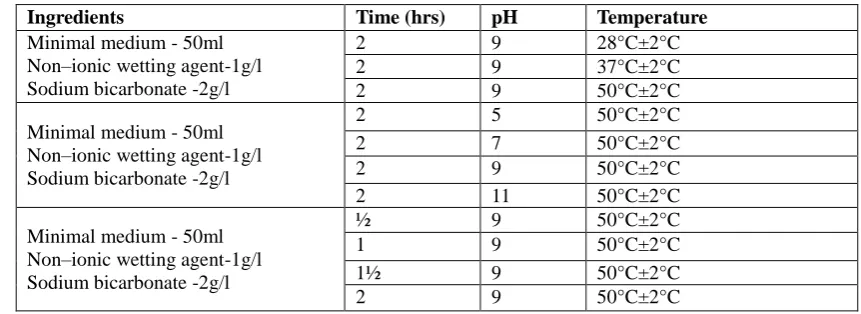
Penicillium citrinum and Bacillus subtilis was taken to test various degumming conditions i.e. temperature, pH and treatment time by calculating percentage weight loss (Table 1)
2.3.5. Comparison of static and shaking conditions on Protease production
To check the effect of static and shaking condition on protease production the media were inoculated with Penicillium citrinum and Bacillus subtilis and then incubated for incubation at 28±2°C and 37±2°C respectively for 7 days in incubator (static) and shaker (for shaking). After completion the raw silk yarn was degummed and the weight loss was checked.
Table 1
Effect of various physical conditions on degumming efficacy
Ingredients Time (hrs) pH Temperature
Minimal medium - 50ml Non–ionic wetting agent-1g/l Sodium bicarbonate -2g/l
2 9 28°C±2°C
2 9 37°C±2°C
2 9 50°C±2°C
Minimal medium - 50ml Non–ionic wetting agent-1g/l Sodium bicarbonate -2g/l
2 5 50°C±2°C
2 7 50°C±2°C
2 9 50°C±2°C
2 11 50°C±2°C
Minimal medium - 50ml Non–ionic wetting agent-1g/l Sodium bicarbonate -2g/l
½ 9 50°C±2°C
1 9 50°C±2°C
1½ 9 50°C±2°C
2 9 50°C±2°C
2.3.6. Weight loss
Weight loss was calculated by
Wt loss % = (Initial weight-final weight) X 100 Initial weight
2.3.7. Dyeing of sample
Samples of silk fibers obtained after degumming processes were dyed using acid Magenta (C.I Number- A. Red 186)
2.3.8. Hunter’s lab Whiteness Index and CIELAB Color system
The degummed samples were tested for Hunter’s whiteness index Premier Colorscan color lab + color matching software (licensed to HP022 SS5100A), the dyed samples were tested for color value (K.S and Kubellka Munk Equation). The hand and texture of the yarn changed after degumming a rating scale of 1-5 was made by the researcher where 1 is poor and 5 is excellent.
3 Results and discussion
3.1. Conventional method of degumming
Out of the five chemical methods tested, the one using soap and sodium carbonate was found to be most effective degumming agent resulting in 24% weight loss. The least degumming of silk yarn 12% was observed when treatment was done with ezee.
On comparing whiteness index and K/S value of Mulberry silk yarn with various chemical methods, maximum whiteness index was 82.85 was found to be of yarns degummed with soap and sodium carbonate, indicating it to be an effective degumming method. The K/S value of soap and sodium carbonate degummed sample was 38.82 indicating a good colour intensity when compared to raw silk yarn sample (13.23). It may be due to incomplete removal of sericin or may be due to fibroin damage.
3.2 Enzymatic Degumming
Procuring of enzyme was difficult as availability of enzyme was scarce as well as these were extremely expensive. Only trypsin was sourced and degumming was carried out by using various concentrations (0.5%. 1%, 3% and 5%). Percentage weight loss of samples found to vary from 2% with 0.5% of enzyme to 28% with 5% enzyme concentration. When compared with control sample, developed using the same silk yarn by treatment with soap and sodium carbonate, degumming with trypsin gave better weight loss of 28%.
Degumming with trypsin gave better weight loss, whiteness index i.e. 28% and 85.69% respectively. Trypsin 5% has highest K/S value i.e. 45.30 leading to good color intensity than control sample 38.72. This means more dye absorption is taken place in trypsin degummed sample.
3.3. Optimization of broth and fermentation condition for degumming
Four protease producing microbes from Division of Plant Pathology, IARI i.e. Penicillium citrinum, Aspergillus niger, Aspergillus flavus and Bacillus subtilis were cultured on different media to observe their protease production efficiency.
After 7 days of incubation, the cultures were filtered out and tested for protease production on casein agar plates. The production of zone of clearance around the wells containing these culture filtrates indicated extracellular protease production and hence can be easily distinguished from the non – proteolytic ones. Zone of clearance was observed in all the casein agar plates though maximum size was observed with the culture filtrate obtained from Minimal medium.
On comparing protease activity of different microbes, it was found that Bacillus subtilis and
Penicillium citrinum produced a larger zone of clearance while Aspergillus niger and Aspergillus flavus produces small zones. So, for further study isolates- Bacillus subtilis and Penicillium citrinum -forming larger zone were selected.
3.4. Degumming at different conditions of time, pH and temperature
Minimal medium broth inoculated with
Penicillium citrinum and Bacillus subtilis was taken to test degumming efficacy using different degumming conditions by calculating percentage weight loss.
3.4.1. Effect of time on degumming of silk
In order to determine the effect of different treatment time intervals on degumming of silk, B. subtilis and P. citrinum culture broths on minimal medium Effective weight loss (24 to 28%) was seen only after 2 hours of treatment. A half an hour treatment with both the cultures showed zero or very little degumming. Highest whiteness index was obtained on treatment for 2 hours with Bacillus subtilis and Penicillium citrinum
cultures.
From the results, it was clear that the best time period for degumming treatment was 2 hrs as maximum weight loss was noticed and even other characteristics of degummed samples were excellent.
3.4.2 Effect of Temperature on degumming of silk
The effect of different temperatures on degumming of silk was checked by using Penicillium citrinum and Bacillus subtilis broths. Bacillus subtilis
showed good weight loss at all the three temperatures tested i.e 28°C, 37°C and 50°C though highest was seen at 50°C (26-28 %). In contrast, Penicillium citrinum
showed zero degumming at a temperature of at 37°C and 28°C respectively. Best degumming was observed at 50°C (24 -26 %)
Shumaila et al. 2017 ISSN: 2349 – 4891
broth, highest K/S value (44.25 & 46.85) was at 50°C and least (35.45 & 36.77) was at 37°C Penicillium citrinum culture broths also gave maximum K/S (46.85 & 42.78) at 50°C and least (31.98 & 33.25) at 28°C. This indicated that different enzyme preparations work better at different temperatures.
The luster, texture and feel of Bacillus subtilis
and Penicillium citrinum broths treated samples at 50°C were excellent while control (with chemical method) showed excellent luster and very good texture and feel. From the above said results, it was clear that the best temperature for degumming was 50°C. Qureshi and associates (2010), reported that “maximum protease activities were produced at 47°C-50°C”. Many investigators studied the correlation between protease secretion and temperature but this depends on the type of organism and culture conditions. Temperature affects all the physiological activities in a living cell and is one of the important environmental factors to control the growth and microbial activity.
3.4.3 Effect of pH on degumming of silk
In order to determine the effect of different pH on degumming of silk, Penicillium citrinum and Bacillus subtili scultures in minimal medium broth were used for the degumming of raw silk yarn. It was carried out in orbital shaker at different pH- 5, 7, 9 and 11 for 2 hrs at 50°C. After degumming the silk yarns were washed with hot water and deactivation of enzyme was done by boiling the broth. All the samples were dried and the weight loss and other characteristics were evaluated.
Bacillus subtilis showed good weight loss in all the three pH 7, 9 and 11, the maximum, however, observed at pH 9. Both Bacillus subtilis and Penicillium citrinum at pH 5 showed zero degumming. This is because acidic conditions damage fibroin and degrade fiber polymer. Penicillium citrinum showed good degumming at pH 7, 9 and 11. All the cultures tested, however gave best results at pH 9.
Bacillus subtilis and Penicillium citrinum both at pH 9 and 11 showed maximum whiteness index and least at pH 5. (Freddi and coworkers, 2003), reported that “alkaline and neutral proteases effectively degummed silk sample and the degumming kinetics depends on the enzyme dosage and treatment time”.
Acidic (pH 5) and alkaline (pH 11) pH caused hydrolysis of polypeptide chains in the fiber. Acid hydrolysis occurs at nearly all peptide linkages in the chains of the fiber. It has been claimed that pH values 6.5 to 9 causes least damage to the fiber. Acid hydrolysis tends to be more damaging to fiber than alkaline hydrolysis.
The pH 11 was not chosen for further study because it is too alkaline and high alkalinity damages fiber polymer. The luster, texture and feel of Bacillus subtilis and Penicillium citrinum at pH 9 was excellent. From the above results, it was clear that the best temperature for degumming is 50°C, best pH was 9 and time period was 2 hours, as maximum weight loss was
noticed under these conditions.
3.5 Comparison of static and shaking conditions
The static medium is more suitable for
Penicillium citrinum as in shaking medium no significant weight was seen. In Bacillus subtilis significant weight loss was seen in both conditions, but maximum weight loss was seen in static medium i.e. 26 to 28%. The whiteness index was found to be more for static cultures. The K/S values and also feel, luster and texture were found to be much better when static culture was used instead of shaking ones. Stable conditions offers many advantages, including superior volumetric productivity, use of simpler machinery and lower energy requirement compared to shaking fermentation.
4. Results and Summary
The results of the study revealed that microbes could be exploited for producing proteolytic enzymes, the characteristics of which depend on the conditions of growth like culture medium, pH, time and temperature. These enzymes can be used for degumming the silk fibers to make the process more eco-friendly. Enzymatically degummed samples were found to be superior in terms of whiteness, dye uptake, luster, feel, softness and percent weight loss as compared to conventionally degummed samples. This is because proteolytic work under milder conditions.
(Duran, 2000), reported in his paper that “proteolytic enzymes have become an integral part of silk finishing process. This is also known as enzymatic degumming. It involves degradation of sericin using an enzyme, which does not attack fibroin”. This is the reason for proteolytic degummed samples to appear whiter, brighter, shiner and softer than the soap degummed samples.
5. Conclusion
From the result, it can be inferred that proteolytic enzymes extracted in lab under different conditions were the best as degumming agents followed by trypsin and then soaps. So these natural enzymes could be used for silk degumming effectively in industries as they have the added advantages of being eco -friendly.
Acknowledgement
We would like to thank university of Delhi, R & D Scheme for providing us the financial support to carry out the research project.
References
1. Arami, M., S. Rahimi., L. Mivehie, and F. Mazaheri. (2007)Degumming of Persian silk with mixed proteolytic enzymes. Journal of Applied Polymer Science 106: 267–275.
bio-degumming versus conventional degumming process, Colourage., 54(11), 63.
3. Gulrajani, M. L., (1992) Degumming of silk. Review of Progress in Coloration and Related Topics, 22: 79–89.
4. Chopra, S., and M. L. Gulrajani. (1994) Comparative evaluation of the various methods of degumming silk. Indian Journal of Fibre and Textile Research 19: 76–83.
5. Duran,N., & Duran, M. (2000) Enzyme applications in the textile industry. Rev. Prog. Coloration, 30:41-44.DOI:10.1111/J.1478-4408.2000.TB03779.
6. Gulrajani, M. L., Agarwal,R., Grover, A., and Suri,M. (2000b) Degumming of silk with lipase and
protease. Indian Journal of Fibre and Textile Research 25: 69–74.
7. Freddi, G., Mossotti,R., and Innocenti. R. (2003) Degumming fabric with several proteases. Journal of Biotechnology 106: 101–112.
8. Fan, J. B., Zheng,L.H., Wang, F., Guo, H.Y., Jiang,L., and Ren,F.Z. (2010) Enzymatic hydrolysis of silk sericin by proteases and antioxidant activities of the hydrolysates. Journal of Food Biochemistry 34: 382–398.
9. Qureshi, S.A., Bhutto, M.A., Khushk, I., & Dahot, M.U. (2011) Optimization of cultural conditions for protease production by Bacillus subtilis EFRL
01,African Journal of Biotechnology,