R E S E A R C H
Open Access
Convergence comparison and stability of
Jungck-Kirk-type algorithms for common
fixed point problems
Abdullah Alotaibi
1*, Vivek Kumar
2and Nawab Hussain
1*Correspondence: [email protected]
1Department of Mathematics, King Abdulaziz University, P.O. Box 80203, Jeddah, 21589, Saudi Arabia Full list of author information is available at the end of the article
Abstract
The aim of this article is to introduce new hybrid iterative schemes, namely Jungck-Kirk-SP and Jungck-Kirk-CR iterative schemes, and prove convergence and stability results for these iterative schemes using certain quasi-contractive operators. Numerical examples showing the comparison of convergence rate and applications of newly introduced iterative schemes are also provided. The obtained results improve, generalize and extend the works of Olatinwo (Acta Math. Univ. Comen. LXXVII(2):299-304, 2008; Fasc. Math. 40:37-43, 2008; Mat. Vesn. 61(4):247-256, 2009; Acta Math. Acad. Paedagog. Nyházi. 25(1):105-118, 2009; Acta Univ. Apulensis 26:225-236, 2011), Chugh and Kumar (Int. J. Contemp. Math. Sci. 7(24):1165-1184, 2012; Int. J. Comput. Appl. 36(12):40-46, 2011), Bosede (Bull. Math. Anal. Appl. 2(3):65-73, 2010), Oleleru and Akewe (Fasc. Math. 47:47-61, 2011) and many others in the literature.
MSC: 47H06; 54H25
Keywords: Jungck-type iterative schemes; Kirk-type iterative schemes; quasi-contractive operators; goat problem
1 Introduction
In the recent years, fixed and common points of operators have been approximated by using different iterative schemes (see [–]). LetXbe a Banach space,Y an arbitrary set andS,T:Y→Xsuch thatT(Y)⊆S(Y). Forx∈Y, consider the following iterative scheme:
Sxn+=Txn, n= , , . . . . (.)
This scheme is called Jungck iterative scheme and was essentially introduced by Jungck [] in . It reduces to the Picard iterative scheme whenS=Id(identity mapping) and
Y=X.
Forαn∈[, ], Singhet al. [] defined the Jungck-Mann iterative scheme as follows:
Sxn+= ( –αn)Sxn+αnTxn. (.)
Forαn,βn,γn∈[, ], Olatinwo defined the Jungck-Ishikawa [] and Jungck-Noor []
iterative schemes as follows:
Sxn+= ( –αn)Sxn+αnTyn,
Syn= ( –βn)Sxn+βnTxn
(.)
and
Sxn+= ( –αn)Sxn+αnTyn,
Syn= ( –βn)Sxn+βnTzn,
Szn= ( –γn)Sxn+γnTxn,
(.)
respectively.
Chugh and Kumar [] defined the Jungck-SP iterative scheme as
Sxn+= ( –αn)Syn+αnTyn,
Syn= ( –βn)Szn+βnTzn,
Szn= ( –γn)Sxn+γnTxn,
(.)
where{αn},{βn}and{γn}are sequences of positive numbers in [, ].
Remark . IfX=Y andS=Id(identity mapping), then Jungck-SP (.), Jungck-Noor
(.), Jungck-Ishikawa (.) and the Jungck-Mann (.) iterative schemes, respectively, be-come the SP [], Noor [], Ishikawa [] and Mann [] iterative schemes.
In , Olatinwo [] introduced the Kirk-Mann and Kirk-Ishikawa iterative schemes as follows.
(a) Kirk-Mann iterative scheme:
xn+=
k
i=
αn,iTixn,
k
i=
αn,i= ,n= , , , . . . , (.)
whereαn,i≥,αn,= ,αn,i∈[, ]andkis a fixed integer. (b) Kirk-Ishikawa iterative scheme:
xn+=αn,xn+
k
i=
αn,iTiyn,
k
i= αn,i= ,
yn= s
j=
βn,jTjxn, s
j=
βn,j= ,n= , , , . . . ,
(.)
wherek≥s,αn,i≥,αn,= ,βn,j≥,βn,= ,αn,i,βn,j∈[, ]andk,sare fixed integers.
Chugh and Kumar [] introduced the following Jungck-Kirk-Noor iterative scheme:
Sxn+=αn,Sxn+
r
i=
αn,iTiyn,
k
Syn=βn,Sxn+
s
j=
βn,jTjzn,
s
j=
βn,j= , (.)
Szn=γn,kSxn+
t
k=
γn,kTkxn,
t
k=
γn,k= ,n= , , , . . . ,
r≥s≥t,αn,i≥,αn,= ,βn,j≥,βn,= ,γn,l≥,γn,= ,αn,i,βn,j,γn,l∈[, ], wherer,
sandtare fixed integers.
Very recently, Hussainet al. [] defined the Jungck-CR iterative scheme as follows:
Sxn+= ( –αn)Syn+αnTyn,
Syn= ( –βn)Txn+βnTzn,
Szn= ( –γn)Sxn+γnTxn,
(.)
where{αn},{βn}and{γn}are sequences of positive numbers in [, ].
PuttingS=Id(identity mapping) andαn= in the Junck-CR iterative scheme, we get
the Agarwalet al. iterative scheme [].
Jungck [] used iterative scheme (.) to approximate the common fixed points of the mappingsSandTsatisfying the following Jungck-contraction:
d(Tx,Ty)≤αd(Sx,Sy), ≤α< . (.)
Singh et al. [, ] established some stability results for Jungck and Jungck-Mann it-erative schemes for both contractive conditions (.) and (.): For some αn= and
≤L,
d(Tx,Ty)≤ad(Sx,Sy) +Ld(Sx,Tx). (.)
Olatinwo and Imoru [] studied the generalized Zamfirescu operators for the pair (S,T), satisfying the following condition: For each pair of pointsx, yinY, at least one of the following is true:
(i) d(Tx,Ty)≤ad(Sx,Sy),
(ii) d(Tx,Ty)≤bd(Sx,Tx) +d(Sy,Ty), (.)
(iii) d(Tx,Ty)≤cd(Sx,Ty) +d(Sy,Tx),
wherea,b,care nonnegative constants satisfying ≤a≤, ≤b,c≤.
Any mapping satisfying (.)(ii) is called a Kannan mapping, while the mapping satis-fying (.)(iii) is called a Chatterjea operator.
The contractive condition (.) implies
d(Tx,Ty)≤δd(Sx,Tx) +δd(Sx,Sy), ∀x,y∈X, (.)
Ranganathan [] used the following more general contractive condition than (.) and (.) to prove some fixed point theorems:
(Tx,Ty)≤cmaxd(Sx,Sy),d(Sx,Tx),d(Sy,Ty),d(Sx,Ty),d(Sy,Tx), (.)
∀x,y∈Xand somec∈[, ).
Note that (.) and (.) are independent of each other but more general than (.).
Hussain et al. [] and Olatinwo [], respectively, used the following more general contractive conditions than (.) to prove the stability and strong convergence results for various iterative schemes: There existsa∈[, ) and a monotone increasing function
ϕ:R+→R+withϕ() = such that
Tx–Ty ≤φ Sx–Tx +a Sx–Sy , (.)
Tx–Ty ≤φ( Sx–Tx ) +ψ( Sx–Sy )
+L Sx–Tx . (.)
Recently, Bosede [] used the following more general contractive condition than (.) to prove the convergence results for the Jungck-Ishikawa iteration process:
Tx–Ty ≤eLSx–Tx δ Sx–Tx +δ Sx–Sy . (.)
Definition .[, ] Letf andgbe two selfmaps onX. A pointxinXis called () a fixed point off iff(x) =x; () a coincidence point of a pair (f,g) iffx=gx; () a common fixed point of a pair (f,g) ifx=fx=gx. Ifw=fx=gxfor somexinX, thenwis called a point of coincidence off andg. A pair (f,g) is said to be weakly compatible iff andgcommute at their coincidence points.
The stability theory has extensively been studied by various authors [, , , , , , ] due to its increasing importance in computational mathematics, especially due to revolution in computer programming.
We use the following definition and lemmas to prove our results.
Definition .[] LetS,T:X→Xbe operators such thatT(X)⊆S(X) andp=Sz=Tz, a point of coincidence ofSandT. Let{Sxn}∞n=⊂Xbe the sequence generated by an iterative procedure
Sxn+=f(T,xn), n= , , . . . , (.)
where x ∈X is the initial approximation and f is some function. Suppose {Sxn}∞n=
converges top. Let {Syn}∞n=⊂X be an arbitrary sequence and setεn=d(Syn,f(T,yn)),
n= , , . . . . Then the iterative procedure (.) is said to be (S,T)-stable or stable if and only iflimn→∞εn= implieslimn→∞Syn=p.
Definition .[, ] Let{un}and{vn}be two iteration procedures that converge to the same fixed pointpon a normed spaceXsuch that the error estimates
and
vn–p ≤bn,
are available, where {an} and {bn} are two sequences of positive numbers (converging to zero). If {an} converges faster than{bn}, then we say that{un}converges faster top
than{vn}.
Definition .[, ] Suppose that{an}and{bn}are two real convergent sequences with limitsaandb, respectively. Then{an}is said to converge faster than{bn}if
lim
n→∞
anbn––ab .
Definition .[] Any functionψ:R+→R+is called a comparison function if it satisfies the following properties:
() ψis monotonic increasing; () limn→∞ψn(t) = ,t≥.
Note that a comparison function always satisfies (i)ψ(t) <t,t∈R+, (ii)ψ() = .
Lemma .[] Letψ:R+→R+be a subadditive,comparison function and let{ε n}∞n=be a sequence of positive numbers such thatlimn→∞εn= ,then for any sequence of positive numbers{un}∞n=satisfying
un+≤ m
k=
δkψk(un) +εn, n= , , , . . . ,
whereδ,δ, . . . ,δm∈[, ]with≤
m
k=δk≤,we havelimn→∞un= .
Now, we define the Jungck-Kirk-SP and Jungck-Kirk-CR iterative schemes as follows: Letr≥s≥t,αn,i≥,αn,= ,βn,j≥,βn,= ,γn,k≥,γn,= ,αn,i,βn,j,γn,k∈[, ],
withri=αn,i=
s
j=βn,j=
t
k=γn,k= wherer,sandtare fixed integers. Then we define
the Jungck-Kirk-SP iterative scheme as follows:
Sxn+=αn,Syn+
r
i=
αn,iTiyn,
Syn=βn,Szn+ s
j=
βn,jTjzn, (.)
Szn=γn,Sxn+ t
k=
γn,kTkxn, n= , , , . . . ,
and the Jungck-Kirk-CR iterative scheme as follows:
Sxn+=αn,Syn+
r
i=
Syn=βn,Txn+
s
j=
βn,jTjzn, (.)
Szn=γn,Sxn+
t
k=
γn,kTkxn, n= , , , . . . .
Remark . Puttingr=s=t= in Jungck-Kirk-type iterative schemes (i.e., JKCR, JKSP,
JKN, JKI, JKM), we get the corresponding Jungck-type iterative schemes (i.e., JCR, JKP, JN, JI, JM).
Also, we shall use the following contractive condition: Letψ:R+→R+be a comparison
function such that
Tix–p≤ψi Sx–p , ∀x∈Xand∀i∈N, (.)
wherepis a point of coincidence ofS,T,i.e.,p=Sz=TzandTi,ψidenote theith iterate
ofTandψ, respectively.
The following example shows that (.) is more general than Jungck contraction (.).
Example . LetX=Y= [, ]. DefineTandSby
T(x) =
, x∈[, )
, x=
, Sx=x, ψ(t) = t.
It is clear thatTandSsatisfy (.) but not Jungck-contraction (.).
If (S,T) are Kannan operators, then from (.)(ii) withi= ,y=z(a coincidence point ofS,T), we get
Tx–Tz ≤a Sx–Tx ≤a Sx–Tz + Tz–Tx ,
which further implies
Tx–Tz ≤ a
–a
Sx–Tz i.e. Tx–p ≤ a
–a
Sx–p .
Hence every Kannan operator satisfies (.) withψ(t) = a
–at,∀t∈R +.
In a similar manner, it can be shown that Chatterjea operators satisfy (.) withψ(t) =
b
–bt,∀t∈R+.
Therefore, we conclude that generalized Zamfirescu operators satisfy (.).
Also, ifψ(t) =δt,∀t∈R+, then (.) reduces to (.) as well as (.), withi= ,x=z,
(a coincidence point ofS,T).
The condition (.) is more general than (.) as well as (.) and (.), withi= ,
x=z,ψ(t) =at,∀t∈R+.
Moreover, (.) reduces to (.) as follows: Lety=z, then from (.), we have
Tx–p ≤cmax Sx–p , Sx–Tx , p–p , Sx–p , p–Tx
≤c Sx–p + Tx–p
≤ c
–c Sx–p .
Hence every mapping satisfying (.) becomes a mapping satisfying (.) withi= ,
ψ(t) = c
–c, ∀t∈R +.
2 Main results
Lemma . Letψ:R+→R+be a subadditive,comparison function,then for any sequence of positive numbers{un}∞n=satisfying
un+≤ m
k=
δkψk(un), n= , , , . . . , (.)
whereδ,δ, . . . ,δm∈[, ]with≤
m
k=δk≤,we havelimn→∞un= .
Proof Letψ¯(un) =
m
k=δkψk(un). Now, we know that a linear combination of comparison
functions is also a comparison function, henceψ¯ is a comparison function and it satisfies ¯
ψ(t) <tfor allt∈R+. Hence,ψ¯(un) <un. Therefore, from (.), we haveun+<un. So,
{un}∞n=is a decreasing sequence of positive numbers bounded below by . Hence{un}∞n=
will converge to ,i.e.,limn→∞un= .
Theorem . Let(X, · )be a normed linear space,let S,T:X→X be operators satis-fying(.)such that T(X)⊆S(X).Assume that S(X)or T(X)is a complete subspace of X,
ψ:R+→R+is a continuous sublinear comparison function and p is a point of coincidence of S and T,i.e.,p=Sz=Tz.Then,for x∈X,the Jungck-Kirk-SP iteration process{Sxn}∞n= defined by(.)converges to p and is(S,T)-stable.Also,p will be the unique common fixed point of S,T provided S and T are weakly compatible.
Proof Ifψ is sublinear, thenψi(iterate ofψ) is also sublinear (see []). Now, first we prove the convergence of the Jungck-Kirk-SP iterative scheme.
Using Jungck-Kirk-SP iterative scheme (.) and contractive condition (.), we have
Sxn+–p ≤αn, Syn–p + r
i=
αn,iTiyn–p
≤αn, Syn–p + r
i= αn,iψi
Syn–p =
r
i= αn,iψi
Syn–p . (.)
Similarly, we have the following estimates:
Syn–p ≤ s
j=
βn,jψj Szn–p (.)
and
Szn–p ≤ t
k= γn,kψk
It follows from (.), (.) and (.) that
Sxn+–p ≤ r i= αn,i s j= βn,j t k=
γn,kψi+j+k
Sxn–p
. (.)
Using Lemma ., (.) yieldslimn→∞Sxn=p.
Thus, the Jungck-Kirk-SP iterative scheme converges strongly top. Next we prove that the Jungck-Kirk-SP iterative scheme is (S,T)-stable. Suppose that{Syn}∞n=⊂Xis an arbitrary sequence,εn= Syn+–αn,Sbn–
k
i=αn,i× Tibn ,n= , , , . . . , whereSbn=βn,Scn+s
j=βn,jTjScn,cn=γn,Syn+
t
k=γn,kTkyn.
First, letlimn→∞Syn=p. Then, we show thatlimn→∞εn= as follows:
εn=
Syn+–αn,Sbn–
r
i=
αn,iTibn
≤ Syn+–p +
p–αn,Sbn–
r
i=
αn,iTibn
= Syn+–p +
r i=
αn,iTiz+αn,Sz–αn,Sbn– r
i=
αn,iTibn
= Syn+–p +
k i= αn,i
Tiz–Tibn
+αn,(Sz–Sbn)
≤ Syn+–p +
k
i=
αn,iTiz–Tibn+αn, Sbn–p
= Syn+–p +
r
i= αn,iψi
p–Sbn +αn, Sbn–p
= Syn+–p + r
i= αn,iψi
p–Sbn
= Syn+–p +
r
i= αn,iψi
s j=
βn,jTjz+βn,Sz–βn,Scn–
s
j=
βn,jaTjcn
= Syn+–p +
r i= αn,iψi s j=
βn,jTjz–Tjcn+βn,(Sz–Scn)
≤ Syn+–p +
r
i= αn,iψi
s
j=
βn,jTjz–Tjcn+βn, p–Scn
≤ Syn+–p + r
i= αn,iψi
s
j= βn,jψj
p–Scn
+βn,
p–Scn
= Syn+–p +
r
i= αn,iψi
s
j= βn,jψj
p–Scn
= Syn+–p
+
r
i= αn,iψi
s
j= βn,jψj
t k=
γn,kTkz+γn,Sz–γn,Syn–
t
k=
γn,kTkyn
= Syn+–p +
r
i= αn,iψi
s
j= βn,jψj
t
k=
γn,kTkz–Tkyn+γn,(Sz–Syn)
= Syn+–p +
r
i= αn,iψi
s
j= βn,jψj
t
k= γn,kψk
p–Syn +γn,(Sz–Syn)
= Syn+–p +
r
i= αn,iψi
s
j= βn,jψj
t
k= γn,kψk
p–Syn
= Syn+–p +
r i= αn,i s j= βn,j t k=
γn,kψi+j+k
Syn–p . (.)
Using Lemma ., (.) yieldsεn= asn→ ∞.
Conversely, we establish thatlimn→∞Syn=pas follows:
Syn+–p ≤
Syn+–αn,Sbn– r
i=
αn,iTibn
+
αn,Sbn+
r
i=
αn,iTibn–p
=εn+
αn,Sbn+
r
i=
αn,iTibn–
r
i=
αn,iTiz–αn,Sz
=εn+
r i= αn,i
Tibn–Tiz
+αn,(Sbn–Sz)
≤εn+ r
i=
αn,iTibn–Tiz+αn, Sbn–p
≤εn+ r
i= αn,iψi
p–Sbn +αn, Sbn–p
=εn+ r
i= αn,iψi
s j=
βn,jTjz+βn,Sz–
s
j=
βn,jTjcn–βn,Scn
=εn+ r
i= αn,iψi
s j= βn,j
Tjz–Tjcn
+βn,(Sz–Scn)
=εn+ r
i= αn,iψi
s
j= βn,jψj
p–Scn +βn, Scn–p
=εn+ r
i= αn,iψi
s
j= βn,jψj
p–Scn
=εn+ r
i= αn,iψi
s
j= βn,jψj
t k= γn,k
Tkz–Tkyn+γn,
Sz–Syn
=εn+ r
i= αn,iψi
s
j= βn,jψj
t
k= γn,kψk
p–Syn
Using again Lemma ., (.) yieldslimn→∞Syn=p.
Now, we provepis the unique common fixed point ofSandTprovidedS,Tare weakly compatible. Let there exist another point of coincidence sayp*. Then there existsq*∈X
such thatSq*=Tq*=p*. But from (.), we have
<p*–p≤Tiq*–p≤ψSq*–p<p*–p,
which impliesp=p*.
Now, asSandT are weakly compatible andp=Tq=Sq, soTp=TTq=TSq=STqand henceTp=Sp. ThereforeTpis a point of coincidence ofS,Tand since the point of coin-cidence is unique, thenp=Tp. ThusTp=Sp=pand thereforepis the unique common
fixed point ofSandT.
Remark . Since the Kirk-Mann iteration scheme is a special case of the
Jungck-Kirk-SP iteration scheme, the convergence and stability result similar to Theorem . also holds for the Jungck-Kirk-Mann scheme.
Theorem . Let(X, · )be a normed linear space,let S,T:X→X be operators sat-isfying(.)such that T(X)⊆S(X).Assume that S(X)or T(X)is a complete subspace of X,ψ:R+→R+is a continuous sublinear comparison function and p is a point of coinci-dence of S and T.Then,for x→X,the Jungck-Kirk-CR iteration process{Sxn}∞n=defined by(.)converges to p and is(S,T)-stable.Also,p will be the unique common fixed point of S,T provided S and T are weakly compatible.
Proof Using Jungck-Kirk-CR iterative scheme (.), we have
Sxn+–p ≤αn, Syn–p + r
i=
αn,iTiyn–p
=αn, Syn–p + r
i= αn,iψi
Syn–p
=
r
i= αn,iψi
Syn–p . (.)
In a similar manner, we have the following estimates:
Syn–p ≤βn, Txn–p + s
j=
βn,jTjzn–p
=βn,ψ
Sxn–p +
s
j= βn,jψj
Szn–p (.)
and
Szn–p ≤ t
k= γn,kψk
It follows from (.), (.) and (.) that
Sxn+–p
≤
r
i= αn,iψi
βn,ψ Sxn–p
+
s
j= βn,jψj
t
k= γn,kψk
Sxn–p
. (.)
Let
¯
ψ=βn,ψ+ s j= βn,j t k=
γn,kψk+j. (.)
Then, obviously, being the linear combination of comparison functions,ψ˜is also a com-parison function and hence (.) yields
Sxn+–p ≤ r
i= αn,iψi
¯
ψ Sxn–p . (.)
Sinceki=αn,i= , hence using Lemma ., (.) yieldslimn→∞Sxn=p.
Thus, the Jungck-Kirk-CR iterative scheme converges strongly top. Next we prove that the Jungck-Kirk-CR iterative scheme is (S,T)-stable. Suppose that{Syn}∞n=⊂Xis an arbitrary sequence,εn= Syn+–αn,Sbn–
r
i=αn,i× Tibn ,n= , , , . . . , whereSbn=βn,Tyn+s
j=βn,jTjcn,Scn=γn,Syn+
t
k=γn,kTkynand
limn→∞εn= . We shall establish thatlimn→∞Syn=pas follows:
Syn+–p ≤
Syn+–αn,Sbn–
r
i=
αn,iTibn
+
αn,Sbn+
r
i=
αn,iTibn–p
=εn+
αn,Sbn+ r
i=
αn,iTibn– r
i=
αn,iTiz–αn,Sz
=εn+
r i= αn,i
Tibn–Tiz+αn,(Sbn–Sz)
≤εn+ r
i=
αn,iTibn–Tiz+αn, Sbn–p
=εn+ r
i= αn,iψi
p–Sbn +αn, Sbn–p
=εn+ r
i= αn,iψi
s j=
βn,jTjz+βn,Sz–βn,Tyn–
s
j=
βn,jTjcn
=εn+ r
i= αn,iψi
s j= βn,j
Tjz–Tjcn+βn,(Sz–Tyn)
=εn+ r
i= αn,iψi
s j=
βn,jψj(p–Scn) +βn,ψ(Sz–Syn)
=εn+ r
i= αn,iψi
s
j= βn,jψj
t k= γn,k
Tkz–Tkyn
+γn,(Sz–Syn)
+βn,ψ Syn–Sz
=εn+ r
i= αn,iψi
s
j= βn,jψj
t k=
γn,kψk(Sz–Syn)
+γn,(Sz–Syn)
+βn,ψ
Syn–p
≤εn+ r
i= αn,iψi
s
j= βn,jψj
t
k= γn,kψk
Sz–Syn
+βn,ψ
Syn–p
. (.)
Then using (.) and (.), we get
Syn+–p ≤εn+ r
i= αn,iψi
¯
ψ Syn–p . (.)
Using Lemma ., from (.) we obtainlimn→∞Syn=p.
Conversely, letlimn→∞Syn=p. Then we shall show thatlimn→∞εn= as follows:
εn=
Syn+–αn,Sbn–
r
i=
αn,iTibn
≤ Syn+–p +
p–αn,Sbn–
r
i=
αn,iTibn
= Syn+–p +
r i=
αn,iTiz+αn,Sz–αn,Sbn–
r
i=
αn,iTibn
= Syn+–p +
r i=
αn,iTiz–Tibn+αn,(Sz–Sbn)
≤ Syn+–p +
r
i=
αn,iTiz–Tibn+αn, Sbn–p
≤ Syn+–p +
r
i=
αn,iψi p–Sbn +αn, Sbn–p
= Syn+–p +
r
i= αn,iψi
s j=
βn,jTjz+βn,Sz–βn,Tyn–
s
j=
βn,jTjcn
= Syn+–p +
k
i= αn,iψi
s j= βn,j
Tjz–Tjcn+βn,(Sz–Tyn)
≤ Syn+–p +
k
i= αn,iψi
s
j=
βn,jψj(Sz–Scn) +βn,ψ(Sz–Syn)
= Syn+–p + k
i= αn,iψi
s
j= βn,jψj
t
k=
γn,kTkz+γn,Sz
–
t
k=
γn,kTkyn–γn,Syn
+βn,ψ
Syn–p
= Syn+–p +
r
i= αn,iψi
s
j= βn,jψj
t
k= γn,k
Tkz–Tkyn
+γn,(Sz–Syn)
+βn,ψ
Syn–p
= Syn+–p +
r
i= αn,iψi
s
j= βn,jψj
t
k= γn,kψk
Sz–Syn
+γn, Sz–Syn
+βn,ψ
Syn–p
. (.)
Using (.) and (.), we get
εn≤ Syn+–p + r
i= αn,iψi
¯
ψ Sxn–p . (.)
Lemma . implies thatlimn→∞εn= .
Thus, the Jungck-Kirk-CR iterative scheme is (S,T)-stable.
The uniqueness of a common fixed point can be proved in the same lines as in
Theo-rem ..
The following example shows the validity of our Theorems . and ..
Example . LetX= [, ],T(x) = (+x),S(x) = –x,αn,= –αn,–αn,,βn,= – βn,–βn,,γn,= –γn,–γn,,αn,=βn,=γn,=αn,=βn,=γn,=√n+ andψ(t) =t.
It is clear thatT andSare weakly compatible operators satisfying (.) with a unique common fixed point .. Convergence of the Junck-Kirk-CR iterative scheme as well as the Junck-Kirk-SP iterative scheme to . is shown in Example ..
3 Results on direct comparison
Theorem . Let(X, · )be a normed linear space,let S,T:X→X be operators satisfying
(.)such that T(X)⊆S(X).Assume that S(X)or T(X)is a complete subspace of X,ψ :
R+→R+is a continuous sublinear comparison function and p is a point of coincidence of S,T(i.e.,Sz=Tz=p).Iflimn→∞αn= then for x∈X,
() Jungck-Kirk-Mann(JKM)iterative scheme is faster than Jungck-Mann(JM)iterative scheme;
() Jungck-Kirk-Ishikawa(JKI)iterative scheme is faster than Jungck-Ishikawa(JI)
iterative scheme;
() Jungck-Kirk-Noor(JKN)iterative scheme is faster than Jungck-Noor(JN)iterative scheme;
() Jungck-Kirk-SP(JKSP)iterative scheme is faster than Jungck-SP(JSP)iterative scheme;
() Jungck-Kirk-CR(JKCR)iterative scheme is faster than Jungck-CR(JCR)iterative scheme.
Proof For a Jungck-type iterative scheme, we have the following estimates:
JMn+–p ≥( –αn) Sxn–p –αn
Txn–p
≥( –αn) Sxn–p –αnψ
Sxn–p
≥( –αn) Sxn–p –αn Sxn–p usingψ(t) <t,∀t∈R+
≥( – αn) Sxn–p
· · ·
≥
n
l=
( – αl) Sx–p ,
JIn+–p ≥( –αn) Sxn–p –αnψ
Syn–p
≥( –αn) Sxn–p –αn Syn–p
≥( –αn) Sxn–p –αn
Sxn–p
≥( – αn) Sxn–p
· · ·
≥
n
l=
( – αl) Sx–p ,
JNn+–p ≥( –αn) Sxn–p –αnψ
Syn–p
≥( –αn) Sxn–p –αn
Syn–p
≥( –αn) Sxn–p –αn
Szn–p
≥( – αn) Sxn–p
· · ·
≥
n
l=
JSPn+–p ≥[ – αn] Syn–p
≥[ – αn][ – βn][ – γn] Sxn–p
≥[ – αn] Sxn–p
· · ·
≥
n
l=
( – αl) Sx–p
and
JCRn+–p ≤( –αn) Syn–p +αnψ
Syn–p
≤( –αn)
( –βn) Txn–p +βn
Tzn–p
+αnψ
( –βn) Txn–p +βn
Tzn–p
≤( –αn)( –βn)ψ
Sxn–p
+ ( –αn)βnψ
Szn–p
+αn( –βn)ψ
Sxn–p
+αnβnψ
Szn–p
≤( –αn)( –βn)ψ Sxn–p + ( –αn)βnψ( –γn) Sxn–p
+γn Txn–p +αn( –βn)ψ Sxn–p
+αnβnψ
( –γn) Sxn–p +γn
Txn–p
≤( –αn)( –βn)ψ
Sxn–p + ( –αn)βn( –γn)ψ
Sxn–p
+ ( –αn)βnγnψ
Sxn–p +αn( –βn)ψ
Sxn–p
+αnβn( –γn)ψ
Sxn–p
+αnβnγnψ
Sxn–p
Also, for Jungck-Kirk-type iterative schemes, we have the following estimates:
JKMn+–p ≤ r
i= αn,iψi
Sxn–p
≤ψ Sxn–p
usingψi≤ψand
r
i= αn,i=
· · ·
≤ψn Sx–p
,
JKIn+–p ≤αn, Sxn–p + r
i= αn,i
s
j= βn,jψi+j
Sxn–p
≤
r
i= αn,iψi
Sxn–p
usingψi+j≤ψiand
s
j= βn,j=
≤ψ Sxn–p
· · ·
JKNn+–p ≤αn, Sxn–p + r
i= αn,iψi
βn,
Sxn–p +
s
j= βn,jψj
Szn–p
≤αn, Sxn–p
+
r
i= αn,iψi
βn,
Sxn–p
+
s
j= βn,jψj
t
k= γn,kψk
Sxn–p
≤
r
i=
αn,iψi Sxn–p
usingψl≤ψforl=k,jand
s
j= βn,j=
t
k= γn,k=
≤ψ Sxn–p
· · ·
≤ψn Sx–p ,
JKSPn+–p ≤
r
i= αn,i
s
j= βn,j
t
k= γn,k
ψi+j+k Sxn–p
≤ψ Sxn–p
usingψi+j+k≤ψand
r
i= αn,i
s
j= βn,j
t
k= γn,k
=
· · ·
≤ψn+ Sx–p
and
JKCRn+–p ≤ r
i= αn,iψi
βn,ψ
Sxn–p +
s
j= βn,jψj
t
k= αn,kψk
Szn–p
(using (.)).
Using the above estimates, we have
JKMn+–p JMn+–p
≤ ψn+( Sx–p ) n
l=( – αl) Sx–p
.
Let
pn= ψ
n+( Sx–p )
n
l=( – αl) Sx–p
.
Then
pn+ pn =
ψn+( Sx–p ) ψn+( Sx–p )( – α
n+)
Butψn+(t) <ψn+(t),t∈R+. Hence
ψn+( Sx–p )
ψn+( Sx–p )=δ(say) < .
Therefore,limn→∞ppnn+=limn→∞
δ
–αn+=δ< . So, by ratio test
pnis convergent. Hencelimn→∞pn= , which further implieslimn→∞ JKMJMnn++–p–p = ,i.e., the JKM
itera-tive scheme converges faster than the JM iteraitera-tive scheme in view of Definition .. Now, since the estimates for JKI, JKN and JKSP are similar to that of JKM, also estimates of JI, JN and JSP are similar to that of JM, therefore using a very similar argument, it can be easily shown that JKI, JKN, JKSP iterative schemes converge faster than JI, JN, JSP iterative schemes.
Now we compare JCR and JKCR iterative schemes.
From estimates of JCR and JKCR iterative schemes, we have
JCRn+–p ≤δ
and
JKCRn+–p ≤δ,
where
δ= ( –αn)( –βn)ψ
Sxn–p
+ ( –αn)βn( –γn)ψ
Sxn–p
+ ( –αn)βnγnψ
Sxn–p +αn( –βn)ψ
Sxn–p
+αnβn( –γn)ψ
Sxn–p
+αnβnγnψ
Sxn–p
and
δ= r
i= αn,iψi
βn,ψ
Sxn–p
+
s
j= βn,jψj
t
k= αn,kψk
Sxn–p
(using (.)).
Usingψj<ψk, forj>k, it can be easily observed thatδ<δ.
Therefore, in view of Berinde’s Definition ., Jungck-Kirk-CR have better convergence
rate as compared to the Jungck-CR iterative scheme.
Example . LetS,T andXbe the same as in Example .. Then convergence speed
comparison of Jungck-Kirk-type iterative schemes with corresponding Jungck-type itera-tive schemes is shown in Table with initial approximationx= . andr=s=t= .
Remark . Although direct comparison among Jungck-Kirk-type iterative schemes is
Table 1 Comparison of Jungck-Kirk-type iterative schemes with corresponding Jungck-type iterative schemes
n JKCR JCR JKSP JSP JKN JN JKI KI JKM KM
0 0.1 0.1 0.1 0.1 0.1 0.1 0.1 0.1 0.1 0.1
1 0.521094 0.53125 0.521094 0.49375 0.521094 0.34375 0.44375 0.325 0.65 0.4 2 0.50014 0.495457 0.499961 0.499636 0.502443 0.423889 0.487565 0.41029 0.481598 0.461237 3 0.499999 0.500867 0.5 0.499962 0.500531 0.458379 0.496449 0.449456 0.49949 0.481794 4 0.5 0.499806 0.5 0.499995 0.500153 0.475493 0.498805 0.46964 0.499933 0.49043 5 0.5 0.500048 0.5 0.499999 0.500052 0.484795 0.499548 0.480889 0.499986 0.494574
6 0.5 0.499987 0.5 0.5 0.50002 0.490185 0.499814 0.487527 0.499996 0.496749
7 0.5 0.500004 0.5 0.5 0.500008 0.493463 0.499918 0.491619 0.499999 0.497968
8 0.5 0.499999 0.5 0.5 0.500004 0.495534 0.499962 0.494233 0.5 0.498687
9 0.5 0.5 0.5 0.5 0.500002 0.496883 0.499981 0.495951 0.5 0.499127
10 0.5 0.5 0.5 0.5 0.500001 0.497785 0.49999 0.497108 0.5 0.499406
11 0.5 0.5 0.5 0.5 0.5 0.498401 0.499995 0.497903 0.5 0.499588
12 0.5 0.5 0.5 0.5 0.5 0.49883 0.499997 0.498459 0.5 0.499709
13 0.5 0.5 0.5 0.5 0.5 0.499133 0.499999 0.498855 0.5 0.499792
14 0.5 0.5 0.5 0.5 0.5 0.499351 0.499999 0.49914 0.5 0.499849
15 0.5 0.5 0.5 0.5 0.5 0.499509 0.5 0.499348 0.5 0.499889
16 0.5 0.5 0.5 0.5 0.5 - 0.5 - 0.5
-- - - - - - - -
-36 0.5 0.5 0.5 0.5 0.5 0.499995 0.5 0.499993 0.5 0.499999
37 0.5 0.5 0.5 0.5 0.5 0.499996 0.5 0.499994 0.5 0.499999
38 0.5 0.5 0.5 0.5 0.5 0.499996 0.5 0.499995 0.5 0.499999
39 0.5 0.5 0.5 0.5 0.5 0.499997 0.5 0.499996 0.5 0.5
40 0.5 0.5 0.5 0.5 0.5 0.499997 0.5 0.499996 0.5 0.5
- - - - - - - -
-48 0.5 0.5 0.5 0.5 0.5 0.499999 0.5 0.499999 0.5 0.5
49 0.5 0.5 0.5 0.5 0.5 0.499999 0.5 0.499999 0.5 0.5
50 0.5 0.5 0.5 0.5 0.5 0.499999 0.5 0.499999 0.5 0.5
51 0.5 0.5 0.5 0.5 0.5 0.5 0.5 0.499999 0.5 0.5
52 0.5 0.5 0.5 0.5 0.5 0.5 0.5 0.499999 0.5 0.5
53 0.5 0.5 0.5 0.5 0.5 0.5 0.5 0.5 0.5 0.5
54 0.5 0.5 0.5 0.5 0.5 0.5 0.5 0.5 0.5 0.5
Example . LetX= [, ],S:X→X=x,T:X→X=x,αn,j=βn,j=γn,j= ,j= , , , n= , , . . . ,nfor somen∈Nandαn,=βn,=γn,=αn,=βn,=γn,=√n,αn,=βn,= γn,= – √n,n>n. It is clear thatT andSare operators satisfying (.) with a unique
common fixed point . Also, it is easy to see that Example . satisfies all the conditions of Theorems . and ..
Proof For JM, JI, JN, JCR, JSP, JKM, JKI, JKN, JKCR and JKSP, iterative schemes with initial approximationx= , we have the following equations:
JMn= n
i=n
–
√
i
x,
JIn= n
i=n
–
√
i–
i
x,
JNn= n
i=n
–√
i–
i –
i
x,
JCRn= n
i=n
–
√i–
i +
i
JSPn= n i=n – √ i+ i –
i
x,
JKMn= n i=n + √i
x, JKIn= n i=n + √i+
i
x,
JKNn= n i=n ,+ √i+
i+
i
x,
JKCRn= n i=n ,+ √i+
i+
i
x and JKSPn= n i=n ,+ √i+
i+
i
x,
respectively.
First we compare Kirk-type iterative schemes with their corresponding Jungck-type iterative schemes.
Forn= , consider
JKMn+ JMn+ = n
i=( + √i)x
n i=( – √
i)x
= n i= –( – √i)
(–√ i) = n i= –( √
i– ) (√i– )
.
It is easy to see that
≤ lim
n→∞ n i= –( √
i– ) (√i– )
≤ lim n→∞ n i= – i = lim n→∞
n = .
Hence,limn→∞|JKMJMnn++|= . Similarly, JKIn JIn = n i=( + √i+
i)x
n
i=(– √
i– i)x
= n i= –( – √i–
i) (–√ i– i) = n i=
–(i– √
i– ) (i– √i– )
with
≤ lim
n→∞ n
i=
–(i– √
i– ) (i– √i– )
≤ lim n→∞ n i= – i = lim n→∞
n =
Again, similarly, JKNn JNn = n i=( ,+ √i+
i+
i
)x
n
i=( –√i– i –
i
)x
= n i= – (,,–
√i– i –
i) ( –√
i– i –
i)
= n i=
–(,i
– ,i– ,√i– ,)
(,i – ,i– ,√i– ,)
with
≤ lim
n→∞ n
i=
–(,i
– ,i– ,√i– ,) (,i – ,i– ,√i– ,)
≤ lim n→∞ n i= – i = lim n→∞
n =
implies|JKNn
JNn |= . Again, similarly, JKCRn JCRn = n
i=(, + √i+
i+
i
)x
n
i=(– √i–
i +
i)x
= n i= – (, –
√i– i –
i) (–
√i– i+
i ) = n i=
–(i
– i– ,√i– ,)
(i – i– ,√i+ ,)
with
≤ lim
n→∞ n
i=
–(i
– i– ,√i– ,) (i – i– ,√i+ ,)
≤ lim n→∞ n i= – i = lim n→∞
n =
implieslimn→∞|JKCRn
JCRn |= . Again, similarly,
JKSPnJSPn =
n
i=(, + √i+
i+
i
)x
n
i=(– √ i+ i – i
)x
= n i= – (, –√ i+ i– i) (–√
i+ i –
i ) = n i=
–(i
– ,i+ ,√i– ,)
(i – ,i+ ,√i– ,)
with
≤ lim
n→∞ n
i=
–(i
– ,i+ ,√i– ,)
(i – ,i+ ,√i– ,)
≤ lim n→∞ n i= – i = lim n→∞
n =
implieslimn→∞|JKSPJSPnn|= .
Therefore, by Definition ., Jungck-Kirk-type iterative schemes converge faster than corresponding Jungck-type iterative schemes to the common fixed point ofTandS.
Now, we compare Jungck-Kirk-type iterative schemes with each other. Forn= , we have
JKMJKInn =
n
i=( + √i+
i)x
n
i=( + √i)x
= n i= –( + √i–
i)
( +
√i)
= n i=
–(i+ √
i– ) (i+ √i)
with
≤ lim
n→∞ n
i=
–(i+ √
i– ) (i+ √i)
≤ lim n→∞ n i= – i = lim n→∞
n =
implieslimn→∞|JKIn
JKMn|= . Similarly, forn= ,
JKNnJKIn =
n
i=(, + √i+
i+
i
)x
n
i=( + √i+
i)x
= n i= – (, +
√i– i–
i) ( +
√i+ i) = n i=
–(i
+ i– √i– ,)
(i+ ,i+ ,√i)
with
≤ lim
n→∞ n
i=
–(i
+ i– √i– ,)
(i + ,i+ ,√i)
≤ lim n→∞ n i= – i = lim n→∞
n =
Also, forn= ,
JKCRnJKNn =
n
i=(, + √i+
i+
i
)x
n
i=(, + √i+
i+
i
)x
= n i= – (√ i– i– i) (, +
√i+ i+
i
) = n i=
– (i– √
i– ,)
(.i+ i+ √i+ )
with
≤ lim
n→∞ n
i=
– (i– √
i– ,)
(.i+ i+ √i+ )
≤ lim n→∞ n i= – i = lim n→∞
n =
implieslimn→∞|JKCRn
JKNn|= . Similarly, forn= ,
JKSPn JKCRn = n
i=,(, + √i+
i+
i
)x
n
i=,(, + √i+
i+
i)x
= n i=, – ( √i+
i–
i )
(, +
√i+ i+
i ) = n i=,
– (i+ , √
i– ,)
(i + i+ ,√i+ ,)
with
≤ lim
n→∞ n
i=,
– (i+ , √
i– ,)
(i + i+ ,√i+ ,)
≤ lim n→∞ n i=, – i = lim n→∞
n =
implieslimn→∞|JKCRJKSPnn|= .
Hence, in view of Definition ., we observe that the decreasing order of Jungck-Kirk-type iterative schemes is as follows:
JKSP, JKCR, JKN, JKI and JKM iterative scheme.
4 Applications
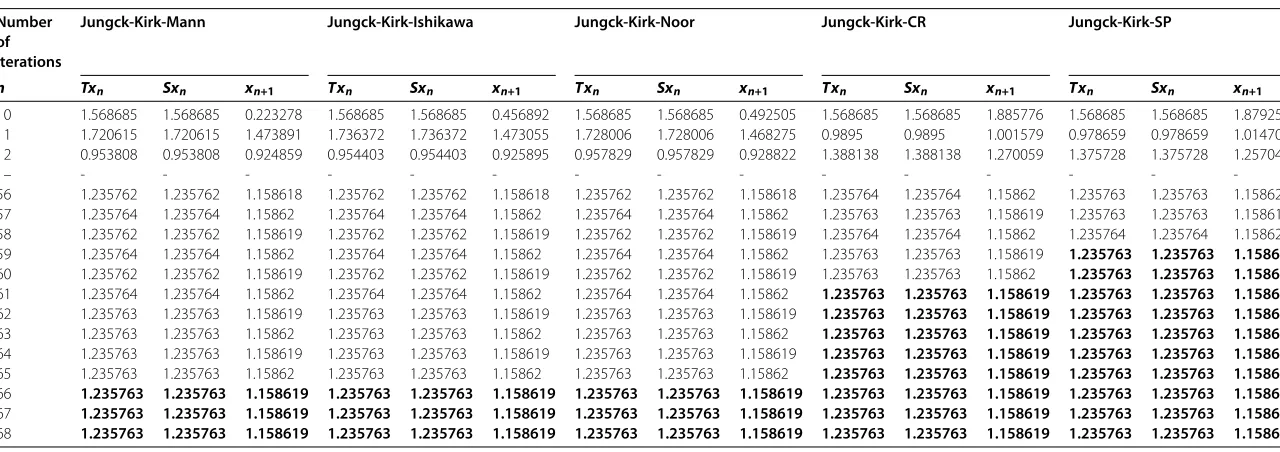
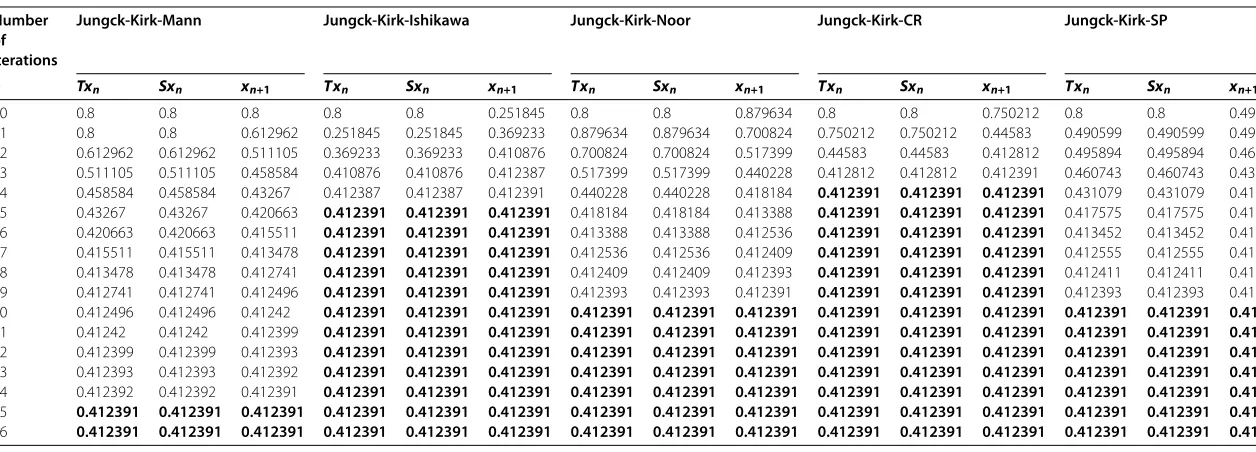
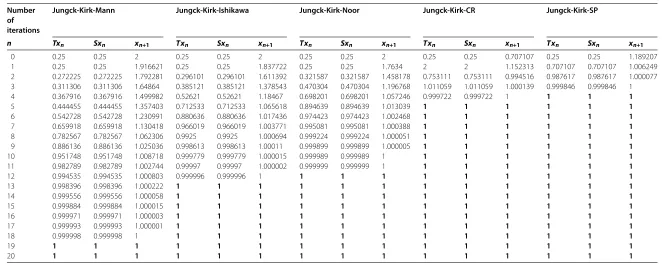
In this section, with the help of computer programs in C++, we explain how and why the newly introduced Jungck-Kirk-type iterative schemes can be applied to solve different types of problems. The outcome is listed in the form of Tables , and , by takingr=s=
al
.
Fix
ed
P
oint
Theor
y
and
A
pplic
ations
2013,
2013:173
P
a
ge
23
of
30
w
.fix
e
dpointtheor
y
andapplications
.c
om/c
ont
e
nt/2013/1/173
Table 2 Goat problem
Number of iterations
Jungck-Kirk-Mann Jungck-Kirk-Ishikawa Jungck-Kirk-Noor Jungck-Kirk-CR Jungck-Kirk-SP
n Txn Sxn xn+1 Txn Sxn xn+1 Txn Sxn xn+1 Txn Sxn xn+1 Txn Sxn xn+1
0 1.568685 1.568685 0.223278 1.568685 1.568685 0.456892 1.568685 1.568685 0.492505 1.568685 1.568685 1.885776 1.568685 1.568685 1.879253
1 1.720615 1.720615 1.473891 1.736372 1.736372 1.473055 1.728006 1.728006 1.468275 0.9895 0.9895 1.001579 0.978659 0.978659 1.014704
2 0.953808 0.953808 0.924859 0.954403 0.954403 0.925895 0.957829 0.957829 0.928822 1.388138 1.388138 1.270059 1.375728 1.375728 1.257049
– - - -
-56 1.235762 1.235762 1.158618 1.235762 1.235762 1.158618 1.235762 1.235762 1.158618 1.235764 1.235764 1.15862 1.235763 1.235763 1.15862
57 1.235764 1.235764 1.15862 1.235764 1.235764 1.15862 1.235764 1.235764 1.15862 1.235763 1.235763 1.158619 1.235763 1.235763 1.158619
58 1.235762 1.235762 1.158619 1.235762 1.235762 1.158619 1.235762 1.235762 1.158619 1.235764 1.235764 1.15862 1.235764 1.235764 1.15862
59 1.235764 1.235764 1.15862 1.235764 1.235764 1.15862 1.235764 1.235764 1.15862 1.235763 1.235763 1.158619 1.235763 1.235763 1.158619
60 1.235762 1.235762 1.158619 1.235762 1.235762 1.158619 1.235762 1.235762 1.158619 1.235763 1.235763 1.15862 1.235763 1.235763 1.158619
61 1.235764 1.235764 1.15862 1.235764 1.235764 1.15862 1.235764 1.235764 1.15862 1.235763 1.235763 1.158619 1.235763 1.235763 1.158619
62 1.235763 1.235763 1.158619 1.235763 1.235763 1.158619 1.235763 1.235763 1.158619 1.235763 1.235763 1.158619 1.235763 1.235763 1.158619
63 1.235763 1.235763 1.15862 1.235763 1.235763 1.15862 1.235763 1.235763 1.15862 1.235763 1.235763 1.158619 1.235763 1.235763 1.158619
64 1.235763 1.235763 1.158619 1.235763 1.235763 1.158619 1.235763 1.235763 1.158619 1.235763 1.235763 1.158619 1.235763 1.235763 1.158619
65 1.235763 1.235763 1.15862 1.235763 1.235763 1.15862 1.235763 1.235763 1.15862 1.235763 1.235763 1.158619 1.235763 1.235763 1.158619