The Open Journal of Occupational Therapy
The Open Journal of Occupational Therapy
Volume 4
Issue 4 Fall 2016 Article 10
October 2016
OT Practitioners’ and OT Students’ Perceptions of Entry-Level
OT Practitioners’ and OT Students’ Perceptions of Entry-Level
Competency for Occupational Therapy Practice
Competency for Occupational Therapy Practice
Minetta Wallingford
Midwestern University - Downers Grove - USA, [email protected]
Lisa J. Knecht-Sabres
Midwestern University - Downers Grove - USA, [email protected]
Michelle M. Lee
Midwestern University - USA, [email protected]
LaVonne Ellen St.Amand
Midwestern University - USA, [email protected]
Follow this and additional works at: https://scholarworks.wmich.edu/ojot
Part of the Occupational Therapy Commons
Recommended Citation Recommended Citation
Wallingford, M., Knecht-Sabres, L. J., Lee, M. M., & St.Amand, L. E. (2016). OT Practitioners’ and OT Students’ Perceptions of Entry-Level Competency for Occupational Therapy Practice. The Open Journal of Occupational Therapy, 4(4). https://doi.org/10.15453/2168-6408.1243
This document has been accepted for inclusion in The Open Journal of Occupational Therapy by the editors. Free, open access is provided by ScholarWorks at WMU. For more information, please contact
OT Practitioners’ and OT Students’ Perceptions of Entry-Level Competency for OT Practitioners’ and OT Students’ Perceptions of Entry-Level Competency for Occupational Therapy Practice
Occupational Therapy Practice
Abstract Abstract
This study examined occupational therapy (OT) practitioners’ and OT students’ perceptions of the importance of 12 specific OT-related entry-level competency skills and the number of weeks required to consistently demonstrate skills for entry-level competency. The results indicated that, on average, practitioners (n = 39) and students (n = 38) agreed that all of the items were important. However, the students had significantly higher ratings regarding the importance of communication, occupation and client-centered goals, time management, interventions, and use of theory and evidence. They also rated a higher number of minimum weeks required to consistently demonstrate entry-level competency. The students who rated use of theory and evidence higher also rated a greater number of weeks to
consistently demonstrate entry-level competency (Pearson r = .38; p= .02). The practitioners who rated psychosocial factors higher also rated a greater number of weeks to consistently demonstrate entry-level competency (Pearson r = .33, p = .04). These findings support the need for further research on defining entry-level competence and highlight the importance of communication between OT practitioners, students, and academic fieldwork coordinators to clarify which competencies are perceived as most important and the expectations regarding how long it takes for students to demonstrate them consistently.
Keywords Keywords
Entry-level competency, Level II fieldwork, Competence, Entry-level practice, Occupational Therapy
Credentials Display
Minetta Wallingford, DrOT, OTR/L; Lisa Jean Knecht-Sabres, DHS, OTR/L; Michelle M. Lee, PhD, ABPP; LaVonne Ellen St.Amand, MPH, OTR/L
Copyright transfer agreements are not obtained by The Open Journal of Occupational Therapy (OJOT). Reprint permission for this Topics in Education should be obtained from the
corresponding author(s). Click here to view our open access statement regarding user rights and distribution of this Topics in Education.
DOI: 10.15453/2168-6408.1243
Level II fieldwork (FW) is an integral component of all entry-level master’s degree occupational therapy (OT) education programs in the United States. Level II FW experiences are designed to provide OT students with opportunities to apply the knowledge and skills gained from their academic courses in current OT practice settings, so that they ultimately develop into competent entry-level generalist OT practitioners (Accreditation Council for Occupational Therapy Education [ACOTE], 2012). ACOTE (2012) requires that OT students engaged in Level II FW participate in at least 24 weeks of full-time OT experience in more than one practice area. This often entails two separate 12-week Level II FW rotations at one or more sites.
Level II FW students are required to be supervised by an occupational therapist who has been practicing full-time for at least one year (ACOTE, 2012; American Occupational Therapy Association [AOTA], 2012). The Level II FW educator is responsible for evaluating if the student’s performance demonstrates entry-level competency based on Level II FW objectives and a formal evaluation process at the end of the Level II FW experience (ACOTE, 2012).
AOTA’s Fieldwork Performance Evaluation for the Occupational Therapy Student (FWPE/OTS) (AOTA, 2002) is a commonly used tool to evaluate OT students’ Level II FW performances in the United States. The FWPE/OTS was developed after an extensive review of key professional and
competency-related documents from both inside and outside of the OT profession that were current
at that time. The results of pilot studies and a Rasch Model Analysis of the FWPE/OTS found that the tool measured entry-level competency. However, the AOTA FW Evaluation Revision Task Force suggested that OT practitioners and educators continue to study the validity and reliability of the FWPE/OTS as practice progresses (Alter, 2003).
The FWPE/OTS defines competency as “adequate skills and abilities to practice as an
entry-level occupational therapist” (AOTA, 2002, p. 8). The FWPE/OTS includes major areas of
competency that were identified as relevant to OT professional practice at the time it was adopted by the AOTA Commission on Education in 2002 (Alter, 2003). Each item is assessed on a 4-point Likert rating scale in which 1 = unsatisfactory performance, 2 = needs improvement, 3 = meets standards, and 4 = exceeds standards (AOTA, 2002).
In addition to the competency expectations on the FWPE/OTS, academic OT programs
collaborate with FW sites to develop objectives that define the basic expectations for Level II FW performance and prepare students for entry-level OT practice (ACOTE, 2012). Further, FW site coordinators are encouraged to develop site-specific objectives for entry-level practice to most
effectively use the FWPE/OTS at their own sites (Alter, 2003; AOTA, 2002). According to the directions on the FWPE/OTS (AOTA, 2002), an additional resource to clarify entry-level
competency expectations is the American Occupational Therapy AssociationStandards of
Practice for Occupational Therapy (AOTA, 2010).
This document outlines the minimum standards for OT practice and is reviewed and updated by the AOTA on a regular basis (AOTA, 2010). In
addition, AOTA provides a variety of FW resources on their website to assist FW educators with writing site-specific objectives, supervising FW students, and using the FWPE/OTS. For example, the AOTA website provides An Introduction to Understanding the OT and OTA Fieldwork Performance
Evaluations (AOTA, 2003).
Another document that provides an extensive framework for entry-level practice and competency is the World Federation of
Occupational Therapists’ (WFOT) Entry-Level Competencies for Occupational Therapists 2008
(WFOT, 2008). This document provides general guidelines for entry-level competency that are relevant to the WFOT member countries, but it is not meant to replace a country’s specific
professional entry-level requirements (WFOT, 2008). As previously mentioned, in the United States, ACOTE outlines the current standards for entry-level OT education and includes standards related to Level II FW and entry-level competency (ACOTE, 2012).
Despite the numerous resources and guidelines for determining entry-level competency for OT Level II FW, the academic FW coordinators at an entry-level master of science OT program noticed variability in how FW educators determined ratings related to entry-level competency on specific items of the FWPE/OTS (AOTA, 2002). In
particular, there was much variability in the use of the ratings 1, 2, and 3 (1 = unsatisfactory
performance, 2 = needs improvement, 3 = meets standards). There also appeared to be a difference in how FW educators and OT students were
defining the term consistent. For example, one item that is evaluated under the professional behaviors section of the FWPE/OTS uses the term consistent in regard to demonstrating work behaviors. It appeared that some FW educators or OT students may consider that a student is meeting the
competency for this item as completing all work tasks accurately and efficiently over the last month of the FW experience. In contrast, other FW educators or students may consider this item met if a student performs all work behaviors accurately and efficiently for only a week or two.
This variability in ratings on the FWPE/OTS may occur for many reasons. For example, because there is not a requirement that all OT FW
supervisors receive specific training in using the FWPE/OTS, some variances in the supervisors’ ratings may occur (Bathje, Ozelie, & Deavila, 2014). It is interesting that physical therapy (PT) students, faculty, and the clinical instructors must complete and pass an online training course before having access to the American Physical Therapy Associations’ Physical Therapist Clinical
Performance Instrument (CPI) (Roach et al., 2012). Like the FWPE/OTS, the CPI is commonly used in the United States for evaluating PT students’ performance on clinical rotations relative to entry-level performance. Other reasons for variability in ratings may include differences in practice settings, various interpretations of academic or site-specific objectives, actual differences in student
The Open Journal of Occupational Therapy, Vol. 4, Iss. 4 [2016], Art. 10
performance, or different definitions of entry-level competency. Since a student is expected to achieve entry-level competency to pass FW, these
inconsistencies in ratings may determine whether a student passes or fails at the end of his or her Level II FW experience. Thus, it is vital that both OT students and OT practitioners have a clear understanding of what determines entry-level competency and how long such skills need to be demonstrated consistently.
Review of the Literature: Studies Related to Defining Entry-Level Competence for Current
Occupational Therapy Practice
As mentioned previously, successful completion of Level II FW in the United States requires that students meet basic competencies to be prepared for entry-level practice. Although the WFOT, the ACOTE Standards (2012), and various AOTA professional documents provide some guidelines for defining entry-level practice, there is limited research that specifically addresses how OT practitioners and OT students define and perceive entry-level competence for current OT practice in the United States. Rather, many studies addressed related concepts, such as preparation for entry-level practice, perceptions of entry-level practice in related disciplines, or expectations related to achieving success on Level II FW.
For example, Fawcett and Strickland (1998) conducted a study that investigated 39 OT
practitioners’ perceptions of accountability and
competence. The participants were asked to consider three definitions of competence for OT practice. The majority of the participants preferred a definition that focused on applying knowledge,
decision making, and interpersonal and
psychomotor skills in their professional roles. However, the participants also indicated that the perception of professional competence may be influenced by specific employers or practice settings where OT practitioners provide services. Although this study addressed OT practitioners’ definitions of competence and was not specific to entry-level competence, these results may also support the potential influence of various practice settings on definitions of entry-level competence. Furthermore, based on the results of this study, the authors suggested that additional research is needed to investigate assumptions and definitions of
competence.
A study of PT clinical instructors’
perceptions of entry-level clinical performance in PT students found that the clinical instructors identified key attributes for entry-level practice that are similar to those in OT professional literature and studies (Jette et al., 2007). Similar to Fawcett and Strickland (1998), Jette et al. (2007) found that PT clinical instructors suggested that expectations of independence related to entry-level practice may be setting or situation specific. More specifically, their findings indicated that students may require more assistance or supervision when working in complex settings or with patients with more complex
conditions. Also notable was that the authors suggested that in addition to objective measures of certain performance skills, a clinical instructor’s gut feeling may play a role in his or her definition of entry-level competency due to some difficulty with quantifying some of the less concrete expectations
required for entry-level practice. Therefore, some subjectivity may also play a role in the overall perception of a student’s achievement of entry-level
performance (Jette et al., 2007).
An additional perspective of FW educators’ perceptions of entry-level competence comes from a qualitative study on commonalities in FW failure (James & Musselman, 2005). The 11 participants in this study were occupational therapists who had supervised failing Level II FW students. Common issues identified with the failing students were difficulties with problem solving, initiation, understanding the overall clinical picture, and applying and generalizing knowledge to address clients’ needs. In contrast, OT students who passed their FW displayed self-initiation, independence in thinking, and openness to feedback. More
importantly, the authors recommended
communication with academic programs, timely objective assessments of student performance, and training to develop FW educators’ comfort in facilitating entry-level competence (James & Musselman, 2005).
An international study considered the perceptions of new graduates concerning preparation for entry-level practice. This study revealed that only 8.5% of New Zealand recent OT graduates and 17.1% of Australian OT graduates reported feeling well prepared for entry-level practice (Gray et al., 2012). Another international study considered new graduates’ preparedness for practice related to the competency requirement of the OT Board of New Zealand’s competencies from the perspective of new graduates, educators,
occupational therapists, and employers (Nayer, Gray, & Blijlevens, 2013). The authors suggested that defining entry-level competency at the time of graduation may not provide the opportunity for new graduates to fully synthesize, apply, and integrate the depth and breadth of skills and competencies that are required for entry-level practice.
This premise was supported in another study comprised of OT students and recent OT graduates (Hodgetts et al., 2007). In this study, the results revealed that the majority of new graduates started perceiving themselves as competent in clinical practice and intervention knowledge and skills after practicing for 6 months to 2 years. In particular, Hodgetts et al. (2007) asserted that entry-level practitioners felt less clinically competent in regard to development of technical skills. Although this study was conducted in Canada, these findings are noteworthy as Level II FW students in the United States are supposed to have achieved initial entry-level competence in their FW settings by the end of their Level II FW experiences.
In sum, several studies highlighted the need for clearer definitions of entry-level competency and expectations related to entry-level practice and FW completion. However, none of the studies addressed both OT practitioners’ and OT students’
perceptions of what currently defines entry-level competency. Thus, there appears to be a need to better understand OT practitioners’ and OT students’ perceptions of entry-level competencies
required for Level II FW completion. This is important because Level II FW requires that FW educators assess students’ readiness and
The Open Journal of Occupational Therapy, Vol. 4, Iss. 4 [2016], Art. 10
competence for current practice. The FWPE/OTS is the primary student evaluation tool for the Level II FW experiences for the OT program at the authors’ institution. Based on their experiences with OT students’ Level II FW rotations, the academic FW
coordinators and faculty at this university sought to better understand the inconsistencies they had observed in ratings related to entry-level competency items on the FWPE/OTS.
Purpose
The aim of this study was to investigate OT practitioners’ and OT students’ perceptions of the
importance of specific OT skills and knowledge related to achieving competence for entry-level OT practice. More specifically, the purpose of this study was to determine: (a) what basic skills are perceived as important for entry-level competency in current OT practice by OT practitioners and OT students, (b) if there are significant differences in the perceived importance of competency skills between OT practitioners and OT students, (c) if there are significant differences in OT practitioners’ and OT students’ perceptions in the length of time needed to consistently demonstrate entry-level competency, and (d) which variables correlate with the minimum number of weeks to consistently demonstrate entry-level competency as rated by OT practitioners and OT students.
Methods
Design
A survey research design was selected for this study. This design was chosen because it was an efficient and objective method to examine both OT practitioners’ and OT students’ perceptions of
specific OT-related competency items for entry-level practice and to ascertain the participants’ perceptions of the minimum number of weeks required to
consistently demonstrate entry-level competency.
Participants
This study involved a convenience sample of 77 participants from different settings. The subject population was comprised of two groups: (a) OT students (n = 38) and (b) OT practitioners (n = 39).
The OT practitioners were recruited from three continuing education events on FW supervision and/or entry-level competency. The participants were given the survey prior to the start of the
continuing education session. Twenty-three percent (n = 9) of the OT practitioners had 0-3 years of experience, 7.7% (n = 3) had 4-7 years of
experience, and 69.2% (n = 27) had 8 or more years of experience.
The OT student participants were comprised of students who attended a continuing education event on FW supervision and entry-level competency at an OT state association annual conference or OT students who were in their final quarter of didactic coursework from the master of science OT program where the authors are faculty members. Only data from the participants who completed all questions on the survey were included in the study.
Measure
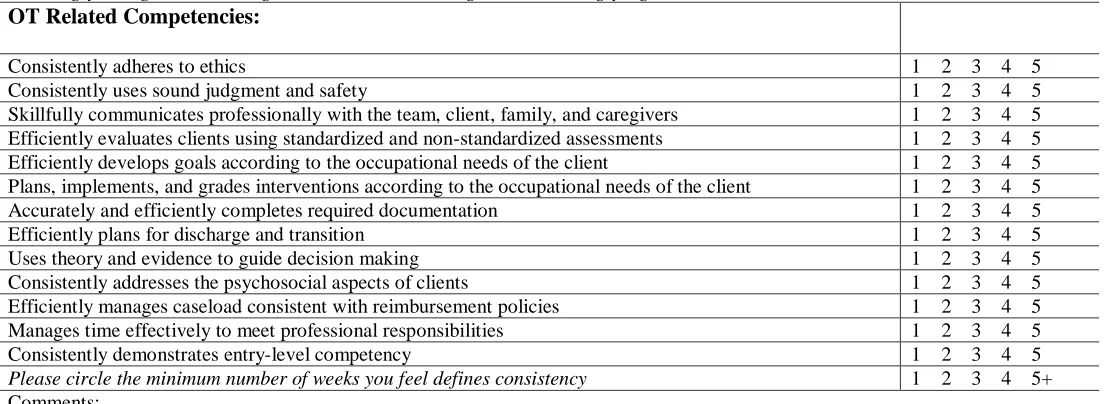
The instrument was a 13-item survey that was developed based on a review of recent professional literature and professional OT educational and practice documents (e.g., the FWPE/OTS, the ACOTE Standards [2007], the AOTA Practice Framework [2008], and the AOTA
Standards of Practice [2010]) that addressed entry-level OT practice and competency at the time the survey was developed in 2012 (see Table 1). The authors developed the instrument because there was not a current tool that met the specific aims of this study. The items on the instrument represented targeted key concepts related to all of the main categories of performance items on the AOTA FWPE/OTS (2002): Fundamentals of Practice, Basic Tenets, Evaluation and Screening, Intervention, Management of OT Services,
Communication, and Professional Behaviors. Since the FWPE/OTS was developed in 2002, additional current professional documents were reviewed to
ensure that other concepts related to the AOTA OT Process, the Standards of Practice, and current ACOTE standards that were reflective of current entry-level practice were included in the instrument. Once the content was identified and the items were written, three of the authors reviewed the items for relevance, clarity, and simplicity. The items were reviewed, discarded, and revised until the authors reached consensus. The items were then prioritized or eliminated to reduce redundancy. The overall design of the instrument and the individual items on the instrument were also selected so that the survey could be easily completed in a short period of time at the beginning of a continuing education event.
Table 1
Items on Survey
Please indicate the number of years in practice: 0-3______ 4-7______ 8+_______
Please indicate your perception based on the following statements regarding importance for entry-level practice: 1 = strongly disagree, 2 = disagree, 3 = neutral, 4 = agree, 5 = strongly agree
OT Related Competencies:
Consistently adheres to ethics 1 2 3 4 5
Consistently uses sound judgment and safety 1 2 3 4 5
Skillfully communicates professionally with the team, client, family, and caregivers 1 2 3 4 5 Efficiently evaluates clients using standardized and non-standardized assessments 1 2 3 4 5
Efficiently develops goals according to the occupational needs of the client 1 2 3 4 5
Plans, implements, and grades interventions according to the occupational needs of the client 1 2 3 4 5
Accurately and efficiently completes required documentation 1 2 3 4 5
Efficiently plans for discharge and transition 1 2 3 4 5
Uses theory and evidence to guide decision making 1 2 3 4 5
Consistently addresses the psychosocial aspects of clients 1 2 3 4 5
Efficiently manages caseload consistent with reimbursement policies 1 2 3 4 5
Manages time effectively to meet professional responsibilities 1 2 3 4 5
Consistently demonstrates entry-level competency 1 2 3 4 5
Please circle the minimum number of weeks you feel defines consistency 1 2 3 4 5+
Comments:
Procedure
All of the participants were provided with a study information sheet that explained the study, specified that participation in the study was voluntary, and stated that completing the survey
indicated consent to participate. In order to maintain the anonymity of the participants in small venues where data was collected, the instrument did not require information such as gender, setting, or role delineation. The participants were asked to deposit
The Open Journal of Occupational Therapy, Vol. 4, Iss. 4 [2016], Art. 10
their surveys in a secure box that was not in the vicinity of the researchers. This process was
implemented to protect anonymity and decrease any perceived coercion to participate. TheInstitutional Review Board (IRB) approved this study and all procedures were in accordance with IRB guidelines.
Data Analysis
The data from the survey were analyzed using descriptive statistics using IBM SPSS for Windows, Version 22. Independent t-tests were used to compare the means and standard deviations (SD) of both the OT student and OT practitioner groups. Pearson correlations were conducted to determine which of the 12 competency item
variables were significantly correlated with item 13 (the minimum number of weeks to consistently demonstrate entry-level competence).
Results
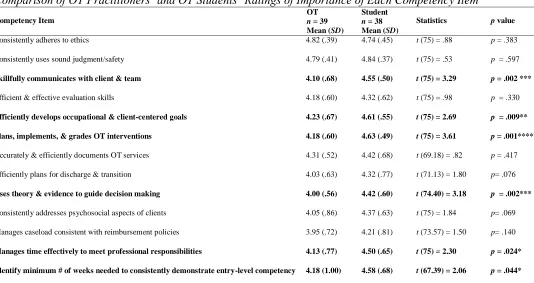
The findings showed that both the OT students and the OT practitioners rated a high level of importance for all OT-related competency items (means = 3.95 to 4.84). However, there were significant differences between the groups. The OT students reported significantly higher ratings than the OT practitioners on the importance of the communication (t(75) = 3.29, p = .002),
occupational and client-centered goals (t(75) = 2.69, p = .009), interventions (t(75) = 3.61, p = .001), use of theory and evidence (t(74.40) = 3.18, p = .002),
and time management (t(75) = 2.30, p = .024) (see Table 2).
There was also a significant difference between OT practitioners’ (M = 4.18, SD = 1.00) and OT students’ (M = 4.58, SD = .68) perceptions related to the minimum number of weeks needed to determine consistency for entry-level competency (t(67.39) = 2.06, p = .044) (see Table 2). Over two-thirds (68.4%) of the OT students felt 5 plus weeks defined entry-level competency, whereas just over half (51.3%) of the OT practitioners chose 5 plus weeks.
Pearson bivariate correlations were
conducted between this item (the minimum number of weeks needed to consistently demonstrate entry-level competency) and the 12 other competency items to determine what might explain variability in each group in response to this item. The results indicated thatOT practitioners who rated
psychosocial factors as having greater importance also rated a higher number of weeks as needed to consistently demonstrate entry-level competency (Pearson r =.33, p =.04). Moreover, the OT students who rated the use of theory and evidence as having greater importance also rated a higher number of weeks needed to consistently
demonstrate entry-level competency (Pearson r = .38, p = .02).
Table 2
Comparison of OT Practitioners’ and OT Students’ Ratings of Importance of Each Competency Item
Competency Item
OT n = 39 Mean (SD)
Student n = 38 Mean (SD)
Statistics p value
Consistently adheres to ethics 4.82 (.39) 4.74 (.45) t (75) = .88 p = .383
Consistently uses sound judgment/safety 4.79 (.41) 4.84 (.37) t (75) = .53 p = .597
Skillfully communicates with client & team 4.10 (.68) 4.55 (.50) t (75) = 3.29 p = .002 ***
Efficient & effective evaluation skills 4.18 (.60) 4.32 (.62) t (75) = .98 p = .330
Efficiently develops occupational & client-centered goals 4.23 (.67) 4.61 (.55) t (75) = 2.69 p = .009**
Plans, implements, & grades OT interventions 4.18 (.60) 4.63 (.49) t (75) = 3.61 p = .001****
Accurately & efficiently documents OT services 4.31 (.52) 4.42 (.68) t (69.18) = .82 p = .417
Efficiently plans for discharge & transition 4.03 (.63) 4.32 (.77) t (71.13) = 1.80 p= .076
Uses theory & evidence to guide decision making 4.00 (.56) 4.42 (.60) t (74.40) = 3.18 p = .002***
Consistently addresses psychosocial aspects of clients 4.05 (.86) 4.37 (.63) t (75) = 1.84 p= .069
Manages caseload consistent with reimbursement policies 3.95 (.72) 4.21 (.81) t (73.57) = 1.50 p= .140
Manages time effectively to meet professional responsibilities 4.13 (.77) 4.50 (.65) t (75) = 2.30 p = .024*
Identify minimum # of weeks needed to consistently demonstrate entry-level competency 4.18 (1.00) 4.58 (.68) t (67.39) = 2.06 p = .044*
Note. Significant values in bold. * indicates p < .05, ** indicates p < .01, *** indicates p < .005, **** indicates p ≤ .001.
Discussion
There were both similarities and differences between the OT students’ and the OT practitioners’
perceptions of entry-level competency. Both the OT students and the OT practitioners agreed, on average, that the majority of the competency items were important for entry-level practice. However, the OT students expressed significantly higher ratings regarding the importance of communication, intervention, occupational and client-centered goals development, use of theory and evidence, and time management for entry-level competency. The fact that the OT students rated so many items as highly important is noteworthy. These results have some similarities to the findings of a study of OT Level II FW students’ coping strategies that was conducted by Mitchell and Kampfe (1993). This study
indicated that a common stressor among OT
students is the perception that they should not make mistakes in knowledge or skill performance while on FW. This finding suggests that many OT students may have extremely high expectations for their performance while on FW. This striving for excellence in OT students’ performance may be part of the reason why so many OT students rated
several items as more highly important for entry-level practice than the majority of the OT
practitioners did in this study.
These results may also be reflective of the strong emphasis of many of these competency areas in current OT academic curricula. Communication is a foundational skill that is emphasized in most courses throughout an OT program’s academic curriculum and on both Level I and Level II FW.
The Open Journal of Occupational Therapy, Vol. 4, Iss. 4 [2016], Art. 10
OT programs also often emphasize the distinct value of occupation and the need to develop occupation and client-centered goals (ACOTE, 2012). Intervention is a primary focus of several ACOTE standards and a major component of the OT process (ACOTE, 2012; AOTA 2008). We can also speculate that time management is a skill that any OT student has to continually hone to complete an OT program successfully, and, therefore, the OT students rated it as very important. Hence, it is understandable that OT students rated several of these items as highly important. This may differ slightly from the OT practitioners’ views, as practitioners may also place high importance on administrative responsibilities and other aspects of patient care that may be inherent in their daily work in their various practice environments.
The results also indicated that while the OT practitioners found the use of theory and evidence important, the OT students rated this item as even more important. Recent studies of OT practitioners’ and health professionals’ use of evidence in practice found that many factors, such as evidence-based practice knowledge, resources, and time constraints, may be perceived as barriers to using evidence in practice (Cahill, Egan, Wallingford, Huber-Lee, & Dess-McGuire, 2015; Harding,Porter, Horne-Thompson, Donley, & Taylor, 2014). Similar factors may have been perceived as barriers by the OT practitioners in this study and, therefore, may have influenced their ratings of the importance of the use of theory and evidence. In addition, OT practitioners may perceive that they have an implicit understanding of theory and evidence,
whereas applying theory and evidence in daily practice may not be as second nature for OT students. Therefore, the OT students may place higher importance on honing these skills while on FW.
Of particular note is the difference shown between the OT practitioners’ and the OT students’ views on the minimum number of weeks needed to demonstrate entry-level competency consistently. Specifically, the OT students reported a
significantly greater number of weeks than the OT practitioners for demonstrating entry-level
competency. Furthermore, the OT students who rated a higher number of weeks to determine consistency for entry-level competency also rated the use of theory and evidence as more important. As discussed previously, OT education emphasizes that theory and evidence guide clinical decision making. Therefore, the students who identified these particular skills as more important also may have perceived that these particular skills need to be demonstrated consistently over time to demonstrate competency.
Moreover, the OT practitioners who rated a higher number of weeks for consistency to
demonstrate entry-level competency also rated the item “consistently addresses psychosocial aspects of
clients” to be more important. These ratings may be related to the setting in which the OT practitioners work, their understanding of the complexity of clients, as well as the value they place on
considering and addressing psychosocial factors to engage clients in meaningful occupations.
An additional consideration that also may have contributed to the results is the OT students’ metacognition. Metacognition involves thecapacity to understand and monitor one’s thinking (Schraw, Crippen, & Hartley, 2006). For instance, a study by Kirke, Layton, and Sim (2007) supports the premise that metacognition may influence OT education and performance on OT FW. In fact, the results of this study suggest that successful FW students
possessing appropriate metacognitive skills have awareness of their own abilities, including their own limitations or lack of knowledge, and “know what they don’t know” (Kirke, Layton, & Sim, 2007, p.
18). Therefore, the OT students’ responses regarding entry-level competency may have been influenced by their own metacognition. Although this study did not include metacognition as a primary consideration related to the OT student participants’ responses or as one of the OT-related
competencies, future studies may want to consider students’ metacognition and how it potentially influences students’ perceptions, performance on
OT-skill related competency items, and findings. Further research is suggested to truly understand the reasons and meaning behind these significant differences in perception between OT practitioners and OT students.
Limitations
A limitation of this study is that it entailed a small number of participants from the Midwestern region of the United States and does not represent a national sample of OT practitioners and OT
students. In addition, the instrument was not pilot-tested prior to the study and the psychometric
properties of the instrument have not been thoroughly established. One limitation of the measurement tool was that there was a ceiling of 5 plus weeks on the scale of item 13 that has the participants circle the minimum number of weeks needed to consistently define entry-level
competency. Since OT Level II FW is typically for 12 weeks, this ceiling did not allow for the
participants to choose a higher number of weeks and may have limited the range of responses on this item. Still, this study shows a statistically
significant difference. Further, in an effort to provide anonymity, the researchers did not collect certain demographic information (e.g., setting, specific number of years in school, gender, and whether the participants were active practitioners, faculty members, or FW educators, etc.). In particular, including a student’s number of years in OT school may have been beneficial, as it may have influenced a student’s metacognition and
perceptions of the importance of certain
competency items. In addition, OT practitioners in different practice settings may have different views, and OT faculty may have different perspectives than OT practitioners. Therefore, obtaining data on OT students’ level of education and OT
practitioners’ roles and practice settings may have
provided a more robust analysis and interpretation of the results.
Implications
The results of this study may have implications for many OT stakeholders but
particularly for OT students, OT faculty, academic FW coordinators, OT FW coordinators, and OT
The Open Journal of Occupational Therapy, Vol. 4, Iss. 4 [2016], Art. 10
practitioners who are FW educators, especially in clarifying what is considered meeting entry-level competence at the completion of Level II FW. The differences in responses between the OT
practitioners and OT students highlight the need for both OT students and OT practitioners working with students to clarify the importance of these competency items and discuss the minimum time frame expected for students to consistently
demonstrate entry-level competency as part of the ongoing supervision process. If OT Level II FW educators use the current FWPE/OTS to evaluate OT FW students, it is essential that both groups review and understand the directions for the FWPE/OTS in advance of the FW experience. It also important that OT students and OT FW educators clarify the rating criteria for the
FWPE/OTS competency items, particularly when an item uses the word consistent.
Moreover, both OT students and OT practitioners should be aware that there may be differencesin perceptions of what skills are deemed as most important to meet entry-level competency and discuss any inconsistencies. These differences in perceptions could cause a conflict during the FW experience and result in a less successful FW experience or even failure. Thus, there should be ongoing feedback and communication among OT students, OT practitioners who supervise them, and their academic FW coordinators. This concept was reinforced by Hanson’s (2011) findings that
indicated FW educators wanted communication and clarity regarding expectations for Level II FW with the OT academic programs. Since OT practitioners
work in such a wide variety of settings, academic FW coordinators can assist OT practitioners at FW sites to develop clear site-specific objectives relative to the items on the FWPE/OTS and
achieving entry-level competency at that particular site. Academic FW coordinators can discuss these objectives with students in advance of the FW so they can understand expectations and how to prepare for their FW placements. Clear
communication and ongoing feedback regarding expectations is essential between the FW educator, the student, and the academic FW coordinator. Although AOTA is in the process of developing a new Level II FW evaluation tool (Koski & Geraci, 2015), many OT programs and FW educators in the United States are still using the FWPE/OTS. Therefore, these findings may be useful for OT practitioners to consider as they continue to use the FWPE/OTS while the new tool is being developed. Moreover, academic FW coordinators need to work closely with OT practitioners at FW sites to provide resources for FW supervision and training and guidance in understanding and using the FWPE/OTS. OT practitioners may want to take theAOTA FW Educators Certificate program that trains FW educators on supervising and working with FW students. Furthermore, future research is suggested to clarify perceptions on what competencies are perceived as important, how long these need to be performed consistently to demonstrate entry-level practice competence, and what other variables correlate with the minimum number of weeks
needed to demonstrate entry-level competency for Level II FW completion.
Conclusion
The results of this study provide some initial insights into how OT practitioners and OT students perceive the importance of OT-related skills for entry-level OT practice. More research that specifically examines definitions of generalist entry-level competency at the completion of Level II FW may be beneficial for OT practitioners, OT students, OT faculty, and other OT stakeholders. AOTA’s 2014 Occupational Therapy Research
Agenda supports the need to more clearly identify and measure entry-level competencies for our profession (AOTA, 2014). In today’s changing practice environment, where OT practitioners are working in an array of traditional and
non-traditional settings, it is vital that there is continued collaboration and communication between OT programs and FW practice settings and that there is further research that encompasses a variety of stakeholders’ views.
References
Accreditation Council for Occupational Therapy Education. (2007). Accreditation standards for a Master’s-degree-level educational program for the occupational therapist. American Journal of Occupational Therapy,
61(6), 652-661. http://dx.doi.org/10.5014/ajot.61.6.652 Accreditation Council for Occupational Therapy Education.
(2012). 2011 Accreditation council for occupational therapy education (ACOTE) standards and
interpretative guide: January 2012 interpretative guide version. Retrieved from
https://sphhp.buffalo.edu/content/dam/sphhp/rehabilita tion-science/acote-standards-2011.pdf
Alter, K. (2003). Using the fieldwork performance evaluation forms: The complete guide. Bethesda, MD: AOTA Press.
American Occupational Therapy Association. (2002).
Fieldwork Performance Evaluation for the
occupational therapy student. Bethesda, MD: Author. American Occupational Therapy Association. (2003).
Understanding the OT and OTA fieldwork performance evaluations. Retrieved from
http://www.aota.org/Education-Careers/Fieldwork/Supervisor/Inservice.aspx American Occupational Therapy Association. (2008).
Occupational therapy practice framework: Domain & process (2nd ed.). American Journal of Occupational Therapy, 62(6),625-683.
http://dx.doi.org/10.5014/ajot.62.6.625
American Occupational Therapy Association. (2010). Standards of practice for occupational therapy. American Journal of Occupational Therapy, 64(Suppl. 6), S106-S111. http://dx.doi.org/10.5014/ajot.2010.64S106
American Occupational Therapy Association. (2012).
Fieldwork level II and occupational therapy students: A position paper. American Journal of Occupational Therapy, 66(Suppl. 6), S75-S77.
http://dx.doi.org/10.5014/ajot.2012.66S75 American Occupational Therapy Association. (2014).
Occupational therapy education research agenda.
America Journal of Occupational Therapy, 68(Suppl. 6), S83-S86.
http://dx.doi.org/10.5014/ajot.2014.685S06
Bathje, M., Ozelie, R., & Deavila, E. (2014). The relationship between admission criteria and fieldwork performance in a masters-level OT program: Implications for admissions. The Open Journal of Occupational Therapy, 2(3), Article 6.
http://dx.doi.org/10.15453/2168-6408.1110
Cahill, S. M., Egan, B. E., Wallingford, M., Huber-Lee, C., & Dess-McGuire, M. (2015). Results of a school-based evidence-based practice initiative. American Journal of Occupational Therapy, 69(1), 1-5.
http://dx.doi.org/10.5014/ajot.2015.014597
The Open Journal of Occupational Therapy, Vol. 4, Iss. 4 [2016], Art. 10
Fawcett, L. C., & Strickland, R. (1998). Accountability and competence: Occupational therapy practitioner perceptions. American Journal of Occupational Therapy, 52(9),737-743.
http://dx.doi.org/10.5014/ajot.52.9.737
Gray, M., Clark, M., Penman, M., Smith, J., Bell, J., Thomas, Y., & Trevan-Hawke, J. (2012). New graduate occupational therapists feelings of preparedness for practice in Australia and Aotearoa/New Zealand.
Australian Occupational Therapy Journal, 59(6), 445-455.
http://dx.doi.org/10.1111/j.1440-1630.2012.01029.x Hanson, D. J. (2011). The perspectives of fieldwork educators
regarding Level II fieldwork students. Occupational Therapy in Health Care, 25(2-3), 164-177.
http://dx.doi.org/10.3109/07380577.2011.561420 Harding, K. E., Porter, J., Horne-Thompson, A., Donley, E., &
Taylor, N. F. (2014). Not enough time or a low priority? Barriers to evidence-based practice for allied health clinicians. Journal of Continuing Education in the Health Professions, 34(4), 224-231. http://dx.doi.org/10.1002/chp.21255
Hodgetts, S., Hollis, V., Triska, O., Dennis, S., Madill, H., & Taylor, E. (2007). Occupational therapy students’ and graduates’ satisfaction with professional education and preparedness for practice. Canadian Journal of Occupational Therapy, 74(3), 148-160. http://dx.doi.org/10.1177/000841740707400303 James, K. L., & Musselman, L. (2005). Commonalities of Level
II fieldwork failure. Occupational Therapy in Health Care, 19(4),67-81.
http://dx.doi.org/10.1080/J003v19n04_05
Jette, D. U., Bertoni, A., Coots, R., Johnson, H., McLaughlin, C., & Weisbach, C. (2007). Clinical instructors’ perceptions of behaviors that comprise entry-level clinical performance in physical therapist students: A qualitative study. Physical Therapy, 87(7), 833-843. http://dx.doi.org/10.2522/ptj.20070003
Kirke, P., Layton, N., & Sim, J. (2007). Informing fieldwork design: Key elements to quality in fieldwork education for undergraduate occupational therapy students. Australian Occupational Therapy Journal,
54(1), S13-S22.
http://dx.doi.org/10.1111/j.1440-1630.2007.00696.x Koski, J., & Geraci, J. (2015). Updates from the fieldwork front.
OT Practice, 20(4), 15-16.
Mitchell, M. M., & Kampfe, C. M. (1993). Student coping strategies and perceptions of fieldwork. American Journal of Occupational Therapy, 47(6), 535-540. http://dx.doi.org/10.5014/ajot.47.6.535
Nayer, S., Gray, M., & Blijlevens, H. (2013). The competency of New Zealand new graduate occupational
Occupational Therapy Journal, 60(3), 189-196. http://dx.doi.org/10.1111/1440-1630.12027
Roach, K., Frost, J. S., Francis, N. J., Giles, S., Nordrum, J. T., & Delitto, A. (2012). Validation of the revised physical therapist clinical performance instrument (PTCPI): Version 2006. Physical Therapy, 92(3), 416-428. http://dx.doi.org/10.2522/ptj.20110129 Schraw, G., Crippen, K. J., & Hartley, K. (2006). Promoting
self-regulation in science education: Metacognition as part of a broader perspective on learning. Research in Science Education, 36(1),111-139.
http://dx.doi.org/10.1007/s11165-005-3917-8 World Federation of Occupational Therapists. (2008).
Entry-level competencies for occupational therapists. Retrieved from
http://www.wfot.org/ResourceCentre.aspx