LOAD BALANCING CHANNEL CAPACITY FLOW
ASSIGNMENT FOR DYNAMIC SPECTRUM ACCESS
NETWORK
*Prachi R. Salve
Department of Computer Engineering. DYPSOEA, Ambi Pune, India
ABSTRACT
Cognitive radio network (Dynamic Spectrum Access Network) is a network with a well-organized channel assignment scheme can to a great extent relieve the spectrum resource sharing. Unlike previous heuristic approaches, we accurately formulate the joint channel obligation and load occurrence problem. In this paper we proposed a novel cluster based load balancing channel capacity and flow assignment solution for our crisis with the intention of optimizing the whole dynamic spectrum access network (DSAN) throughput. Through simulation results we proved our proposed work has increased the DSAN performance than existing schemes.
Keywords: Access Point (AP), CA (Channel assignment) , CCFA (Channel Capacity Flow Assignment) , CRN (Cognitive radio network) , Dynamic Spectrum Access Network (DSAN).
I.
INTRODUCTION
The rapid development of wireless devices has led to a dramatic increase in the need of spectrum access from wireless services. Taxonomy of channel assignment algorithms for spectrum access network is presented in as well. SAFE [20] scheme is introduced in which channel assignment is performed in a randomized and distributed manner, which maintains network connectivity and minimizes the channel assignment problem for routing.
In [21] authors study a Polynomial-Time Approximation Scheme (PTAS) to develop a channel assignment algorithm for a multi-channel CRN. In [22] authors evaluates a multi-hop cognitive network architecture that can be built using standard hardware by equipping each node with multiple interface cards operating on different channels.
2 channel used by an SU is no longer available, the SU needs to break its on-going communication and find out a new available channel to prolong the transmission.
In this paper we propose a new load balancing spectrum allocation through clustering process. In order to validate the channel allocation in the mobility pattern we used bird flock mobility model for dynamic spectrum access network to analyze the accessibility of the spectrum. Two types of assignment are proposed in this . One is Channel assignment and second is Capacity & flow assignment.
II.
RELATED WORK
III.
SYSTEM
MODEL
We propose a linear programming based load balancing algorithm for channel assignment. We define a novel metric called system utility, which take average throughput and average packet delay into description and include a parameter that can be used to accentuate one over the other. This paper has two part as : 1. channel scheduling and 2. capacity-flow scheduling. The two phases of the optimal CCFA algorithm are perform repeatedly to progress the system utility which allow designed for a swap between delay and throughput that can be achieve in a cognitive broadcasting network.
Usually when spectrum network needs to share multimedia resources, the multimedia resources are converted in to stream packets and streams are transmitted to receiver in the allocated channels. The channel allocation is dependent on the size of the multimedia resources. When source node wanted to share the spectrum resources to the receiver, depends upon the type of data the channel capacity and flow is allocated. The access point (AP) in the cluster is responsible for balancing the resource load and allocates the flow assignment.
This paper resembles the minimum channel allocation without the maximum amount of data lost. Based on the type of resource required. by secondary users the channel is allocated. The proposed cognitive cluster mechanism reduces the load across the dynamic spectrum access network (DSAN) and TDMA scheduling will add advantage to avoid spectrum collision.
1) Mobility model and cluster formation
The mobility pattern plays a vital role in network link maintenance. In this paper we are using bird flock mobility model for mobility pattern. In this mobility model the node’s direction is chosen according to the bird flock behavior. This behavior is summarized as at each time step a host gets the list of its all neighborhood. From this list, the host has a tendency to select the one hop neighboring nodes. This tendency constitutes the new direction. In real flocks, a bird can move away from the group of various reasons like avoiding obstacles. To translate this we introduce a probability Ф. Thus at each time step the nodes is moved in the network according to the flock mobility model with a probability Ф. The mathematical expression for the mobility model is follows,
S = {(𝑐𝑖,𝑐𝑗,𝑧𝑟, q) U {(𝑐𝑖, q} (1)
Where “s” is the finite state space, “𝑐𝑖” is the current location occupied, “𝑐𝑗” is the destination
location, “𝑧𝑟” is the speed and “q” is the indicator of node moving towards the target location.
Cluster formation plays a vital role in load balancing and increasing the network life time. In our work , the clusters are formed using the harmony search algorithm. It is expected to minimize the intra cluster distances between the clusters and optimize the energy distribution of the dynamic spectrum access network (DSAN). As it is reducing intra cluster distance between the clusters, a direct communication range among cluster members is formulated.
Algorithm – cluster formation
Repeat
4 For i=1 to N do
Calculate the distance d (node (i), node (j)) between all nodes of cluster
Assign node to cluster c in which d (node (i), node (j)) belongs to direct transmission range End for
Compute the cost of cluster formation Form cluster with minimum distance
Stop
1) Channel Assignment
The main issue in channel allocation in dynamic spectrum access networks are connectivity, error minimization, and load balancing. One of the first works on channel allocation in spectrum system is the common channel assignment design in which the radios at each user are allocating the similar set of channels. Such a channel allocation conserves the system connectivity. But the advantage obtained is partial because of its static nature. This channel assignment algorithm first sort the access point of a cluster, based on the approximate traffic on diverse links. The mathematical derivation for channel allocation is as follows,
CA = min 𝑎𝑥𝑗𝑥𝑖 𝑖𝑗𝑥𝑖r𝑥𝑗r (2)
Where CA is channel assignment, “𝑎𝑖𝑗” is the number of channels assigned by the source “i” to the transmitter “j”, “𝑥𝑖r” is the resource transmitted by the source node to the receiver “𝑥𝑗r”. The equation (2) states that the channel allocation depends upon the size of the spectrum resources.
2) Capacity and Flow Assignment (CFA)
In the CFA problem, the system topology, channel allocation, and transmitter-receiver traffic load are well-known. The crisis is to allot link capacity and flow. We assume to facilitate around N channel and each one of AP (Access Point) can offer a capacity of C bps at the packet interface to which they are allocated. A suitable channel allocation to the entire radio interface at every node is assumed. The interfering constraint has to take into account the channel allocation at various nodes. Unlike the CA crisis both link capacity and flow are variables now. The target can be either to exploit the system throughput or to minimize the average network delay.
bare minimum lasting link capacity in the DSAN. This method results in a load balancing behaviour that minimizes the maximum link congestion in the network. We successfully used this technique in the channel allocation problem. However with both the link capacity and flow being variables in the CFA crisis. This approach might lead to improvement in network throughput for the reason that both flows and capacities on cluster links might be resulted in an effort to balance the load on different access point. The capacity and flow assignment are allocated on the basis of minimum path cost. The mathematical derivation for CF assignment is follows,
A capacity flow of network N is a function CF: E ->RR (resource routing). Capacity flow is feasible flow , it satisfies the following two conditions :
1. Capacity flow is depending on number of edges in between the source and destination.
For every e € E, 0 ≤ cf (e) ≤ c (e) (3) For every v € V\ {i, j},
2. The flow assignment is done based on the 1-hop neighbor
cf e =
1−hop neighbour (i) 1−hop neighbour (j) cf (e) (4)
The value of CF is defined as,
CF = min 1−hop neighbour (i)cf(e) (5)
Where equation (3) represents the capacity assignment . The capacity is assigned based on the minimum edge cost (e) . The flow assignment is represented using equation (4) , based on the 1-hop neighbor the flow is assigned. Equation (5) represents the capacity flow assignment based on minimum path from transmitter to receiver.
Algorithm1: For Scheduling
For (i=0; i>2; i++) {
Verify (user_id, receiver)
If (resource_id, receiver == type of resource) Enter to scheduling process
Else
Do not have access to resources }
Algorithm 2: Channel Allocation
6 {
Allocate the resources with allocated channel to user1 in higher priority Then Simultaneously allocate the resources to user2 in second higher priority
} Else {
Allocate resource with allocated channel to user2 in higher priority Then
Allocate resource to user1 in second higher priority }
IV.
SIMULATION
RESULTS
In this section, we discuss the simulation results of dynamic spectrum access network’s (DSAN’s) clustering method. The simulation set up uses the network area 2100*2110 meters, the mobility model used is the - bird flock mobility model. The no. of nodes - 49.avg. no. clusters = 6, initial energy level 100joules and simulation time =50 sec.
Totally 49 nodes are distributed to form a spectrum network, nodes are grouped to form a pair of three clusters. Each cluster has an around six nodes and each cluster has an access point (AP) and gateway node. All clusters are interconnected with access point and gateway node. Gateway node is act as an entry node for intra cluster communication and access point serves as accessing medium for capacity and flow allocation.
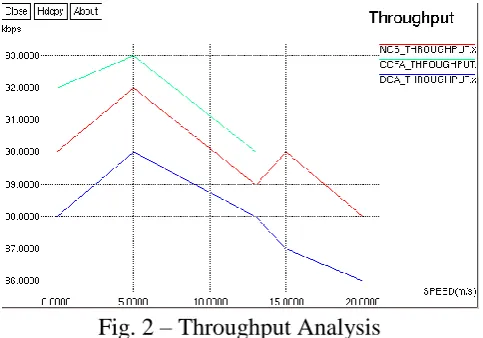
Fig. 2 – Throughput Analysis
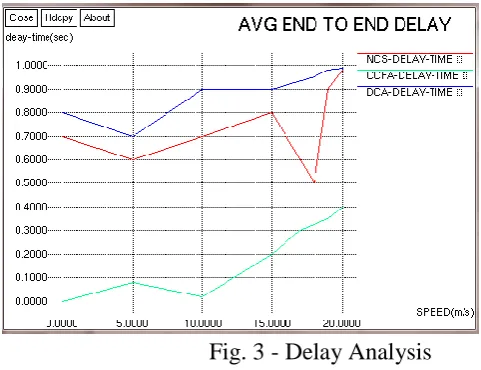
Fig. 3 - Delay Analysis
The figure 3 represents the average end to end delay analysis of our proposed CCFA over existing NCS and DCA schemes with respect to speed. From the graphical analysis we observe the end to end delay of proposed system is lower than the existing systems.
Fig. 4– PDR Analysis
The figure 4 represents the PDR (Packet deliver ratio) analysis of our proposed CCFA over existing NCS and DCA schemes with respect to speed. From the graphical analysis we observe the PDR of proposed system is higher than the existing systems.
V.
CONCLUSION
8
VI.
R
EFERENCES[1] Akyildiz, W. Lee, M. Vuran, and S. Mohanty. NeXt generation/dynamic spectrum
access/cognitive radio wireless networks: A survey. Computer Networks, 50(13):2127–2159,
2006.
[2] T. Chen, Z. Honggang, G.M. Maggio, I. Chlamtac, CogMesh: A Cluster-Based Cognitive Radio Network, 2nd IEEE International Symposium on New Frontiers in Dynamic Spectrum Access Networks, 2007, DySPAN 2007, pp. 168 -178.
[3] M. Cesana, F. Cuomo, and E. Ekici, “Routing in cognitive radio networks: Challenges and solutions,” Ad Hoc Networks, vol. 9, no. 3, pp. 228–248, May2011.[Online].Available:
http://www.sciencedirect.com/science/article/pii/S157087051000079X
[4] C. Sun, W. Zhang, and K. B. Letaief, “Cluster-based cooperative spectrum sensing in cognitive radio systems,” in Proc. IEEE ICC ’07, pp. 2511–2515, 2007.
[5] D. Willkomm, M. Bohge, D. Holl´os, J. Gross, and A. Wolisz, “Double hopping: A new approach for dynamic frequency hopping in cognitive radio networks,” in in Proc. IEEE PIMRC ’08, Sept. 2008.
[6] A. Abbasi and M. Younis, “A survey on clustering algorithms for wireless sensor networks,” Comput. Commun., vol. 30, no. 14-15, pp. 2826–2841, 2007.
[7] V. Kawadia and P. R. Kumar, “Power control and clustering in ad hoc networks,” in In Proc. IEEE infocom ’03, pp. 459–469, 2003.
[8] C. R. Lin and M. Gerla, “Adaptive clustering for mobile wireless networks,” IEEE Journal on Selected Areas in Communications, vol. 15, pp. 1265–1275, 1997.
[9] S. Basagni, “Distributed clustering for ad hoc networks,” in Proc. I-SPAN ’99, pp. 310 –315, 1999.
[10] L. Lazos, S. Liu, and M. Krunz, “Spectrum opportunity- based control channel assignment in cognitive radio networks,” in Proc. IEEE SECON ’09, pp. 1 –9, jun. 2009.
[11]C Guo, T Peng, S Xu, H Wang, W Wang, in IEEE 69th Vehicular Technology Conference 2009 (VTC Spring 2009). Cooperative spectrum sensing with cluster-based architecture in cognitive radio networks (IEEE Piscataway, 2009), pp. 1–5
[12] E Karami, AH Banihashemi, in 2011 Ninth Annual Communication. Networks and Services Research Conference (CNSR). Cluster size optimization in cooperative spectrum sensing (IEEE Piscataway, 2011), pp. 13–17.
[13] J. Zhao, H. Zheng, and G.-H. Yang. Spectrum sharing through distributed coordination in dynamic spectrum access networks. Wireless Communications and Mobile Computing Journal, 7(9):1061–1075, 2007.
[14]Tao Chen, Honggang Zhang, and Marcos Kartz, "Cloud networking formation in CogMesh environment," arXiv.org>cs> arXiv 0904.2028 (http//arxiv.org/abs/0904.2028), April 2009.
[15]A. A. K. Jeng and R.-H. Jan, “The r-neighborhood graph: An adjustable structure for topology control in wireless ad hoc networks,” IEEE Trans.Parallel Distrib. Syst., vol. 18, no. 4, pp. 536–549, Apr. 2007.
networks with frequency hopping signaling,” Proc. IEEE, vol. 75, no. 1, pp. 56–73, Jan. 1987. [17]T. Ohta, S. Inoue, and Y. Kakuda, “An Adaptive Multihop Clustering Scheme for Highly
Mobile Ad Hoc Networks,” in proceedings of 6th ISADS’03, Apr. 2003.
[18]Q. Guan, F. R. Yu, S. Jiang, and G. Wei, “Prediction-based topology control and routing in cognitive radio mobile ad hoc networks,” IEEE Trans. Veh. Technol., vol. 59, no. 9, pp. 4443– 4452, Nov. 2010.
[19]S. Krishnamurthy, R. Chandrasekaran, N. Mittal, and S. Venkatesan, “Synchronous Distributed Algorithms for Node Discovery and Configuration in Multi-channel Cognitive Radio Networks”, in DISC 2006, September 2006.
[20] Minho shin “Distributed channel assignment scheme for multi radio wireless network” in oct 2006
[21] Sen, A. ; Arizona State Univ., Tempe ; Murthy, S “An Interference-Aware Channel Assignment Scheme for Wireless Mesh Networks” in june 2007.
[22] Y. Thomas Hou, “On the Throughput of MIMO-Empowered Multihop Cognitive Radio Networks”, VOL. 10, NO. 11, NOVEMBER 2011.