Vol. 13, 2018, 65-80
ISSN: 2349-0632 (P), 2349-0640 (online) Published 13 May 2018
www.researchmathsci.org
DOI: http://dx.doi.org/10.22457/jmi.v13a7
65
Journal of
On
θθθθ
g*-Closed Sets in Topological Spaces
P. Sathishmohan, V. Rajendran, L. Chinnapparaj* and K. Radha Kongunadu Arts and Science College, Coimbatore
Tamilnadu, India
*
Corresponding author. Email: [email protected]
Received 1 April 2018; accepted 30 April 2018
Abstract. In this paper, we have introduce a new class of closed sets in topological spaces called
θ
-generalized star closed set (briefly θg*-closed set) and study some of its properties. Further we introduce the the concept of θg*-continuous functions,θg*-irresolute functions and contra θg*-continuous functions and study the relationship between other existing functions in topological spaces. Also we investigate the composition of the functions between θg*-continuous functions and between continuous and contra θg*-continuous functions and between θg*-continuous functions and
θg*-irresolute functions. Moreover, we introduce the application of
θ
g*-closed sets as three spaces namely,)
1/2
T
θ * spaces, *θT1/2 spaces, θT1/2 * *
spaces in topological spaces and are analyzed.
Keywords: θg*-closed sets, θg*-continuous functions, θg*-irresolute functions, contra
θg*-continuous functions, θT1/2*
- space, *θT1/2- space, θT1/2**
-space.
AMS Mathematics Subject Classification (2010): 54A05 1. Introduction
The first step of generalized closed sets introduced by Levine [16] in the year of 1970. Velicko [34] defined two subclasses of closed sets namely,
δ
- closed sets andθ
- closed sets in 1968. Levine [16], Mashhour et.al. [21] and Njastad [23] introduced semi-open sets, pre-open sets,α
-sets andβ
-sets respectively. Dontchev, Gnanambal [12] and Palaniappan and Rao [25] are introduced a sets namely gsp-closed sets, gpr-closed sets and rg-closed sets respectively. Veerakumar [33] introduced a new class of sets called*
g -closed sets, which is properly placed in between the class of closed sets and the class of g-closed sets. Arya and Nour [1] are define a set namely, gs-closed sets in 1990. Dontchev and Ganster were introduced semi-generalized closed sets, generalized semi- closed sets,
α
-generalized closed sets, generalizedα
-closed sets and respectively.66
[24] introduced
π
gp-closed sets in topological spaces. Dontchev, Noiri [7], Quasi Normal spaces andπ
g-closed sets are introduced. Aslin, Caksu Guler and Noiri [3] introducedgs
π
-closed sets in topological spaces.Balachandran, Sundaram and Maki were introduced generalized continuous functions [4] in the year of 1991. Dontchev [9] introduce a contra continuous functions in 1996. Dontchev and Maki are introduced
θ
g- continuous functions [8] in the year of 1999. Fomin [11] introducedθ
-continuous functions in 1943. Veerakumar [30] introduce a new class of sets called g*- continuous functions in topological spaces.In this paper, we introduce the new class of sets namely,
θ
g*-closed sets in topological spaces and study some basic properties. Also, we study the application of1/2
T
θ *-space, θT1/2 * *
- space and θ*T1/2 - space. Further, we introduce
θ
g*-continuousfunctions and
θ
g*-irresolute functions and study the relationships of existing functions.Moreover we introduce a new generalization of contra-continuity called contra
θ
g* -continuous functions.2. Preliminaries
We recall the following definitions, which are the useful in the sequel.
Definition 2.1. A subset A of a space (X,
τ
) is called • a semi-closed set[16] if int(cl(A))⊆ A. • a pre-closed set[21] if cl(int(A))⊆ A. • aα
-closed set[18] if cl(int(cl(A)))⊆ A.• a semi-pre closed[2] (=
β
-closed) if int(cl(int(A)))⊆ A. • a r-closed set[27] if A=cl(int(A)).• a
π
-closed set[35] if A is the union of regular closed sets. • aθ
-closed set[34] if A=clθ(A),where clθ( A) = x∈X :int(cl(U))∩A≠
φ
,U ∈τ
and x∈Uz.Definition 2.2. A subset A of a space (X,
τ
) is called• a generalized closed [17] (briefly g-closed) if cl(A)⊆U whenever A⊆U and U is open in X .
• a semi generalized closed [5] (briefly sg-closed) if scl(A)⊆U whenever A⊆U and U is semi open in X .
• a generalized semi closed [33] (briefly gs-closed) if scl(A)⊆U whenever A⊆U and U is open in X .
• a generalized
α
-closed [20] (briefly gα
-closed) ifα
cl(A)⊆U whenever A⊆U and U isα
- open in X .67
• a regular generalized closed [25] (briefly rg-closed) if cl(A)⊆U whenever U
A⊆ and U is regular open in X .
• a generalized pre-closed [19] (briefly gp-closed) if pcl(A)⊆U whenever A⊆U and U is open in X .
• a generalized star closed [33] (briefly g*-closed) if cl(A)⊆U whenever A⊆U and U is g-open in X .
• a generalized star semi closed [30] (briefly g*s-closed) if scl(A)⊆U whenever U
A⊆ and U is g-open in X .
• a generalized pre-regular closed [12] (briefly gpr-closed) if pcl(A)⊆U whenever U
A⊆ and U is regular open in X .
• a weakly generalized closed [22] (briefly wg-closed) if cl(int(A))⊆U whenever U
A⊆ and U is open in X .
• a regular weakly generalized closed [22] (briefly rwg-closed) if cl(int(A))⊆U whenever A⊆U and U is regular open in X .
• a
π
-generalized closed [7] (brieflyπ
g-closed) if cl(A)⊆U whenever A⊆U and U isπ
open in X .• a
π
-generalizedα
closed [15] (brieflyπ
gα
-closed) ifα
cl(A)⊆U whenever UA⊆ and U is
π
open in X .• a
π
-generalizedβ
- closed [26] (brieflyπ
gβ
-closed) ifβ
cl(A)⊆U whenever UA⊆ and U is
π
open in X .• a
π
-generalized pre-closed [24] (brieflyπ
gp-closed) if pcl(A)⊆U whenever UA⊆ and U is
π
open in X .• a
π
-generalized semi-closed [3] (brieflyπ
gs-closed) if scl(A)⊆U whenever UA⊆ and U is
π
open in X .• a
θ
-generalized closed [8] (brieflyθ
g-closed) if clθ(A)⊆U whenever A⊆U and U is open in X .• a weakly- closed [28] (briefly
w
-closed) if cl(A)⊆U whenever A⊆U and U is semi-open in X .• a semi weakly generalized-closed[22] (briefly swg-closed) if cl(int(A))⊆U whenever A⊆U and U is semi-open in X .
• a g#s - closed [31] (briefly g#s-closed) if scl(A)⊆U whenever A⊆U and U is
α
g-open in X .• a
ψ
-closed [31] (brieflyψ
-closed) if scl(A)⊆U whenever A⊆U and U is sg-open in X .
68 • continuous[16] if 1( )
V
f− is a closed in X for every closed set V of Y.
• r-continuous[27] if f−1(V) is a r-closed in X for every closed set V of Y. •
π
-continuous[24] if f−1(V) is aπ
-closed in X for every closed set V of Y. •π
gr-continuous[14] if 1( )V
f− is a
π
gr-closed in X for every closed set V of Y.•
π
g-continuous[7] if f−1(V) is aπ
g-closed in X for every closed set V of Y. •π
gβ
-continuous[19] if f−1(V) is aπ
gβ
-closed in X for every closed set V of Y. • gp-continuous[17] if f−1(V) is a gp-closed in X for every closed set V of Y. • gs-continuous[33] if 1( )V
f− is a gs-closed in X for every closed set V of Y
• gpr-continuous[12] if f−1(V) is a gpr-closed in X for every closed set V of Y. •
π
gs-continuous[3] if f−1(V) is aπ
gs-closed in X for every closed set V of Y.Definition 2.4. A function f :(X,
τ
)→(Y,σ
) from a topological space X into a topological space Yis called g*-irresolute [4] if f−1(V) is a g*-closed in X for every g*-closed set V of Y.Definition 2.5. A function f :(X,
τ
)→(Y,σ
) from a topological space X into a topological space Yis called contra-continuous [9] if f−1(V) is a closed in X for every open set V of Y, contraα
- continuous [13] if f−1(V) is aα
-closed in X for every open set V of Y.Definition 2.6. A space (X,
τ
) is called a1. Tb-space[6] if every gs-closed set in it is closed.
2. T1/2-space[10] if every g-closed set in it is closed.
3. αTd-space[18] if every
α
g-closed set in it is g-closed.4. Td-space[5] if every gs-closed set in it is g-closed.
5. T1/2*-space[30] if every *
g -closed set in it is closed.
Lemma 2.7. If A and B are subsets of a topological space (X,
τ
), then) ( ) ( = )
(A B cl A cl B
clθ ∪ θ ∪ θ and clθ(A∩B)=clθ(A)∩clθ(B).
3.
θ
g∗-closed setsIn this chapter, we introduce and study the notion of
θ
g*-closed sets in topological spaces and obtain some of its basic properties.69 U
A
clθ( )⊆ , whenever A⊆U and U is g-open in (X,
τ
).Theorem 3.2. Every r-closed set is
θ
g*-closed but not conversely.Proof: Suppose that A be a r -closed set in X . Let U be a g-open set such that U
A⊆ . Since A is r-closed, then we have rcl(A)= A⊆U . But, U
A rcl A
clθ( )⊆ ( )⊆ . Therefore clθ(A)⊆U. Hence A is a
θ
g*-closed set.Example 3.3. Let X ={a,b,c},
τ
={X,φ
,{a},{b},{a,b},{b,c}},r -closed= {X,
φ
,{b,c},{a,c}} andθ
g*-closed set= {X,φ
,{a},{c},{a,c},{b,c}}. Let A= a{ }. Then the subset A isθ
g*-closed but not a r -closed set.Example 3.4. Let X ={a,b,c},
τ
={X,φ
,{b},{a,b}},θ
g*-closed=}} , { }, , { }, { , ,
{X
φ
c b c a c , rg-closed,π
g-closed,π
gα
-closed,π
gp-closed, gsπ
-closed,π
gβ
-closed, rgβ
-closed, gpr-closed, andα
grclosed set={
φ
,X,{a},{b},{c},{a,b},{b,c},{a,c}}. Let A= a{ }. Then the subset A is rg-closed,π
g-closed,π
gα
-closed,π
gp-closed,π
gs-closed,π
gβ
-closed,β
rg -closed, gpr-closed,
α
gr-closed but notθ
g*-closed.Example 3.5. Let X ={a,b,c},
τ
={X,φ
,{a}},θ
g*-closed= {X,φ
,{b,c}}, gp and gs-closed= {X,φ
,{b},{c},{a,b},{b,c},{a,c}}. Let A={a,b}. Then the subsetA is gp-closed and gs-closed but not
θ
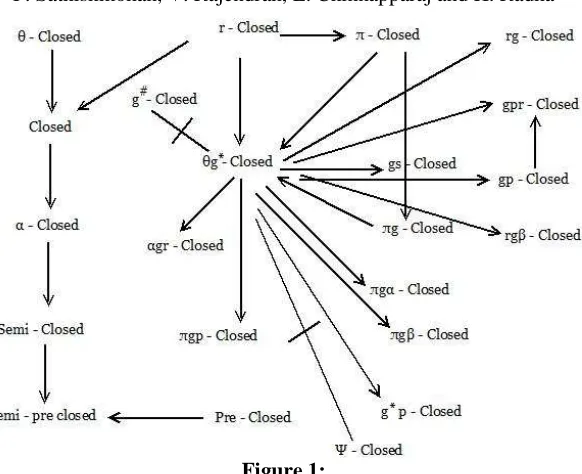
g*-closed.Remark 3.6. The following diagram shows that the relationships of
θ
g*-closed sets with70 Figure 1: B
A→ represents A implies B but not conversely.
4. Properties of
θ
-generalized star closed setsIn this section, we discuss the properties of
θ
-generalized star closed sets.Theorem 4.1. The union of two
θ
g*-closed subsets areθ
g*-closed.Proof: Let A and B any two
θ
g*-closed sets in X . Such that A⊆U and B⊆Uwhere U is g-open in X and so A∪B⊆U . Since A and B are
θ
g*-closed.)
(A
cl
A⊆ θ and B⊆clθ(B) and hence A∪B⊆clθ(A)∪clθ(B)⊆clθ(A∪B) .
Thus A∪B is
θ
g*-closed set in (X,τ
).Example 4.2. Let X ={a,b,c},
τ
={X,φ
,{b},{c},{b,c}} andθ
g*-closed =}} , { }, , { }, { }, { , ,
{X
φ
a c a b a c . Let A= a{ } and B= c{ }, then A∪B = { ca, } is alsoθ
g*-closed set.Theorem 4.3. The intersection of two
θ
g*-closed subset areθ
g*-closed.Proof: Let A and B any two
θ
g*-closed sets in X . Such that A⊆U and B⊆Uwhere U is g-open in X and so A∩B⊆U . Since A and B are
θ
g*-closed.)
(A
cl
A⊆ θ and B⊆clθ(B) and hence A∩B⊆clθ(A)∩clθ(B)⊆clθ(A∩B) . Thus A∩B is
θ
g*-closed set in (X,τ
).71
} , { }, , { }, { }, { , ,
{X
φ
a c a b a c . Let A={a,b} and B={a,c}, then A∩B= a{ } is also*
g
θ
-closed set.Theorem 4.5. The intersection of a
θ
g*-closed set and aθ
-closed set is alwaysθ
g* -closed.Proof: Let A be a
θ
g*-closed set and let F beθ
-closed. Let U be an open set such that A∩F⊆U. Set G= X\F. Then A⊆U∪G. Since G isθ
-open, U∪G is open and since A isθ
g*-closed, clθ(A)⊆U∪G. Now by Lemma [2.4],) ( ) ( )
(A F cl A cl F
clθ ∩ ⊆ θ ∩ θ = clθ(A)∩F
⊆ (U∪G)∩F= (U ∩F)∪(G∩F)= (U∩F)∪
φ
⊆U.Theorem 4.6. The intersection of a
θ
g-closed set and aθ
g*-closed set is alwaysθ
g -closed.Proof: Let A be a
θ
generalized-closed set and let F beθ
g*-closed. Let U be anopen set such that A∩F ⊆U. Set G=X \F. Then A⊆U∪G. Since G is
θ
g* -open, U∪G is open and since A isθ
g-closed, clθ(A)⊆U∪G. Now by Lemma [2.4], clθ(A∩F)⊆clθ(A)∩clθ(F) = clθ(A)∩F⊆ (U∪G)∩F= (U ∩F)∪(G∩F)= (U∩F)∪
φ
⊆U.Theorem 4.7. For any element x∈X . The set X is
θ
g*-closed set or g-open.Proof: Suppose X \ x{ } is not g-open, then X is the only g-open set containing
} { \ x
X . This implies clθX \{x}⊆X . HenceX \ x{ } is
θ
g*-closed or g-open in X .5. Separation axioms of
θ
g*-closed setsAs applications of
θ
g*-closed sets, three spaces namely, θT1/2 *spaces, *θT1/2 spaces,
1/2
T
θ ** spaces are introduced and investigated.
Definition 5.1. A space (X,
τ
) is called• a θT1/2 * space if every
θ
g*-closed set of (X,τ
) is a closed set. • a *θT1/2 space if every*
g
θ
-closed set of (X,τ
) is a g*-closed set. • a θT1/2 ** space if everyθ
g*-closed set of (X,τ
) is g-closed.Theorem 5.2. Every Tb space is θT1/2* space but not conversely. Proof: Let (X,
τ
) be a Tb space. Let A be a*
g
θ
-closed set of (X,τ
). Then A is also a gs-closed set. Since (X,τ
) is a Tb space, then A is a closed set of (X,τ
). Therefore (X,τ
) is a θT1/2*
72
Example 5.3. Let X ={a,b,c} and
τ
={X,φ
,{a},{b},{a,b}}. Then the space) ,
(X
τ
is not a Tb space. Since {a} is a gs-closed set but not a closed set of (X,τ
). However (X,τ
) is a θT1/2*
space.
Theorem 5.4. Every T1/2 space is T1/2 *
space but not conversely. Proof: Let (X,
τ
) be a T1/2 space. Let A be a*
g -closed set of (X,
τ
). Then A is also a g-closed set. Since (X,τ
) is a T1/2 space, then A is a closed set of (X,τ
). Therefore (X,τ
) is a T1/2 * space.Example 5.5. Let X ={a,b,c} and
τ
={X,φ
,{a}}. Then the space (X,τ
) is not a1/2
T space. Since {b} is a g-closed set but not a closed set of (X,
τ
). However (X,τ
)is not a T1/2 *
space.
Theorem 5.6. Every T1/2 space is *T1/2 space but not conversely.
Proof: Let (X,
τ
) be a T1/2 space. Let A be a g-closed set of (X,τ
). Then A isalso a g-closed set. Since (X,
τ
) is a T1/2 space, then A is a g*-closed set of (X,τ
)Therefore (X,
τ
) is a *T1/2 space.Example 5.7. Let X ={a,b,c} and
τ
={X,φ
,{a,c}}. Then the space (X,τ
) is not a1/2
T space. Since { ba, } is a g-closed set but not a closed set of (X,
τ
). However) ,
(X
τ
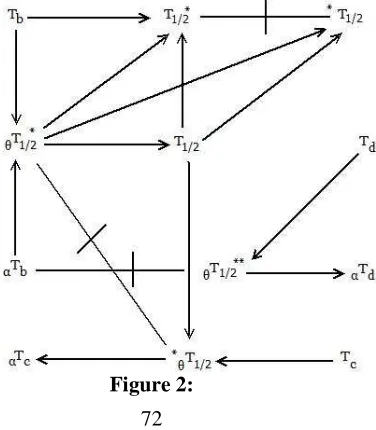
is not a *T1/2 space.Remark 5.8. The diagram of Figure 2 shows that the relationship of θT1/2 *
-space,
* 1/2
T
θ -space, and θT1/2 * *
-space with other known existing sets.
73 B
A→ represents A implies B but not conversely.
Example 5.9. Let X ={a,b,c} and
τ
={X,φ
,{b},{c},{b,c}}. Then the space (X,τ
)is not a θT1/2* space. Since {c} is a
θ
g*-closed set but not a closed set of (X,τ
). However (X,τ
) is a T1/2 space and T1/2* space.Example 5.10. Let X ={a,b,c} and
τ
={X,φ
,{b},{c},{b,c}}. Then the space) ,
(X
τ
is not a *θT1/2 space. Since {c} is a *g
θ
-closed set but not a g*-closed set of) ,
(X
τ
. However (X,τ
) is a αTc space.Example 5.11. Let X ={a,b,c} and
τ
={X,φ
,{b},{c},{b,c}}. Then the space) ,
(X
τ
is not a θT1/2** space. Since {c} is aθ
g*-closed set but not a g-closed set of) ,
(X
τ
. However (X,τ
) is a αTd space.Theorem 5.12. A space (X,
τ
) is a T1/2 space if and only if it is *1/2
T and T1/2 *
. Proof: Necessity: Follows from the Theorems [5.4] and [5.5].
Sufficiency: Suppose (X,
τ
) is both T1/2 *and *T1/2. Let A be a g-closed set of
) ,
(X
τ
. Since (X,τ
) is *T1/2 space, then A is *g -closed. Since (X,
τ
) is a T1/2 *space, then A is a closed set of (X,
τ
). Thus (X,τ
) is a T1/2 space.6.
θ
g*-continuous functions andθ
g*-irresolute functionsThis section is devoted to introduce
θ
g*-continuous functions andθ
g*-irresolute functions and discussed the relationships between the other known existing functions.Definition 6.1. A function f :(X,
τ
)→(Y,σ
) is calledθ
g*-continuous if f−1(V) is a*
g
θ
-closed set of (X,τ
) for every closed set V of (Y,σ
).Theorem 6.2. For a function f :(X,
τ
)→(Y,σ
), every continuous function isθ
g* -continuous but not coversely.Proof: Let f be a continuous function and let V be a closed set in (Y,
σ
), then) (
1
V
f− is closed set in (X,
τ
). Since every closed set isθ
g*-closed set, 1( )V f− is
*
g
θ
- closed set in (X,τ
). Therefore f isθ
g*-continuous.74 } , { = }) , ({ 1 b a b a
f− is
θ
g*-closed but not closed set in (X,τ
).Theorem 6.4. For a function f :(X,
τ
)→(Y,σ
), the following hold.Every
θ
g*-continuous function is rg -continuous, gpr -continuous, gs -continuous, gp-continuous,π
g-continuous,π
gs-continuous,π
gβ
-continuous.Proof: Let f be a
θ
g*-continuous function and let V be a closed set in (Y,σ
), then) (
1
V
f− is
θ
g*-closed set in (X,τ
). Since everyθ
g*- closed set is rg-closed set (gpr -closed, gs -closed, gp -closed,π
g-closed,π
gs -closed,π
gβ
-closed), f−1(V) isrg -closed ( gpr -closed, gs -closed, gp -closed,
π
g -closed,π
gs -closed,π
gβ
-closed) set in (X,τ
) . Therefore f is rg -continuous ( gpr -continuous, gs -continuous, gp-continuous,π
g-continuous,π
gs-continuous,π
gβ
-continuous).Example 6.5.
1. Let X =Y ={a,b,c} with
τ
={φ
,{a},{b},{a,b},X} andσ
={φ
,{c},Y}. Let the function f :(X,τ
)→(Y,σ
) be defined by f(a)=b, f(b)=a, f(c)=c. Then f is rg-continuous but notθ
g*-continuous. Since for the closed set { ba, } in Y ,} , { = }) , ({ 1 b a b a
f− is rg-closed but not
θ
g*-closed set in (X,τ
).2. Let X =Y ={a,b,c} with
τ
={φ
,{a},{c},{a,c},X} andσ
={φ
,{b},Y}. Let the function f :(X,τ
)→(Y,σ
) be defined by f(a)=c, f(b)=b, f(c)=a. Then f is gpr-continuous but notθ
g*-continuous. Since for the closed set { ca, } in Y,} , { = }) , ({ 1 c a c a
f− is gpr-closed but not
θ
g*-closed set in (X,τ
).3. Let X =Y ={a,b,c} with
τ
={φ
,{a},{a,c},X} andσ
={φ
,Y,{b},{a,b}}. Let the function f :(X,τ
)→(Y,σ
) be an identity function, then f is gs-continuous but notθ
g*-continuous. Since for the closed sets { ca, } and {c} in Y, f−1({a,c})={a,c}and f−1({c})={c} is gs-closed but not
θ
g*-closed set in (X,τ
).4. Let X =Y ={a,b,c} with
τ
={φ
,{a},{a,b},X} andσ
={φ
,Y,{a,c}}. Let the function f :(X,τ
)→(Y,σ
) be an identity function, then f is gp-continuous but not*
g
θ
-continuous. Since for the closed set {b} in Y, f−1({b})={b} is gp-closed but notθ
g*-closed set in (X,τ
).5. Let X =Y ={a,b,c} with
τ
={φ
,{a},{b},{a,b},{a,c},X} and{ =
σ
,{b},{c},{b,c},{a,c},Y}. Let the function f :(X,τ
)→(Y,σ
) be an identity function, then f isπ
g-continuous but notθ
g*-continuous. Since for the closed set}} { }, { }, , { }, ,
{{a b a c a b in Y, f−1({a,b})={a,b}, f−1({a,c}={a,c},
} { = }) ({ 1 a a
75
6. Let X =Y ={a,b,c} with
τ
={,{b},{c},{a,b},{b,c},X} and{ =
σ
,{c},{a,c},{b,c},Y}. Let the function f :(X,τ
)→(Y,σ
) be defined by f(a)= c, f(b)= b, f(c)= a. Then f isπ
gs- continuous but notθ
g*- continuous. Since for the closedset {a,b}, {b}, {a} in Y, f−1({a,b}) = {b,c}, f−1({b}) = {b} and f−1({a}) = {c}, which is
π
gs- closed but notθ
g*- closed set in (X,τ
).7. Let X=Y= {a,b,c} with
τ
= {φ
,{a},{a,b},X} andσ
= {φ
, a{ }, {b },,c Y}. Let the function f:(X,τ
)→
(Y,σ
) be defined by f(a)= b, f(b)= c, f(c)= a. Then f isπ
gβ
- continuous but notθ
g*- continuous. Since for the closed set {a} and {b,c} in Y, f−1({a})= {c} and f−1({b,c}) = {a,b} which is
π
gβ
- closed but notθ
g*- closed set in (X,τ
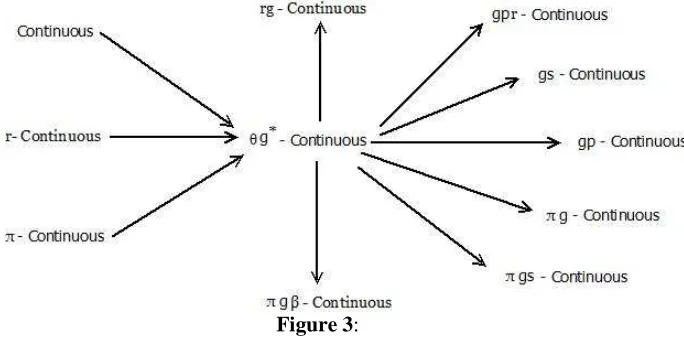
).Remark 6.6. The following diagram shows the relationship of
θ
g*- continuous with otherknown exixting sets.
Figure 3:
B
A→ represents A implies B but not conversely.
Definition 6.7. A function f:(X,
τ
) → (Y,σ
) is calledθ
g*- irresolute if f−1(V) is a*
g
θ
-closed set of (X,τ
) for everyθ
g*-closed set of (Y,σ
).Theorem 6.8. For a function f :(X,
τ
)→(Y,σ
), everyθ
g*- irresolute function isθ
g* - continuous but not conversely.Proof: Let V be a closed set in (Y,
σ
). Since every closed set isθ
g*-closed set. Therefore V isθ
g*-closed set of Y. Since f isθ
g*- irresolute, then f−1(V) isθ
g* -closedset in X. Thus f is
θ
g*-continuous.76
σ
= {φ
,{a},{b,c},X} andθ
g*= {φ
,{a},{b,c},Y}. Define a function f(a)= a, f(b)= b, and f(c)= c then f−1({a})= {a}, f−1({b,c})= {b,c} which is notθ
g*- irresolute. Since it isθ
g* - closed set of Y but the inverse is not aθ
g*- closed set of X. But it isθ
g*- continuous.Theorem 6.10. Let a function f :(X,
τ
)→(Y,σ
) be aθ
g*- continuous function. If (X,τ
) is θT1/2*- space, then f is continuous function.Proof: Let V be a closed set in (Y,
σ
). Since f isθ
g*-continuous, f−1(V) isθ
g*- closed in (X,τ
). Since (X,τ
) is θT1/2*, f−1(V) is closed in (X,τ
). Therefore f is continuous.Remark 6.11. The composition of two
θ
g*- continuous functions need not beθ
g*- continuous as shown in the following example.Example 6.12. Let X=Y=Z= {a,b,c} with
τ
= {φ
,{a},{a,b},X},σ
= {φ
,{b},{b,c},Y} andη
= {φ
,{c},{a,b},Z}. Define f :(X,τ
)→(Y,σ
) by f(a)= a, f(b)= b, f(c)= c. Define g:(Y,σ
)→
(Z,η
) by g(a)=b, g(b)= a, g(c)= c.Then
θ
g*C(X,τ
)= {φ
,X,{c},{b,c},{a,c}} andθ
g*C(Y,σ
)={φ
,Y,{a},{a,b},{a,c}}. Here {a,b} is a closed set in (Z,η
). But (go
f)−1({a,b})= {a,b} is not aθ
g*- closed set in (X,τ
). Therefore go
f is notθ
g*- continuous.7. Contra
θ
g*-continuous functionsIn this section, we introduce a new class of continuous function called contra
θ
g*-continuous functions and studied the composition between
θ
g*-continuous functions and*
g
θ
-irresolute functions.Definition 7.1. A function f :(X,
τ
)→(Y,σ
) is said to be contraθ
g*- continuous if f1
−
(V) is
θ
g*- closed set in X for every open set V in Y.Theorem 7.2. For the function f :(X,
τ
)→(Y,σ
), the following hold. [a] Every contra r-continuous function is contraθ
g*-continuous.[b] Every contra
θ
g*-continuous function is contra rg-continuous (contra gpr-continuous, contra gs-continuous, contra gp-continuous, contraπ
g-continuous, contraπ
gs-continuous, contraπ
gβ
-continuous).Proof: [a] Suppose we take V be an open set in Y. Since f is contra r-continuous, then f−1
(V) is r-closed in X. Since every r- closed set is
θ
g*- closed, f−1(V) isθ
g*- closed in X.77
[b] Suppose we take V be an open set in Y. Since f is contra
θ
g*- continuous,then f−1(V) is
θ
g*- closed in X. Since everyθ
g*- closed set is rg- closed (gpr-closed,gs-closed,gp-closed,
π
g-closed,π
gs-closed,π
gβ
-closed), f −1 (V) is rg-closed (gpr-closed,gs- closed,gp-closed,π
g-closed,π
gs-closed,π
gβ
-closed) in X. Thus we have f is contra rg-continuous (contra gpr-continuous, contra gs-continuous, contra gp-continuous, contraπ
g-continuous, contraπ
gs-continuous, contraπ
gβ-continuous).Example 7.3.
[a] Let X= {a,b,c} =Y with
τ
= {X,φ
,{a},{b},{a,b}} andσ
= {Y,φ
,{b},{c},{b,c}}. Letthe function f :(X,
τ
)→(Y,σ
) be the identity function. Then f is contraθ
g*- continuous but not in contra r-continuous. Since for the open set {c} in Y, f−1({c})={c} is*
g
θ
- closed but not a r- closed set in (X,τ
).[b] Let X= {a,b,c} =Y with
τ
= {X,φ
,{c},{b,c}} andσ
= {Y,φ
,{b,c}}. Let the function) , ( ) , (
: X
τ
Yσ
f → be the identity function. Then f is contra rg- continuous but not in
contra
θ
g*-continuous. Since for the open set {b,c} in Y, f−1({b,c})={b,c} is rg- closedbut not
θ
g*- closed set in (X,τ
).[c] Let X= {a,b,c} =Y with
τ
= {X,φ
,{a},{a,b}} andσ
= {Y,φ
, b{ }, { ba, }}. Let the function f :(X,τ
)→(Y,σ
). Define a set f(a)=b, f(b)=a, f(c)=c. Then f 1({ })b −
={a} and
f−1({a,b})={a,b} which is contra gpr - continuous but not in contra
θ
g*-continuous. However f is contra gpr- continuous.[d] Let X= {a,b,c} =Y with
τ
= {X,φ
,{a}} andσ
= {Y,φ
,{a}, {a,b}}. Let the function) , ( ) , (
: X
τ
Yσ
f → . Defined by the set f(a)=b, f(b)=a, f(c)=c. Then f−1({a})={b}, f−1
({a,b})={a,b}, which is contra gs - continuous but not in contra
θ
g*-continuous. However f is contra gs- continuous.[e] Let X= {a,b,c} =Y with
τ
= {X,φ
,{c},{b,c}} andσ
= {Y,φ
,{b}}. Let the function) , ( ) , (
: X
τ
Yσ
f → be the identity function. Then f is contra gp - continuous but not in
contra
θ
g* - continuous. Since for the open set {b} in Y, f−1({b})={b} is gp - closed butnot
θ
g*- closed set in (X,τ
).78
({b})={b} and f−1({b,c})={b,c} which is
π
g- closed but notθ
g*- closed set in (X,τ).[g] Let X= {a,b,c} =Y with
τ
= {X,φ
,{b},{c},{b,c}} andσ
= {Y,φ
,{b}}. Let thefunction f :(X,
τ
)→(Y,σ
) be the identity function. Then f is contraπ
gs - continuous but not in contraθ
g*-continuous. Since for the open set {b} in Y, f−1({b})={b} isπ
gs-closed but not
θ
g*- closed set in (X,τ
).[h] Let X= {a,b,c} =Y with
τ
= {X,φ
,{a},{b},{a,b},{a,c}} andσ
= {Y,φ
,{a}}. Let thefunction f :(X,
τ
)→(Y,σ
) be the identity function. Then f is contraπ
gβ
- continuous but not in contraθ
g*-continuous. Since for the open sets {a} in Y, f−1({a})={a} is
π
gβ
- closed but notθ
g*- closed set in (X,τ
).Theorem 7.4. Let f :(X,
τ
)→(Y,σ
) be a contraθ
g*- continuous function and g:(Y,σ
) → (Z,η
) be a continuous function then gof: (X,τ
) → (Z,η
) is contraθ
g* - continuous.Proof: Let V be any open set in Z. Since g:(Y,
σ
)→
(Z,η
) be a continuous, g−1(V) isopen in Y. Since f :(X,
τ
)→(Y,σ
) be a contraθ
g*- continuous, f−1(g−1(V)) is a*
g
θ
- closed set in X. Hence (gof)−1(V)=f−1(g−1(V)) is aθ
g*- closed set in X. Therefore gof: (X,τ
)→
(Z,η
) is contraθ
g*- continuous.Theorem 7.5. Let f :(X,
τ
)→(Y,σ
) be aθ
g* -irresolute and g:(Y,σ
)→
(Z,η
) be a contraθ
g*- continuous function then gof: (X,τ
)→
(Z,η
) is contraθ
g*- continuous.Proof: Now we take V be any open set in Z. Since g:(Y,
σ
) → (Z,η
) be a contraθ
g*-continuous, g −1 (V) is
θ
g* - closed in Y. Since f :(X,τ
)→(Y,σ
) be aθ
g* -irresolute, f−1(g−1(V)) is aθ
g*- open set in X. Therefore gof: (X,τ
) → (Z,η
) iscontra
θ
g*- continuous.8. Conclusion
In this paper, a new class of sets called
θ
g*- closed sets has been introduced and some ofits properties has been studied. Based on this sets, some of the functions called
θ
g*-continuous functions,
θ
g*- irresolute functions and contraθ
g*-continuous functions are also introduced in the topological spaces and some of its properties has been studied. Further, the application ofθ
g*-closed sets has been introduced interms of spaces namely,1/2
T
79 REFERENCES
1. S.P.Arya and T.M.Nour, Characterization of s-normal spaces, Indian J. Pure Appl. Math., 21(8) (1990) 717-719.
2. D.Andrijevic, Semi pre-open sets, Mat. Vesnik, 38(1) (1986) 24-32.
3. G.Aslim and A.Caksu Guler, Noiri On
π
gs- closed sets in topological spaces, Acta. Math. Hunger., 112(4) (2006) 275-283.4. K.Balachandran, P.Sundaram and H.Maki, On generalized continuous maps in topological spaces, Mem. Fac. Kochi Univ. Ser. A, Math., 12 (1991) 5-13.
5. P.Bhathacharyya and B.K.Lahiri, Semi generalized closed sets in topological spaces, Indian J.Pure Apple.Math., 29 (1987) 376-382.
6. R.Devi, H.Maki and K.Balachanran, Semi generalized homeomorphisms and generalized semi homeomorphisms, Indian J. Pure. Appl. Math., 26(3) (1995) 271 -284.
7. J.Dontchev and T.Noiri, Quasi normal spaces and
π
g-closed sets, Acta Math. Hungar., 89(3) (2000) 211-219.8. J.Dontchev and H.Maki, On
θ
-generalized closed sets, Int.J. Math. Math. Sci. 22 (1999) 239-249.9. J.Dontchev, Contra-continuous functions and strongly s- closed spaces, International Journal of Mathematical Sciences, 19(2) (1996) 303-310.
10. W.Dunham, T1/2 space, Kyungpook Math.J., 17 (1977) 161-169.
11. S.V.Fomin, Extensions of topological spaces, Ann. of Maths., 44 (1943) 471-480. 12. Y.Gnanambal, On generalized pr-closed sets in topological spaces, Indian. J. Pure
Appl. Math., 28 (1997) 351-360.
13. S.Jafari and T.Noiri, Contra-
α
-continuous functions between topological space, Iranian International Journal of Science, 2(2) (2001) 153-167.14. V.Jeyanthi and C.Janaki,
π
gr- closed sets in topological spaces, Asian Journal of Current Engg. Math., 1 (2012) 241-246.15. C.Janaki, Studies on
π
gα
- closed sets in topological spaces, Ph.D Thesis, Bharathiar University, Cbe (2009).16. N.Levine, Semi-open and semi-continuity in topological spaces, Amer. Math. Monthly, 70 (1963) 36-41.
17. N.Levine, Generalized closed sets in topological spaces, Rend. Circ. Mat. Patermo, 2 (19) (1970) 89-96.
18. H.Maki, R.Devi and K.Balachandran, Associated topologies of generalized
α
-closed sets andα
-generalized closed sets, Mem. Fac. Sci. Kochi Univ. Ser. A. Math., 15 (1994) 51-63.19. H.Maki, J.Umehara and T.Noiri, Every topological space is pre-T1/2, Mem. Fac.Sci. Kochi Univ. Ser. A. Math., 17 (1996) 33-42.
20. H.Maki, R.Devi and K.Balachandran, Generalized
α
-closed sets in topology, Bull Fukuoka Univ. Ed., 42 (1993) 13-21.21. A.S.Mashhour, M.E.Abd, El.Monsef and S.N.E.Deebl, On pre continuous and weak pre continuous mappings, Proc. Math. and Phys. Soc. Egypt, 53 (1982) 47-53. 22. N.Nagaveni, Studies on generalized homeomorphisms in topological spaces, Ph.D.
80
23. O.Njastad, Some classes of nearly open sets, Pacific J. Math., 15 (1965) 961-970. 24. J.H.Park, On
π
gp- closed sets in topological spaces, Indian J. Pure Appl. Math, 2004. 25. N.Palaniappan and K.C.Rao, Regular generalized-closed sets, Kyung-pook Math. J.,33 (1993) 211-219.
26. M.S.Sarasak and N.Rajesh,
π
-Generalized semi-preclosed sets, International Mathematical Forum, 5 (2010) 473-478.27. M.Stone, Application of the theory of boolean rings to general topology, Trans. Amer. Math. Soc., 41 (1937) 374-481.
28. M.Sheikjohn, w- closed sets in topology, Acta Ciencia Indica, 4 (2000) 389-392. 29. M.K.R.S.Veerakumar, Semi-closed sets and semi-pre-closed sets, Rend. Intit. Mat.
Univ. Trieste, XXXII (2000) 25-41.
30. M.K.R.S.Veerakumar, g*-semi-closed sets in topology, Acta Ciencia India, 29M(1) (2003) 81-90.
31. M.K.R.S.Veerakumar, g#-semi-closed sets in topology, Indian J. Math., 44(1) (2002) 73-87.
32. M.K.R.S.Veerakumar, Between closed sets and g- closed sets, Mem. Fac.Sci. Kochi Univ. (Math.) 21 (2000) 1-19.
33. M.K.R.S.Veerakumar, gs- closed sets in topological spaces, Kochi University Series A, 21 (2000)1-19.
34. N.V.Velicko, H-closed topological spaces, Trans. Aner. Math. Soc., 78 (1968) 103-118.