doi: 10.15171/rdme.2019.014 https://rdme.tbzmed.ac.ir
Facilitating student learning: An instructional design perspective for
health professions educators
Babu Noushad1*ID, Faraz Khurshid2ID
1College of Health Sciences, University of Buraimi, Sultanate of Oman
2Medical Education Unit, School of Medicine, Western Sydney University, Campbelltown Campus, New South Wales,
Australia
Introduction
Education in the 21st century has become significantly transformed owing to advancements in technology, instructional design and curricular innovation. Nevertheless, the process of learning is similar to what it has always been. Learners still need to gather information, acquire skills and critically analyze them to develop competencies transferable to other tasks and situations. However, substantial changes in learning conditions and facilities that provide access to a vast extent of knowledge demands teachers to adapt to situations and exhibit readiness to bring essential modifications in instructional strategies.1 Educational approaches in health professions typically demand an integration of knowledge, skills, and attitude to prepare professionals for real-life situations. The mental effort and dedicated task approach required to tackle complex concepts in health professions is more challenging. The field of health professions education has embraced a number of theories from other disciplines, especially psychology. This article will discuss a similar
approach in an attempt to incorporate one of the most promising scientific theories from educational psychology – the cognitive load theory (CLT) – to design instructional strategies for optimizing student learning.
Cognition and the human memory model
Cognition refers to the “mental process by which the external or internal information is transformed, reduced, elaborated, stored, recovered and used” and comprises many higher order activities such as attention, memory, judgment and evaluation, comprehension, reasoning,
problem solving and decision making.2 The cognition
process hence utilizes our existing knowledge and continuously generates new knowledge.
Memory is the ability to retain and recall the information that we have acquired in the past to perform a cognitive task in the present.3 Atkinson and Shiffrin suggested that the information that enters into our memory system goes through three different interdependent stages: sensory memory, short-term memory (STM), and long-term
*Corresponding author: : Babu Noushad, Email: [email protected]; [email protected]
© 2019 The Authors. This is an Open Access article distributed under the terms of the Creative Commons Attribution License PPuubblliisshhiinngg
G Grroouupp
TUOMS
Article Type:
Review
Article History:
Received: 7 Aug. 2019 Accepted: 22 Sep. 2019 epublished: 30 Dec. 2019
Keywords:
Cognition
Cognitive load theory Instructional design Memory
Schema
Abstract
Learning in any context involves acquisition, storage and utilization of information by the human memory system. Teaching and learning in health professions is a complex process since it demands learners interact with a number of novel information and concepts and critically analyze them to make important clinical decisions. Therefore, it is imperative for Instructional designers and instructors in health professions education to optimize learning content by considering the characteristics of memory and learning processes of students. This review explores stages of the human memory system, the process of learning, the various types of cognitive loads a learner experiences while learning, and the implications of these factors on instructional designs on the basis of a fairly new theory in educational psychology – the Cognitive Load Theory (CLT). By analyzing the unique features of the processing, storage and retrieval of information by human memory system, this article advocates for health professional educators to plan and design instructional strategies that facilitate student learning.
Article info
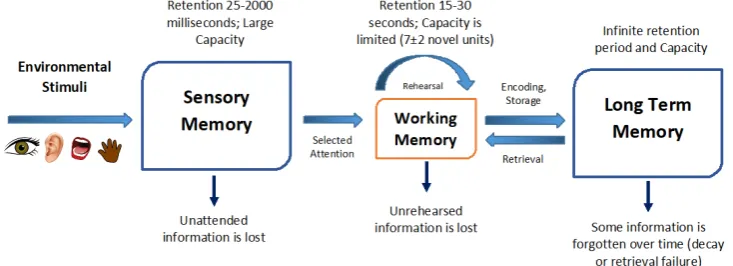
memory (LTM) (Figure 1).4 The incoming information first enters the sensory memory, which has a large capacity, but a life span of less than a second. It can accept information with great accuracy from all of our senses, but fades quickly. An example of sensory memory experience is afterimage: when a person looks at a bright light source, a trail of it remains for a very short duration after the light is removed.
Generally, we do not attend to all the information that we encounter. The information that we are interested in is transferred to our short-term (working) memory for processing. According to Miller, a well-known cognitive psychologist, the capacity and duration of STM is very limited. He theorized that human STM cannot hold more than five to nine novel information elements (7 ± 2) and cannot actively process more than two to four of those elements simultaneously. This is because STM has only a certain number of slots to hold information.5 Atkinson and Shiffrin suggested that the STM information span is between 15-30 seconds unless we rehearse verbally.4 This short-term or temporary location is also a place for several complex cognitive tasks such as language comprehension, reasoning, and learning.6
Information that survives the duration and capacity constraints of STM enters LTM. LTM has a huge capacity to store complex information in the form of cognitive schemas. Schemas are individual knowledge units in which information is organized. Moreover, they allow the encoding, storage and retrieval of information specific to a domain or a task. Schemas are dynamic (they develop and change continuously as new information is added), they provide guidance to interpret new information and they store both declarative (“what” – knowing facts) and procedural (“how” – knowing how to do something) information. LTM is a permanent storehouse for information. Once information is transferred to LTM, it cannot be lost. Sometimes we tend to forget facts due to failure of retrieval, but not because of permanent loss of information.4
Learning process
Learners develop proficiency when they weave the strands
of schemas into coherent and complex ones by combining simple schemas (i.e., chunking) or by incorporating new elements to already established schemas (i.e., elaborating). The process of bringing information elements together into familiar and manageable schemas is known as “chunking”. For example, in an experiment where people were given five seconds to view and memorize the arrangement of pieces on a chess board, chess experts could recall nearly all the pieces, while non-experts could remember, on average, only nine out of 32 pieces. However, when the pieces were arranged randomly, the memory performance of both groups did not differ. Chess experts could remember meaningful arrangement of chess pieces as a single ‘chunk’ or group. However, when the organization was disrupted, they could no longer remember them and had a similar capacity of the working memory of a
non-expert.7 Construction of a schema is therefore an
important aspect in the memory system as this supports the working memory by reducing its load.
Another inherent modification of a schema to facilitate working memory is ‘automation’. Constructed schemas can become automated by repeated practice of a given task.8 In a nutshell, there is a systematic process that controls the information flow from sensory memory to LTM. Only a selected set of information (selective attention) is transferred from sensory memory to STM, where that information is retained with the help of rehearsal (maintenance rehearsal). These elements are then transferred to LTM through elaborative rehearsal, a process that attempts to connect the ‘to be maintained information’ to an already existing schema. If a learner can create a greater number of associations in LTM around new information, that information can become permanent. Thus, well-designed instructional strategies are expected to facilitate learners in constructing meaningful schemas, to elaborate and automate these so the information can be retrieved at any time.
What makes learning ‘easy’ or ‘difficult’?
In the late 1980s, Sweller proposed CLT to explain why some materials are difficult to learn compared to other materials.9 According to CLT, the human cognitive system
has severely limited working memory and unlimited LTM
capacities.10 The limitation of working memory can be
nullified if it is given an option to engage and manipulate
organized information accessed from LTM.11 CLT aims to
provide a framework for instructional design principles that takes into consideration the characteristics and
interdependence of these two memory units.12 It argues
that the level of difficulty to solve a problem or to learn a new concept depends on the amount of processing (cognitive load) needed for the acquisition and automation of schemas in working memory.
STM, or working memory, is the locus of all ongoing cognitive activities. Thus cognitive load can be termed as the total working memory effort or the resources essential to carry out a learning task. When a learner encounters novel information, three types of loads are imposed on working memory: intrinsic load, extraneous load and
germane load.13 Intrinsic load, as the name suggests,
is inherent to the task that is to be performed. In other words, it is the level of complexity or difficulty associated with a concept, a topic, or even a term being taught. A final year medical student who is interacting with the term “parasympathetic” can process the word in his working memory very easily and unconsciously since the term and associated information is stored in LTM as a single schema which can be readily retrieved. For a novice learner, interpreting the multiple scribbles that create the term “parasympathetic” is a challenging task due to the complex interaction between each of its elements (element interactivity). This high element interactivity increases the intrinsic cognitive load for a novice learner. For an expert, the same scribbles are aligned as one element and enforce a limited cognitive load due to minimal element interactivity. Therefore, intrinsic cognitive load can be influenced by task complexity (whether it is a term, a concept or a topic) as well as the prior knowledge of the learner.13,14
Extraneous cognitive load is determined by how the information is presented to the learner and what the learner is expected to do with the information to advance understanding. The intrinsic complexity of a task has no influence on the extraneous cognitive load but rather is affected by the strategies utilized by instructional designers and teachers to communicate with learners. Thus, it can be manipulated by altering instructional strategies.13 For example, if an instructor is describing the cardiovascular system, using visual media such as diagrams, simulations or videos would decrease the extraneous cognitive load compared to a mere verbal description. Similarly, if a set of students is learning the Lens Maker’s formula to estimate the desired focal length of spectacle lenses to be made, a completely worked-out example or even a partially-solved example would help them lessen the
extraneous load compared to conventional problems.15,16
These instructional modifications are known to break down the number of elements that a learner needs to
simultaneously process in his working memory and hence reduces element interactivity.
Lastly, germane cognitive load refers to the effort required to learn. The goal of instructional strategies is to reduce extraneous load and increase germane load. Germane cognitive load has a positive effect on learning since the associated effort channels working memory resources to process and construct a schema. Appropriately designed instructional strategies reduce extraneous load so that more working memory resources are available to deal with intrinsic load and thus to facilitate learning.14 In contrast to extraneous load, germane load refers to the process of forming cognitive schemas in working memory in order to transfer them to LTM. Therefore, in the recent iterations of CLT, germane load is considered to be intertwined with intrinsic load as it essentially represents the efforts needed to handle intrinsic load.17
Instructional design considerations
In health professions learning, learners come across multiple challenges due to the large volume of information they encounter. Further, mastery of tasks and professional competencies require integration of varied levels of knowledge, skills, and behaviors in any given situation.18 These requirements automatically increase element interactivity and the associated cognitive load. When cognitive load exceeds the limit of working memory capacity, the process of learning is affected.
Before discussing instructional design approaches, it is important to understand how experts are different from novices. The basic step of learning is to construct a schema, then transfer and automate the schema to LTM so that it can be retrieved to the working memory whenever required. Evidence suggests that the acquisition of organized knowledge about a specific domain in the form of a schema is the distinguishing factor between
a novice and an expert.9 Expertise develops with
experience and an expert can organize new information faster than a novice due to a reduction in intrinsic load. Consider both a novice and a final year medical student attending an ‘angina’ patient in an emergency department. The working memory of a novice will be taxed with processing individual symptoms presented by the patient and multiple permutations and combinations of those symptoms to arrive a diagnosis. For the final year student, it is less complicated to recognize and retrieve the pattern of presenting symptoms to a single schema of “angina” to working memory.
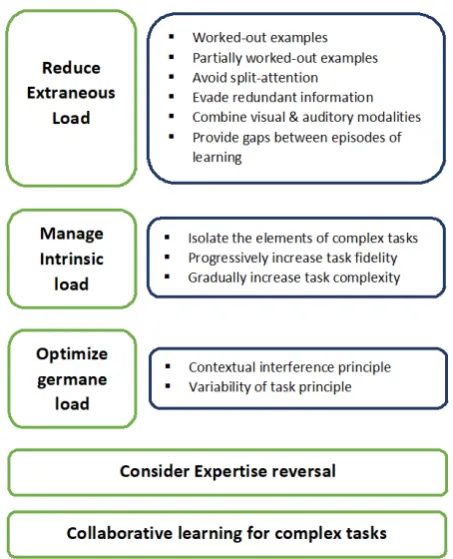
germane load in order to facilitate the construction and automation of schemas. Though it will be difficult to manipulate intrinsic load, an effort to simplify the task at hand for learners can have a complementary effect. Some instructional strategies are suggested from the recommendations of Van Merriënboer and Sweller to optimize student learning in their learning environments (Figure 2).19
A. Reduce extraneous load
The smaller components that constitutes learning material are known as ‘elements’ and these elements interact simultaneously in working memory. As discussed earlier, the complexity and interaction between these elements determines the amount of intrinsic load. Further, instructional strategies specifically chosen to communicate these elements and their interaction with learners determine the extent of element interactivity and the resulting extraneous cognitive load. Any approach to reducing element interactivity is known to reduce the
overall cognitive load. Sweller and Cooper20 suggested
to use worked-out examples and Van Merrienboer and
Krammer21 proposed the use of partially completed
solutions rather than using traditional solution questions. Traditional problem solving questions demand the learner to search for the whole solution from the beginning and hence increases extraneous load. Sweller and Chandler observed that cognitive load will be higher if two or more sources of information that otherwise cannot be understood in isolation are presented separately in space or time (split-attention). For instance, a diagram presented separately from its accompanying text on two separate PowerPoint slides requires more cognitive load to integrate the information rather than placing both elements together on a single PowerPoint slide.22 Presenting redundant information is another source of high element interactivity. A diagram that illustrates the transmission of neural signals across different retinal layers does not really require textual explanation.23 Tindall-Ford et al suggested utilizing a combination of visual and auditory modalities to transfer the information rather than taxing the learner with one modality. A good example for this approach is to utilize auditory explanations (rather than written text on the screen) with animations or instructional videos.24 Chen et al proposed to provide gaps between episodes of learning so that simultaneous interactions between multiple complex elements can be eased into the working memory.25
Information presented to learners in the form of verbal, audio or video means are often transient (disappearing a few seconds after presentation) compared to the same in the form of written text or images. In the case of a long video or animation, learners will have to retain the information for a longer time in the working memory for processing which increases the cognitive load. Compensatory strategies such as segmentation or
self-Figure 2. Instructional design considerations.
pacing are recommended in these situations. Mayer and Chandler reported a positive effect of allowing learners to control the pace of an instructional video or animation to manage the transient information.26 Another effective strategy was segmented animations (i.e., providing pauses between animations) as it has been found to be more efficient than running it continuously.27
B. Manage intrinsic load
Intrinsic cognitive load is inherent to the complexity of the task that is to be carried out. This cognitive load is determined by the interaction between the elements of the content to be learned with the prior knowledge of the learner. Hence, it is clear that intrinsic load cannot be altered without changing the learner’s level of understanding. It was observed that presenting a complex task as a set of isolated elements of information can reduce intrinsic load rather than presenting the task as a whole.28 For example, the concept of a ‘visual cycle’ can be taught in stages that will help learners to develop ‘chunks’ for individual parts of it before attending to the complex cycle as a whole.
increasing the complexity of the task is also an effective strategy to manipulate the element interactivity. In the above example of retinoscopy, if learners are directed to handle patients of complex eye conditions (e.g., post-operative eyes, keratoconus, aphakia), they can slowly transform their skills towards mastery.18
C. Optimize Germane load
Utilizing appropriate strategies to minimize the impact of intrinsic and extraneous cognitive loads would allow more working memory resources to dedicate to actual learning process. In order to optimize the germane load, it is desirable to increase the intrinsic load.30 Van Merriënboer et al suggested increasing the contextual interference (CI) so that germane load can be enhanced. CI is the random presentation of different tasks in a learning session
rather than offering them in blocks of similar tasks.31
For example, in a lecture on discussing different stages of diabetic retinopathy, the instructor first shows the correct sequence of progressive retinal changes and then presents them in random order asking learners to identify the stage correctly. This random presentation facilitates comparison between the images, which can facilitate the learning process.
Variability of the task at hand is another technique that might enhance learning. This change in difficulty upsurges the number of interactive elements, causing intrinsic load to increase.30 When describing a symptom of ‘high intraocular pressure,’ illustrate it using subjects of different age, ocular history, associated eye and systemic conditions, ethnicity, etc.
D. Expertise reversal
The expertise reversal effect is an interaction between a learner’s expertise and different cognitive loads.19 As a learner develops expertise, contents that caused high element interactivity earlier are less of an issue since those concepts are now stored in LTM as a single element and are ready to be transferred to working memory to be applied in appropriate situations. Instructional strategies that work well for novice learners have no effect or even an adverse effect on experienced learners.32 For instance, a novice learner will benefit from worked examples, while an expert learner would find the worked example redundant and can induce an unnecessary extraneous load hampering learning. Thus, it is very crucial to consider the learner’s prior experience and knowledge while designing instructional strategies for students at different stages of an academic program.
E. Collective working memory
Collaborative learning describes the concept of two or more learners sharing effort and activities to attain a mutual learning goal.33 This collaborative working space has the potential to contribute to collective working memory created by communicating and coordinating
relevant knowledge possessed by individual learners. Under this environment, various interactive elements within a learning task can be distributed among the working memories of individual group members, thus reducing the load on a single working memory. However, from an instructional point of view, care must be taken to identify a sufficiently complex task that would demand and benefit from a collective approach. If the identified task is a less complex one (causing less element interactivity), individual group members would probably have sufficient cognitive capacity to handle the whole task on their own and thus an instructor might refrain from a collective approach.33
Ethical approval
Not applicable.
Competing interests
The authors declare that there is no conflict of interest.
Authors’ contributions
BN conceived the idea, wrote the manuscript and FK contributed in editing the content.
Acknowledgements
Ms. Blessy Anderson, Faculty of Nursing, College of Health Sciences, University of Buraimi, Sultanate of Oman, extended her support to check and review the manuscript.
References
1. Jungwirth B, Bruce BC. Information overload: threat or opportunity? J Adolesc Adult Lit. 2002;45(5):400-6. 2. Neisser U. Cognitive Psychology: Classic Edition. 1st ed.
New York: Psychology Press; 2014.
3. Piaget J, Inhelder B. Memory and Intelligence (Psychology Revivals). 1st ed. London: Psychology Press; 2015.
4. Atkinson RC, Shiffrin RM. Human memory: a proposed system and its control processes. In: Spence KW, Spence JT, eds. Psychology of Learning and Motivation. Vol 2. Oxford, England: Academic Press; 1968. p. 89-195. doi: 10.1016/ S0079-7421(08)60422-3.
5. Miller GA. The magical number seven, plus or minus two: Some limits on our capacity for processing information. Psychol Rev. 1956;63(2):81-97. doi: 10.1037/h0043158. 6. Baddeley A. Working memory. Science.
1992;255(5044):556-9. doi: 10.1126/science.1736351992;255(5044):556-9.
7. Chase WG, Simon HA. The mind’s eye in chess. In: Chase WG, ed. Visual information processing. New York: Academic Press; 1973. p. 215-81. doi:10.1016/B978-0-12-170150-5.50011-1.
8. de Bruin ABH, van Merriënboer JJG. Bridging Cognitive Load and Self-Regulated Learning Research: a complementary approach to contemporary issues in educational research. Learn Instr. 2017;51:1-9. doi: 10.1016/j.learninstruc.2017.06.001.
9. Sweller J. Cognitive load during problem solving: effects on learning. Cogn Sci. 1988;12(2):257-85. doi: 10.1016/0364-0213(88)90023-7.
10.1016/0959-4752(94)90003-5.
11. Ericsson KA, Kintsch W. Long-term working memory. Psychol Rev. 1995;102(2):211-45. doi: 10.1037/0033-295x.102.2.211.
12. Sweller J, Sweller S. Natural information processing systems. Evol Psychol. 2006;4(1):147470490600400135. doi: 10.1177/147470490600400135.
13. Sweller J. Element interactivity and intrinsic, extraneous, and germane cognitive load. Educ Psychol Rev. 2010;22(2):123-38. doi: 10.1007/s10648-010-9128-5.
14. Sweller J, van Merriënboer JJG, Paas F. Cognitive architecture and instructional design: 20 years later. Educ Psychol Rev. 2019;31(2):261-92. doi: 10.1007/s10648-019-09465-5.
15. Dijkstra S, van Hout-Wolters BH, van der Sijde P. Research on instruction: design and effects. 1st ed. New Jersey: Educational Technology; 1989.
16. van Gog T, Paas F, van Merriënboer JJG. Effects of studying sequences of process-oriented and product-oriented worked examples on troubleshooting transfer efficiency. Learn Instr. 2008;18(3):211-22. doi: 10.1016/j. learninstruc.2007.03.003.
17. Kalyuga S. Cognitive load theory: how many types of load does it really need? Educ Psychol Rev. 2011;23(1):1-19. doi: 10.1007/s10648-010-9150-7.
18. Young JQ, van Merriënboer JJG, Durning S, Ten Cate O. Cognitive load theory: implications for medical education: AMEE Guide No. 86. Med Teach. 2014;36(5):371-84. doi: 10.3109/0142159x.2014.889290.
19. van Merriënboer JJG, Sweller J. Cognitive load theory in health professional education: design principles and strategies. Med Educ. 2010;44(1):85-93. doi: 10.1111/j.1365-2923.2009.03498.x.
20. Sweller J, Cooper GA. The use of worked examples as a substitute for problem solving in learning algebra. Cogn Instr. 1985;2(1):59-89.
21. van Merriënboer JJG, Krammer HPM. Instructional strategies and tactics for the design of introductory computer programming courses in high school. Instr Sci. 1987;16(3):251-85. doi: 10.1007/bf00120253.
22. Sweller J, Chandler P. Why some material is difficult to learn. Cogn Instr. 1994;12(3):185-233. doi: 10.1207/
s1532690xci1203_1.
23. Chandler P, Sweller J. Cognitive load theory and the format of instruction. Cogn Instr. 1991;8(4):293-332. doi: 10.1207/ s1532690xci0804_2.
24. Tindall-Ford S, Chandler P, Sweller J. When two sensory modes are better than one. J Exp Psychol Appl. 1997;3(4):257-87. doi: 10.1037/1076-898X.3.4.257.
25. Chen O, Castro-Alonso JC, Paas F, Sweller J. Extending cognitive load theory to incorporate working memory resource depletion: evidence from the spacing effect. Educ Psychol Rev. 2018;30(2):483-501. doi: 10.1007/s10648-017-9426-2.
26. Mayer RE, Chandler P. When learning is just a click away: does simple user interaction foster deeper understanding of multimedia messages? J Educ Psychol. 2001;93(2):390-7. doi: 10.1037/0022-0663.93.2.390.
27. Spanjers IAE, Wouters P, van Gog T, van Merriënboer JJG. An expertise reversal effect of segmentation in learning from animated worked-out examples. Comput Human Behav. 2011;27(1):46-52. doi: 10.1016/j.chb.2010.05.011. 28. Pollock E, Chandler P, Sweller J. Assimilating complex
information. Learn instr. 2002;12(1):61-86.
29. van Merriënboer JJG, Kirschner PA. Ten Steps to Complex Learning: A Systematic Approach to Four-Component Instructional Design. 3rd ed. New York: Routledge; 2017. 30. Paas FG, van Merriënboer JJG. Variability of worked
examples and transfer of geometrical problem-solving skills: a cognitive-load approach. J Educ Psychol. 1994;86(1):122-33. doi: 10.1037/0022-0663.86.1.122.
31. van Merriënboer JJG, Schuurman JG, de Croock MBM, Paas FGWC. Redirecting learners’ attention during training: effects on cognitive load, transfer test performance and training efficiency. Learn instr. 2002;12(1):11-37. doi: 10.1016/S0959-4752(01)00020-2.
32. Kalyuga S, Rikers R, Paas F. Educational implications of expertise reversal effects in learning and performance of complex cognitive and sensorimotor skills. Educ Psychol Rev. 2012;24(2):313-37. doi: 10.1007/s10648-012-9195-x. 33. Kirschner PA, Sweller J, Kirschner F, Zambrano R. J. From