Power Transformer
Modelling for Optimal
Performance
School of Engineering and Information
Technology
Mohammed Alabdrbalreda
Abstract
Power transformer efficiency is dependent on various losses. Efficiency is simply a ratio of the power output to power input. Due to losses the efficiency of a power transformer is always less than 100 per cent. Moreover, the transformer’s performance slightly varies under different loads because of load-dependent losses (winding losses). The main objective of this thesis is to find the optimum load which maximises the efficiency and minimises the voltage regulation on a power transformer operated at its rated voltage. The complete equivalent circuit of a power transformer is developed with various losses taken into account such as winding losses, leakage fluxes, core losses, and magnetisation currents. The model parameters are found by carrying out laboratory measurements. Once the complete equivalent circuit is developed, it is used to calculate the efficiency and the voltage regulation under different loading cases. A simulated model on ICAP is also used to validate the experimental results. A sensitivity analysis is also conducted in this project to see the effect of variations in the parameters on the transformer’s performance.
Acknowledgment
I would like to take the chance in this acknowledgment to thank my project supervisor Dr. Sujeewa Hettiwatte for the academic guidance and motivation he has been supporting to me during this project as well as previous units. Dr. Sujeewa has a very good insight at power transformers. Therefore, he has been supporting me with his insightful comments and recommendations. I completed this project under Dr. Sujeewa’s supervision and has become, therefore a possible graduate engineer. It is really an honour having Dr. Sujeewa as my supervisor since I built my electrical engineering knowledge with his support.
I would like to also thank the academic staff in the School of Engineering and IT at
Murdoch University including Dr. Gregory Crebbin, Dr. Gareth Lee, Dr. Martina Calais, Dr. Trevor Pryor and Prof. Graeme Cole.
I am also grateful to my sponsor, the Saudi Arabian Cultural Mission, for the funding supplied for the whole degree including this project.
I am thankful to Mr Alnasser Majed, who helped me throughout my studies and also proofread this report.
Table of Contents
Abstract ... iii
Acknowledgment ... v
List of Figures ... viii
List of Tables ... ix
Acronyms ... Error! Bookmark not defined. 1.0 Introduction ... 1
1.1 Project Objectives ... 2
1.2 Scope of Work ... 2
1.3 Literature Review ... 3
1.4 Determination of Transformer Parameters ... 8
1.4.1 Open-Circuit Test ... 9
1.4.2 Short-Circuit Test ... 11
1.5 Voltage Regulation ... 13
2.0 System Model ... 15
3.0 Experimental Measurements ... 16
3.1 Open-Circuit Test... 16
3.2 Short-Circuit Test ... 20
3.3 Voltage Regulation and Efficiency ... 24
3.4 Winding Resistance Segregations ... 29
3.4.1 Determination of Winding Resistance by Energizing the Transformer ... 30
3.4.2 Measuring the Windings Resistance Using DMM ... 34
4.1 No-Load Voltage ... 36
4.2 Voltage Regulation and Efficiency Simulations ... 37
5.0 Maximum Efficiency Criterion ... 41
6.0 Sensitivity Analysis ... 44
6.1 Electrical Parameters ... 44
6.1.1 Core-loss Resistance (𝑹𝒄) ... 44
6.1.2 Magnetizing Reactance (𝑿𝑴) ... 47
6.1.3 Equivalent Winding Resistance (𝑹𝒆𝒒) ... 48
6.1.4 Equivalent Leakage Reactance (𝑿𝒆𝒒) ... 51
6.2 Physical Design Parameters ... 51
6.2.1 Core losses ... 52
6.2.2 Winding Losses ... 62
7.0 Conclusions and Future Work ... 72
8.0 Annotated Bibliography ... 74
9.0 References ... 76
List of Figures
Figure 1 Shell-Type Core... 4
Figure 2 Core Type ... 4
Figure 3 Transformer Power Flow [3] ... 8
Figure 4 Transformer Equivalent Circuit Under Open-circuit Conditions ... 10
Figure 5 Current Phasor Diagram ... 11
Figure 6 Transformer Equivalent Circuit Under Short-circuit Conditions ... 12
Figure 7 Voltage Phasor Diagram ... 13
Figure 8 Open Circuit Test Experiment [7] ... 16
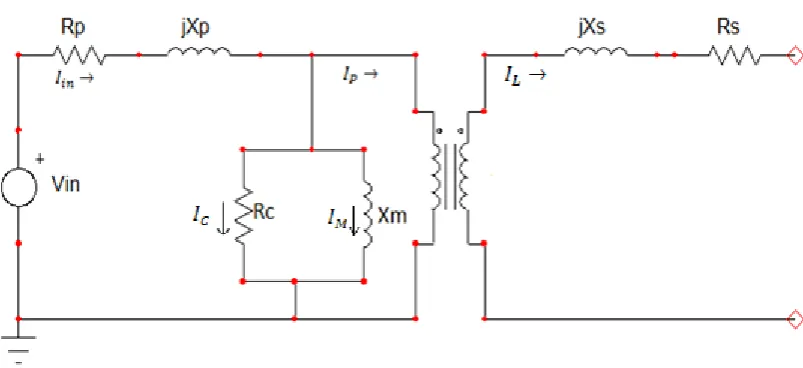
Figure 9 Transformer Exact Equivalent Circuit Open-circuited ... 18
Figure 10 Short-Circuit Test Experiment [7] ... 20
Figure 11 Transformer Exact Equivalent Circuit Short-Circuited ... 22
Figure 12 Transformer Model ... 24
Figure 13 Voltage Regulation and Efficiency Experiment [7] ... 24
Figure 14 Regulation Curves... 29
Figure 15 Primary Winding Resistance Measurement Under Open-circuit Conditions [7] ... 31
Figure 16 Primary Winding Resistance Measurement Under Short-circuit Conditions [7] ... 32
Figure 17 Secondary Winding Resistance Measurement Under Open-circuit Conditions [7] ... 33
Figure 18 Secondary Winding Resistance Measurement Under Short-circuit Conditions [7] ... 33
Figure 19 Regulation Curves (based on simulation results) ... 40
Figure 20 Efficiency vs Load Current ... 42
Figure 21 Load Current at Maximum Efficiency ... 43
Figure 22 Efficiency against PF ... 43
Figure 25 Eddy Current Loss vs Lamination Thickness ... 57
Figure 26 Eddy Current loss Against Electrical Resistivity ... 58
Figure 27 “Magnetization curves of 9 ferromagnetic materials, showing saturation. 1.Sheet steel, 2.Silicon steel, 3.Cast steel, 4.Tungsten steel, 5.Magnet steel, 6.Cast iron, 7.Nickel, 8.Cobalt, 9.Magnetite” [17] ... 59
Figure 28 Eddy Current Loss vs. 𝐁𝐦𝐚𝐱 ... 60
Figure 29 Hysteresis Loss vs. 𝐁𝐦𝐚𝐱 ... 60
Figure 30 Core Losses vs 𝐁𝐦𝐚𝐱 ... 61
Figure 31 Windings arrangment of single-phase transformer [3] ... 70
List of Tables Table 1 LabVolt Series (8341-0A) Transformer’s Specifications ... 15
Table 2 Open-Circuit & Short-Circuit Tests Summary ... 23
Table 3 Resistive Load ... 26
Table 4 Inductive Load ... 26
Table 5 Capacitive Load ... 27
Table 6 Voltage Regulation ... 28
Table 7 Efficiency for Each Load Type at Variable Impedance ... 28
Table 8 Winding Resistance Segregation ... 34
Table 9 No-Load Simulation Input Data ... 36
Table 10 No-Load Voltage Simulation Results ... 37
Table 11 Resistive Load Simulation Results ... 37
Table 12 Inductive Load Simulation Results ... 38
Table 13 Capacitive Load Simulation Results ... 38
Table 15 Core-Loss Resistance 10% Increase ... 45
Table 16 Core-Loss Resistance 10% Increase ... 45
Table 17 Efficiency Improvement due to Core-loss Resistance Reduction ... 47
Table 18 Magnetizing Reactance 10% Increase ... 48
Table 19 Winding Resistance 10% Increase ... 48
Table 20 Winding Resistance 10% Decrease ... 49
Table 21 Increased Voltage Regulation due to Increase in the Equivalent Winding Resistance ... 50
Table 22 Leakage Reactance 10% Increase ... 51
Table 23 AK Non-oriented Electrical Steel M27 ... 57
Table 24 Design Parameters of Transformer Used for Winding Type Analysis ... 66
Table 25 Winding Type Analysis Results ... 69
Table 26 Core Losses for Different Materials ... 79
Table 27 AK Non-oriented Electrical Steel Resistivity ... 79
Table 28 Eddy Current Loss vs Lamination Thickness ... 80
Table 29 Eddy Current Loss vs Electrical Resistivity ... 80
Symbols
𝐵𝑚𝑎𝑥=Maximum flux density
𝐼𝐶= Current loss due to core resistance
𝐼𝐿= Load current
𝐼𝐿𝜂=Load current at maximum efficiency
𝐼𝑀=Magnetisation current
𝐼𝑆𝐶=Short-circuit current across the secondary terminal
𝐼𝑖𝑛= The input current from power supply
𝑁𝑃=Number of primary winding turns
𝑁𝑆=Number of secondary winding turns
𝑃ℎ=Hysteresis loss
𝑃𝐶=Copper loss
𝑃𝑂=Output power delivered to load
𝑃𝑒=Eddy current loss
𝑃𝑖𝑛=Input power from power supply
𝑃𝑚=Core power loss
𝑅𝐿=Load Resistance
𝑅𝑆=Secondary winding resistance
𝑅𝑐=Core-loss resistance
𝑅𝑒𝑞=Equivalent winding resistance referred to primary side
𝑉𝐹𝐿=Load voltage at full-load conditions
𝑉𝑁𝐿=Voltage across secondary terminals with no load attached
𝑉𝑃= Primary terminal voltage
𝑉𝑆=Secondary terminal voltage
𝑉𝑋𝑒𝑞=Voltage across 𝑋𝑒𝑞
𝑉𝑖𝑛=Input voltage
𝑋𝑀=Magnetization reactance
𝑋𝑃=Primary winding reactance
𝑋𝑆=Secondary winding reactance
𝑋𝑒𝑞=Equivalent winding reactance referred to primary side
𝑍𝐿=Load impedance
Ω=Ohm
𝑎=Transformer turns ratio
𝑡=Lamination thickness
𝛷𝑀=Maximum flux
𝜌=Electrical resistivity
Acronyms
HV=High voltage
LV=Low voltage
𝑃𝐹=Power factor
1.0 Introduction
In this project, the equivalent model of a single-phase power transformer is developed to analyse its performance under various loads using the electrical circuits simulator Spice ICAPS as well as carrying out laboratory based experiments. In particular, the
performance variation of interest in this project is that of the load voltage due to load-dependent losses as well as the efficiency. High load-load-dependent losses can lead to
undesirable wide variations in the load voltage in weakly designed power transformers or by exceeding the load limitations of the transformer. The measure of such variations is called voltage regulation which is minimized in an efficient transformer. Therefore, the methods of controlling such losses will be discussed in this project.
The model parameters of the equivalent circuit are first determined by carrying out two simple procedures in the laboratory called the open-circuit test and the short-circuit test. After developing the complete equivalent circuit, a simulated model is built which will be also used to analyse the transformers performance.
This section covers the literature review associated with voltage regulation and its related losses. The literature describes the methodologies used to control voltage regulation and optimize the transformer’s efficiency. The literature associated with the design aspects of a power transformer is also covered.
1.1 Project Objectives
The objective of this project is to investigate on the effect of load variation on the performance of a single-phase transformer using both laboratory experiments and a computer based simulator Spice ICAPS. The main points of interest are to test the transformer’s efficiency and voltage regulation while varying the load at the rated voltage. The first aim of the project is to find the optimum load which maximises the efficiency and minimises the voltage regulation. It identifies the maximum efficiency criterion of a power transformer and the load current at these conditions. The transformer is operated under rated input conditions with secondary terminals open-circuited in order to find the fixed losses (core losses) and their related impedances. It will also be operated at the rated output with the secondary terminal short-circuited in order to find the windings resistance and leakage reactance.
The second part of the project aims to optimise the key design parameters of a
transformer operating under rated conditions to improve its efficiency. This includes the design parameters associated with both the core losses (no-load losses) and variable losses. The core losses considered in this project are the hysteresis loss and eddy currents loss. Different types of windings will be considered in order to minimise the copper loss (variable loss).
1.2 Scope of Work
The steps undertaken in this project are summarised as follows:
-selection of a LabVolt single-phase transformer available in the laboratory
-Developing the complete equivalent circuit
-Experimentally varying the load at the rated voltage to test the efficiency and voltage
regulation
-Building a simulated model using the model parameters from experimental measurements on ICAPS
-Utilizing ICAPS to verify the experimental results
-Detailed research on the design parameters and relating them to electrical parameters by mathematical models.
1.3 Literature Review
This section covers the literature reviewed for the purpose of this project. The major losses of a power transformer are discussed. Moreover, a maximum efficiency criterion is considered since efficiency optimization is one of the project aims.
Core losses:
The core loss is dependent on the laminations it is made of. Thinner laminations make the core more flux-permeable between the primary and secondary windings. A transformer is said to be efficient if most of the flux is transferred between the winding. The core
lamination material properties determine the core permeability. Silicon, for example, has a property of low magnetic losses which in turn optimizes the transformer’s efficiency. The common laminations thickness ranges from 0.35 to 0.61 mm [1].
form the primary and secondary windings. The core form is rectangular-shaped with the coils wound around each side of the rectangle. In order to minimize eddy currents the laminations should be electrically separated from each other. The leakage flux can be minimized by wrapping the primary and secondary windings on top of each other (as in the shell-type core). Another advantage of this arrangement is isolating the high voltage winding from the core [2].
Figure 1 Shell-Type Core
Figure 2 Core Type
Winding Losses:
The flow of the load current through the winding causes some resistive loss. This type of
loss varies with the square of the load current. There is also load-dependent eddy current loss due to the leakage flux cutting the winding. The resistive loss cannot be totally eliminated, but it can be minimized by transformer designers. Using a high-conductivity copper for the winding is important to minimize the resistive loss. Lower number of winding turns and bigger cross-sectional area of the turn conductor also reduce the resistive losses. However, reducing the number of turns implies that 𝛷𝑀 has to be
increased which in turn requires a bigger core cross-section. Increasing the core core-section has to be traded against the resulting iron loss. Therefore, the optimum design of the frame (core cross-section) has to satisfy all factors [3].
The eddy current loss in the winding flows in complex paths. The leakage flux cutting through the winding causes axial and radial flux variations at a point in space at any time. Consequently, there are voltages induced that result in currents flowing at right angles to the varying flux. The path resistance of these currents is inversely proportional to their magnitude. This resistance can be minimized by using a winding conductor with smaller cross-section. Alternatively, the winding conductor can be subdivided into several insulated strands [3]. The resulting cost increase is not considered in this project as it is mainly concerned with efficiency optimization.
Magnetization current:
The current flowing through the primary side of a transformer with its secondary terminal
open-circuited is the current required to produce flux in a ferromagnetic core. This current comprises the magnetization current and the core-loss currents. The magnetization current, 𝐼𝑀, is the current required to produce the total flux on the
primary side. The core-loss current, 𝐼𝐶, is composed of hysteresis and eddy current losses
(see Figure 4) [2]. For an efficient transformer, the core-loss current should be minimized by designers. The magnetization current is not sinusoidal and has higher harmonics due to the magnetic saturation in the core. Once the core is saturated, a further small
increase in the peak flux would require a large increase in the magnetization current. The magnetization current lags the voltage applied across the primary terminal of the
transformer and the current through the core loss resistance 𝑅𝑐 by 90° (see Figure 5) [4].
The core-loss current makes up the hysteresis and eddy current losses in the core. The peak eddy current in the core is reached when the flux passing through it is zero.
Therefore, the total core-loss current is greatest when the flux passing through the core is zero [2].
Inrush current
challenge is to determine the transient magnetic flux in the transformer’s core. The inrush current can affect the magnetic property of the core permanently. Consequently, the core becomes less flux-permeable which in turn affects the transformer’s efficiency [5].
Maximum Efficiency Criterion:
The efficiency of a power transformer is the ratio of its output power to its input power. In practice, the efficiency is always less than 100 per cent due to fixed and variable losses. The core loss consists of eddy current and hysteresis losses. In order to minimize the eddy current loss, thinner core laminations are used. The hysteresis loss depends on the core material’s magnetic properties. The core loss is fixed since the flux in the core is constant [1].
On the other hand, the copper loss is dependent on the load current flowing through the transformer’s windings. This loss is given by equation 1 below.
𝑃𝑐 = 𝐼𝑖𝑛2𝑅
𝑒𝑞 (1)
Where,
𝐼𝑖𝑛 is the input current flowing the primary winding
𝑅𝑒𝑞 is the equivalent winding resistance referred to the primary side (see Figure 12)
The input power comprises the output power and power losses (core loss and copper loss). Figure 3 below shows a single-line diagram of the power flow in a power
transformer.
Figure 3 Transformer Power Flow [3]
The efficiency is zero at no-load conditions and it starts increasing as the load is
increased. There is a load limit after which the efficiency starts going down. Therefore, the efficiency reaches its maximum at this limit [1].
1.4 Determination of Transformer Parameters
tests are carried out in the laboratory to take the measurements needed to calculate the model parameters.
1.4.1 Open-Circuit Test
Figure 4 Transformer Equivalent Circuit Under Open-circuit Conditions
It can be seen from Figure 4 above that the input current is only supplying the excitation current in this case. The excitation current is composed of the magnetizing current 𝐼𝑀 ,
which is responsible for establishing the magnetic flux in the core, and the core-loss current 𝐼𝐶 . The only power loss in this case is the core-loss which can be measured by a
wattmeter across the primary terminal. This kind of power loss is fixed regardless of variations in the load [1].
Since the core-loss is modelled by the resistance, 𝑅𝐶, the core-loss current is in phase
with the supply voltage. The magnetizing current, on the other hand, lags the supply voltage by 90°, since the magnetizing component is modelled by an inductive reactance
Figure 5 Current Phasor Diagram
𝑅𝐶 can be calculated using the measured input power as shown in equation 3 in section
3.1. From the phasor diagram above, the input current, which represents the excitation current in this case, is the hypotenuse of the right-angle triangle. The magnetizing current can be, therefore, calculated using equation 5 in order to work out the magnetizing reactance [1].
1.4.2 Short-Circuit Test
The equivalent winding resistance and leakage reactance can be determined by
performing the short-circuit test. In this test, one side of the transformer is short circuited by an ammeter while the other side is excited by the voltage source at the rated
The measurements can be taken on either side again, but it is safer to perform it on the high-voltage side. 𝑉𝑆 is zero in this case since the secondary terminal is short-circuited. Consequently, 𝑉𝑃 is also zero under short-circuit conditions [5].
Now, the secondary winding impedance can be referred to the primary side which makes it in parallel with the excitation element. The core-loss and the magnetizing currents can be ignored since the applied voltage is only a small fraction of the rated voltage. This means, in practice, that the magnetizing reactance is infinitely large and the core loss is zero [1]. The resulting equivalent circuit of the transformer under these conditions referred to the primary side is show in Figure 6 below.
Figure 6 Transformer Equivalent Circuit Under Short-circuit Conditions
Where,
𝑉𝑅𝑒𝑞 is the equivalent winding resistance referred to the primary side
The wattmeter across the primary terminal in this case is measuring the variable loss (copper loss) at full load as this kind of loss is load-dependent [1]. Therefore, the total windings resistance 𝑅𝑒𝑞 referred to the primary side can be calculated using the
measured input power and the short-circuit current as shown in equation 9. The voltage drop across the total leakage reactance 𝑉𝑋𝑒𝑞 leads the current through it and the voltage
drop across 𝑅𝑒𝑞 by 90°. 𝑉𝑋𝑒𝑞 can be therefore calculated using Pythagoras as the input
voltage forms the hypotenuse of the right-angle triangle [5]. A phasor-diagram representation is shown in Figure 7 below.
Figure 7 Voltage Phasor Diagram
The total leakage reactance 𝑋𝑒𝑞 referred to the primary side of the transformer can be
finally calculated as shown in equation 11 (see section 3.2).
1.5 Voltage Regulation
2.0 System Model
The LabVolt single-phase transformer module is used for this project. The module is composed of three discrete coils that can be utilized as either primary or secondary for multiple purposes. It also features tap changers which allow input and output variations up to 80 per cent. The transformer is designed in a way such that the regulation curves associated with different load types are easily recognized [6].
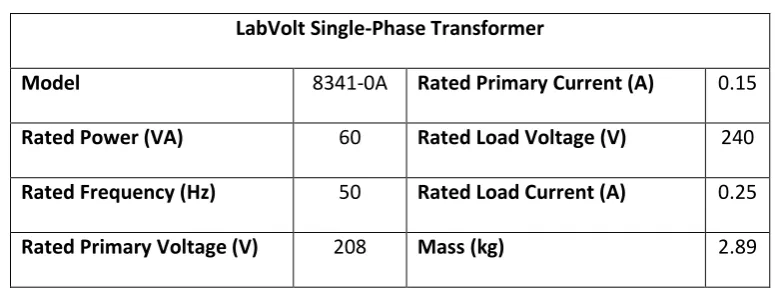
The LabVolt Series (8341-0A) transformer’s specifications are obtained from the manufacturer’s data sheet as well as the name plate and reproduced in Table 1 below.
Table 1 LabVolt Series (8341-0A) Transformer’s Specifications
LabVolt Single-Phase Transformer
Model 8341-0A Rated Primary Current (A) 0.15
Rated Power (VA) 60 Rated Load Voltage (V) 240 Rated Frequency (Hz) 50 Rated Load Current (A) 0.25
3.0 Experimental Measurements
A set of laboratory experiments is carried out in order to find the model parameters and test the transformer’s performance under various loads. The aim of each experiment, procedure and results are discussed in sections (3.1-3.4).
3.1 Open-Circuit Test
The aim of this experiment is to find the core resistance and the magnetizing reactance. The rated voltage is applied to the primary side of the transformer, while keeping the secondary open. The input voltage, current and power was measured.
Equipment List
1 x LabVolt Power Supply; 1 x Single Phase Transformer unit; 1 x Voltech PM-300 Power Analyser
Figure 8 below shows the transformer model operating at the rated input voltage (208V ac) with the secondary terminals open-circuited.
Where, 4-N is the AC power supply terminals; 𝐼𝑖𝑛 is the input current (on the primary side); 𝑉𝑖𝑛 is the voltage applied to the primary side; 3-7 is the low-voltage terminals of the
single phase transformer unit; 5-6 is the high-voltage terminals with a rated voltage of 240V AC.
Procedure
1. The circuit shown in Figure 8 is connected.
2. The power supply is switched on and adjusted to 208V ac as indicated by the power analyser (PM-300).
3. The input voltage, input current and input power are measured and recorded in Table 2.
4. The power supply is returned to zero and switched off.
Under these operation conditions, all the input current flows through the excitation branch. Therefore, all the power loss is caused by the core [1]. Using the measurements in Table 2 the core-loss resistance, 𝑅𝑐, and the magnetization reactance, 𝑋𝑀, can be
determined.
Figure 9 Transformer Exact Equivalent Circuit Open-circuited
Where,
𝑉𝑖𝑛 is the input voltage to the primary side; 𝐼𝑖𝑛 is the input current; 𝐼𝐿 is the secondary current flowing through the load; 𝑅𝑃 and 𝑅𝑆 are the primary and secondary winding resistance; 𝑋𝑃 and 𝑋𝑆 are the primary and secondary winding reactance; 𝑅𝐶 is the core-loss resistance; 𝑋𝑀 is the magnetization reactance.
Since the secondary terminal is open-circuited, there is no current flowing through it (𝐼𝐿 = 0). Ideally, the primary current (𝐼𝑃) equals the secondary current (hence 𝐼𝑃=0) [5].
Therefore, all the input current flows through the excitation element [2].
The primary winding impedance is relatively negligible compared to the excitation branch [1].
The approximation made in equation 2 implies that 𝑅𝐶 is the only resistance dissipating power in this case [1]. The input voltage and the input power can be used to calculate 𝑅𝐶
as equation 3 shows below.
𝑅𝐶 = 𝑉𝑖𝑛 2
𝑃𝑖𝑛 (3)
The current flowing through this resistor can be calculated as shown in equation 4 below.
𝐼𝐶 = 𝑉𝑖𝑛
𝑅𝐶 (4)
𝐼𝑖𝑛 is the phasor sum of 𝐼𝐶 and the current through the magnetization reactance, 𝐼𝑀. Since 𝑋𝑀 is an inductive reactance, the current through it lags the input voltage (and 𝐼𝐶)
by 90° [1]. 𝐼
𝑀 can be calculated using equation 5 below.
𝐼𝑀 = √𝐼𝑖𝑛2 − 𝐼𝐶2 (5)
Finally, 𝑋𝑀 can be calculated using Ohm’s law as equation 6 shows.
𝑋𝑀 =𝑉𝑖𝑛 𝐼𝑀
3.2 Short-Circuit Test
This experiment was carried out to determine the equivalent winding resistance and reactance. The secondary terminal was short circuited by an ammeter while taking measurements of the input current, voltage and power.
Equipment List
1 x LabVolt Power Supply; 1 x Single Phase Transformer unit; 1 x Voltech PM-300 Power Analyser; 1 x Digital Multi Meter (DMM) UNI-T UT803
Figure 10 below shows the circuit configuration of this experiment. The transformer secondary short-circuit current is set at full-load conditions (𝐼𝐿 = 0.25 𝐴).
Figure 10 Short-Circuit Test Experiment [7]
Where,
4-N is the power supply terminals; 𝐼𝑖𝑛 is the input current (on the primary side); 𝑉𝑖𝑛 is the
transformer unit; 5-6 are the high-voltage terminals; 𝐼𝑆𝐶 is the short-circuit current
flowing through the secondary terminals.
Procedure
1. The circuit shown in Figure 10 is connected.
2. The power supply is switched on and the input voltage is increased until the short-circuit current reaches the full load current (0.25A) as indicated by the ammeter 𝐼𝑆𝐶.
3. The input voltage, input current and input power are measured and recorded in Table 2.
4. The power supply is returned to zero and switched off.
Since the secondary terminal is short circuited, the voltage across it is zero (𝑉𝐿 = 0). This also implies that the voltage across the primary terminal is ideally zero (𝑉𝑖𝑛 = 0). The
winding impedance is referred to the primary side in Figure 11 below. Therefore, the secondary impedance (referred to the primary side) is in parallel with the excitation element. An approximation can be made to neglect the effect of the excitation branch as shown in equation 7 below [5].
Figure 11 Transformer Exact Equivalent Circuit Short-Circuited
Now, the secondary winding impedance (referred to primary) and the primary winding
impedance can be combined in series. The equivalent impedance is shown in equation 8 below.
𝑅𝑒𝑞+ 𝑗𝑋𝑒𝑞 = (𝑎2𝑅𝑆+ 𝑗𝑎2𝑋𝑆) + (𝑅𝑃+ 𝑗𝑋𝑃) (8)
The equivalent winding impedance can be determined using the short-circuit
measurements in Table 2. The equivalent winding resistance,𝑅𝑒𝑞 , is the only element
that dissipates power [5]. Therefore, it can be determined using the input power and the input current as shown in equation 9 below.
𝑅𝑒𝑞= 𝑃𝑖𝑛
𝐼𝑖𝑛2 (9)
Since the equivalent winding reactance, 𝑋𝑒𝑞, is an inductive reactance, the current
flowing through it lags the voltage across it, 𝑉𝑋𝑒𝑞 , by 90° [1]. 𝑉𝑋𝑒𝑞 can be determined
𝑉𝑋𝑒𝑞 = √𝑉𝑖𝑛2 − 𝑉𝑅𝑒𝑞2
(10)
Where, 𝑉𝑅𝑒𝑞 = 𝐼𝑖𝑛 𝑅𝑒𝑞 ,is the voltage across the equivalent winding resistance. 𝑋𝑒𝑞 can
now be determined using Ohm’s law as shown in equation 11 below.
𝑋𝑒𝑞= 𝑉𝑋𝑒𝑞
𝐼𝑖𝑛 (11)
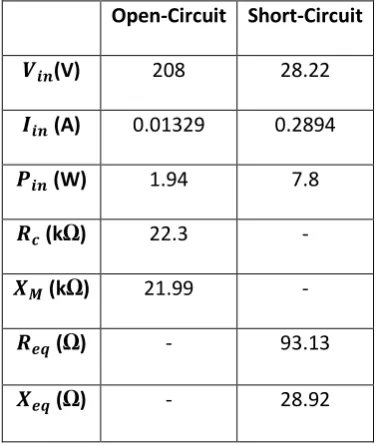
The open-circuit test and the short-circuit test results summary is shown in Table 2 below. The tests were performed on the primary side of the 60-VA, 208/240-V, 50-Hz LabVolt transformer.
Table 2 Open-Circuit & Short-Circuit Tests Summary
Open-Circuit Short-Circuit
𝑽𝒊𝒏(V) 208 28.22
𝑰𝒊𝒏 (A) 0.01329 0.2894 𝑷𝒊𝒏 (W) 1.94 7.8 𝑹𝒄 (kΩ) 22.3 -
𝑿𝑴 (kΩ) 21.99 -
𝑹𝒆𝒒 (Ω) - 93.13
𝑿𝒆𝒒 (Ω) - 28.92
Figure 12 Transformer Model
3.3 Voltage Regulation and Efficiency
These sets of experiments were carried out to test the transformer’s voltage regulation and efficiency under various loading conditions in order to find the optimal load. Three types of loads were used; resistive, inductive and capacitive. Each load type can be varied from no-load to 4800 Ω to find the load with the maximum efficiency and minimum voltage regulation [8]. The load is initially set to rated conditions (240 V, 0.25 A hence 𝑍𝐿=960 Ω). Figure 13 below shows the circuit connection for this experiment.
Equipment List
1 x LabVolt Power Supply; 1 x Single Phase Transformer unit; 2 x Voltech PM-300 Power
Analyser; 1 x Resistive Load; 1 x Inductive Load; 1 x Capacitive Load
Procedure
1. The circuit in Figure 13 is connected.
2. A resistive load is attached to the secondary terminal.
a) Initially, the transformer is operated at full-load conditions by connecting the full-load resistive impedance (960 Ω) at 𝑉𝐿 = 240V ac as indicated by the voltmeter (Power Analyser) on the secondary side.
b) The input current, 𝐼𝑖𝑛, the output current(load current), 𝐼𝐿, the input voltage, 𝑉𝑖𝑛, the output voltage (load voltage), 𝑉𝐿, the input power, 𝑃𝑖𝑛, and the output power, 𝑃𝑂,are
measured and recorded in Table 3 below.
c) For the same input voltage in (b), the secondary terminal is open circuited by opening the resistive load switch to measure the no-load voltage and record it in Table 3.
d) (b) is repeated for different load resistance as shown in Table 3. The power supply voltage to the transformer primary is held constant.
Table 3 Resistive Load
R(Ω) 𝑽𝑳 (𝐕𝒓𝒎𝒔) 𝑽𝒊𝒏 (𝐕𝐫𝐦𝐬) 𝑰𝑳 (𝐦𝐀𝐫𝐦𝐬) 𝑰𝒊𝒏 (𝐦𝐀𝐫𝐦𝐬) 𝑷𝒐 (W) 𝑷𝒊𝒏 (W)
OC 270.95 235 0 16 0 3
4800 263.7 235 55.22 74.23 14.55 17.21
2400 257.1 235 107.31 133.89 27.68 31.39
1600 251.2 235 157 191 40 45
1200 245 235 209 250 51 59
960 240 235 253 302 60 70
3. Step 2 is repeated using inductive load and the measurements are recorded in Table 4 below.
Table 4 Inductive Load
𝑿 (Ω) 𝑽𝑳 (𝑽𝒓𝒎𝒔) 𝑽𝒊𝒏 (𝑽𝒓𝒎𝒔) 𝑰𝑳 (𝒎𝑨𝒓𝒎𝒔) 𝑰𝒊𝒏 (𝒎𝑨𝒓𝒎𝒔) 𝑷𝒐 (W) 𝑷𝒊𝒏 (W)
OC 254.6 221.4 0 14.4 0 2.14
4800 251.8 221.4 53.98 73.79 1.69 4.13
2400 248.7 221.4 108.77 136.79 3.22 6.84 1600 245.7 221.4 160.07 195.73 4.68 9.95
1200 243 221.4 209.4 252.7 5.35 12.94
4. Step 2 is repeated using capacitive load and the measurements are recorded in Table 5 below.
Table 5 Capacitive Load
𝑿 (Ω) 𝑽𝑳 (𝑽𝒓𝒎𝒔) 𝑽𝒊𝒏 (𝑽𝒓𝒎𝒔) 𝑰𝑳 (𝒎𝑨𝒓𝒎𝒔) 𝑰𝒊𝒏 (𝒎𝑨𝒓𝒎𝒔) 𝑷𝒐 (mW) 𝑷𝒊𝒏 (W)
OC 232.7 202.4 0 12.96 0 1.86
4800 234.4 202.4 49.91 50.13 133 2.13
2400 236.1 202.4 100.39 107.78 103 2.98
1600 237.4 202.4 149.55 164.48 135 4.49
1200 238.6 202.4 197 219.2 108 6.39
960 240 202.4 247.2 276.8 115 9.1
Now, the Tables above can be used to calculate the voltage regulation for each load type as shown in equation 12 below.
𝑉𝑅 =𝑉𝑁𝐿− 𝑉𝐹𝐿
𝑉𝑁𝐿 × 100%
(12)
Table 6 Voltage Regulation
The transformer efficiency for different impedance values in each load type can be also calculated from Tables (3-5) above using equation 13.
𝜂 = 𝑃𝑂
𝑃𝑖𝑛 × 100%
(13)
Where, 𝑃𝑂 is the output power (delivered to load) and 𝑃𝑖𝑛 is the input power from the
power supply.
Table 7 Efficiency for Each Load Type at Variable Impedance
Impedance (Ω) Resistive (%) Inductive (%) Capacitive (%)
4800 84.54 40.92 6.24
2400 88.18 47.03 3.01
1600 88.89 47.08 3.46
1200 86.44 41.13 1.69
960 85.71 39.03 1.26
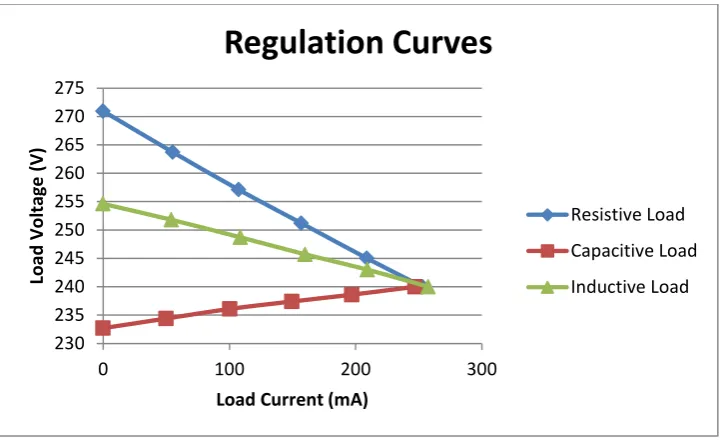
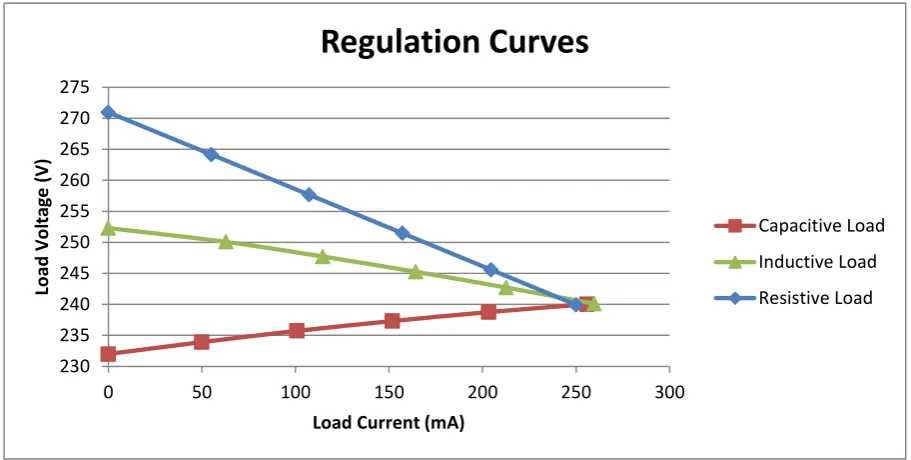
Figure 14 below shows the regulation curve for each load type. Load VR%
Figure 14 Regulation Curves
Observations
It can be seen from Tables (3-5) that a practical transformer’s output voltage is affected by load variation. Voltage regulation measures the change in the output voltage due to load variations [5].
From Table 6, the transformer has the worst voltage regulation when the resistive load is used. The capacitive load gives a negative voltage regulation because the no-load voltage is lower than the full-load voltage.
The inductive load has a higher efficiency than the capacitive load due to resistance in the
inductive load which makes it consume more active power [2]. In other words, the inductive load is not ideal and has some resistance in it.
3.4 Winding Resistance Segregations
The winding resistance and leakage reactance found from the short-circuit test are the equivalent values of the primary and secondary side referred to the primary side.
230 235 240 245 250 255 260 265 270 275
0 100 200 300
Load
Vo
ltage
(V)
Load Current (mA)
Regulation Curves
Resistive Load
Capacitive Load
Therefore, this experiment was carried out in order to find the separate values of 𝑅𝑃 and 𝑅𝑆.
Since the transformer is available in the laboratory, 𝑅𝑃 and 𝑅𝑆 were measured directly using a digital multi meter (DMM). 𝑅𝑃 and 𝑅𝑆 were also experimentally determined by
energizing one side of the transformer while the other is open-circuited or short
circuited. A dc power supply was used to energize the transformer to eliminate the effect of the leakage reactance in this experiment.
3.4.1 Determination of Winding Resistance by Energizing the Transformer
In this experiment, each side of the transformer is energized using a dc power supply at the rated current in order to count for the heat effect while determining the windings resistance. The resistance is determined by dividing the measured supply voltage by the rated current (Ohm’s Law).
Primary side
In this experiment, the primary side of the transformer is energized with the dc power supply at the rated current with the secondary side open-circuited or short-circuited in order to determine the primary winding resistance.
Figure 15 Primary Winding Resistance Measurement Under Open-circuit Conditions [7]
In Figure 15 above, measurements of the supply voltage and current are taken on the primary side with the secondary side open-circuited.
Equipment List
1 x LabVolt Power Supply (dc); 1 x Single Phase Transformer unit; 1 x VolTech PM-300 Power Analyser
Procedure
1. The circuit shown in Figure 15 is connected.
2. The power supply is switched on and the input voltage is increased until the rated winding current is reached (0.15A) as indicated by the ammeter 𝐼𝑖𝑛.
3. The input voltage, input current are measured and recorded in Table 8.
Procedures (1-4) are repeated with the secondary terminal short-circuited this time as shown in Figure 16 to see if this has any effect on the measurements of current and voltage.
Figure 16 Primary Winding Resistance Measurement Under Short-circuit Conditions [7]
Secondary side
In this experiment, the secondary side of the transformer is energized with the dc power supply at the rated current with the primary side open-circuited or short-circuited in order to determine the secondary winding resistance.
Figure 17 Secondary Winding Resistance Measurement Under Open-circuit Conditions [7]
The experiment is repeated with the primary side short-circuited as shown in Figure 18 below. The measurements are recorded in Table 8.
Table 8 Winding Resistance Segregation
Excitation side Primary Side Energized Secondary Side Energized Measurements 𝑰𝒊𝒏 (𝒎𝑨𝒓𝒎𝒔) 𝑽𝒊𝒏 (𝑽𝒓𝒎𝒔) 𝑹𝒑 (Ω) 𝑰𝒊𝒏 (𝒎𝑨𝒓𝒎𝒔) 𝑽𝒊𝒏 (𝑽𝒓𝒎𝒔) 𝑹𝒔 (Ω)
Open-Circuit 0.15 9.84 65.6 0.25 10 40
Short-Circuit 0.15 9.5 63.33 0.25 9.9 39.6
Observations
It can be seen from Table 8 that the open-circuited or short-circuited side of the
transformer has a negligible effect on the energized side where measurements of current and voltage are taken. Values of 𝑅𝑝 and 𝑅𝑠 are very close under open-circuit and
short-circuit conditions. Therefore, it does not really matter whether one side of the
transformer is open-circuited or short-circuited while taking measurements on the other (energized) side.
The equivalent value of the windings resistance referred to the primary side obtained from the short-circuit test in Table 1 (𝑅𝑒𝑞) is close to the equivalent value of 𝑅𝑝 and 𝑅𝑠 in
Table 8 above. The short-circuit test is found to be accurate enough to estimate the equivalent resistance of the windings. Therefore, the 𝑅𝑒𝑞 value (93.13 Ω) was used in the
simulated model.
3.4.2 Measuring the Windings Resistance Using DMM
The resistance across the primary and secondary windings was measured in the laboratory directly using a digital multi meter. The measured values are as follows;
4.0 Simulations
After finding the model parameters from the experimental measurements (see Figure 11), several simulations were run to verify the experimental results.
4.1 No-Load Voltage
These simulations were run to verify which load type gives the highest no-load voltage. The transformer is operated at full-load conditions (𝑉𝐿 = 240V ac, 𝐼𝐿 = 0.25A ac, 𝑍𝐿 = 960 Ω). The secondary terminal is then open-circuited to measure the no-load voltage.
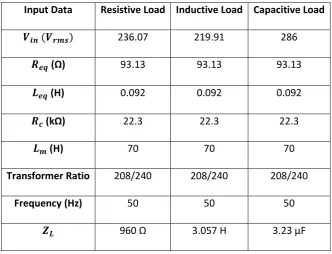
The input data is summarized in Table 9 below.
Table 9 No-Load Simulation Input Data
Input Data Resistive Load Inductive Load Capacitive Load
𝑽𝒊𝒏 (𝑽𝒓𝒎𝒔) 236.07 219.91 286
𝑹𝒆𝒒 (Ω) 93.13 93.13 93.13
𝑳𝒆𝒒 (H) 0.092 0.092 0.092
𝑹𝒄 (kΩ) 22.3 22.3 22.3
𝑳𝒎 (H) 70 70 70
Transformer Ratio 208/240 208/240 208/240
Frequency (Hz) 50 50 50
𝒁𝑳 960 Ω 3.057 H 3.23 µF
The simulation results agreed with the experimental measurements as shown in Table 10
Table 10 No-Load Voltage Simulation Results
Load Resistive Load Inductive Load Capacitive Load
960 (Ω) Experimental 239.93 V 240 V 240.1 V 240 V 240.04 V 240V OC Experimental 270.95 V 270.95 V 252.29 V 254.6 V 232 V 232.7 V
4.2 Voltage Regulation and Efficiency Simulations
This set of simulations was run to find out the voltage regulation and efficiency for each load type at variable impedance. The simulation results will be compared with
experimental results. The input data is the same as in Table 9, but the load impedance will be varied from no load to 4800 Ω. Tables (11-13) summarize the simulation results for each load type.
Table 11 Resistive Load Simulation Results
R
(Ω)
𝑽𝑳
(𝑽𝒓𝒎𝒔)
𝑽𝒊𝒏
(𝑽𝒓𝒎𝒔)
𝑰𝑳
(𝒎𝑨𝒓𝒎𝒔)
𝑰𝒊𝒏
(𝒎𝑨𝒓𝒎𝒔) 𝑷𝒐 (W) 𝑷𝒊𝒏 (W) VR (%) 𝜼 (%)
OC 270.95 236.071 0 19.87 0 3
11.45 0 4800 264.15 236.071 55.03 75.78 15 18 83.33 2400 257.66 236.071 107.36 135.078 27.66 31.65 87.39 1600 251.47 236.071 157.17 192 40 45 88.89 1200 245.57 236.071 204.64 246.39 50 58 86.21
Table 12 Inductive Load Simulation Results
𝑿
(Ω)
𝑽𝑳
(𝑽𝒓𝒎𝒔)
𝑽𝒊𝒏
(𝑽𝒓𝒎𝒔)
𝑰𝑳
(𝒎𝑨𝒓𝒎𝒔)
𝑰𝒊𝒏
(𝒎𝑨𝒓𝒎𝒔)
𝑷𝒐 (mW) 𝑷𝒊𝒏 (W) L (H) VR (%) 𝜼 (%)
OC 252.3 219.9 0 18.5 0 2.22 0
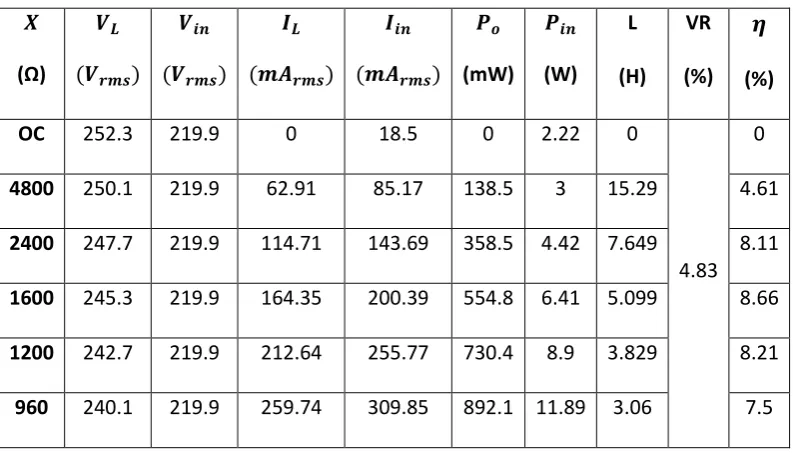
4.83 0 4800 250.1 219.9 62.91 85.17 138.5 3 15.29 4.61 2400 247.7 219.9 114.71 143.69 358.5 4.42 7.649 8.11
1600 245.3 219.9 164.35 200.39 554.8 6.41 5.099 8.66 1200 242.7 219.9 212.64 255.77 730.4 8.9 3.829 8.21 960 240.1 219.9 259.74 309.85 892.1 11.89 3.06 7.5
Table 13 Capacitive Load Simulation Results
𝑿
(Ω)
𝑽𝑳
(𝑽𝒓𝒎𝒔)
𝑽𝒊𝒏
(𝑽𝒓𝒎𝒔)
𝑰𝑳
(𝒎𝑨𝒓𝒎𝒔)
𝑰𝒊𝒏
(𝒎𝑨𝒓𝒎𝒔)
𝑷𝒐 (mW) 𝑷𝒊𝒏 (W) C (µF) VR (%) 𝜼 (%)
OC 232 286 0 17.015 0 2 0
-3.46 0 4800 233.92 286 49.93 50.84 3.6 2.13 0.663 0.169 2400 235.73 286 100.857 108.351 3.678 3.02 1.33 0.122 1600 237.315 286 151.84 166.76 8.46 4.55 1.99 0.196 1200 238.76 286 203.3 225.9 13.2 6.75 2.65 0.186 960 240.037 286 255.92 286.48 28.12 10 3.31 0.2812
Moreover, the inductive load gave significantly lower values of efficiency in the
simulations. This may be due to the resistance in the inductive load (in the experiment). Therefore, this inductive load can be modelled by a resistor in series with an ideal inductor and repeating the simulation. The resistance across each inductive load was measured and taken into account in the simulation. Table 14 shows the simulation results after adding the resistance to an ideal inductive load.
Table 14 Simulation results after modelling an inductive load using an ideal inductor in series
with a resistor
Inductive+R 𝑽𝑳(𝑽𝒓𝒎𝒔) 𝑷𝒊𝒏 (W) 𝑷𝒐 (W) Efficiency (%) 𝑹𝑳Measured (Ω)
4800 240.39 1.73 0.47 27.40 269
2400 239.96 2.79 0.98 35.21 147
1600 240.65 4.12 1.42 34.56 95
1200 240.14 5.67 1.79 31.62 68
The regulation curve based on the simulations results for each load type is shown in Figure 19 below.
Figure 19 Regulation Curves (based on simulation results)
It can be seen from Figure 19 above that the load voltage drops as the load current is increased except in the capacitive load case where the voltage regulation is negative. The voltage drops across the winding resistance increases as the load current is increased which results deviation from the nominated load voltage [1]. This also agrees with the experimental measurements (see section 3.3).
230 235 240 245 250 255 260 265 270 275
0 50 100 150 200 250 300
Load
Vo
ltage
(V)
Load Current (mA)
Regulation Curves
Capacitive Load
Inductive Load
5.0 Maximum Efficiency Criterion
Equation 13 can be rewritten in a more detailed form that indicates power losses as shown in equation 14 below.
𝜂 = 𝑎𝑉𝐿𝐼𝐿𝑃𝐹 𝑎𝑉𝐿𝐼𝐿𝑃𝐹 + 𝑃𝑚+ 𝐼𝐿2𝑅
𝑒𝑞 × 100% (14)
Where 𝑎 is the transformer’s turns ratio, 𝑉𝐿 is the load voltage, 𝐼𝐿 is the load current, PF is the power factor, 𝑃𝑚 is the core loss, 𝑅𝑒𝑞is the equivalent winding resistance referred to
primary side.
The core loss is fixed regardless of variations in the load [1]. 𝑃𝑚 is measured as the input
power in the open-circuit test . This is because the magnetization element is dissipating all the input power in this case [1]. The copper loss, on the other hand, is proportional to the current flowing through the winding [1].
The efficiency increases as the load increases up to a certain value after which it starts going down [1]. The load current at the maximum efficiency is given by equation 15 below [1].
𝐼𝐿𝜂 = √ 𝑃𝑚
The efficiency is calculated using equation 14 at load currents of (20 per cent-100 per cent) of the rated value with all other variables fixed at rated conditions with a power factor of 0.8. A plot of efficiency against load current is shown in Figure 20 below.
Figure 20 Efficiency vs Load Current
The efficiency reaches its maximum when the copper loss equals the core loss [3]. This is shown in Figure 21 below. The percentage load current and the copper loss are based on the load current measurements in Table 3 (Resistive Load). Figure 21 shows that copper losses equals core losses at around 60 per cent load current, which implies that the maximum efficiency is at about 60 per cent of the rated load current.
Figure 21 Load Current at Maximum Efficiency
From equation 14, the power factor also affects the efficiency. Therefore, the efficiency at a power factor ranging from (0.5-1) with all other variables fixed at rated conditions is plotted in Figure 22 below.
Figure 22 Efficiency against PF
81 82 83 84 85 86 87 88 89 90 91
0.5 0.6 0.7 0.8 0.9 1 1.1
Eff
ic
ie
n
cy
(%
)
PF
Efficiency vs PF
6.0 Sensitivity Analysis
A sensitivity analysis is carried out on the efficiency to the electrical parameters as well as the design parameters. The relationship between power losses and the associated design parameters is discussed. A mathematical model that directly relates the design
parameters to the efficiency is then developed.
6.1 Electrical Parameters
In this section, each of the model parameters is varied by ± 10 per cent of its value to see the effect of such variations on the transformer’s performance at full load conditions. This sensitivity analysis is based on the simulated model using ICAPS. Tables (15-22) show the transformer’s behaviour in response to variations in each of the model parameters.
6.1.1 Core-loss Resistance (𝑹𝒄)
The core resistance 𝑅𝑐 is varied by 10 per cent higher and lower than the original value in the complete equivalent circuit (see Figure 10). First, 𝑅𝑐 is increased by 10 per cent which brings it to 24.53 kΩ. 𝑅𝑐 is associated with the core loss which can be determined by the
open-circuit test. It is inversely proportional to the core-loss current [2]. Therefore, it is mainly the input power that will be tracked in this simulation as it represents the core-loss (no-load core-loss) under open-circuit conditions.
Table 15 Core-Loss Resistance 10% Increase
Original Value 10% Increase
𝑹𝒄→ 22.3kΩ 24.53kΩ
𝑽𝑳 (𝐕𝒓𝒎𝒔) 270.95 271.016 𝑽𝒊𝒏 (𝐕𝒓𝒎𝒔) 236.071 236.071 𝑰𝒊𝒏 (mArms) 19.87 19.39
𝑷𝒊𝒏(W) 2.565 2.34
It can be seen from Table 15 above that increasing 𝑅𝑐 by 10 per cent leads to 8.59 per cent decrease in 𝑃𝑖𝑛 which means the core-loss is reduced. This is expected as the eddy current loss component of the core-loss is inversely proportional to 𝑅𝑐. Therefore, the
transformer’s efficiency improves if it is designed to have low core-loss resistance
Now, 𝑅𝑐 is reduced by 10 per cent this time and the simulation results are recorded in
Table 16 below.
Table 16 Core-Loss Resistance 10% Decrease
Original Value 10% Decrease
𝑹𝒄 → 22.3kΩ 20.07kΩ
𝑽𝑳 (𝐕𝒓𝒎𝒔) 270.95 270.788 𝑽𝒊𝒏 (𝐕𝒓𝒎𝒔) 236.071 236.071 𝑰𝒊𝒏 (mArms) 19.87 20.53
Reducing 𝑅𝑐 by 10 per cent, on the other hand, leads to increased core-loss by 10.72 per
cent of the original value.
Now, 𝑅𝑐 is further increased up to 70 per cent in steps of 10 per cent. The efficiency is then calculated and plotted against 𝑅𝑐 in Figure 23. Since the effect of the fixed loss
(no-load loss) on efficiency is considered in this case, it does not matter what (no-load is attached to the transformer. Therefore, a resistive load with an impedance of 960Ω is chosen for this analysis.
Figure 23 Efficiency Improvement due to Increased Core-loss Resistance
85.2 85.4 85.6 85.8 86 86.2 86.4 86.6 86.8
20 25 30 35 40
Eff
ic
ie
n
cy
(%
)
Rc(kΩ)
Efficiency vs Rc
The data used to plot the efficiency against 𝑅𝑐 is shown in Table 17 below.
Table 17 Efficiency Improvement due to Core-loss Resistance Reduction
𝑹𝒄 (kΩ) 𝑷𝒐 (W) 𝑷𝒊𝒏 (W) Efficiency (%)
22.3 60 70.28 85.37 24.53 60.04 70.1 85.65 26.76 60.07 69.95 85.88 28.99 60.1 69.83 86.07 31.22 60.13 69.72 86.25 33.45 60.15 69.63 86.39 35.68 60.17 69.55 86.51 37.91 60.18 69.48 86.61
6.1.2 Magnetizing Reactance (𝑿𝑴)
The magnetizing reactance (𝑋𝑀) is increased by 10 per cent of its original value to see its
effect on the core loss. The transformer is operated under open-circuit conditions in order to find the core loss after increasing 𝑋𝑀 by 10 per cent. The simulation results are
Table 18 Magnetizing Reactance 10% Increase
Original Value 10% Increase
𝑿𝑴 → 21.99kΩ 24.189kΩ
𝑽𝑳 (𝐕𝒓𝒎𝒔) 270.95 270.979 𝑽𝒊𝒏 (𝐕𝒓𝒎𝒔) 236.071 236.105 𝑰𝒊𝒏 (mArms) 19.87 18.698
𝑷𝒊𝒏(W) 2.565 2.561
Increasing 𝑋𝑀 by 10 per cent has a negligible effect on the input power which represents
the core loss in this case.
6.1.3 Equivalent Winding Resistance (𝑹𝒆𝒒)
Similarly, the equivalent winding resistance (𝑅𝑒𝑞) is varied by 10 per cent to see its effect
on the transformer’s performance. 𝑅𝑒𝑞 is associated with the copper loss which is
load-dependent. Therefore, the simulation is run under full-load conditions to observe the maximum copper loss. 𝑅𝑒𝑞 is increased by 10 per cent and the simulation results are
summarised in Table 19 below.
Table 19 Winding Resistance 10% Increase
Original Value 10% Increase
𝑹𝒆𝒒→ 93.13Ω 102.443Ω
𝑽𝑭𝑳 (𝐕𝒓𝒎𝒔) 239.93 237.151 𝑽𝑵𝑳 (𝐕𝒓𝒎𝒔) 270.95 270.798
It can be seen from Table 19 that the voltage regulation (VR) has increased by 8.65 per cent of its original value after increasing the equivalent winding resistance by 10 per cent. This is expected because the higher the winding resistance, the higher the voltage drops lost across it.
Now, 𝑅𝑒𝑞 is reduced by 10 per cent and the simulation results are summarised in Table
20 below.
Table 20 Winding Resistance 10% Decrease
Original Value 10% Decrease
𝑹𝒆𝒒 → 93.13Ω 83.817Ω
𝑽𝑭𝑳 (𝐕𝒓𝒎𝒔) 239.93 242.847 𝑽𝑵𝑳 (𝐕𝒓𝒎𝒔) 270.95 270.95
𝑽𝑹% 11.44 10.38
The voltage regulation has decreased by 9.31 per cent after reducing 𝑅𝑒𝑞 by 10 per cent.
𝑅𝑒𝑞 is further increased up to 70% in steps of 10 per cent in order to see its effect on the
transformer’s voltage regulation. The voltage regulation is then plotted against 𝑅𝑒𝑞 in
Figure 24 Increased Voltage Regulation due to Variations in the Equivalent Winding Resistance
The analysis data used to plot the voltage regulation against 𝑅𝑒𝑞 is shown in Table 21
below.
Table 21 Increased Voltage Regulation due to Increase in the Equivalent Winding Resistance
𝑹𝒆𝒒(Ω) 𝑽𝑵𝑳 (𝐕𝒓𝒎𝒔) 𝑽𝑭𝑳 (𝐕𝒓𝒎𝒔) 𝑽𝑹%
93.13 239.93 270.95 11.44 102.44 237.15 270.798 12.43 111.76 234.49 270.726 13.38 121.07 231.83 270.61 14.33
130.38 229.23 270.495 15.25 139.69 226.69 270.38 16.16 149.01 224.2 270.265 17.04 158.321 221.77 270.15 17.90857 11 12 13 14 15 16 17 18 19
90 110 130 150 170
VR(
%
)
Req(Ω)
Voltage Regulation vs Req
It can be seen that the voltage regulation is highly sensitive to variations in 𝑅𝑒𝑞. The
voltage regulation has increased by 56.56 per cent of its original value.
6.1.4 Equivalent Leakage Reactance (𝑿𝒆𝒒)
In this section, the voltage regulation is also traced against variations in the equivalent leakage reactance. 𝑋𝑒𝑞 is increased by 10 per cent and the simulation results are
summarised in Table 22 below.
Table 22 Leakage Reactance 10% Increase
Original Value 10% Increase
𝑿𝒆𝒒→ 28.92 Ω 31.81 Ω
𝑽𝑭𝑳 (𝐕𝒓𝒎𝒔) 239.93 239.866 𝑽𝑵𝑳 (𝐕𝒓𝒎𝒔) 270.95 270.869
𝑽𝑹 % 11.44 11.45
The change in the voltage regulation due to 10 per cent increase in 𝑋𝑒𝑞 is only 0.09 per
cent of the original value which is quite negligible.
The simulations indicated that the transformer’s performance is most sensitive to the windings equivalent resistance which is proportional to the copper loss. This is expected as copper loss is in turn proportional to the voltage regulation [1]
6.2 Physical Design Parameters
6.2.1 Core losses
A well designed transformer core is meant to have a low reluctance path for the magnetic flux linking the primary and secondary windings. The core has hysteresis and eddy
currents due to iron losses in the form of heat. The alternating flux also can generate un-tolerated noise especially in large transformers. Therefore, reduction of noise is another concern besides loss reduction for transformer designers [3]. This project, however, is only focused on loss reduction in order to maximise efficiency.
There are two types of core loss: the hysteresis loss which is proportional to the
frequency of operation, the volume of the material and the hysteresis loop area [9]. The area of a hysteresis loop is determined by the magnetic characteristics of the core material. Specifically, it is the peak flux density of the core material that determines the hysteresis loop area. The other type of core loss is the eddy current loss which is
dependent on the square of frequency of operation. The thickness of the core material is also a major factor which determines the eddy current loss [3]. Consequently, a well-designed transformer core is made of a material having a minimum area of hysteresis loop, thin laminations and high material resistivity in order to minimise eddy current and hysteresis loss.
Hysteresis loss is given by equation 16 and eddy current loss is represented by equation 17 below [10].
𝑃ℎ = 2.2𝑘ℎ𝑓𝐵𝑚𝑎𝑥𝑛 (W/kg)
𝑃𝑒 =
𝜋2𝑓2𝑡2𝐵 𝑚𝑎𝑥2
6𝜌 (W/𝑚3) (17a)
𝑃𝑒𝑥𝑐= (1.6282𝐿
𝑡 − 1)𝑃𝑒 (17b)
Where, 𝑘ℎ is a material constant
𝑓 is the frequency of operation (Hz)
𝑡 is the material thickness (mm)
𝜌 is the material resistivity
𝐵𝑚𝑎𝑥 is the maximum flux density (Tesla)
𝑛 is a function of the material called the ‘Steinmetz exponent’ [3]
𝐿 is the domain width
𝑛 varies from 1.6 to 2.5 for modern transformer core materials with high flux densities [3]. For hot-rolled laminations 𝑛 has a value of 1.6 to 2 and higher than 2 for cold-rolled
laminations [11].
field and further apart in a weak one [12]. In the case of a laminated core, the flux lines are further apart which makes it harder for eddy current to flow.
It can be seen from the eddy current loss equation above that it is composed of two components: the first is called the classical eddy current loss which is dependent on the square of frequency times material thickness times flux density (from equation 17a above); the second component is the residual loss (excess eddy current loss) which is dependent on the material structure such as the magnetic domain movement during the magnetizing cycle. The relationship between classical eddy current loss and excess eddy current loss is given by equation 17b [13]. The residual loss forms half of the total steel loss, which is a significant proportion. Therefore, it is the residual that is significantly reduced by special processing of the core material [3]. There is a wide range of
conventionally rolled core steels processed in a way such that core-loss is minimized. A few types of these core materials will be considered in this project to see variations in the eddy current loss and the hysteresis loss.
Hot-rolled steel
Adding silicon to the core material reduces the area of the hysteresis loop. Moreover, it
reduces eddy current loss as it increases the core’s resistivity and permeability. However, the quantity of the added silicon is limited to 4.5 per cent of the material because adding too much silicon makes the core too brittle for the manufacture process. Silicon also has the advantage of carbon elimination, which significantly reduces the core loss [3].
Purified core materials have substantially lower losses. For example, the first steel-silicon manufactured had a specific loss of 7 W/kg at 1.5 Tesla and 50 Hz. In 1990, alloys at the same conditions (1.5 Tesla and 50 Hz) with higher purity levels have losses of 2 W/kg [3].
Since steel sheets characterize a crystalline structure (grains), their magnetic properties depend on the measurement direction in those individual grains [3]. In hot-rolled steel, the grains are packed randomly. Therefore, the measured magnetic properties in this kind of sheet are the average of values for different measurement directions. This kind of material is called isotropic [3].
Grain-oriented (cold-rolled) steel
Once it was realized that silicon steel crystals are anisotropic, the orientation of the steel crystal had been taken into account to optimize the magnetization in the core [3]. In this kind of steel, the grains are aligned within ±6°of the rolling direction (ideal Goss
orientation) which reduces the hysteresis loss component in the core [3]. The thickness of grain-oriented steel is reduced to 0.28 mm which reduces the classical eddy current loss.
operation, the more power lost due to hysteresis. In transformers, heat energy loss is not desirable unlike other magnetic circuits such as permanent magnets. Therefore, a well-designed transformer should have a core made of an alloy having a thin hysteresis loop. In other words, the core should have a small residual flux density which results in a thinner hysteresis loop [6].
In practice, there are other factors affecting core-loss that are not considered in this project. This includes poorly insulated core laminations, improper handling of the core steel during the manufacture process and poorly arranged core joints. These are
modelled by the building factor which is a ratio of the experimentally measured core-loss to the core-loss nominated by the manufacturer [7].
The American Iron and Steel Institute (AISI) designates electrical steel types by the letter M (magnetic material) followed by the type number [14].
Core loss sensitivity analysis
Table 23 AK Non-oriented Electrical Steel M27
AK Non-oriented Electrical Steel M27
Nominal Thickness Range (mm) 0.35-0.64
Density (kg/𝑚3) 7650
𝑘ℎ (J/lb/cycle) 0.0077
Electrical Resistivity (µΩ.cm) 43
𝐵𝑚𝑎𝑥 (T) 1
Firstly, the thickness of the lamination, 𝑡, is varied within the given range in Table 23
above with all other parameters in equation 17a fixed. Eddy current loss is plotted against the lamination thickness in Figure 25 below.
Figure 25 Eddy Current Loss vs Lamination Thickness
However, the relationship is still quadratic as shown in equation 17a. Consequently, eddy current loss can be minimized by using thin core laminations.
According to the AK Steel datasheet [15], non-oriented steel is available in different grades (M15, M36, M43, M45 and M47) with different electrical resistivity (see
appendix). Therefore, eddy current loss is calculated at different values of 𝜌. A plot of the eddy current loss against 𝜌 is shown in Figure 26 below.
Figure 26 Eddy Current loss Against Electrical Resistivity
By varying the electrical resistivity from 37 to 51 µΩ.cm, the eddy current loss drops by 27.53 per cent. This is expected because 𝜌 is inversely proportional to the eddy current
loss as shown in equation 17a.
The maximum flux density in the core, 𝐵𝑚𝑎𝑥, also depends on the core material. The
magnetization curves (B-H curves) for different magnetic materials are shown in Figure 27 below.
0.65 0.7 0.75 0.8 0.85 0.9 0.95
36 41 46 51
Pe(W)
𝜌(µΩ.cm)
Eddy Current Loss vs Electrical
Resistivity
Figure 27 “Magnetization curves of 9 ferromagnetic materials, showing saturation. 1.Sheet
steel, 2.Silicon steel, 3.Cast steel, 4.Tungsten steel, 5.Magnet steel, 6.Cast iron, 7.Nickel,
8.Cobalt, 9.Magnetite” [17]
It can be seen from Figure 27 above that silicon steel typically has a maximum flux density of 1.7 T. However, there are different grades of silicon steel with 𝐵𝑚𝑎𝑥 ranging from 1-2 T [15]. Both the eddy current loss and the hysteresis loss are dependent on 𝐵𝑚𝑎𝑥.
Figure 28 Eddy Current Loss vs. 𝐁𝐦𝐚𝐱
Figure 29 Hysteresis Loss vs. 𝐁𝐦𝐚𝐱
It can be seen that the core losses are highly sensitive to variations in 𝐵𝑚𝑎𝑥. Therefore, 𝐵𝑚𝑎𝑥 is a key design parameter that controls the core losses, which in turn affects the transformer’s efficiency. Moreover, hysteresis loss is more sensitive to variations in 𝐵𝑚𝑎𝑥
Figure 30 Core Losses vs 𝐁𝐦𝐚𝐱
Now, the power losses are related to the efficiency by equation 18 below.
𝜂 = 𝑃𝑜
𝑃𝑜+ 𝑃𝑒+ 𝑃ℎ+ 𝑃𝑐
(18)
Substituting the equations of each of the losses gives equation 19 below which directly relates the design parameters to the efficiency.
𝜂 = 𝐼𝐿𝑉𝐿cos 𝜃
𝐼𝐿𝑉𝐿cos 𝜃 +𝜋2𝑓2𝑡2𝐵𝑚𝑎𝑥2
6𝜌 + 𝑘ℎ𝑓𝐵𝑚𝑎𝑥𝑛 + 𝐼𝐿2𝑅𝑒𝑞 (19)
The partial derivative of the efficiency with respect to each of the design and electrical parameters in equation 19 above is given in equation 20 below.
0 1 2 3 4 5 6 7 8
1 1.5 2
Co
re
Losse
s
(W)
𝐵𝑚𝑎𝑥 (T)
Core Losses vs
𝐵𝑚𝑎𝑥
Hysteresis Loss

![Figure 3 Transformer Power Flow [3]](https://thumb-us.123doks.com/thumbv2/123dok_us/9650700.1947170/21.595.118.506.199.435/figure-transformer-power-flow.webp)
![Figure 8 Open Circuit Test Experiment [7]](https://thumb-us.123doks.com/thumbv2/123dok_us/9650700.1947170/29.595.121.518.553.715/figure-open-circuit-test-experiment.webp)