
RESEARCH LETTER
Climate variability and causes: from the
perspective of the Tharaka people of eastern
Kenya
Charles W. Recha
1*, George L. Makokha
2and Chris A. Shisanya
2Abstract
The study assessed community understanding of climate variability in semi-arid Tharaka sub-county, Kenya. The study used four focus group discussions (FGD) (N= 48) and a household survey (N= 326) to obtain information from four agro-ecological zones (AEZs). The results were synthesized and descriptively presented. People in Tharaka sub-county are familiar with the term climate change and associate it with environmental degradation. There are, however, mis-conceptions and gaps in understanding the causes of climate change. There was a mismatch between community and individual perception of onset and cessation of rainfall—evidence that analysis of the impact of climate change should take into account the scale of interaction. To improve climate change knowledge, there is a need for climate change education by scientific institutions—to provide information on local climatic conditions and global and regional drivers of climate change to local communities.
Keywords: Perception, Climate variability, Tharaka
© The Author(s) 2017. This article is distributed under the terms of the Creative Commons Attribution 4.0 International License (http://creativecommons.org/licenses/by/4.0/), which permits unrestricted use, distribution, and reproduction in any medium, provided you give appropriate credit to the original author(s) and the source, provide a link to the Creative Commons license, and indicate if changes were made.
Background
Construction of narratives regarding global warming and climate change has long been rooted in natural sci-ences—an attempt to understand the biophysical pro-cesses. This has involved monitoring of El Niño southern oscillation (ENSO) and other oceanic and atmospheric predictors of climate (Yasunaka and Hawana 2005; Hast-ernrath et al. 2004); and sectoral assessment of impacts of climate change (Fabeku and Okogbue 2014; Ton-nang et al. 2010; Kundezewicz et al. 2008; Hansen and Indeje 2004). Biophysical assessment of global warming has led to improvement in the understanding of inter-actions between atmosphere, sea, and land surfaces; advances in modeling and prediction of the global cli-mate system. This has laid the foundation for adaptation (Hansen 2005). Indeed, the idea of climate change has been universalized—generalized (Hulme 2008). The gen-eralization of climate change may apply to the physical
drivers (such as El Niño southern oscillation), global-scale impacts (such as sea level rise), and on global ben-efits of mitigation to climate change (Locatelli 2011). Although universalization is in line with globalization, it fails to account for the geographical diversity of the phys-ical and human environments. Understanding of climate change can be improved when the physical dimensions are allowed to be interpreted by their cultural meanings.
There have been efforts to highlight the magnitude and impacts of climate change at different geographical scales in the different sectors of human interest; notably agri-culture, water, economics, health among others. Given the relative lack of data especially in developing coun-tries, research on impact of climate change has been at macro-levels with heavy reliance on models (Washington et al. 2006; Hansen 2005). Climate change modeling has often been associated with uncertainties. These limita-tions, identified as early as in the 1980s and 1990s led to calls for research on cultural adaptation and climate change to give useful insights (Vedwan and Rhoades
2001). This has prompted a re-examination of climate change needs in order to include the contribution of interpretative humanities and social sciences (Hulme
Open Access
*Correspondence: [email protected]
1 Department of Geography, Egerton University, P. O. Box 536, Egerton 20115, Kenya
2008). This re-examination should include attempts to reconnect communities in a local setting with climate, and provide an understanding of what climate change means to people in specific cultural and geographical environments.
There are studies that have sought to establish a rela-tionship between actual impacts or changes in climate and people’s perception of these changes. The findings yield varied results. For instance, Adimassu et al. (2014) and Becken et al. (2013) established that communities are not always scientifically accurate in their assessment of climate change. Thus, there are cases where climate change and its associated impacts are exaggerated or underestimated. In Gladstone South Africa, Gandure et al. (2013) found mixed results; farmers’ perception of high rainfall variability was supported by meteorologi-cal data while their perception of rainfall onset was at variance with meteorological data. The implication is that awareness of climate change impact if not verified with empirical data, can lead to misinformation. On the other hand, Howe et al. (2014) established that in India, respondents who indicated annual rainfall changes (increasing or decreasing) were located in parts of India that corresponded with their perceived changes. There are other studies that have examined the influence of socio-economic factors on the perception of climate change. For instance, Opiyo et al. (2016) established that gender, livestock ownership, and access to extension services influenced the perception of climate change. Maddison (2007) found that experience (years spent in farming) influenced farmer perceptions of climate change. These findings suggest that perception of climate change assumes a spatial scale and will depend on socio-economic attributes of the population under study.
Despite the shortcomings, perception studies can bring to the fore community understanding of local environ-ment and climate (Becken et al. 2013). Kashaigili et al. (2014) and Li (2015) examined perception of climate change and variability among peri-urban and rural com-munities in Tanzania and China, respectively. Whereas the approaches of Kashaigili et al. (2014) and Li (2015) seek to bring out variation in climate change perception based on socio-economic environment, there is a need for perception studies among marginal groups—espe-cially in arid and semi-arid lands. Lorenzoni and Pidgeon (2006) investigated the public conceptualization of cli-mate change on a regional scale—highlighting differences in the USA and Europe. Similarly, Leiserowitz (2005) examined risk perceptions and connotative meanings of global warming among Americans (in the USA). These findings serve to demonstrate how economic benefits and influence of the media shape public perceptions on impacts of climate change. For developing countries such
as Kenya, climate change often connotes economic losses and human suffering—necessitating public perception of impacts of climate change.
Perception studies on climate change make valuable contributions because they provide information on local climatic condition and knowledge which can be factored in empirical studies. This study is premised on the need for knowledge of public attitude, beliefs, and percep-tions in complementing biophysical research in climate change in Kenya (Republic of Kenya 2010a). According to Leiserowitz (2005), public risk perceptions are critical components of the socio-political context within which policymakers operate. In this study, we postulate that understanding local perception of climate change indica-tors and causes is critical to arriving at understanding the choice of community responses.
Methods
Study area
Tharaka sub-county is found in Tharaka-Nithi County and covers an area of 1569.5 km2 and a population of
closer to people of Tharaka. But a meaningful diagno-sis of the problem of climate change and variability, like other problems in Tharaka sub-county, depends on per-ception. Thus, understanding of and responses to climate change significantly depend on how the people perceive patterns and causes of climate change.
Data collection
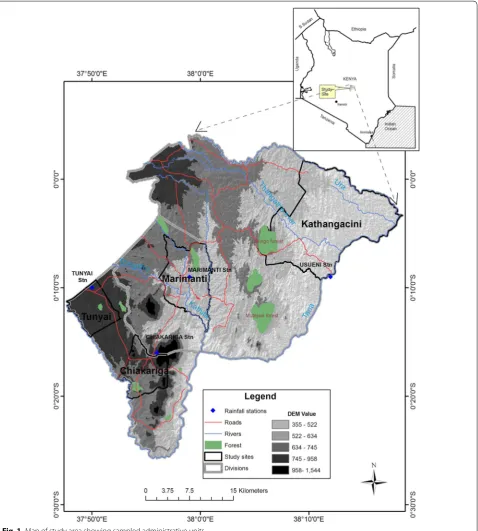
The study utilized two sets of data: focus group discus-sions (FGD) and household survey. The target study sites were Tunyai (LM4), Chiakariga (LM5), Marimanti (IL5), and Kathangacini (IL6) divisions (3rd lowest administra-tive unit in Kenya). Selection of study sites was based on
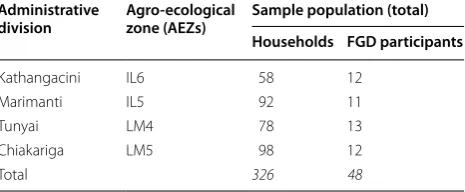
agro-ecological zones in Tharaka sub-county (Jaetzold et al. 2007). The rationale was to try as much as possi-ble to include the diversity of environmental and climatic conditions that people experience (This approach was also used by Becken et al. 2013). However, culture was assumed to be a constant since majority of the people in Tharaka sub-county are of the Tharaka tribe. The first set of data was collected through FGDs which were con-ducted in each of the four study sites as shown in Table 1
(also see Fig. 1).
A total of forty-eight (48) respondents were purposively sampled to participate in the FGD (Additional files 1 and
2). Sampling of participants was carried out with the assis-tance of field monitors working for the Department of Arid Lands in Tharaka sub-county. Selection of FGD par-ticipants was based on field monitors’ knowledge of their socio-economic well-being (age, education, gender, and income) and participation in social programmes in the community. Open-ended questions were used to seek information from FGD participants (Additional file 3). According to Becken et al. (2013) open-ended questions facilitate spontaneous opinions and avoid restrictions—an attribute critical for this study. The discussions were facili-tated in Swahili—a national language widely spoken in Kenya. Where necessary, field monitors (themselves of a Tharaka tribe) would translate questions. This was however not common as most respondents could express them-selves in Swahili. In conducting FGDs, reference was made to a twenty-year period (climate change). Thus although respondents’ age ranged from 18 years and above, the spe-cific question of ‘has climate changed in your locality in the past 20 years?’ was mainly directed to participants aged 36 years and above. The purpose of FGD was to gener-ate qualitative data to provide information on community understanding of climate change and variability.
Like FGDs, household respondents were drawn from across the four main agro-ecological zones. A total of 326 respondents were sampled and interviewed across the four study sites. Selection of respondents was informed by the number of household population at sub-location level as guided by the sub-county development officer in
Tharaka. In each of the four study sites, 5% of the house-holds were selected for interview using the method of Kajembe et al. (2005). Household survey provided data on perceived variations of climate indices. The targeted climate indices were frequency of extreme events, and changes in onset and cessation of the two main grow-ing seasons—MAM and OND. Household survey results were used to validate the findings of FGDs. It is instruc-tive to note that effort was made to ensure that respond-ents involved in the household survey did not participate in the FGD to avoid potential undue advantage of the nature of the study.
Data analysis
Household survey data were coded, entered, and descrip-tively analyzed using the statistical package for social sci-entists (SPSS) version 11.5. Deliberations of FGDs were recorded and subjected to interpretations. It is instruc-tive to note that in this study, the first day of rainfall onset for MAM and OND seasons were considered as March 1st and October 1st, respectively. For rainfall cessation, the last days were considered as May 31st and January 31st for MAM and October–November–December–Jan-uary (ONDJ) seasons, respectively. Even though most of the rain is received during the OND season, there is usu-ally a spill over effect into January (Shisanya 1996). Fur-ther, very often seasonal climate forecasts by the Kenya Meteorological forecast have occasionally indicated ces-sation of the short rains extending into January (http:// www.meteo.go.ke). On these two accounts, January was therefore considered as the rainfall cessation month for the short rain season. The demarcation of these seasons was useful in the determination of the perceived dates of onset and cessation of rainfall by respondents.
Results and discussion
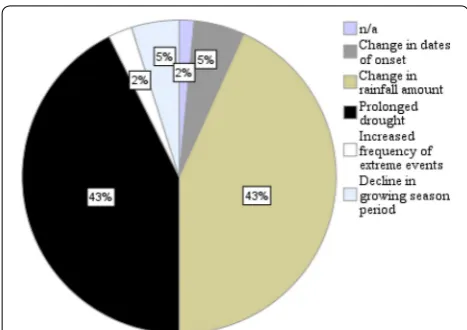
The opinion that rainfall patterns had changed in Tharaka sub-county was virtually universal (98%). This response was strong across agro-ecological zones, gender, and age (reference made to persons aged 36 years and above. These persons are considered to be able to recall events of the past 20 years). The main indicators of change (of rainfall pattern) were increase in frequency of extreme events (specifically prolonged drought) (43%), change in rainfall amount (43%), change in dates of onset (5%), and reduced growing season (5%) (Fig. 2). A higher number of respondents in agro-ecological zones IL6 (43%) and IL5 (48%) considered change in rainfall amount the main evi-dence of change in climate patterns. While a higher num-ber of respondents in agro-ecological zone LM4 (48%) and agro-ecological zone LM5 (38%) regarded extreme events such as droughts and floods as evidence of change in climate variability.
Table 1 Sample population by study sites Administrative
division Agro-ecological zone (AEZs) Sample population (total) Households FGD participants
Kathangacini IL6 58 12 Marimanti IL5 92 11 Tunyai LM4 78 13 Chiakariga LM5 98 12
Tharaka people’s perception is in line with long-term empirical analysis of rainfall which shows that OND and annual rainfall have been persistently below nor-mal (Recha et al. 2012). Study findings relate with those of Sanchez-Cortes and Chavero (2011) and Howe et al. (2014) where communities in Mexico and India, respec-tively, perceived a decrease in rainfall amount and dura-tion. Variations in perception by agro-ecological zones can be attributed to diversity in livelihoods (Gioto et al.
2016). Agro-ecological zones IL5 and IL6 are character-ized by marginal mixed farming of livestock and drought-tolerant crops (millet and green gram). Thus, insufficient rainfall amount to support cropping may lead to depend-ency on livestock. On the other hand agro-ecological zones LM4 and LM5 are mixed farming and rain-fed cropping livelihood zones, respectively. For these liveli-hood zones, frequency of extreme events—especially drought, severely affects dairy farming and crop farming (maize and beans). Note that livelihood activities in LM4 and LM5 demand more water than in IL5 and IL6.
FGD participants were asked to describe the terms cli-mate, weather, climate variability, and climate change. They were further asked to describe the rainfall regime of their area and outline consequences of climate vari-ability in their communities. An attempt to get the word for weather and climate in the local dialect—Kitharaka, proved futile. This was despite having elderly partici-pants of over 75 years of age. Climate was described as variations in wind, temperature, or rainfall. Climate was further understood as the annual change of weather. According to participants, seasons of high and low rain-fall, low and high temperatures, represent climate.
Climate variability was seen more as variations that bring about seasons. Participants described nthano (March–May rainfall season), muratho (October– December rainfall season), thano (August–October
dry period), and kiathu (February–March dry period). Respondents further referred to climate variability as the annual variation of seasonal rainfall. From the findings, the people of Tharaka have four seasons—contrary to the long-standing narrative that Kenya has two rainfall sea-sons—MAM and OND. In Tharaka, there are two rain-fall seasons and two dry seasons. Leonard et al. (2013) observed that knowledge of seasons and sub-seasons form the hierarchy for which all other traditional eco-logical knowledge within the season calendar is ordered. Among the Tharaka, knowledge of seasonality heavily influences cropping system, grazing patterns, and live-lihood support adaptation strategies to climate vari-ability. According to Sanchez-Cortes and Chavero (2011) knowledge of how people experience climate variability is essential, taking into account their local calendar of agricultural activities. To the Tharaka people, knowledge of the quantity of rainfall received in each season is an important guide to their livelihood support system.
According to FGD participants, rainfall onset and ces-sation have changed, and within-season rainfall distribu-tion has become irregular when compared to the past 20 years. For instance, in the past, onsets of MAM and OND seasonal rains was in early March and mid Octo-ber, respectively. While cessation for MAM and OND occurred at end of May and early January, respectively. Respondents claimed that at present, onset is in early April and November for MAM and OND growing sea-sons, respectively. Rainfall cessation is said to occur in the last week of April and mid-December for MAM and OND growing seasons. The consequence of change in onset and cessation dates was a shift from maize to sorghum and millet farming—particularly in the drier IL6 (Kathangacini). The observation suggests that rain-fall variability has altered the cropping system. Early onsets in the past were always associated with high crop yields. This is no longer the case as growing seasons have become shorter and the within-season distribution has become poor. The reduced amount of rainfall has also contributed to reduced water levels in streams, especially in LM4 (Tunyai).
But community perception of changes in onset and ces-sation was at variance with household survey. A major-ity of households opined that onset of MAM and OND rainfall seasons was mainly in the 2nd week of March and October, respectively. For the MAM season, 34 and 49% of respondents observed that onset was realized in the 2nd and 3rd weeks of March, respectively. Onset of OND season was reported to occur in the 2nd week (28%) and 3rd week (51%) of October. To a majority of respondents cessation usually occurred in the 4th week of May (35%) during MAM and the 2nd week of January (52%) dur-ing OND. In a related study usdur-ing historical rainfall data,
Recha et al. (2012) established that mean rainfall onset for MAM and OND was between 21st and 25th of March and October, respectively; while mean rainfall cessation occur on May 16–20th for MAM season and January 5–10th for ONDJ season. Thus, results of historical rain-fall data are in agreement with household survey but dif-fer with FGD results.
Variations in perception and historical data analysis of climate variability were also reported in Adimassu et al. (2014) where farmers perceived a decreasing rainfall amount and crop yield, contrary to historical data. The differing view of households and FGD on onset and ces-sation highlights a fundamental issue in understanding climate change and variability; that there are differences in group and individual perception of climate change. This can potentially lead to a wrong diagnosis of the problem of climate change. Such variation reinforces the need to accurately collect rainfall data (and other weather elements) for community use in decision making instead of relying on perceptions. Basic skills in climate data col-lection, analysis, and descriptive presentation among community members would improve the understanding of climate.
The term climate change was very familiar to partici-pants as they had heard it from the radio and extension officers. There was unanimity in all the four FGDs that there was climate change in Tharaka sub-county. Partici-pants associated climate change with change in weather elements in a specified period. To illustrate climate change, participants gave an example of how in the past temperatures were relatively low compared to the pre-sent. Participants associated climate change with char-coal burning and industrial pollution which are ‘tearing the sky apart.’ Climate change, especially warm tempera-tures was attributed to deforestation.
FGD results indicated that the terms weather and cli-mate are synonymous in Kitharaka. Lack of differentia-tion of these terms poses the risk of failing to tap into climate as a resource. This can be corrected by educating communities on quantitative characteristics of climate and generally providing facts of their locality. Commu-nity understanding of climate variability and change had similarity with standard definitions such as that given by van de Steeg et al. (2009). Participants closely linked cli-mate change and variability to environmental degrada-tion. Deforestation and destruction of wetlands to create land for human settlement were cited as lead causes of climate change and variability. Other causes of climate change and variability cited by respondents were pollu-tion of major oceans (through ship transportapollu-tion), use of pesticides and insecticides (as a result of land surface run-off), and God’s plan.
The correct identification of deforestation, wetland destruction, and industrial pollution as causes of cli-mate change and variability can be seen as an outcome of increased awareness and can be used to serve as a basis to encourage collective learning on land degra-dation as observed by Tscharkert (2007). The observa-tion that human activities are ‘tearing the sky apart’ was interpreted to mean the depletion of the ozone layer. In related studies of Silva et al. (2014), Gandure et al. (2013), Mubaya et al. (2012), and Byg and Salick (2009), com-munities were found to associate climate change and variability to God’s retribution and human activities such mining, car emissions, deforestation, recreational fish-ing, tourism, and mining. It is evident from the findings that Tharaka people’s perception of the causes of climate change and variability mirrors that of other communities. However, there were misconception and gaps in under-standing the causes of climate change and variability. To associate climate change and variability with pollution of the ocean and use of pesticides demonstrates a gap in understanding the role of oceans in climate change and variability. Indeed Li (2015) also established that the Chinese rural community had poor knowledge of causes and impacts of climate change science. Provision of basic information on the role of the inter tropical convergence zone, monsoon trade winds, and sea surface tempera-tures on East Africa climatology (Seleshi and Zanke 2004; Camberlin and Okoola 2003) would address the current misconceptions. Relating good rain season with suc-cessful tree planting among participants demonstrate a level of awareness on the need to conserve the environ-ment and mitigate climate change. Withdrawal of maize farming in the drier IL6 should be seen as a realization that maize is not a viable venture in light of a changing climate. The choice of maize farming may have been informed by dietary preferences but persistent failure of the crop over the years may have gradually informed the decision to increase acreage of more drought-toler-ant crops such as millet and green gram (Smucker and Wisner 2008). Overall, to improve knowledge on causes and impacts of climate change in Tharaka, will require scaling-up effort to use credible scientific institutions to communicate climate change science.
Conclusion
climate change and variability with deforestation and industrial pollution, showing awareness on the role of man in altering the climate. This awareness should be harnessed into an opportunity to mitigate climate change. There are however misconceptions on the causes of climate change and variability. The paper recommends involvement of scientific institutions in communicating climate change science. Knowledge of determinants of climate variability and basic skills in data collection and descriptive statistics are a way of improving awareness of climate science among local communities in arid and semi-arid lands.
Abbreviations
MAM: March–April–May; AEZ: agro-ecological zone; ENSO: El Niño southern oscillation; FGD: focus group discussion; IL: intermediate low-land; LM: lower midlow-land; OND: October–November–December; ONDJ: October–November–December–January.
Authors’ contributions
CWR: conceptualized and executed the research, drafted the manuscript. GLM: supervisor to 1st author, played a major part in the improvement of the methods (sampling and data analysis), revised manuscript. CAS: supervisor to 1st author, played a major part in the improvement of literature review and discussion of results, revised manuscript. All authors read and approved the final manuscript.
Authors’ information
Charles W. Recha has a Ph.D. in climatology. Research areas include rainfall variability, use of climate forecasts in decision-making, perception studies in climate change and climate variability and NDVI nexus. Currently a chair and lecturer of Geography, Egerton University. George L. Makokha has a Ph.D. in urban climatology. Research areas include urban climate studies, integrated watershed management. Currently a senior lecturer in Department of Geog-raphy, Kenyatta University. Chris A. Shisanya has a Ph.D. in agro-climatology. Research areas include climate variability and crop production, integrated watershed management, agro-forestry. Currently professor of Geography and Dean School of Humanities and Social Sciences.
Author details
1 Department of Geography, Egerton University, P. O. Box 536, Egerton 20115, Kenya. 2 Department of Geography, Kenyatta University, P. O. Box 43844, Nairobi 00100, Kenya.
Acknowledgements
The authors acknowledge financial support from the African Climate Change Fellowship Programme a programme of International SysTem for Analysis, Research and Training (START) for a study fellowship award to the first author and fieldwork support from the EU Water Facility Project (No. 9 ACP RPR 50/11). We further acknowledge the valuable support of the Department of Arid Lands—Tharaka sub-county and the receptive people of Tharaka who participated in the survey, without which this study would not have been possible.
Competing interests
The authors declare that they have no competing interests. Additional files
Additional file 1. Focus group discussion data.
Additional file 2. Household survey data.
Additional file 3. Interview schedule for focus group discussion.
Availability of data and materials
Attached is household survey data (refer to variables B6.2.1a–B6236c2) and FGD tool used in the study (applicable questions to this manuscript are in part C of the tool)—provided as Additional files 1, 2, 3. It’s instructive to note here that data and results in this manuscript were derived from a PhD thesis of the first author (Recha 2013, Kenyatta University, unpublished).
Consent for publication
This is original work that has not been submitted anywhere for publication.
Ethics approval and consent to participate Not applicable.
Funding
Eu Water Facility, Project No. 9 ACP RPS 50/11: a project of Siegen University, Germany and Kenyatta University. African Climate Change Fellowship (ACCFP), 2009/2010: a project of International System for Analysis, Research and Train-ing (START), USA.
Publisher’s Note
Springer Nature remains neutral with regard to jurisdictional claims in pub-lished maps and institutional affiliations.
Received: 23 January 2017 Accepted: 19 September 2017
References
Adimassu Z, Kessler A, Stroosnijder L (2014) Farmers strategies to perceived trends of rainfall and crop productivity in the central Rift Valley of Ethio-pia”. Environ Dev 11:123–140. doi:10.1016/j.envdev.2014.04.004
Becken S, Lama AK, Espiner S (2013) The cultural context of climate change impacts: perceptions among community members in the Annapurna conservation area, Nepal”. Environ Dev 8:22–37. doi:10.1016/j. envdev.2013.05.007
Byg A, Salick J (2009) Local perspectives on a global phenomenon—climate change in Eastern Tibetan villages. Glob Environ Change 19:156–166. doi:10.1016/j.gloenvcha.2009.01.010
Camberlin P, Okoola RE (2003) The onset and cessation of the long rains in eastern Africa and their inter-annual variability. Theor Appl Climatol 75:43–54. doi:10.1007/s00704-002-0721-5
Fabeku BB, Okogbue EC (2014) Trends in vegetation response to drought in Sudao-Sahelian part of northern Nigeria. Atmos Clim Sci 4:569–588. doi:10.4236/acs.2014.44052
Gandure S, Walker S, Botha JJ (2013) Farmer’s perceptions of adaptation to climate change and water stress in a South African rural community. Environ Dev 5:39–53. doi:10.1016/j.envdev.2012.11.004
Gioto L, Wandiga S, Oludhe C (2016) Climate change detection across all livelihood zones in Tharaka Nithi County. J Met Relat Stud 9:11–17. doi:10.20987/jmrs.2.08.2016
Hansen W (2005) Integrating seasonal climate prediction and agricultural models for insights into agricultural practice. Philos Trans R Soc B 360:2037–2047. doi:10.1098/rstb.2005.1747
Hansen J, Indeje M (2004) Linking dynamic seasonal climate forecasts with crop simulation for maize yield prediction in semi-arid Kenya. Agric For Meteorol 125:143–157. doi:10.1016/j.agrformet.2004.02.006
Hastenrath S, Polzin D, Camberlin P (2004) Exploring the predictability of the short rains at the coast of East Africa. Int J Climatol 24:1333–1343 Howe DP, Thaker J, Leiserowitz A (2014) Public perception of rainfall changes in
India. Clim Change 127:211–225. doi:10.1007/s10584-014-1245-6
Hulme M (2008) Geographical work at the boundaries of climate change. Trans Inst Br Geogr 33:5–11
Jaetzold R, Schmidt H, Hornetz B, Shisanya C (2007) Farm management handbook of Kenya: part C, East Kenya, vol II, 2nd edn. Ministry of Agriculture, Nairobi Kajembe GC, Julius F, Nduwamungu PW, Mtakwa PW, Nyange DA (2005)
Kashaigili JJ, Levira P, Liwenga E, Mdemu MV (2014) Analysis of climate vari-ability, perceptions and coping strategies of Tanzania’s coastal forest dependent communities. Am J Clim Change 3:212–222
Kundezewicz ZW, Mata LJ, Arnel NW, Doll P, Jimenez B, Miller K, Oki T, Sen Z, Shiklomanov I (2008) The implication of projected climate change for freshwater resources and their management. Hydrol Sci 53(1):3–10 Leiserowitz AA (2005) American risk perceptions: is climate change
danger-ous? Risk Anal 25(6):1433–1442. doi:10.1111/j.1540-6261.2005.00690.x
Leonard S, Person M, Olawsky K, Kofod F (2013) The role of culture and traditional knowledge in climate change adaptation: insights from East Kimberly, Australia. Glob Environ Change 23:623–632. doi:10.1016/j. gloenvcha.2013.02.012
Li Y (2015) The urban-rural disparities in public awareness of climate change in China: a study of outreach communication strategies. Int J Clim Change: Impacts Responses 8(1):11–19
Locatelli B (2011) Synergies between adaptation and mitigation in a nutshell. COBAM Brief. Centre for International Forestry Research (CIFOR), Bogor. doi: 10.17528/cifor/003619
Lorenzoni I, Pidgeon NF (2006) Public views on climate change: European and USA perspectives. Clim Change 77:73–95. doi:10.1007/sl0584-006-9072-z
Maddison DJ (2007) The perception of and adaptation to climate change in Africa. World bank policy research working paper no. 4308. http://ssrn. com/abstract=1005547
Mubaya CP, Njuki J, Mutsvangwa EP, Mugabe FT, Nanja D (2012) Climate variability and change or multiple stressors? Farmer perceptions regard-ing threats to livelihoods in Zimbabwe and Zambia. J Environ Manag 102:9–17
Mutai CC, Ward MN, Coleman AW (1998) Towards the prediction of the East Africa short rains based on sea surface temperature-atmospheric cou-pling. Int J Climatol 18:975–997
Mworia L, Ndiku JM (2012) Inter ethnic conflict in Kenya: a case of Tharaka-Tigania conflict, causes, effects and intervention strategies. J Res Peace Gend Dev 2(7):162–170 (ISSN: 2251-0036). http://www.interesjournals. org/JRPGD
Opiyo F, Wasonga OV, Nyangito MM, Mureithi SM, Obando J, Munang R (2016) Determinants of perceptions of climate change and adaptation among Turkana pastoralists in northwestern Kenya. Clim Dev 8:179–189. doi:10.1 080/17565529.2015.1034231
Orindi VA, Ochieng A (2005) Case study 5 Kenya: seed fairs as a drought recov-ery strategy in Kenya. IDS Bull 36(4):87–102. doi:10.1111/j.1759-5436.2005. tb00236.x
Recha CW (2013) Effects of climate variability on water resources and livelihoods and state of adaptive capacity in semi-arid Tharaka district, Kenya, PhD thesis, Kenyatta University. http://ir-library.ku.ac.ke/han-dle/123456789/6952 (unpublished)
Recha CW, Makokha GL, Traore PS, Shisanya C, Lodoun T, Sako A (2012) Deter-mination of seasonal rainfall variability, onset and cessation in semi-arid Tharaka district, Kenya. Theor Appl Climatol 108:479–494. doi:10.1007/ s00704-011-0544-3
Republic of Kenya (2010a) National climate change response strategy. http:// cdkn.org/wp-content/uploads/2012/04/National-Climate-Change-Response-Strategy_April-2010.pdf. Accessed 20 May 2016
Republic of Kenya (2010b) Population and housing census, 2009, vol 1a. The Kenya National Bureau of Statistics, Nairobi
Sanchez-Cortes MS, Chevero EL (2011) Indigenous perception of changes in climate variability and its relationship with agriculture in a Zoque community of Chiapas, Mexico. Clim Change 107:363–389. doi:10.1007/ s10584-010-9972-9
Seleshi Y, Zanke U (2004) Recent changes in rainfall and rainy days in Ethiopia. Int J Climatol 24:973–983. doi:10.1002/joc.1052
Shisanya CA (1996) Chances and risks of maize and bean growing in the semi-arid areas of SE Kenya during the expected deficient, normal and above normal rainfall of the short rainy season (published doctoral thesis). Trier Universitet, Trier Germany
Silva CJ, Albernaz-Silveira R, Noguera PS (2014) Perceptions on climate change of the traditional community Cuiabá Mirim, Pantanal Wetland, Mato Grosso, Brazil. Clim Change 127:83–92. doi:10.1007/s10584-014-1150-z
Smucker T, Wisner B (2008) Changing household responses to drought in Tharaka, Kenya: vulnerability, persistence and challenge. Disasters 32(2):190–215. doi:10.1111/j.1467-7717.2007.01035.x
Tonnang H, Richard EZ, Kangalawe YM, Yanda, PZ (2010) Predicting and map-ping malaria under climate change scenarios: the potential redistribution of malaria vectors in Africa. Malar J 9:1–10. http://www.malariajournal. com/content/9/1/111
Tscharkert P (2007) Views from the vulnerable: understanding climatic and other stressors in the Sahel. Glob Environ Change 17:381–396. doi:10.1016/j.gloenvcha.2006.11.008
van de Steeg JA, Herrero M, Kinyangi J, Thornton PK, Rao KPC, Stern R, Cooper P (2009) The influence of current and future climate-induced risk on the agricultural sector in East and Central Africa: sensitizing the ASARECA strategic plan to climate change. International Livestock Research Institute, Nairobi
Vedwan N, Rhoades R (2001) Climate change in western Himalayas of India: a study of local perception and response. Clim Res 19:109–117. http:// www.jstor.org/stable/24866773. Accessed 18 Jul 2017
Washington R, Harrison M, Conway D, Black E, Challinor A, Grimes D, Jones R, Morse A, Kay G, Todd M (2006) Africa climate change: taking a shorter route. Am Meteorol Soc 87(10):1355–1366. doi:10.1175/BAMS-87-10-1355
![Racemic tricarbonyl[(4a,5,6,7,8,8a η) 2 phenyl 3,4 dihydro 2H 1 benzopyran]chromium(0)](data:image/gif;base64,R0lGODlhAQABAIAAAP///wAAACH5BAEAAAAALAAAAAABAAEAAAICRAEAOw==)