RESEARCH ARTICLE
Developing the universal unified prevention
program for diverse disorders for school-aged
children
Shin‑ichi Ishikawa
1*, Kohei Kishida
2,3, Takuya Oka
4, Aya Saito
4,8, Sakie Shimotsu
5, Norio Watanabe
6,
Hiroki Sasamori
7and Yoko Kamio
4,9Abstract
Background: Psychological problems during childhood and adolescence are highly prevalent, frequently comorbid, and incur severe social burden. A school‑based universal prevention approach is one avenue to address these issues.
Objective: The first aim of this study was the development of a novel, transdiagnostic cognitive‑behavioral universal prevention program: The Universal Unified Prevention Program for Diverse Disorders (Up2‑D2). The second aim of this study was to examine the acceptability and fidelity of the Up2‑D2.
Methods: Classroom teachers who attended a 1‑day workshop implemented the Up2‑D2 independently as a part of their regular curricula. To assess the acceptability of the Up2‑D2, 213 children (111 boys and 102 girls) aged 9–12 years completed questionnaires about their enjoyment, comprehension, attainment, applicability, and self‑efficacy after completing Lessons 1–12. For fidelity, research assistants independently evaluated audio files that were randomly selected and assigned (27.3%).
Results: Our preliminary evaluation revealed the program was highly enjoyable, clear, and applicable for students. In addition, self‑efficacy demonstrated a trend of gradually increasing over the 12 sessions. The total fidelity observed in the two schools was sufficient (76.2%), given the length of the teacher training.
Conclusions: The results of this study supported the theory that the Up2‑D2 could be feasible in real‑world school settings when classroom teachers implement the program. We discussed current research and practical issues of using universal prevention to address mental health problems in school, based on implementation science for user‑ centered design.
Keywords: Cognitive‑behavioral therapy, Universal prevention, Transdiagnostic, School, Children
© The Author(s) 2019. This article is distributed under the terms of the Creative Commons Attribution 4.0 International License (http://creat iveco mmons .org/licen ses/by/4.0/), which permits unrestricted use, distribution, and reproduction in any medium, provided you give appropriate credit to the original author(s) and the source, provide a link to the Creative Commons license, and indicate if changes were made. The Creative Commons Public Domain Dedication waiver (http://creativecommons.org/ publicdomain/zero/1.0/) applies to the data made available in this article, unless otherwise stated.
Background
Contrary to widespread belief, mental disorders are com-mon during childhood and adolescence with 10–20% of all children experiencing one or more of these problems, incurring severe social burden; consequently, mental health promotion is an urgent issue, and early detection and intervention are essential [1]. Moreover, a recent meta-analysis estimated that the worldwide prevalence
of mental disorders was 13.4% (95% confidence inter-val 11.3–15.9) among a sample of 87,742 children [2]. This suggests that approximately 241 million youths are affected by at least one mental disorder globally.
Although fear and anxiety are considered normal emo-tions that every child experiences during typical devel-opment, some children have profoundly high anxiety levels compared to typically developing children, which can cause severe impairment in their daily lives. Anxiety disorders are the most common psychological problem among children and adolescents [2, 3]. Moreover, anxi-ety disorders in children and adolescents predict men-tal health difficulties broadly in their later life including
Open Access
*Correspondence: [email protected]
1 Faculty of Psychology, Doshisha University, 1‑3 Tatara Miyakodani,
Kyotanabe, Kyoto 610‑0394, Japan
anxiety disorders, mood disorders, and substance abuse [4].
Children and adolescents are also currently experienc-ing depression at an unprecedented rate [5]. Recently, prevalence studies in Japan have shown that 8.8% of adolescents aged 12–14 years met one or more depres-sive disorders based on the Diagnostic and Statistical Manual of Mental Disorders, Fourth Edition, Text Revi-sion [6]. Depression in children and adolescents often co-occurs with anxiety disorders [7]. Furthermore, anxiety and depression are also frequently occurring in children and adolescents with neurodevelopmental disorders such as attention-deficit/hyperactivity disorders (ADHD) or autism spectrum disorder.
Finally, anger and irritability are relatively common behaviors in children and adolescents aged 9 to 16 years (51.4% showed phasic irritability in a community sample) [8] and are the most frequent reasons for mental health referrals [9]. Although anger/irritability is a core symp-tom of oppositional defiant disorder or disruptive mood dysregulation disorder, irritability is also seen in children with anxiety disorders, depressive disorders, or ADHD [10]. Children and adolescents frequently experience a wide variety of emotional and behavioral difficulties throughout their development. Regardless of whether the severity of these issues meet the clinical criteria for a diagnosis, preventive interventions can support behav-ioral and emotional regulation related to a wide variety of concerns, ultimately promoting positive youth devel-opment and even mitigating the onset or severity of later disorders.
Preventative actions in schools
Since students learn and develop their social and emo-tional competence in school, schools play a key role in fostering healthy social and emotional development among youths [1]. Specifically, teachers, as models, are in a very powerful position and their opinions concern-ing what constitutes mental health impacts the concepts of mental health adopted by their students [11]. School-based approaches, especially those implemented by schoolteachers, are a crucial avenue for the prevention of mental health problems [12].
Diverse school-based prevention programs have been developed and examined in several countries. There are three types of school prevention programs: univer-sal, selective, and indicated [13]. Universal prevention includes all members regardless of their risk status. Selec-tive prevention focuses on individuals who have a risk for mental disorders, such as parental psychopathology or adverse circumstances. Indicated prevention means an intervention for individuals who already have mild to moderate symptoms.
Among the three types of prevention programs, uni-versal prevention in school has several inherent advan-tages. First, a universal prevention program can access most students who are enrolled in each school district, while rarely experiencing attrition. Second, a universal approach can minimize the risk of “labeling” for stu-dents who are removed from a classroom for selective or indicated interventions. Third, a universal approach can strengthen the protective role of the school environ-ment, which might have proximal influences on chil-dren, according to the ecological model of child mental health [14]. Fourth, because all students can participate regardless of risk or diagnostic status, implementation of a universal prevention program can support future selective and/or indicated interventions as a framework for layered or stepped preventive approaches. Universal prevention based on a cognitive-behavioral approach is designed to enhance individuals’ specific coping strate-gies for current/future adversity, and encourages applica-tion of those skills to support other students. A previous trial for adult outpatients with anxiety and depressive symptoms suggested that group cognitive-behavioral therapy (CBT) can ameliorate their emotional symptoms as well as improve their self-stigma [15]. A group-based CBT in the classroom showed increased knowledge about mental health and decreased stigma to individuals with mental disorders. Moreover, students in the 5th and 6th grades who participated in the intervention showed significant improvement in self-efficacy, indicating that they can support friends and people around them with mental health problems [16]. Therefore, students, as well as school personnel, can acquire mental health literacy and reduce stigma for mental disorders through teaching cognitive-behavioral skills.
Evidence of prevention programs in schools
Most school prevention programs for mental health were based on cognitive-behavioral interventions [17]. Some were created as universal programs, whereas others were originally designed for selective or indicated programs. For example, open trials for universal depression preven-tion intervenpreven-tions have shown a significant improvement in social skills and a reduction in depressive symptoms among elementary school children aged 8 to 12 years [16, 18], and the positive effect was maintained three years later [19].
Cochrane Review in 2011 affirmed some evidence that universal, as well as targeted depression, prevention programs may prevent the onset of depressive disorders compared with no intervention in children and adoles-cents aged 5 to 19 years [23]. However, the latest review of depression prevention programs concluded that pre-vention programs delivered universally to child and ado-lescent populations aged 5 to 19 years showed “a sobering lack of effect when compared with an attention placebo control” ([24] p. 49).
Regarding anxiety, Neil and Christensen [25] reviewed 27 randomized controlled trials of school-based pro-grams for children (5–12 years) or adolescents (13– 19 years). Over half the studies (59%) were universal prevention programs (30% were indicated programs and 11% were selective programs). Approximately eleven of the sixteen (69%) universal trials reported signifi-cant improvement post-intervention (ES = 0.31 to 1.37), while five trials failed to find significant improvement (ES =− 0.21 to 0.28). According to a meta-analysis of school-based prevention programs focused on both anxi-ety and depression for kindergarten through 12th grade, including 31 universal trials [26], there was no clear effect for anxiety; however, a significant improvement for depression was shown in a direct comparison between intervention and control participants (Zs = 0.99 and 2.77, respectively, p < 0.01). Whereas universal preventive actions for anger and anger-related problems have been addressed as being useful to improve children’s social and academic development in kindergarten and early child-hood [27], there is no research using CBT-based uni-versal prevention programs for anger-related problems in middle to late childhood (6–18 years) [28]. Therefore, despite its promising results and partial support for its effectiveness, there is room for improvement in univer-sal prevention research, especially concerning the magni-tude of its effects.
The current research tasks for universal prevention programs in schools
Previous studies suggested two issues that should be addressed in future studies of universal prevention pro-grams in school: (1) to optimize inherent advantages of universal prevention in school overcoming limited effects, and (2) to explore the user-centered design of a universal prevention program for enhancing participants’ motivation that might facilitate more reliable gains.
Recently, a transdiagnostic approach is gathering much attention. This approach can address comorbidities fre-quently seen in clinical populations and redundancies of learning distinct treatment manuals for practition-ers [29, 30]. There are three types of transdiagnostic approaches: the core dysfunction approach, common
elements approach, and principle-guided approach [30]. First, the core dysfunctional approach addresses multiple psychological problems by targeting underlying common dysfunction. As a typical example, the Unified Protocol for the Transdiagnostic Treatment of Emotional Disorders (UP) [31] shows the frequently used approaches include treatment for problems that possess overlapping etiology, underlying shared pathological processes, or maintaining common processes [32]. Therefore, whereas it might be one of the first-line options for anxiety and depression, it needs further consideration to expand its utilization to more diverse disorders. Second, a common elements approach intends to select as many as common compo-nents that are derived from empirically supported treat-ments designed for distinct disorders. The approach may be workable when the elements can be compiled as separable, independent, and structured components [30]. Given that classroom teachers are used to teaching struc-tured components in the classroom, the approach might be advantageous for universal prevention in schools. On the other hand, a flexible approach which allows thera-pists to use these components discreetly is not adequate for universal prevention programs. Third, the principle-guided approach possesses a high level of flexibility for intervention content and sequencing based on thera-pists’ clinical decisions. Therefore, the principle-guided approach might be efficacious for clinical settings due to its flexibility; however, it is also difficult to apply to the universal prevention protocols that are implemented by schoolteachers.
research is often concerned with adaptation and imple-mentation after completion of efficacy studies [38]. Spe-cifically, (a) as previously stated, some efficacy trials of universal prevention programs targeting a single psycho-logical problem failed to show clear evidence according to the rigorous criteria; (b) however, each program tar-geting a single psychological problem included evidence-based components derived from CBT, which is strongly empirically supported; and (c) we should explore if an entirely new transdiagnostic universal program that can be applied to diverse children and adolescents in actual school settings.
Study purpose
To tackle these issues, first, we developed a new school-based universal prevention program—the Univer-sal Unified Prevention Program for Diverse Disorders (Up2-D2), which targets transdiagnostic mental health problems based on a cognitive-behavioral approach in schools. Our second purpose was to examine the accept-ability and fidelity of the Up2-D2 in school settings after
schoolteachers implemented the Up2-D2. Since the acceptability and fidelity of the program should be con-firmed in real school settings, classroom teachers and their students evaluated the implementation of the Up2-D2 rather than researchers and clinicians.
Development of the Up2‑D2
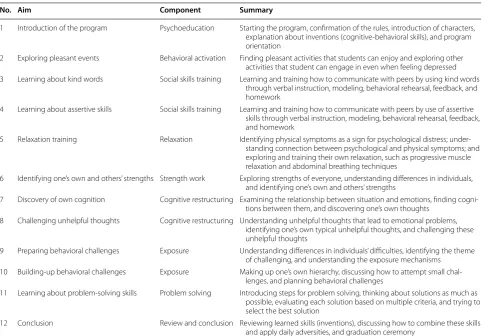
The Up2-D2 aims at broad-band effects on mental health problems in elementary and junior high school (i.e., mid-dle school) students aged 8–15 years. The Up2-D2 was designed to integrate common components in CBT for children and adolescents based on evidence-based psy-chosocial interventions [35] such as psychoeducation, behavioral activation, social skills training, relaxation, cognitive restructuring, gradual exposure, and prob-lem-solving (Table 1). As mentioned in detail below, we modified and adjusted these components to a school cur-riculum as well as an educational format so that class-room teachers can run the program in their classclass-room, which was based on previous evidence [39].
Table 1 Components of the Up2‑D2
Up2-D2 the Universal Unified Prevention Program for Diverse Disorders
No. Aim Component Summary
1 Introduction of the program Psychoeducation Starting the program, confirmation of the rules, introduction of characters, explanation about inventions (cognitive‑behavioral skills), and program orientation
2 Exploring pleasant events Behavioral activation Finding pleasant activities that students can enjoy and exploring other activities that student can engage in even when feeling depressed 3 Learning about kind words Social skills training Learning and training how to communicate with peers by using kind words
through verbal instruction, modeling, behavioral rehearsal, feedback, and homework
4 Learning about assertive skills Social skills training Learning and training how to communicate with peers by use of assertive skills through verbal instruction, modeling, behavioral rehearsal, feedback, and homework
5 Relaxation training Relaxation Identifying physical symptoms as a sign for psychological distress; under‑ standing connection between psychological and physical symptoms; and exploring and training their own relaxation, such as progressive muscle relaxation and abdominal breathing techniques
6 Identifying one’s own and others’ strengths Strength work Exploring strengths of everyone, understanding differences in individuals, and identifying one’s own and others’ strengths
7 Discovery of own cognition Cognitive restructuring Examining the relationship between situation and emotions, finding cogni‑ tions between them, and discovering one’s own thoughts
8 Challenging unhelpful thoughts Cognitive restructuring Understanding unhelpful thoughts that lead to emotional problems, identifying one’s own typical unhelpful thoughts, and challenging these unhelpful thoughts
9 Preparing behavioral challenges Exposure Understanding differences in individuals’ difficulties, identifying the theme of challenging, and understanding the exposure mechanisms
10 Building‑up behavioral challenges Exposure Making up one’s own hierarchy, discussing how to attempt small chal‑ lenges, and planning behavioral challenges
11 Learning about problem‑solving skills Problem solving Introducing steps for problem solving, thinking about solutions as much as possible, evaluating each solution based on multiple criteria, and trying to select the best solution
One of the fields of research should be the imple-mentation and promotion of the systematic adoption of research findings and other evidence-based practices into routine practice; thus, research focusing on implementa-tion could improve the quality and effectiveness of men-tal health services [40]. To achieve the application of the research findings, the Up2-D2 was created to examine the principle of a user-centered design for the evidence-based practice. In line with these concepts, Lyon and Koerner [41] conceptualized seven elements for ensuring its usability and effective implementation of the packages that were originally developed by researchers outside of the field. These programmatic concepts were applied for the purpose of this study. The first concept, learnability, means that the developer should consider how to build understanding rapidly and easily for teachers and stu-dents from the program. Second, efficiency refers to the idea that a school-based program should minimize the time, effort, and cost of its usage for addressing targeted problems. Third, memorability suggests that a program should be designed to maximize competencies in teach-ers and students for remembering core elements of CBT. Fourth, error reduction aims to prevent error and ensure rapid recovery from the misuse and misunderstanding by use of refinement and elaboration of design. Fifth, satisfaction/reputation refers to developing a program
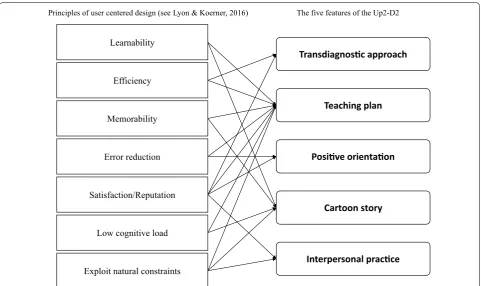
that should be acceptable, valuable, and attractive for all related users including principals, administrators, teach-ers, parents, and students in the school. Sixth, a low cog-nitive load means that the developer should focus on simple activities, as well as developing a structure that would be welcomed by the school in order to minimize the cognitive load. Seventh, a program that intends to exploit natural constraints is one that should be designed to fit their context of use and maximize existing cir-cumstances and natural contexts. Figure 1 illustrates the correspondence between the seven principles of the user-centered design and the five features of the Up2-D2: transdiagnostic approach, teaching plan, positive orienta-tion, cartoon story, and interpersonal practice.
Transdiagnostic approach
A transdiagnostic approach is one of the avenues to achieve the goals of efficiency and satisfaction/reputa-tion in addisatisfaction/reputa-tion to enhancement on coverage of diverse mental health problems. Teachers can efficiently admin-ister the unified program targeting multiple problems instead of spending more time conducting multiple pro-grams targeting a single problem. Reducing training load, especially for novices, is one of the inherent benefits related to efficiency in the transdiagnostic approach [42]. Moreover, a program that can cover both internalizing
Learnability
Efficiency
Principles of user centered design (see Lyon & Koerner, 2016)
Memorability
Error reduction
Satisfaction/Reputation
Low cognitive load
Exploit natural constraints
Transdiagnosc approach
The five features of the Up2-D2
Teaching plan
Posive orientaon
Cartoon story
Interpersonal pracce
and externalizing problems of students might be highly acceptable for school personnel considering Japanese educational needs. A previous study that examined depression prevention programs in schools noted that feedback from teachers stated that they need more com-prehensive programs that can deal with externalizing and internalizing problems [39]. Further, a recent national survey in Japan revealed the worst rates of school refusal, violence, and bullying in elementary schools in recorded history and suggested complex mental health problems may underlie such school issues [43].
Teaching plan
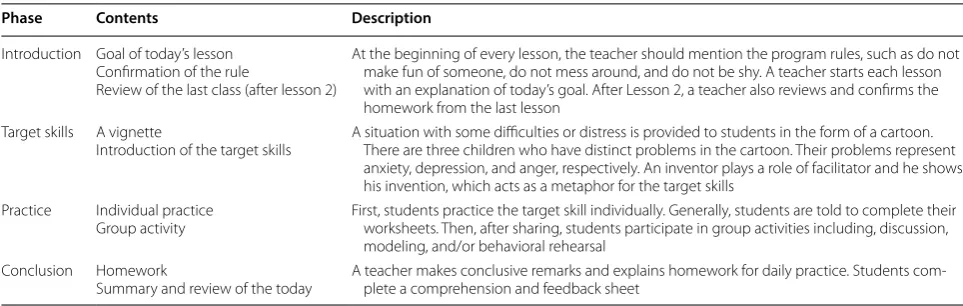
We created a “teaching plan” for all lessons concerning all elements for effective implementation in schools: learn-ability, efficiency, memorlearn-ability, error reduction, low cog-nitive load, satisfaction/reputation, and exploit natural constraints. In Japan, all academic classes such as mathe-matics, English, and science are taught based on teaching plans. In addition, they can be optimized depending on each class in accordance with the guidelines provided by the Ministry of Education. Therefore, teaching plans are subject to limitations in existing resources and time-lim-ited opportunities in educational settings. In the teach-ing plans, every psychological term used in the treatment manual was carefully translated into commonly used expressions in the educational settings to enable teach-ers to learn the components of the Up2-D2 efficiently and effortlessly. A teaching plan describes all proce-dures of each lesson of the Up2-D2, which guides teach-ers to engage in a school-based CBT (Table 2). The plan shares common steps through Lessons 1 to 12 including an introduction, target skills, practice, and conclusion. Since the steps were consistent with the regular curric-ula, it was also profitable for teachers to comprehend the outline of each lesson, capture the objectives of specific
techniques, and monitor the progress of both what they and their students understood. Therefore, preparation of the teaching plans is helpful and indispensable for opti-mizing the integrity of the present program.
Positive orientation
Positive orientation means that teachers and students can participate in the program with a positive mind and a warm atmosphere by using specific materials, activi-ties, and classroom management. The perception that “childhood is cheeriness and naivety,” or the Japanese proverb to “let sleeping dogs lie,” might represent one of the cultural aspects regarding an unwillingness to tackle mental health problems in children, explicitly [39]. A previous survey in Japan suggested that teachers exhib-ited less knowledge regarding mental health literacy con-cerning childhood psychological disorders than mental health professionals and graduate students [44]. With this in mind, we shifted the Up2-D2 from pure cogni-tive-behavioral techniques to focus more on educational interventions that are positively oriented to minimize misunderstandings, enhance the self-efficacy of teach-ing, obtain more acceptability, and improve the general reputation of school personnel. In addition, we added works where students are encouraged to find both their own and peers’ strengths in the Up2-D2. Such activities that are derived from the positive psychological interven-tion for classroom [45] will be welcomed to the Japanese educational settings as positive-oriented classwork. Since Japanese individuals tend to emphasize interdepend-ent aspects where a member is expected to consider and sense what others are feeling and thinking [46], students may find it difficult to ponder their differences rather than their commonalities. Even if they do find their dif-ferences, they are liable to be reluctant to disclose such discrepancies in front of their class, especially regarding Table 2 Flow of each lesson for the Up2‑D2
Up2-D2 the Universal Unified Prevention Program for Diverse Disorders
Phase Contents Description
Introduction Goal of today’s lesson Confirmation of the rule
Review of the last class (after lesson 2)
At the beginning of every lesson, the teacher should mention the program rules, such as do not make fun of someone, do not mess around, and do not be shy. A teacher starts each lesson with an explanation of today’s goal. After Lesson 2, a teacher also reviews and confirms the homework from the last lesson
Target skills A vignette
Introduction of the target skills A situation with some difficulties or distress is provided to students in the form of a cartoon. There are three children who have distinct problems in the cartoon. Their problems represent anxiety, depression, and anger, respectively. An inventor plays a role of facilitator and he shows his invention, which acts as a metaphor for the target skills
Practice Individual practice
Group activity First, students practice the target skill individually. Generally, students are told to complete their worksheets. Then, after sharing, students participate in group activities including, discussion, modeling, and/or behavioral rehearsal
Conclusion Homework
negative thoughts and/or adversities. Rather, through strength work, students will be likely to identify some differences among individuals more smoothly in positive orientation; then, they will work on their difficulties and adversities more naturally. In addition, given the current model of mental health, which encourages assessment of both wellness and illness [47], universal prevention in school should focus on positive mental health promo-tion as well as the risk factors of psychological disor-ders. Since previous strength-based school interventions produced positive gains in life satisfaction and positive affects [48], a cognitive-behavioral intervention com-bined with strength work could promote positive mental health as well as decrease psychopathological problems.
Cartoon story
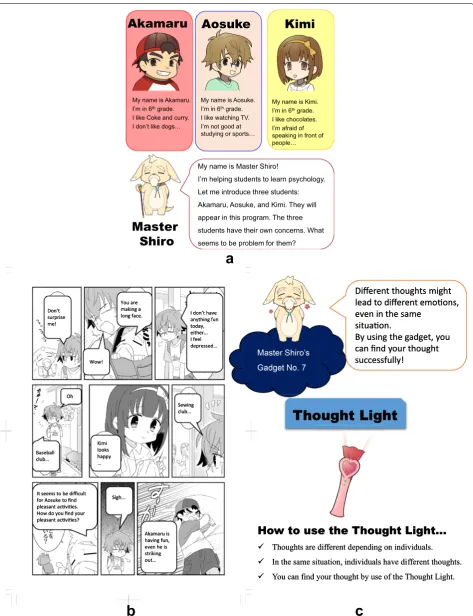
To strengthen the learnability, memorability, low cogni-tive load, and exploit natural constraints, we created four original cartoon characters: one plays a teacher-like role (a facilitator), and three characters (depressed, anxious, or irritable child) learn skills through lessons (Fig. 2a). The Up2-D2 was developed to have a storyline in which the characters experience distress in a common situation at school and learn how to cope with them (Fig. 2b). First, a common situation with some difficulties or distress in school is shown to students in the target skills section. Through simulating experiences of those characters, stu-dents can imagine feeing distressed that they have not experienced so far and can understand how to help their peers overcome such adversities. Second, a target skill that students are expected to learn from the lesson is vis-ualized as a metaphor. This was named a “gadget,” where a facilitator (who is a hermit dog-like animal called “Mas-ter Shiro”) provides to the three child charac“Mas-ters to help them. It could be useful for students to remember essen-tial points of learned skills with a less cognitive load stim-ulating intuitive comprehension. For example, “Thought Light” in Lesson 7 was used to represent a skill to iden-tify an individual’s thought (Fig. 2c). Since Japanese stu-dents are very familiar with cartoons, learning by use of cartoons can maintain long-term memories and enhance motivation in students [49].
Interpersonal practice
In addition to the cartoon story, interpersonal prac-tice, another facet of cultural adaptation in the Up2-D2, can ensure the satisfaction and reputation of the program as well as exploit natural constraints (see Table 2). According to a systematic review of recent CBT studies for children and adolescents in Japan [50], group-based interventions especially focused on inter-personal relationships were highly prevalent and were well accepted. In addition, teachers in Japan are clearly
encouraged to use group activities as much as they can (especially in “integrated study” and “special activities”). Spence [51] noted that environmental—(e.g., peer sup-port and positive classroom environments), as well as individual-protective factors (e.g., building children’s cognitive-behavioral skills), are essential for universal preventive intervention (i.e., the dual approach) [19]. Although group works and activities are frequently used by the previous programs globally, environmental com-ponents should be more underscored and imperative for successful cultural adaptation of CBT originated from Western culture [39]. In the Up2-D2, activities which are usually handled individually like cognitive restructur-ing (e.g., to find negative maladaptive thoughts or to find more appropriate thoughts) are also reorganized as group ones, given the interdependency of Asian culture [46].
A preliminary implementation: acceptability and fidelity of the Up2‑D2 in schools
We examined the acceptability and fidelity the Up2-D2 when schoolteachers implemented this program in real school settings.
Methods
Participants and procedures
Upon our request, four local boards of education invited all elementary schools in their district to participate in the program; eight principals indicated their interest and consented to participate after receiving a detailed expla-nation of the study by the research team. Overall, eight public schools participated in the Up2-D2. The current study used feedback sheets filled out by students regard-ing their perceptions of the program as well as audio data of each lesson recorded by the researchers. Teach-ers had students complete and return the feedback sheets at the end of each lesson. At the end of this study, we obtained the sheets from 213 children aged 9 to 12 years (4th grade: 39 boys and 47 girls; 5th grade: 46 boys and 42 girls; 6th grade: 26 boys and 13 girls) in seven classes from two schools which comprised of 29.79% of the ini-tial participants. The procedures were conducted in accordance with the ethical standards and approved by the third author’s (A2016-035) institutional research committees and only data that were obtained through an opt-out consent process from the students’ parents were analyzed.
Akamaru Aosuke
Kimi
My name is Master Shiro!
I’m helping students to learn psychology. Let me introduce three students: Akamaru, Aosuke, and Kimi. They will appear in this program. The three students have their own concerns. What seems to be problem for them?
Master
Shiro
My name is Akamaru. I’m in 6thgrade.
I like Coke and curry. I don’t like dogs…
My name is Aosuke. I’m in 6thgrade.
I like watching TV. I’m not good at studying or sports…
My name is Kimi. I’m in 6thgrade.
I like chocolates. I’m afraid of speaking in front of people…
I don’t have anything fun today, either... I feel depressed… You are
making a long face.
Wow! Don’t
surprise me!
Sewing club…
Kimi looks happy … Oh
Baseball club…
Akamaru is having fun, even he is striking out… Sigh... It seems to be difficult
for Aosuke to find pleasant acvies. How do you find your pleasant acvies?
Thought Light
Thoughts are different depending on individuals. In the same situation, individuals have different thoughts. You can find your thought by use of the Thought Light.
How to use the Thought Light…
Different thoughts might lead to different emoons, even in the same
situaon.
By using the gadget, you can find your thought successfully!
I don’t have anything fun today, either... I feel depressed… You are
making a long face.
Wow! Don’t
surprise me!
Sewing club…
Kimi looks happy … Oh
Baseball club…
Akamaru is having fun, even he is striking out… Sigh... It seems to be difficult
for Aosuke to find pleasant acvies. How do you find your pleasant acvies?
Thought Light
Thoughts are different depending on individuals. In the same situation, individuals have different thoughts. You can find your thought by use of the Thought Light.
How to use the Thought Light…
Different thoughts might lead to different emoons, even in the same
situaon.
By using the gadget, you can find your thought successfully!
a
b
c
author. The teaching plans and visual materials were dis-tributed to them, and they could review the DVD mate-rial on which the training session provided by the first author was recorded. Both schools provided the Up2-D2 once per week from September to October.
Measurements Acceptability
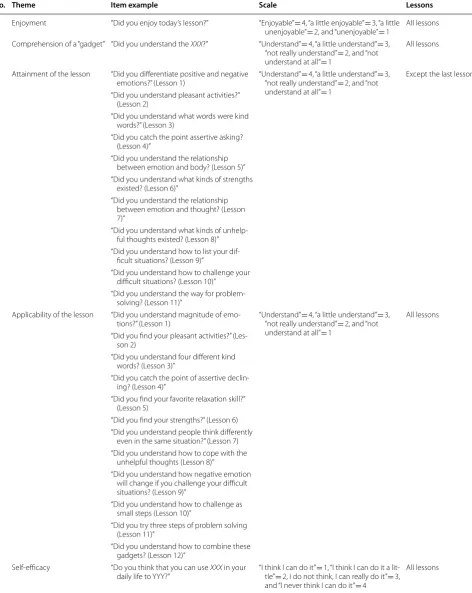
To test the acceptability of the Up2-D2, we developed a feedback sheet containing five questions (except the last lesson, which had four questions; see Table 3). Stu-dents completed feedback sheets after each lesson (in most cases, during daily circle time). The first question inquired about the degree of enjoyment of each lesson. The second question was related to the degree that stu-dents could understand a “gadget” as a metaphor of cog-nitive-behavioral skills taught. The third question refers to the degree that they could attain the goal of each les-son. The fourth question was related to experiential understanding while the third question was about con-ceptual understanding. As shown in Table 3, verbatim expressions of the questions varied according to each les-son. The fifth question asked the degree that they thought they could apply the learned skills to their daily situation. Since the last class was a review of the past lessons, we provided four questions for enjoyable; understandings of all the metaphors; comprehension concerning how to combine learned skills; and promoting daily self-efficacy through all of the lessons. High scores indicated high acceptability and scores of 3 or more can be interpreted as the indices exceeding a threshold of acceptability.
Fidelity
We examined the fidelity in real school settings by a test of fidelity when classroom teachers implemented the Up2-D2. All lessons were recorded by IC recorders on site and the archive audio files were kept in the storage of each school. Twenty-one lessons (27.3%) were extracted for evaluation based on a table of random numbers con-sidering the counterbalance of both schools. Research assistants had received rating training though hypo-thetical lessons independent from the implementation of this study until they obtained over 90% accuracy scores in accordance with the criteria that was set by the first author. Then, they visited each school and independently listened to assigned audio files to evaluate the fidelity of the classes. The first author made evaluation sheets for each class based on the teaching plan. Each sheet had approximately 30 items to evaluate (i.e., range max 24–36 points depending on each lesson), and research assis-tants confirmed whether a teacher followed the prepared teaching plan.
The evaluation sheets also included what must not be done by teachers in addition to what needs to be done. For example in the group activity in Lesson 2, to fulfill the fidelity criteria, the classroom teachers needed to (1) ask students to generate as many pleasant activities as pos-sible in small groups, (2) have each group express how many activities the students found, and (3) celebrate the group which reported the greatest number of activities; however, teachers should not 4) decide which answers were correct or wrong for each activity, or (5) criticize the group which reported the fewest activities.
Results Acceptability
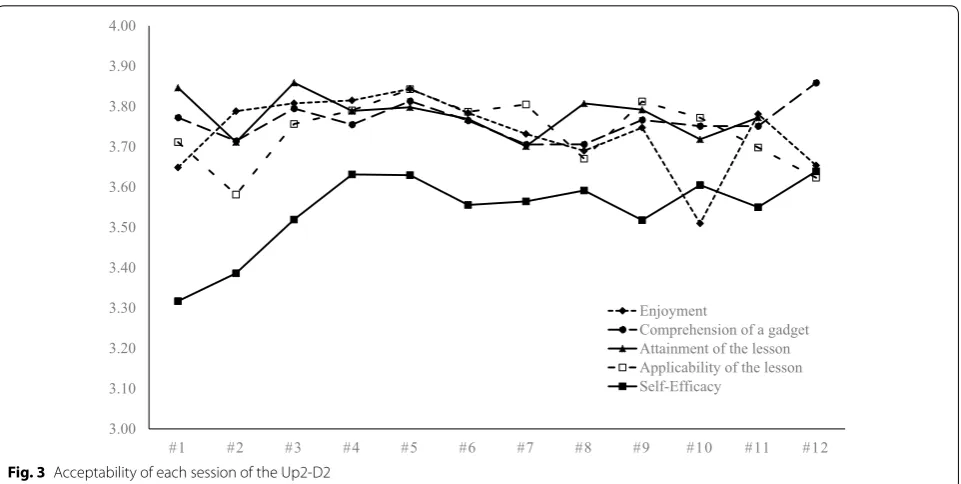
Total, 2322 feedback sheets were available (response rate = 90.85%; Table 4). Figure 3 depicts trends of enjoy-ment, comprehension, attainenjoy-ment, applicability, and self-efficacy from Lessons 1–12 (see also Additional file 1: Table S1). A Tau-U analysis revealed that the trend of self-efficacy was marginally significant, z= 1.71, p= 0.086. Specifically, self-efficacy had a tendency of gradual increasing through the 12 sessions from 3.32 to 3.64 whereas enjoyment, comprehension, attainment, and applicability were stable and higher than 3.5 for all sessions. Moreover, more than 90% of students who par-ticipated in the Up2-D2 responded, “I think I can do it (or a little)” in all lessons (range = 90.59–96.79%) to items of self-efficacy, and 96.10% of them had the confi-dence to apply leaned cognitive-behavioral skills outside of the classroom immediately after Lesson 12. Whereas Y elementary school showed higher scores for enjoy-ment than X eleenjoy-mentary school in Lessons 10, 11, and 12, after applying the Bonferroni correction (p≤ 0.004), there were no significant differences for comprehension, attainment, applicability, and self-efficacy between the two schools. As a result, all indices of acceptability were above a threshold in all sessions.
Fidelity
Table 3 Acceptability questions for the Up2‑D2
XXX a specific gadget name for the lesson, YYY a specific application for the lesson, Up2-D2 the Universal Unified Prevention Program for Diverse Disorders
No. Theme Item example Scale Lessons
1 Enjoyment “Did you enjoy today’s lesson?” “Enjoyable” = 4, “a little enjoyable” = 3, “a little
unenjoyable” = 2, and “unenjoyable” = 1 All lessons 2 Comprehension of a “gadget” “Did you understand the XXX?” “Understand” = 4, “a little understand” = 3,
“not really understand” = 2, and “not understand at all” = 1
All lessons
3 Attainment of the lesson “Did you differentiate positive and negative
emotions?” (Lesson 1) “Understand” “not really understand” = 4, “a little understand” = 2, and “not = 3, understand at all” = 1
Except the last lesson
“Did you understand pleasant activities?” (Lesson 2)
“Did you understand what words were kind words?” (Lesson 3)
“Did you catch the point assertive asking? (Lesson 4)”
“Did you understand the relationship between emotion and body? (Lesson 5)” “Did you understand what kinds of strengths
existed? (Lesson 6)”
“Did you understand the relationship between emotion and thought? (Lesson 7)”
“Did you understand what kinds of unhelp‑ ful thoughts existed? (Lesson 8)” “Did you understand how to list your dif‑
ficult situations? (Lesson 9)”
“Did you understand how to challenge your difficult situations? (Lesson 10)”
“Did you understand the way for problem‑ solving? (Lesson 11)”
4 Applicability of the lesson “Did you understand magnitude of emo‑
tions?” (Lesson 1) “Understand” “not really understand” = 4, “a little understand” = 2, and “not = 3, understand at all” = 1
All lessons
“Did you find your pleasant activities?” (Les‑ son 2)
“Did you understand four different kind words? (Lesson 3)”
“Did you catch the point of assertive declin‑ ing? (Lesson 4)”
“Did you find your favorite relaxation skill?” (Lesson 5)
“Did you find your strengths?” (Lesson 6) “Did you understand people think differently
even in the same situation?” (Lesson 7) “Did you understand how to cope with the
unhelpful thoughts (Lesson 8)”
“Did you understand how negative emotion will change if you challenge your difficult situations? (Lesson 9)”
“Did you understand how to challenge as small steps (Lesson 10)”
“Did you try three steps of problem solving (Lesson 11)”
“Did you understand how to combine these gadgets? (Lesson 12)”
5 Self‑efficacy “Do you think that you can use XXX in your
daily life to YYY?” “I think I can do it” tle” = 2, I do not think, I can really do it” = 1, “I think I can do it a lit‑= 3, and “I never think I can do it” = 4
Discussion
This article described the rationale, components, and preliminary implementation of our new intervention, the Up2-D2. Outwardly, the effort of this study might be considered as usual or ordinary procedures to intro-duce a new intervention; however, implementation works have rarely appeared in academic papers per se, and it is difficult to share and disseminate such practical wis-dom among the field [52]. Since the elaboration tends to
be accumulated exclusively within one-party, this study described the effort of implementation explicitly. There-fore, based on the relationships between principles of user-centered design and program features (Fig. 1), we discussed not only current research issues and future perspective of the Up2-D2 but also several challenges in practice and research about universal prevention pro-grams for mental health in schools from the viewpoint of social implementation.
Table 4 Cross‑tabulation of feedback sheets for all lessons
We failed to collect feedback sheets of Lesson 7 in 5th grade in X elementary school. The numbers of feedback sheets were combined from two classes in Y elementary school
No. X elementary school Y elementary school Total
4th grade 5th grade 6th grade 4th grade 5th grade
Lesson 1 34 30 37 47 54 202
Lesson 2 37 31 35 47 53 203
Lesson 3 38 32 34 24 28 156
Lesson 4 37 29 35 45 54 200
Lesson 5 37 28 35 44 54 198
Lesson 6 34 32 36 43 55 200
Lesson 7 35 – 37 43 49 164
Lesson 8 38 32 36 35 47 188
Lesson 9 37 32 34 43 52 198
Lesson 10 38 30 35 47 56 206
Lesson 11 38 29 36 46 53 202
Lesson 12 38 30 36 46 55 205
Total 441 335 426 510 610 2322
3.00 3.10 3.20 3.30 3.40 3.50 3.60 3.70 3.80 3.90 4.00
#1 #2 #3 #4 #5 #6 #7 #8 #9 #10 #11 #12
Enjoyment
Comprehension of a gadget Attainment of the lesson Applicability of the lesson Self-Efficacy
As a transdiagnostic approach
CBT-based universal prevention programs that typically focus on transdiagnostic approaches have not been well researched. The current study is the first report on the development of a universal transdiagnostic prevention program for both internalizing and externalizing prob-lems in schools. Student feedback indicated that they found the Up2-D2 to be highly enjoyable, understanda-ble, and applicable. In addition, the fidelity of the Up2-D2 was sufficient (approximately 80%), given that the length of teacher training (one-day workshop) was relatively short. Therefore, our findings suggest that the Up2-D2 could be feasible in real school settings when classroom teachers implement the program. Although our findings are encouraging, further trials are needed with larger sample sizes, comprehensive assessments, and rigor-ous research design for the intervention to be acknowl-edged as a transdiagnostic program. In particular, future studies should examine the program’s efficacy through a multi-method, multi-informant assessment on multiple domains of psychopathology, such as anxiety, depression, and anger. The current study is a preliminary study and it should be noted that we are aiming to report the effi-cacy of the Up2-D2 within all eight elementary schools from three prefectures and across five cities. Further tri-als are necessary to test the efficacy and effectiveness of the Up2-D2.
Application of teaching plans
As discussed before, teaching plans, instead of ordinary treatment manuals for psychologists, are useful to help teachers ease comprehension and monitoring because of their user-friendliness. Further, teachers are free from special efforts to learn the components of CBT and are prone to adhere to the present program. Indeed, our results showed that all the components were highly understandable for children aged 9–12 years; although, ceiling effects might be seen due to the scale range (i.e., 4-points). Moreover, the fidelity of the program was acceptable given its time-efficiency and methods of evaluation, although it was somewhat lower than those determined in previous trials regarding the prevention of depression in Japan (85–100%) [16]. For example, one of the targeted prevention programs that focused on anxi-ety and depression in schools required 3 days of training for implementation and used an 11-item questionnaire to measure the competency of cognitive-behavioral prac-tice for evaluation for fidelity [37]. While intensive train-ing is ideal to enhance adherence and fidelity, it is not always feasible in Japanese schools. A nationwide sur-vey revealed that over 99% teachers work over 40 h per a week and an average of 11 h per day [53]. Considering these conditions, it is indispensable to balance cost and
benefit between launching the new program and pre-ventive benefit for students. Therefore, one of the ways to exploit natural constraints is to rewrite evidence-based psychotherapies into a specific format that pro-vides familiarity, approachability, and learnability, while considering the context. To enhance further program fidelity, consecutive training such as ongoing coaching, continuous consultation, or follow-up training, rather than a one-time training, may be required. Future studies should explore the elements of optimal training in terms of dose and content.
The role of positive orientation
Concerning positive orientation, the Up2-D2 was devel-oped using educational language and integrated strength works into the lessons. Although face validity is not regarded as formal validity and almost meaningless for researchers [54], it might be helpful for dissemination to the public. Some teachers might feel a cognitive-behavio-ral program too complicated to learn and misunderstand the program as designed only for children with emotional and behavioral disorders if it excessively emphasized treatment techniques and psychopathology. If the inclu-sion of strength work convinces school personal to buy into the program, it might be a notable option regarding establishment in educational settings. Moreover, expo-sure is frequently misunderstood and misused among components of CBT techniques [55, 56], and Japa-nese children might be reluctant to engage in cognitive restructuring as mentioned previously. Even though, this study showed highly stable satisfaction during the lat-ter part and minimal decrease in enjoyment in building anxiety hierarchy. Therefore, the alignment of the com-ponent in this study might be functional for teachers and students to get rid of their hesitation and misunderstand-ings. However, we need to further investigate the actual reputation of the program and whether potential errors are effectively precluded in the implementation.
Usability of cartoon story
were likely to receive more therapeutic benefits from cognitive-behavioral techniques thanks to more matured cognitive development than younger children [57, 58]. Of interest, components that seem to be relevant to cognitive development such as cognitive restructur-ing and problem-solvrestructur-ing were also highly understand-able even when elementary school children aged younger than 13 years participated. Given that teachers generally have no specific knowledge and skills for specific psy-chotherapies, it is possible that the carton and gadget features of the Up2-D2 can also contribute to learnabil-ity, memorability, and low cognitive load for teachers in delivering cognitive-behavioral interventions through a realistic dose of training. Furthermore, the use of car-toons to learn cognitive-behavioral skills can exemplify one of the cultural adaptations to exploit ingenious cul-tural strengths in line with other health education in schools (e.g., stroke education) [59].
Emphasizing interpersonal practice
Interpersonal practice was another characteristic of the Up2-D2 as well as cultural adaptation along with the cartoon story. All lessons consisted of group activities to exploit natural constraints in Japanese elementary edu-cational settings. In addition, social skills trainings were included in Lessons 3 and 4 as an active component. Regarding satisfaction/reputation, small-group activi-ties could play a vital role in the program being highly acceptable and well-regarded in school. First, as afore-mentioned, group social-skills interventions are prevail-ing CBT approaches among Japanese schools [50]. In a conservative society, it might be more functional to embrace the existing movements since they bear their own benefits; then, one can explore a further integra-tive approach with extant activities rather than drastic or expulsive ways. Second, teachers in elementary school are used to managing group activities in their classroom. As aforementioned, teachers already use group format and encourage further application in several subjects. Although there have been no empirical studies compar-ing mono and dual approaches, interpersonal works to enhance the protective environment in each class might lead to utilization of the strength of Japanese culture.
Limitations and future directions
There are some limitations to be noted, raising future issues related to the social implementation of universal programs for the prevention of diverse mental health problems in schools. First, for future studies using ran-domized controlled trial design, it is important that
future issues, in which domain should be included as an outcome, examine universal transdiagnostic pre-vention trials. As mentioned above, a multi-method, multi-informant assessment on multiple domains of psy-chopathology is required to capture intervention gains for a transdiagnostic approach. However, Ollendick and his colleagues criticized that previous studies of transdi-agnostic approaches have often focused on psychopath-ological measurements and never measured how or if changes in these presumed processes mediate treatment outcome [60]. Moreover, universal prevention might pro-mote active personal agency in resilience processes like self-control, self-regulation, or self-efficacy beyond the absence of psychopathological disorders [61]. Besides, previous studies suggested that strength-based interven-tions in school could promote positive mental health [48, 62]. Therefore, an essential future issue to be explored is how to evaluate gains of universal transdiagnostic pre-ventive interventions focusing on mediators and positive mental health promotion in addition to psychopathologi-cal measures.
Second, whereas the study supported social imple-mentation of the Up2-D2, the repeated measurements regarding enjoyment comprehension, attainment, appli-cability and self-efficacy were used to evaluate each ses-sion. More specific and individual assessments could determine more nuanced relationships between the principals and characteristics of the Up2-D2. Since the five characteristics are composed of general features (i.e. teaching plan and cartoon story) as well as more specific aspects to each component (e.g., positive orientation and interpersonal practice), future studies should examine different aspects of social implementation for each lesson considering contextual variables.
Supplementary information
Supplementary information accompanies this paper at https ://doi. org/10.1186/s1303 4‑019‑0303‑2.
Additional file 1: Table S1. Means and standard deviations of acceptabil‑
ity of the Up2‑D2 in children (N= 213).
Abbreviations
ADHD: attention‑deficit/hyperactivity disorders; CBT: cognitive‑behavioral therapy; ES: effect size; UP: Unified Protocol for the Transdiagnostic Treatment of Emotional Disorders; Up2‑D2: Universal Unified Prevention Program for Diverse Disorders.
Acknowledgements
The manuscript was provided language help by the Editage. The authors thank the research participants, their families, and schoolteachers who made this study possible. We are also grateful to Honami Yamaguchi, Chiaki Kuwabara, Kazuki Kondo, Yukari Yokoyama, Noriko Hida, Hiroshi Sato, Honami Arai, Yo Nakanishi, Yumi Kaneyama, Nozomi Abe, Ayaka Ubara, Yusuke Nishio, Kohei Matsubara, Mihoko Nakamine, Masaya Takebe, Keiko Takemori, Chisato Kuribayashi, and Shino Takaoka for their assistance throughout this project. Finally, the first author would like to thank Susan H. Spence, Griffith University, and Jane Gillham, Swarthmore College for their helpful comments on devel‑ opment of the program.
Authors’ contributions
KK analyzed and interpreted the acceptability data. TO and AS organized onsite works of the fidelity evaluation. SS contributed to the assessment and the development of the program. HS contributed to the recruitment of schools. NS and YK were major contributors to writing the manuscript. All authors read and approved the final manuscript.
Funding
This work was supported by JSPS KAKENHI (grant numbers: JP15H03516 and JP26590267).
Availability of data and materials
The datasets used and/or analyzed during the current study are available from the corresponding author on reasonable request.
Ethics approval and consent to participate
All performed procedures were in accordance with the ethical standards and approved by the institutional research committees of the first (17002) and the third author (A2016‑035). The principals of the two elementary schools agreed to participate in the study. Only the data that were obtained through an opt‑ out consent process from the students’ parents were analyzed.
Consent for publication Not applicable.
Competing interests
The authors declare that they have no competing interests.
Author details
1 Faculty of Psychology, Doshisha University, 1‑3 Tatara Miyakodani, Kyotanabe,
Kyoto 610‑0394, Japan. 2 Graduate School of Psychology, Doshisha Univer‑
sity, 1‑3 Tatara Miyakodani, Kyotanabe, Kyoto 610‑0394, Japan. 3 The Japan
Society for the Promotion of Science, 5‑3‑1 Kojimachi, Chiyoda‑ku, Tokyo 102‑0083, Japan. 4 Department of Preventive Intervention for Psychiatric
Disorders, National Institute of Mental Health, National Center of Neurol‑ ogy and Psychiatry, 4‑1‑1, Ogawa Higasahi‑cho, Kodaira, Tokyo 187‑8553, Japan. 5 Faculty of Human Development and Education, Kyoto Women’s
University, 35 Kitahiyoshi‑cho, Imakumano, Higashiyama‑ku, Kyoto 605‑8501, Japan. 6 Department of Health Promotion and Human Behavior, Department
of Clinical Epidemiology, Kyoto University Graduate School of Medicine/ School of Public Health, Yoshida Konoe‑cho, Sakyo‑ku, Kyoto, Kyoto 606‑8501, Japan. 7 Center for Promoting Education for Persons with Developmental Dis‑
abilities, National Institute of Special Needs Education, 5‑1‑1 Nobi, Yokosuka,
Kanagawa Prefecture 239‑8585, Japan. 8 Center for Institutional Research,
Educational Development, and Learning Support, Ochanomizu University, 2‑1‑1 Ohtsuka, Bunkyo‑ku, Tokyo 112‑8610, Japan. 9 Institute for Educational
and Human Development, Ochanomizu University, 2‑1‑1 Ohtsuka, Bunkyo‑ku, Tokyo 112‑8610, Japan.
Received: 30 October 2018 Accepted: 25 October 2019
References
1. World Health Organization. The world health report: 2001. Switzerland: World Health Organization; 2001.
2. Polanczyk GV, Salum GA, Sugaya LS, Caye A, Rohde LA. Annual research review: a meta‑analysis of the worldwide prevalence of mental disorders in children and adolescents. J Child Psychol Psychiatry. 2015;56(3):345–65. 3. Higa‑McMillan CK, Francis SE, Chorpita BF. Anxiety disorders. In: Mash EJ,
Barkley RA, editors. Child psychopathology. 3rd ed. New York: Guilford; 2014. p. 345–428.
4. Seligman LD, Gahr JL. Course and outcome of child and adolescent anxiety. In: Essau CA, Ollendick TH, editors. Treatment of childhood and adolescent anxiety disorders. London: Wiley‑Blackwell; 2013. p. 44–67. 5. Abela JRZ, Hankin BL. Handbook of depression in children and adoles‑
cents. New York: Guilford; 2008.
6. Sato H, Shimotsu S, Ishikawa S. Prevalence rate of depressive disorders in a community sample of adolescents in Japan. Seishin Igaku (Clinical Psychiatry). 2008;50(5):439–48.
7. Essau CA. Comorbidity of depressive disorders among adolescents in community and clinical settings. Psychiatry Res. 2008;158(1):35–42. 8. Copeland WE, Brotman MA, Costello EJ. Normative irritability in youth:
developmental findings from the Great Smoky Mountains Study. J Am Acad Child Adolesc Psychiatry. 2015;54(8):635–42.
9. Sukhodolsky DG, Smith SD, McCauley SA, Ibrahim K, Piasecka JB. Behav‑ ioral interventions for anger, irritability, and aggression in children and adolescents. J Child Adolesc Psychopharmacol. 2016;26(1):58–64. 10. American Psychiatric Association. Diagnostic and statistical manual of
mental disorders. 5th ed. Washington, D.C: American Psychiatric Associa‑ tion; 2013.
11. World Health Organization. Promoting mental health: concept, emerging evidence, practice. Switzerland: World Health Organization; 2005. 12. Masia‑Warner C, Nangle DW, Hansen DJ. Bringing evidence‑based child
mental health services to the schools: general issues and specific popula‑ tions. Educ Treat Child. 2006;29(2):165–72.
13. Mrazek PJ, Haggerty RJ. Reducing risks for mental disorders: frontiers for preventive intervention research. Washington, D.C: National Academy Press; 1994.
14. Bronfenbrenner U. The ecology of human development. Cambridge: Harvard University Press; 1979.
15. Shimotsu S, Horikawa N, Emura R, Ishikawa SI, Nagao A, Ogata A, Hiejima S, Hosomi J. Effectiveness of group cognitive‑behavioral therapy in reducing self‑stigma in Japanese psychiatric patients. Asian J Psychiatry. 2014;10:39–44.
16. Sato H, Imajo T, Togasaki Y, Ishikawa SI, Sato Y, Sato S. School‑based cogni‑ tive behavioral intervention for depressive symptoms in children. Jpn J Educ Psychol. 2009;57(1):111–23.
17. Ishikawa SI, Togasaki Y, Sato S, Sato Y. Prevention programs for depres‑ sion in children and adolescents: a review. Jpn J Educ Psychol. 2006;54(4):572–84.
18. Ishikawa SI, Iwanaga M, Yamashita B, Sato H, Sato S. Long‑term effects of social skills training on depressive symptoms in children. Jpn J Educ Psychol. 2010;58(3):372–84.
19. Sato S, Ishikawa SI, Togasaki Y, Ogata A, Sato Y. Long‑term effects of a uni‑ versal prevention program for depression in children: a 3‑year follow‑up study. Child Adolesc Ment Health. 2013;18(2):103–8.
20. Calear AL, Christensen H. Systematic review of school‑based pre‑ vention and early intervention programs for depression. J Adolesc. 2010;33(3):429–38.
22. Stice E, Shaw H, Bohon C, Marti CN, Rohde P. A meta‑analytic review of depression prevention programs for children and adolescents: factors that predict magnitude of intervention effects. J Consult Clin Psychol. 2009;77(3):486.
23. Merry SN, Hetrick SE, Cox GR, Brudevold‑Iversen T, McDowell H. Psycho‑ logical and educational interventions for preventing depression in chil‑ dren and adolescents. Cochrane Database Syst Rev. 2011;12:CD003380. 24. Hetrick SE, Cox GR, Witt KG, Bir JJ, Merry SN. Cognitive behavioural
therapy (CBT), third‑wave CBT and interpersonal therapy (IPT) based interventions for preventing depression in children and adolescents. Cochrane Database Syst Rev. 2016;8:CD003380.
25. Neil AL, Christensen H. Efficacy and effectiveness of school‑based prevention and early intervention programs for anxiety. Clin Psychol Rev. 2009;29(3):208–15.
26. Mychailyszyn MP, Brodman DM, Read KL, Kendall PC. Cognitive‑behav‑ ioral school‑based interventions for anxious and depressed youth: a meta‑analysis of outcomes. Clin Psychol. 2012;19(2):129–53.
27. Greenberg MT, Domitrovich C, Bumbarger B. The prevention of mental disorders in school‑aged children: current state of the field. Prevent Treat. 2001;4(1):1a.
28. Sukhodolsky DG, Kassinove H, Gorman BS. Cognitive‑behavioral therapy for anger in children and adolescents: a meta‑analysis. Aggress Viol Behav. 2004;9(3):247–69.
29. Ehrenreich‑May J, Chu BC. Overview of transdiagnostic mechanism and treatments for youth psychopathology. In: Ehrenreich‑May J, Chu BC, edi‑ tors. Transdiagnostic treatments for children and adolescents: principles and practice. New York: Guilford; 2012. p. 3–14.
30. Marchette LK, Weisz JR. Practitioner review: empirical evolution of youth psychotherapy toward transdiagnostic approaches. J Child Psychol Psychiatry. 2017;58(9):970–84.
31. Barlow DH, Farchione TJ, Fairholme CP, Ellard KK, Boisseau CL, Allen LB, Ehrenreich‑May J. The unified protocol for transdiagnostic treatment of emotional disorders: therapist guide. New York: Oxford University Press; 2010.
32. Chu BC. Translating transdiagnostic approaches to children and adoles‑ cents. Cogn Behav Pract. 2012;19:1–4.
33. Brunwasser SM, Gillham JE, Kim ES. A meta‑analytic review of the Penn Resiliency Program’s effect on depressive symptoms. J Consult Clin Psychol. 2009;77(6):1042.
34. Kendall PC, O’Neil Rodriguez KA, Villabø MA, Martinsen KD, Stark KD, Ban‑ neyer K. Cognitive‑behavioral therapy with children and adolescents. In: Ehrenreich‑May J, Chu BC, editors. Transdiagnostic treatments for children and adolescents: principles and practice. New York: Guilford; 2012. p. 161–82.
35. Society of Clinical Child and Adolescent Psychology. Effective child therapy: evidence‑based mental health treatment for children and ado‑ lescents. 2017. http://effec tivec hildt herap y.org/. Accessed 17 Dec 2017. 36. Martinsen KD, Kendall PC, Stark K, Neumer SP. Prevention of anxiety and
depression in children: acceptability and feasibility of the transdiagnostic EMOTION program. Cogn Behav Pract. 2016;23(1):1–3.
37. Patras J, Martinsen KD, Holen S, Sund AM, Adolfsen F, Rasmussen LM, Neumer SP. Study protocol of an RCT of emotion: an indicated interven‑ tion for children with symptoms of anxiety and depression. BMC Psychol. 2016;4(1):48.
38. Embry DD, Biglan A. Evidence‑based kernels: fundamental units of behavioral influence. Clin Child Fam Psychol Rev. 2008;11(3):75–113. 39. Ishikawa S, Sasagawa S, Chen J, Essau CA. Prevention program for
depression among children and adolescents in Japan: challenges and opportunities. In: Shute RH, Slee PT, editors. Mental health and wellbeing through schools: the way forward. New York: Routledge; 2016. p. 157–70. 40. Eccles MP, Mittman BS. Welcome to implementation science. Implement
Sci. 2006;1:1.
41. Lyon AR, Koerner K. Use‑centered design for psychosocial intervention development and implementation. Clin Psychol. 2016;23:180–200. 42. Chu BC, Ehrenreich‑May J. In: Ehrenreich‑May J, Chu BC, editors. Transdi‑
agnostic treatments for children and adolescents: principles and practice. New York: Guilford; 2014. p. 420–31.
43. Ministry of Education, Culture, Sports, Science and Technology. The survey of behavioral problems and related with school guidance. 2017.
http://www.e‑stat.go.jp/SG1/estat /NewLi st.do?tid=00000 10167 08. Accessed 17 Dec 2017.
44. Kamio, Y, Takemori, K, Shimotsu, S, Ishikawa, S. A research of childhood mental health literacy. In: Kim Y, editor. Remodeling of community col‑ laboration for promotion of mental health: An outcome to the public policy. Annual Report of Ministry of Health Labour Sciences Research Grant. 2017. p. 43–51.
45. Seligman ME, Ernst RM, Gillham J, Reivich K, Linkins M. Positive educa‑ tion: positive psychology and classroom interventions. Oxford Rev Educ. 2009;35(3):293–311.
46. Markus HR, Kitayama S. Culture and the self: implications for cognition, emotion, and motivation. Psychol Rev. 1991;98(2):224.
47. Suldo SM, Shaffer EJ. Looking beyond psychopathology: the dual‑factor model of mental health in youth. Sch Psychol Rev. 2008;37:52–68. 48. Proctor C, Tsukayama E, Wood AM, Maltby J, Eades JF, Linley PA. Strengths
gym: the impact of a character strengths‑based intervention on the life satisfaction and well‑being of adolescents. J Posit Psychol. 2011;6:377–88. 49. Kogo T, Kogo C. The effects of comic‑based presentation of instruc‑
tional materials on comprehension and retention. Educ Technol Res. 1998;22(2):87–94.
50. Ishikawa S, Hida N, Kishida K, Ueda Y, Nakanishi Y, Kaneyama Y. The empirical review of academic activities regarding cognitive behavioral therapies for children and adolescents in Japan: before and after the World Congress of Behavioral and Cognitive Therapies in 2004, Kobe. Jpn J Cogn Ther. 2016;9:34–43.
51. Spence SH. Integrating individual and whole‑school change approaches in the prevention of depression in adolescents. In: Abela JRZ, Hankin BL, editors. Handbook of depression in children and adolescents. New York: Guilford; 2008. p. 333–53.
52. Kamio Y. Community‑based participatory research for promoting chil‑ dren’s development and improving their mental health: towards social implementation. J Ment Health. 2017;63:5–10.
53. Ministry of Education, Culture, Sports, Science and Technology. The survey of work condition for teachers: summary. 2017. http://www.mext. go.jp/b_menu/houdo u/29/04/__icsFi les/afiel dfile /2017/04/28/13851 74_001.pdf. Accessed 17 Dec 2017.
54. Kazdin AE. Research design in clinical psychology. 4th ed. Needham Heights: Allyn & Bacon; 2003.
55. Kendall PC, Comer JS, Marker CD, Creed TA, Puliafico AC, Hughes AA, Martin ED, Suveg C, Hudson J. In‑session exposure tasks and therapeutic alliance across the treatment of childhood anxiety disorders. J Consult Clin Psychol. 2009;77(3):517.
56. Whiteside SP, Deacon BJ, Benito K, Stewart E. Factors associated with practitioners’ use of exposure therapy for childhood anxiety disorders. J Anxiety Dis. 2016;40:29–36.
57. Bennett DS, Gibbons TA. Efficacy of child cognitive‑behavioral interven‑ tions for antisocial behavior: a meta‑analysis. Child Fam Behav Ther. 2000;22(1):1–5.
58. Durlak JA, Fuhrman T, Lampman C. Effectiveness of cognitive‑behavior therapy for maladapting children: a meta‑analysis. Psychol Bull. 1991;110(2):204.
59. Shigehatake Y, Yokota C, Amano T, Tomii Y, Inoue Y, Hagihara T, Toyoda K, Minematsu K. Stroke education using an animated cartoon and a manga for junior high school students. J Stroke Cerebrovasc Dis. 2014;23(6):1623–7.
60. Ollendick TH, Fraire MG, Spence SH. Transdiagnostic treatments: issues and commentary. In: Ehrenreich‑May J, Chu BC, editors. Transdiagnostic treatments for children and adolescents: principles and practice. New York: Guilford; 2012. p. 405–19.
61. Rutter M. Annual research review: resilience ‑clinical implications. J Child Psychol Psychiatry. 2013;54(4):474–87.
62. Quinlan DM, Swain N, Cameron C, Vella‑Brodrick DA. How ‘other matter’ in a classroom‑based strengths intervention: exploring interpersonal strate‑ gies and classroom outcomes. J Posit Psychol. 2015;10:77–89.
Publisher’s Note