P R O T O C O L
Open Access
Mental contrasting as a behaviour change
technique: a systematic review protocol
paper of effects, mediators and moderators
on health
Ainslea Cross
1*and David Sheffield
2Abstract
Background:Mental contrasting is a self-regulation strategy that is required for strong goal commitment. In mental contrasting, individuals firstly imagine a desired future or health goal that contrasted with the reality proceeding the goal state, which after reflection is viewed as an obstacle (Oettingen et al. J Pers Soc Psychol 80:736–753, 2001). Mentally contrasting a positive future with reality enables individuals to translate positive attitudes and high efficacy into strong goal commitment.
Methods:A systematic review of the literature is proposed to explore the efficacy of mental contrasting as a behaviour change technique (Michie et al., Ann Behav Med 46: 81-95, 2013) for health. The review also aims to identify the effects of mental contrasting on health-related behaviour, as well as identifying mediator and moderator variables.
Discussion:This will be the first systematic review of mental contrasting as a health behaviour change technique. With sufficient studies, a meta-analysis will be conducted with sensitivity and sub group analyses. If meta-analysis is not appropriate, a narrative synthesis of the reviewed studies will be conducted.
Systematic review registration:Review protocol registered on PROSPERO reference CRD42016034202.
Keywords:Mental contrasting, MCII, Implementation intentions, Self-regulation, Goal attainment, Goal pursuit
Background
Goal setting interventions, such as mental contrasting and implementation intentions, have become increasingly popular in promoting health behaviour change [1, 3–5]. Mental contrasting involves guiding an individual to translate positive attitudes and high self-efficacy into strong goal commitment. This intervention can help guide goal pursuit behaviours, and is hypothesised to be most effective when goal attainment is challenging [3, 5]. Mental contrasting is theoretically based on the principles of fantasy realisation theory [1] (FRT). FRT posits that goal commitment is required for goal attain-ment, particularly when those goals are perceived as difficult to achieve [5], although this has received little
empirical support. It is hypothesised that an individual’s goal commitment is founded on their high expectations of success and high incentive value held towards the goal [6], but it is possible that behaviour change could occur even when the individual’s expectation of success is not high (particularly so in the case of the difficulty of achieving long-term weight loss), but the incentive value is high.
Evidence of the effectiveness of mental contrasting as a behaviour change technique for improving motivation and performance is growing [3–11]. Studies have assessed goal pursuit using various indicators including cognitive (e.g. making plans), affective (e.g. feelings of anticipated disappointment in case of failure), motivational (e.g. feelings of determination), physiological (e.g. energization assessed by cardiovascular measures), and behavioural (e.g. number of initiated actions) measures. Effects have
* Correspondence:[email protected]
1University of Derby Online Learning, University of Derby, Derby, UK
Full list of author information is available at the end of the article
been observed regardless of whether these indicators were self-reported or observed, whether they were assessed im-mediately after the mental exercise or weeks later, and whether mental contrasting was experimentally induced or self-generated [12–15].
There is emerging psychophysiological evidence that mental contrasting operates by energising individuals thus providing the resources for behaviour change. This energization has been studied through changes in sys-tolic blood pressure [15, 16]; when perceived expectation of chances of success were high, mental contrasting in-creased systolic blood pressure (SBP), whereas when they were low, mental contrasting decreased SBP. Moreover, changes in energization have been suggested as a mediator for the relationship between expectations and goal pursuit [17]. It is hypothesised that mentally indulging on a de-sired goal without performing mental contrasting uses too much energy and is then detrimental to achieving the in-dividual’s desired behaviour change. Mental contrasting is hypothesised to mobilise sufficient energy resources to cope with obstacles in order to attain goals and facilitate goal pursuit. Importantly, mental contrasting conserves energy resources and reduces the probability of depletion and exhaustion thus permitting behavioural flexibility in responding to urgent environmental demands and accom-plishing behaviour change goals [16].
In order to address this challenge and to understand the most effective active ingredients of interventions, the behaviour change taxonomy [2] aims to create a shared language. Thus, the BCT taxonomy facilitates the design and evaluation of effective interventions and is used to synthesise evidence about the effectiveness of mecha-nisms underlying behaviour change. Version one of the taxonomy specified 93 hierarchically clustered behaviour change techniques (BCTs). Mental contrasting most strongly relates to the goals and planning hierarchical cluster, which specifically includes the BCTs 1.1. Goal Setting (behaviour), 1.2 Problem Solving and 1.3 Goal Set-ting (outcome). This accords with the theory of planned behaviour study findings [18] that goal setting and form-ing intentions to change behaviour alone do not necessar-ily result in behaviour change. Mental contrasting may bridge this intention-behaviour gap (TPB) by requiring an individual to imagine a desired future or health goal, and to then contrast their goal with the reality preceding the goal state. This reflection on goals and intention requires the individual to identify potential obstacles and to form plans that increase the chances of the behaviour being performed [1].
In summary, mental contrasting shows promise as a BCT for improving health-related behaviours due to its ability to raise goal commitment and performance when perceived expectations of success are high, rather than allowing the individual to indulge and dwell [1, 7–9, 11].
Accordingly, mental contrasting is proposed as a self-regulation strategy that translates expectancy into behaviour.
Mental contrasting and implementation intentions (MCII)
More recently, research has begun to focus on the com-bination of mental contrasting and implementation in-tentions (MCII) for improving health. Implementation intentions are simple action plans that follow an if–then format by specifying when, where and how a goal intention should be implemented into action [19]. After mental contrasting, the formation of implementation intention may help to translate desires into behaviour. Forming an if–then plan creates a perceptual readiness to recognise the critical cue and link it to a specific goal-directed behaviour. When the cue is then encountered, the goal-directed behaviour is automatically enacted without the need for conscious intent. Implementation intentions have been shown to facilitate goal attainment in laboratory experiments using standardised perform-ance tasks, as well as in field studies using complex be-havioural tasks. They have been shown to be effective in various domains such as achievement, interpersonal re-lations and health, as revealed in a meta-analysis of 94 studies [20].
Objectives
This is the first review to systematically identify and evaluate the effectiveness mental contrasting as a behav-iour change technique for improving physical health-related behaviours and outcomes. The aims of this sys-tematic review are to answer the following questions:
How effective is mental contrasting as a BCT for improving health-related behaviours in adult populations compared with control or active control groups?
What are the mediators (e.g. energization) and moderators (e.g. age, gender, type of behaviour) of mental contrasting on health-related behaviours? Does the addition of implementation intentions to
mental contrasting (MCII) lead to improvements in the effectiveness of mental contrasting?
Review methods
This protocol has been reported using the Preferred Reporting Items for Systematic Reviews and Meta-Analyses Protocols (PRISMA-P) guidelines [21], included as Additional file 1.
Eligibility criteria
Study characteristics
from 1995 to present (2016). Randomised control trials will be included in the review as they provide the gold standard of evidence and are most suited to evaluating the effectiveness of mental contrasting interventions.
Participants
This review will include only studies with adult partici-pants (18 or older) with no upper age limit.
Intervention
Studies will be included if they describe a randomised control trial evaluating a mental contrasting intervention, or use mental contrasting for physical health behaviour (e.g. exercise, smoking cessation, diet) as one of its pri-mary aims. Intervention approaches must include at least one BCT from the BCT taxonomy v1 [2], hierarchical cluster 1:‘Goals and Planning’, but do not need to have a specified theoretical basis. Where BCTs are noted to come from hierarchical clusters other than‘Goals and Planning’, these will be recorded and reported. Interventions can be delivered in a variety of settings (e.g. university, commu-nity centres, hospital, clinic, private residence) or modes of delivery (e.g., face-to-face, online, text message, phone call). Studies will be excluded if they do not report using mental contrasting and/or they report outcomes other than health-related behaviour, for example, education or time management.
Papers will be entered into the review where they are available in full text, report primary quantitative data from randomised controlled trial designs, and are either published within peer-reviewed sources, or, for registered trials only, unpublished but completed and with results ob-tainable from the authors. Studies from 1995 onwards will be included as the theory, and approach for mental con-trasting was first described at this point. Professional trans-lation will be sought for non-English language papers. Where results from the same trial are reported across mul-tiple sources, information from these sources will be pooled and treated as a single trial for the purpose of analysis.
Comparator or control
This review will include randomised control trials stud-ies that compare a mental contrasting intervention that contains at least one BCT to either passive control groups (e.g. usual care, waiting list control, no treatment), active control groups or passive control groups.
Outcome measures
Primary outcomes: Health-related behaviour outcomes (e.g. increasing physical activity, healthy eating or smoking cessation), self-report, observation, behavioural and physio-logical outcomes. Objective outcomes will be prioritised in terms of the following hierarchy of behavioural outcomes:
1. Objectively measured behaviour, e.g. number of steps as measured by a pedometer
2. Observed behaviour, i.e. a sampled number of observations, such as a health care professional observing and reporting a patient’s step count 3. Physiological changes related to behaviour, e.g.
reported changes in heart rate following physical activity
4. Ecological momentary self-report of behaviour, e.g. diaries or real time monitoring of steps
5. Retrospective self-report, e.g. questionnaires of health behaviour requiring retrospective recall
Secondary outcomes
For the studies that meet the principal inclusion criteria, the following outcomes will also be assessed if available: type of effects (i.e. classification), dropout (i.e. data on participants who set a mental contrasting behavioural goal but are lost to follow-up), mediator and moderator variables.
Information sources
This review will include comprehensive searches on the following electronic databases: Databases to be searched include: Scopus (1960 to present), PsycINFO (1966 to present), CINAHL (1982 to present) and Web of Science Core Collection (1970 to present). In addition to the electronic database searches, relevant conference pro-ceedings from 1995 onwards will be searched to identify unpublished studies.
We will also search for published systematic reviews of behaviour change in the Database of Abstracts of Re-views of Effects (DARE) and the Cochrane Database of Systematic Reviews (CDSR). Ongoing research will be identified through the National Institute of Health Re-search (NIHR) portfolio for recently completed or ongoing studies, ongoing trial registers (http://www.isrctn.com/ and www.clinicaltrials.gov) and the System for Information on Grey Literature (SIGLE) will be searched for further grey literature. Furthermore, we will hand search the bibliog-raphies of all included studies and request from experts in the field any relevant information on unpublished and on-going research and key-related journals from our scoping search including the British Journal of Health Psychology, Journal of Health Psychology and Psychology and Health.
Search strategy
Data management
The results from all literature searches will be imported into the Endnote reference management software, with duplicates removed by the main reviewer.
Selection process
One reviewer will screen all retrieved records by title and abstract for all inclusion and exclusion criteria. A second reviewer will also screen a random 20% of the total titles and abstracts. Any disagreements at this stage will be included for further assessment. Following initial screening, full-text versions of all potentially relevant studies will be retrieved and reviewed independently for suitability (using the inclusion and exclusion criteria to guide study selection choice) by two reviewers. Study au-thors will be contacted where necessary if relevant infor-mation on eligibility is missing. Reasons for inclusion and exclusion will be recorded, and a group discussion will resolve any discrepancies following a blind review by a third researcher.
Data extraction
Two independent reviewers (AC and DS) will complete a data extraction (using PRISMA and QUOROM guide-lines) form for each selected study and will be assessed for bias against the Cochrane tool for bias. The reviewers will independently extract data from included studies into Excel using the data extraction form. Any disagreements will be resolved by discussion with a third researcher and/or by seeking further clarification from study authors.
Data items
Two reviewers will code and extract data independently using the following categories based on the template for intervention description and replication (TIDIER) check-list of information to include when describing and reporting interventions [22]
General: date of data extraction, author(s), article title, type of publication, country of origin and source of funding
Study characteristics: aims/objectives of the study, description of comparator/control group features,
inclusion and exclusion criteria, details of pre-protocol registration, source of funding, recruitment and sampling methods (including unit of randomisation and blinding), fidelity measures and unit of
allocation
Participants: population type and setting, inclusion and exclusion criteria, number of participants, and baseline characteristics (e.g. age, gender, weight status, ethnicity, socioeconomic status and health/ risk factors)
Features of interventions: description of the intervention(s), intervention setting, control condition(s), coding of BCTs based on the BCT taxonomy v1 [2], guidelines for reporting of interventions, and theoretical basis, mediator and moderator variables
Measurement description: unit of measurement, type of measurement used (objective/subjective), additional outcomes measured, follow-up duration, and frequency
Where possible, we will include results that have used intention-to-treat analysis, and if effect sizes cannot be calculated, further information will be sought from study authors. The study authors will be contacted to supply missing information where necessary. If information is not forthcoming from this process, the most conserva-tive estimates will be made using available data, i.e., at the lower 95% confidence interval (CI).
Risk of bias in individual studies
Two reviewers will independently assess the methodo-logical quality of each of the studies using the Cochrane tool for assessing risk of bias. This tool evaluates the quality of allocation sequence generation and conceal-ment; blinding of participants, intervention providers and outcome assessors; completeness of data; the extent to which outcomes are selectively reported; and any other potential sources of bias. Each study will be rated for bias as either:‘low risk for bias’,‘unclear risk for bias’and‘high risk for bias’. Information on quality for each study will be accompanied by a description of the assessment and decision-making process. Further, AMSTAR criteria will
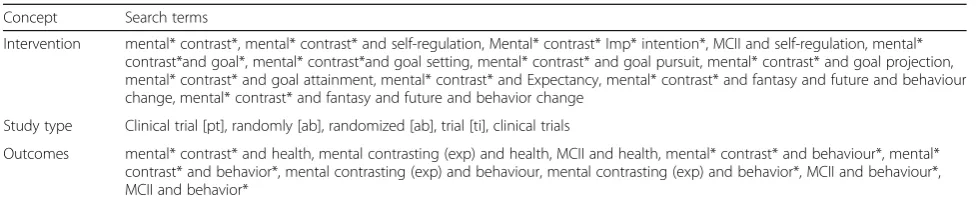
Table 1Search terms to be used
Concept Search terms
Intervention mental* contrast*, mental* contrast* and self-regulation, Mental* contrast* Imp* intention*, MCII and self-regulation, mental* contrast*and goal*, mental* contrast*and goal setting, mental* contrast* and goal pursuit, mental* contrast* and goal projection, mental* contrast* and goal attainment, mental* contrast* and Expectancy, mental* contrast* and fantasy and future and behaviour change, mental* contrast* and fantasy and future and behavior change
Study type Clinical trial [pt], randomly [ab], randomized [ab], trial [ti], clinical trials
be followed to evaluate and reduce the potential for bias in the review [23].
Data synthesis
Differences in effectiveness will be analysed according to outcomes and the number and type of BCTs used in each review study. Appropriate statistical techniques will be used for each type of continuous (weighted mean dif-ferences if outcomes are consistent or standard mean difference if different outcomes are used, with 95% CI) and dichotomous variables (risk ratios, with 95% CI). This review will also include a meta-analysis (if there is sufficient homogeneity of outcomes) to calculate pooled effect sizes across studies, using a random-effect model. Heterogeneity will be investigated in each study usingχ2 (significance level: 0.1) and Higgins I2 statistics, with high levels (as specified by guidance in the Cochrane Handbook for Systematic Reviews of Interventions [24]) being considered suitable for subgroup analysis to deter-mine the source of the heterogeneity.
If a meta-analysis is not possible, a narrative synthesis of all relevant studies will be conducted, including tables of study characteristics, participant and intervention de-tails, settings and outcomes.
Subgroups and sensitivity analysis
Analysis by subgroups will include (if possible or appro-priate) the following: mode of delivery (e.g. face-to-face or internet-delivered); BCTs; theoretical basis; and target-ing starget-ingle versus multiple health outcomes/behaviours, where possible subgroup analysis for categorical predictors will be undertaken, along with meta-regression for metric predictors. Sensitivity analysis will be carried out to deter-mine the effects of studies with a high risk of bias on the overall results with and without these studies. Mediators are likely to include (but not limited to) energisation, and moderator variables may be age, gender or type of health behaviour.
Meta-bias
This review will assess study protocols for outcome reporting bias by judging whether authors have selectively reported outcomes using the Cochrane tool for assessing risk of bias. Reporting bias will be analysed using statistics and forest plots.
Confidence in cumulative evidence
The quality of evidence for primary outcomes from each of the studies included in the review will be assessed using the Grading of Recommendations Assessment, Development and Evaluation (GRADE) guidelines [25], which include the following domains: design, study limi-tations, consistency, directness, precision and publica-tion bias. Each study and its relative outcomes will be
assessed using the GRADE guidelines. The quality of each review study will be judged as high (for studies in which we have a high level of confidence that the true effect lies close to that of the estimate of the effect), moderate (where we can be moderately confident in the effect estimate: the true effect is likely to be close to the estimate of the effect, but there is a possibility that it is substantially different), low (where our confidence in the effect estimate is limited because the true effect may be substantially different from the estimate of the effect), or very low (we have very little confidence in the effect esti-mate: the true effect is likely to be substantially different from the estimate of effect).
Discussion
This systematic review will provide a detailed overview of the existing evidence base for mental contrasting in-terventions that have been designed to improve health outcomes and health-related behaviour. It will also consider the effectiveness of the self-regulation strategy of mental contrasting as a behaviour change technique. Furthermore, examining the use of behaviour change techniques within mental contrasting interventions may provide clarity on the effective components of mental contrasting interventions. This will afford recommendations to be made about whether mental contrasting is effective as a stand-alone intervention, or whether the addition of other behaviour change techniques (such as those in implementation intentions) result to more improvement in health out-comes and health behaviours. Examining mediators may enable inferences about probable mechanisms of action to be made. Possible moderators may allow de-termination of those who are most likely to benefit from mental contrasting.
Our interpretation of the review studies will take into account limitations in review studies that have identified by the authors, along with any limitations identified by our review methodology. In conclusion, this is the first re-view to systematically identify and evaluate the effective-ness mental contrasting as a technique to change health behaviour.
Additional file
Additional file 1:Mental contrasting as a behaviour change technique: a systematic review protocol paper of effects, mediators and moderators on health. Preferred Reporting Items for Systematic review and Meta-Analysis Protocols (PRISMA-P) 2015 checklist: recommended items to address in a systematic review protocol. (DOC 115 kb)
Abbreviations
meta-analyses; QUOROM: Quality of reporting of meta-analyses; TIDIER: Template for intervention description and replication
Acknowledgements
No additional funding source is available. However, the resources and facilities of the University of Derby were used for identifying the review question. With thanks to Thomas Fuller, Ramona Meister and Judy Wright for their helpful comments and suggestions.
Funding
None
Availability of data and materials
All materials described in this protocol and the final manuscript will be made freely available to any scientist wishing to use them for non-commercial purposes.
Authors’contributions
AC and DS identified the review question and were co-authors on preparing and submitting the PROSPERO registration, including formulating the research question, search strategy and other aspects of the design of the review protocol. Both authors read and approved the final manuscript.
Authors’information
Not applicable
Competing interests
The authors declare that they have no competing interests.
Consent for publication
Not applicable
Ethics approval and consent to participate
Not applicable
Author details
1University of Derby Online Learning, University of Derby, Derby, UK. 2College of Life and Natural Sciences, University of Derby, Derby, UK.
Received: 11 May 2016 Accepted: 14 November 2016
References
1. Oettingen G, Pak H-J, Schnetter K. Self-regulation of goal-setting: turning free fantasies about the future into binding goals. J Pers Soc Psychol. 2001;80:736–53.
2. Michie S, et al. The behaviour change technique taxonomy (v1) of 93 hierarchically clustered techniques: building an international consensus for the reporting of behaviour change interventions. Ann Behav Med. 2013;46(1):81–95.
3. Oettingen G, Kappes HB, Guttenberg KB, Gollwitzer PM. Self-regulation of time management: mental contrasting with implementation intentions. Eur J Soc Psychol. 2015;45:218–29.
4. Duckworth AL, Kirby TA, Gollwitzer A, Oettingen G. From fantasy to action: mental contrasting with implementation intentions (MCII) improves academic performance in children. Soc Psychol Personal Sci. 2013;4:745–53. 5. Gawrilow C, Morgenroth K, Schultz R, Oettingen G, Gollwitzer P. Mental
contrasting with implementation intentions enhances self-regulation of goal pursuit in schoolchildren at risk for ADHD. Motiv Emot. 2013;37:134–45. 6. Locke EA, Latham GP. A theory of specifying goals and task performance.
Engle-wood Cliffs: Prentice-Hall; 1990.
7. Houssais S, Oettingen G, Mayer D. Using mental contrasting with implementation intentions to self-regulate insecurity-based behaviors in relationships. Motiv Emot. 2013;37:224–33.
8. Kappes A, Wendt M, Reinelt T, Oettingen G. Mental contrasting changes the meaning of reality. J Exp Soc Psychol. 2013;49:797–810.
9. Oettingen G, Schwörer B. Mind wandering via mental contrasting as a tool for behavior change. Front Psychol. 2013;4:562.
10. Sevincer AT, Oettingen G. Spontaneous mental contrasting and selective goal pursuit. Pers Soc Psychol Bull. 2013;39:1240–54.
11. Sheeran P, Harris P, Vaughan J, Oettingen G, Gollwitzer PM. Gone exercising: mental contrasting promotes physical activity among overweight, middle-aged, low-SES fishermen. Health Psychol. 2013;32:802–9.
12. Oettingen G. Future thought and behaviour change. In: Stroebe W, Hewstone M, editors. European Review of Social Psychology, vol. 23; 2012. p. 1–63
13. Oettingen G, Mayer D, Sevincer AT, Stephens EJ, Pak H, Hagenah M. Mental contrasting and goal commitment: the mediating role of energization. Pers Soc Psychol Bull. 2009;35:608–22.
14. Sevincer AT, Kluge L, Oettingen G. Implicit theories and motivational focus: desired future versus present reality. Motiv Emot. 2014;38(1):36–46. 15. Oettingen G. Future thought and behaviour change. Eur Rev Soc Psychol.
2012;23(1):1–63.
16. Gendolla GH, Silvestrini N. Bounded effort automaticity: a drama in four parts. In: Handbook of biobehavioral approaches to self-regulation: Springer New York; 2015. p. 271–86
17. Oettingen G. Expectancy effects on behavior depend on self-regulatory thought. Soc Cogn. 2000;18(2):101.
18. Sniehotta F, Presseau J, Arujo-Soares V. Time to retire the theory of planned behaviour. Health Psychol Rev. 2014;8(1):1–7.
19. Gollwitzer PM, Rohloff UB. The speed of goal pursuit. Advances in social cognition. 1999;12:147–59.
20. Gollwitzer PM, Sheeran P. Implementation intentions and goal achievement: a meta‐analysis of effects and processes. Adv Exp Soc Psychol. 2006;38:69–119. 21. Moher D, Liberati A, Tetzlaff J, Altman DG. Preferred reporting items for
systematic reviews and meta-analyses: the PRISMA statement. Ann Intern Med. 2009;151(4):264–9.
22. Hoffmann TC, Glasziou PP, Boutron I, Milne R, Perera R, Moher D, Lamb SE. Better reporting of interventions: template for intervention description and replication (TIDieR) checklist and guide. BMJ. 2014;348:g1687.
23. Shea BJ, Grimshaw JM, Wells GA, Boers M, Andersson N, Hamel C, Porter AC, Tugwell P, Moher D, Bouter LM. Development of AMSTAR: a measurement tool to assess systematic reviews. BMC Medical Res Methodology. 2007;7(10):1–10. e7-8.
24. Higgins JP, Green S, editors. Cochrane handbook for systematic reviews of interventions, vol. 5. Chichester: Wiley-Blackwell; 2008.
25. GRADE Working Group. Grading of recommendations. Assessment, Development, and Evaluation. 2007.
• We accept pre-submission inquiries
• Our selector tool helps you to find the most relevant journal • We provide round the clock customer support
• Convenient online submission • Thorough peer review
• Inclusion in PubMed and all major indexing services • Maximum visibility for your research
Submit your manuscript at www.biomedcentral.com/submit