ISSN 1392-2785 ENGINEERING ECONOMICS. 2006. No 2 (47)
WORK HUMANISM
Level of Labour Force and Average Wage: Correlation Aspect
Daiva Dum
č
iuvien
ė
, Gražina Startien
ė
, Renatas Morkv
ė
nas
Kauno technologijos universitetas Laisvės al. 55, LT-44309, Kaunas
Many years have passed and the world changed be-yond recognition since Adam Smith originated his supply and demand theory of labour market. Consequently the question comes to the fore: Do the models of economy from extramundane satisfy real situation of present-day market? This article presents the latest situation of the labour market. The number of employees in the labour market is not a vital factor but the most important is knowledge they have. To evaluate the knowledge of la-bour market is not so easy, because it is the qualitative parameter. But we can use statistical information which lets us estimate the correlation between knowledge level of labour force and average wages.
The technical achievements make a man study hard in order to maintain his personal value in the labour market. The latest achievements and globalization proc-ess oblige employers to find such employees who pass universal abilities and have very good orientation in the dynamic environment. The number of employees has de-creased to minimum because figures in employment are not too important. The main focus is on employee’s abili-ties and knowledge. The concept of these thoughts is: classical supply and demand theory of labour market does not work anymore, as it was created when we do not have modern transport system, huge capital, data and labour flows.
Innovations in information technologies are chang-ing economy. Organizational changes require complex processes and learning of new skills in enterprises. All areas of economy are transformed, because new tech-nologies demand to be adopted. As a consequence, the demand for knowledge is constantly growing everyday because the knowledge creation by professional groups such as researchers and engineers as well as by the different social communities, developing different forms of life, working life, family life, leisure and pub-lic space.
As the competition in labour market is very tough, lifelong learning becomes the most important. For a modern man one learning cycle during his life time is not enough because knowledge gets outdated very quickly. The interviews showed that distance studies are really a good proof in favour of lifelong learning, because in the era of globalization this fits the best. Recently education and training systems have been facing the challenge of building a so called learning society, improving their access to knowledge to different kinds of users taking advantage of the different kinds of media.
Keywords: labour force, knowledge economy, average wage.
Introduction
The globalization processes and technical achieve-ments force man to study lifelong that he would keep his value in the labour market. The most important task for a today employer is to find highly-qualified specialists yet number of them in the labour market is not a vital factor. Although world famous economist Adam Smith (1751 - 1790) wrote in his famous book “An Inquiry into Nature and Causes of the Wealth of Nations”: “But the wages of labour are generally higher in a prosperous town than in a country village. In such a town people who own great fund so as to employ many workers, frequently cannot called the number of workmen they need, and therefore they compete with one another in order to satisfy they needs, which raises the wages of labour, and lowers prof-its in stock”. However, in the present knowledge econ-omy the demand for knowledge increased very much. So the question is, what determines the average wages by circumstances of knowledge economy in the labour mar-ket – the number of employees that can be employed (Smith A., Ricardo D., Samuelson P., Saks D., Wonna-cott P., WonnaWonna-cott R. and etc.) or the abilities of workers that is knowledge and education?
In the last decade of the twentieth century American economist P. Drucker analysing the social side of post-industrial reformations characterised the new society as the knowledge society, which was already neither capital-ism, nor socialism. The transforming force of this new society is knowledge, which demotes capital, labour, land and other factors of production and creates wealth. How-ever, gaining knowledge necessitates much more invest-ments than investinvest-ments to capital.
Con-sequently, if the knowledge level of the country’s popula-tion can be evaluated, the influence of labour force knowledge level on average wage can be assessed using statistical methods as well.
Research object: average wage level in the knowl-edge economy.
Research objective: to prove that knowledge deter-mines average wages in the labour market in reference to the results of various scientific researches.
Research tasks: 1) The review of knowledge de-mand origin; 2) The analysis of life-long learning; 3) The analysis of the knowledge role in the modern economy; 4) Analysis of the country's knowledge level correlation with annual average wage.
Research methods applied - logical analysis and synthesis of scientific literature, the systematic analysis of statistics, interview, and the comparison and generali-zation method.
The origin of knowledge demand
For hundreds of years knowledge has been the main source of competitive ability in the market. In the old times a unique product “family recipe” used to be passed on from generation to generation. Although this was working very slowly but it opened the door to modern models of knowledge control such as the Internet.
The knowledge history goes back to the times of Plato and Aristotle; however, its modern conception is associated with such scientists as Daniel Bell (1973), Alvin Toffler (1980) and Japanese guru Ikujiro Nonaka (1995). Other scientists such as Sveiby (1997) and James Stewart (2002) popularized the knowledge conception as the main asset of organization. Nonaka names two kinds of knowledge - tacit and explicit knowledge. In the proc-ess of learning both kinds of knowledge intertwine.
At the end of the 20th century industrial countries en-tered a new stage of development – the stage of information society and knowledge economy. Information society enlists into itsdevelopment new fields of social life by transform-ing the modern culture and social – economical system.
In the sixties Drucker analyzing the role of knowl-edge in the enterprise introduced two new concepts “knowledge work” and “knowledgeable worker”. He was the first to mention that the USA economy turned from the industrial to the knowledge economy where the main resources are knowledge as opposed to capital, work and land. It means turning from the products market to the market economy. However, knowledge requires much more investments than investment to capital.
In the seventies the Massachusetts Institute of Tech-nology (MIT) and Stanford scientists analyzed how USA companies created, used and implemented knowledge. It was a basic step in the evolution of knowledge manage-ment. Till the eighties enterprises didn’t consider knowl-edge as an asset.
In the eighties introduction of the internet was the beginning of knowledge management. The internet pro-vided access to various publications about the concept of knowledge management, and knowledge management became a realizable idea.
The tendency of lifelong learning in the information society
The development of information society is related to technical and technological reversal and changes of social relations in society. These are the main differences be-tween information economy and industrial economy (Bell, 1973; Amidon, 2001).
The changes of social relations are conditioned by new information networks, and these relations already are not the work relations of industrial economy, thus they determine the birth of the new type social structure. Bell states that changes of social work relations appears when the nature is disengaged from work and daily activities, this situation occurs because work in the information society is no longer the relation with nature – it primarily is the relation of man and artificial environment, which is represented by intellectual producing machines.
Information society is often described as community constantly studying because the manual and technical basis of information society – information technologies - is developing so apace (Dodson, 1993; Mandelli, 2000) that the demand of learning lifelong becomes a necessity. The same opinion is presented by Bauman: “The techno-logical reversal of time/dimensional distances does not relieve existence of individual but gives him a gross obli-gation to study lifelong”. The life-long learning inten-tions of companies' employees can be demonstrated by analyzing data of Mykolas Riomeris University and re-sults, gained during the research of demand for distance studies (Morkvėnas, 2005), in which the focus group was the employees of Lithuanian banks.
The quantity of respondents was estimated by con-sidering that result reliability rate is 95 percent, standard error value units with normal distribution z = 1.96, ple error e = 5 percent and the proportion of general sam-ple is p = 50 percent. The general samsam-ple of the research is not very broad: N = 7369 (i.e. the number of bank em-ployees in 2004). Thus the number of bank emem-ployees is not bigger than 50 000, the magnitude of research sample n is calculated according to formula 1:
n=p(1-p)/((e/z)2 + p*(1-p)/N (1) n= 0,5*(1-0,5)/ (0,05/1,96 )2 + 0,5*(1-0,5) / 7369 = 0,25/0,0006507+0,00003391= 385 (respondents)
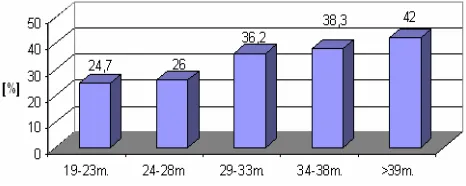
Employees of Lithuanian banks answered the ques-tion “If I decided to take up distance studies my choice would be predetermined”, and the results showed, that the older a man, the bigger a demand for the knowledge of the latest tendencies in their professional field (Figure 1).
It is obvious, that results prove a very big demand of life-long learning. The main reason for this is a great importance to know the latest tendencies of one's own professional field. Shifting from the youngest age range to the oldest the necessity of being aware of the latest tendencies of professional field rapidly increases: 19-23m. – 24.7 percent, 24-28m. – 26.0 percent, 29-33m. – 36.2 percent, 34-38m. – 38.3 percent and >39m. – 42.0 percent.
Such a big importance to study lifelong can be ex-plained by the fact that professional backwardness re-duces competitive ability of employees and companies, and consequently employees are constrained to seek for ways of learning (therefore reducing the risk of losing a job), so that they can keep their value and get a salary. The studying employees renew or develop new skills, which are the base of getting a salary. If the employees do not update qualifications and do not improve, a threat of losing income source appears. For this reason older people are obliged to revive their knowledge, and this explains the results showed in Figure 1. The constant seek for new knowledge proves the existence of relation between employees' knowledge and wages.
Scientific literature states that innovations in infor-mation technologies are changing our lives and the changes determine self learning and gaining knowledge. There can be discerned three main causes of changes:
• firstly, the incorporation of human intelligence in a wide variety of machines in factories and house-holds, with its ultimate expression in the com-puter, as a simulator and a multiplier of brain power (Negroponte, 1996).
• secondly, the development of telecommunication able to transmit voice, data and image, wired or wireless, which have multiplied the networked computers and improved interaction among all sorts of intelligent units (Cairncross, 1998; Mork-venas, 2006).
• thirdly, the invention of a pattern of interaction among networked computers – the Internet – that is particularly flexible and open to new initiatives and that is creating a new reality of organised in-formation, referred to as the Web (Levy, 1997; Mandelli, 2000; Morkvenas, 2006).
The role of knowledge in the knowledge economy
The result of learning is gained knowledge and skills, however just effective practical usage of knowledge can secure the long-lasting success in the hard competitive fight (Wikstrom, 1994). The knowledge itself is not valu-able until it is merged into the common knowledge sys-tem of the company or country. This generalizes the modern business orientation to knowledge management and country's orientation to knowledge economy. The main objective of knowledge management is to use intel-lectual capital effectively and profitably. The major aim of knowledge economy is to establish a favourable envi-ronment for spreading and creating knowledge, i.e. for forming of knowledge system.
Knowledge can be created by research or practical experimentation or acquired by recruitment or by
compe-tence assessment. Regarding knowledge application, it is possible to integrate it by product development, to repli-cate it by best practice transfer, to store it in data bases and to pool it by strategic planning. Specialised software provides useful tools for all these operations. Neverthe-less, the key factors of success in knowledge management are (Amidon, 2001):
• analysing the system of added-value where the company is placed;
• defining the innovation goals that can lead this company to more added-value;
• improving the synergy between marketing, re-search and production;
• building a learning network within the company and with its external partners;
• ensuring an effective leadership of this learning process.
There are at least tree tendencies of development, which explain the role of knowledge in modern knowl-edge economy.
The bigger part of social product of typical high tech-nology society is composed of the sales of “informa-tion/knowledge products and services” (Agyris, 1993). Knowledge substantially changes the traditional factors of manufacturing: capital and labour. Yet in 1980 Drucker stated, that in the sectors of intensive researches the expenses for knowledge made the biggest part of all costs: „Almost 70 percent of cost of semiconductor mi-crochips production composes from intellectual work (researches, development, testing) and manual work amounts no more than 12 percent. Similarly, in the phar-maceutical industry: manual work form no more than 12 percent and intellectual work includes almost 50 percent of all production costs” (Drucker, 1993). In such knowl-edge-intensive sectors as consulting, finance, software, biotechnology and etc, the knowledge input in the surplus value is especially big, because here primary investment are necessary for the creation of knowledge. Manual work can not be accomplished without proper knowledge as well. First of all, a man must gain a profound knowl-edge and then he can start to work.
The second tendency is market globalization which determines internationalization processes of many enter-prises. International division of labour influences the demand of knowledge selecting enterprises locations: for example, manufacturing is located in the undeveloped countries but researches and administration in the devel-oped countries (Agyris, 1993; Benchimol, 2001).
The third tendency is growing spread of information and communication technologies lead to the new forms of technology diffusion. In parallel with flexible manufac-turing the new information and communication technolo-gies enable to implement very useful forms of transac-tions between chains of value creation (e-commerce) (Benchimol, 2001).
the twenty-first century a primary asset of a company is the intellectual labour force, because they are holders of their working implements – knowledge. Also with refer-ence to Drucker research, we could draw a conclusion, that people who are employed for manual work and do not have proper knowledge for it have the lesser wages-fund in comparison to a wages-wages-fund of employees, that do intellectual work.
A new social structure is developing in the society, and workers who possess knowledge are a leading power in this society. They control both implements of produc-tion and work process. The main successful way to or-ganize activity is implementation of new methods of team-work, self-control and liability of employees (Drucker, 1994).
Annual average wage correlation with knowl-edge level of the labour market
The annual average wage is calculated by dividing all annual wage fund by average employee number. The analysis of data of distance learning demand research proved the existence of relation between employee knowledge and wages Drucker research showed, that a considerable part of wage fund is committed for intellec-tual work. If we assessed the level of labour force knowl-edge of variuos countries using the same index and as-suming that every country is a separate labour market, it will be possible to estimate the correlation between la-bour force knowledge level and annual average wage. The result of such estimation will show if knowledge really determines average wage.
As knowledge is a qualitative parameter, it is hard to evaluate it. However, countries are computing various indices of knowledge level. The World Bank offers to use the knowledge assessment methodology (KAM). The KAM was designed as an interactive tool for benchmark-ing a country’s position vis-a-vis others in the global knowledge economy. The KAM consists of 80 structural and qualitative variables, which let us estimate the gen-eral economical characteristics and knowledge levels of different countries. As working with a large set of 80 variables can be unwieldy, in this research only the main KAM indices, will be used. These indices are composed of separate parameters: 1) Knowledge Economy Index (KEI); 2) Knowledge Index (KI); 3) Education Index (II).
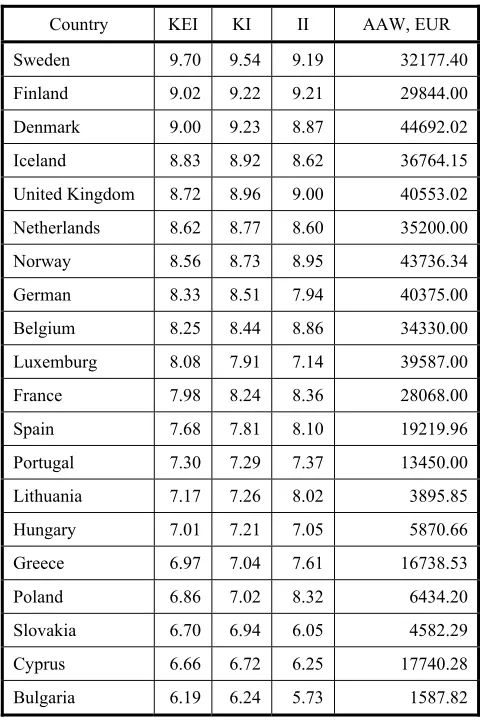
The data, which is used for the research, is assembled in table 1. Knowledge economy, Knowledge and Educa-tion indices are taken from the statistical data-base KAM of World Bank and the annual average wages (AAW) are taken from the reports of Statistical Department „Euro-stat” of European Union (2005).
The range of KEI, KI and II indices are from 0 to 10 (Table 1). These parameters are normalized, and the methods of normalization are described in World Bank knowledge evaluation methodology KAM.
The Knowledge Economy Index (KEI) takes into account whether the environment is conducive for knowl-edge to be used effectively for economic development. It is an aggregate index that represents the overall level of development of a country or region towards the Knowl-edge Economy. The KEI is calculated based on the
aver-age of the normalized performance scores of a country or region on all four pillars related to the knowledge econ-omy: 1) economic incentive and institutional regime; 2) education and human resources; 3) the innovation system; 4) Information and communication technology.
Table 1 The statistics of European countries annual wages and indices
of knowledge level (2003-2004)
Country KEI KI II AAW, EUR
Sweden 9.70 9.54 9.19 32177.40
Finland 9.02 9.22 9.21 29844.00
Denmark 9.00 9.23 8.87 44692.02
Iceland 8.83 8.92 8.62 36764.15
United Kingdom 8.72 8.96 9.00 40553.02
Netherlands 8.62 8.77 8.60 35200.00
Norway 8.56 8.73 8.95 43736.34
German 8.33 8.51 7.94 40375.00
Belgium 8.25 8.44 8.86 34330.00
Luxemburg 8.08 7.91 7.14 39587.00
France 7.98 8.24 8.36 28068.00
Spain 7.68 7.81 8.10 19219.96
Portugal 7.30 7.29 7.37 13450.00
Lithuania 7.17 7.26 8.02 3895.85
Hungary 7.01 7.21 7.05 5870.66
Greece 6.97 7.04 7.61 16738.53
Poland 6.86 7.02 8.32 6434.20
Slovakia 6.70 6.94 6.05 4582.29
Cyprus 6.66 6.72 6.25 17740.28
Bulgaria 6.19 6.24 5.73 1587.82
Source: Eurostat and World Bank
Knowledge Index (KI) measures a country's ability to generate, adopt and diffuse knowledge. This is an indi-cation of overall potential of knowledge development in a given country. Methodologically, the KI is the simple average of the normalized performance scores of a coun-try or region on the key variables in three Knowledge Economy pillars: 1) education and human resources; 2) the innovation system; 3) information and communica-tion technology.
Education Index (KI) – this indice consists of dif-ferent educational parameters: “brain drain”, accessibility to Internet at schools, scale of employee learning, ex-penses for education, etc.
The results of the statistical research show that corre-lation between the knowledge level indices and annual average wages is very strong (Table 2, Figure 2). The coefficient of correlation exceeds 50 percent. Further-more, calculated general multiple regression coefficient R equals 85 percent, so the conclusion can be drawn that correlation between knowledge level indices of countries and annual average wages is very strong. The general coefficient of determination shows that almost 75 percent of annual average wage is determined by the country knowledge level. Other 25 percent (100 – 75 = 25 per-cent) is unvalued factors.
Table 2 The correlation between knowledge level indices and annual
average wages
KEI KI II AAW, EUR
KEI 1 0.99 0.84 0.85
KI 1 0.86 0.85
II 1 0.66
AAW, EUR 1
Total regression coefficient 0.87
Total determination coefficient 0.75
0 5000 10000 15000 20000 25000 30000 35000 40000 45000 50000
5.50 6.00 6.50 7.00 7.50 8.00 8.50 9.00 9.50 10.00
Unit of index
V
M
DU,
E
U
R
With Education index With Knowledge index With Knowledge Economy index
Turning point
Figure 2. Correlation of annual average wage with KEI, KI, EI
Source: Eurostat and World Bank
As it can be seen in Figure 2, the correlation between KEI, KI and II is positive, i.e. the general tendency is described like this: when aforementioned indices are increasing, the average wages are increasing as well. It should be noted that correlation between Education index and annual average wage is a bit weaker (66 percent) than the correlation between KEI and KI with AAW. So the conclusion arises that a well developed educational sys-tem does not necessarily guarantees high level of wages. The similar tendency can be seen in Figure 2 as well, because when the II is low, the annual average wages are very high. This situation can be explained with the argu-ment that education provide only knowledge, but it have to be used in practice, and that requires experience, fa-vourable environment, resources, i.e. possibilities to im-plement and to manage knowledge, which in fact is what the indices KI and KEI assess. In countries where there are no knowledge economy (KEI and KI are low), the annual average wages are lower in comparison with the general tendency.
The marked break-point (Figure 2) shows that an-nual average wages starts to increase when KEI and KI reaches the value of ~7,3.
Conclusions
The average wages of a country or region is deter-mined not only by the number of workers of a labour market, but by the level of labour force knowledge as well, because:
1. The demand of knowledge is increasing and
life-long learning is becoming inevitable. Analyses of demand of distance studies showed that moving from the youngest age range to the oldest the de-mand for finding out the latest tendencies of pro-fessional field rapidly increases: 19-23m. – 24,7 %, 24-28m. – 26,0 %, 29-33m. – 36,2 %, 34-38m. – 38,3 % ir >39m. – 42,0 %; Such constant seek-ing of knowledge proves the existence of relation between employees' knowledge and wages.
2. The analyses of notable scientists (Drucker P., Bell
D., Dodson, M., Agyris, C., and other) works pro-vided more evidences and the main conclusion is that knowledge economy really creates greater sur-plus value. Especially important is the research done by Drucker, the results of which indicated that: “Almost 70 percent of cost of semiconductor microchips production composes from intellectual work (researches, development, testing) and manual work amounts no more than 12 percent. Similarly, in the pharmaceutical industry: manual work form no more than 12 percent and intellectual work in-cludes almost 50 percent of all production costs”
(KEI, KI, II) of countries and annual average wages is very strong. The general coefficient of determination shows that almost 75 percent of an-nual average wage is determined by the country knowledge level.
Such changes emerged because of global reasons as they basically determined the formation of information society and knowledge economy:
1. Development of transport system, huge capital and data flows (Internet).
2. High technology and particularly rapid diffusion of innovation and technology in the society. 3. The formation of global and mobile labour market. 4. A huge competition in the global labour market. 5. The new possibilities to study and improve
life-long (distance learning).
6. The growing influence of transnational companies. The results of the statistical research proved that edu-cation does not guarantee high annual average wage, i.e. knowledge provides benefit only if it is used in practice.
References
1. Agyris, C. An Organisational Learning. Blackwell, 1993, p.112- 135. 2. Amidon, M. Innovation et Management des Connaissances. Paris:
Editions d'Organination, 2001, p.122-123.
3. Benchimol, G. E-organisation, mode d‘emploi, Paris: Editions d‘Oganisation, 2001.
4. Bell, D. The Coming of Post-Industrial Society: A Venture in Social Forecasting. New York: Basic Books, 1973.
5. Bauman, Z. Globalizacija: pasekmės žmogui. Laikas ir klasė. Vil-nius: Strofa Academia, 2002, p.7-26.
6. Cairncross, F. The Death of Distance – How the Communications Revolution will Change our Lives. London: Orion Business, 1998, 15p. 7. Cole, G.A. Personnel Management. Theory and practice. London: DP
Publications Ltd., 1993. 128p.
8. Dodgson, M. Organisation Learning: A Review of Some Literatures // Organisation Studies, 1993, Vol. 4, No 3, p.375-394.
9. Drucker, P. Post-Capitalist Society. New York: Harper Business, 1993, p.68-83.
10. Drucker, P. Knowledge Work and Knowledge Society: The Social Transformations of this Century // Lecture at Harvard University‘s John F. Kennedy School of Government, 1994. Prieiga per internetą: <http://www.ksg.harvard.edu/ifactory/ksgpress/www/
ksg_news/transcripts/drucklec.htm>
11. Garrone, P. L‘Economia Digitale, Bologna / P. Garrone, S. Mariotti // Il Mulino, 2001, 165p.
12. Nonaka, I. The Knowledge-Creating Company./ I. Nonaka, H. Ta-keuchi // Oxford University Press, 1995, 91p.
13. Levy, P. Cyberculture, // Editions du Conseil de l‘Europe, Paris: Editions Odile Jacob, 1997.
14. Mandelli, A. Il Mondo in Rette – Economia di Network e Nouvi Media. Milano: E.G.E.A, 2000.
15. Morkvėnas, R. The distance studies demand in the Lithuania Bank Sector – report // Mykolo Romerio University, 2005. p.9-12. 16. Morkvėnas, R. The Adopting Strategies and Problems of Information
Technology in the Enterprise // Information Technology - 2006: pro-ceedings of the scientist conference on information technology. ISBN 9955-09-993-3. Kaunas, 2006, p.657-662
17. Negroponte, N. Being Digital. New York: Vintage Books, 1996. 18. Panorama of the European Union. Europe in figures // Eurostat
year-book 2005. Chapter 3. European Commission, 2005. 32p.
19. Ricardo, D. On the Principals of political Economy and Taxation. Cambridge University Press. Prieiga per internetą: <http:// online-books.library.upenn.edu>
20. Samuelson P. Macroeconomics / P. Samuelson, W. Nordhaus. Bos-ton, MA: McGraw-Hill, 2001. p.97-105.
21. Smith, A. An Inquiry into Nature and Causes of the Wealth of Na-tions. Oxford University Press. Prieiga per internetą: <http:// online-books.library.upenn.edu>
22. Sveiby, E. The new organizational wealth. San Francisco, Berrett-Koehler Publishers, 1997.
23. Stewart, J. "Individual Learning", in Human Resources in Organisa-tions / J. Stewart, J. Leopold. FT Prentice Hall, 2002.
24. Toffler, A. The Third Wave: The Classic Study of Tomorrow. Ban-tam Books, 1980.
25. Wikstrom, S. Knowledge and Value – a New Perspective on Corpo-rate Transformation / S. Wikstrom, R. Normann. London: Routledge, 1994, p.48-67.
26. Wonnacott P., Wonnacott R. Mikroekonomika./ P. Wonnacott, R. Wonnacott. Kaunas: Poligrafija ir Informatika, 1997, p. 415- 431 27. The World Bank. Knowledge Assessment Methodology, 2005
Prieiga per internetą: <http://info.worldbank.org/etools/kam2005/>
Daiva Dumčiuvienė, Gražina Startienė, Renatas Morkvėnas
Darbo jėgos žinių lygio ir vidutinio darbo užmokesčio koreliacija
Santrauka
Globalizacijos procesai ir techniniai pasiekimai verčia žmogų
mokytis, kad jis išlaikytų savo vertę darbo rinkoje. Šiandieniniam darbdaviui svarbiausia surasti tinkamos kvalifikacijos darbuotojus, ir jų skaičius darbo rinkoje nebėra esminis. Nors vienas žymiausių
pasaulio ekonomistų A. Smith (1751 - 1790) savo žymiajame veikale „Tautų turto prigimties ir priežasčių tyrinėjimas“ rašė: „Klestinčiame mieste, kur žmonės turi daug kapitalo, jie dažnai negauna tiek darbi-ninkų, kiek norėtų, ir todėl kelia kainas, norėdami gauti tiek darbi-ninkų, kiek pajėgtų įdarbinti. Tai pakelia darbo kainą ir numuša pelną“, tačiau dabartinėje, žinių ekonomikoje labai smarkiai išaugo žinių paklausa. Todėl iškyla klausimas, kas lemia vidutinį darbo užmokestį darbo jėgos rinkoje žinių ekonomikos sąlygomis? Ar darbuotojų, kurie gali būti pasamdyti, skaičius (A. Smith, D., Ricar-do, P. Samuelson, D. Saks, P. Wonnacott, R. Wonnacott ir kt.)? Ar darbuotojų gebėjimai, t.y. žinios ir išsilavinimas?
XX a. paskutiniame ketvirtyje pramonės šalys įžengėį naują sa-vo vystymosi stadiją – informacinės visuomenės ir žinių ekonomikos stadiją. Informacinės visuomenės vystymasis (Bell, 1980) susijęs su perversmu technikoje ir technologijoje bei socialinių santykių pobū -džio pokyčiais visuomenėje. Tuo informacinė ekonomika skiriasi nuo prekių ekonomikos. Informacinė visuomenėį savo vystymąsi įtraukia vis naujas visuomeninio gyvenimo sferas, transformuodama šiuolai-kinę kultūrą ir socialinę bei ekonominę sistemą. Tai sąlygoja į vyks-tantys dideli pokyčiai įmonėse, reikalaujantys sudėtingų organizaci-nių pasikeitimų ir naujų gamybos, organizavimo ar vadovavimo metodųįsisavinimo.
Mokslinė literatūra nurodo, kad inovacijos ir informacinės te-chnologijos keičia žmogaus gyvenimą, o pokyčiai savaime lemia mokymąsi ir žinių įgijimą. Pagaliau žinios tampa įdomiu tyrimų
objektu ir svarbiausiu žinių ekonomikos veiksniu.
20 a. 8-ajame dešimtmetyje Masačusetso technologijos instituto (MIT) ir Stenfordo universiteto mokslininkai analizavo kaip JAV kompanijos kuria, naudoja ir paskleidžia žinias. Tai buvo esminis žingsnis žinių valdymo evoliucijoje. Iki 9-ojo dešimtmečio kompani-jos žinių nevertino kaip turto. Ekspertinės sistemos suklestėjo kai 1980-1990-aisiais bandyta sukurti „mąstančias mašinas”, o ne panau-doti mašinas žmogaus mąstymui patobulinti.
Ekonomika, paremta žiniomis, reikalauja glaudaus visų instituci-jų bendradarbiavimo, kadangi aplinka pasidarė labai sudėtinga ir tik komandinis darbas teikia galimybę sukurti didelę pridėtinę vertę.
Žinios gali būti sukurtos ir kaupiamos, pasitelkus mokymąsi, mokslinius tyrimus, praktinius pritaikymus ar pritraukiant naujus darbuotojus. Dėl to atsiranda galimybė žinias pritaikyti produkto (paslaugos) vystymui ir gamybai, įtraukti į strateginį planavimą ir pan. Pačios žinios nėra vertingos, kol neįtrauktos į bendrą žinių si-stemą – įmonės ar valstybės lygmeniu. Šiandieninis verslas orientuo-jasi į žinių vadybą, o valstybė – į žinių ekonomiką. Žinių vadybos pagrindinis tikslas – efektyviai ir pelningai išnaudoti intelektualinį
kapitalą. Žinių ekonomikos pagrindinis tikslas – sukurti palankią
aplinką žinioms skleisti, kurti, t.y. žinių sistemai formuoti.
Tyrimo tikslas: remiantis mūsų ir kitų mokslininkų tyrimų rezul-tatais, parodyti, kad žinios lemia vidutinį darbo užmokestį darbo jėgos rinkoje.
Uždaviniai, kuriuos išsprendus įgyvendinamas tikslas, yra šie: žinių poreikio atsiradimo apžvalga; mokymosi visą gyvenimą analizė; žinių vaidmens šiuolaikinėje ekonomikoje analizė; šalies žinių lygio koreliacijos su vidutiniu metiniu darbo užmokesčiu analizė.
Atliktas nuotolinių studijų poreikio tyrimas Mykolo Romerio uni-versitete parodė, kad poreikis mokytis visą gyvenimą yra labai didelis. Pradedant nuo jauniausios amžiaus grupės iki seniausios būtinybė žinoti naujausias savo darbo srities tendencijas stipriai auga: 19-23m. – 24.7 proc., 24-28m. – 26,0 proc., 29-33m. – 36,2 proc., 34-38m. – 38,3 proc. ir >39m. – 42 proc. Iš to padarėme pirmąją išvadą: nuolatinis žinių siekimas leidžia teigti, kad egzistuoja ryšys tarp darbuotojų žinių ir darbo užmoke-sčio. Jei darbuotojas neatnaujina savo kvalifikacijos ir netobulėja, at-siranda grėsmė prarasti pajamų šaltinį.
Nagrinėdami kitų mokslininkų tyrimų rezultatus, išskirtinį dė -mesį skyrėme Drucker tyrimui, nes jo rezultatai parodė, kad intensy-vių tyrimų šakose didžiąją kaštų dalį sudaro mokestis už žinias: „Beveik 70 proc. puslaidininkinių mikroschemų gamybos kaštų su-daro intelektualinis darbas, t.y. tyrinėjimas, vystymas ir testavimas ir ne daugiau kaip 12 proc. fizinis darbas. Vaistų pramonėje fizinis darbas sudaro ne daugiau kaip 15 proc., o intelektualinis beveik 50 proc. visų gamybos kaštų“. Drucker nuomone, didžiausias kompani-jos turtas XXI amžiuje – tai protinio darbo darbuotojai: jie yra savo darbo priemonių – žinių savininkai. Darbuotojų, dirbančių fizinį
darbą, darbo užmokesčio fondas daug mažesnis, palyginti su darbuo-tojų, atliekančių intelektualinį darbą (Drucker, 1994,1993).
Nuotolinių studijų poreikio tyrimo duomenų analizė parodė, kad esama ryšio tarp darbuotojų žinių ir darbo užmokesčio; be to Drucker tyrimas rodo, kad didelė darbo užmokesčio fondo dalis atitenka in-telektualiam darbui atlikti. Jei galėtume skirtingų šalių darbo jėgos žinių lygįįvertinti tuo pačiu indeksu ir kiekvieną šalį laikytume kaip atskirą darbo rinką, tai galėtume nustatyti darbo jėgos žinių lygio ir vidutinio metinio darbo užmokesčio1 koreliacinį ryšį. Gautas
rezulta-tas parodytų ar tikrai žinios lemia vidutinį darbo užmokestį.
Straipsnyje pateikta žinių įvertinimo metodologijos (KAM) samprata. KAM buvo sukurtas kaip žinių lygio nustatymo įrankis (benchmarking), leidžiantis įvertinti šalių poziciją globalioje žinių
ekonomikoje. KAM susideda iš 80 struktūrinių ir kokybinių rodiklių, matuojančių bendras ekonomines šalių charakteristikas ir žinių
1Vidutinis metinis darbo užmokestis (VMDU) apskaičiuojamas visą
metinį darbo užmokesčio fondą padalijus iš vidutinio darbuotojų
skai-čiaus.
nomikos lygį. Tačiau darbas su 80 rodiklių yra sudėtingas, todėl savo statistiniame tyrime naudojome pagrindinius KAM indeksus, susid-edančius iš atskirų rodiklių:
1. Žinių ekonomikos indeksą (KEI) – jis įvertina, ar aplinka leidžia efektyviai panaudoti žinias ekonomikos vystymui; 2. Žinių indeksą (KI) – jis įvertina šalių sugebėjimus generuoti,
įsisavinti ir skleisti žinias;
3. Išsilavinimo indeksą (II) – jis susideda iš įvairių išsilavinimą
apibūdinančių rodiklių: protų nutekėjimo, interneto prieina-mumo mokyklose, darbuotojų mokymosi masto, išlaidų
mokslui ir t.t.
Kadangi galime įvertinti šalies gyventojų žinių lygį, tai pasinau-doję statistiniais metodais, įrodėme, kad darbo jėgos žinių lygis stipriai koreliuoja su vidutiniu darbo užmokesčiu, nes apskaičiuoti koreliacijos koeficientai viršija 50 proc. Apskaičiuotas bendras de-terminacijos koeficientas rodo, kad net 75 procentus vidutinio metinio darbo užmokesčio, nulemia šalies žinių lygis. Statistiniam tyrimui atlikti panaudota Europos šalių vidutinio metinio darbo užmokesčio statistika ir Pasaulio banko skaičiuojami žinių lygį
matuojantys indeksai.
Pažymėtina, kad išsilavinimo indekso ir vidutinio metinio darbo užmokesčio koreliacija yra silpnesnė (66 proc.) už KEI (85 proc.) ir KI (85 proc.) koreliaciją su VMDU. Vadinasi, išsilavinimas dar negarantuoja aukšto darbo užmokesčio, nes išsilavinimas teikia tik žinias, tačiau joms realizuoti reikia patirties, tinkamos aplinkos, išteklių, t.y. galimybių realizuoti ir sugebėjimų valdyti žinias, ką ir
įvertina KI ir KEI. Todėl šalyse, kuriose nėra žiniomis paremtos ekonomikos (KEI ir KI žemi), vidutinis metinis darbo užmokestis yra žemesnis.
Pažymėtas lūžio taškas (2 paveikslas) rodo, kad vidutinis metinis darbo užmokestis pradeda augti tada, kai KEI ir KI pasiekia ~7,3 reikšmę.
Taigi, remdamiesi kitų mokslininkų tyrimų rezultatais (Drucker tyrimas) ir savo atliktais tyrimais nustatėme, kad yra poreikis atnau-jinti ir papildyti profesinės srities žinias, kas sąlygoja mokymosi visą
gyvenimą tendenciją, ir įrodėme, kad šalies arba regiono vidutinį
metinį darbo užmokestį lemia ne tik darbuotojų skaičius darbo rin-koje, bet ir darbo jėgos žinių lygis.
Raktažodžiai: konkurencingumas, darbo jėga, žinių ekonomika, vidutinis darbo užmokestis.
The article has been reviewed.