Vol.7 (2017) No. 1
ISSN: 2088-5334
Framework based on Mobile Augmented Reality for Translating Food
Menu in Thai Language to Malay Language
Muhammad Pu, Nazatul Aini Abd Majid, Bahari Idrus
* #Center for Artificial Intelligence Technology (CAIT), Faculty of Information Science and Technology, Universiti Kebangsaan Malaysia (UKM), 43600 Bangi, Selangor, Malaysia
E-mail: *[email protected]
Abstract— Augmented reality (AR) technology is a technique that combines the real world and the virtual world digitally using
mobile devices. Mobile AR technology is expected to help Malaysian tourists who have difficulties to understand the Thai language when visiting the country. Hence, a prototype called ARThaiMalay translator was developed to translate printed Thai food menu to Malay language. The objective of this study is to design a food menu translation framework from Thai to Malay language based on mobile AR, develop a translator application and to test the effectiveness of the translator application. The prototype consists of three main components which are translation based on optical character recognition (OCR) technology, dictionary development using SQLite database and display data from the local database. Evaluation of the developed application shows its effectiveness to perform translation of Thai text with certain features to Malay language.
Keywords— malay language; mobile augmented reality; optical character recognition; thai language; translation.
I. INTRODUCTION
Translating foreign language for a tourist using a mobile phone can prevent undesirable difficulties and allow the tourist to explore the visited country with ease. In visiting Thailand, for example, the use of mobile phone for translating the Thai language to Malay language can help Malaysian tourists to experience the Thai culture effectively. However, developing a real-time translator for Thai language is difficult since the language is complex with 44 voiced consonants, 32 vocals, four stage tones in one paragraph, 10 numbers and five special symbols. The problems in translating Thai language have motivated this research to use mobile AR and OCR to develop a new Thai-Malay translator. AR technology is a technology that allows a virtual image to combine with physical objects on a computer screen or a smartphone in real time [1]. Wagner et al [2] reported the camera phone allows the use of magic lens in carrying out technology-based AR application. For example, mARGraphy application that uses a mobile phone camera to detect a traditional map marker in identifying and displaying objects in 3D so that the user can clearly understand the information on the map [3]. In addition, OCR technology is a powerful tool to bring information from analog to digital [4]. OCR technology is capable to detect, recognize and extract either printed or written text to understand the writing so that it will help users to scan
documents that need further analysis.Both technology, AR and OCR has been used for a number of proposed translators including TranslatAR: a mobile augmented reality translator on the Nokia N900 [5], android real time translation for translating Japan language to Indonesia language [6], and application of augmented reality: mobile camera based Bangla text detection and translation [7]. These works have shown the potential of a mobile AR and OCR based apps to translate complex languages such as non-Roman languages. Therefore, this paper presents a model to develop a mobile AR and OCR based app that can be used to translate complex Thai language to Malay language. This paper is organized as follows: Section 2 presents related work about Thai language and translation and also described about AR for translation. Section 3 discussed the model of ARThai Malay translator. Finally, section 4 presents the conclusion.
A. Thai Language and Translation
Fig. 1. Examples of some Thai characters that are almost the same
According Tanprasert and Koanantakool [10], writing Thai language is starting from left to right with the line of the page from top to bottom. Every word in Thai language has a four-level tones of voice. The meaning of the word depends on the tone of those words. Fig. 2 shows that there are four stages in the writing of Thai language. This stages cause Thai letter recognition process difficult. Although there are online dictionary for translating Thai Language to Malay language such as Bing and Google Translate, it is difficult for tourists to type in the words in Thai Language. Furthermore, some words were not accurately translated by Bing and Google translate. Therefore, there is a need to develop a new translator that can directly capture Thai printed texts without typing and translate it into Malay language. Mobile AR with OCR technology is the viable option to develop the translator.
Fig. 2. Four stages in the writing of Thai words
B. Models of Translation Application
Du et al. [11] explained that the two examples of very famous translation app is Pleco and Word Lens. Pleco application [12], is the Chinese dictionary application that designed to translate Chinese into English without requiring an internet connection. Pleco application can be used on iOS and Android platforms. While Word Lens [13] is a smartphone app that can translate signboards in English to Spanish using camera phone with the results of translations will be directly displayed on the phone screen. However, both of these applications work properly if the translation involve the words one by one. Word Lens uses the camera of a smartphone to scan the text and identify the text. The text will be translated and displayed on mobile devices according to the selected language. The original text is displayed and the translation is done in real time without an internet connection. After the text translation, the translated word is displayed as the original image was captured. Word Lens is an AR application that can read printed text using OCR technology. Translation applications based mobile AR technology have also been studied by several researchers, including [5], [7], [6] and [14].
C. Automatic text detection for mobile augmented reality translation
Fragoso et al. [5] developed a mobile AR translation system, using a smartphone's camera and touchscreen that can automatically detect, extract, track and translate a text that has been tapped earlier, and finally present the translation as a live AR overlay. The application starts by scanning a marker text and the translation results will be displayed in the form of AR display. An algorithm was developed to locate and orient the text precisely on streaming directly. The ICDAR 2003 detection dataset was used to evaluate the system. In the system, OCR technique was used to recognize the patterns of the text. Tesseract OCR is easy to use because it can be compiled on any target platform. The input language was detected automatically by Google Translate, and the desired output language can be selected by the user in the GUI of the system. Fig. 3 shows the main steps in the system. Petter et al. [14] developed a detection algorithm for text translation system that was designed for AR based application. The aim of their study was to improve the capabilities of translation application that was built by Fragoso et al. [5] where the proposed application can automatically find the text for translation without tapping on the mobile phone screen. The algorithm consists of three main steps as shown in Fig. 4.
Fig. 4. Three steps in text detection algorithm [14]
D. Mobile augmented reality translation for Japan-Indonesia and Bangla-English
Application of mobile augmented reality for Japan to English was developed by Nugroho et al. [6] by using engine (Tesseract) and Google translate API for Android operating system. Meanwhile, an application for translating Bangla to English was developed by Mahbub-Uz-Zaman & Islam [7] that also used similar techniques which are engine (Tesseract) and Google translate API for Android operating system. The framework for both applications can be visualized in several steps as shown Fig. 5. This framework put less focus in text detection technique as compared to the framework in Fig. text detection technique as compared to the framework in Fig. 3 by Fragoso et al. [5]. As shown in Table I, mobile AR has been used to translate languages using OCR but none of the apps focus on translating Thai language to Malay language. Most of the apps in Table 1 must use internet connection and Google API for translation. Since some texts cannot be accurately translated using Google translation, especially three words, this research proposed a translator based on mobile AR with OCR, and used a local database, SQLite, as part of the translation.
Fig. 5. Main steps for mobile augmented reality translation for Japan-Indonesia and Bangla-English [6]
TABLEI
RESEARCH ON USING AR WITH OCR FOR TRANSLATION
Research Implementation Technique Advantages / disadvantages
TranslatAR: A Mobile AR Translator on the Nokia N900 [5]
The text area detection, video frames orientation and works with the press of a button. Displays results directly on phone screen.
- Using standard off the shelf as a library to support multiple language - OCR and AR
Using the internet connection to translate words Automatic text detection for mobile AR translation [14]
Using a mobile phone camera and the touch screen. User simply tap on the words that need to be translated, and the results appear in the form of AR
- Use ICDAR 2003 dataset - Using a
mobile phone camera and touchscreen - OCR
- Cannot translate Thai - Using the
internet connection to translate words Realtime Android applications Translation to translate Japanese to Indonesian [6] Design applications for translation using a pre-identified programming language. The results appear in the form of AR
- OCR - Google API - Mobile phone
camera and touchscreen
- Translate Japanese to Indonesia only - Using the
internet connection to translate words Application of AR Mobile camera based Bangla text detection and translation [7]
Users do not need to type a word to translate. The text is captured by a mobile phone camera. The test is translated and displayed on the mobile phone screen.
- Tesseract OCR - Google API - Open source application based on Android and OCR
- Translating from English to Bangla language only. - Using the
internet connection to translate words
II. MATERIAL AND METHOD
Fig. 6. Development architecture for ARThaiMalay translator
Fig. 7. Framework for ARThaiMalay Translator
Fig. 8. Results of the scanning
The tracking component processes the captured images with two main steps. Firstly, the captured image is decoded using an OCR engine which is tesseract. The result of the recognition of the Thai language using the OCR technique is passed to the translation module. Secondly, the result which is the Thai text is translated to Malay words by using local database, SQLite. The identified Thai texts are matched with Thai word contained in the database and translated into Malay words. This study only uses a tracking technique that is based on the vision camera. If the translation for the Thai word has been found, the result will be sent to the rendering component. The rendering component will overlay the AR output which is the translation of the Thai words in Malay language. Framework for dictionary development provides functions to add menu in Thai language and their translation in Malay Language and save them into the database of the application (Fig. 9). All the menu lists are stored in a SQLite database. An example of data for the database listed in Table II. Framework for display provides function to display all the lists of Thai and Malay language menu on the screen of the mobile phone. Users will be able to view the food menu in Thai and the meanings in Malay on the mobile screen (Fig. 10).
Fig. 9. Interface for developing a dictionary
TABLEII
EXAMPLE OF INPUT FOR DICTIONARY DEVELOPMENT
No Menu in Thai Menu in Malay
1 ปลาทอด Ikan Goreng
2 ขาวเปลา Nasi Putih
Fig. 10. Interface for displaying information
III. RESULTS AND DISCUSSION
One of a popular Thai menu is fried sea bass or in Thai is
ปลากระพงทอด. This menu is not accurately translated by
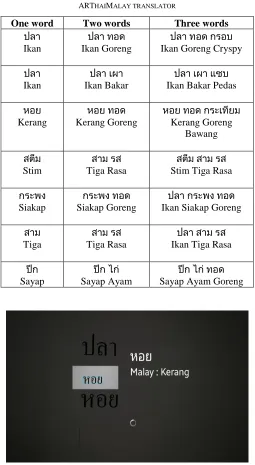
Google translate or Bing (Fig. 11) because the correct translation is ikan siakap goreng. Furthermore, the tourists need to type in the words in Thai Language by using this online dictionary. A prototype of ARThaiMalay translator developed for android phone can directly capture printed Thai words and translate it to Malay language without typing the Thai words. The result is shown in Fig. 12. This shows the use of the prototype based on the framework in Fig. 7 is a viable option to develop an effective translator for Thai to Malay language. As shown in Table III, the ARThaiMalay translator can translate Thai food menu to Malay language effectively although with different light setting (e.g. Fig. 12, 13 and 14). The translation accuracy for the listed words in Table 3 is 100%.
Fig. 11. Translation from Bing translator
Fig. 12. Translation for three words of Thai Language
TABLEIII
LIST OF MENU THAT CAN BE ACCURATELY TRANSLATED USING
ARTHAIMALAY TRANSLATOR
One word Two words Three words
ปลา Ikan
ปลาทอด
Ikan Goreng
ปลาทอดกรอบ
Ikan Goreng Cryspy
ปลา Ikan
ปลาเผา
Ikan Bakar
ปลาเผาแซบ
Ikan Bakar Pedas
หอย Kerang
หอยทอด
Kerang Goreng
หอยทอดกระเทียม
Kerang Goreng Bawang
สตีม Stim
สามรส
Tiga Rasa
สตีมสามรส
Stim Tiga Rasa
กระพง Siakap
กระพงทอด
Siakap Goreng
ปลากระพงทอด
Ikan Siakap Goreng
สาม Tiga
สามรส
Tiga Rasa
ปลาสามรส
Ikan Tiga Rasa
ปก Sayap
ปกไก Sayap Ayam
ปกไกทอด
Sayap Ayam Goreng
Fig. 14. Translation for two words of Thai Language
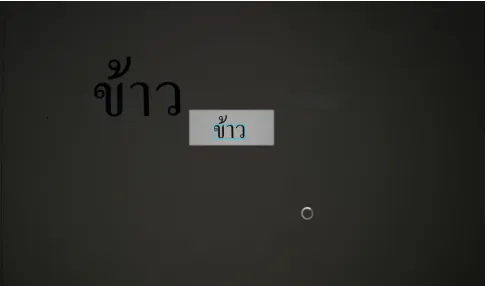
However, there is also a list of food menu that cannot be translated accurately using ARThaiMalay translator (e.g Fig 15, 16 and 17) as listed in Table IV. This might be related to the words that involve the fourth stage in Thai language (Fig. 2). Future work should focus on text detection so the every stage in Thai language can be detected.
Fig. 15. Unsuccessful translation for one word of Thai Language
Fig. 16. Unsuccessful translation for two words of Thai Language
Fig. 17. Unsuccessful translation for three words of Thai Language
TABLEIII
LIST OF MENU THAT CANNOT BE TRANSLATED ACCURATELY USING
ARTHAIMALAY TRANSLATOR
One word Two words Three words
ผัด goreng
ขาวผัด Nasi goreng
ขาวผัดปู Nasi goring
ketam
ขาว nasi
ไขเจียว Telur dada
ขาวไขเจียว Nasi telur dada
ยํา kerabu
ยําปลา
Kerabu ikan
ยําปลาดุก Kerabu ikan keli
สลัด salad
ทูนา tuna
สลัดทูนา Salad ikan tuna
เนื้อ daging
เนื้อแดด Daging kering
เนื้อแดดเดียว Daging kering
lada hitam
ตม rebus
ตมยํา tomyam
ตมยําปลา Tomyam ikan
ลาป Kerabu
daging
ลาปเนื้อ Kerabu daging
ลาปเนื้อเผา Kerabu daging
bakar
IV. CONCLUSIONS
of mobile AR, OCR and local database. It is expected to improve the process of translation of non-Roman language using mobile phone without internet connection.
ACKNOWLEDGMENT
We acknowledge our AP-2013-011 grants for funding this research.
REFERENCES
[1] Z. Feng, et al., "Trends in augmented reality tracking, interaction and display: A review of ten years of ISMAR," in Mixed and Augmented Reality, 2008. ISMAR 2008. 7th IEEE/ACM International Symposium on, 2008, pp. 193-202.
[2] D. Wagner, et al., "Multiple target detection and tracking with guaranteed framerates on mobile phones," in Mixed and Augmented Reality, 2009. ISMAR 2009. 8th IEEE International Symposium on, 2009, pp. 57-64.
[3] A. Choi, et al., "mARGraphy: Mobile AR-based Dynamic Information Visualization," in Ubiquitous Virtual Reality (ISUVR), 2011 International Symposium on, 2011, pp. 37-39.
[4] M. Elmore and M. Martonosi. (2008, A Morphological Image Preprocessing Suite for Ocr on Natural Scene Images. Available: http://archive2.cra.org/Activities/craw_archive/dmp/awards/2008/El more/melmore_dmp.pdf
[5] V. Fragoso, et al., "TranslatAR: A mobile augmented reality translator," in Applications of Computer Vision (WACV), 2011 IEEE Workshop on, 2011, pp. 497-502.
[6] O. Nugroho Kusumo, et al., "Pengembangan Aplikasi Android Realtime Translation Untuk Menerjemahkan Bahasa Jepang Ke Bahasa Indonesia," BINUS., 2013.
[7] S. Mahbub-Uz-Zaman and T. Islam, "Application of Augmented Reality: Mobile Camera Based Bangla Text Detection and Translation.," BRAC University., 2012.
[8] K. Woraratpanya, et al., "Improved Thai text detection from natural scenes," in Information Technology and Electrical Engineering (ICITEE), 2013 International Conference on, 2013, pp. 137-142. [9] C. Tanprasert and S. Sae-Tang, "Thai type style recognition," in
Circuits and Systems, 1999. ISCAS '99. Proceedings of the 1999 IEEE International Symposium on, 1999, pp. 336-339 vol.4. [10] C. Tanprasert and T. Koanantakool, "Thai OCR: a neural network
application," in TENCON '96. Proceedings., 1996 IEEE TENCON. Digital Signal Processing Applications, 1996, pp. 90-95 vol.1. [11] J. Du, et al., "Snap and Translate Using Windows Phone," in 2011
International Conference on Document Analysis and Recognition, 2011, pp. 809-813.
[12] Pleco. (2015). Available: http://www.pleco.com/ [13] Word Lens. (2016). Available: http://questvisual.com/