Feedback Error Based Discontinuous and
Continuous Variable Learning Rate CMAC
A. Rawat and M. J. Nigam
Department of Electronics and Communication Engineering, Indian Institute of Technology, Roorkee, India Email: {abhishek25.rawat, mkndnfec}@gmail.com
Abstract—In this paper, Cerebellar Model Articulation Controller (CMAC) is used in conjunction with feedback control law to control a second order unstable plant. The memory of CMAC is updated according to the feedback error which makes the learning rate of CMAC sensitive to feedback error and hence responsible for the convergence of error. The paper starts with the comparison of unit step response of second order plant for different learning rates which show that the proposed variation in CMAC is sensitive to learning rates. Performance of the response is measured in terms in terms of key characteristics like rise time, peak overshoot, settling time and integral square error. Then discontinuous and continuous variable learning rate schemes are proposed to ameliorate the response of the plant in terms of peak overshoot, settling time and integral square error which is well supported by the simulation results done in MATLAB Simulink.
Index Terms—Cerebellar model articulation controller, discontinuous variable learning rate CMAC, continuous variable learning rate CMAC
I. INTRODUCTION
The CMAC known as Cerebellar Model Articulation/Arithmetic Controller was proposed by J. Albus in 1975 [1], [2]. CMAC performs a multivariable function approximation in a generalized look-up table form. Due to its high learning speed and local generalization it is used in variety of applications [3]-[7]. In the memory update rule, learning rate is one of the key parameter of CMAC which is responsible for the rate of convergence of error. The effect of learning rate on the response of the controlled plant is illustrated with the help of second order unstable plant. The control law is derived using feedback control law in conjunction with CMAC. It is found that CMAC is sensitive to learning rates as learning rate decides the speed with which the response converges to zero error. It is evident that increase in learning rate is accompanied by the rapid convergence to zero error, but increasing learning rate in a quest to reach the zero error tends to make the system oscillatory. So learning rate must be chosen wisely so that response will be faster as well as there are no oscillations in the steady state.
The response of the system can be improved by changing the control law which usually demands high
Manuscript received February 14, 2014; revised July 22, 2014.
control effort. In order to improve the response of the system without changing the control effort appreciably there must be some modifications in the CMAC algorithm. Intuitively learning rates must be high when error is large and must be small when error is small. But in basic CMAC learning rate is fixed. Thus two variable learning rate schemes are suggested so as to improve the response of the system without changing the control effort appreciably. The simulation studies shows that the variable learning rate schemes are better than basic CMAC in terms of peak overshoot, settling time and Integral square error.
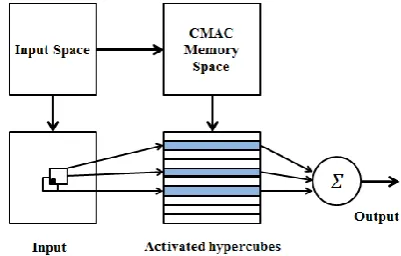
Figure 1. Cerebellar model articulation controller
II. CEREBELLAR MODEL ARTICULATION CONTROLLER
(i) Number of inputs=n
(ii) Number of elements for a particular input=m, which is also the number of quantized state for input.
(iii) Total memory=mn
(iv) Number of layers of CMAC=L
(v) Number of hypercubes in ith layer=ki, where i=1, 2,
3…..L
(vi) Total number of hypercube ∑ , which is the memory of CMAC.
When an input is encountered, L hypercubes are activated and output of the network is simply the sum of the contents of that hypercube. That is if CMAC is an approximator its basis function can be defined as [11]
{ } (1)
The memory content update rule is given by least square mean as [1]
( ) ( ) (2) where lr is the learning rate of CMAC and e is the network error.
In this paper, there is a slight modification in the weight update law by taking the error of the feedback system instead of network error and hence called feedback error based CMAC. The main focus of the paper is to study and observe the behavior of learning rate of CMAC and then suggest two variable learning rate schemes which improve the response of the system. The output value for an input point can be considered as a weighted sum of selected basis functions. The order of the plant determines the number of inputs of CMAC. A. Effect of Learning Rate on CMAC
Increase in learning rate implies that the response will try to reach the zero error level as soon as possible. Thus the consequence of increasing learning rate is the faster rise time which can be seen from the simulation results and from the table. Though there must be some constraints on the learning rate of CMAC as higher learning rates may lead to the instability. As far as the stability concerned, higher learning rate means large value of overshoot but faster settling time while lower learning rates have sluggish response and have large settling time. Thus while choosing the values of learning rates there is a tradeoff between overshoot and settling time. Hence learning rate is one of the parameters of CMAC which needed to be chosen wisely. The variation of peak overshoot with learning rate is shown in Fig. 2. Though another way to get the desired response is to change the error dynamics of feedback control law but usually it leads to the larger control effort which is not desirable in control system applications. In order to improve the response of the system CMAC algorithms needs to be altered such that there is no appreciable change in feedback control law. Another way to improve the response of the system is to change the learning rate of the system according to error. That is, when error is high learning rate is made high so that it move towards the zero error quickly when error is low learning rate is
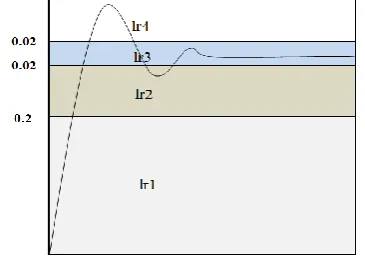
made lower so that the response doesn’t go beyond the zero error level due to higher learning rate. Thus to apply this logic response of the system is divided into four regions. In order to understand why these four regions are used one must understand the implications of using variable learning rate scheme. Initially the error is very high due to which larger learning rate is recommended. Due to higher learning rate, response will reach the zero error level quickly but it will not stop at this level and it will go further. When it goes beyond the prescribed level of error, learning rate is increased further due to which there is a dampening in the speed of response due to which the overshoot as compared to fixed learning rate scheme will decrease. As the error reaches within the prescribed range, learning rate can be made lower as there is no need to learn more. Not only this, due to the curbing of response in upward direction due to the higher learning rate response tends to move in downward direction quickly, the decrease in learning rate in this region tends to slow down the response in downward direction. In spite of the lowering in learning rate in this region it may be possible that undershoot may cross the prescribed error range. Thus again to suppress undershoots, learning rate must be increased such that it will push the response towards zero error position. To reduce the overshoot further, one may keep the learning rate very low at the start of the response due to which rise time will increase but it’s harmless as compared to the peak overshoot. Thus response of the system is divided into four regions with different learning rate namely lr1, lr2, lr3 and lr4 respectively.
Figure 2. Division of unit step response region according to learning rates
III. DISCONTINUOUS VARIABLE LEARNING RATE CMAC
In this variable learning rate scheme, the step response of a system is divided into four regions as shown in Fig. 2. A. Region 1
B. Region 2
This region is decided on the basis of undershoots which occurs due to curbing of peak overshoot. In real time applications undershoot are undesirable. Learning rate in this region can be made high and low depending upon the two cases.
Case 1: If there are not any undershoots or undershoots not going beyond Region 3. Then the value of learning rate in this region must be made very low as it serves two purposes. First, at the start of the response lower value of learning rate slows the speed of response due to which peak overshoots in the region 4 will not be high. Second, as there are not undershoots after the peak overshoot, there is no chance that these undershoots are going to occur in future.
Case 2: In case the peak overshoots are very high in the region4 and to suppress that learning rate is made very high, there is a chance that suppression may push the response in downwards direction to such extent that it may cross the prescribed error level. Thus to suppress that overshoot learning rate is made high but not higher than lr4 in this region.
C. Region 3
In this region error is small so learning rate must be kept small so as to avoid the harmful effects of higher learning rate.
D. Region 4
Since error is high in this region, learning rate must be kept high in comparison to other three regions. This will curb the overshoots. Though making it much higher tends to push the response in downwards direction which may lead to undershoots as discussed in Region 2 section.
That is, learning rate
{
} (3)
Thus, from the four regions it is evident that if first case of region 2 occurs then else for the other cas . Note that the learning rate is varied sharply with respect to error i.e. the variation of learning rate with respect to error is made discontinuous. To vary the learning rate smoothly with respect to error continuous variable learning rate CMAC is proposed.
IV. CONTINUOUS VARIABLE LEARNING RATE CMAC
This variable learning rate scheme uses the same logic as that scheme1. But rather learning rate is not varied sharply but smoothly with respect to error.
Learning rate can be written as, For case 1:
{
( )
( ) (| | ) ( ) ( ) }
(4)
For case 2:
{
( ) ( )
( )
( ) (| | ) ( ) ( ) }
(5)
V. CONTROL SCHEME
To demonstrate the behavior of learning rates simulations are done on unstable second order plant in which CMAC is used in conjunction with feedback control law to control the plant. Though CMAC has the capability to learn nonlinear functions quickly, linear plant is discussed here for simplicity. The plant can be written in state space form as
{ ̇ ̇ } (6)
It can also be written as
{ ̇ ̇ ( ) } (7)
Figure 3. Simulink diagram of CMAC
Control law for the state space equation given by (8) can be written as,
[ ( ) ̂] (8) where is the input signal, ̂ being the function to be estimated online, k1 and k2 is such that the polynomial
is Hurwitz. The Simulink diagram to implement the CMAC is shown in Fig. 3.
VI. SIMULATION AND RESULTS
For simulation purpose, an unstable plant with transfer function as given by (6) is used
( )
(9)This plant can be written in state space form
{ ̇ ̇ } (10) Since the plant is of second order, two inputs CMAC is used. Parameters of two input CMAC
Quantization=20 Generalization=6
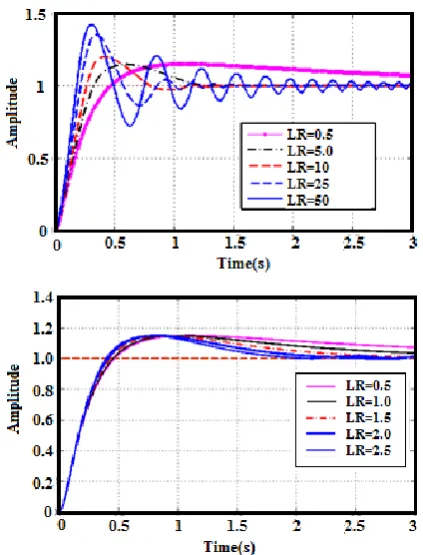
Figure 4. Response of the system for different learning rates
TABLEI. EFFECT OF DIFFERENT LEARNING RATES WHEN COVERING
LARGE RANGE OF LEARNING RATE
Learning rate
Rise time(s)
Peak overshoot
(%)
Settling time(s)
Integral Square
Error
0.5 0.4735 14.98 5.7992 0.1603
5 0.3073 14.89 1.0162 0.1146
10 0.2592 23.65 1.0132 0.1127
20 0.2216 35.09 0.9772 0.1152
25 0.2119 39.34 3.1549 0.1225
30 0.2010 42.15 3.0742 0.1276
50 0.1783 48.85 4.0260 0.1488
TABLEII. EFFECT OF DIFFERENT LEARNING RATES WITH LOWER
LEARNING RATES
Learning rate
Rise time(s)
Peak overshoot
(%)
Settling time(s)
Integral Square Error
0.5 0.4735 14.98 5.7992 0.1603
1.0 0.4432 14.83 3.1054 0.1414
1.5 0.4182 14.73 2.2112 0.1338
2.0 0.3948 14.61 1.7882 0.1287
2.5 0.3753 14.53 1.5423 0.1250
Figure 5. Variation of peak overshoots with learning rates
The range of inputs x1 and x2 is taken to be -5 to 5 units.
From the Table I and Table II and simulation results of Fig. 4, it is concluded that peak overshoot increases with increase in learning rate. Though increasing in learning rate beyond 10 makes the response oscillatory due to which integral square error increases slightly. From the response of the system it is easy to see that for higher learning rate error though converges to zero value but it will oscillate around zero error level. If learning rate is taken to be low it is found that peak overshoot decreases with increase in learning rate. From Fig. 5, it has been found that peak overshoot remains nearly the same at about 15% for learning rate from 0 to 5. After that range it will increase monotonically with the increase in learning rates. So the response for the learning rates from 0.5 to 2.5 is chosen.
To improve the response two variable learning schemes are used. For the variable learning schemes to be implemented two cases which have been discussed in Region 2 must be taken into account. Case1 is applicable if there are no undershoots or the value of undershoots are very less. It is evident from the response that there are no undershoots for lower learning rates.
Figure 6. Comparison of unit step responses of CMAC, DVL CMAC and CVL CMAC
TABLEIII. RESPONSE FOR DISCONTINUOUS VARIABLE LEARNING
SCHEME
Rise time
Peak overshoot
Settling time
Integral square
error
0.1 0.1 0.5 2.0 0.5009 11.57 1.9265 0.1329
0.1 0.1 0.5 3.0 0.5009 10.77 1.5706 0.1300
0.1 0.1 0.5 4.0 0.5009 10.19 1.3921 0.1284
0.1 0.1 0.5 5.0 0.5009 9.71 1.2817 0.1275
0.1 0.1 0.5 6.0 0.5009 9.37 1.2050 0.1269
0.1 0.1 0.5 7.0 0.5009 9.06 1.1468 0.1265
0.1 1.0 0.5 1.5 0.5025 12.68 2.3082 0.1369
0.1 1.5 1.0 2.0 0.4939 12.40 1.9232 0.1342
0.1 1.0 0.5 2.0 0.4963 12.11 1.9239 0.1339
0.1 1.5 0.5 2.0 0.4939 12.40 1.9233 0.1343
0.1 1.0 0.5 2.5 0.4963 11.66 1.7066 0.1318
0.1 1.5 0.5 2.5 0.4939 11.94 1.7050 0.1322
0.1 0.1 0.5 1.5 0.5010 12.12 2.3046 0.1359
0.1 0.1 0.5 2.0 0.5010 11.57 1.9272 0.1329
TABLEIV. RESPONSE FOR CONTINUOUS VARIABLE LEARNING
SCHEME
Rise time
Peak overshoot
Settling time
Integral square
error
0.1 0.1 0.5 2.0 0.5000 11.14 1.6107 0.1304
0.1 0.1 0.5 3.0 0.5000 10.45 1.3620 0.1284
0.1 0.1 0.5 4.0 0.5000 9.95 1.2332 0.1274
0.1 0.1 0.5 5.0 0.5000 9.58 1.1515 0.1267
0.1 0.1 0.5 6.0 0.5000 9.28 1.0921 0.1263
0.1 0.1 0.5 7.0 0.5000 9.03 1.0486 0.1260
0.1 1.0 0.5 1.5 0.4786 13.20 2.1663 0.1360
0.1 1.5 1.0 2.0 0.4728 13.10 1.8029 0.1336
0.1 0.1 0.5 2.5 0.4998 11.23 1.6512 0.1309
Thus Case1 is applicable for lower learning rates. For simulation,
.
From Fig. 6 Peak overshoot gets reduced from 14.88% to 9.71% and ISE=0.1275. Settling time=1.2817 sec. Table III and Table IV show the response for variable learning rate scheme.
Case 2 is applicable for higher learning rates. For Simulation,
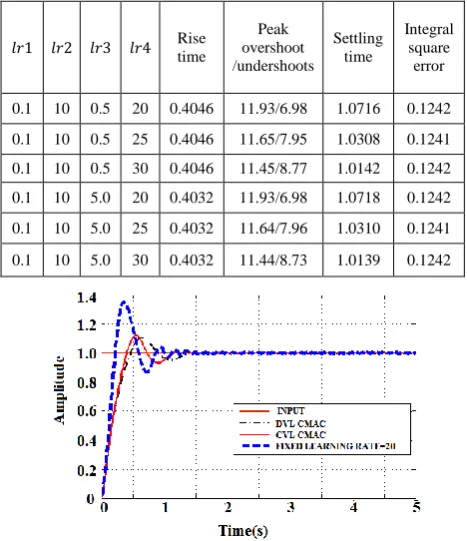
If Case 2 arises, from Fig. 7 the continuous and discontinuous variable learning rate scheme shows significant improvement over single fixed learning rate of 20 by decreasing the peak overshoot of 34.7% to 10.53% and 11.93% respectively. Table V and Table VI show the different learning rates of the region for CVL CMAC and DVL CMAC. CVL CMAC is better than DVL CMAC in rise time, settling time and integral square error while peak overshoots of DVL CMAC is marginally better than that of CVL CMAC. From Fig. 3 the minimum value of overshoot for different learning rate is 14.33, the CVL and DVL scheme have been able to suppress the overshoots below 14.33 which implies both the CVL CMAC and DVL CMAC are better than fixed learning rate feedback error based CMAC in suppressing overshoots.
TABLEV. RESPONSE FOR DISCONTINUOUS VARIABLE LEARNING
RATE SCHEME
Rise time overshoot Peak /undershoots
Settling time
Integral square
error
0.1 10 0.5 20 0.4652 10.53/4.69 1.2969 0.1261
0.1 10 0.5 25 0.4652 9.94/5.48 1.2864 0.1259
0.1 10 0.5 30 0.4652 9.49/6.19 1.2760 0.1259
0.1 10 5.0 20 0.4652 10.53/4.69 1.2923 0.1261
0.1 10 5.0 25 0.4652 9.94/5.45 1.2853 0.1259
0.1 10 5.0 30 0.4652 9.50/6.17 1.2747 0.1259
TABLEVI. RESPONSE FOR CONTINUOUS VARIABLE LEARNING RATE
Rise time
Peak overshoot /undershoots
Settling time
Integral square
error
0.1 10 0.5 20 0.4046 11.93/6.98 1.0716 0.1242
0.1 10 0.5 25 0.4046 11.65/7.95 1.0308 0.1241
0.1 10 0.5 30 0.4046 11.45/8.77 1.0142 0.1242
0.1 10 5.0 20 0.4032 11.93/6.98 1.0718 0.1242
0.1 10 5.0 25 0.4032 11.64/7.96 1.0310 0.1241
0.1 10 5.0 30 0.4032 11.44/8.73 1.0139 0.1242
Figure 7. Comparison of unit responses of CMAC, DVL CMAC and CVL CMAC
VII. CONCLUSION
CMAC have better response than fixed learning rate CMAC. Rate of convergence of CVL CMAC is slightly better than that of DVL CMAC while DVL CMAC handles the overshoots better than CVL CMAC.
REFERENCES
[1] J. Albus. “Data storage in the cerebellar model articulation controller (CMAC),” Trans. ASME J. Dynamic Systems Measurement and Control, vol. 97, pp. 228-233, 1975.
[2] J. Albus, “A new approach to manipulator control: The cerebellar model articulation controller (CMAC),” Trans. ASME J. Dynamic Systems Measurement and Control,vol. 97, pp. 220-227, 1975. [3] W. T. Miller, F. H. Glanz, and L. G. Kraft, “CMAC: An
associative neural network alternative to backpropagation,”
Proceedings of the IEEE, vol. 78, pp. 1561-1567, 1990.
[4] W. T. Miller and C. M. Aldrich, “Rapid learning using cmac neural networks: real time control of an unstable system,” in Proc. IEEE Intelligent Control Symposium, Philadelphia, PA, 1990, pp. 465-470.
[5] M. F. Yeh and C. H. Tsai, “Standalone CMAC control systems with On-line learning ability,” IEEE Transactions on Systems, Man and Cybernetics-Part B, Cybernetics, vol. 40, pp. 43-53, Feb. 2010.
[6] W. T. Miller, F. Glantz, and G. Kraft, “Real-Time dynamic control of an industrial manipulator using a neural network based learning controller,” IEEE Transactions on Robotics and Automation, vol. 6, pp. 1-9, 1990.
[7] W. T. Miller, “Sensor based control of Robotic Manipulators using a general learning algorithm,” IEEE Journal of Robotics and Automation, vol. 3, pp. 157-165, Apr. 1987.
[8] S. Lane, D. Handelman, and J. Gelfand. “Theory and development of higher order CMAC neural networks,” IEEE Control Systems Magazine, vol. 12, pp. 23-30, 1992.
[9] P. An, W. Miller, and P. Parks, “Design improvements in associative memories for cerebellar model articulation controllers(CMAC),” in Proc. International Conference on Artificial Neural Networks, 1991, pp. 1207-1210.
[10] J. Chen, “An adaptive robust CMAC controller for nonlinear systems,” IEEE Transactions, 2007.
[11] J. A. Farrel and M. M. Polycarpau, Adaptive Approximation Based Control: Unifying Neural, Fuzzy and Traditional Adaptive Approximation Approaches, Wiley Interscience, 2006, pp. 87-93.
Abhishek Rawat received the B.E. degree in
Instrumentation and Control Engineering from Netaji Subhas Institute of Technology (N.S.I.T), Delhi, India in 2008. He is currently an M. Tech. student in Department of Electronics and Communication Engineering with specialization in System Modeling and Control, Indian Institute of Technology (IIT) Roorkee, Roorkee, India. His main areas of research interest are Adaptive Control, Fuzzy Control, Adaptive approximation based control and neural network in control systems.
M. J. Nigam received the B.Tech. degree in