Current Research in Microbiology and Biotechnology
Vol. 6, No. 2 (2018): 1518-1524Research Article Open Access
I
ISSSSNN:: 22332200--22224466
Cellulase enzyme production from solid state
fermentation and submerged fermentation using
Trichoderma
species isolated from Iraqi soils
Noor T. Hamdan
1,* and Hameed M. Jasim
21 University of Baghdad, College of Science, Department of Biology, Baghdad city, Iraq. 2 University of Nahrain, College of Biotechnology, Baghdad city, Iraq.
* Corresponding author:Noor T. Hamdan; e-mail: [email protected]
ABSTRACT
In this study, forty-eight soil samples were collected from fields cultivated with wheat and barley from different governates of Iraq to isolate fungi producing cellulolytic enzyme. Fungal isolates were screened for enzymes production on selective media containing carboxymethyl cellulose (CMC) as a sole source for carbon and energy. Results of semi-quantitative screening showed that forty-eight isolates were able to produce cellulase with variable degrees depending on the formation of halo zones around colonies of these isolates. These isolates in producing cellulase were selected and subjected to quantitative screening by determining cellulase specific activities in the culture filtrates. Results showed that the isolate symbol N48 was the most efficient among the other isolates in cellulase production since it produced the highest yield of cellulase enzyme. The specific activity of cellulase of this isolate reached 50.1U/mg protein.
Keywords:
Cellulase, Trichoderma spp, Submerged Fermentation, Solid-state fermentation.1. INTRODUCTION
Cellulases are glycoside hydrolases (GHs) that decompose cellulose a hydrophilic, water-insoluble polymer composed of repeated units of D-glucose interlinked by β-1,4- glycosidic bonds into shorter chain polysaccharides such as cellodextrin, cellobiose, and glucose [1]. Cellulases are industrially important enzymes with a market share of 500 million dollars that is expected to rise to 1.5 billion dollars by 2018. Cellulases play a crucial role in generating sugar feedstock for lignocellulosic based biorefinery platform. In addition, their demand in textile, paper, feed and food industries is rising steadily. However, these industrial applications require thermostable, catalytically highly efficient cellulases for making the processes commercially viable [2]. Cellulase has been produced from different organism, mainly fungi, bacteria, and protozoans, but the fungus Trichoderma spp was recorded as one of the most important commercial cellulase producers and has been widely
used in a variety of industries. Trichoderma sp. are widely distributed all over the world and occur in nearly all soils and other natural habitats, especially in those containing organic and inorganic matter [3]. They are ubiquitous colonizers of cellulosic materials and can thus often be found wherever decaying plant material is available as well as in the rhizosphere of plants, where they can induce systemic resistance against pathogens [4].
Solid-state fermentation (SSF) is a process whereby an insoluble substrate is fermented with sufficient moisture but in the absence of free-flowing water. However, the substrate must possess enough moisture to support growth and metabolism of the microorganism [7]. Solid state fermentations have been reported to have high enzyme productivities as compared to submerged fermentations [8]. The exact reasons for higher titres in SSF as compared to submerged fermentations are currently not wellknown. There are however suggestions that higher biomass and lower protein breakdown contribute to better production in SSF. SSF holds a tremendous potential for the production of enzymes especially where the crude fermented products may be used directly as an enzyme source. SSF processes have lower energy requirements and produce less wastewater [9]. SSF offers numerous advantages lower cost and reduced need for asceptic techniques compared to submerged fermentations (SmF) [10].
This study aimed to investigate the efficient fungal isolate from all among fungal isolates in cellualse production through solid state fermentation and submerged fermentation.
2. MATERIALS AND METHODS
2.1 Isolation, maintenance, Identification of Trichoderma spp.
Soil samples were collected from fields cultivated with wheat and barley crops from different locations in some Iraqi governorates. About 100 g portions of each soil sample was taken from a depth of about 15 cm from the soil surface and placed in a sterile polyethylene bag and transported to the laboratory of the college of biotechnology Al-Nahrain University. Serial dilutions of each soil samples were prepared by mixing 1g with 9 ml of sterile distilled water, and shaked vigorously, then dilutions of 10-4 and 10-5 were
carried out [11]. Aliquots of 0.1ml of each dilution was spread on TSM agar medium as a selective medium for isolation Trichoderma spp. which was constituted as g/L( K₂HPO₄, 0.9 , MgSO₄.H2O, 0.2 , KCl, 0.15, Glucose, 3,
NH4NO₃,1, Chloramphenicol, 0.25, Metalaxyl, 0.01,
PCNB, 0.2, Rose Bengal, 0.15, Agar, 20) [12], plates were then incubated at 28oC for 7 days. After
incubation, pure fungal isolates were subcultured on PDA agar plates as an inrichment medium for maintenance and identification of fungal isolates. Then plate were incubated at 28oC for 7 days, and kept at 4oC
for further analysis. These isolates were identified of fungal isolates according to the genus [13].
2.2 Inoculation of cellulase production medium Inoculation of cellulase production medium was achieved by transferring 1ml from each fungal fresh cultures of Trichoderma spp. which were cultured these isolates on PDB medium and incubated 28C for
2.3Screening for Cellulase production
2.3.1 Qualitative Screening
Cellulolytic activity of Trichoderma spp on CMC agar medium (K₂HPO₄ 1, MgSO₄ 0.5, KCl 0. 5, CMC Sodium salt 5,Peptone 2, Na NO₃ 1, Agar 15) was determined qualitatively by iodine plate assay method which was described by [14]. Fresh culture (6days old) of
Trichoderma spp. from PDA slant were cultured on CMC agar medium and incubated for 5 days at 30°C, then plates were flooded with Gram‘s iodine solution (It was prepared by dissolving 1 g iodine crystals and 2 g of potassium iodide in 100 ml D.W and stored in a dark bottle) for 3 to 5 min. [15] and incubated for 15 min at 28 oC, then excess stain was drained off in order
to observe and measure zone of clearance around each fungal colony which indicates the hydrolysis of CMC. The highest cellulase activity assumed by the largest clear zone of hydrolysis .The Zone of cellulose hydrolysis was appeared as a clear area around the colony [16].
2.3.2 Semi –Quantitative Screening
Semi–quantitative screening for cellulase production by fungal isolates was achieved by using agar diffusion method. Aliquot of 1ml of fresh culture of each fungal isolates were used to inoculate 50 ml of mandel medium containing 1% CMC in conical flasks then incubated at 30oC for four days in shaker incubator
(100 rpm). After incubation cultures were centrifuged at 8000 rpm for five minutes, then 0.5ml of culture filtrates were added into wells of CMC – agar plates(0.5% CMC, 1.7% agar) and incubated at 30 oC
for 24 hours, then wells were rinsed out using tap water. After that plates were flooded with congo red solution (0.25%)( It was prepared by dissolving 1g of Congo red in 400 ml distilled water, and kept at 4°C until use) and left to stand for 15 minutes, then rinsed with 1M NaCl. Wells containing cellulase activity gave a clear zone measured in mm showing a promotion idea of cellulase activity[17]
2.3.3 Quantitative Screening
Quantitative Screening for cellulase production by fungal isolates was achieved by determining cellulase activity (U/ml) in culture filtrates according to [18] as follows:
1. Conical flasks containing 50 ml of CMC broth medium were inoculated with 1ml fresh culture of each fungal isolates, and incubated in shaker incubator (100 rpm) at 30 oC for four days.
2. After incubation each culture was centrifuged at 8000 rpm for five minutes.
3. Aliquot of 100μl of supernatant (crude enzyme) was transferred to test tubes containing 0.9 ml of 0.5% CMC in 50 mM sodium acetate buffer solution (pH5), and vortexed for few seconds.
4. Test tubes were incubated in water bath at 50 oC
left to cool at room temperature and the absorbance at 540nm was read.
6. Cellulase activity was calculated according to glucose stranded curve[19].
Cellulase activity (U\ml) =
Specific activity (U\mg protein) =
[20]
Enzyme activity was defined as the amount of enzyme that release 1μmol of glucose per minute under experiment conditions.
2.4 Estimation of protein concentration in culture filtrates
Protein concentration was determined by adding 0.1 ml of crude filtrate to 0.4 ml of Tris-HCl , then 2.5 ml of Coomassie brilliant blue was added. After shaking for 2min., absorbance at 595 nm was measured, and the protein concentration( mg/ml) was calculated from the standard curve for BSA[21].
2.5 Cellulase production by Trichoderma spp.
Cellulase production by Trichoderma spp was achieved in liquid medium and on solid medium to examine the higher Cellulase production in both culture medium.
2.5.1 Submerged Fermentation
Conical flasks containing 50ml of mineral salt medium (Mandel medium) which was constituted as g/L( K₂HPO₄ 2, MgSO₄7.H2O 0.3, CMC-Na 7.5, Urea 0.3, NH4
SO4 1, ZnSO₄.7H2O 0.0014, CoCl2.6 H2O 0.002, pepton1,
Tween80 2 ml, CaCl2.2 H2O 0.3, FeSO₄.7H2O 0.005,
MnSO₄.H2O, 0.0016, Triton X-100, 1 ml) pH 6.5 were
inoculated with 1 ml of fresh culture of the each fungal isolates and incubated at 30oC in shaker incubator (100
rpm) for seven days. After incubation cultures were centrifuged at 8000 rpm for five minutes, then cellulase activity and protein concentration were determined in crude filtrates as shown in (2.3.3) and (2..4) respectively.
2.5.2 Solid State Fermentation
To examine the ability of the fungal isolates of
Trichoderma spp in cellulase production by using solid state fermentation and compare it with the enzyme productivity in submerged fermentation medium, the fungal isolates were grown on wheat bran medium [22].
Ten grams portion of wheat bran in conical flasks were wetted with 20 ml of mineral salt solution which was constituted as g/L( K₂HPO₄ ,5, NH4NO3 , 5, MgSO₄7H2O,
21, Urea, 2, ZnSO₄.7H2O, 0.001, CoCl2. ,0.0002, Pepton,
5, Tween80, 0.5, NaCl ,5, CaCl2, 1, FeSO₄.7H2O,
0.005,MnSO₄.7H2O, 0.001) [23], pH was adjusted to 5,
then flasks were sterilized by autoclaving , after cooling to room temperatures flasks were inoculated with 1ml of fresh culture of each fungal isolate and incubated at 30 ºC for five days, then 50 ml of D. W. was added to each flask, and shaked vigrously for 1-2 minutes, then centrifuged at 8000 rpm for 5 min., cellulase activity and protein concentration was determined in supernatants as shown in (2.3.3) and (2. 4) respectively . Because enzyme production (specific activity) on solid state fermentation is higher than enzyme production in submerged fermentation, the former was used for cellulase production under the optimum conditions.
3. RESULTS AND DISCUSSION
3.1 Identification of fungal isolatesThe results of the identification fungal isolates observed that all isolates are Trichoderma spp. according to the taxonomic key [13].
3.2 Ability of local isolates in producing cellulase enzymes
3.2.1 Screening of isolates for cellulase production
To select the most efficient isolates for cellulase production, the local isolates were screened using solid and liquid medium supplemented with CMC as sole source of carbon.
3.2.1.1 Qualitative screening
Table 1: Qualitative activity of cellulase enzyme produced by fungal isolates after incubation for 5 days at 30ºC.
Isolate No. Hydrolysis Zone of
(mm) Isolate No.
Zone of Hydrolysis
(mm) Isolate No.
Zone of Hydrolysis
(mm)
N1 18 N17 19 N33 40
N2 17 N18 19 N34 33
N3 19 N19 27 N35 13
N4 18 N20 25 N36 40
N5 12 N21 38 N37 34
N6 15 N22 39 N38 40
N7 15 N23 40 N39 33
N8 41 N24 38 N40 40
N9 40 N25 39 N41 32
N10 10 N26 28 N42 39
N11 23 N27 38 N43 40
N12 33 N28 35 N44 39
N13 20 N29 36 N45 22
N14 29 N30 27 N46 38
N15 28 N31 29 N47 14
N16 40 N32 41 N48 42
3.2.1.2 Semi-quantitative screening
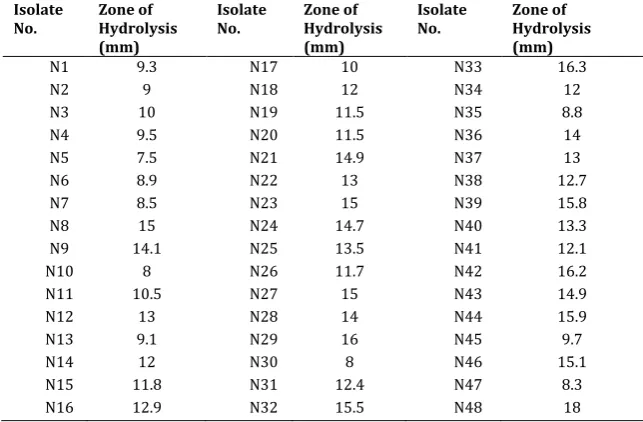
The semi-quantitative method was used to determine the capacity of the studied fungi in the production of cellulase enzyme. Appearance of pale zone around the fungal colony is an evidence of the degradation of carboxymethyl cellulose (CMC-Agar) by the enzyme cellulase produced by these fungi as a result of the disintegration of cellulose into simple sugars. All fungi
gave positive results with differed variable levels in their ability to produce cellulase enzyme as reported in table 2. Isolate N 48 produce the highest efficiency in the degradation of carboxymethyl cellulose, it was observed that the clear zone diameter of decomposition around the fungal colony began from the second day of incubation that reached (18) mm in diameter. Similar results have been reported by Rathore [26].
Table 2: Semi quantitative activity of cellulase enzyme produced by fungal isolates after incubation for 24hours at 30ºC.
Isolate
No. Zone of Hydrolysis (mm)
Isolate
No. Zone of Hydrolysis (mm)
Isolate
No. Zone of Hydrolysis (mm)
N1 9.3 N17 10 N33 16.3
N2 9 N18 12 N34 12
N3 10 N19 11.5 N35 8.8
N4 9.5 N20 11.5 N36 14
N5 7.5 N21 14.9 N37 13
N6 8.9 N22 13 N38 12.7
N7 8.5 N23 15 N39 15.8
N8 15 N24 14.7 N40 13.3
N9 14.1 N25 13.5 N41 12.1
N10 8 N26 11.7 N42 16.2
N11 10.5 N27 15 N43 14.9
N12 13 N28 14 N44 15.9
N13 9.1 N29 16 N45 9.7
N14 12 N30 8 N46 15.1
N15 11.8 N31 12.4 N47 8.3
N16 12.9 N32 15.5 N48 18
inappropriate pH of the media of this fungi[27]. However the efficiency of the cellulase enzyme production by the fungi varies by different species [28].
Similar results have been reported by Miklaszewska [29] that found the highest CMCase activity at 0.197
IU/ml was observed for Trichoderma isolate 1.12 grown on CMC when compared with other strains of
Trichoderma. Additionally, Patel [30] who reported that specific activity of cellulase in Smf was higher in
Penicillium sp. than Aspergillus and Trichoderma sp.
Table 3: Specific Activity of Cellulase produced by different fungal isolates by Submerged State Fermentation.
Isolate No. Activity
(U/ml) Specific activity (U/mg)
Isolate
No. Activity (U/ml) Specific activity (U/mg)
N1 35.35 33.0 N25 1.47 0.6
N2 26.49 20.2 N26 3.69 1.5
N3 37.97 26.0 N27 1.39 0.6
N4 28.05 22.2 N28 4.26 2.5
N5 47.08 35.6 N29 11.48 6.1
N6 29.03 22.3 N30 4.92 3.7
N7 41.42 27.4 N31 19.1 9.1
N8 54.87 35.8 N32 1.8 0.6
N9 28.54 20.8 N33 10.33 6.6
N10 20.99 13.8 N34 4.42 1.4
N11 20.67 15.7 N35 5.08 3.0
N12 30.51 22.4 N36 10.82 5.2
N13 56.10 43.1 N37 5.49 2.6
N14 45.60 32.1 N38 11.48 7.6
N15 75.05 4.3 N39 2.70 0.6
N16 7.38 8.5 N40 4.34 1.6
N17 9.43 5.6 N41 0.57 0.1
N18 8.85 5.0 N42 1.39 0.6
N19 8.77 11.6 N43 2.78 2.05
N20 3.3 2.5 N44 6.64 36.8
N21 3.52 3.3 N45 2.95 1.85
N22 3.93 2.6 N46 23.62 4.2
N23 12.79 6.6 N47 22.31 47.7
N24 3.69 2.1 N48 17.55 50.1
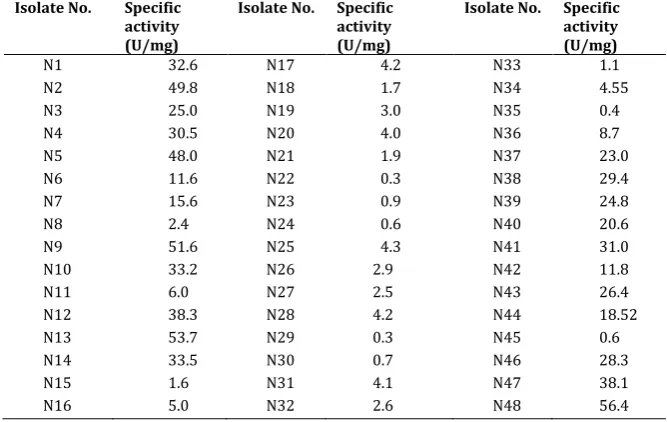
Table 4: Specific Activity of Cellulase produced by different fungal isolates by Solid State Fermentation.
Isolate No. Specific activity (U/mg)
Isolate No. Specific activity (U/mg)
Isolate No. Specific activity (U/mg)
N1 32.6 N17 4.2 N33 1.1
N2 49.8 N18 1.7 N34 4.55
N3 25.0 N19 3.0 N35 0.4
N4 30.5 N20 4.0 N36 8.7
N5 48.0 N21 1.9 N37 23.0
N6 11.6 N22 0.3 N38 29.4
N7 15.6 N23 0.9 N39 24.8
N8 2.4 N24 0.6 N40 20.6
N9 51.6 N25 4.3 N41 31.0
N10 33.2 N26 2.9 N42 11.8
N11 6.0 N27 2.5 N43 26.4
N12 38.3 N28 4.2 N44 18.52
N13 53.7 N29 0.3 N45 0.6
N14 33.5 N30 0.7 N46 28.3
N15 1.6 N31 4.1 N47 38.1
3.2.1.3.2 Solid State Fermentation
In total, forty-eight fungi were isolated and tested for cellulase production under solid state fermentation. Higher yield of cellulase in SSF cultures compared to Smf was reportd by vantila [31], Longwei [32] which considered the SSF process are strongly recommended as systems for producing higher concentration cellulases at lower price than submerged cultures along with reducing the step in downstream processing, in turn reducing the cost of operation. The CMCase activities obtained by SSF, through the action of all isolates, indicting a potentially variable degrees in productivity with the substrate wheat bran, but isolate N48 gave highest efficiency of cellulase enzyme with that substrate after 5 days of the incubation, reaching to 56.4 U/mg as shown in table 4. It should be mentioned that wheat bran has been employed in numerous reports for enzyme production in SSF, because it is a good source of nitrogen and carbon [33]. This result also agrees with the previous reported results by El-shishtawy [34] indicated that the
Trichoderma virens reported higher CMCase activity with wheat bran compared with other Trichoderma
species. On the basis of these results, the wheat bran was selected as the indicated substrate for further experiments.
4. CONCLUSION
The selected fungal isolate Trichoderma spp. N48 showed and reported maximum cellulase activity among all fungal isolates using several screening and fermentation procedures mentioned.
5. REFERENCES
1. Garvey M, Klose H, and Fischer R. (2013). Cellulases for biomass degradation: comparing recombinant cellulase expression platforms. Trends Biotech- nol .31:581–593.
2. Sani Rk and Krishnaraj RN (2017). Extremophilic Enzymatic processing of lignocellulosic feedstocks to bioenergy. In Approaches for bioprospecting cellulases. Springer, Switzerland .PP301
3. Montoya Q V, Meirelles L A, Chaverri P et al (2016).“Unraveling Trichoderma species in the attine ant environment: description of three new taxa,” Antonie van Leeuwenhoek,Int. J. Gen. Mol. Microbiol., 109, ( 5):633–651. 4. Atanasova L, LeCromS Gruber S, and Coulpier F (2013).
Comparative transcriptomics reveals different strategies of
Trichoderma mycoparasitism. BMC Genomics 14:121-127. 5. Reddy G P K, Narasimha G, Kumar K D, and Ramanjaneyulu G
(2015). Original Research Article Cellulase production by
Aspergillus niger on different natural lignocellulosic substrates, 4(4): 835–845.
6. Farinas C S (2015). Developments in solid-state fermentation for the production of biomass degrading enzymes for the bioenergy sector. Renewable and Sustainable Energy Reviews, 52: 179-188
7. Agrawal Sh., (2015). Solid state fermentation for cellulase production, Biotec.Res.J, 1(1):108-112.
8. Prévot V, Lopez M, Copinet E et al (2013). Comparative
performance of commercial and laboratory enzymatic complexes from submerged or solid-state fermentation in
lignocellulosic biomass hydrolysis. Bioresource
technology, 129: 690-693.
10.De la Cruz Quiroz R, Roussos S, Hernández D, et al (2015). Challenges and opportunities of the bio-pesticides production by solid-state fermentation: Filamentous fungi as a model. Crit. Rev. Biotechnol. 35: 326–333.
11.Clark HE, Geldrich EF, Kabler PW et al (1958). Applied Microbiology. 1st Edn., International Book Company, New York, pp: 27-53.
12.Elad Y, Chet I, and Henis Y. (1981). A selective medium for improving quantitative isolation of Trichoderma spp. from soil. Phytoparasitica , 9:59–68.
13.Samuels GJ and Hebbar PK (2015).Trichoderma Identification and Agricultural Applications.,American Phytopathological Society.,1st Edn.,USA. pp.196.
14.Kasana R C, Salwan R, Dhar H et al (2008). A rapid and easy method for the detection of microbial cellulases on agar plates using Gram’s iodine. Current Microbiol. 57: 503-507. 15.Neethu K, Rubeena M, Sajith S et al ( 2012). A novel strain of
Trichoderma viride shows complete lignocellulolytic activities,” .2012 : 1160–1166.
16.Gautam SP, Bundela PS, Pandey AK et al ( 2011) Optimization for the Production of Cellulase Enzyme from Municipal Solid Waste Residue by Two Novel Cellulolytic Fungi. Biotechnol. Res. Int. 8-16.
17.Hassan M M and El-Awady M AM (2011) “Isolation and molecular characterization of some Trichoderma spp. with high cellulase enzyme activities. Arab J. Biotech., Vol. 14, No. (2): 155-166.
18.Mandel M, Andreotti R, Roche C (1976). Measurement of saccharifying cellulase. Biotechnol Bioeng Symp. 6: 21-23. 19.Otajevwo F D and Aluyi H S A (2011). Cultural conditions
necessary for optimal cellulase yield by cellulolytic bacterial organisms as they relate to residual sugars released in broth medium. Modern Appl. Sci. 5(3): 141- 151.
20.Whitaker J R (1972). Priniciple of enzymology for the food science. Marcel Dekker, Inc. New York.USA.8:22-23.
21.Bradford M M (1976). A rapid and sensitive method for the quantitation of microgram quantities of protein utilizing the principle of Protein-Dye Binding. Analy. Biochem, 72: 248-254.
22.Andrade JP, Bispo ASR, Marbach PAS, et al (2011). Production and partial characterization of cellulases from
Trichoderma sp. IS-05 isolated from sandy coastal plains of Northeast Brazil. Enzyme Research, Volume 2011(2011),Article ID 167248, 7 pages.
23.Mekala N K, Singhania R R, Sukumaran R K et al (2008). Cellulase production under solid-State fermentation by
Trichoderma reesei RUT C30: Statistical optimization of process parameters. Applied Biochemistry and Biotechnology. 151(2–3), 122–131.
24.Pachauri P, V A, More S, Sullia SB, et al (2017). Purification and characterization of cellulase from a novel isolate of
Trichoderma longibrachiatum. Biofuels. 1–7.
25.Zeng R, Yin X, Ruan T et al (2016). A Novel Cellulase Produced by a Newly Isolated Trichoderma virens. Bioengineering. 3(2),1–9.
26.Rathore S S, Mannivannan A, and Narendhirakannan R T
(2014). Screening of cellulase producing microorganisms from lake area containing water hyacinth for enzymatic
hydrolysis of cellulose. Journal of Advanced Scientific
Research. 5(3) : 23–30.
27.Ang S K, Shaza E M, Adibah Y et al (2013). Production of cellulases and xylanase by Aspergillus fumigatus SK1 using untreated oil palm trunk through solid state fermentation.
Process Biochemistry. 48: 1293–1302.
28.Wen Z, Liao W, and Chen S (2005). Production of cellulase by
Trichoderma reesei from dairy manure. Bioresour. Technol. 96: 491-499.
29.Miklaszewska B, Macko D, Klosowski G, et al (2016).
Application of semi-quantitative and quantitative methods for the selection of cellulolytic filamentous fungi isolated
from pulp mill materials. BioTechnologia. Journal of
© 2018; AIZEON Publishers; All Rights Reserved This is an Open Access article distributed under the terms of the Creative Commons Attribution License which permits unrestricted use, distribution, and reproduction in any medium, provided the original work is properly cited. 31.Vantila T, Dragomirescu M, Jurcoane S et al (2009).
Production of cellulase by submerged and solid-state cultures and yeasts selection for conversion of lignocellulose to ethanol. Romanian Biotechnol Lett. 14:4275–4281. 32.Longwei G, Hongman C, HuihuiW et al (2014). Optimization
of solid-state fermentation conditions for the production of cellulase and its hydrolytic potentials by Trichoderma virrideSn-9106,8(26):2547–2554.
33.Ortiz G E, Guitart M E, Cavalitto S F et al (2015).
Characterization, optimization, and scale-up of cellulases
production by Trichoderma reesei cbs 836.91 in solid-state
fermentation using agro-industrial products. Bioprocess and
biosystems engineering. 38(11): 2117-2128.
34.El-shishtawy R M, Mohamed S A, Asiri A M et al (2015). Saccharification and hydrolytic enzyme production of alkali pre-treated wheat bran by Trichodermavirens under solid state fermentation. BMC biotechnology. 15(1): 37 1–13.