P-ISSN: 2305-6622; E-ISSN: 2306-3599
International Journal of
Agriculture and Biosciences
www.ijagbio.com; [email protected]Research Article
Evaluation of Weed Control Methods on Some Soil Chemical Properties and
Performance of Okra (Abelmoschus esculentus L. Moench) in an Ultisol, South
Eastern Nigeria
Uko I
1, Onunwa AO
2, Ndukwe OO
1, Anikwe HO
2,
Eugene EC
1and Okonkwo NJ
11Department of Crop Science and Horticulture, Faculty of Agriculture, Nnamdi Azikiwe University, Awka
2Department of Soil Science and Land Resources Management, Faculty of Agriculture, Nnamdi Azikiwe University,
Awka, Anambra State, Nigeria
*Corresponding author: [email protected]
Article History: Received: September 23, 2018 Revised: November 20, 2018 Accepted: November 30, 2018
AB ST RACT
A field investigation was conducted in the Soil Science and Land Resources Management Research Farm of Nnamdi Azikiwe University, Awka, to evaluate the effects of different weed control methods on Okra (Abelmoschus esculentus L. Moench) growth and yield together with their impact on the chemical properties of the soil. The study was laid out as a 2x4 factorial experiment in randomized complete block design (RCBD), replicated 3 times. The treatments consisted of two Okra varieties (a hybrid, “Lady’s finger” and local variety, “Otukwuru-Omia”), plus four weed control methods namely: hoeing at 3 weeks interval; application of pre-emergence herbicide (Metolachlor 250 a.i. g/L at 1.5 kg a.i./ha) at 3 weeks interval; hoeing at 4 weeks after sowing (WAS) followed by pre-emergence herbicide (Metolachlor 250 a.i. g/L at 1.5 kg a.i./ha) one week after hoe weeding and a control of unweeded check. Soil analysis was by described standard procedures and data collected were subjected to analysis of variance. The results showed that all the weed control methods employed, significantly (P<0.05) decreased weed densities at 4 and 8 WAS when compared with the unweeded checks. Hoe weeding at 4 WAS followed by Metolachlor, a week after hoe weeding, recorded the tallest Okra stems, highest number of branches, greater number of leaves, leaf area and pod yield. There were significant differences (P<0.05), in the soil chemical properties resulting from the weed control methods and the Okra varieties after harvest. However, the soil organic carbon and nitrogen contents were reduced as a result of nutrient loss due to plant nutrient uptake for growth and yield of Okra. The results therefore, suggest that farmers in Awka can effectively reduce the burden of multiple hoe weeding and cut down on labour costs, by use of pre-emergence herbicide application, one week after hoe weeding.
Key words: Abelmoschus esculentus, Weed control methods, Soil chemical properties
INTRODUCTION
Okra, Abelmoschus esculentus L. Moench, (Family Malvaceae) is considered one of the most valuable vegetable crops grown in the tropics (Iremiren, 1988; Ahmed, 1995 and Iyagba et al., 2012). It is widely eaten and cherished for its palatability, rich protein and mineral contents, as well as high yield (Siemonsma and Hamon, 2002). In Nigeria, the crop ranks third in terms of consumption (Ibeawuchi, 2007) and is usually grown in small farm holdings intercropped with staple food crops such as cassava, yam, maize and pepper or with various other vegetable crops (Odeleye et al., 2005).
Regardless of the method of growing the crop, Olasotan (2001), Odeleye, et al., (2005) and Oyeyemi and
Ojo (2010) noted that weeds can seriously impede the growth and subsequent development of the Okra plants. Yield losses due to weeds ranging from 54% to 91% have been reported by Govindra et al. (1982), Adejonwo et al. (1989) and Smith et al. (2012). The authors however, reported significant yield increases when the weed-free period extended up to 60 days after sowing, thereby indicating that Okra, is highly susceptible to weed competition during its early stages of development. Furthermore, cost of labour for weeding is very expensive. Herbicides may therefore, offer better promising alternatives in Okra production (Sutton and Burgis, 1966; Montelaro and Maryel, 1966; Wascom and Fontenot 1967).
Generally, weeds are either controlled by cultural, mechanical, chemical and biological methods, alone or a combination of two or more of these methods. Weed control through manual weeding and hoeing, although effective in reducing weed competition, is not free from several limitations. Such constraints include unavailability of adequate labour during peak periods and difficulty in the use of mechanical weeders in heavy soils due to incessant rainfall. In fact, these constitute the major constraints in effective weed control in Okra production industry in South Eastern Nigeria (Iyagba et al. 2012). Moreover, hand-weeding is expensive, tedious and time-consuming (Adigun, 2005 and Osipitan, 2017) and many at-times, damages surface feeding roots of the crop during the process. It has therefore, become necessary to find alternative methods of reducing the weed load during early crop growth of Okra, in order to sustain yields. Thus, application of herbicides in combination with hoeing and/or mechanical weeding, may remain the only option under such situations. A number of chemicals have been developed for controlling weeds in the Okra crop at different periods and stages of production. Certain of these are commercially available, while others are in the pipeline. The present studies were therefore, carried out to evaluate the impact of different weed control methods, either alone or in combination, on Okra growth and yield, and effects on the soilchemical properties.
MATERIALS AND METHODS
The experiment was conducted in the Teaching and Research Farms, of the Department of Soil Science and Land Resources Management, Nnamdi Azikiwe University, Awka, Anambra State, Nigeria. Awka is located at 447 meters above sea level, with geographical coordinates of 6° 15' N and 7° 07' E. The average annual rainfall ranges from 1650-2000mm, mean minimum and maximum temperatures of 27°C and 30°C, respectively and average relative humidity of 75-80% (Ezenwaji et al., 2014). The experimental field had a relatively uniform topography and well-drained soil. The soil parent material is predominantly sedimentary and classified as ferralitic, red yellow soils of the Humid Tropics (Duze and Afolabi, 1981). Land preparation was done by ploughing, harrowing and pulverizing with hand-hoe. The layout plan of the experiment was a 2×4 factorial in randomized complete block design (RCBD) and replicated 3 times. The treatments included: two varieties of Okra, namely: ‘Lady’s finger’ (a hybrid) and ‘Otukwuru-omia’ (a local variety). Four weed control methods: T1= (unweeded check); T2 = (manual weeding at 3-weekly interval); T3 = (application of pre-emergence herbicide (Metolachlor 250 a.i. g/L @ 1.5 kg a.i./ha) at 3-weekly interval) and T4 = (hoe-weeding 4 weeks after sowing (WAS) plus Metolachlor, one week after weeding) were tested. Lady’s finger was sourced from Delfarms Project Limited, Igbariam, Anambra State, while the local variety was sourced from New Market, Enugu in Enugu State, Nigeria. The Okra seeds were sown at 3 seeds/hill and later, thinned down to one stand per/hill, two weeks after germination. Thus, a total of 16 plants/plot were left, and 8 plants were used as the sample size/plot, at spacing
distance of 50 cm×50 cm. A blanket application of fertilizer (NPK 20:10:10) at 300 kg/ha was done 3 WAS using band basement method. The length and width of leaves and plant height were measured with meter rule, and recorded in centimeter (cm), 4 and 8 weeks after sowing (WAS), respectively. The number of leaves was determined by counting. Okra leaf area was determined non-destructively from its relationship with the length of the mid-rib, by using the linear equation described by Asif (1977). Thus, the measurement of the length of the midrib was fitted into the equation for Okra leaf area, as: Y = 135.47 + 22.06X (Asif, 1977); where Y = leaf area in cm2;
X = length of the midrib. The number of branches was recorded by counting the number of branches per stand. Number of leaves was recorded at four (4) weekly intervals, for a period of two months. The number of fruit pods, length and circumference of Okra fruits and fresh weight of fruits were recorded at harvest. These were carried out by means of measuring tape, veneer caliper and electronic digital weighing balance. Number of weeds within the 50 cm x 50 cm quadrant, placed diagonally in each plot, were counted and recorded. Total fresh and dry weights of weeds were determined by using a sensitive weighing balance (ATOM-120). Initial soil samples were randomly collected from 6 different locations of the experimental field at 0 -15 cm depth. After harvest, soil samples were taken with soil auger, from each of 3 different points selected from each of the 3 replications of the same treatment. The soil samples were air dried, sieved with a 2 mm mesh sieve, clearly labeled and analyzed with standard procedures as described by Nelson and Sommers (1982). Data collected were subjected to analysis of variance (ANOVA) following the procedures described for randomized complete block design (RCBD). Means were separated, using the least significant difference (LSD) at 5% level of significance.
RESULTS
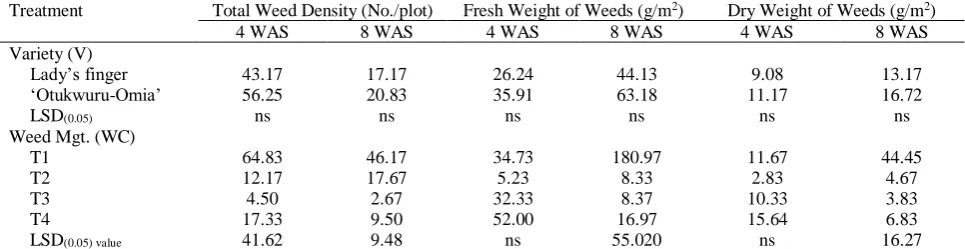
Weed density: The influence of crop variety and different
weed control methods on weed density are presented in Table 1. The result showed that Okra variety had no significant (P>0.05) effect on weed density, 4 and 8 WAS, while weed control methods significantly (P<0.05), affected weed density at both. At the 4th and 8th WAS, the application of pre-emergence herbicide (Metolachlor 250 a.i. g/L at 1.5 kg a.i./ha) at 3-weekly intervals, significantly (P<0.05), controlled the weeds. The highest weed density was recorded by hoe-weeding at 4 WAS, followed by Metolachlor, while at 8 WAS, the unweeded checks had the highest density of weeds. The interaction between crop variety and weed control methods showed no significant (P>0.05) effect on weed density at both periods (Table 1).
Total fresh and dry weights of Weeds (g): The combined
224 recorded by the very weedy checks while application of Metolachlor at 3 weekly intervals had the least weed fresh weight. The dry matter content of weeds followed the same trend as the total fresh weight.
Growth Parameters of Okra Plants
Number of Branches: The number of branches of Okra
was significantly different (P<0.05), 4 weeks after sowing, but was not, after 8 weeks. The highest number of branches (1.89) of Okra was recorded in the Lady’s finger + pre-mergence herbicide treatment at 3 weekly interval, while the lowest number was recorded in Lady’s finger in the unweeded plots and the plots where hoe weeding was carried out at 3 weekly intervals (Table 3).
Leaf Area: The Okra leaf area was significantly (P<0.05)
affected by interaction between the varieties and weed control methods at 4 weeks after sowing, (Table 3). The Lady’s finger in the unweeded checks gave the broadest leaf area (1182.14 cm2), followed by the same variety
under hoe-weeding at 4 WAS followed by Metolachlor (1171.97 cm2) application. This showed a significant
difference (P<0.05) from the lowest leaf area (816.07 cm2) recorded in ‘Otukwuru-Omia’ under hoe-weeding
treatment at 4 WAS followed by Metolachlor application.
Number of Leaves: The number of leaves was not
significantly (P>0.05) affected by the weed control methods and Okra varieties at 4 and 8 WAS (Table 3). However, the highest number of leaves (8.92) at 4 WAS was recorded by Lady’s finger in unweeded plots and under hoe-weeding at 4 WAS followed by Metolachlor application. At 8 WAS, Lady’s finger planted under hoe-weeding after 4 weeks of sowing, gave the highest number of leaves (14.25). This was followed by those under Metolachlor application. However, this was not significantly different (P>0.05) from the lowest leaf count (11.67) recorded by the same variety in the unweeded plots.
Plant Height: The combined effect of Okra variety and
weed control methods significantly (p<0.05) influenced plant height at 4 and 8 WAS (Table 3). Lady’s finger in the plots that were weeded at 4 WAS had the tallest plants (59.33cm). Next were those under Metolachlor
application at 4 WAS. These were significantly different (p<0.05) from the shortest plant height (11.67cm) recorded for variety ‘Otukwuru-Omia’ in the unweeded plots. It is interesting to note that, at 8 WAS, Lady’s finger in the plots that were hoe-weeded 4 WAS had the tallest plants (147.58 cm) followed by those under Metolachlor application. The ‘Otukwuru-Omia’ in the plots where Metolachlor was applied at 3 weekly interval had the shortest plants (67.50 cm).
Yield Parameters of Okra
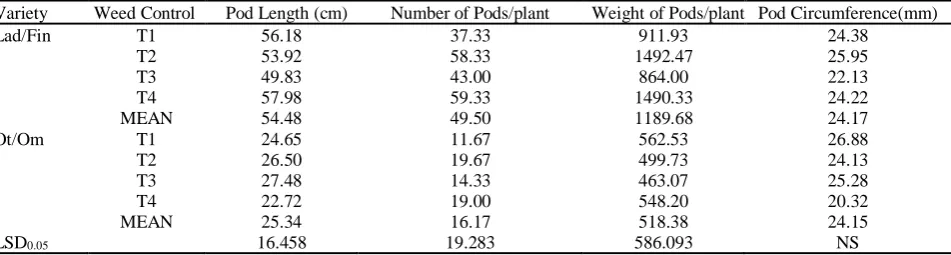
Pod Length (cm): Pod length was significantly (P<0.05)
influenced by combination of crop variety and weed control methods (Table 4). Lady’s finger produced the longest pods irrespective of the weed control methods employed. The shortest pods (22.72 cm) were produced by ‘Otukwuru-Omia’ in the hoe-weeded plots, at 4 WAS + Metolachlor.
Number of Pods: Table 4 showed that Lady’s finger in
the plots hoe-weeded 4 WAS followed by Metolachlor application significantly (P<0.05) produced the largest number of pods (59.33). This was followed by the same variety in the plots hand-weeded at 3 weekly interval (58.33). These were significantly (P<0.05) higher than the least number of pods (11.67) produced by ‘Otukwuru-Omia’ in the unweeded plots.
Weight of Pods (g): Table 4 showed that fresh weight of
pods was significantly (P<0.05) influenced by combination of crop variety and weed control methods. Lady’s finger in the plots that were hoe-weeded at 3 weekly intervals, gave the highest pod weight (1492.47 g). Next was Lady’s finger in the plots hoe-weeded at 4 WAS followed by Metolachlor application (1490.33). These were also significantly different (P<0.05) from the lowest pod weight (463.07 g) produced by ‘Otukwuru-Omia’ in plots where Metolachlor was applied at 3 weekly interval.
Pod Circumference (mm): The circumference of Okra
pods was not significantly (P>0.05) influenced by variety and weed control methods (Table 4). However, ‘Otukwuru-Omia’ in the unweeded plots had the biggest pod circumference (26.88 mm), followed by Lady’s finger in plots which were hoe-weeded at 3 weekly interval
Table 1: Influence of Okra varieties and different weed control methods on weed density, total fresh and dry weights of weeds, at 4 and 8 weeks after sowing.
Treatment Total Weed Density (No./plot) Fresh Weight of Weeds (g/m2) Dry Weight of Weeds (g/m2)
4 WAS 8 WAS 4 WAS 8 WAS 4 WAS 8 WAS
Variety (V)
Lady’s finger 43.17 17.17 26.24 44.13 9.08 13.17
‘Otukwuru-Omia’ 56.25 20.83 35.91 63.18 11.17 16.72
LSD(0.05) ns ns ns ns ns ns
Weed Mgt. (WC)
T1 64.83 46.17 34.73 180.97 11.67 44.45
T2 12.17 17.67 5.23 8.33 2.83 4.67
T3 4.50 2.67 32.33 8.37 10.33 3.83
T4 17.33 9.50 52.00 16.97 15.64 6.83
LSD(0.05) value 41.62 9.48 ns 55.020 ns 16.27
T1= no weeding from sowing to harvest, T2 = hoe weeding at 3 weekly interval, T3 = application of pre-emergence herbicide (Metolachlor 250a.i. g/L at 1.5kg a.i./ha) at 3 weekly interval, T4 = hoe-weeding at 4 weeks after sowing (WAS) followed by
Table 2: Initial Soil Chemical Properties of the Experimental Plots.
Soil components
pH 6.9
Exchangeable cations (cmol/kg)
Ca2+ 6.75
Mg2+ 2.96
Exchangeable acidity (cmol/kg)
Al3+ 0.94
H+ 0.58
Organic Carbon content (%) 1.23
Total Nitrogen (%) 0.123
(25.95 mm). These were however, not significantly different (P<0.05) from the smallest pod circumference (20.32 mm) recorded by ‘Otukwuru-Omia’ in the plots that were hoe-weeded 4 WAS followed by Metolachlor application.
Some soil chemical properties
Initial chemical properties of the soil in the study site:
The initial chemical properties of the soil in the study site prior to the experiment are shown in Table 2. The pH of
the soil was neutral (6.9). The Organic Carbon content and total Nitrogen were 1.23% and 0.12%, respectively. Thus, the soil fertility was relatively low for Okra production (FAO, 2008).
Exchangeable Acidity and soil pH: The Aluminum
content in the soil was higher (1.80 cmol/kg) in the check
(control) plots which were planted with Lady’s finger. Next was in plots where ‘Otukwuru-Omia’ was sown under hoe-weeding at 3 weekly intervals (1.60 cmol/kg). This showed that there were significant differences (P<0.05) between them. The least concentration of Al3+
(0.65 cmol/kg) was found in plots where ‘Otukwuru-Omia’ was grown under hoe-weeding after 4 weeks of sowing plus Metolachlor application one week after weeding (Table 5).
The plots that had Lady’s finger under weedy control checks, recorded the highest Hydrogen ion content (1.65 cmol/kg), (Table 5). This was significantly different (P<0.05) from the least (0.40 cmol/kg) recorded in plots where variety ‘Otukwuru-Omia’ was grown under Metolachlor application at 3 weekly interval.
The highest soil pH of 6.7 was recorded in plots that were hoe-weeded at 4 WAS followed by Metolachlor application one week after weeding. These were also significantly different (P<0.05) from the soil pH of 6.2 in the control plots grown with Lady’s finger (Table 5).
Exchangeable Bases: The highest concentration of
calcium and magnesium contents of 21.25 and 16.50 cmol/kg, respectively were recorded in plots that had Lady’s finger grown, under application of Metolachlor at 3 weekly intervals. This showed there were significant differences (P<0.05) between the chemical concentrations in these plots and the low ion contents (9.50 and 5.50 cmol/kg) respectively, in plots grown with ‘Otukwuru-Omia’ under hoe-weeding at 3 weekly interval (Table 5).
Table 3: Interaction Effect Of Weed Control Methods And Variety On The Growth Of Okra At 4 and 8 Weeks After Sowing (WAS).
Number of branches Leaf Area (cm2) Number of leaves Plant height (cm)
Variety WC 4 WAS 8 WAS 4 WAS 8 WAS 4 WAS 8 WAS 4 WAS 8 WAS
Lady’s Finger T1 0.00 7.25 1182.14 8576.00 8.92 11.67 37.33 138.33
T2 0.00 6.33 1089.80 9686.55 8.17 12.92 58.33 146.75
T3 1.89 8.42 1086.40 8561.91 8.50 12.75 43.00 123.00
T4 0.33 6.83 1171.97 10469.94 8.92 14.25 59.33 147.58
MEAN 0.56 7.21 1132.58 9323.60 8.63 12.90 49.50 138.915
Otukwuru - omia T1 1.67 5.25 940.07 9378.11 8.25 12.17 11.67 92.00
T2 1.17 5.92 1052.88 9003.84 8.42 13.33 19.67 81.08
T3 0.83 6.17 1016.02 9065.64 8.33 13.67 14.33 67.50
T4 1.33 8.50 816.07 10460.43 8.17 13.50 19.00 69.00
MEAN 1.25 6.46 956.26 9477.01 8.30 13.17 16.17 77.40
LSD 1.754 ns 210.716 ns ns ns 5.695 24.931
WC = Weed Management; T1= (check), no weeding from sowing to harvest; T2 = hoe-weeding at 3 weekly interval; T3 = application of pre-emergence herbicide (Metolachlor 250a.i. g/L at 1.5kg a.i./ha) at 3 weekly interval; T4 = hoe-weeding at 4 WAS followed by
Metolachlor one week after hoe-weeding. ns = not significant (P>0.05).
Table 4: Interaction Effect of Weed Control Treatments vs Crop Variety on Okra Performance at Harvest: (Pod Length, Number of Pods, Weight of Pods and Pod Circumference).
Variety Weed Control Pod Length (cm) Number of Pods/plant Weight of Pods/plant Pod Circumference(mm)
Lad/Fin T1 56.18 37.33 911.93 24.38
T2 53.92 58.33 1492.47 25.95
T3 49.83 43.00 864.00 22.13
T4 57.98 59.33 1490.33 24.22
MEAN 54.48 49.50 1189.68 24.17
Ot/Om T1 24.65 11.67 562.53 26.88
T2 26.50 19.67 499.73 24.13
T3 27.48 14.33 463.07 25.28
T4 22.72 19.00 548.20 20.32
MEAN 25.34 16.17 518.38 24.15
LSD0.05 16.458 19.283 586.093 NS
Lad/Fin= Lady’s Finger, Ot/Om= ‘Otukwuru-Omia’; T1= no weeding from sowing to harvest; T2 = hoe weeding at 3 weekly interval; T3 = application of pre-emergence herbicide (Metolachlor 250a.i. g/L at 1.5 kg a.i./ha) at 3 weekly interval; T4 = hoe-weeding at 4
226
Table 5: Effects of weed control methods and okra variety on the chemical properties of the soil after harvest.
Okra Variety
Weed control method
Al3+
(cmol/kg)
H+
(cmol/kg)
Ca2+
(cmol/kg)
Mg2+
(cmol/kg)
N2
(%)
Soil Carbon (%)
Org/matters (%)
pH
(H2O)
pH (KCl)
L/Fn T1 1.800 1.650 14.250 7.500 0.002 0.024 0.041 6.20 5.00
T2 0.700 0.450 18.750 6.500 0.0923 0.924 1.593 6.60 5.70
T3 1.300 0.650 21.250 16.500 0.055 0.540 0.931 6.50 5.70
T4 0.750 0.550 18.250 14.750 0.077 0.768 1.324 6.70 5.70
MEAN 1.138 0.825 18.125 11.313 0.057 0.564 0.973 6.50 5.53
O/m T1 1.100 0.950 11.500 9.500 0.054 0.540 0.931 6.50 5.70
T2 1.600 0.550 9.500 5.500 0.097 0.972 1.676 6.60 5.80
T3 1.000 0.400 12.250 9.250 0.065 0.636 1.096 6.60 5.80
T4 0.650 0.480 13.500 8.500 0.041 0.408 0.703 6.70 5.70
MEAN 1.088 0.595 11.688 8.188 0.064 0.639 1.102 6.60 5.75
LSD 0.492 0.052 0.366 0.369 0.002 0.004 0.003 0.27 0.1972
L/Fn= Lady’s Finger; O/m= ‘Otukwuru-Omia’, Al3+ = Aluminium, H+ = Hydrogen, Ca2+ = Calcium, Mg2+ = Magnesium, N
2 =
Nitrogen, Soil Carb. = Soil organic carbon; Org/matter = Soil organic matter; T1= no weeding from sowing to harvest; T2 = hoe weeding at 3 weekly interval; T3 = application of pre-emergence herbicide (Metolachlor 250a.i. g/L at 1.5 kg a.i./ha) at 3 weekly interval; T4 = hoe-weeding at 4 weeks after sowing (WAS) followed by Metolachlor one week after hoe-weeding.
Soil Organic Carbon Content: The organic content of the
soil was higher in plots grown with ‘Otukwuru-Omia’ under hoe-weeding at 3 weekly intervals (0.972 %). The lowest (0.024 %) organic content was recorded in plots grown with Lady’s finger in the weedy control treatments (Table 5). These were also significantly different (P<0.05).
DISCUSSION
Application of pre-emergence herbicide (Metolachlor 250 a.i. g/L at 1.5 kg a.i./ha) at 3-weekly interval significantly (P<0.05) controlled weed density as well as increased the fresh weight and dry matter contents of Okra. This could be attributed to the residual effects of the herbicide that prevented the weed seeds from germinating before the Okra formed enough canopies, thereby reducing the level of weed infestation in the plots. Similar observations were also reported by Akobundu, (1987) and Omole, (1997).
Okra varieties responded differently to weed infestation in the absence of any control measure. For instance, Lady’s finger in the control plots grew much taller at the early stages of crop development (4 WAS). These plots were heavily infested by weeds, and as such, there would be competition for light between the Okra plants and the weeds. However, the same variety, Lady’s finger, in plots that were hoe-weeded after four weeks of sowing (4 WAS) followed by Metolachlor application one week after hoe-weeding, had the tallest plants at 8 WAS. These observations agreed with the findings by Basha and Reddy (2001) who reported that chemical treatments alone or in combination with hoe-weeding, significantly (p<0.05) controlled weeds and improved the growth and yield of Okra. Furthermore, the development of branches by the crops was influenced by the weeds. For instance, the number of branches per plant was influenced by the presence of weeds. The plots planted with Lady’s finger under the uncontrolled weedy checks, as well as those in the plots that were hand-weeded at three weekly intervals had no branches at their early growth stage (4 WAS), while this variety under similar condition gave the least number of branches at 8 WAS. This therefore, indicated there were some adverse effects of the weeds on the crops.
This is in consonance with reports by Prakash et al. (2001).
The formation of leaves was equally influenced by the type of weed control methods employed. Thus, plots cultivated with Lady’s finger and left under weedy control condition, produced the highest number of leaves per plant at the early growth stage (4 WAS) of the crop, but later at the 8 WAS, the number of foliage significantly (P<0.05) reduced. Again, this could be attributed to the competition for moisture and nutrients by both crops and weeds. Thus, the crop plants could not produce enough foliage required at the critical stages of growth. Similar factors could have been responsible for the reduced leaf area reported in unweeded plots by Basha and Reddy (2001).
The Okra yield and other components of crop performance were similarly influenced by the weed control methods adopted. For example, higher crop yields were obtained in plots cropped with Lady’s finger under hoe-weeding at 4 WAS followed by Metolachlor application one week after weeding. This high productivity of the crop is most likely to be attributed to the large number of leaves and larger leaf area produced by the plants under this method of weed control. Furthermore, the increased number of leaves and larger leaf area would enhance photo-reception and thus, improve photosynthesis by the crop plants. These results again agree with the findings of Gogoi et al. (1997) and Khan and Hassan (2003).
The slightly acidic soil in plots of Lady’s finger grown under weedy controls, significantly increased (P<0.05) to moderately acidic, when compared with the initial pH of the soil. It should be noted that the H+
content of soil increased, and could be as a result of the chemical and floral decomposition in the soil. This would most likely lead to increased acidity of the soil. Similar observations were also reported by Barak et al., (1997). These authors were of the opinion that long-term effects of soil acidification due to fertilizer input resulted from chemicals such as urea and ammonium nitrate fertilizers.
with biological activities of soil inhabiting microorganisms during land preparation, coupled with weed control method employed, in conjunction with nutrient loss due to uptake by Okra plants. Similar observations had earlier been reported by Ells et al., (1993) and Fontaine et al., (2007).
Conclusion
The various weed control methods significantly (P<0.05) influenced the chemical properties of the soil. Weedy control plots, hoe-weeding at 3 weekly intervals, and application of pre-emergence herbicide at 3 weekly interval, increased aluminum and hydrogen ion concentrations. This has led to a shift in the soil pH from slightly acidic to moderately acidic after crop harvest. However, the soil organic carbon and nitrogen contents were reduced as a result of nutrient loss due to uptake by Okra plants. Interestingly too, hoe-weeding at four weeks after sowing combined with pre-mergence herbicide application a week after weeding, significantly increased the overall yield of crop.
Nevertheless, within limits of these trials, 4 WAS plus pre-mergence herbicide application one week after hoe-weeding has proved to be most effective. The approach was less tedious and cheaper than manual weeding alone. Combination of herbicide and hoe-weeding at the intervals specified, increased both vegetative growth and yield of Okra. It would therefore, be suggested that farmers in Awka should reduce the burden of hoe-weeding alone, and cut down costs of labour by using pre-emergence herbicides for weed control in Okra production.
REFERENCES
Adejonwo KO, MK Ahmed, STO Lagoke, and SK Karikari, 1989. Effects of Variety, nitrogen and period of weed interference on growth and yield of okra (Abelmoshus esculentus). Nigeria Journal of Weed Science. 2:21-27.
Adigun JA, 2005. Critical period of weed interference in Rainfed and Irrigated tomatoes in the Nigerian Savanna. Agricultura Tropica et Subtropica. 38:73-80.
Ahmed KU, 1995. Vegetables crop business in Bangladesh. A consultancy report under AVRDC-BARC/BARI-USAID Bangladesh project, BARI, GAZIPUR, Bangladesh, 400 pp.
Akobundu IO, 1987. Weed Science in the Tropics. Principles and Practice. John Wiley & Sons Inc., 522 pp.
Asif MI, 1977. Estimation of leaf area in okra Abelmoschus esculents (L) Moench. Tropical Agriculture (Trinidad), 54: 192.
Barak P, OJ Babou, RK Armand, AP Lloyd and AL David, 1997. Effects of long-term soil acidification due to agricultural inputs in Wisconsin. Plant and Soil. 197. 61-69. 10.1023/A: 1004297607070. Basha GK and KB Reddy, 2001. Integrated weed
management in summer irrigated okra (Abelmoschus esculentus (l .) Moench). Madras Agril. J. 88 (10-12): 678-682.
Duze M and Afolabi MA, 1981. Senior School Atlas Macmillam Education Ltd. Nigeria.
Ells JE, AE McSay, PN Soltanpour, FC Schweissing, MF Bartolo and EC Kruse, 1993. Onion irrigation and nitrogen leaching in the Arkansas valley of Colorado, 1990–1991. Hort Technology, 3: 185–187.
Ezenwaji EE, PO Pil-Eze, IC Enete and BO Osuiwu, 2014. An Analysis of the Cycles and Periodicity of Annual Rainfall over Awka Region, Nigeria. Atmospheric and Climatic Sciences, 4: 665-671. Fontaine S, S Barot, P Barre, N Bdioui, B Mary, Rumpel
C, 2007. Stability of organic carbon in deep soil layers controlled by fresh carbon supply. – Nature, 450: 277–280.
Food and Agricultural Organization, 2008. Food and Agricultural Organization of the United Nations. Gogoi S, PH Gogoi, A Mazumder and TP Saikia, 1997.
Integrated method of weed control in a seed crop of okra (Abelmoschus esculentus L. Moench). J. Agri. Sci. Soc. of North East India. 9 (1): 138-142.
Govindra, Singh. YM Bhan and SS TIipathi, 1982. Weed control in okra [Abelmoschus esculentus (L) Moench] Indian Journal of Weed Science 14: 19-23. Ibeawuchi IK, 2007. Intercropping a food production
strategy for resource poor farmers. Nature and Science, 5:46–49.
Iremiren GO, 1988. Frequency of weeding okra (Abelmoschus esculentus) for optimum growth and yield. Exploration Journal of Agriculture, 24: 12-20.
Iyagba AG, BA Onuegbu and AE IBE, 2012. Growth and Yield Response of Okra (Abelmoschus esculentus (L.) Moench) Varieties to Weed Interference in South-Eastern Nigeria. Global Journal of Science Frontier Research Agriculture and Veterinary Sciences, 12(7): 23-31.
Khan M and W Hassan, 2003. Effect of S-metolachlor (Dual Gold 960 EC) on weed control and yields in different crops. Sarhad J. Agril. 19 (3): 333-339. Montelaro 1 and ME Maryel, 1966. Chemical weed
control for Florida vegetable crops. Circular, Florida University Agricultural Experiment Station 196B, 8 pp.
Nelson, D.W and Sommers, L.E 1982. Total carbon, organic carbon and organic matter. In: Page, A.L. (ed). Methods of Soil Analysis Part 2. American Society of Agronomy and Soil Science Society of America.Madison, Wisconsin. pp 539-579.
Odeleye FO, OMO Odeleye, OA Dada and AO Olaleye, 2005. The response of okra to varying levels of poultry manure and plant population density under sole cropping. Journal of Food, Agriculture and Environment, 3(3,4): 68-74.
Odeleye FO, OMO Odeleye, OA Dada and OA Olaleye, 2005. The response of okra to varying levels of poultry manure and plant population density under sole cropping. Journal of Food, Agriculture and Environment, 3(4): 6874.
Olasotan FO, 2001. Optimum population density for okra (Abelmoschus esculentus (L) Moench) in a mixture with cassava (Manihot esculentus) and its relevance to rainy season-based cropping system in south-western Nigeria. Jr. of Agric. Sc. 136: 207-214.
228 Tech. Project, the Federal University of Technology, Akure, Nigeria. 27 pp.
Osipitan OA, 2017. Weed interference and control in cowpea production: A review. J. Agric Science. 9(12):11-20. Available: https://doi.org/10.5539/jas. v9n12p11
Oyeyemi AD and OF Ojo, 2010. Period of Weed Control in Okra [Abelmoschus esculentus (L.) Moench] as Influenced by Varying Rates of Cattle Dung and Weeding Regimes. Not. Bot. Hort. Agrobot. Cluj, 38 (1): 149-154.
Prakash Ved. Pandey AK, RD Singh, HS Gupta and V Prakash, 2001. Integrated weed management in okra. Indian J. Weed Sci. 33 (1-2): 49-51.
Siemonsma JS and CS Hamon, 2002. Abelmoschus caillei (A.Chev.) stevels Record from Protabase. Oyen,
L.P.A. and Lemmens, R.H.M.J (Eds.) PROTA (Plant Resources of Tropical Africa/Resources, Vegetables de l’Afrique tropicale), Wageningen, The Netherlands.
Smith MAK, KO Oloyede and AB Adedeji, 2012. Preliminary evaluation of weed management method x crop variety interaction on weed control and okra yield. Journal of Applied Biosciences, 22: 1283– 1288.
Sutton P and DS Burgis, 1966. Tolerance of okra to several herbicides. Proceedings 19th Southern Weed Conference, 1966, pp. 589-592, Dover, Florida. Wascom BW and JF Fontenot, 1967. Effect of several