THIRD YEAR - MATHEMATICS
PLANE COORDINATE GEOMETRY
Basic Education Assistance for Mindanao (BEAM) project. Prior approval must be
given by the author(s) or the BEAM Project Management Unit and the source must
be clearly acknowledged.
Mind Map
The Mind Map displays the organization and relationship between the concepts and activities in this Learning Guide in a visual form. It is included to provide visual clues on the structure of the guide and to provide an opportunity for you, the teacher, to reorganize the guide to suit your particular context.
Stages of Learning
The following stages have been identified as optimal in this unit. It should be noted that the stages do not represent individual lessons. Rather, they are a series of stages over one or more lessons and indicate the suggested steps in the development of the targeted competencies and in the achievement of the stated objectives.
Assessment
All six Stages of Learning in this Learning Guide may include some advice on possible formative assessment ideas to assist you in determining the effectiveness of that stage on student learning. It can also provide information about whether the learning goals set for that stage have been achieved. Where possible, and if needed, teachers can use the formative assessment tasks for summative assessment purposes i.e as measures of student performance. It is important that your students know what they will be assessed on.
1. Activating Prior Learning
This stage aims to engage or focus the learners by asking them to call to mind what they know about the topic and connect it with their past learning. Activities could involve making personal connections.
Background or purpose
In this stage, the students will determine the midpoint and distance between the given points on the number line.
Strategy
DECODING. A strategy used to translate data or a message from a code into the original language or form. In the context of this activity, students will perform certain expressions. After which, students will look for the corresponding answers on the choices to decode the words that will satisfy the given challenge/puzzle.
Material
Activity 1: “Keep Distance”
1. Organize the class into groups of 3 or as desired and distribute to them the activity sheet.
2. Allow them to finish the activity with the time you set. 3. After which, let them compare outputs with the other groups.
4. Ask group volunteers to present their output to the class for discussion.
Formative Assessment
See to it that the students are contributing ideas in their group discussion. Check their outputs using the answer key on page 12.
Roundup
The students would have determined the midpoint and distance between the given points on the number line.
2. Setting the Context
This stage introduces the students to what will happen in the lessons. The teacher sets the objectives/expectations for the learning experience and an overview how the learning experience will fit into the larger scheme.
Background or purpose
The students in this stage will determine the distance and midpoint between the given points on a Cartesian Plane.
Strategy
THINK PAIR SHARE. This strategy allows students to think individually about an issue, question or problem and record response. Discuss ideas with a partner and record what they have shared. Share with the whole group or join another pair to reach consensus.
Material
• activity sheet (refer to Student Activity 2 on page 13)
Activity 2: “Point It Out”
1. Let the students look for a partner and distribute to them the activity sheet. 2. Instruct them to answer individually the task in a separate sheet and share it with
their partner. Then, tell them to finalize their answer on the activity sheet. 3. After which, ask them to join another pair for outputs' comparison for them to
reach a consensus.
Formative Assessment
Check their outputs using the possible answer below:
1. ● (1, 3) ● (9, 3) ● (9, 9)
2. ● 8 units or 40 meters ● 6 units or 30 meters
4. ● (9, 6) ● (5, 3)
Roundup
The students would have determined the distance and midpoint between the given points on a Cartesian Plane.
3. Learning Activity Sequence
This stage provides the information about the topic and the activities for the students. Students should be encouraged to discover their own information.
Background or purpose
In this stage, the students will be able to:
derive and state the Distance Formula using the Pythagorean Theorem; derive and state the midpoint Formula; and
apply the Distance and Midpoint Formulas to find the lengths of segments and unknown vertices or points.
Strategies
INTERACTIVE LECTURE. This strategy provides students with a general outline to give them a framework for thinking about a subject and to structure their note taking. This type of lecture involves students by focusing their attention on key words. This emphasizes information transfer at the knowledge, recall, and comprehension levels of learning.
NUMBERED HEADS. This strategy measures group accountability. Groups will be lettered off by A, B, C, etc. and each group member will be numbered off by 1, 2, 3, ... in such a way that each student in the class has its identity from A1, A2, A3, ..., B1, B2, ..., so on and so forth. Each numbered head will be called one by one to stand in front and answer a question. If the person does not know the answer to question, he/she returns to his/her group to find the answer under a time limit.
Materials
• activity sheet (refer to Student Activity 3 on page 14) • ruler
Interactive Lecture
In Activity 2, questions 2 and 4 can be answered easily by counting since the segments joining those points are parallel to either the x-axis or the y-axis.
Connect the points representing the location of the health center, the mosque, and Ana's house. What have you noticed?
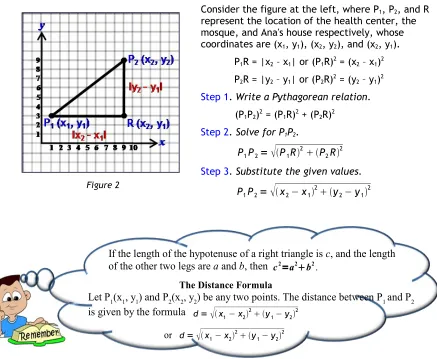
[image:6.595.84.521.190.549.2]The line segment joining the health center and the mosque is the hypotenuse of the right triangle formed. Thus, we can apply here the Pythagorean Theorem to find the distance from the mosque and the health center.
Figure 2
Consider the figure at the left, where P1, P2, and R
represent the location of the health center, the mosque, and Ana's house respectively, whose coordinates are (x1, y1), (x2, y2), and (x2, y1).
P1R = |x2 – x1| or (P1R)2 = (x2 – x1)2
P2R = |y2 – y1| or (P2R)2 = (y2 – y1)2
Step 1. Write a Pythagorean relation. (P1P2)2 = (P1R)2 + (P2R)2
Step 2. Solve for P1P2. P1P2=
P1R 2 P2R 2
Step 3. Substitute the given values. P1P2=
x2−x12
y2−y1 2
Using the formula, we can now find the distance between the health center (P1) and the
mosque (P2), where (P1) has coordinates (1,3) and (P2) has coordinates (9, 9), that is,
P1P2=
x2−x1 2 y2−y1 2
P1P2=
9−12 9−32=
8262=
6436 =
100=10 Thus, the distance between the health center and the mosque is 10 meters. This time, how do you find the point midway between the health center (P1) and the
mosque (P2) in figure 2?
Recall that the average of two numbers is one-half of their sum.
LetP1(x1, y1) and P2(x2, y2) be any two points. The distance between P1 and P2 is given by the formula
or
d=
x1−x2 2 y1−y2 2
d=
x1−x22 y1−y22 .If the length of the hypotenuse of a right triangle is c, and the length of the other two legs are a and b, then c2=a2b2.
In number line, the midpoint of certain line segment is equal to the average of the coordinates of that line segment.
Consider a segment in the coordinate plane with endpoints P1(x1, y1) and P2(x2, y2). To find the
midpoint M, draw the horizontal and vertical segments such that R will have coordinates (x2, y1),
MP∥P2R and P1P = PR.
If P1P = PR, then P1P =
1
2P1R. Since MP∥P2R,
∆P1MP ∼ ∆P1P2R, and thus, P1M
P1P2 =
1 2P1R
P1R . By
simplification, P1M=1
2P1P2. Therefore, M has the
x-coordinate x1x2
2 . Similarly, M has the y-coordinate y1y2
2 .
Going back to the problem, by using the Midpoint Formula,
x= x1x2 2
x=19 2
x=5
y=y1y2 2
y=39 2
y=6
we can see that the point midway between the mosque and the health center is 5 meters from the y-axis and 6 meters from the x-axis.
Activity 3: “From A Distance”
1. Organize the class into groups of 5 or as desired. Name the groups with letters A, B, C, etc. Number each group members off by 1, 2, 3, ... in such a way that each student in the class has its identity from A1, A2, ..., B1, B2, B3, ..., so on and so forth. Keep the list of the numbered heads to be used later.
2. Distribute to them the activity sheet on page 14. 3. Set a time allotment for them to complete the activity.
4. After which, do the Numbered Head Strategy (refer to page 5 for its description). .
The Midpoint Formula
If P1(x1, y1) and P2(x2, y2) are any two points, then the midpoint M of is the point
P1P2
x1x22 ,
y1 y2
2
5. Check their answers using the answer key on page 15.
Formative Assessment
Ensure the involvement of the students in the given activity by roaming around in every group and see to it that all members of the group are contributing ideas.
Roundup
The students would have:
derived and stated the Distance Formula using the Pythagorean Theorem; derived and stated the midpoint Formula; and
applied the Distance and Midpoint Formulas to find the lengths of segments and unknown vertices or points.
4. Check for Understanding of the Topic or Skill
This stage is for teachers to find out how much students have understood before they apply it to other learning experiences.
Background or purpose
Students at this stage will find the lengths of segments and unknown vertices or points applying the distance and midpoint formulas.
Strategy
DECODING. A strategy used to translate data or a message from a code into the original language or form. In the context of this activity, students will find distance between given points and will determine midpoint of the given line segment. After which, students will look for the corresponding answers on the choices to decode the words that will satisfy the given challenge/puzzle.
Material
• activity sheet (refer to Student Activity 4 on pages 16-17)
Activity 4: “He Quotes”
1. With the groups of 4 or as desired, distribute to them the activity sheet. 2. Let them complete the activity with the time you set.
3. After which, ask them to compare outputs with the group.
4. Call group volunteers to present their outputs to the class for discussion.
Formative Assessment
Monitor the involvement of the students in the group discussion. Check their output using the answer key on page 18.
Roundup
The students would have calculated the lengths of segments and unknown vertices or points applying the distance and midpoint formulas.
5. Practice and Application
In this stage, students consolidate their learning through independent or guided practice and transfer their learning to new or different situations.
Background or purpose
In this stage, students' learning on distance and midpoint formulas will be applied to situations related to real life experiences.
Strategy
TASK CARD. A strategy which encourages small groups of students to work for a common goal. It can be used across the curriculum areas. Making tasks “real life” tasks make them more meaningful. Tasks can be issued to practise a newly developed skill.
Material
• task cards (refer to Teacher Resource Sheet 1 on pages 19-20)
Activity 5: “Far Away”
1. Organize the class into groups of 5 or as desired. 2. Distribute to each group one set of task cards. 3. Set a time allotment for them to finish the tasks.
4. After which, let them compare outputs with the other group.
Formative Assessment
See to it that the students are working cooperatively with their group. Check their outputs using the answer key on page 21.
Roundup
The students would have applied their learning about distance and midpoint formulas in situations related to real life experiences.
6. Closure
This stage brings the series of lessons to a formal conclusion. Teachers may refocus the objectives and summarize the learning gained. Teachers can also foreshadow the next set of learning experiences and make the relevant links.
Background or purpose
Students in this stage will consolidate their learning on distance and midpoint formulas through journal writing.
Strategy
JOURNAL. This provides a good opportunity for students to demonstrate and reflect on their learning. It is a good source of assessment for teachers. Journals don't have to be written- diagrams and drawings are authentic forms of demonstrating learning.
Material
• journal (refer to Teacher Resource Sheet 2 on page 22)
Activity 6: “Exit Notes”
1. Prior to the activity, prepare an enlarged copy of the journal to be posted on the board.
2. Let each student complete the journal.
3. After which, ask them to pair up and compare outputs.
4. Collect and check their outputs. Conduct further discussion for clarification if needed.
Formative Assessment
Ensure that all the students are writing their journal.
Roundup
Students would have consolidated their learning on distance and midpoint formulas by writing a journal.
Teacher Evaluation
(To be completed by the teacher using this Teacher’s Guide) The ways I will evaluate the success of my teaching this unit are: 1.
2. 3.
STUDENT ACTIVITY 1
Keep Distance
Determine the distance and midpoint between the given points
on the number line.
A) Use the number line below to answer the questions that follow.
(Note: letters above the number line are names of the points and at the same time code of the answer)
1. How many units are there between points
S
and
J
?
2. What point is 6 units to the left of point
C
?
3. What point is 4 units to the right of point
I
?
4. How many units is point
T
away from point
N
?
5. What is the distance between points
P
and
V
?
6. How far is point
P
from point
W
?
7. What is the midpoint between points
S
and
V
?
8. Point
Z
is the midpoint of points
F
and
_____
.
B) Look for the letters of your answers in the number line and write them in the
boxes above its corresponding item number in the table below to reveal the word.
C) Define the word formed.
Objective:
STUDENT ACTIVITY 1
Keep Distance
Answer Key
A)
1. 12 (M)
2. -2 (E)
3. 10 (R)
4. 8 (F)
5. 3 (A)
6. 7 (L)
7. -7 (O)
8. -4 (U)
B)
C) Possible definition
Formulae,
noun. The plural form of
formula
.
STUDENT ACTIVITY 2
Point It Out
Use the figure below to answer the questions that follow.
1. Where can you locate the following:
•
health center,
•Ana's house, and
•mosque?
2. How far is the
•
health center from Ana's house?
•mosque from Ana's house?
3. Can you determine the distance between the mosque and the health center?
Support your answer.
4. What is the point halfway between the
•
mosque and Ana's house?
•health center and Ana's house?
5. Can you determine also the point halfway between the mosque and the
health center? Support your answer.
Directions:
(1 unit = 5 meters)
(1
u
ni
t
=
5
m
et
er
STUDENT ACTIVITY 3
From A Distance
Find the lengths of the segments and unknown vertices or
points using the distance and midpoint formulas.
A) Use this figure to answer the problems that follow.
1. Find the distance between the given points to the nearest hundredths and
connect them with a straight line to form a figure.
2. Find the coordinates of the midpoint of the following segments.
Directions:
AB
CD
EF
GH
JK
KL
LM
STUDENT ACTIVITY 3
From A Distance
Answer Key
1.
2.
4.24
2
3.90
5
3.90
2
4.24
2.24
2.24
9
9
9
2.24
2.24
AB
CD
EF
GH
JK
KL
LM
STUDENT ACTIVITY 4
He Quotes
A) Use the figure below to answer the problems that follow.
Find the distance between the following given points:
1) A and B
2) A and C
3) D and E
4) D and G
5) J and K
6)
I
and M
7) G and C
8) F and B
Calculate the distance between the midpoints of the following:
9)
AB
and
AC
10)
AB
and
BC
11)
EF
and
AC
12)
BC
and
DG
Directions:
A
B
C
D E
G F
H
I
J K
B) Look for the letter of your answer in the decoder below and write each in the
empty box above its item number to complete the quotation of the famous
scientist- Louis Pasteur.
DECODER
STUDENT ACTIVITY 4
He Quotes
Answer Key
Find the distance between the following given points:
1) A and B
8.06
2) A and C
14
3) D and E
10
4) D and G
8
5) J and K
4.5
6)
I
and M
3.5
7) G and C
14.42
8) F and B
13
Calculate the distance between the midpoints of the following:
9)
AB
and
AC
4.03
10)
AB
and
BC
7
11)
EF
and
AC
6.40
12)
BC
and
DG
10.40
“
Teacher Resource Sheet 1
Far Away
Task Cards
Reproduce 5 copies of each card and cut. Give one set to each
group.
Task
Card 1
1. How far is Edgar's
home from
Andres' home?
2. If they walk at the
same rate towards
each other, at what
point will they meet?
Note: 1 unit = 5 meters
Two ships leave the port at
the same time. Ship
A
travels
east at 12 miles per hour. Ship
B
travels north at 8 miles per
hour. How far apart are they
after 4.5 hours?
Task
Card 2
task
A lake is shown at the
right. An island is
located at (4, 5). A boat
travels in a straight line
from (2, 0) to the island.
How far does the boat
travel?
Task
Card 3
Note: 1 unit = 10 meters
Rashid jogs 3 kilometers due
west and 4 kilometers due
north and then he stops.
While Aisa jogs only for 2
kilometers due west and
stops.
How far are they from each
other after jogging?
STUDENT ACTIVITY 5
“Far Away”
Answer Key
Task Card 1. 1.
dP1P2 =
x2−x1 2 y2−y1 2
d=
−6−42 −4−52 =
10081=
181 =13.45 2.
x1x22 ,
y1y2
2
=
4 −6 2 ,5 −4 2
=
−1,1 2
Task Card 2.
Solution: We need to calculate the distance traveled by each ship in 4.5 hours. Recall that the distance traveled = Rate x Time.
Ship A's distance is given by A = 12(4.5) = 54 miles.
Ship B's distance is given by B = 8(4.5) = 36 miles. The total distance separating them is
d=
542362
=
29161296 =
4212≈64.9
Task Card 3.
d=
4−22 5−02=
425=
29=5.39 units
or 53.9 meters
Task Card 4.
d=
3−22 4−02=
116=
17=4.12 kilometers
Therefore, Rashid and Aisa are 4.12 kilometers away from each.
A B
d = how far apart the ships are
Teacher Resource Sheet 2
Exit Notes
Things I learned about Distance and Midpoint Formulas ...
Thing I like most about the topic ...
For the Teacher:
Translate the information in this Learning Guide into the following matrix to help you prepare your lesson plans.
Stage
1.
Activating Prior Learning
2.
Setting the
Context
3.
Learning
Activity Sequence
4.
Check for
Understanding
5.
Practice and
Application
6.
Closure
Strategies
Activities from the Learning Guide
Extra activities you may wish to include
Materials and planning needed
Estimated time for this Stage