R E S E A R C H
Open Access
Long-term consequences of
in utero
irradiated mice indicate proteomic changes
in synaptic plasticity related signalling
Stefan J. Kempf
1,5, Christine von Toerne
2, Stefanie M. Hauck
2, Michael J. Atkinson
1,3,
Mohammed A. Benotmane
4and Soile Tapio
1*Abstract
Background:The harmful consequences ofin uteroirradiation on learning and memory have been recognised but the molecular mechanisms behind the damage are still unknown.
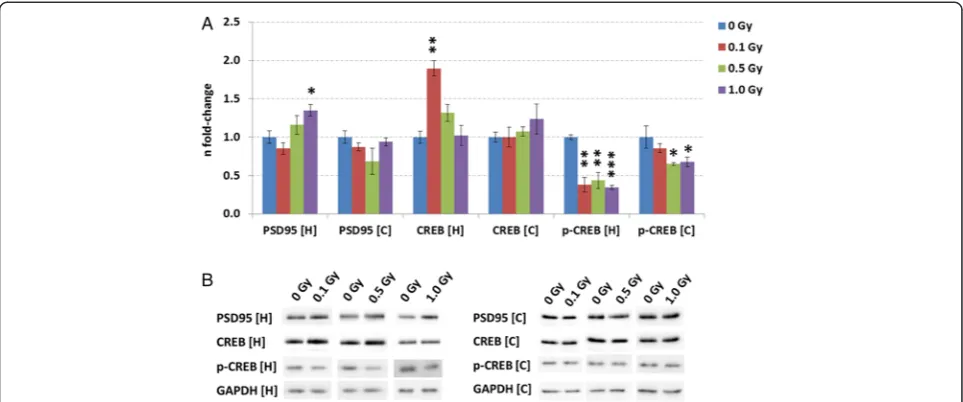
Results:Using a mass spectrometry-based approach, we investigated the long-term changes in the global cortical and hippocampal proteome 6 months after 0.1, 0.5 and 1.0 Gyin uteroX-ray irradiation delivered on embryonic day 11 in male C57Bl/6 J offspring. We noted alterations in several signalling pathways involved in cognition, the transcription factor cAMP response element-binding protein (CREB) playing a central role. Immunoblotting of CREB and phosphorylated CREB (Ser133) showed an altered expression profile at all doses in the hippocampus and at 0.5 and 1.0 Gy in the cortex. The greatest reduction in the phospho-CREB level was seen at 1.0 Gy in the hippocampus. It was accompanied by enhanced expression of postsynaptic density protein 95 (PSD95), suggesting effect on synaptic plasticity in neuronal dendrites.
Conclusions:As the CREB signalling pathway plays a crucial role in neuronal plasticity and long-term memory formation in the brain, the radiation-induced alterations of this pathway seen here are in good agreement with the cognitive dysfunction seen inin uteroirradiated populations. These data contribute to a deeper biological understanding of molecular mechanisms behind the long-term damage induced by relatively low doses of ionising radiation during gestation.
Keywords:Learning, Memory, Ionising radiation, CREB,in uteroirradiation, Hippocampus, Cortex, Proteomics
Background
Epidemiological studies on atomic bomb survivors exposed
in uteroshow that ionising radiation may induce perman-ent cognitive dysfunction, particularly if the exposure oc-curred during early gestational phases (weeks 8 to 15) [1]. This developmental phase of the brain is characterised by rapidly dividing cells called the brain growth spurt [2]. It is probable that ionising radiation during the early gestational phases targets mainly proliferating and differentiating cells in the brain [1, 3]. In addition to cortex, the hippocampus is important in learning and memory [4, 5] and shows a high degree of proliferation and lifelong neurogenesis
where neural stem cells give rise to neural progenitor cells and mature neurons. This process is known to be nega-tively affected by irradiation [6–9]. Thus, not only the cor-tex, but also the hippocampus may be a target forin utero irradiation damage.
The early gestational weeks 7 and 8 in human relate to embryonic days E11 and E12 in mice [10]. This time point has been shown to be the most radiation-sensitive period in mural gestation when doses as low as 0.35 Gy cause sig-nificant reduction in locomotor and exploratory activities [11]. This period coincides with the earliest time point for generation of neurons in the cerebral cortex ofMus
musculus[12, 13].
We have recently demonstrated that both male NMRI and female C57BL/6J mice irradiated at postnatal day 10 (PND10) with radiation doses as low as 0.5 Gy show * Correspondence:[email protected]
1Institute of Radiation Biology, Helmholtz Zentrum München, German Research Center for Environmental Health GmbH, Ingolstaedter Landstrasse 1, 85764 Neuherberg, Germany
Full list of author information is available at the end of the article
changes in synaptic signalling pathways several months post-irradiation [14, 15]. Especially the long-term potenti-ation/depression-associated CREB signalling was shown to be altered in whole hippocampus and cortex [14] as well as synaptosomes isolated from these [15]. In agree-ment with this, both male and female C57BL/6J mice as well as male NMRI mice showed cognitive behaviour defi-cits after irradiation with 0.5 Gy but not at lower doses [16], (Per Eriksson, personal communication).
The aim of this work was to elucidate the molecular con-sequences, especially those in the CREB signalling pathway, observed in adult mice afterin utero irradiation. Pregnant C57Bl/6J mice were irradiated on E11 with total body doses of 0.1, 0.5 and 1.0 Gy. Alterations in cognitive signal-ling pathways of the hippocampus and cortex were investi-gated in the male offspring 6 month post-irradiation using mass spectrometry- and immunoblotting-based experi-mental approaches.
Results and Discussion
In uteroirradiation affects long-term hippocampal and cortical signalling pathways associated with CREB-mediated synaptic plasticity
Mass spectrometry-based global proteomics using Isotope Coded Protein Label method (ICPL quadruplex approach)
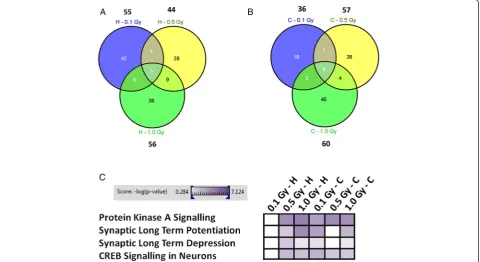
showed a deregulation of several proteins in the total hippocampus (0.1 Gy/0.5 Gy/1.0 Gy: 55/44/56 proteins) and entire cortex (0.1 Gy/0.5 Gy/1.0 Gy: 36/57/60 pro-teins) 6 months post-irradiation (Fig. 1 a and b). The number of deregulated proteins address 11 %/9 %/12 % in the hippocampus and 12 %/19 %/21 % in the cortex at radiation doses of 0.1, 0.5 and 1.0 Gy, respectively, in relation to the total number of confident quantifiable proteins (≥2 unique ICPL-labelled peptides found in n-1 runs, ICPL variability≤30 %).
Importantly, only a few proteins were shared between all the applied doses in the same brain region (Fig. 1 a and b) or between the brain regions at similar doses (Additional file 1: Figure S1 A, B and C). However, the majority of shared proteins were deregulated in the same direction (SI Additional file 2: Table S2, Additional file 1: Figure S1 D, E and F). SI Additional file 2: Table S1 shows the list of identified deregulated proteins categorised by radiation dose.
The expression of several (serine/threonine) protein kinases, protein phosphatases and mitochondrial re-spiratory proteins (SI Additional file 2: Table S1) was found to be altered by irradiation. In the hippocampus, we found at 0.1, 0.5 and 1.0 Gy 1/3/3 (serine/threonine) protein kinases, 3/3/2 protein phosphatases and 5/3/4
mitochondrial respiratory proteins, respectively. Similarly, in the cortex at 0.1, 0.5 and 1.0 Gy a change in 4/2/5 (serine/threonine) protein kinases, 1/1/4 protein phospha-tases and 3/10/6 mitochondrial respiratory proteins, re-spectively, was found. Thus, no dose-dependent increase in the number of proteins in these groups or in the total number of deregulated proteins can be seen. This result is in agreement with our previous studies with neonatally irradiated mice where the persistent changes in the amount of deregulated proteins showed no dose-dependency, except with the very low dose (0.02 Gy) where the number of deregulated proteins was smaller than at higher doses [14, 15].
A significant increase in redox scavengers such as per-oxiredoxin (Prdx5) at 0.1 and 0.5 Gy in the hippocampus and superoxide dismutase (Sod1) at 1.0 Gy in the cortex was observed (SI Additional file 2: Table S1). Similar persistent increase in the level of Prdx5 has been found previously in the hippocampus and cortex of neonatally irradiated mice [14, 15]. The increase in the levels of radical scavengers may reflect enhanced amounts of re-active oxygen species produced by altered mitochon-drial respiratory complexes [17]. However, analysis of radiation-induced changes in the mitochondrial respir-ation as previously seen in hippocampal mitochondria after neonatal irradiation [15] is necessary to verify this. Interestingly, the level of ubiquinol-cytochrome c reduc-tase core protein 1 (Uqcrc1), a member of the respiratory Complex III, was increased afterin utero irradiation at all doses in the hippocampus and cortex (SI Additional file 2: Table S1, SI Additional file 2: Table S2). The expression of this protein was also found increased in hippocampus and cortex of neonatally irradiated NMRI and C57BL/6 mice several months post-irradiation [14, 15]. Overexpression of Uqcrc1 has been associated with neurological symp-toms in mice, coupled to enhanced complex III activity in neuroblastoma cells [18].
In this study, a decrease in the level of the Rac1 pro-tein was observed in the cortex at 1.0 Gy. Rac1 is a small RhoGTPase that regulates actin polymerisation in the synapse [19]. Radiation-induced decrease in Rac1 ex-pression has been found frequently in hippocampus and cortex [15, 16, 20] implying its essential role at early de-velopmental stages.
Increased levels of ankyrin2 (Ank2) were found in this study at 0.1 Gy in both hippocampus and cortex. Similar upregulation of this protein was identified previously in hippocampus [14] and cortex [15] of neonatally irradiated mice. Ank2 is necessary to elevate cyclic AMP (cAMP) levels in neurons [21]. Importantly, we found a number of changes in cAMP-dependent regulatory protein kinases in the cortex at 0.1 Gy (increase in Prkacb level), 0.5 Gy (de-crease in Prkacb level) and 1.0 Gy (in(de-crease in Prkar2a level) (SI Additional file 2: Table S1). The cAMP levels
influence the activity of protein kinases A (Prka’s) and mitogen-associated protein kinases (MAPK’s) that regulate phosphorylation of cAMP-responsive element binding pro-tein (CREB) on Ser133 [22]. Moreover, calmodulin propro-tein kinases (CaMK’s) are also involved in the process of CREB phosphorylation [22, 23]. The expression levels of Prka’s and CaMKs were altered in the hippocampus (0.5 Gy, 1.0 Gy). In cortex, these proteins were found to be deregu-lated at all doses (Additional file 2: Table S1–green and orange highlighted PANTHER protein classes). Both types of kinases are essential in learning and memory formation [24, 25]. Interestingly, the protein kinase Map2k1 that is also involved in the regulation of the CREB activity was increased in both hippocampus and cortex only at 0.1 Gy (Additional file 2: Table S1—brown highlighted PANTHER protein class).
These data are consistent with the outcome of the path-way analysis showing that radiation-affected signalling pathways related to memory formation (PKA signalling, synaptic long-term potentiation and depression, CREB sig-nalling) are affected at all radiation doses in the cortex but only at 0.5 and 1.0 Gy in the hippocampus (Fig. 1 c). These pathways are interconnected as PKA is involved in the maintenance of synaptic long-term potentiation [26, 27] through activation of the transcription factor CREB [28]. CREB functions as the common downstream transcription factor for all these pathways.
In uteroirradiation alters CREB signalling in adult mice
of male mice as used in this study that were irradiated
in utero with doses of 0.5 and 1.0 Gy had a reduced hippocampal-dependent spatial learning and memory capacity at the age of 12 weeks, as evaluated by differ-ent behavioural tests [34]. Further, it was demonstrated that the animals irradiated with 1.0 Gy at E11 showed at the age of 40 weeks depletion of the neuronal marker N-acetyl-aspartate in the cortex, indicating neuronal cell loss accompanied with enlarged ventricles and im-paired juvenile hippocampal neurogenesis [34]. Conse-quently, the molecular changes observed here in the CREB signalling may partially reflect the difference in cellular composition between sham-irradiated and irra-diated brain.
Interestingly, the most significant reduction in the level of phosphorylated CREB was noted at 1.0 Gy in the hippocampus. This was coinciding with an increase of the PSD95—a protein exclusively localised in neur-onal dendrites [35] (Fig. 2 a and b). This was in accord-ance with our proteomics data (PSD95: fold-change of 1.41) (Additional file 2: Table S1). The establishment of learning depends on the strength and number of synap-tic connections and alterations in PSD95 expression levels are able to affect this synaptic plasticity process. Previous studies have shown that a deletion in the PSD95 protein leads to imbalances between long-term potentiation and long-term depression through altered function of glutamatergic NMDA receptors [36]. This enhances long-term potentiation status that is accom-panied by severely impaired spatial learning [37]. In contrast, PSD95 overexpression elevates the ratio of
excitatory-to-inhibitory synaptic contacts [37] leading to impairment in neurotransmission, thus also affecting the memory function. The increased expression of this protein in our study is consistent with recently pub-lished data showing increased PSD95 levels in neurons of the hippocampal granule cell layer 1 month after postnatal radiation exposure (1.0 Gy) [38]. Further, our data are in good agreement with our previous studies demonstrating that acute ionising radiation affects syn-aptic plasticity in vitro and in vivo at 1.0 Gy [16].
Conclusions
To the best of our knowledge, this study provides the first attempt to perform global proteomics analysis of murine hippocampus and cortex several months after a prenatal exposure to ionising radiation. We show that gestational irradiation even at relatively low doses leads to persisting alterations in these brain regions including changes in the memory-related CREB signalling. This result is in good agreement with the cognitive dysfunc-tion observed inin uteroexposed populations. The mo-lecular similarity of these data to our previous results with male and female NMRI and C57BL/6J strains may be due to the very early age of irradiation (PND10 and E11); the mice had not reached puberty where the sex-ual hormones may start influencing the outcome. How-ever, further studies with bigger number of animals are important to clarify this point. Our data contribute to a deeper biological understanding of the adverse effects of ionising radiation on the developing brain.
Methods
Ethics statement, irradiation of animals and tissue collection
Experiments were carried out in accordance with the European Communities Council Directive of November 24, 1986 (86/609/EEC) and approved by the local ethical com-mittee SCK-CEN/VITO (ref. 02–012). Pregnant C57Bl/6J mice (Janvier - Bio-services, Uden, The Netherlands) were total body irradiated on embryonic day 11 (E11) of gesta-tion with a single exposure to X-ray irradiagesta-tion (0.35 Gy/ min, Pantak RX tube operating at 250 kV, 15 mA [1 mm Cu-filtered X-rays]) at doses of 0 (sham-irradiated control), 0.1, 0.5 and 1.0 Gy (Radiobiology Unit, Belgian Nuclear Re-search Centre, SCK-CEN, Mol, Belgium). Dose verification was done with an ionisation chamber. The sham-irradiated and irradiated male offspring from comparable litter sizes were kept until 6 months post-irradiation and sacrificed via cervical dislocation. Brains were excised and transferred to ice-cold phosphate buffered saline (PBS), rinsed carefully, and dissected under stereomicroscopic inspection under cold conditions. Entire hippocampi and cortices without meninges from each hemisphere were separately sampled, gently rinsed in ice-cold PBS and snap-frozen in liquid ni-trogen. Samples were stored at −80 °C until isolation of proteins. Three independent biological replicates per dose group were tested. These animals originated from 12 differ-ent pregnant mice.
Isolation of total protein
Brain tissues (total hippocampus and cortex) were homo-genised in 6 M guanidine hydrochloride on ice using a manual plastic mortar. Homogenates were briefly vor-texed, sonicated, and cleared by centrifugation (20,000×g, 1 h, 4 °C). The supernatants were collected and stored at −20 °C before further use. Total protein content was determined using Bradford assay (Thermo Fisher) fol-lowing the manufacturer’s instructions.
Mass spectrometry-based proteome analysis
The Isotope Coded Protein Label (ICPL) quadruplex mass spectrometry approach was used to identify differences in the global protein levels in total protein homogenates from hippocampus and cortex as reported in detail else-where [16]. Briefly, three individual replicates of whole cortex and hippocampus were used for proteomic analysis at each radiation dose. After reduction and alkylation of Cys-residues, the proteins were labelled with ICPL re-agents as follows: control (sham-irradiated) with ICPL-0, 0.1 Gy sample with ICPL-4, 0.5 Gy sample with ICPL-6 and 1.0 Gy sample with ICPL-10. The labelled samples representing each radiation dose per brain region were combined, followed by 1-dimensional protein separation with 12 % SDS-polyacrylamide gel electrophoresis as de-scribed elsewhere [16]. Visualisation of protein bands was
performed with Coomassie Blue and the gel lanes were cut into five equal slices, destained and overnight trypsinised as described recently [16, 39]. LC-MS/MS analysis was per-formed on a LTQ-Orbitrap XL device (Thermo Fisher) coupled with a nano-HPLC (Ultimate 3000, Dionex). LC-MS/MS conditions and parameters of analysis are de-scribed in detail elsewhere [16, 39]. Briefly, ICPL pairs (ICPL4/ICPL0, ICPL6/ICPL0 and ICPL10/ICPL0) were analysed with Proteome Discoverer software (Version 1.3—Thermo Fisher). To be highly confident in the de-regulation of each protein, we applied the percolator al-gorithm (q < 0.01) and a false discovery rate (FDR) criteria (FDR < 0.01) as used previously [14, 40]. Pro-teins were considered significantly deregulated if they fulfilled the following criteria: (i) identification by at least two unique peptides in n-1 mass-spectrometry runs (n: number of biological replicates), (ii) quantifica-tion with an ICPL-variability of≤30 % and (iii) a fold-change of≥1.3 or≤ −1.3. The raw-files of the obtained MS-MS spectra can be found under http://storedb.org/pro-ject_details.php?projectid=47 with dataset-ID 54 (http:// storedb.org/dataset_details.php?do=details&datasetid=54).
Bioinformatics analysis
A signalling pathway analysis was performed with all deregulated proteins for each dose group using IN-GENUITY Pathway Analysis (IPA) (http://www.ingen-uity.com) applying databases of experimental and predictive origin. Only the database information regarding central nervous system (CNS) was used to be confident about the potentially affected learning- and memory-related signalling pathway changes. Core and comparison signalling pathway analyses were performed with all deregulated pro-teins from each dose group using IPA. The IPA comparison analysis ranks the significantly affected signalling pathways based on the calculated p-value and reports it hierarchic-ally. The significance values (p-values) between each bio-logical or molecular event and the imported proteins are generated by the software using the Fischer’s exact test. Sig-nalling pathways were reported to be significantly changed if they reached ap-value of≤0.05. The software PANTHER (http://www.pantherdb.org) was used to annotate proteins via the PANTHER protein class function.
Quantification of PSD95, CREB and phospho-CREB levels via immunoblotting
considered for further quantification. Immunoblots were quantified with TotalLab TL100 software (www.totallab.-com) using software-suggested background correction. Three biological replicates were used for statistical analysis (unpaired Student’st-test) with a significance threshold of 0.05. These biological replicates (individual mice) were the same as used for the proteomics analysis.
Additional files
Additional file 1: Figure S1.Mass spectrometry-based proteomics– comparison of overlapping proteins between hippocampus and cortex at the same radiation dose. Venn diagrams showing the number of overlapping proteins between hippocampus and cortex at 0.1 Gy (A), 0.5 Gy (B) and 1.0 Gy (C). The panels D to F show the overlapping proteins between hippocampus and cortex at the different radiation doses with fold-changes, variability and number of counts from the global mass-spectrometry proteomics experiments. D: 0.1 Gy; E: 0.5 Gy; F: 1.0 Gy. (PDF 186 kb)
Additional file 2: Table S1.Deregulated proteins found in hippocampus and cortex ofin uteroirradiated mice in comparison to sham-irradiated mice 6 months post-irradiation using mass spectrometry-based proteomics. Complete detailed list of deregulated proteins (name, unique peptides, n-fold-change, variability and counts per biological replicate) obtained from cortex and hippocampus 6 months afterin uteroirradiation at doses of 0.1, 0.5 and 1.0 Gy;n= 3. Deregulated proteins were categorised into protein classes using PANTHER classification system software and the general annotation from UniProt as indicated by an asterisk. Green highlighted proteins function as calmodulin/calmodulin protein kinases; orange ones as protein kinases and brown ones as key proteins in MAPK signalling pathway.Table S2.Mass spectrometry-based proteomics– comparison of dose-independent overlapping proteins found in hippocampus and cortex. Overlapping deregulated proteins found in hippocampus and cortex at doses of 0.1, 0.5 and 1.0 Gy are shown with protein names and fold changes;n= 3.Table S3.Antibodies used for immunoblotting. (XLS 138 kb)
Abbreviations
Gy:Gray; CREB: cAMP response element-binding protein; PSD95: Postsynaptic density protein; CaMK: Calmodulin protein kinase; PKA: Protein kinase A; MAPK: Mitogen-activated protein kinase; PrK: Protein kinase; PBS: Phosphate-buffered saline; ICPL: Isotope coded protein label; HPLC: High performance liquid chromatography; LC-MS/MS: Liquid chromatography tandem mass spectrometry; IPA: Ingenuity pathway analysis; CNS: Central nervous system; GAPDH: Glyceraldehyde 3-phosphate dehydrogenase.
Competing interests
The authors declare no competing interests.
Authors’contributions
Stefan J. Kempf, Christine von Toerne, and Stefanie M. Hauck performed the proteomic experiment and western blotting, Stefan J. Kempf, Mohammed A. Benotmane, Michael J. Atkinson and Soile Tapio designed the study and wrote the manuscript; Mohammed A. Benotmane irradiated the mice. All authors have read and approved the final manuscript.
Acknowledgements
The research leading to these results was supported by a grant from the European Community’s Seventh Framework Programme (EURATOM) contract no. 295552 (CEREBRAD). The funders had no role in study design, data collection, analysis and interpretation, decision to publish, or preparation of the manuscript.
We thank Stefanie Winkler, Mieke Neefs and Sandra Helm for their excellent technical assistance.
Author details 1
Institute of Radiation Biology, Helmholtz Zentrum München, German Research Center for Environmental Health GmbH, Ingolstaedter Landstrasse 1, 85764 Neuherberg, Germany.2Research Unit Protein Science, Helmholtz Zentrum München, German Research Center for Environmental Health GmbH, Neuherberg, Germany.3Chair of Radiation Biology, Technical University Munich, Munich, Germany.4Radiobiology Unit, Belgian Nuclear Research Centre, SCK-CEN, Mol, Belgium.5Present address: Department of Biochemistry and Molecular Biology, University of Southern Denmark, Odense, Denmark.
Received: 17 August 2015 Accepted: 10 November 2015
References
1. Otake M, Schull WJ. Radiation-related brain damage and growth retardation among the prenatally exposed atomic bomb survivors. Int J Radiat Biol. 1998;74(2):159–71.
2. Dobbing J, Sands J. Quantitative growth and development of human brain. Arch Dis Child. 1973;48(10):757–67.
3. Mettler FA, Sinclair WK, Anspaugh L, Edington C, Harley JH, Ricks RC, et al. The 1986 and 1988 UNSCEAR (United Nations Scientific Committee on the Effects of Atomic Radiation) reports: findings and implications. Health Phys. 1990;58(3):241–50.
4. Kirwan CB, Wixted JT, Squire LR. Activity in the medial temporal lobe predicts memory strength, whereas activity in the prefrontal cortex predicts recollection. J Neurosci. 2008;28(42):10541–8. doi:10.1523/jneurosci.3456-08.2008.
5. Clopath C. Synaptic consolidation: an approach to long-term learning. Cogn Neurodyn. 2012;6(3):251–7. doi:10.1007/s11571-011-9177-6.
6. Rola R, Raber J, Rizk A, Otsuka S, VandenBerg SR, Morhardt DR, et al. Radiation-induced impairment of hippocampal neurogenesis is associated with cognitive deficits in young mice. Exp Neurol. 2004;188(2):316–30. doi: 10.1016/j.expneurol.2004.05.005.
7. Allen AR, Eilertson K, Sharma S, Schneider D, Baure J, Allen B, et al. Effects of radiation combined injury on hippocampal function are modulated in mice deficient in chemokine receptor 2 (CCR2). Radiat Res. 2013;180(1):78–88. doi: 10.1667/rr3344.1.
8. Raber J, Rola R, LeFevour A, Morhardt D, Curley J, Mizumatsu S, et al. Radiation-induced cognitive impairments are associated with changes in indicators of hippocampal neurogenesis. Radiat Res. 2004;162(1):39–47. 9. Mizumatsu S, Monje ML, Morhardt DR, Rola R, Palmer TD, Fike JR. Extreme
sensitivity of adult neurogenesis to low doses of X-irradiation. Cancer Res. 2003;63(14):4021–7.
10. Clancy B, Darlington RB, Finlay BL. Translating developmental time across mammalian species. Neuroscience. 2001;105(1):7–17.
11. Baskar R, Devi PU. Influence of gestational age to low-level gamma irradiation on postnatal behavior in mice. Neurotoxicol Teratol. 2000;22(4):593–602. 12. Levers TE, Edgar JM, Price DJ. The fates of cells generated at the end of
neurogenesis in developing mouse cortex. J Neurobiol. 2001;48(4):265–77. 13. Reznikov KY. Cell proliferation and cytogenesis in the mouse hippocampus.
Adv Anat Embryol Cell Biol. 1991;122:1–74.
14. Kempf SJ, Casciati A, Buratovic S, Janik D, von Toerne C, Ueffing M, et al. The cognitive defects of neonatally irradiated mice are accompanied by changed synaptic plasticity, adult neurogenesis and neuroinflammation. Mol Neurodegener. 2014;9:57. doi:10.1186/1750-1326-9-57.
15. Kempf SJ, Sepe S, von Toerne C, Janik D, Neff F, Hauck SM, et al. Neonatal irradiation leads to persistent proteome alterations involved in synaptic plasticity in the mouse hippocampus and cortex. J Proteome Res. 2015. doi: 10.1021/acs.jproteome.5b00564.
16. Kempf SJ, Buratovic S, von Toerne C, Moertl S, Stenerlow B, Hauck SM, et al. Ionising radiation immediately impairs synaptic plasticity-associated cytoskeletal signalling pathways in HT22 cells and in mouse brain: an in vitro/in vivo comparison study. PLoS One. 2014;9(10):e110464. doi:10.1371/ journal.pone.0110464.
17. Barjaktarovic Z, Schmaltz D, Shyla A, Azimzadeh O, Schulz S, Haagen J, et al. Radiation–induced signaling results in mitochondrial impairment in mouse heart at 4 weeks after Exposure to X-rays. PLoS One. 2011;6(12):e27811. doi: 10.1371/journal.pone.0027811.
19. Impey S, Davare M, Lesiak A, Fortin D, Ando H, Varlamova O, et al. An activity-induced microRNA controls dendritic spine formation by regulating Rac1-PAK signaling. Mol Cell Neurosci. 2010;43(1):146–56. doi:10.1016/j.mcn. 2009.10.005.
20. Kempf SJ, Moertl S, Sepe S, von Toerne C, Hauck SM, Atkinson MJ, et al. Low-dose ionizing radiation rapidly affects mitochondrial and synaptic signaling pathways in murine hippocampus and cortex. J Proteome Res. 2015;14(5):2055–64. doi:10.1021/acs.jproteome.5b00114.
21. Ooashi N, Kamiguchi H. The cell adhesion molecule L1 controls growth cone navigation via ankyrin(B)-dependent modulation of cyclic AMP. Neurosci Res. 2009;63(3):224–6. doi:10.1016/j.neures.2008.11.009. 22. Carlezon Jr WA, Duman RS, Nestler EJ. The many faces of CREB. Trends
Neurosci. 2005;28(8):436–45. doi:10.1016/j.tins.2005.06.005.
23. Wu GY, Deisseroth K, Tsien RW. Activity-dependent CREB phosphorylation: convergence of a fast, sensitive calmodulin kinase pathway and a slow, less sensitive mitogen-activated protein kinase pathway. Proc Natl Acad Sci U S A. 2001;98(5):2808–13. doi:10.1073/pnas.051634198.
24. Shonesy BC, Jalan-Sakrikar N, Cavener VS, Colbran RJ. CaMKII: a molecular substrate for synaptic plasticity and memory. Prog Mol Biol Transl Sci. 2014; 122:61–87. doi:10.1016/b978-0-12-420170-5.00003-9.
25. Sun MK, Alkon DL. The“memory kinases”: roles of PKC isoforms in signal processing and memory formation. Prog Mol Biol Transl Sci. 2014;122:31–59. doi:10.1016/b978-0-12-420170-5.00002-7.
26. Abel T, Nguyen PV, Barad M, Deuel TA, Kandel ER, Bourtchouladze R. Genetic demonstration of a role for PKA in the late phase of LTP and in hippocampus-based long-term memory. Cell. 1997;88(5):615–26.
27. Frey U, Huang YY, Kandel ER. Effects of cAMP simulate a late stage of LTP in hippocampal CA1 neurons. Science. 1993;260(5114):1661–4.
28. Lalli E, Sassone-Corsi P. Signal transduction and gene regulation: the nuclear response to cAMP. J Biol Chem. 1994;269(26):17359–62.
29. Banks PJ, Warburton EC, Brown MW, Bashir ZI. Mechanisms of synaptic plasticity and recognition memory in the perirhinal cortex. Prog Mol Biol Transl Sci. 2014;122:193–209. doi:10.1016/b978-0-12-420170-5.00007-6. 30. Miyamoto E. Molecular mechanism of neuronal plasticity: induction and
maintenance of long-term potentiation in the hippocampus. J Pharmacol Sci. 2006;100(5):433–42.
31. Restivo L, Tafi E, Ammassari-Teule M, Marie H. Viral-mediated expression of a constitutively active form of CREB in hippocampal neurons increases memory. Hippocampus. 2009;19(3):228–34. doi:10.1002/hipo.20527. 32. Sekeres MJ, Neve RL, Frankland PW, Josselyn SA. Dorsal hippocampal CREB
is both necessary and sufficient for spatial memory. Learn Mem. 2010;17(6): 280–3. doi:10.1101/lm.1785510.
33. Suzuki A, Fukushima H, Mukawa T, Toyoda H, Wu LJ, Zhao MG, et al. Upregulation of CREB-mediated transcription enhances both short- and long-term memory. J Neurosci. 2011;31(24):8786–802. doi:10.1523/jneurosci. 3257-10.2011.
34. Verreet T, Quintens R, Van Dam D, Verslegers M, Tanori M, Casciati A, et al. A multidisciplinary approach unravels early and persistent effects of X-ray exposure at the onset of prenatal neurogenesis. J Neurodev Disord. 2015;7(3):1–21. 35. Woods GF, Oh WC, Boudewyn LC, Mikula SK, Zito K. Loss of PSD-95
enrichment is not a prerequisite for spine retraction. J Neurosci. 2011;31(34): 12129–38. doi:10.1523/jneurosci.6662-10.2011.
36. Migaud M, Charlesworth P, Dempster M, Webster LC, Watabe AM, Makhinson M, et al. Enhanced long-term potentiation and impaired learning in mice with mutant postsynaptic density-95 protein. Nature. 1998; 396(6710):433–9. doi:10.1038/24790.
37. Prange O, Wong TP, Gerrow K, Wang YT, El-Husseini A. A balance between excitatory and inhibitory synapses is controlled by PSD-95 and neuroligin. Proc Natl Acad Sci U S A. 2004;101(38):13915–20. doi:10.1073/ pnas.0405939101.
38. Parihar VK, Limoli CL. Cranial irradiation compromises neuronal architecture in the hippocampus. Proc Natl Acad Sci U S A. 2013;110(31):12822–7. doi:10. 1073/pnas.1307301110.
39. von Toerne C, Kahle M, Schafer A, Ispiryan R, Blindert M, Hrabe De Angelis M, et al. Apoe, Mbl2, and Psp plasma protein levels correlate with diabetic phenotype in NZO mice–an optimized rapid workflow for SRM-based quantification. J Proteome Res. 2013;12(3):1331–43. doi:10.1021/pr3009836. 40. Kempf SJ, Moertl S, Sepe S, von Toerne C, Hauck SM, Atkinson MJ, et al.
Low-dose ionizing radiation rapidly affects mitochondrial and synaptic signaling pathways in murine hippocampus and cortex. J Proteome Res. 2015. doi:10.1021/acs.jproteome.5b00114.
Submit your next manuscript to BioMed Central and take full advantage of:
• Convenient online submission
• Thorough peer review
• No space constraints or color figure charges
• Immediate publication on acceptance
• Inclusion in PubMed, CAS, Scopus and Google Scholar
• Research which is freely available for redistribution