C
HAPTER
3:
S
TEADY
S
TATE
1-D
C
ONDUCTION
We already mentioned the parallels between heat flow and electrical
current flow and the idea of k and h
being measures of the resistance to heat transfer through a medium
For electricity, resistance is related to the flow (of electrons) by Ohm’s Law:
In parallel, for heat flow:
R
T
q
=
∆
We will generate expressions for
thermal resistance R in different cases Voltage – Driving Force
R
V
I
=
Electrical Resistance to Flow
Temperature Difference - Driving Force
Thermal Resistance to Flow Flow (of
electrons)
Flow (of heat)
Conduction Through Plane Walls In general: = + ∂ ∂ ∂ ∂ + ∂ ∂ ∂ ∂ + ∂ ∂ ∂ ∂ q z T k z y T k y x T k
x & t
T cp
∂ ∂
ρ
For a slab or wall at steady state with no internal heat generation (applying the semi-infinite assumption)
= 0
∂ ∂ ∂ ∂ x T k
x ! 2 0
2 = ∂ ∂ x T
if k=constant
Integrating this expression:
T(x) = C1x + C2
" y=mx+b – linear T profile inside slabs with no heat generation
Since q = −kA∂∂Tx , therefore q = −kAC1
where C1=slope of temp. profile
If C1 is the slope,
x
T
x
x
T
T
C
∆
∆
=
−
−
=
1 2
1 2
1
So, q = −kA ∆∆Tx = ∆RT
Thus, thermal resistance is defined as
R = ∆kAx (slab, 1-D, steady state) We could also get this result by
applying our boundary conditions: In general, T(x) = C1x + C2
B.C. #1 – Dirichlet - T=T1 at x=0
! T1=C1(0)+C2 ! T1= C2
B.C. #2 – Dirichlet - T=T2 at x=L
! T2=C1L+C2 = C1L+T1
C T LT Tx
∆ ∆
=
−
= 2 1 1
x
T1
T2
qx
L
Conduction Through Cylinders
For a tube or hollow cylinder, it is harder to give an equation since the semi-infinite assumption may not hold i.e. the axis over which the heat flow is occurring may be different
Radial flow is most common:
0 1
=
∂ ∂ ∂
∂
r T kr r
r (no heat generation)
if k is constant = 0
∂ ∂ ∂
∂
r T r r
Integrating, C1 r
T
r =
∂ ∂
, r
C r
T 1
=
∂ ∂
Therefore, the temperature profile is:
2
1 lnr C
C
T = +
Thus, in a cylinder, the temperature profile is logarithmic over the radius.
Applying boundary conditions:
T = Ti @ r = ri
T = To @ r = ro
Solve for C1, C2 via
substitution: − = o i o i r r T T C ln 1
(
) ( )
− − = o i i o i o i i r r r T T r r T C ln ln ln 2Substituting into T = C1 ln r + C2 :
o o i o o i T r r r r T T T + − = ln ln ) (
or
= − − o i o o i o r r r r T T T T ln ln
and
− = ∂ ∂ o i o i r r T T r r T ln 1
(since d/dx(ln ax)=1/x) ro
ri Ti To ro
ri Ti To
For a cylinder, the rate of heat flow is:
r
T
r
kA
q
∂
∂
−
=
(
)
A(r)=radial cross-sectional area= 2πrL
Therefore,
(
)
r
T
rL
k
q
∂
∂
−
=
2
π
Substituting dT/dr:
−
⋅
−
=
i o
o i
r
r
T
T
kL
q
ln
2
π
Again in parallel to Ohm’s Law, with q
as the flow term and ∆T = Ti – To as
the driving force, the measure of
thermal resistance for this example is:
(cylinder, 1D radial, steady state)
Q: What if ri = 0?
kL
r
r
R
io
π
2
ln
=
Conduction Through Spheres
For a hollow sphere, again it is harder to give an equation since the
semi-infinite assumption may not hold
i.e. the axis over which the heat flow is occurring may be different
Again, radial flow is most common:
0
1
22
=
∂
∂
∂
∂
r
T
kr
r
r
(no heat generation)For constant k: 2 = 0
∂ ∂ ∂
∂
r T r
r
Thus, 1
2
C r
T
r =
∂ ∂
and 2
1
1r C
C
T = − +
B.C. T = Ti @ r = ri ! 2 1
1r C
C
Ti = i− +
B.C. T = To @ r = ro ! 2 1
1r C
C
To = o− +
Combining, 1 1 1 1 − −
−
=
−
i o oi
C
r
T
C
r
T
Rearranging,(
)
−
−
=
o i o ir
r
T
T
C
1
1
1 Substituting,(
)
2 1 11 r C
r r T T T o i o i + − − =
Using B.C. T = To @ r = ro again to
solve for C2 and substituting, we get,
o r r r r o
i
T
T
T
T
o i o+
−
−
−
=
1 1 1 1)
(
or o i o r r r r o i oT
T
T
T
1 1 1 1−
−
=
−
−
and
(
)
(
)
1
1 1
2 i o
r r
T
T
r
r
T
o i−
−
−
=
δ
δ
For a sphere, the heat flow rate is:
r
T
r
kA
q
∂
∂
−
=
(
)
A(r) = radial cross-sectional area = 4πr2
Therefore,
(
)
r
T
r
k
q
∂
∂
−
=
4
π
2Substituting dT/dr,
[
]
o i rr
o
i
T
T
k
q
1 1
4
−
−
=
π
Again in parallel to Ohm’s Law, with q as the flow term and ∆T = Ti – To as
the driving force, the measure of
thermal resistance for this example is:
(sphere, 1D radial, steady state)
[
]
k
R
ri roπ
4
1 1
−
=
Just as with conduction, we can derive resistive terms to express heat
transfer for convection and radiation
Convection:
q
=
hA
(
T
s−
T
∞)
Therefore,
q
hA
T
T
R
=
s−
∞=
1
Radiation:
q
rad=
h
rA
(
T
s−
T
surr)
whereh
r=
εσ
(
T
s+
T
surr)
(
T
s2+
T
surr2)
Therefore,
q
h
A
T
T
R
r
s
−
=
1
=
∞
NOTE: hr is not a true heat transfer
coefficient but represents a grouped,
T-sensitive term which allows us to linearize the radiation equation
R
T
q
=
∆
R
T
q
=
∆
Contact Resistance at Joints:
In the real world, surfaces are NEVER smooth, so when two objects are
pressed together, there will be an
irregular gap filled with air, oil, etc. " also: adhesives, joints, welds
The temperature profile is therefore discontinuous – there is a thermal contact resistance (Rtc).
See Tables 3.1,3.2
NOTE: text values are per unit area
(Rtc”) and thus represent 1/hc
A
h
q
T
T
R
c B
A tc
1
=
−
=
Temp. Profile
Summary of Resistance Terms (all terms should be in units K/W)
Conduction: 1D, steady (Table 3.3)
kA
x
R
=
∆
kL
r
r
R
io
π
2
ln
=
[
]
k
R
ri roπ
4
1 1
−
=
Wall/slab Cylinder Sphere
Convection:
q
hA
T
T
R
=
s−
∞=
1
Radiation:
q
h
A
T
T
R
r
s
−
=
1
=
∞
Contact:
So… How do these equations help us solve heat transfer problems?
A
R
A
h
q
T
T
R
tcc B
A tc
"
1
=
=
−
=
E
QUIVALENT
T
HERMAL
C
IRCUITS
Electric circuits can be analyzed as a series of resistive elements
Resistors in series Total resistance =
sum of resistances
R1 + R2 + R3 = Rtotal
Resistors in parallel Total resistance =
reciprocal sum of resistances
total
R
R
R
R
1
1
1
1
3 2
1
=
+
+
The same method can be used to solve heat flow problems (but NOT temperature distribution problems)
R3
R1
R2
R1
R1 R2 R3
Consider the analogy with fluid flow:
Flow=Pressure Gradient (driving force)
Frictional Drag (resistance) Q: Compare the resistance in the following scenarios (hollow tubes):
(a)
(b)
(c)
(d)
(e)
Answer:
Using (a) as the reference case
Resistance in flow direction
(b) decrease tube length decrease
total friction from fluid decrease resistance ( )
(c) decrease tube diameter increase % of fluid in contact with wall
increase friction, resistance ( )
(d) fluid experiences 1/2 friction of (a) + 1/2 friction of (b) add friction
(e) fluid can distribute between large d (lower friction, higher flow) and small d (higher friction, lower flow)
tubes more fluid flows
EXAMPLE 1: Glass window at steady state, with convective heat transfer inside and outside and conduction
through the glass – find the heat flow:
We can solve this problem directly using conservation of energy i.e.
q(out) of any layer must equal q(in):
A
h
T
T
A
k
x
T
T
A
h
T
T
q
o
o o
s
glass o s i
s
i
i s i
x
1
1
, ,
, ,
,
, ∞
∞
−
=
∆
−
=
−
=
Need to know at least one surface temperature to solve the problem
Instead, write an equivalent thermal circuit accounting for each of these heat transfer events:
Thus, we can reduce the problem to a set of resistors in series, such that the total heat transfer resistance is:
kA
h
A
L
A
h
R
o i
total
1
1
+
+
=
and the total heat flow is:
total
o i
x
R
T
T
q
=
∞,−
∞,Ignore temperatures in the interior of circuit
system of equations ! simple algebra 1/hiA
1/hoA L/kA q
EXAMPLE 2: Heat flows from left to right in the composite material below
q
A k
L
A
A k
( )
AL
B B
3 2
A B
C
D
( )
A kL
C C
3 1
A k
L
D D
Q: How will the heat get distributed between materials B and C?
In this case, the heat transfer is a
combination of units in series (A,B/C, and D) and parallel (B and C)
q
L
2/3y
1/3y
Insulation
( )
( )
∑
+ +
+ =
=
−
A k
L
A k
L
A k
L A
k L R
R
D D
A A
C C B
B t
tot
1
3 1 3
2
1 1
Q: What would happen in this case?
One branch
of the circuit One branch of the circuit
q
L
2/3y
1/3y
A B C
D
E
Insulation
EXAMPLE 3: Critical Insulation
A pipe with containing stationary hot water at Tw is insulated using a layer
of foam. Find the heat flow through the insulation as a function of the radius and the insulation thickness which gives the maximum heat flow.
Do the heat analysis using both heat balances and equivalent circuits.
ho, T∞
rp
ri
ro
Tp
Ti
To
ANSWER:
Heat Balances
Water at rest: Tw = Tp (no convection)
Conduction through pipe: Conduction through insulation: Convection from outer surface:
Add all equations – inner T cancel:
(
)
+ + = ∞ − p i i o o o w r r kL q r r kL q L r h q T T ln 2 1 ln 2 1 2 1 π π π(
r
L
)
h
kL
r
r
kL
r
r
T
T
q
o o i o p i wπ
π
π
2
1
2
ln
2
ln
+
+
−
=
∞
=
−
p i i pr
r
kL
q
T
T
ln
2
1
π
(
r
L
)
Equivalent Circuits:
(
r
L
)
h
kL
r
r
kL
r
r
T
T
R
T
T
q
o o i o p i w total w xπ
π
π
2
1
2
ln
2
ln
+
+
−
=
−
=
∞ ∞! same as heat balance approach!
qtotal Tw
Ti To
T∞ kL r r p i π 2 ln kL r r i o π 2 ln hA 1
pipe insulation surface
To maximize q, we must minimize the denominator by changing ro:
0
=
o
dr
dq
(condition for maximization)
( )
oo i o p i w x
r
h
k
r
r
k
r
r
L
T
T
q
1
ln
ln
1
)
2
)(
(
+
+
−
=
∞π
( )
0 1 ln ln 1 ) 2 )( ( = + + − = ∞ o o i o p i o w o r h k r r k r r dr d L T T dr dq πCancelling the constant terms and taking the derivative (quotient rule):
0
1
1
1
2=
−
o ohr
r
k
!h
k
r
o,crit=
What does this result mean?
Heat flow through an insulating layer has a maximum at a thickness ro
Why? This rather unexpected result is due to the fact that the addition of
insulation significantly increases the effective (outside) heat transfer area of small cylinders (i.e. wires)
" Applied to cool high voltage power transmission wires
Typical value, ro,crit ~ 0.05/5 = 1 mm
q
r
r
ir
o,T
HERMAL
C
IRCUITS
W
ITH
H
EAT
I
NPUTS
If a thermal circuit includes a heat
generating element, add that element into the circuit and perform an energy balance at the point of generation
EXAMPLE: Rear window of an
automobile with a thin film heater on the inside and a tinted layer on the outside. Draw the thermal circuit and find the electrical power required to keep the inside surface at 15°C
Inside air
T∞,i = 25°C
hi = 65W/m2K
Ts,i = 15°C
Window Lw=0.01m
kw = 1.4W/mK
Thin heater
qh”
Tinted Window
Ltw = 0.002m
ktw = 0.5W/mK
Outside air
T∞ = -10°C
ho = 100W/m2K
Q: What if the contact resistance between the non-tinted and tinted
glass was not negligible? Rewrite the thermal circuit and heat balance
equation using resistance theory.
A: Thermal Circuit:
Heat Balance:
A hi
1
T∞,i
q”h
A R A
h
tc c
"
1
=
A k
L
w w
A k
L
tw tw
T∞,o
qtotal
Ts,i
A ho
1
∞ → →
∞ ,
+
=
, ,,
"
"
"
i i sq
hq
i s oq
o tc
tw tw w
w
o i
s h
i i s i
h
R
k
L
k
L
T
T
q
h
T
T
1
1
", ,
" ,
,
+
+
+
−
=
+
−
∞∞
D
EALING WITH
V
OLUMETRIC
H
EAT
G
ENERATION
Resistance approaches are not directly useful in cases in which a volumetric (i.e. not “thin”) body in the system is generating heat. Instead:
" Develop an algebraic expression for T(x) by integrating the heat diffusion equation (as we did in deriving the resistance terms) " Find the surface temperatures
around the generating body
" Use these temperatures as the initial or final nodes of your
resistance circuit
Two typical cases are plane wall
(reaction vessel) and cylinder (wire – electrical resistance) heat transfer
For Plane Walls: 0 = + ∂ ∂ ∂ ∂ q x T k
x & ! 2 0
2 = + ∂ ∂ k q x T &
Integrate: 1 2
2
2k x C x C q
T = − & + +
Boundary Conditions:
T(-L) = Ts1; T(L) = Ts2
If Ts = Ts1 = Ts2, then
the midplane (x=0) temperature To is
!!!!
If Ts is unknown, do surface energy
balance: Egenerated = Elost by convection
!!!! -L +L
x=0
Ts1 Ts2
2 2
1 2
)
( 2 1 1 2
2 2 2 s s s
s T T
L x T T L x k L q x
T + − + +
− = & s T L x k L q x
T +
− = 2 2 2 1 2 ) ( & s o T k L q
T = +
2
2
& ( ) 2
= − − L x T T T x T o s o ) )( 2 ( ) 2
( L = h A T − T∞ A
q& s q&(L) = h(Ts − T∞ )
For Cylinders: 0 1 = + ∂ ∂ ∂ ∂ q r T kr r
r & ! 0
1 = + ∂ ∂ ∂ ∂ k q r T r r r &
Integrate: 1 2
2
ln
4k r C r C q
T = − & + +
Boundary Conditions:
T(ro) = Ts; 0
0 = = r dr dT (symmetry) s o o T r r k r q r
T +
− = 2 2 2 . 1 4 ) ( &
Centreline (ro=0) temperature To is:
Again, if Ts is not known, do surface
energy balance: Egenerated = Econvection
!
!
!
!
L ro Ts 0 2 1 ) ( − = − − o s o s r r T T T r T)
)(
2
(
)
(
r
2L
=
h
r
L
T
−
T
∞q
&
π
oπ
o sh
r
q
T
T
s oEXAMPLE: Find the heat generation rate in section B given the surface temperatures Ts1 = 80°C and Ts2 =
60°C. Assume the system is at steady state. Heat is dissipated via
convection only at the edges of objects A and E
2/3y
1/3y
A B
q
C D
E
h, T∞ h, T∞
L Ts1 Ts2
.
Q: What if you did not know the surface temperatures of B?
(a) use a T(x) function you were
given to solve for Ts1 = T(-1/2LB)
and Ts2 = T(+1/2LB)
! any function such as T(x) = ax2 +
bx + c is essentially the solution to the heat diffusion equation for this situation (T(x,y,z,t))
(b) solve the heat diffusion equation to find the x value within
component B where q = 0 (adiabatic point)
! by locating the adiabatic point, you can estimate what fraction of heat is dissipated out each side of the object.
THERMAL CIRCUITS TIPS:
1) Nodes (locations of known temperatures) assigned to
interfaces, resistors assigned to heat transfer pathways
2) Circuits must be drawn so that a single node has the same
temperature no matter the path of heat flow in or out of the node
3) You need to know either (a) both temperatures at either end of your circuit OR (b) the heat flow/flux
through your circuit and one of the terminal node temperatures to
solve a heat transfer problem
4) Point sources of heat (“thin”) can be drawn as vectors into a given node (do energy balance at node) 5) Circuits can NOT be drawn through
heat-generating volumes – start nodal network at interface.
T
HIN
F
ILM
E
FFECTS
The use of thin solid or fluid films has significantly increased with the
development of new nanotechnology techniques to make small-dimensional functional devices
Examples:
Microfluidic (lab-on-a-chip) reactors for
chemistry, detection, separations, etc.
Flexible, thin-film solar panels for energy
collection/conversion
Thin-film insulators or electrodes for compact transistors/chips
When the thickness of a solid film or the gap between two solids (air, fluid-filled) is extremely thin (µm ! nm
scale), molecular-scale effects must also be considered in conduction
Thick gas layer: Gas molecules collide with each other much more than with either solid surface !
thermal energy based on bulk gas
Thin gas layer: Probability of gas molecule collisions with wall becomes large ! wall changes thermal energy
The impact of the surface on the
kinetic energy (temperature) of the thin film gas is described by thermal accommodation coefficient (
α
t):s i
sc i
t
T T
T T
− − =
α TTisc = = TT just before collision with surface just after collision with surface
Ts = T of solid surface
High
α
t: solid surface significantlychanges gas T (e.g. air-steel ~ 0.97) Low
α
t: surface has minimal effect ongas T (e.g. helium-metal ~0.02)
The resistance to heat transfer across the thin gas film is a combination of the resistances associated with gas-gas (m-m) collisions and gas-solid surface (m-s) collisions:
(
t m m t m s)
s s
R R
T T
q
− − +
−
=
, ,
2 , 1
,
Gas-gas collisions: conventional
resistance across a conducting slab:
A k
L R
f m
m
t, − =
Gas-surface collisions: must consider molecular-scale effects ! collision
frequency of gas molecules
L = distance between two surfaces
kf = thermal conductivity of gas
A = cross-sectional area of contact
For ideal gas: +− − = − 1 5 9 2 , γ γ α α λ t t mfp s m t kA R
λmfp = mean free path distance –
average distance travelled by an
energy carrier (electron or phonons ! vibrations in lattice) before a collision
For an ideal gas: mfp kBdT2 p
2π
λ =
kB = Boltzmann’s constant (1.381 x 10⁻²³ J/K)
d = diameter of gas molecule (see Fig. 2.8)
p = pressure (assume 1 atm if no info given)
γ = ratio of cp/cv (specific heat
capacities at constant pressure and constant volume respectively)
Monoatomic gases (Ar, He): γ~1.6
Diatomic gases (H2, O2, N2, CO): γ~1.4
Triatomic gases (SO2, CO2): γ~1.3
Thus, for thin gas films:
Note: If L/λmfp is large and αt ≠ 0,
P(m-s collisions) << P(m-m collisions)
∴
Rt,m-s << Rt,m-m and Rtotal = L/kASimilarly, for solid films:
(
,1 ,2)
3 1
s s
mfp
T T
L
A L k
q −
−
=
λ
!
L = thickness of thin film
λmfp = mean free path of solid film material
! see Table 2.1 for sample materials (nm)
A = cross-sectional area of contact between
thin film and surrounding material
Ts,1 and Ts,2 = temperatures at thin film –
surface interfaces
As with a thin gas layer, if L/λmfp is
large,
(
Ts,1 Ts,2)
L kA
q = − (like any slab)
" Use thin film resistances if L/λmfp
is <10 as a rule of thumb
A L k
L R
mfp
−
=
3 1 λ
F
INS
Fins are extended surfaces attached to heat transfer equipment for
increasing the rate of heat exchange.
e.g. heat sink mounted on a CPU microchip
Why? qx = UA
∆
TU,
∆
T can be changed, but within limitsMore area = faster heat transfer
HOT
Cold Fluid
Many designs are possible:
Spines Baffles
Platters
Straight, Straight, Annular Pin Uniform A Non-Uniform A
In general, heat transfer from fins is
perpendicular to the principal direction of heat transfer within the solid.
X=0 X=L
qqconv qcond
F
IN
E
FFECTIVENESS
The fin effectiveness εf is the ratio of
the fin heat transfer rate to the heat transfer rate that would exist if the fin was not present:
qf = actual heat from fin
Ac,b = fin cross-sectional
area at the base
Tb = T at base of fin
T∞ = convective fluid T
Usually, installing fins is not
worthwhile unless εf > 2 (usually >50)
For an infinite fin (Case I): Q: What does this mean for designing effective fins?
To evaluate εf, we need to be able to
calculate qf, the fin heat dissipation
) (
q
,
f
∞
− =
T T
hAc b b
f ε
2 1
=
c f
hA kP
ε
F
IN
E
NERGY
B
ALANCES
For any extended surface at steady state (assume constant k, h, no heat generation, negligible radiation):
Energy balance:
q
x=
q
x+dx+
dq
convqx ! conduction: dx
dT x
kA
qx = − c ( )
Ac = cross-sectional area of
conductive heat flow up fin (may or may not be a function of x)
dAs
dx
qx+dx
qx
dqconv
Ac(x)
qx+dx ! conduction at x - heat losses dx dx dq q dq q
qx+dx = x + x = x + x (Taylor exp.) Substituting and differentiating:
dx dx dT A dx d k q
qx dx x c
− = +
dqconv ! convective heat loss over dx
dqconv = −hdAs (T −T∞)
Substitute into energy balance:
conv x x conv dx x
x
dx
dq
dx
dq
q
dq
q
q
+
+
=
+
=
+Therefore,
+
conv=
0
xdq
dx
dx
dq
Substituting and dividing by k dx:
− (T −T∞) = 0
dx dA k h dx dT A dx d s c
Performing the d/dx differentiation:
0 ) ( 1 1 2 2 = − −
+ T T∞
F
INS WITH
U
NIFORM
C
ROSS
-S
ECTIONAL
A
REA
The previous equation is the general solution to a generic fin problem. In cases in which the cross-sectional
area is constant as a function of x, the problem can be greatly simplified:
For a rectangular fin,
L
dx
x Tb
T∞,f
Ac = wt ! constant with respect to x
No change in Ac over x ! dAc/dx = 0
As = Px, where P= perimeter (2w+2t)
Therefore dAs/dx = P
w
t
Substitute these simplifications into the general fin equation
0 ) ( 1 1 2 2 = − −
+ T T∞
dx dA k h A dx dT dx dA A dx T d s c c c
" 2 ( ) 0
2 = − −
+ T T∞
k h A P dx T d c
The same equation applies to uniform diameter pin fins, in which case:
Ac =
π
π
π
π
r2 and As = 2π
π
π
π
rxTo solve the differential equation, we introduce the variable
θ
= T −T∞Substituting: 2 0 2 = − c kA hP dx
d θ θ
(T∞ constant)
Define kAc
hP
m2 =
(all constants)
This is a linear, homogeneous second-order differential equation with
constant coefficients, the general solution of which is:
θ
=
C
1e
mx+
C
2e
−mxThe integration constants C1 and C2
can be determined by substituting the appropriate boundary conditions.
At x = 0, T = Tb (base temperature of
the fin) ! ALWAYS applies
At x = L, different conditions may apply according to the fin properties CASE 1 – Fin has an infinite length CASE 2 – Fin tip is adiabatic
CASE 3 – Convective heat transfer occurs at fin tip
CASE 4 – Fin tip is at a defined T
We will develop solutions for each.
CASE I: Fin is Infinite Length
Assume L approaches infinity for a
long, thin fin. Thus, the temperature at the end of the fin should be
approximately equal to the
temperature of the surrounding fluid.
The boundary conditions are:
at x = 0, T = Tb
θ
= Tb −T∞ =θ
b at x = L, T = T∞∞∞∞θ
= T∞ −T∞ = 0Determination of C1 and C2 leads to:
(
mx)
b −
=
θ
expθ
!(
mx)
b
− = exp
θ
θ
or
(
∞)
+ ∞
− −
= x T
kA hP T
T T
c b exp
Heat flow (loss) from surface (x=0) is
0
=
∂ ∂ −
=
x c
x T kA
q
! q = hPkAc
(
Tb −T∞)
CASE II: Fin Tip is Adiabatic
The fin has a finite length, L, and the end is insulated.
Thus, at x = L, c x L
x T kA
q
=
∂ ∂ −
= = 0
The boundary conditions are:
at x = 0, T = Tb
θ
= Tb −T∞ =θ
bat x = L, dTdx = 0, ddx
θ
= 0 (adiabatic) The integration constants are:(
mL)
C b
2 exp 1
1
+
=
θ
and(
mL)
C b
2 exp
1
2
− +
=
θ
Therefore,
[
(
[ ]
mL)
]
x L
m T
T
T T
b
b cosh
cosh −
= −
− =
∞ ∞
θ
θ
Heat flow (loss) from surface (x=0) is
(
)
−
= ∞ L
kA hP T
T hPkA q
c b
c tanh
CASE III: Fin Tip Loses Heat Via
Convection at Surface
The fin has a finite length, L, and
losses heat by convection from its end
Therefore, at x=L, by energy balance,
qcond,L= qconv,L !
(
∞)
=−
=
− h A T T
dx dT
kA L c L
L x c
or
(
∞)
=
− =
− h T T
dx dT
k L L
L x
where hL is the convection coefficent
at the end of the fin
" Need to know fluid velocity at tip of fin in order to accurately use
The boundary conditions are:
at x = 0, T = Tb
θ
= Tb −T∞ =θ
bat x = L,
θ
hLθ
dxd
k =
−
L
L T
T
θ
θ
= − ∞ =Substituting to find C1 and C2 and
then rearranging:
(
)
[
]
[
(
)
]
[ ]
[ ]
mLmk h mL x L m mk h x L m T T T T L L
b cosh sinh
sinh cosh + − + − = − − ∞ ∞
Heat flow (loss) from surface (x=0) is
[ ]
[ ]
[ ]
[ ]
⋅ + + = mL mk h mL mL mk h mL q L L sinh cosh cosh sinhNOTE: To evaluate the hyperbolic functions in these expressions, interpolate solutions based on
Appendix B1 or substitute definitions:
) (
2 1 )
sinh(x = ex − e−x ( ) 2
1 )
cosh(x = ex + e−x
x x x x e e e e x x x − − + − = = ) cosh( ) sinh( ) tanh(
(
T −T∞)
hPkAc b
CASE IV. Fin Tip at Defined T
The fin has a finite length, L, and loses heat from its end T(L) = TL
The boundary conditions are:
at x = 0, T = Tb
θ
= Tb −T∞ =θ
bat x = L, T = TL
θ
= TL −T∞ =θ
LSubstituting to find C1 and C2 and
then rearranging:
(
)
(
)
[ ]
[
(
)
]
[ ]
mLx L
m mx
T T
T T
T T
T T
b L
b cosh
sinh
sinh + −
− −
=
− −
∞ ∞
∞ ∞
Heat flow (loss) from surface (x=0) is
(
)
[ ]
(
)
(
)
[ ]
mL T TT T
mL T
T hPkA
q b
L
b c
sinh cosh
∞ ∞
∞
− − −
− =
See summary of results in Table 3.4
EXAMPLE: Fin Design Equations
How long does a rectangular fin have to be to provide 99% of the heat
transfer provided by an infinite fin? Assume an adiabatic tip. What is the temperature distribution in this fin? What is the midpoint temperature?
L
dx
x Tb
T∞,f
Tb =
80°C
L
t=2mm
w=20mm
k=100W/mK
T∞ = 20°C
h = 250W/m2K
F
INS OF
A
RBITRARY
S
HAPE
Annular fins and triangular fins are
other popular geometries for extended surfaces. In this case, since one or
both of the cross-sectional area or surface area change over x, we must retain terms in the overall fin equation
0 )
( 1
1 2
2
=
−
−
+ T T∞
dx dA k
h A dx
dT dx
dA A
dx T
d s
c c
c
...and life becomes more difficult!
For example, consider an annular fin – both the
surface area and cross-sectional area vary as a function of r, i.e.
rt
Ac = 2
π
As = 2π
(r2 − r12)where t = thickness of the fin
r1 = radius of the inner cylinder
Substituting into the general fin equation (replacing x with r):
0 ) ( 1 1 2 2 = − −
+ T T∞
dr dA k h A dr dT dr dA A dr T d s c c c
(
4)
( ) 0 2 1 ) 2 ( 2 1 2 2 = − − + r T T∞
k h rt dr dT t rt dr T d π π π π Simplifying, 0 ) ( 2 1 2 2 = − −
+ T T∞
kt h dr dT r dr T d
or 2 1 2 0
2 = −
+ θ θ
θ m dr d r dr d
if m2 = 2kth
The solution to this problem is given in your textbook (see section 3.6.4). However, even for this relatively
simple geometry, these calculations (done algebraically) get extremely complicated! Instead, you can use tabular fin efficiency data.
F
IN
E
FFICIENCY
M
ETHOD
The fin efficiency ηf is the ratio
between the actual heat transfer
from a fin relative to the heat transfer which would be achieved if the entire fin was at the base temperature
" the maximum possible convective heat loss occurs if Tfin = Tb
(highest overall T differential)
qf = actual heat from fin
Af = total fin surface area
= PL (flat surface fin)
= πDL (cylindrical fin)
Q: What is the range of possible ηf?
We can use the fin efficiency ηf to
calculate the heat dissipation from fins using either geometry-specific efficiency equations or diagrams.
b f f
hA
θ
η
= qf1) Fin Efficiency Equations
To develop efficiency equations for each fin geometry, substitute the
derived analytical heat expressions as
qf in the efficiency equation.
Example: for an adiabatic (Case II) fin
(
)
( )
(
)
( )
mL mL T
T hPL
mL T
T hPkA
b b c f
tanh tanh
=
− −
=
∞ ∞
η
The actual heat flow from the fin can be calculated by substituting the
resulting efficiency value into
Expressions for the fin efficiencies for other geometries, derived based on the analytical solutions for those
geometries, are given in Table 3.5 for straight, circular, and pin fins
(rectangular, triangular, or parabolic)
b f f
hA
θ
η
= qfCAUTION: Equations given in Table 3.5 apply directly to adiabatic fin tips.
We can use the same expression for fins with convection at the tip by
substituting Lc = L+t/2 for L, equating
heat transfer from the actual fin to that of a longer fin with an adiabatic tip (accurate if ht/k ≤ 0.0625)
=
Tip with convection Adiabatic Tip
Similarly, for a cylindrical fin,
convection from the end area can be compensated for by setting Lad= Lc =
L + r/2 (accurate if hr/2k ≤ 0.0625)
t
w
Lc= L+t/2
t
w
L
2) Fin Efficiency Diagrams
For straight fins, if w>>t, P~2w
2
3 2 1 2
1
2
c p
c c
c L
kA h L
kA hP
mL
=
=
Lc = L+t/2 (convective) or Lc = L (adiabatic)
[image:63.612.60.531.339.720.2]Ap = profile area of fin = Lct
Figure 3.18 (rectangular, triangular, and parabolic fins) and Figure 3.19 (annular fins) show plots of ηf vs. mLc
b f f
hA
θ
η
= qfF
IN
P
ROBLEMS
–
M
ETHODS
1) Analytical – specific solution to the fin heat diffusion equation for the geometry ! straight or cylindrical fins
2) Fin Efficiency Equations – find the appropriate ηf expression in Table
3.5, calculate the fin efficiency, and find heat flow using qf = ηf qmax ! all
geometries except annular fins
3) Fin Efficiency Diagrams –
calculate 2
3 2 1
c p
L kA
h
and read the fin efficiency from Figure 3.18
(rectangular, triangular, or parabolic slab fins) or Figure 3.19 (annular
fins); find heat flow using qf = ηf qmax
NOTE: In methods 2 and 3, use L if tip is adiabatic, Lc if tip is convective
EXAMPLE: Using Fin Efficiencies
For the square fin pictured, find the heat flux from the surface of the fin using (a) the design equations (b) the thermal efficiency approach and (c) the graphical approach. Assume the fin tip undergoes convection.
L
dx
x Tb
T∞,f
w=20mm
t=2mm
L=50mm
Tb =
80°C
T∞ = 20°C
h = 250W/m2K
k=100W/m2K
C
HOOSING THE
R
IGHT
F
IN
In design applications, we try to
maximize performance with respect to weight (e.g. minimum weight for
maximum heat flow). For minimum weight and maximum heat loss, the optimal fin shape is a parabolic pin:
Other considerations include the cost of machining the fins, the cost of the fin material, fouling, the geometry of the device, etc.
" the fin used is not necessarily always the most efficient one!
parabolic
F
IN
T
HERMAL
R
ESISTANCE
The fin thermal resistance term can be defined as:
f f f
b f
t
hA q
T T
R
η
1
, =
−
= ∞ note:
The fin area Af for several common
geometries is given in Table 3.5
This is useful if a contact resistance is present at the fin-base interface,
since the total heat transfer resistance offered by the fin assembly may be
estimated using a thermal circuit:.
tot t c t f c t c f f
hA A
h R
R R
η
1 1
, ,
, + = +
=
Thus, heat flow from the surface is
tot b f
f f
R T T
hA q
q =
η
max =η
= − ∞max f
q
q
f =
η
O
VERALL
H
EAT
F
LOW
The calculations up to this point apply to heat flow over a single fin.
However, a heat sink is typically
comprised of multiple fins positioned around areas with no fins
Example:
Temperature profile of an aluminum rod with thin
circular
aluminum fins. The outer
boundary of the
rod is at Tb =
120oC, and the
fluid (h = 100
W/m2K) is
at T∞ = 20oC
Consider the total surface area of the extended surface, fins and base area.
qf
qb Tb T∞
qf
qb
qf
qb Tb T∞
qf
qb
N = number of fins
Ab = base surface area exposed to the
convective fluid (Ab = Asurf – NWtfin for
rectangular or annular fins)
The total heat transfer by convection from the exposed surface is:
qt = N
η
f hAf(
Tb −T∞)
+ hAb(
Tb −T∞)
qt = h
(
Tb −T∞)
[
Nη
f Af + Ab]
b f
t NA A
A = +
Or, since At = Ab + Af
(
b)
[
f f(
t f)
]
t h T T N A A NA
q = − ∞
η
+ −Rearranging:
(
)
(
)
− −
−
= ∞ f
t f b
t t
A NA T
T hA
q 1 1
η
From this, we can get the overall
efficiency of the finned surface in the same manner as the fin efficiency:
(
)
(
f)
t f
b t
t o
A NA
T T
hA q
η
η
= − −−
=
∞
1 1
Thus, to calculate the total heat flow from the entire heat transfer surface,
q
t=
η
oq
max=
η
ohA
t(
T
b−
T
∞)
This approach can be used to
calculate the total heat dissipation from any finned surface.
To account for contact resistance at the point of fin attachment, use an equivalent thermal circuit approach.
In the fin thermal circuit:
f f b c c t f conv f c f t hNA NA R R R R
η
1 , " , , , , = + = +R”t,c = contact resistance of fins per unit contact A
Rc,f = contact resistance of a single fin;
Ac,b = total contact area between fins and base
Ab = exposed area of base (=Ab,t – NAc,b)
In the free surface thermal circuit:
) ( 1 1 , , f t b s conv s t NA A h hA R R − = = =
Since these resistances are in parallel:
(
)
∞ ∞ ∞ − − = − = + = T T T T hA T T q R R R b b t o b t s t f t totalη
, , 1 1 1 Solving:Rt,c << Rt,f !
EXAMPLE: Resistance Analysis
A fuel cell of Wc = 50mm and Lc = 50mm is
equipped with 10 rectangular aluminum fins, each of length 8mm, thickness 1mm, and
width 50mm, which are mounted on a tb =
2mm aluminum coating surrounding the fuel
cell (k = 200 W/mK). The entire fuel cell
assembly is then encased inside an insulated chamber in contact with the fins. A contact
resistance of R”t,c = 10-3 m2K/W exists at the
fuel cell-aluminum interface. If the fuel cell is maintained at 70°C, what is the heat flow out of the fuel cell? Air is used as the convective
coolant (h = 50 W/m2K, T
∞ = 20°C).
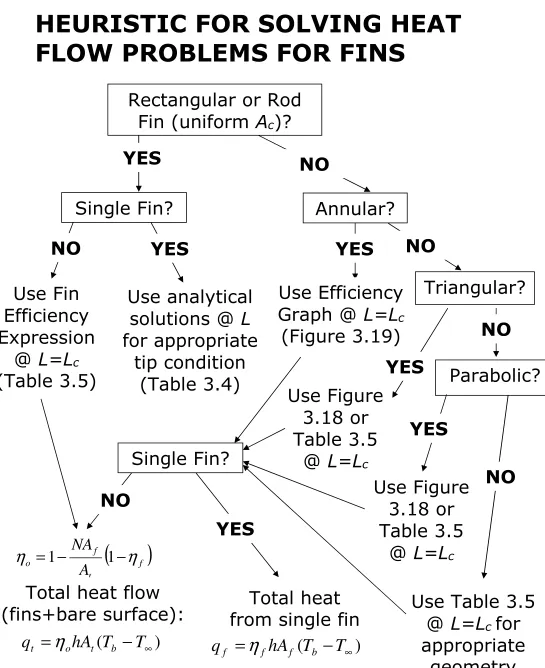
HEURISTIC FOR SOLVING HEAT FLOW PROBLEMS FOR FINS
Single Fin? Use analytical
solutions @ L
for appropriate tip condition
(Table 3.4)
YES NO
Annular? Rectangular or Rod
Fin (uniform Ac)?
YES
Use Fin Efficiency Expression
[image:81.612.37.582.64.732.2]@ L=Lc
(Table 3.5)
YES NO
Use Efficiency Graph @ L=Lc
(Figure 3.19)
Triangular?
YES
NO
Use Figure 3.18 or Table 3.5
@ L=Lc
Parabolic?
YES
NO
Use Figure 3.18 or Table 3.5
@ L=Lc
Use Table 3.5 @ L=Lc for
appropriate geometry Single Fin?
NO
YES NO
) ( − ∞
= hA T T
qf ηf f b
Total heat from single fin
(
f)
t f o
A NA
η η =1− 1−
) ( − ∞
= hA T T
qt ηo t b
Total heat flow (fins+bare surface):