Abstract—This paper describes some management lessons learned from a Global Software Development project undertaken in an educational setting with the students from Senegal, India, and the US. It was the first time that the project adopted Agile Methodologies and Scrum for the development of a mobile application. The students considered this Scrum experience a rewarding learning process. As the only experienced working IT professional among the participants, the author has summarized some important management lessons based on the accomplished collaborative work and interviews with the student developers and professors. The relevant suggestions for Educators and Project Managers for similar projects are provided.
Index Terms—Management lessons, scrum, computer science education, global software development.
I. INTRODUCTION
Pace University in New York City has been working with different institutions worldwide to integrate Global Software Development (GSD) project into the Computer Science Education and student developers write software together [1]-[10]. In 2009, Agile Methodologies and Scrum were adopted for the first time for developing a mobile application.
Inspired by some Scrum practices, the author of this paper, a graduate student in Computer Science and the only working IT professional with project management experience, naturally observed some interesting behaviors of developers and compares the difference between the plan and the result based on some project metrics, summarizes certain management lessons, and provides relevant suggestions for Educators or Project Managers in doing projects.
II.PROJECT
A. Project Setting
The GSD 2009 project intended to develop an educational mobile application by Java ME for a Product Owner. This application allows 5- to 6-year-old children to try exercises in 4 subjects – math, geography, reading and writing, and to check whether their answers are correct immediately. Five graduate students distributed across the US (Pace University), India (University of Delhi) and Senegal (Ecole Supérieure Polytechnique de Dakar) participated in this project as developers and working closely with Product
Manuscript received October 9, 2011; revised November 23, 2011.
Owner who was a lead instructor of the project. A professional process coach watched the team and provided weekly comments.
With regard to Scrum practices, the requirements of the product were maintained by Product Owner and prioritized in the form of User Stories in the Product Backlog. The development process consisted of short iteration cycles under Scrum's iterative and incremental framework called
Sprints. At the beginning of each Sprint, developers discussed and determined the goal of the Sprint with Product Owner, selected the Stories and broke them down to tasks. Each developer picked the desired tasks and took every effort to accomplish them. We had totally 3 Sprints which lasted 14 days each, following a preparation phase of 24 days. The IBM Rational Team Concert 2.0 (RTC) software [6] was employed as our collaborative tool. All the statistics data of this paper were produced from RTC.
B. The Expected vs. the Actual Situations
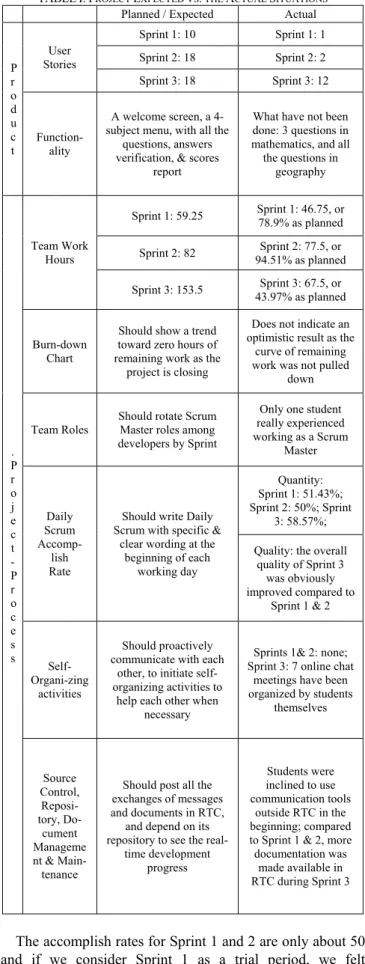
During the preparation period, all the student participants were given tutorial resources on Scrum practices, Java ME, and RTC. A set of Scrum practices has been accorded in this period and showed in the “Planned/Expected” section of Table 1. As a comparison, the “Actual” results were listed. Both were categorized by “Product” and “Project Process”.
1) Product
a) User Stories
We have planned to finish 10, 18 and 18 User Stories in Sprint 1, 2, and 3 respectively, whereas we closed 1, 2 and 12 of them correspondingly at the end of each Sprint.
b) Functionality
We delivered the application that included a welcome screen, a four-subject menu, 2 questions of mathematics, and all the questions of reading and writing with relevant answers verification, and scores report. As we reflected the reasons for the difference between the plan and the result, we saw that:
As in Sprint 1, everything was new and we were at the steep part of learning curve. About half of tasks focused on “learning Java ME” or “testing different features of RTC” or “reading Scrum primer” and 41 hours, or about 70% of total planned time (out of totally 59.25 hours, see 2.1 in Table 1) went to these pure learning activities. The only Story closed was “Java ME learning”.
Sprint 2 was not very productive as some developers had exams and religious activities; we retarded the goal-setting meeting, omitted some other planned meetings, and did not have any of them with full attendance.
In Sprint 3, we enforced team communication by designating one Scrum Master dedicated in controlling the project process. The team dragged most of Stories from
Some Management Principles Learned from Scrum
Practices within a Global Software Development Project
previous Sprints and really “sprinted” to the end of the project and we finally closed 14 Stories.
2) Project Process
a) Team Work Hours
The percentages of the actually hours to the planned ones are 78.9%, 94.51% and 43.97%, for 3 Sprints respectively.
The distinct gap of Sprint 3 is mostly due to the fact that some developers did not close work items upon completion, the time estimated for some tasks at the later phase was not updated, and the time spent for some other tasks was not factored in RTC.
As for Sprint 2, we did not start planning work items until its second week, and it was much easier to estimate the time needed for 1-week tasks than 2-week ones. That is why we have a high percentage of 94.51%.
b) The Burndown Chart
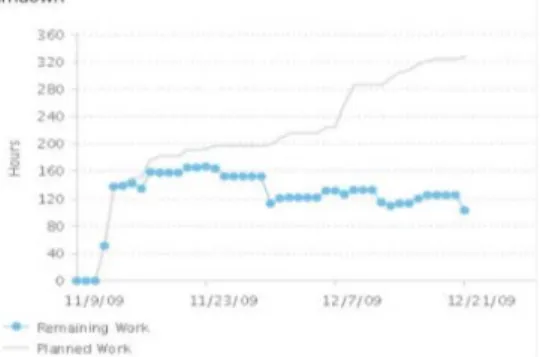
The trend of burn down does not indicate an optimistic result as we did not pull down the remaining work curve. However, it should be pointed out that the chart here is solely for the reference, as it does not completely reflect the real situation as many items were not closed upon the completion and the work items did not 100% accurately log the reality.
c) BTeam Roles
As a learning process, the team agreed to rotate the role of Scrum Master among developers. Scrum Master mainly helps the team remove impediments and ensures the project progress. The author proactively practiced this role in Sprint 1 and learned by doing. In Sprint 2, the predefined Scrum Master did not carry out the due work and we lost the track of the progress. The planned Stories were not integrated as we committed to and the team received a serious warning from Product Owner. At the end of Sprint 2, the author sensed that it was time to take over Scrum Master and hopefully that could help foster communications, strengthen the teamwork and ensure the product delivery. In Sprint 3, with the coordination of the lead professor and the process coach and with the agreement of the other developers, the author became Scrum Master, and spent most of time in managing the team and process so that she had to give up certain development tasks which were planned before Sprint 3. That was part of reason why the whole mobile application did not make the questions of all subjects ready at the end.
d) Daily Scrum Accomplish Rate
The team agreed to write Daily Scrum with quality wording – by specific and clear descriptions and post them in RTC before starting each working day. We should mark down: one's work on the day before, the plan for the current day and any obstacles. In case of forecasted absences, notes like “Not a working day, I will be back on <date>” should be posted.
As we were distributed across 3 different time zones, we could not fully benefit from Daily Standup meeting, one of the best Scrum practices. In our preparation phase, we were in accordance that everyone would update Daily Scrum in RTC in a clear and timely fashion. We understood the importance of this routine, that everyone took a few minutes to report in thus to make the team movement transparent. This simple but rigid practice helped us in examining and improving our organizing skills – planning tasks then
realizing them, and pushed us to constantly reflect on our performance and efficiency.
TABLEI:PROJECT EXPECTED VS. THE ACTUAL SITUATIONS Planned / Expected Actual
P r o d u c t User Stories Sprint 1: 10 Sprint 1: 1 Sprint 2: 18 Sprint 2: 2 Sprint 3: 18 Sprint 3: 12 Function-ality A welcome screen, a 4-subject menu, with all the
questions, answers verification, & scores
report
What have not been done: 3 questions in mathematics, and all the questions in geography . P r o j e c t -P r o c e s s Team Work Hours
Sprint 1: 59.25 Sprint 1: 46.75, or 78.9% as planned Sprint 2: 82 94.51% as planned Sprint 2: 77.5, or Sprint 3: 153.5 43.97% as planned Sprint 3: 67.5, or
Burn-down Chart
Should show a trend toward zero hours of remaining work as the
project is closing
Does not indicate an optimistic result as the
curve of remaining work was not pulled
down
Team Roles
Should rotate Scrum Master roles among developers by Sprint
Only one student really experienced working as a Scrum Master Daily Scrum Accomp-lish Rate
Should write Daily Scrum with specific &
clear wording at the beginning of each working day Quantity: Sprint 1: 51.43%; Sprint 2: 50%; Sprint 3: 58.57%; Quality: the overall
quality of Sprint 3 was obviously improved compared to Sprint 1 & 2 Self- Organi-zing activities Should proactively communicate with each
other, to initiate self-organizing activities to
help each other when necessary
Sprints 1& 2: none; Sprint 3: 7 online chat
meetings have been organized by students themselves Source Control, Reposi- tory, Do-cument Manageme nt & Main-tenance
Should post all the exchanges of messages and documents in RTC,
and depend on its repository to see the
real-time development progress Students were inclined to use communication tools outside RTC in the beginning; compared to Sprint 1 & 2, more documentation was
made available in RTC during Sprint 3
The accomplish rates for Sprint 1 and 2 are only about 50% and if we consider Sprint 1 as a trial period, we felt embarrassed about the same rate for Sprint2: the process has been dragged along very slow, some developers have not updated Daily Scrums for 10 consecutive days; the poor wordings such as “Try to do tasks allocated to me”, or
“Unstable Internet” were overused. We barely had updates in Sprint 2. Fortunately in Sprint 3, with the continuous reminders and supervision of the new Scrum Master, the average rate increased to 58.57%. The quality was improved too: the more concrete descriptions have been recorded, e.g.: “I am going to do Task 223 that is part of User Story 79” and “I have an exam today and tomorrow, will be back next Tuesday”.
Fig. 1. The burndown chart for the entire project.
e) Self-Organizing Activities
We developers were supposed to communicate constantly, learn from each other, reflect skills and lessons learned, and push forward the development work together. There is no better practice than this to nurture ourselves, as an individual and as a team. One of the best indicators is to see if the team actively held meetings and talked to each other outside of the planned meetings led by professors. In our records, only in the final phases, have 7 self-organized online meetings and exchanges among developers been witnessed, after a supervisory role aimed at enhancing communication was added.
f) Source Control, Repository, Documentation Management and Maintenance
The team had planned to use RTC to log all the exchanges of messages and documents occurred, and to depend on its repository to see the real-time development progress. As the team was new to this tool, emails and online chats became our main communication media at the most of time in the preparation phase and the first half of Sprint 1. And we found that we were naturally inclined to hold the tools we were more comfortable with, and were mainly pushed by the lead instructor to give up other tools and returned to RTC. In Sprint 2, we did not really progress much so the exchanges reflected in RTC remained as low as Sprint 1. With the supervision of new Scrum Master, Sprint 3 recorded obviously more documents, including meeting minutes, chats, work items change logs, and associated email notifications. We were glad to see the team working much more closely and the overall communication had been enhanced.
II. SOME MANAGEMENT PRINCIPLES LEARNED AND SUGGESTIONS
With reference to the above comparison and post-project interviews [1], the author concluded with some important management principles, based on which she would like to provide Educators or Project Managers relevant suggestions for project practices.
A. Lesson 1: “Everything Starts with the Will!”
The students were expected to be highly self-motivated to take extra work for this project in addition to their original coursework. All the developers realized that, in exchange for voluntary efforts, they would gain knowledge, skills, experience and camaraderie. Everyone seemed excited on Day 1 and they agreed to commit to a set of Scrum practices. However, we have seen different cases that participants lost or lacked motivation, did not report daily progress, did not commit to planned rituals, and felt reluctant to communicate. The interviews showed that some of them preferred code writing much more than administrative reporting, and they also considered this a safe school project so they were not threatened by “breaking the rules”.
Suggestion: Educators or Project Managers shall ask students to write down their motivation and commitments, that they may agree to same at the beginning and use the records to remind students--especially as their enthusiasm flags over the course of time, combined with constant psychological reassurance, along the lines of simple empowering slogans such as "You can do it!" and “Don't feel bad if you make mistakes – only those who don't work make no mistakes!”
As for the preference problem, students need to be told that principles are intended to provide a regulatory frame of reference for the project. No matter what you do, whether at work or among society, you need to follow the pertinent rules regardless of personal interest. One should seek a wider perspective, seeing the whole picture and relinquishing petty pride to comply with them, since they are necessary means to accomplish a greater purpose [which one desires to accomplish]. Let your motivation inspire you and guide you!
B. Lesson 2: “Recall the 20-80 Rule!”
As this project required specific programming skills and software engineering concepts notably the Scrum with which most developers were unfamiliar, the team spent 24 days (in preparation phase) and about 70% of total planned time in Sprint 1 in “learning” all these new things. The later practices taught us that this "overemphasize-everything" approach was unnecessary and unattainable. A handful of frequently used features in general documentation management and a few basic operations within the repository would be enough. The famous 20-80 rule of management here revealed its truth – 20% of tasks have priority over the remaining 80% and require 80% of the time.
The author should point out that most students, according to their feedback, had some prior experience of this rule, but apprehended it this time in a more direct, visceral, way – as a team we committed this mistake together and lost a lot of time together. We could have used the time better.
Suggestion: Educators or Project Managers should pay attention to students' activities and stress this rule constantly. Students should be given immediate warning on their attempts to master details on everything. Some industry practice principles like “prioritize your tasks (do the right thing) then work on the effectiveness (do it right)”, or “don’t lose 100% of market for a 1% deficiency” need to be repeated. The author’s experience suggests that they can’t be emphasized enough!
C. Lesson 3: “Time Management: Keep Practicing…”
Most students budgeted time inefficiently, especially at the beginning of the project. They devoted too much time to tasks relatively unimportant and trivial in overall product functionality, such as “trying to learn RTC” or “looking for the picture for welcome screen”.
All students expressed their willingness in improving their skills in time management. Interestingly, most students said that they knew some principles of good time management, such as “do the most important and urgent tasks first”, and good habits like “finishing today's tasks today”. These are all important within Scrum practices; however, they were adjudged “difficult to put into action” and dismissed with “words are 1000 times easier than actions”. But they admitted that regulated by Scrum rituals and the obligatory adherence to them, this project provided a good chance to understand all of these in a more explicit and direct manner: they saw results of bad time management and bad habits right away, and they had to shoulder the responsibility of their “mistakes” after that.
Suggestion: Educators or Project Managers should convey lessons like “we cannot afford to lose clients when it comes to product delivery”, and “victory goes to the swift”. Students’ allocation of time should be watched, and they should be reminded to concentrate on the tasks that matter most, that really carry out the most functions of the application based on the Sprint plan.
Specifically, for better time management, here are some useful practices according to our project findings:
1) Before the project starts, students should be given a few trial-and-error chances to test their time-budgeting skills – estimating time for certain tasks and recording the real time spent. They would understand themselves better by then and make the next-run estimation more accurately;
2) Students should be guided to analyze and prioritize their to-do lists, and be supervised to start from the most important and the most urgent item;
3) For the students with a perfectionist mindset, they might be given one-time chance to “excel” as they wish, and be allowed to fall. They would learn that being perfect is impossible and unnecessary, and there is not the “best”, only “better”;
4) Students should be reminded to think about the preciousness of time, and taught a quick and simple maxim – however long one has for a specific task, the task will consume just that amount of time, and be encouraged to trust in their time management, and given confidence to simply go forward and challenge themselves: Go forth, set a time frame and follow it with conviction!
As mentioned above, most students were aware of some of these principles. The problem was that "words are a thousand times easier than actions." Here is where the purpose of education comes into play: in transferring and reinforcing the understanding of basic principles of good time management, to encourage students to practice them, and to supervise them through compliments, suggestions, and warnings. If students can gain a rewarding experience in the course of developing skills, and manage to turn “good theory” into “good practice”, then they will come to tell Educators or Project Managers that “words are easier than actions, but this time we learned how to manage the
transition from words to actions”, and our pedagogical practices will have proven their effectiveness.
D. Lesson 4: “Be Cool…Keep a Constant Working Pace!”
Some developers were so very passionate about technical skills, mainly programming that they attempts to implement Stories extraneous to the plan without reporting it, and ended up implementing less than expected due to time constraint and the difficulties of integration. Some of them burned out through all-nighters in order to finish the tasks that should be evenly distributed in 10 days. All these “outrage” behaviors – common among students – resulted in the criticisms of the Product Owner. Staying within the boundaries and complying with rules save us, in this sense. Working at a constant pace keeps us healthy, the team healthy and protect ourselves in front of customers: who would appreciate getting shocked at the sight of nothing in the repository just at the closing time of one Sprint?
Suggestion:
Educators or Project Managers should emphasize the concept of agility, which is a balanced agile speed over the whole production phase with no fluctuation, not an absolute unwavering speed at any time. A supervisory role is needed.
E. Lesson 5: “Ends Justify the Means!”
In delivering a small application like this under Agile Methodologies, we firstly need to make sure the software works. In the practices of refactory within Java ME, some developers scrutinized the coding efficiency and aesthetics too much. Nothing wrong about that, as we were all learning new techniques but we recognized more deeply that even though coding efficiency and aesthetics can be considered as benchmarks, delivering workable software must always take precedence. And as we also piloted some light peer reviews, we all agreed that refactory was about finding the bug, not about the coding style.
Suggestion:
Given this particular mobile application context, Educators or Project Managers should emphasize the concept of “software must work, computer must compute, and function over all!” The clients are the God, and only look at the ends. They require us to focus on an application that works, and there lies our sine qua con.
F. Lesson 6: “The maximum Water Volume of One Bucket Depends on its Shortest Plank”
If this bucket refers to one person, then his weakness is his shortest plank. Scrum practices let everyone get exposed to different aspects of a development project: techniques, management, communication and teamwork; we gain better understanding on our own preference, strength and weakness.
If the bucket refers to one team, then the shortest plank is the weakest member, whose performance mostly decides the team's overall level. But the weakest one should have some other strong points that others don't have. They might be good at performing certain tasks that fall in the category of 20% priority. The team would need a good understanding of everyone's strength and weakness and came out with the best strategy to cover the shortcomings of the weakest member. Scrum rituals require us to do a lot of communication, which just help us comprehend each other
better. One bucket can hold a certain volume of water, when every plank contributes; whereas one plank can't hold any water; just as one hero-developer cannot triumph. Teamwork counts when we work in a team, each one of us succeeding only when the team as a whole succeeds.
Scrum practices, in some ways, provide us a good opportunity to examine our shortest plank and reinforce our understanding of teamwork. One explicit example is Daily Scrum: regardless of personal willingness, developers are exposed to the whole team, which, as a psychological effect, forces everyone to be more serious, to think in the stature of the whole team, rather than the individual. On the other hand, from what others do and the progress they make, we can constantly reflect on ourselves: what am I doing that is lacking in comparison to her? What shall I do to catch up? When?
Suggestion: With respect to Scrum context, Educators or Project Managers should illustrate and emphasize the notion of teamwork, along with the willingness to shoulder responsibility. A dedicated supervisory role shall be added, as it will most likely ensure overall communication.
A vivid example with a bucket consisting of different-height planks might be employed as a prop in the due course as the project moves on, students might be given some time to think about this metaphor and reflect on themselves, and be given a session to discuss with team-members on the bucket analogy to the project they participate in.
III. CONCLUSION
We thanked Scrum’s simple but strict practices, which forced us to go through a cycle of speculation, collaboration, learning by doing and adjusting, filled with opportunities for self-reflection and self-improvement. We felt grateful to learn all the important management principles listed, which are as important as some other “real” techniques: Java ME, refactory, RTC, and some software engineering concepts.
We saw ourselves making mistakes, adjusting, improving and growing. All the students considered this project a rewarding experience.
However, to use Scrum in a more efficient way, adding a strict supervision role is indispensable. It not only gives students a hand when necessary, but also assures the accuracy of project data. Some students acknowledged a better team performance in the later phase by the new Scrum
Master and stated that a dedicated supervision role is necessary.
We recommend integrating a teaching and discussing session on these essential management principles, in the course of similar software engineering projects.
IV. ACKNOWLEDGMENTS
The author would like to thank Dr. Christelle Scharff, Dr. Olly Gotel, Prof. Vidya Kulkarni, Mr. David Soler and all the students involved for the support in writing this paper.
REFERENCES
[1] O. Gotel, V. Kulkarni, M. Say, C. Scharff, and T. Sunetnant, “Quality indicators on Global Software Development Projects: Does ‘Getting to Know You’ really matter?,” in Proc. the 5th IEEE Conf. on Global Software Engineering (ICGSE 2009), Limerick, Ireland, 2009, pp. 3-7. [2] O. Gotel, V. Kulkarni, M. Say, C. Scharff, and T. Sunetnanta, “A Global and Competition-based Model for Fostering Technical and Soft Skills in Software Engineering Education,” in Proc. the 22nd Conf. on Software Engineering Education and Training (CSEET 2009), Hyderabad, India, 2009, pp. 271-278.
[3] O. Gotel, V. Kulkarni, L. Neak, and C. Scharff, “Instructor or Project Manager: What is the Right Balance as Software Engineering Education Goes Global?” in Proc. the 38th annual Conf. on Frontiers in Education (FIE 2008), Saratoga Springs, USA, 2008, pp. T2E-13-T2E-18.
[4] O. Gotel, V. Kulkarni, L. Neak, and C. Scharff, “Working Across Borders: Overcoming Culturally-Based Technology Challenges in Student Global Software Development,” in Proc. 21st Conf. on Software Engineering Education and Training (CSEET 2008), Charleston, South Carolina, USA, 2008, pp. 33-40.
[5] O. Gotel, V. Kulkarni, L. Neak, and C. Scharff, “Keeping Software Engineering Education Up-to-date with Globally Distributed Software Development and Delivery,” presented at the 12th Annual NCIIA Meeting (National Collegiates Inventors and Innovators Alliance), Dallas, Texas, USA, March 19-22, 2008.
[6] O. Gotel, V. Kulkarni, L. Neak, and C. Scharff, “The Role of Wiki Technology in Student Global Software Development: Are All Students Ready?” presented at Wiki for Software Engineering Workshop (Wiki4SE) 2007, Montreal, Canada, October 21, 2007. [7] O. Gotel, V. Kulkarni, M. Say, C. Scharff, and T. Sunetnanta,
“Distributing Responsibilities to Engineer Better Requirements: Leveraging Knowledge and Perspectives for Students to Learn a Key Skill,” in Proc. the 4th Int'l Workshop on Requirements Engineering Education and Training, Atlanta, Georgia, USA, 2009, pp. 28-37. [8] O. Gotel, C. Scharff, and S. Seng, “Preparing Computer Science
Students for Global Software Development,” in Proc. 36th IEEE Annual Conf. on Frontiers in Education (FIE 2006), San Diego, California, USA, 2006, pp.9-14.
[9] O. Gotel, C. Scharff, and S. Seng, “Incubating the Next Generation of Offshore Outsourcing Entrepreneurs,” presented at the Symposium on Information Technology and Entrepreneurship (ITE 2005), Oklahoma City, USA, April 19-20, 2005.